

The CEO Playbook: A Modern Guide to the Duties and Responsibilities of a CEO
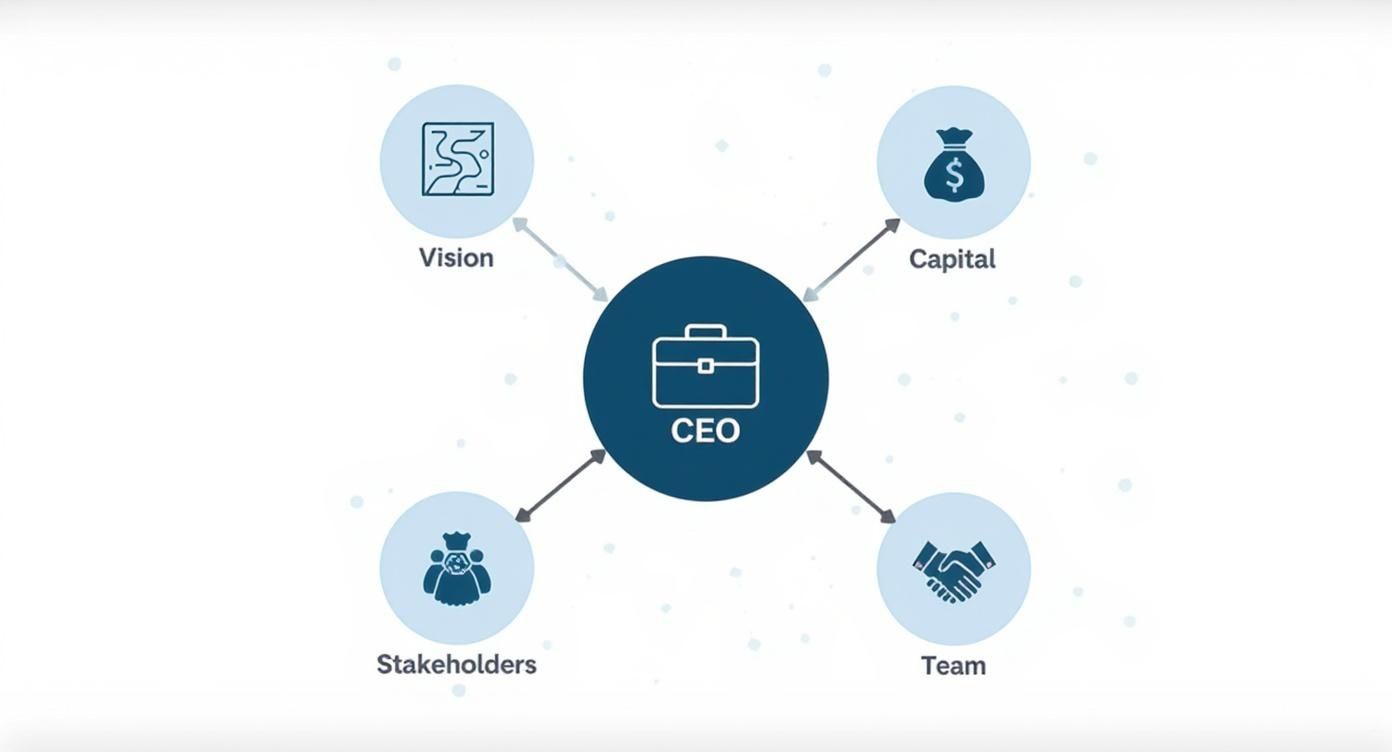
At its core, a CEO's job is to be the ultimate steward of a company's direction, resources, and culture. They are on the hook for setting the long-term vision, allocating capital to the most promising initiatives, building a world-class leadership team, and keeping key stakeholders like the board and investors aligned.
In short, they are the architects of the company's future. But in a business world that changes by the minute, what does that really mean?
What Are the True Duties of a Modern CEO?

Forget the corner office for a second. What does a CEO actually do? The role is a complex juggling act that demands a rare blend of strategic foresight, financial savvy, and inspirational leadership. It's far more than just being the final decision-maker.
Think of a CEO as the captain of a ship. They aren't swabbing the deck or hoisting the sails. Their job is to chart the course (vision), ensure the ship has the right crew and supplies (team and capital), maintain morale (culture), and report back to the ship’s owners (stakeholders).
It's a high-stakes job that's only getting tougher. The average CEO tenure is shrinking as the role's complexity skyrockets. You can discover more insights about CEO turnover on russellreynolds.com. This pressure makes having the right leadership—or the right leadership support—more critical than ever.
The Four Foundational Pillars
To understand the duties and responsibilities of a CEO, it helps to break the role down into four essential pillars. These functions are the bedrock of effective leadership, whether you're running a five-person startup or a global powerhouse.
-
Setting Vision and Strategy: The CEO is the chief visionary. They define where the company is headed—its "North Star"—and draw the map to get there. This involves analyzing market trends, spotting opportunities, and making hard calls about what the company will and, just as importantly, will not do.
-
Allocating Capital: Capital isn't just money; it's also the team's time and focus. A CEO’s most critical duty is deploying these finite resources toward projects with the highest potential return, balancing today's needs with tomorrow's big bets.
-
Building the Culture and Team: A great CEO hires, develops, and nurtures the senior leadership team. Their most profound impact comes from architecting the company’s culture—the shared values that define how work gets done.
-
Managing Stakeholders: This is about managing relationships with the board, investors, customers, and key partners. The CEO must build trust, keep everyone aligned, and clearly communicate the company's strategy and performance.
"A CEO’s real job is to manage the company's energy, not its time. It’s about ensuring the entire organization is focused on the right things with passion and purpose."
The Four Pillars of CEO Responsibilities at a Glance
| Pillar | Core Responsibility | Primary Outcome |
|---|---|---|
| Vision & Strategy | Define the company's North Star and the roadmap to get there. | A clear, unified direction for the entire organization. |
| Capital Allocation | Deploy money, time, and focus on the highest-return initiatives. | Sustainable growth and effective use of resources. |
| Culture & Team | Hire, develop, and retain a world-class leadership team. | A high-performing organization with strong, shared values. |
| Stakeholder Management | Maintain alignment and trust with board, investors, and partners. | Strong external support and confidence in leadership. |
These four pillars are the operating system for any successful chief executive. Mastering them is what separates someone who just holds the title from a leader who truly guides an organization. For companies navigating tricky growth stages, getting this high-level strategic guidance can be a total game-changer, but finding the right fit is a common pain point.
Mastering the Four Pillars of CEO Leadership
The CEO role boils down to these four critical pillars. Effective leadership means juggling all four at once. Think of it like the legs of a table—if one is wobbly, the whole thing becomes unstable. For a growing company facing intense pressure, this balance is often the difference between success and a frustrating plateau.
Let's break down each function: Vision and Strategy, Capital Allocation, Building the Leadership Team, and Stakeholder Management.
Pillar 1: Vision and Strategy
At its core, the CEO's primary job is to be the company's chief visionary. This isn't about daydreaming. It's about defining a clear, compelling destination—a "North Star"—and then drawing up a practical, actionable map to get there.
- The vision answers, "Where are we going?"
- The strategy answers, "How will we get there?"
A powerful vision inspires the whole team and gives every action a sense of purpose. A weak vision leads to wasted effort. For instance, a fintech startup’s vision might be "to democratize wealth creation for millennials." Their strategy would then break down into specific moves, like building an intuitive mobile investment app and partnering with financial influencers. Every decision ties back to that big-picture vision.
Pillar 2: Capital Allocation
A CEO's most critical task is deciding where to put the company's finite resources. And capital isn’t just money—it’s also the team's time, energy, and focus. Every "yes" to a project is an implicit "no" to countless others, making capital allocation a high-stakes game of strategic trade-offs.
Smart capital allocation means funneling resources into things that promise the highest return, all while staying aligned with the long-term vision. This involves making tough calls, like shutting down an underperforming product to double down on a new market. It's about making hard choices to strengthen the core business for the long haul.
Pillar 3: Building the Leadership Team
No CEO can execute a grand vision alone. A huge part of the role is attracting, hiring, developing, and aligning a world-class senior leadership team. This team is the CEO's force multiplier, turning high-level strategy into real-world execution.
This is about more than just filling seats. It's about building a cohesive team where skills are complementary, ideas are challenged constructively, and everyone is committed to the mission. The CEO acts as a coach, ensuring the exec team operates with trust and alignment. The quality of this team often sets the ceiling for how far the company can go. To dig deeper, check out our guide on what is executive leadership.
A-players hire A-players, but B-players hire C-players. A CEO's commitment to hiring only the best for their leadership team sets the standard for talent across the entire organization.
Pillar 4: Stakeholder Management
Finally, the CEO is the main point of contact between the company and its key stakeholders: the board, investors, employees, customers, and partners. The CEO's job is to build trust, keep everyone aligned, and manage expectations.
This requires top-notch communication skills. The CEO must:
- Report to the Board: Give transparent updates on performance, strategy, and risks.
- Inspire Investors: Tell a compelling growth story to secure funding and maintain confidence.
- Engage Employees: Communicate the vision relentlessly to keep everyone connected to the mission.
- Listen to Customers: Stay plugged into the market to ensure the company is delivering value.
When done right, stakeholder management creates a powerful support system around the company—a core fiduciary duty for any leader.
How CEO Responsibilities Evolve with Company Growth
A CEO's job description isn't static. The role is fluid, with priorities that must adapt as a company scales. The leader who wills a ten-person startup into existence must evolve to guide that same company at 500 employees.
Think of it like being a chef. The chef running a popular food truck is totally hands-on. They craft the menu, cook every order, and talk to every customer. That’s the Startup CEO.
But when they expand to a small chain of restaurants, they can't cook every meal. Their job shifts to hiring great chefs, standardizing recipes, and managing a supply chain. This is the Scale-Up CEO. When they oversee a global empire, their focus is on brand management, market strategy, and high-level finance. That's the Enterprise CEO. The core duties remain, but the execution changes dramatically.
This evolution is a journey from "doing the work" to "building the machine that does the work." Many businesses struggle during these transitions, a common pain point where experienced, flexible leadership can make all the difference.
CEO Focus by Company Stage
| Responsibility Area | Startup CEO Focus | Scale-Up CEO Focus | Enterprise CEO Focus |
|---|---|---|---|
| Vision & Strategy | Find product-market fit. Validate the core idea and survive. | Scale the proven model. Define repeatable growth processes. | Defend market position. Drive long-term innovation and new market entry. |
| Team & Culture | Personally recruit the first 5-10 hires. Embody the culture. | Hire a senior leadership team. Systematize culture and communication. | Steward the culture at scale. Focus on succession planning and talent density. |
| Capital & Finance | Secure seed/angel funding. Manage burn rate meticulously. | Raise Series A/B/C. Build financial systems and forecasting capabilities. | Manage public markets/investor relations. Oversee complex P&L and M&A. |
| Operations | Do whatever it takes. Sell, code, support—wear all the hats. | Build scalable systems and processes. Delegate functional ownership. | Optimize for efficiency at scale. Manage risk and regulatory compliance. |
Let's dig into what this really means at each phase.
The Startup Phase: Doer-in-Chief
In the beginning, the CEO is the chief "doer." The role is intensely tactical and hands-on. They’re a player-coach, spending most of their time building the product, closing the first crucial sales, and personally pitching anyone who will listen.
At this stage, their world is consumed by a few key things:
- Finding Product-Market Fit: The CEO is obsessed with the customer, running interviews and absorbing feedback to ensure the idea solves a real problem.
- Securing Initial Funding: They are the chief fundraiser, crafting the pitch deck and building relationships to land critical seed capital.
- Recruiting the Founding Team: The CEO personally recruits the first handful of employees, selling them on the vision.
The mission is simple: survive and prove the concept. A startup CEO has to be a generalist, comfortable wearing a dozen hats and making fast decisions.
A startup CEO's job is to do whatever it takes to keep the company alive long enough to figure out what it's supposed to be. It's a role defined by scrappiness and a relentless focus on the customer.
The Scale-Up Phase: Architect of Growth
Once a company nails product-market fit, the CEO’s role undergoes its most difficult transformation: from "doer" to "architect." This is where many founders stumble. They must let go of daily tasks and start building the systems and leadership team that allow the company to grow without breaking.
During this high-growth phase, the focus pivots entirely:
- Building the Leadership Team: The CEO’s most important job becomes hiring VPs who can own entire functions. They stop managing individuals and start leading leaders.
- Implementing Systems: It's time to move from scrappy workflows to scalable systems for everything from performance reviews to financial reporting.
- Communicating the Vision Relentlessly: As the team grows, the CEO must constantly reinforce the mission to keep everyone aligned.
The scale-up CEO spends more time working on the business than in it. Their success is no longer about personal output but their ability to build a high-performing machine.
The Enterprise Phase: Visionary and Statesperson
By the time a company matures into a stable enterprise, the CEO’s role shifts again. They are no longer building the machine; they're steering it through a competitive landscape. The job becomes more external and long-term.
Here, the key duties look very different:
- Driving Innovation at Scale: The main job is to protect the company from disruption by placing strategic bets on new markets, products, or technologies.
- Managing Complexity: They oversee multiple business lines, navigate global regulations, and ensure operational excellence.
- Public and Investor Relations: The CEO is the public face of the company, managing relationships with Wall Street, major partners, and government bodies.
The enterprise CEO operates from a 30,000-foot view, guiding long-term strategy. Understanding these shifts is crucial. For many businesses, bridging the gaps during these tough transitions is key, often requiring specialized, fractional leadership to provide the right expertise at the right time.
The Shifting Landscape for Modern CEOs
The core duties of a CEO are timeless. But the playbook for how to do that job is being rewritten in real-time. Today’s leaders grapple with forces that were barely on the radar a decade ago.
The biggest game-changer? The relentless pace of technology. A CEO can no longer just delegate the "tech stuff." Innovation isn't a department; it's a survival instinct for the entire company.
The Rise of the Tech-Fluent CEO
In today's market, understanding new tech like AI is a central CEO duty. It's about fundamentally rethinking your business model. A modern CEO must be a translator, bridging the gap between what's technologically possible and strategically brilliant.
This isn't just a trend. A recent IDC CEO Survey found that 66% of CEOs are already seeing real business value from their generative AI projects. You can learn more about 2025 CEO priorities on IDC.com.
This means the modern CEO must:
- Champion AI Integration: Actively sponsor AI initiatives that solve real business problems.
- Manage Technology Risk: Balance innovation with solid governance, managing ethical and security risks.
- Prove ROI on Tech Spend: Articulate how every tech investment ties back to strategic goals.
More Than Growth: Building Resilience
Beyond technology, the world has just gotten more volatile. Today's CEOs must be masters of crisis management. The goal isn't just to react to shocks but to build a company that can withstand them in the first place.
Adaptability is no longer a soft skill for a CEO; it is the core competency. The ability to pivot strategy while keeping the organization focused is what separates great modern leaders.
This new reality means weaving new priorities into the core duties of a CEO.
Expanding the Modern CEO's Toolkit
A CEO's strategic dashboard is more crowded than ever. These new, non-negotiable priorities have a direct line to your bottom line and brand reputation.
- Cybersecurity Oversight: The buck stops with the CEO. This means pulling cybersecurity out of the IT silo and into the boardroom.
- Supply Chain Fortification: A fragile supply chain is an existential threat. CEOs must be directly involved in building resilient, diversified supply networks.
- ESG and Transparency: Stakeholders demand accountability on environmental, social, and governance (ESG) issues. The best leaders embed these principles into their core strategy, not as a PR move, but as a driver of long-term value.
Juggling these modern challenges requires a level of agility that's tough for any single leader to master. This is another pain point where bringing in specialized, fractional expertise can be a game-changer for growth-stage companies.
How to Measure CEO Performance Effectively
So, how do you tell if a CEO is doing a great job? It's tempting to just look at the stock price, but that’s only half the story. An effective leader builds a company that’s not just profitable today, but healthy and resilient for the long haul.
That means you need a balanced scorecard of Key Performance Indicators (KPIs) to get the full picture. It's a holistic health check-up for the business, combining hard numbers with the vital signs of the organization.
Blending Financial and Non-Financial Metrics
A solid evaluation of a CEO’s performance hinges on a smart mix of quantitative and qualitative data.
-
Financial Health: These are the classic measures of success, showing if the CEO can drive profitability. Key metrics include Revenue Growth Rate, EBITDA, and Free Cash Flow. For a deeper dive, check out our guide on how to measure business growth.
-
Organizational Vitality: This is where you measure long-term sustainability. These KPIs reveal the strength of your culture, customer loyalty, and market position.
A great CEO delivers a healthy bottom line today while building a sustainable, thriving company for tomorrow. Ignoring one for the other is a recipe for eventual failure.
Key Non-Financial Indicators to Track
To get a complete view, boards must look beyond the balance sheet. These non-financial metrics are the canaries in the coal mine, signaling the underlying health of the organization.
The latest KPMG global CEO outlook shows that confidence in the global economy has dipped, forcing leaders to be more nimble. KPIs that reflect this new reality include:
- Employee Engagement: Measured through surveys, this KPI reflects morale, cultural health, and the CEO's ability to inspire. Low engagement is a serious red flag.
- Customer Satisfaction (NPS): The Net Promoter Score is a powerful indicator of customer loyalty and how much people love your product.
- Market Share Growth: Are you gaining ground on your competitors? If so, it’s a strong sign the CEO's strategy is working.
When to Hire a Fractional CEO to Accelerate Growth

Not every growing business needs—or can afford—a full-time CEO. The six-figure salary, benefits, and equity can feel out of reach. Yet, the need for that C-suite strategic guidance is undeniable, especially when navigating fundraising, a market pivot, or rapid scaling.
This gap is exactly where a Fractional CEO becomes a company's secret weapon. This model gives you access to elite executive talent on a flexible, part-time basis. You get the benefit of decades of experience without the crushing financial commitment.
Identifying the Right Moments for a Fractional Leader
A fractional executive isn't just a consultant. They integrate into your leadership team, taking ownership of specific duties and responsibilities of a CEO for a set number of hours. They execute, providing the exact leadership you need, precisely when you need it most.
Imagine a SaaS company that’s nailed product-market fit but is now stalling. The founder is a brilliant product visionary but lacks the operational leadership to scale from $2 million to $10 million ARR. Instead of a costly search for a full-time CEO, they can bring on a fractional leader to build the systems, hire the team, and accelerate growth now.
Here are a few classic moments where a fractional CEO delivers incredible value:
- Preparing for a Fundraise: An expert who has successfully raised capital can refine your pitch, shore up your financials, and guide you through due diligence.
- Navigating a Strategic Pivot: A fractional CEO provides an objective voice to guide the transition and keep the team focused.
- Mentoring a First-Time Founder: Many founders are masters of their product but are learning to scale a business on the fly. A fractional executive acts as a coach and mentor.
- Managing Through a Transition: If a key executive leaves, a fractional leader can bridge the gap, providing stability while you find the right permanent hire.
By engaging a fractional executive, you are essentially renting the specific experience you need to overcome your immediate growth hurdles. It’s a targeted injection of leadership designed to solve a problem, not just fill a seat.
The Strategic Advantages of Fractional Leadership
While cost-effectiveness is a key benefit, the real value goes deeper. You get instant access to a vast network of contacts—investors, talent, partners—that would take years to build.
This model also de-risks a critical hire, allowing you to "try before you buy." A fractional leader brings a fresh, unbiased perspective, free from internal politics. They spot the blind spots and challenge assumptions that might be holding you back. For a deeper dive into the role, our guide explains what a fractional CEO is and how they drive results.
Ultimately, fractional leadership is about getting the right expertise at the right time—a flexible, high-impact solution for ambitious companies that need seasoned guidance.
What Is the Single Most Important Responsibility of a CEO?
If you had to boil it down to one thing, it's this: set, communicate, and relentlessly champion the company's vision.
The vision is the North Star that guides every decision, gets the team rowing in the same direction, and convinces the best talent and investors to come along. Without a clear vision, even the most brilliant team will work at cross-purposes. The CEO’s job is to make that vision feel real for everyone, every single day.
How Does a CEO Balance Short-Term Results with Long-Term Vision?
This is the classic tightrope walk. The best CEOs don't see it as a conflict. Instead, they build a strategic bridge where short-term goals are logical stepping stones toward the long-term vision. They make it obvious how hitting this quarter's numbers gets the company one step closer to its ultimate mission.
It all comes down to resource allocation. A great CEO manages a portfolio of projects—some that pay the bills today, and others that are big bets on the future.
A CEO's ultimate fiduciary duty is to serve the long-term health of the organization, which requires a masterful blend of short-term execution and unwavering commitment to the future vision.
What Are the Biggest Mistakes a New CEO Can Make?
It's easy for a new CEO to stumble, especially when shifting from "doer" to "leader." Knowing the common landmines is the first step to avoiding them.
- Trying to do everything themselves instead of empowering their team. This leads to burnout and bottlenecks growth.
- Making sweeping changes too quickly. Understand the culture and what’s working before tearing things down.
- Neglecting the board. Failing to build a strong, transparent relationship with the board is a classic rookie error.
- Not communicating the strategy enough. You might feel like a broken record, but if you aren't communicating the strategy constantly, you'll end up with a misaligned organization.
Getting these things right is crucial for building credibility. It's why many first-time CEOs bring in a seasoned mentor or a fractional executive to navigate these early days.
The CEO role is one of the most demanding jobs out there, and having the right strategic partner can be a game-changer. At Shiny, we connect growing companies with elite, vetted fractional executives who provide the specific leadership you need, right when you need it.
If your business is facing a growth challenge that requires seasoned executive guidance, we can help you find the right leader to navigate the path forward.
Schedule a consultation today to see how fractional leadership can help you hit your most ambitious targets.
