
A Guide to Writing Your Chief Growth Officer Job Description
A chief growth officer job description isn’t just another hiring document. It's a strategic tool designed to attract a very specific kind of leader—one who can unify marketing, sales, product, and customer success to drive sustainable revenue.
This role is less about managing one department and more about orchestrating the entire customer journey, from that first flicker of awareness all the way to long-term loyalty. Getting this document right is the first, and most critical, step to finding the right person for the job.
Why a CGO Is Your Next Essential Hire
The old way of running separate marketing, sales, and product teams is failing modern businesses. These silos create friction, misaligned goals, and a clunky customer experience. You've probably seen it yourself: marketing celebrates a record number of leads while the sales team struggles with abysmal conversion rates. This internal disconnect is exactly where growth grinds to a halt.
The Chief Growth Officer (CGO) was born out of the need to solve this fragmentation. This role acts as the connective tissue, the glue that holds the entire revenue engine together, ensuring every department is rowing in the same direction.
Breaking Down Silos for Unified Growth
A CGO’s primary mission is to build a single, cohesive growth machine. They don't just oversee marketing or own a sales number; they own the entire funnel.
Think of them as an orchestra conductor. Marketing (the violins) creates the opening melody, sales (the brass section) delivers the powerful call to action, and product (the percussion) provides the steady rhythm that keeps customers coming back. Without a conductor, it’s just noise. With a CGO, it's a symphony.
The CGO role has surged in popularity over the past decade, especially in fast-moving industries like SaaS, fintech, and e-commerce. It's no surprise that companies growing over 25% annually need this kind of unified leadership to keep their momentum going. They do it by aligning everyone under a single, clear growth mission. If you want to dive deeper, you can learn more about the rise of the CGO and what truly defines the role.
The core problem a CGO solves isn’t a marketing problem or a sales problem—it’s a systems problem. They re-architect how your company acquires, engages, and retains customers for maximum long-term value.
A Smarter Path to Executive Leadership
For many businesses, especially startups and scale-ups, the thought of adding another C-suite salary is daunting. The cost and risk of a full-time executive hire can feel completely out of reach. This is where a more agile approach really shines.
The fractional CGO model offers a powerful alternative. It gives you the same high-caliber strategic leadership without the full-time financial baggage. This approach lets you bring in a seasoned executive who can:
- Develop a scalable growth strategy that’s actually tailored to your business.
- Build the foundational processes and systems your teams desperately need.
- Mentor your existing leaders so they can execute the growth plan effectively.
This model de-risks the entire hiring process and delivers an immediate strategic impact. Instead of spending months and a huge chunk of capital on a full-time hire, you get access to top-tier expertise on your own terms. If your growth has flatlined or your teams feel out of sync, it might not be a sign you need to replace individual department heads. It might be the clearest signal that you need a leader to connect the dots.
We help businesses find these transformative leaders. To see how fractional executive leadership can get your business moving, schedule a consultation with our team.
So, What Does a CGO Actually Do?
Let's get straight to the point: the Chief Growth Officer (CGO) isn't just another C-suite title. They're the strategic architect of your entire commercial engine. Think of them as the master weaver who pulls together marketing, sales, product, and customer success into a single, high-performance machine.
This is a huge departure from the traditional, siloed roles we're used to. While a Chief Marketing Officer (CMO) is zeroed in on brand and lead generation, and a Chief Revenue Officer (CRO) lives and breathes sales execution, the CGO takes a much broader view. They own the entire customer lifecycle, from that very first ad impression all the way through to long-term loyalty and expansion.
A Cross-Functional Role in the Real World
Picture a fast-growing SaaS company that's bleeding customers. The sales team is crushing its quotas and marketing is pumping out leads like there's no tomorrow, but customers are churning out after just a few months. In a typical company, this is where the finger-pointing starts.
A CGO, however, sees this for what it is: a systemic problem. They roll up their sleeves, dive into the data, and start connecting the dots. They'll work directly with:
- Product teams to pinpoint feature gaps or user experience friction that's causing people to leave.
- Marketing teams to make sure the value proposition being sold actually matches the in-product experience.
- Sales teams to tighten up the ideal customer profile (ICP), so they stop bringing in poor-fit clients who were destined to churn.
- Customer success teams to build a killer onboarding process that shows customers the product's value from day one.
This is the CGO role in a nutshell. They don't just manage functions; they orchestrate them to solve the company's biggest growth challenges. They're on the hook for metrics that show the health of the entire customer journey, not just one piece of it.
How the CGO Role Differs from CMO and CRO
The lines can definitely seem blurry at first, but the CGO's focus and accountability are fundamentally different. A CMO might get a bonus for hitting a brand awareness or MQL target, while a CRO's world revolves around closing deals. The CGO? They're ultimately responsible for one thing: sustainable, long-term revenue growth.
That means revenue optimization is the absolute core of the Chief Growth Officer job description. This requires a deep understanding of customer acquisition, retention strategies, and how to open up new income streams, often in completely new markets. CGOs work shoulder-to-shoulder with their C-suite peers to set the right KPIs, use analytics to track what's working, and shift budgets to where they'll have the biggest impact. This is how you see game-changing results like a 40% increase in Net Revenue Retention (NRR) or a massive expansion in market share. For a deeper dive, check out these insights on CGO responsibilities and their impact on revenue.
To make these distinctions crystal clear, let's look at how each role would tackle a new market entry.
| Function | Chief Marketing Officer (CMO) | Chief Revenue Officer (CRO) | Chief Growth Officer (CGO) |
|---|---|---|---|
| Primary Goal | Generate brand awareness and qualified leads in the new market. | Build a sales team and close the first set of foundational deals. | Validate product-market fit and build a scalable, repeatable go-to-market engine. |
| Key Metric | Cost Per Lead (CPL) and MQLs | New Bookings and Sales Pipeline Velocity | Customer Acquisition Cost (CAC) Payback Period and Lifetime Value (LTV) |
| Main Activities | Launching localized campaigns, PR, and top-of-funnel content. | Hiring and training sales reps, setting quotas, and establishing sales processes. | A/B testing pricing models, analyzing user behavior, and optimizing the entire funnel for conversion. |
As you can see, the CGO is playing a completely different game. They aren't just thinking about the next campaign or the next quarter's sales number; they're engineering a profitable growth model that can last. They're constantly asking questions like, "Are we acquiring the right customers?" and "Is our product actually delivering on the promises our marketing is making?"
A CGO is fundamentally an experimenter and a systems thinker. They are less concerned with who gets credit and more obsessed with building a seamless customer journey that translates directly into revenue.
For an e-commerce brand, a CGO might spearhead an international launch by not only directing the marketing strategy but also working with operations on logistics and with the product team on localizing the user experience. For a B2B tech company, they might champion a shift from a sales-led to a product-led growth motion, completely reorienting how the company acquires and converts customers.
This unique, cross-functional authority is precisely what makes the CGO such a powerful role for any company that's serious about scaling. When you sit down to write your Chief Growth Officer job description, this holistic, business-wide mandate should be front and center.
How to Write Your CGO Job Description
Crafting a compelling Chief Growth Officer job description is less about filling in a template and more about telling a story. Your goal isn't just to list a bunch of requirements; it's to paint a vivid picture of the challenges and, more importantly, the opportunities waiting for the right person.
A generic, copy-paste job description attracts exactly who you'd expect: generic, uninspired applicants. But a sharp, specific, and outcome-focused one? That’s how you attract a true strategic leader.
The single biggest mistake companies make is leaning on vague language. Phrases like "drive growth" or "manage marketing" are practically meaningless. You have to get specific. Articulate the exact problems this CGO is coming in to solve and the measurable impact they’ll be expected to make. This precision is what separates a job post that gets scrolled past from one that lands you a game-changing executive.
Start with the Strategic Context
Before you even think about responsibilities, set the stage. Why are you hiring a CGO right now? What critical point has your business reached? This introduction is your hook—a chance to grab a top-tier candidate by presenting them with a puzzle they'll be genuinely excited to solve.
Ditch the bland company boilerplate. Instead, frame your current situation with strategic clarity. Are you a Series B SaaS company that’s hit a growth plateau? An e-commerce brand crushing it domestically and now eyeing international markets?
A great intro might sound something like this:
We've successfully nailed product-market fit and built a loyal customer base, growing to $10M ARR mostly through founder-led sales. Now, we're at a crossroads. We need a strategic leader to come in and build a scalable, predictable revenue engine that can take us to $50M and beyond. This isn't a role for a maintainer; we need a builder.
This immediately tells a candidate the scale of the challenge and the kind of leader you’re looking for. It filters out anyone looking to just manage an existing system and speaks directly to those who thrive on creating something from the ground up.
Detail Outcome-Focused Responsibilities
Once you’ve set the scene, you can get into the core responsibilities. But again, stay away from generic task lists. Every single responsibility should be tied directly to a business outcome. Connect the "what" with the "why." This is where you translate your company's biggest headaches into a clear mandate for your new CGO.
For example, don't just say, "Oversee marketing and sales." Break it down into tangible, outcome-driven goals:
- Architect and execute a multi-channel demand generation strategy designed to slash our Customer Acquisition Cost (CAC) by 30% within the first 12 months.
- Systematize our entire sales process, implementing a new CRM and sales methodology to boost lead-to-close conversion rates from 2% to 4%.
- Own the full customer lifecycle, working hand-in-hand with product and customer success to lift Net Revenue Retention (NRR) from 95% to 110%.
- Build and mentor a high-performing growth team that lives and breathes data-driven experimentation and accountability.
This level of detail shows candidates you’ve put serious thought into the role and gives them a crystal-clear picture of what success will look like on day one.
This diagram shows the CGO's core operational loop—a constant cycle of strategy, execution, and optimization.
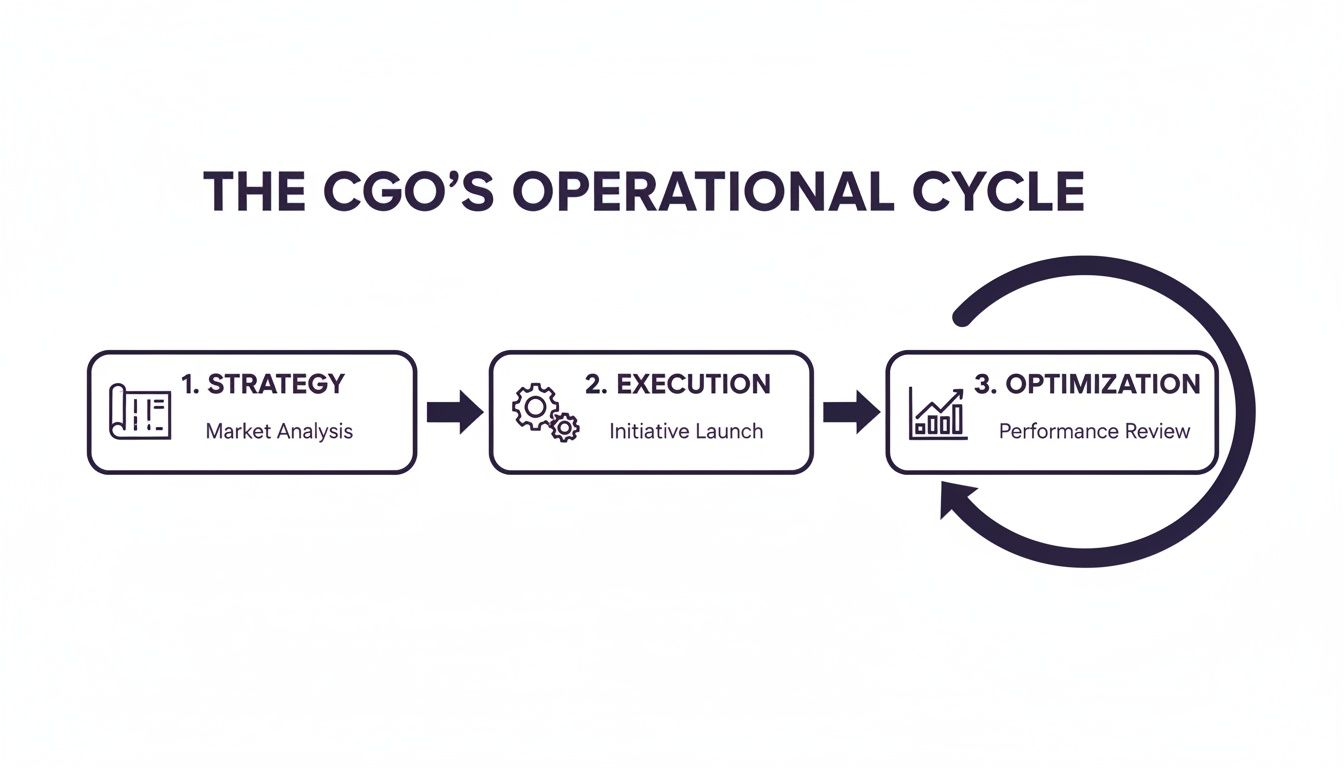
It’s a perfect illustration of how a CGO’s work is never static. It's a continuous process of planning, doing, and refining to drive real, sustainable growth.
Define the Required Skills and Experience
Now it’s time to get granular about the qualifications. Go way beyond just "X years of experience." List the specific skills and proven wins you’re looking for. A great CGO is a rare mix of analytical horsepower, strategic vision, and inspiring cross-functional leadership.
Your requirements should be a direct reflection of the responsibilities you just laid out. Be explicit about what it will take to succeed.
- Proven Track Record: We want to see demonstrated experience scaling a company from a similar revenue stage (e.g., from $10M to $50M ARR). Be prepared to share the numbers.
- Data Fluency: You need to have deep expertise in marketing and sales analytics, with a history of using data to drive make-or-break business decisions. Mention specific tools if they're core to your stack (e.g., HubSpot, Salesforce, Mixpanel).
- Cross-Functional Leadership: We're looking for someone with a documented ability to influence and align marketing, sales, product, and customer success teams toward common goals—often without direct authority over all of them.
- Experimental Mindset: You should have hands-on experience designing and running A/B tests, growth experiments, and new channel pilots with a clear methodology for measuring the results.
Writing a killer job description is a critical first step, and the principles apply across the entire C-suite. For more tips, check out our guide on crafting excellent executive job descriptions.
By being relentlessly specific, you're doing more than just writing a job description; you're creating a powerful magnet for the exact type of strategic leader who can transform your business. This clarity is the foundation of a successful hire, whether you're bringing someone on full-time or as a fractional CGO.
Setting KPIs That Actually Measure Growth
A Chief Growth Officer job description without clear success metrics is just a vague wishlist. If you want to attract a top-tier candidate, you have to define what winning actually looks like. This means getting past the vanity metrics and zeroing in on Key Performance Indicators (KPIs) that directly map to the health and momentum of your business.
A CGO's success isn't measured by one magic number. Think of it as a balanced scorecard covering the entire customer journey. These metrics tell the real, data-backed story of whether your growth engine is firing on all cylinders. They’re the language of accountability.
Connecting Metrics to the Full Funnel
The best CGOs live and breathe the full funnel. While a traditional marketer might fixate on something like Marketing Qualified Leads (MQLs), a CGO is obsessed with what happens next. How efficiently does that lead become a paying customer? And how valuable is that customer over their entire lifetime?
This holistic view is everything. It forces marketing, sales, and product teams to align, ensuring your efforts are bringing in customers who stick around, not just generating clicks.
To get this right, the KPIs in your job description should cover three core areas:
- Acquisition Health: These metrics tell you how efficient your customer acquisition machine is. Are you bringing in the right people at a cost that makes sense for the business?
- Customer Value: This is all about the long-term worth of each customer. Are you keeping the customers you win? Are you successfully growing their value over time?
- Revenue Impact: These are the bottom-line numbers. They show the direct financial outcome of all your growth initiatives and answer the ultimate question: "Are our strategies translating into real, sustainable revenue?"
Sample CGO KPIs by Business Model
The specific KPIs a CGO will own are going to look different depending on your business model. What a SaaS company obsesses over is not the same as the top priorities for an e-commerce brand or a services firm. The trick is to pick metrics the CGO can directly control or heavily influence through their cross-functional work.
If you want to go deeper on this, check out our complete guide on how to measure business growth.
To get you started, here’s a breakdown of sample KPIs you can adapt for your own job description.
| Metric | SaaS / Tech | E-commerce / D2C | Professional Services |
|---|---|---|---|
| CAC Payback Period | How many months of revenue it takes to recoup acquisition costs. A crucial indicator of capital efficiency. | Time to recover marketing spend from a customer's first few purchases. | The period needed for a new client's fees to cover the cost of acquiring them. |
| LTV to CAC Ratio | The ratio of Lifetime Value to Customer Acquisition Cost. A 3:1 ratio is a common benchmark for healthy growth. | Measures long-term profitability by comparing total customer spend to the cost of acquiring them. | Compares the total projected revenue from a client engagement to the sales and marketing costs. |
| Net Revenue Retention | Measures revenue from existing customers, including upsells, downgrades, and churn. Anything over 100% indicates growth from your current base. | Focuses on repeat purchase rate and average order value (AOV) growth from existing customers. | Tracks client retention and the expansion of services within existing accounts. |
| Churn Rate | The percentage of customers who cancel their subscriptions in a given period. Both logo churn and revenue churn are critical. | The rate at which customers stop making purchases over a specific time frame. | The percentage of clients who do not renew their contracts or engagements. |
| Lead-to-Close Rate | The percentage of leads that convert into paying customers. This metric directly ties marketing efforts to sales outcomes. | The conversion rate from initial website visit or lead capture to a completed purchase. | The conversion rate from qualified prospect to a signed client contract. |
Defining these KPIs upfront does more than just fill out a section in a job post.
You’re creating a clear contract for success. It signals to candidates that you are a serious, data-driven organization that knows how to measure what truly matters.
Ultimately, the right KPIs give your CGO a North Star. They guide every strategic decision and ensure all that effort is aimed at creating measurable, long-term value. For a leader who can actually deliver results, that kind of clarity is non-negotiable.
Why a Fractional CGO Might Be Your Smartest Move
Let's address the elephant in the room: a full-time C-suite executive is a massive expense. As you start outlining a Chief Growth Officer job description, the salary numbers alone can be staggering. Base pay often kicks off well above $200,000 and climbs from there, and that’s before you even factor in equity, bonuses, and benefits.
For most ambitious companies, that’s a high-stakes gamble. A bad hire at this level isn't just a financial hole in your P&L; it's months of lost momentum and strategic dead-ends. This is exactly why so many businesses are now turning to a more flexible, capital-efficient alternative.
The Fractional Model as a Strategic Advantage
The fractional CGO model is a game-changer. Instead of locking in a massive long-term salary, you get access to the same caliber of strategic leadership on a part-time basis. It’s like having an on-demand growth architect who can step in, build your playbook, and guide your team for a fraction of the cost.
This approach gives you the best of both worlds. You get the deep, battle-tested experience of an executive who has scaled companies before, but without the full-time financial drain. A fractional CGO can parachute in and focus their time on your most pressing growth challenges, like:
- Building a Scalable Go-to-Market Strategy: They’ll lay the foundation to get you from one revenue stage to the next, predictably.
- Optimizing Your Growth Engine: They dive into your data to plug leaks in the funnel, slash customer acquisition costs, and boost retention.
- Mentoring Your Team: They level up your existing marketing and sales leaders, building a stronger internal capability that lasts long after their engagement ends.
This model fundamentally de-risks the entire hiring process. You see an immediate impact and gain strategic clarity while freeing up precious capital for other growth initiatives.
A fractional executive isn't just a temporary consultant. They are a part-time member of your leadership team, deeply embedded in your business and fully accountable for driving results. It's about getting the exact expertise you need, right when you need it most.
Why It Works for Lean, Ambitious Companies
The fractional model is tailor-made for startups and scale-ups where agility and efficiency are everything. Instead of burning six months on an exhaustive executive search, you can connect with a vetted leader through a marketplace and have them making a real impact within weeks.
This allows founders to stay laser-focused on product and vision while a seasoned expert handles the complexities of building a predictable revenue machine. They bring a fresh, outside perspective, untangled from internal politics, and can quickly pinpoint the roadblocks that are holding your company back.
Ultimately, choosing a fractional CGO is a strategic decision to accelerate growth intelligently. It provides the senior leadership you need to navigate complex challenges—like entering new markets or launching new products—without the crushing long-term financial burden. By tapping into a marketplace of experienced executives, you’re not just hiring another leader; you're investing in a proven partner for your growth journey.
Got Questions About Hiring a CGO?
Bringing a Chief Growth Officer into the fold is a big move, and it naturally sparks a lot of questions for founders and leadership teams. Before you commit to such a critical hire, you need clarity. Let's tackle some of the most common queries head-on so you can move forward with confidence.
CGO vs. CMO: What's the Real Difference?
This one comes up all the time. Is a CGO just a CMO with a trendier title? Not at all, and the distinction is crucial.
A Chief Marketing Officer typically owns the top of the funnel. Think brand awareness, lead generation, and campaign execution. Their world often revolves around marketing-specific metrics.
A CGO, on the other hand, has a much broader mandate that covers the entire customer lifecycle. They're tasked with integrating marketing, sales, product, and even customer success to drive hard revenue outcomes. While a CMO is focused on building the brand and filling the pipeline, the CGO is ultimately on the hook for business results like ARR, the LTV:CAC ratio, and net revenue retention. Their role is inherently cross-functional and relentlessly focused on the bottom line.
When Is the Right Time to Hire a CGO?
Timing is everything. You'll get the most value from a CGO after you've found product-market fit and are ready to hit the accelerator.
If your growth has flatlined, your customer acquisition costs are spiraling out of control, or your teams are visibly working in silos, those are powerful signals. You need a CGO's unifying leadership to break through the plateau.
Of course, for many early-stage companies, the financial commitment is daunting.
For businesses not yet ready for a full-time executive salary, a fractional CGO provides a strategic bridge. It allows you to access top-tier strategic guidance and build your growth playbook without the significant long-term overhead.
This flexible approach helps you install the right systems early on, setting the stage for explosive growth when you're ready to invest fully.
How Should We Evaluate a CGO Candidate?
When you're sizing up a CGO candidate, your focus should be relentless: what is their track record of measurable impact?
Dig deeper than the resume. Ask for specific, quantifiable examples of how they scaled revenue, improved key metrics like LTV or NRR, and brought disconnected teams together. A strong candidate will be fluent in data and think like a systems architect.
A great way to see their strategic mind in action is to give them a real business problem to solve during the interview process. Pay attention to how they deconstruct the challenge. They should also be asking you deep, insightful questions about your business—it shows they have an analytical mind and genuine curiosity.
What Is a Typical CGO Compensation Package?
A full-time Chief Growth Officer's pay reflects their direct impact on revenue, making it a significant investment. You can expect base salaries to range from $218,000 to over $427,000, and that’s before performance bonuses and a substantial equity package.
This high cost is exactly why so many startups and SMBs are turning to the fractional CGO model. It unlocks the same elite expertise and strategic firepower at a much more manageable and predictable cost, making world-class growth leadership accessible long before you could afford a full-time hire.
Ready to tap into executive-level expertise without the C-suite price tag? Shiny connects you with a marketplace of over 3,000 vetted fractional executives who can build and scale your growth engine. Schedule a consultation today to find your perfect match.