

What Is Organizational Effectiveness A Guide to Sustainable Growth
Organizational effectiveness isn't just another piece of corporate jargon. It's the measure of how well your company can actually deliver on its promises—how effectively it turns resources like people, money, and ideas into real, valuable outcomes.
Think of it as the alignment of your strategy, operations, and leadership. When these three elements are in perfect sync, you get sustainable growth. It’s not about just hitting a quarterly sales target; it's about building a machine that can consistently win, quarter after quarter.
Defining Organizational Effectiveness Beyond the Buzzwords
So, what is organizational effectiveness, really? It’s the engine that powers long-term success. It's crucial to understand it’s not the same as efficiency.
Efficiency is about doing things right—optimizing a process to cut costs or speed up a timeline. But effectiveness is about doing the right things—making sure that what you're efficiently producing is something your customers desperately want and are willing to pay for.
Imagine a Formula 1 team. The car's design is your strategy. The pit crew's lightning-fast tire changes are your operations. The driver's split-second decisions on the track are your leadership. You can have the most efficient pit crew in the world, but if the car is a lemon or the driver can't handle the corners, you're not winning any races. Real effectiveness happens when all three are working in perfect harmony.
The Four Pillars of a Healthy Organization
To build an organization that truly works, you have to look at its health from every angle. It's a balanced system. A weakness in one area will always, eventually, pull the others down. Think of it as the four legs of a table—if one is shorter than the rest, the whole thing wobbles.
Here’s a simple way to break down what makes an organization effective.
The Four Pillars of Organizational Effectiveness
A summary of the core components that define a truly effective organization.
| Pillar | What It Means for Your Startup | Key Question to Ask |
|---|---|---|
| Financial Health | It's not just about being profitable this month. It's about building a business model that can last and grow. | Are we just making money, or are we building a truly sustainable business? |
| Operational Agility | Can your internal processes bend without breaking when the market throws you a curveball? | Can we adapt quickly to market shifts without causing internal chaos? |
| Customer Loyalty | Your customers don't just buy from you; they stick with you because you solve their problems better than anyone. | Do our customers stay because of our price, or because they genuinely love what we do? |
| Team Engagement | Your team isn't just showing up for a paycheck. They believe in the mission and have what they need to excel. | Is our team motivated, aligned with our vision, and truly set up to win? |
This holistic view forces you to ask deeper, more meaningful questions about the state of your business.
An organization is truly effective when it is designed in a way that enables every individual to make a real impact. This happens by creating an environment and a structure that allow this to take place.
This concept is tightly linked to another critical piece of the puzzle. To see how the right structure creates the foundation for success, check out our guide on what is organizational design?.
Ultimately, organizational effectiveness is the difference between being busy and being productive. It's how well your company translates its inputs into meaningful outputs for customers and stakeholders.
For startups, this is a constant battle. Founders are often stuck trying to balance explosive growth with the need to build stable systems and a strong culture. Chasing short-term wins at the expense of effectiveness leads to burnout, high turnover, and operational messes that kill momentum. But if you tackle it head-on, you build a resilient foundation that can actually handle the pressures of scaling.
How to Measure Your Company's Health with Proven Frameworks
Knowing what organizational effectiveness is conceptually is one thing, but actually measuring it is another ballgame. Without a structured way to diagnose your company’s health, you’re flying blind—making big decisions based on gut feelings instead of hard data.
Proven frameworks give you the clarity you need to see where your organization is strong and, more importantly, where things are starting to break down. Think of them as a blueprint for your business, helping you move beyond vague ideas and start asking sharp, specific questions. For any leader trying to build a resilient, high-performing company, this kind of systematic approach is non-negotiable.
This concept map shows how core elements like strategy, operations, and leadership all have to work together to drive real effectiveness.
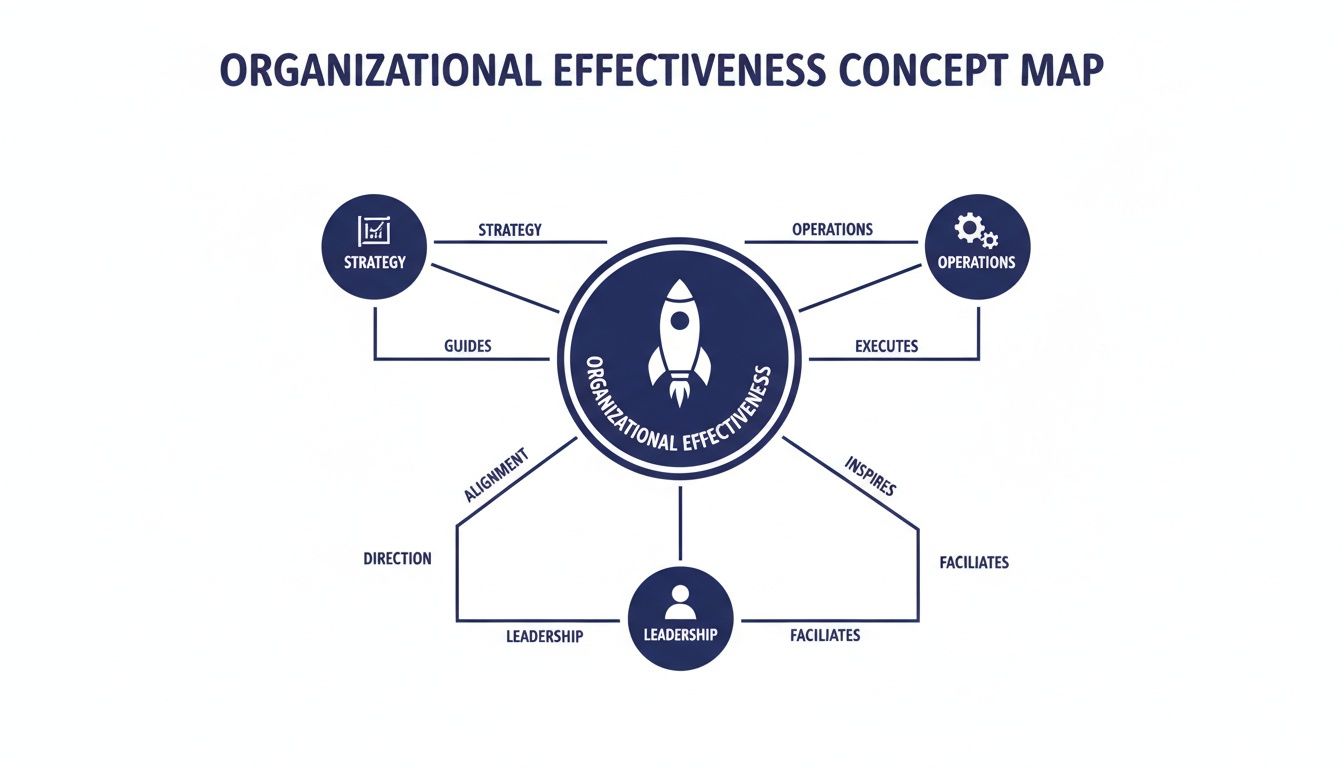
The key takeaway? True effectiveness isn't about being great in just one area. It’s about creating synergy between your vision, your execution, and your leadership.
The McKinsey 7S: An Organizational Health Checklist
The McKinsey 7S model is a fantastic diagnostic tool for understanding the web of connections inside your organization. It's a comprehensive health checklist that makes sure all the critical parts of your company are actually working in harmony. For an organization to really perform, seven key elements have to be aligned.
These elements are broken down into two groups:
- Hard Elements: These are the tangible things you can easily point to—your official strategy docs, org charts, and internal systems.
- Soft Elements: These are the fuzzier, more cultural aspects, like your team’s shared skills, your leadership style, and the company values that actually get lived out.
Here’s the full breakdown of the seven elements:
- Strategy: Your game plan for winning in the market.
- Structure: How the company is organized; who reports to whom.
- Systems: The day-to-day processes and procedures people use to get work done.
- Shared Values: The core values that show up in your company culture and work ethic.
- Style: The leadership approach modeled by the top team.
- Staff: Your employees and their overall capabilities.
- Skills: The specific competencies and skills your organization excels at.
For a startup, this framework is gold for spotting misalignments. For example, you might have a killer Strategy (Hard Element) but a leadership Style (Soft Element) that accidentally crushes the very innovation you need to execute it. The 7S model makes those kinds of contradictions impossible to ignore.
The Balanced Scorecard: A CEO's Master Dashboard
While the 7S model is perfect for checking internal alignment, the Balanced Scorecard (BSC) gives you a more complete, 360-degree view of performance. It pushes back against the old-school, finance-only view of company health by creating a "master dashboard" that tracks how you're doing across four crucial areas. This ensures you're not just fixated on lagging indicators like revenue, but also on the leading indicators that predict future success.
Today's business environment is volatile. According to McKinsey's 2023 State of Organizations report, only 50% of leaders feel their companies are ready for external shocks, and a staggering 67% see their current structures as overly complex and inefficient. The Balanced Scorecard helps build resilience by giving you the full picture. You can dive deeper into the McKinsey State of Organizations 2023 report for more insights.
The BSC framework forces you to balance your short-term financial goals with the long-term drivers of growth: your customers, your internal processes, and your team's ability to learn and grow.
For a SaaS startup, applying the BSC might look something like this:
- Financial Perspective: Goal: Increase Annual Recurring Revenue (ARR) by 40%.
- Customer Perspective: Goal: Achieve a Net Promoter Score (NPS) of 50+.
- Internal Process Perspective: Goal: Reduce average bug resolution time by 25%.
- Learning & Growth Perspective: Goal: Ensure 80% of engineers complete advanced security training.
By using frameworks like these, leaders can stop reacting to problems and start proactively building a stronger organization. They provide a common language and a structured process for what can otherwise feel like a chaotic journey.
But even with the best frameworks, execution can be a massive hurdle—especially when your internal expertise is stretched thin. If you've identified gaps but don't have the senior leadership bandwidth to drive change, bringing in fractional executive support could be your next strategic move.
Choosing Key Performance Indicators That Actually Matter
Think of frameworks as the map for your business journey. Key Performance Indicators (KPIs), on the other hand, are your compass—they tell you if you're actually heading in the right direction.
To see what organizational effectiveness looks like in the real world, you have to translate your big goals into specific, measurable numbers. This is where many leaders get tangled up, creating messy dashboards full of "vanity metrics" that feel good but don't actually predict success.
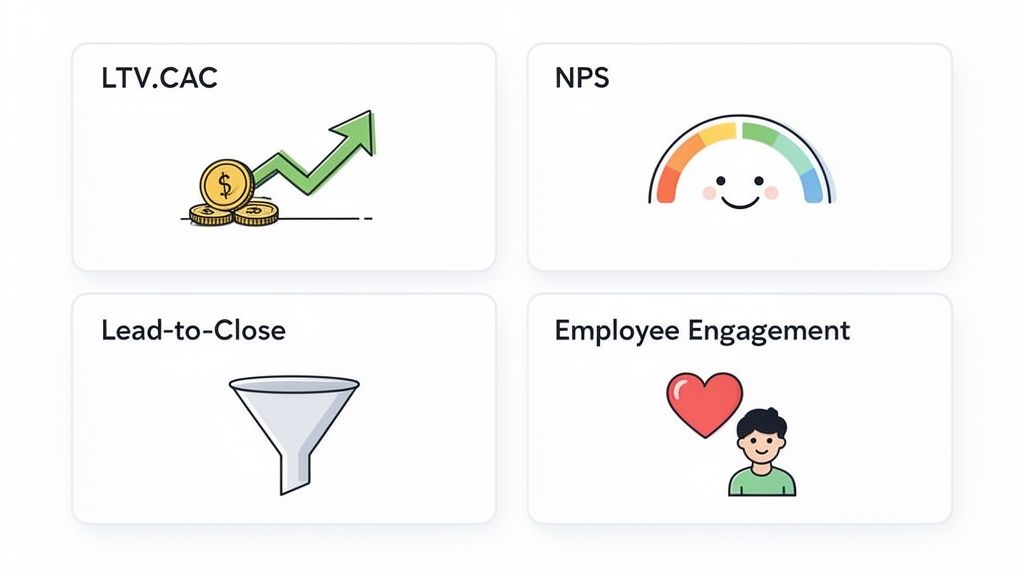
The trick is to zero in on a handful of vital signs that give you a painfully honest picture of your company's health. For a startup trying to scale, that means picking metrics that reflect the four pillars of a strong organization: financial stability, customer devotion, operational speed, and employee passion.
Financial Health Metrics
For a startup, financial health is about more than just revenue. It’s about proving your business model can actually last. You need a metric that confirms you can acquire customers profitably and keep them coming back.
- LTV:CAC Ratio (Customer Lifetime Value to Customer Acquisition Cost): This is the ultimate health check for a scalable business. It answers one simple, brutal question: Are we spending more to get customers than they’re worth to us? A healthy ratio, ideally 3:1 or higher, is a clear signal that your marketing dollars are creating real, long-term value.
Customer Loyalty Metrics
Happy customers aren’t just a nice-to-have; they're the bedrock of an effective company. But true loyalty is more than just repeat purchases. It’s about creating genuine fans who go out of their way to tell others about you.
- Net Promoter Score (NPS): This metric cuts through the noise by asking one simple, powerful question: "On a scale of 0-10, how likely are you to recommend our company to a friend?" It sorts your customers into Promoters, Passives, and Detractors, giving you a clear score that reflects brand love and predicts future growth.
Operational Agility Metrics
An effective organization moves fast. It knows how to turn a flicker of interest into a paying customer without friction. A slow, leaky sales process is a classic sign of operational weakness that can cripple a growing company.
- Lead-to-Close Ratio: This KPI measures the percentage of leads that actually convert into customers. It gives you a direct look into the health of your sales funnel, helping you spot bottlenecks and figure out which marketing channels are bringing in the best prospects.
Employee Vitality Metrics
Let's be clear: your team is your single greatest asset. An engaged workforce is more productive, more creative, and more committed to the mission. Disengaged employees? They're a quiet but constant drain on resources and morale.
Your organization’s ability to achieve its strategic goals hinges entirely on how effectively its culture fuels that ambition. Organizational health isn’t a soft concept; it’s the engine that unlocks the full potential of every employee.
- Employee Engagement Score (eNPS or Survey Score): Often measured with quick, regular pulse surveys, this metric tracks your team's commitment and motivation. A high score is a leading indicator of lower turnover, better customer service, and, ultimately, a healthier bottom line.
By focusing on a curated set of KPIs like these, you can build a dashboard that tells you what you actually need to know. If you're ready to go deeper, our guide on key performance indicators for startups will help you build the right measurement system from the ground up.
Choosing the right KPIs is a critical leadership function. For founders who are stretched thin, bringing in a fractional executive can provide the focused expertise needed to define these metrics, implement tracking systems, and drive accountability across the organization.
Stumbling Blocks: The Common Barriers Holding Startups Back
Even the most brilliant startup ideas can get tripped up on the path to greatness. You can have a world-changing vision and obvious product-market fit, but if the internal engine is sputtering, you'll never reach full speed. It's the operational friction—the small stuff that adds up—that quietly sabotages progress.
Pinpointing these common hurdles is the first step toward building a company that’s built to last. Many of them are born from the very same beautiful chaos that fuels early-stage growth. The problem is, what works for a five-person team crammed in a garage becomes a crippling bottleneck for a team of fifty. Founders who learn to spot these patterns are the ones who make the leap from surviving to thriving.
The Founder's Trap
In the beginning, the founder is everything. They're the chief strategist, the lead salesperson, the head of product, and sometimes even the janitor. This centralization is a massive advantage—it creates speed, agility, and a perfectly unified vision.
But as the company grows, that strength can curdle into a critical weakness known as the "Founder's Trap."
When a founder hangs on to every decision for too long, they become the single point of failure. Progress grinds to a halt as teams wait for a simple approval. Innovation gets stifled because no one feels empowered to take a risk without explicit permission. And the founder? They're on a collision course with burnout. Getting out of this trap means making a conscious, often painful, shift from doing everything to empowering others to lead.
Chaos from Unclear Roles
"Move fast and break things" is a great motto until nobody knows who's supposed to be fixing them. In a fast-growing startup, everyone wears multiple hats. While that creates a scrappy, all-hands-on-deck atmosphere, it quickly leads to ambiguity.
Critical tasks get dropped, responsibilities are duplicated, and accountability vanishes. When goals are missed, the finger-pointing begins because no one was ever truly sure who owned what. Defining roles and responsibilities isn't about creating bureaucracy; it's about building a foundation for effective execution. It’s how you get things done, consistently.
A key building block of Organizational Effectiveness is Organizational Design. This involves the deliberate structuring of roles, processes, and frameworks to ensure that companies are optimally aligned with their strategic goals.
A little structure here prevents a lot of chaos down the road.
Scaling Culture Without Losing Its Soul
A startup’s early culture is often its most powerful, yet intangible, asset. It’s that magnetic energy built on shared passion, late-night pizza sessions, and a unified belief in the mission. But keeping that special sauce intact while you're hiring dozens of new people is one of the toughest challenges a founder will ever face.
Without a deliberate effort to define, communicate, and embed the core values, the culture just gets watered down with every new hire. New folks don't get the unwritten rules, communication starts to break down, and that powerful sense of shared purpose fades. You end up with a collection of talented individuals, not a cohesive, high-performing team.
Breaking through these barriers takes dedicated leadership and specific expertise. If you're seeing these red flags in your own organization but just don't have the senior-level bandwidth to fix them, it might be time to think differently about your leadership team. A seasoned fractional executive can bring in the focused, expert guidance needed to navigate these exact challenges and build a company that's truly effective.
A Step-By-Step Plan to Improve Organizational Effectiveness
Knowing your company has operational friction is one thing; fixing it is another. But improving organizational effectiveness doesn’t mean you have to hit pause and launch some massive, disruptive overhaul.
The best approach is focused and methodical. Think of it like tuning a high-performance engine. You don't take the entire thing apart at once. You isolate the specific component causing the issue, fix or upgrade it, and then measure the performance gain. This process stops you from trying to "boil the ocean" and makes sure your efforts actually lead to tangible results.
This simple, four-step cycle gives you a roadmap for turning insights into action and creating a culture of continuous improvement.
Step 1: Diagnose Your Current State
Before you can fix anything, you need an honest, unflinching look at where you are right now. This is the moment to pull out those frameworks we talked about, like the McKinsey 7S model or a Balanced Scorecard. They aren't just academic exercises; they're powerful diagnostic tools.
Use them to gather real data and honest feedback. Talk to your team. Survey your customers. Dig into your performance metrics. The goal isn't to assign blame, but to pinpoint the specific misalignments holding you back. Are your systems (like your CRM) actually fighting against your sales strategy? Is your leadership style accidentally stifling your team's skills?
Step 2: Prioritize the Biggest Levers
Once you've diagnosed the issues, you'll probably have a laundry list of potential fixes. The key to making progress is ruthless prioritization. You can't fix everything at once.
Your job is to identify the one or two areas that, if improved, would have the most dramatic, positive impact on your business. What's the one bottleneck causing the most pain? Which fix will deliver the quickest win to build some much-needed momentum? This is where you focus your limited time and resources—on the levers that create a ripple effect across the entire organization.
The hard truth is this: No matter how ambitious its strategic goals are, an organization’s ability to achieve them hinges entirely on how effectively its culture fuels that ambition. Organizational health isn’t a soft concept; it’s the engine that unlocks the full potential of every employee.
Choosing the right lever is a critical leadership decision that separates the merely busy teams from the truly effective ones.
Step 3: Execute Targeted Changes
With your priorities locked in, it’s time to act. This step demands crystal-clear ownership and a well-defined action plan. Vague goals like "improve communication" are doomed from the start.
Instead, get specific. If the problem is a chaotic product launch cycle, the solution isn't to "be more organized." It's to implement a clear project management process, assign a single owner to every launch, and define strict communication protocols. Clear accountability is non-negotiable here.
Step 4: Measure and Refine
Finally, you have to measure the impact of your changes. This is where your KPIs become your best friend. Did the new process actually reduce your lead-to-close time? Did clarifying roles and responsibilities improve your employee engagement score?
This measurement loop is what makes the process stick. It lets you see what’s working, what isn’t, and where to focus your energy next. It transforms organizational improvement from a one-off project into a continuous, data-driven discipline.
This focused approach delivers massive wins without derailing the entire company. If your team lacks the senior expertise to lead this kind of strategic change, finding the right fractional executive can provide the focused leadership needed to drive these improvements.
How Fractional Leaders Accelerate Your Path to Effectiveness
So, you’ve done the hard work. You have a roadmap and you know which KPIs to track, but you’ve still hit a wall. It’s a familiar story: you know what needs to be fixed—like building a sales process that scales or getting your financial reporting in order—but you lack the senior-level horsepower to get it done.
Your team is sharp and dedicated, but they're already stretched thin. And the thought of hiring a full-time, C-level executive? The cost and risk feel massive at this stage. This is exactly where fractional leadership flips the script, offering a modern solution to a timeless scaling problem.
The Right Expertise at the Right Time
A fractional executive is a seasoned, C-suite leader—think a fractional CMO, CFO, or COO—who joins your team on a part-time basis. They plug into your company for a set number of days each month to tackle your biggest organizational hurdles head-on.
Don't mistake them for a consultant who drops off a report and vanishes. A fractional leader becomes a genuine part of your leadership team, rolling up their sleeves to drive execution. For instance, instead of hiring a full-time CMO, you can bring in a fractional marketing pro for 10 hours a week to build your entire demand-gen engine from scratch.
Fractional leadership de-risks growth by giving you access to top-tier executive talent without the long-term commitment and hefty price tag of a full-time hire. It’s about getting the exact expertise you need, right when you need it most.
This flexible model allows you to fill critical leadership gaps with surgical precision, ensuring your company’s structure and capabilities keep pace with your growth.
An Immediate Impact on Effectiveness
The real value of a fractional leader is their ability to deliver results, fast. They aren't learning on the job. These are experienced operators who have seen your exact problems dozens of times before. That experience lets them skip the learning curve and start making an impact from day one.
Their work directly strengthens the core pillars of organizational effectiveness:
- Building Scalable Systems: A fractional COO can take your chaotic, ad-hoc workflows and turn them into documented, repeatable processes that are built to scale.
- Driving Strategic Clarity: A fractional CFO can implement the kind of robust financial models and KPI dashboards that provide a clear, real-time view of your business's health.
- Improving Team Engagement: A great fractional leader doesn’t just build systems; they mentor your existing team, level up their skills, and introduce a structure that reduces burnout and clarifies roles.
That last point is huge. Disengaged teams are a silent killer. According to Gallup's 2023 Global Workplace Report, a mere 23% of employees are truly engaged at work. This costs the global economy an estimated $8.8 trillion annually. Fractional leaders are experts at fixing the systemic issues that cause disengagement.
By injecting this focused expertise, you can finally overcome the operational hurdles holding you back. To learn more about how this model works, explore our detailed guide to fractional leadership. It's a modern talent strategy that lets you build a more effective, resilient organization without breaking the bank.
Common Questions on Organizational Effectiveness
Founders and leaders often have a few key questions when they start digging into what organizational effectiveness really means for their business. Let's tackle the most common ones.
What's The Difference Between Organizational Efficiency And Effectiveness?
It's easy to confuse these two, but the distinction is critical. Think of it like this: efficiency is about doing things right, while effectiveness is about doing the right things.
Efficiency is all about process—minimizing waste, cutting costs, and saving time. On the other hand, effectiveness is about the outcome—are you actually achieving your company's core strategic goals?
A company can be incredibly efficient at making a product nobody wants to buy. In that case, you have a perfectly efficient but completely ineffective organization. The real goal is to hit both: to efficiently execute the right strategy.
How Can A Small Startup Improve Its Effectiveness With Limited Resources?
For a startup, the key is to be focused and surgical. Don't try to boil the ocean by overhauling your entire company at once. That’s a fast track to burnout and frustration.
Instead, pick one critical area that's causing the most pain or offers the biggest potential reward. It could be as simple as defining three core KPIs for the whole company or just clarifying roles for a single, vital project. Small, early wins build the momentum you need to tackle bigger challenges down the road.
How Long Does It Take To See Real Improvements?
The timeline really depends on the scope of the change you're making. Some improvements can have an almost immediate impact.
Simple changes, like clarifying goals or defining ownership for a key initiative, can boost team alignment and focus within a matter of weeks.
But deeper, more fundamental shifts—like changing your leadership style or redesigning core operational processes—require more patience. These kinds of transformations often take six to twelve months to fully take root and show their true impact. The key is consistent effort and actually measuring your progress along the way.
Navigating these challenges requires expert leadership, but you don't have to face them alone. Shiny connects you with a marketplace of vetted fractional executives who can provide the targeted guidance needed to build a more effective organization, faster. Schedule a consultation to find the right executive for your team.
