
How to Hire a CTO: A Founder’s Guide to Finding the Right Tech Leader
Hiring a Chief Technology Officer (CTO) is one of the most pivotal decisions a founder will make. It's not just about finding a great coder; it's about securing a strategic partner who will build your technical foundation, scale your engineering team, and ultimately shape your company's future.
But what does that leader look like? Is it a full-time executive, or could your business get more leverage from a part-time, fractional expert? The path to the right hire involves understanding the stakes, defining the role with precision, sourcing candidates from the right places, and running a process that reveals true leadership.
The High Stakes of Your First Critical Tech Hire
Let's be clear: getting your CTO hire right isn't just another box to check. It's one of the most consequential decisions you'll make for your company's future. You're not just looking for a senior developer who can manage a few people; you're looking for a strategic partner who will lay the foundation for your technology, build out your engineering team, and ultimately define your company’s trajectory.
The cost of getting this wrong is staggering. A bad hire can leave you drowning in technical debt, stuck with a product vision that goes nowhere, and watching your best engineers walk out the door. All of that burns through precious capital and, more importantly, time you can never get back. Think of it like building a house: a bad architect might design something that looks okay at first, but if the foundation is cracked, you're in for years of expensive, disruptive repairs.
The Ripple Effect of a Bad CTO Hire
The wrong technical leader creates problems that ripple out way beyond just the code. The damage often looks like this:
- Wasted Resources: Months of salary and equity go down the drain on a leader who can't deliver a scalable product or a coherent tech strategy.
- Team Attrition: A-player engineers won't stick around for a leader who lacks a clear vision, can't communicate, or doesn't have technical credibility. They have options.
- Lost Market Opportunity: While you’re trying to put out fires internally, your competitors are shipping features and winning over customers.
On the flip side, the right CTO is a force multiplier. They don’t just manage technology; they drive innovation. They’re the ones making the tough build-vs-buy calls that save you money, attracting other top engineers to the team, and translating your business goals into a technical roadmap that actually works.
The search for a CTO is a high-stakes game because you are literally hiring for your future. This person will make foundational decisions that will either launch you into hyper-growth or become a massive roadblock.
What makes this even tougher is the brutally competitive market. The tech talent shortage is real, with over 90% of organizations worldwide expected to face IT skills gaps by 2026. For a role as specialized as a CTO—where there are only about 26,345 employed across the entire US—that scarcity means long, expensive searches are the norm. You can see just how small the talent pool is by exploring the latest CTO demographics on Zippia.com.
This is why you have to go into this process with a clear, strategic mindset. Understanding the pitfalls—and the immense upside—is the first step toward finding a leader who won't just build your product, but help you build your business.
Choosing Your Model: Full-Time, Fractional, or Interim?
Once you’ve grasped the stakes, the next big decision is figuring out the exact shape of the leadership you need. The default for many founders is to jump straight into the hunt for a full-time, long-term CTO. But honestly, that’s not always the smartest—or most capital-efficient—move.
This isn’t a one-size-fits-all situation. The choice between a full-time, fractional, or interim CTO has to be intentional, driven by your company's stage, technical maturity, and what you need to get done right now.
Think of it like a home renovation. You wouldn't hire a full-time, salaried architect just to pick out paint colors; you'd bring them in for a specific consultation. It's the same logic here—match the executive model to the job at hand.
When a Full-Time CTO Makes Sense
Bringing on a full-time CTO is a major commitment, both financially and culturally. This is the right call when you’ve hit product-market fit and are ready to pour gas on the fire. Technology isn't just a part of your business anymore; it is the business, and you need a dedicated leader living and breathing it.
You're likely ready for a full-time hire if you're seeing these signs:
- Your team is exploding: You need someone to build and lead a growing engineering org, handling everything from recruiting to mentorship.
- Your tech strategy is getting complex: The roadmap involves a sophisticated, scalable architecture that will define the company for years to come.
- The CTO needs a seat at the big table: They need to be a core part of the executive team, shaping the company's long-term vision.
The Power of Fractional Leadership
For a lot of startups and even scale-ups, that full-time commitment is just too much, too soon. This is where fractional leadership comes in as a powerful alternative.
A fractional CTO gives you high-level strategic guidance on a part-time basis, usually anywhere from 5-25 hours a week. You get access to a seasoned executive's brain without the hefty price tag and equity dilution.
Let's talk numbers. A full-time CTO comes with a steep cost. The national average salary is $266,122 annually, which can easily hit $273,000 with bonuses. And that’s before you even factor in equity or recruiter fees. That's a huge chunk of change that could be going into product development or marketing. Fractional models, on the other hand, can slash leadership costs by up to 70% while still giving you the strategic horsepower you need.
This model is a game-changer when you need:
- Strategic oversight for your existing tech team.
- Expertise for a specific project, like a security audit or cloud migration.
- A credible technical voice in the room for fundraising or board meetings.
A fractional CTO is your strategic co-pilot. They help you build the technical roadmap and set up best practices, empowering your existing team to execute without the full-time overhead.
This decision tree can help you visualize which path makes the most sense based on where your company is today.
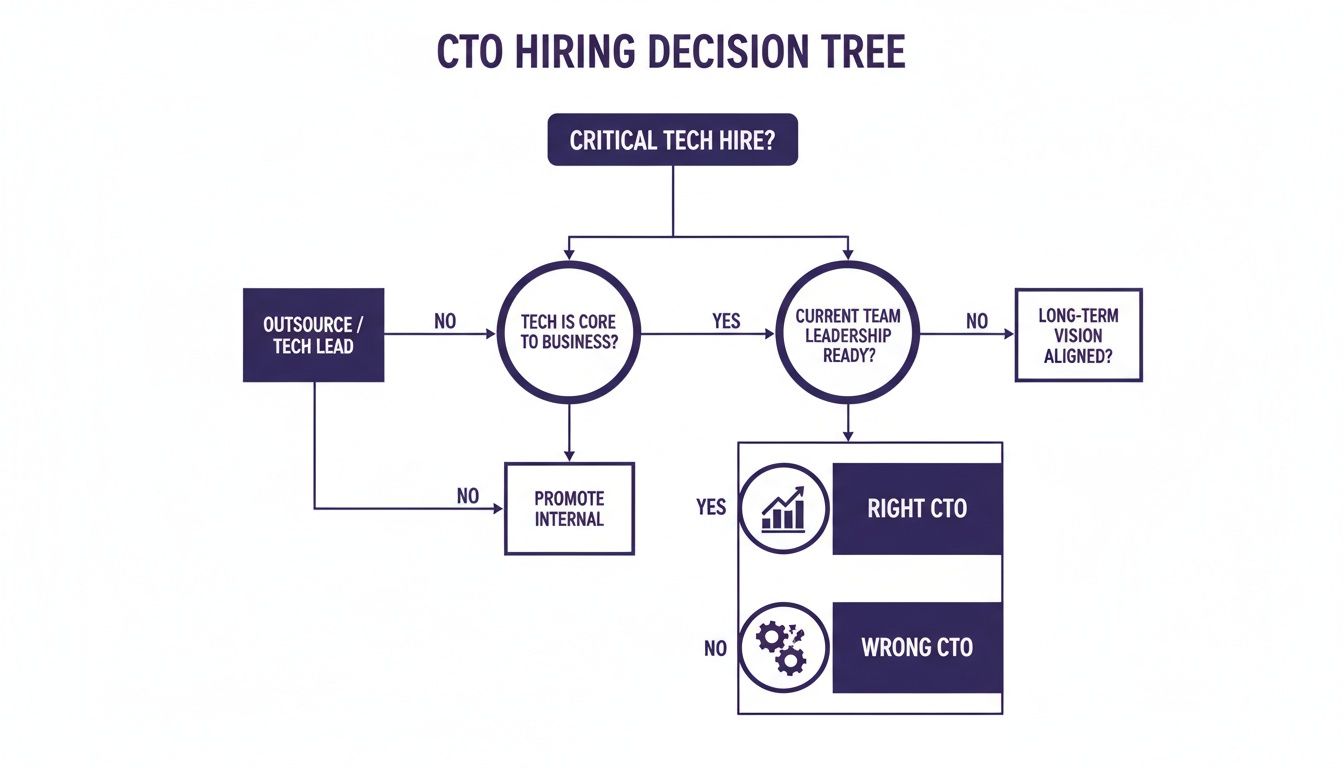
As the flowchart shows, picking the right model has a direct impact on your growth. For a much deeper look at how this works in practice, our ultimate guide to fractional CTO services breaks it all down.
Filling a Gap With an Interim CTO
Finally, there’s the interim CTO. This role serves a very different, very specific purpose. Think of them as a temporary, full-time leader you bring in to fill a critical gap during a period of transition.
An interim leader is your go-to when a CTO suddenly leaves, or you need to stabilize the engineering team while you run a search for a permanent hire. Their mission is clear and time-bound: keep the ship steady, manage the team, and make sure key projects don't grind to a halt. They’re the experienced captain you call to navigate a storm, not to chart a course for a new continent.
To make the decision clearer, here’s a quick comparison of the three models.
CTO Hiring Models Compared
| Attribute | Full-Time CTO | Fractional CTO | Interim CTO |
|---|---|---|---|
| Commitment | Long-term, permanent member of the executive team. | Part-time, ongoing strategic partner (5-25 hrs/week). | Temporary, full-time leader for a defined period (3-12 months). |
| Cost | Highest cost: full salary, benefits, equity, bonuses. | Moderate cost: retainer or hourly, no benefits/equity. | High cost during engagement, but no long-term commitment. |
| Best For | Scaling companies with established product-market fit. | Early-stage startups needing strategic guidance without the cost. | Companies in transition (e.g., after a CTO departs). |
| Primary Focus | Long-term vision, team building, deep company integration. | High-level strategy, roadmap, process, technical advising. | Stability, crisis management, project continuity, team morale. |
| Analogy | The full-time Architect designing and overseeing the entire city. | The consulting Architect who advises on the city's master plan. | The experienced Foreman who steps in to finish a critical building. |
By taking a hard look at your stage, budget, and strategic goals, you can pick the CTO model that gives you the right expertise at the right time. This deliberate approach ensures your investment in tech leadership actually accelerates growth instead of just draining your runway.
Crafting a Job Description That Attracts Leaders
A generic job description attracts generic candidates. If you want to hire a true leader, your job post needs to do more than list duties—it has to be a magnet for the exact type of talent you need to win.
So, forget the stale bullet points and corporate jargon. Think of your job description as a strategic document. It's your first pitch, designed to sell your vision and challenge top candidates to solve your most interesting problems.
Great candidates aren't just looking for another job; they're looking for impact. Your description needs to immediately lay out your mission, the compelling technical hurdles they'll face, and the real influence they'll have. This is your chance to show you're looking for a partner, not just another employee.
Moving Beyond the Standard Template
The best job descriptions read like a conversation, not a legal document. They tell a story about where your company is headed and why this specific role is critical to getting there. Start by painting a clear, compelling picture of the opportunity.
Instead of leading with a laundry list of requirements, open with your mission. What problem are you solving for the world? Follow that with a transparent look at your current tech landscape and the specific challenges the new CTO will need to tackle head-on.
Here’s a way to frame it that gets straight to the point:
- The Mission: "We're building a platform to help small farms cut water waste by 30%. Your job is to build the scalable, data-driven infrastructure that makes this a reality."
- The Challenge: "Our current monolith is holding back our growth. Your first major challenge will be leading the migration to a modern, microservices-based architecture on AWS."
- The Impact: "Within your first 90 days, you will have a technical roadmap in place, hired two key engineers, and overseen the launch of our first major architectural update."
This approach immediately filters for candidates who are genuinely excited by your specific problems, not just hunting for a title. It respects their expertise by being direct and honest about what's ahead. For a deeper dive into what this role really involves, check out our guide on a CTO's primary duties and responsibilities.
Defining Non-Negotiable Skills with a Scorecard
Once you've set the stage, it's time to get specific about the core competencies. To keep your hiring process objective and your team aligned, create a candidate scorecard before you even think about posting the job. This internal tool forces everyone to agree on the non-negotiables, ensuring every candidate is measured against the same yardstick.
A solid scorecard goes way beyond just technical skills. It should cover four key areas:
- Technical Expertise: Specific experience with your stack (e.g., Python, Kubernetes), cloud architecture, and security protocols.
- Strategic Leadership: Proven ability to build a tech roadmap, manage budgets, and align technology with business goals.
- Team Mentorship: A real track record of hiring, developing, and retaining top-tier engineering talent.
- Business Acumen: A genuine understanding of market dynamics, product management, and how technology actually drives revenue.
Your scorecard isn't just a checklist; it's a compass for your entire hiring team. It helps keep personal bias out of the process and ensures everyone stays focused on finding the candidate who truly meets the strategic needs of the business.
This structured approach is especially critical for a CTO role. Experience is non-negotiable here, with top candidates often bringing at least 10 years in IT management and strategy to the table. That deep expertise comes at a premium—veterans can command salaries up to $273,000. You can find more CTO compensation insights on RobertHalf.com. Highlighting this need for seasoned leadership is crucial, as hiring a full-timer with the wrong profile can be an incredibly costly mismatch.
Articulating Success in the First 90 Days
Finally, the most compelling job descriptions answer the candidate's biggest unasked question: "How will I know if I'm succeeding here?" Define clear, realistic goals for the first 90 days. This shows you’ve thought deeply about the role and sets a clear bar for performance right from the start.
These goals should be a mix of strategic and tactical wins:
- First 30 Days: Complete a full audit of the current tech stack, infrastructure, and team capabilities.
- First 60 Days: Present a 12-month technical roadmap to the executive team and board.
- First 90 Days: Finalize the 2025 engineering budget and lead the hiring process for two critical engineering roles.
By crafting a job description that is visionary, specific, and impact-oriented, you shift from passively collecting resumes to actively attracting the strategic leaders who can truly elevate your business. This groundwork ensures your search for a CTO starts on the strongest possible footing.
Finding and Vetting Candidates Beyond LinkedIn
The best CTO candidates aren't spending their days scrolling through job boards. They’re heads-down, busy building incredible products and leading high-performing teams. If you want to hire a truly top-tier CTO, your "post and pray" strategy on LinkedIn just isn't going to cut it.
You need to shift your mindset to proactive sourcing. This means actively going out and finding the leaders who aren't even looking for a new role. It sounds like a ton of work, but focusing your energy on the right channels will connect you with talent you’d otherwise never find.
Uncovering Talent in Niche Communities
Instead of casting a wide net on huge job sites, get surgical. Your ideal candidate is probably already hanging out in very specific online and offline spaces, sharing their knowledge and learning from their peers.
Drill down into these high-value channels:
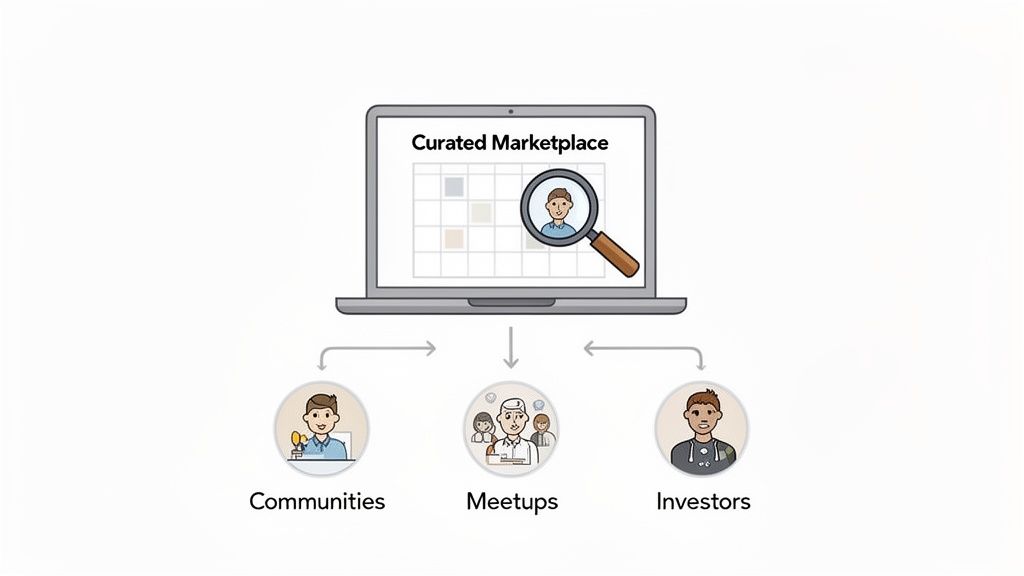
- Niche Developer Communities: Forget generic forums. Look for active contributors and moderators in Slack, Discord, or GitHub communities that are directly related to your tech stack. A respected voice in a niche community—say, one dedicated to AI in FinTech—is an instant signal of deep expertise.
- Your Investor Network: Don't forget the people who are already betting on you. Your investors have a vested interest in your success and often have incredible networks of proven operators. Ask them for warm introductions to CTOs they've backed or worked with before.
- Local and Virtual Meetups: Pay close attention to who's speaking at industry-specific events and conferences. The people on stage are often passionate leaders and recognized experts in their field.
Yes, these channels take more effort than posting a job ad. But the quality of candidates you’ll find is worlds apart. You're tapping into a talent pool that's already been vetted and respected by a community of their peers.
The Strategic Advantage of Curated Marketplaces
For many founders, especially those looking for a fractional leader, the most direct path to a great CTO hire is through a curated talent marketplace. These platforms do all the heavy lifting of sourcing and vetting for you, presenting a pre-qualified pool of executives ready for their next gig.
Think of it as the difference between fishing in the open ocean versus a well-stocked private lake. Platforms like Shiny connect you directly with hundreds of vetted fractional leaders who have already been screened for technical chops, leadership skills, and a track record of success. This alone can save you hundreds of hours of sourcing and initial screening.
A curated marketplace is your fast track to quality conversations. It cuts through the noise of unqualified applicants and connects you with executives who have the specific, battle-tested experience to solve your immediate business problems.
This becomes incredibly powerful when you need specialized expertise. Need a CTO who has scaled a B2B SaaS platform past $10 million ARR? Or one with deep experience in HIPAA compliance for a HealthTech startup? Marketplaces make finding that needle-in-a-haystack leader far more achievable.
Mastering the 15-Minute Initial Screen
Once you have a few promising candidates lined up, the next step is to qualify them quickly and respectfully. A well-structured 15-minute screen is all you need to gauge alignment before you both commit to a full interview loop.
Your goal here is simple: confirm their background matches your needs and get a feel for their communication style. This is not the time to dive deep into technical weeds.
Structure the call around three key questions:
- "Walk me through a project where you took a product from a simple idea to a scalable solution." This gets right to their ability to connect technical execution with real business outcomes.
- "What's your philosophy on building and mentoring engineering teams?" This gives you a quick read on their leadership style and whether they'll be a good cultural fit.
- "Based on what you know about our company, what's the biggest technical challenge you think we'll face in the next year?" Their answer reveals if they've done their homework and if they can think strategically about your business.
This short conversation is your first critical filter. It helps you zero in on leaders who not only have the right resume but also possess the strategic mindset and communication skills that are absolutely essential for a successful CTO hire.
Designing an Interview Process That Reveals True Skill
The resumes are in and you've done the initial screens. Now it's time to separate the talkers from the builders.
A generic interview process—a few casual chats followed by a coding challenge—just won't cut it. It won’t reveal the strategic depth a true CTO needs. A great process feels less like an interrogation and more like a collaborative workshop, giving both you and the candidate a real sense of what it’s like to work together.
To really understand how a candidate thinks, you have to move beyond hypotheticals. Ditch the abstract puzzles. Instead, ground your process in the real-world challenges your business is facing right now. This gives you a powerful, practical preview of how they diagnose problems, devise solutions, and lead a team through execution.
Go Beyond Technical Puzzles
A CTO’s value isn’t just in writing pristine code; it’s in their ability to apply deep technical knowledge to solve actual business problems. Your interview process has to reflect this reality.
While a baseline of technical competency is a must-have, the focus should be on strategic application, not just algorithmic purity. A structured, multi-stage approach lets you evaluate both their technical expertise and leadership qualities in tandem.
Think of it this way: instead of asking them to solve a complex algorithm on a whiteboard, ask them to critique your current architecture and propose a six-month roadmap. Their response will tell you far more about their strategic mind than any coding test ever could.
A Multi-Stage Interview Framework
A solid interview loop gives multiple people on your team a chance to evaluate the candidate from different angles. This ensures you get a well-rounded assessment and helps build buy-in across the company for your final decision.
Here’s a proven, three-part framework that works wonders:
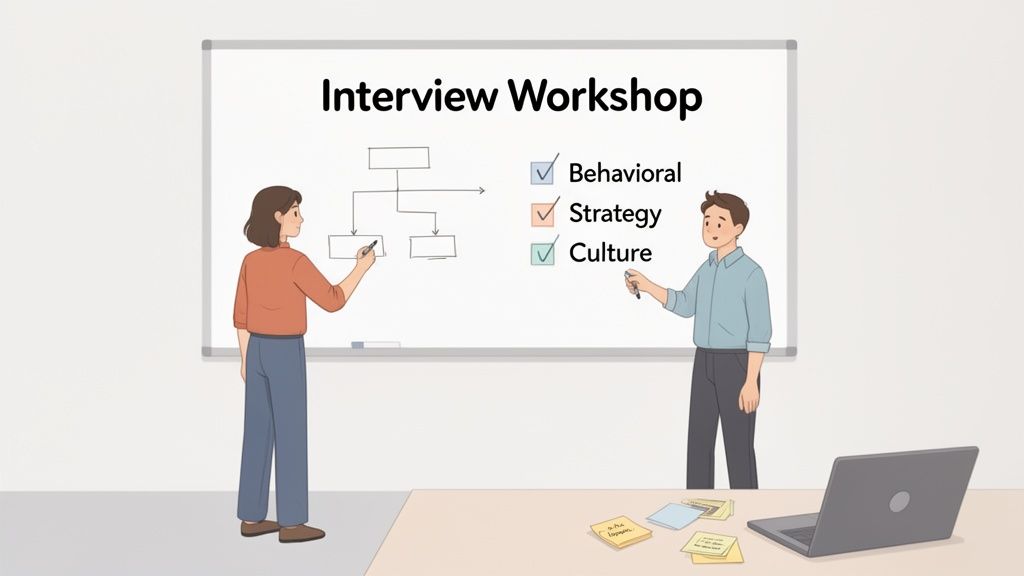
- The Behavioral Deep Dive: This interview is all about using past performance to predict future success. Ask targeted questions about how they've handled team conflicts, managed spiraling technical debt, or navigated tight budget constraints. The goal is to see how they’ve dealt with real-world adversity.
- The Practical Strategy Session: This is the core of the evaluation. Present the candidate with one of your company’s genuine, current business problems. Ask them to whiteboard their approach, from initial diagnosis to a phased execution plan. You get to see their problem-solving skills in real-time.
- The Culture and Vision Alignment: The final chat should be with the CEO or the founding team. This isn’t a technical screen. It’s a gut check on alignment. Talk about the company’s mission, its long-term vision, and your core values to make sure you’re bringing in a true partner.
The most insightful interviews are simulations of the actual job. When you ask a candidate to solve one of your real problems, you're not just testing them—you're getting a free consultation and a preview of their working style.
This kind of structured process keeps you from getting swayed by a candidate who interviews well but lacks substance. It forces an evidence-based decision, grounded in demonstrated skill rather than just a confident presentation. To help you get started, we've compiled a list of powerful questions to ask a potential CTO that you can adapt for each stage.
Evaluating Leadership and Communication
Remember, a CTO is an executive first and a technologist second. Their ability to translate complex technical concepts for non-technical stakeholders—like the board, investors, or other department heads—is an absolutely critical skill.
During that practical strategy session, pay close attention to how they communicate.
- Do they ask clarifying questions before jumping to a solution?
- Can they explain technical trade-offs in simple business terms?
- How do they respond to constructive feedback or challenges to their ideas?
This is where you truly assess their leadership potential. A great CTO doesn't just have the right answers; they bring others along, build consensus, and foster a collaborative environment. Your interview process should give them every opportunity to prove they can do just that.
Closing the Deal and Onboarding for Immediate Impact
You’ve navigated the interviews, vetted the candidates, and found a leader who gets your vision. Awesome. But don't pop the champagne just yet. The final phase—getting them to sign on the dotted line and ensuring they hit the ground running—is where many hiring processes fall apart.
A misstep here can undo weeks of hard work, sending you right back to the drawing board.
The offer itself needs to be compelling, but it also has to align with the role you’ve defined. For a full-time hire, that means putting together a carefully structured package of salary, performance bonuses, and meaningful equity. For a fractional CTO, it’s about a crystal-clear contract that spells out the scope, deliverables, and a retainer that respects their high-caliber expertise.
But the offer is only half the battle. Top-tier candidates aren't just looking at the numbers; they're judging how seriously you take their integration into the business. This is where a well-defined onboarding plan becomes your most powerful closing tool.
A Strategic 30-Day Onboarding Plan
Forget the standard HR checklist of paperwork and IT setup. That’s table stakes. A strategic onboarding process immerses your new leader in the business from day one, giving them the context they need to start making an impact immediately.
This is especially true for a fractional executive. Their time is incredibly focused, and they need to ramp up fast to deliver the value you're paying for.
Your 30-day plan should be all about strategic immersion, not administrative box-ticking.
- Week 1: Business Deep Dives. Don't just show them the tech stack. Schedule dedicated sessions with the heads of Product, Sales, and Marketing. The goal is for the new CTO to deeply understand customer pain points and core business objectives.
- Week 2: The Technical Audit. Give them the keys to the kingdom. This is their time for diagnosis. Provide full access to review the codebase, infrastructure, and current engineering workflows without interruption.
- Weeks 3-4: Hunt for Quick Wins. Empower them to identify and execute one or two high-impact, low-effort improvements. This could be as simple as fixing a nagging bug that's been frustrating the sales team, optimizing a slow database query, or formalizing a chaotic code review process.
A great onboarding plan doesn't just welcome a new hire; it accelerates their journey from an outsider to a trusted strategic partner. It’s the difference between a CTO who spends three months just finding their footing and one who is delivering tangible wins in their first 30 days.
This kind of structured approach signals to candidates that you’re not just hiring a pair of hands—you’re bringing on a strategic partner. It shows you value their time and are fully prepared for their arrival.
By pairing a competitive offer with a thoughtful onboarding roadmap, you dramatically increase your odds of closing your top candidate. You're not just offering a job; you're setting the stage for a partnership that adds real value from the moment they sign.
If you’re ready to connect with pre-vetted fractional executives who can integrate quickly and drive immediate results, exploring a curated marketplace is your next step. Discover how our network of seasoned leaders can help accelerate your growth.
Still Have Questions About Hiring a CTO?
Getting your first key technology leader on board is a huge step, and it's natural to have questions. Founders often ask the same things about timing, what mistakes to watch out for, and how to handle the equity conversation. Let's clear up some of the most common ones.
When Is the Right Time to Hire a CTO?
You'll know it's time when technology stops being a simple tool and starts becoming the core of your business strategy. Is your team hitting technical walls that are slowing down growth? Do you need to scale your product reliably? Do you need a strategic tech voice in the room during leadership meetings? If you answered yes to any of these, it’s probably time.
For most early-stage companies, bringing on a fractional CTO is the perfect first move. You get that crucial strategic oversight without the commitment and cost of a full-time salary.
What's the Biggest Mistake to Avoid When Hiring?
The single most common pitfall is hiring a brilliant engineer who can't lead. It’s an easy mistake to make, but a CTO’s job isn't to write code all day. Their real value comes from leading the tech organization, aligning the product roadmap with business goals, and making those high-stakes strategic calls.
A great CTO is a business leader first, and a technology expert second. Always prioritize management experience and strategic thinking over pure coding chops.
How Much Equity Should a Founding CTO Get?
This is the million-dollar question, and the answer varies wildly. For a full-time founding CTO, equity can range from 1% to 10% or even more. The final number really depends on their experience, your company's stage, and how foundational their contribution will be.
Someone joining as a true co-founder at the idea stage will command a much higher stake than a CTO hired when the product is already built and gaining traction.
Finding the right executive shouldn't be a bottleneck. Shiny connects you with a network of over 3,000 pre-vetted fractional executives who have the strategic expertise you need to scale. Explore our marketplace and find your perfect match today.