
The Modern Responsibilities of a Chief Marketing Officer
The role of a Chief Marketing Officer has been completely redefined. It's no longer just about brand stewardship; it’s about architecting the entire engine for business growth. Today’s CMO is a strategic leader who weaves sales, product, and marketing into a single, powerful force, designing the blueprint for sustainable revenue that impacts every corner of the organization.
From Brand Guardian To Growth Architect
For many founders, the idea of marketing leadership can feel a bit fuzzy, often blurring the lines between managing social media and running ad campaigns. But true marketing leadership at the C-suite level is a whole different ballgame.
The modern CMO is less of a brand guardian and more of a growth architect. Their primary job is to build the systems that generate predictable, scalable revenue. Think of them not as the person who paints the building, but as the architect who designs the entire structure to be both beautiful and functional.
This isn't just a change in title; it’s a seismic shift in function. Where marketing was once seen as a cost center focused on visuals and brand awareness, it's now an accountable driver of tangible business outcomes. A great CMO connects every marketing dollar spent to a clear result—a new lead, a closed deal, or a boost in customer lifetime value.
To give you a clearer picture, let's break down what a modern CMO is really responsible for.
Core Responsibilities of a Modern CMO at a Glance
For leaders who need the bottom line, this table summarizes the key pillars of a modern CMO’s role. It’s a move from isolated tactics to integrated, revenue-focused strategy.
| Responsibility Pillar | Core Focus Area | Primary Goal |
|---|---|---|
| Strategic Vision | Market Positioning & Go-to-Market | Own the company's growth narrative and revenue engine. |
| Operational Execution | Marketing Systems & Performance | Build a scalable, data-driven marketing machine. |
| People & Partnerships | Team Leadership & Alignment | Foster a high-performing team aligned with sales & product. |
As you can see, the scope is broad and deeply integrated into the business's core functions, from high-level strategy to the nuts and bolts of daily execution.
The Modern CMO Mandate
So, what does this actually look like day-to-day? Today's marketing leaders are expected to own the entire customer journey and prove a clear ROI. This bigger scope is changing the job itself in a few key ways:
- End-to-End Ownership: They’re accountable for everything from the first time a customer hears about the brand to their long-term loyalty and repeat purchases.
- Data-Driven Strategy: Gut feelings don’t cut it. A modern CMO builds the infrastructure to track, analyze, and act on performance data, turning marketing into a measurable science.
- Cross-Functional Alignment: Silos kill growth. A massive part of their job is getting marketing, sales, and product teams to work from the same playbook, chasing the same business goals.
This diagram shows how much the role has evolved, absorbing functions that once belonged solely to sales or brand to become the central architect of growth.
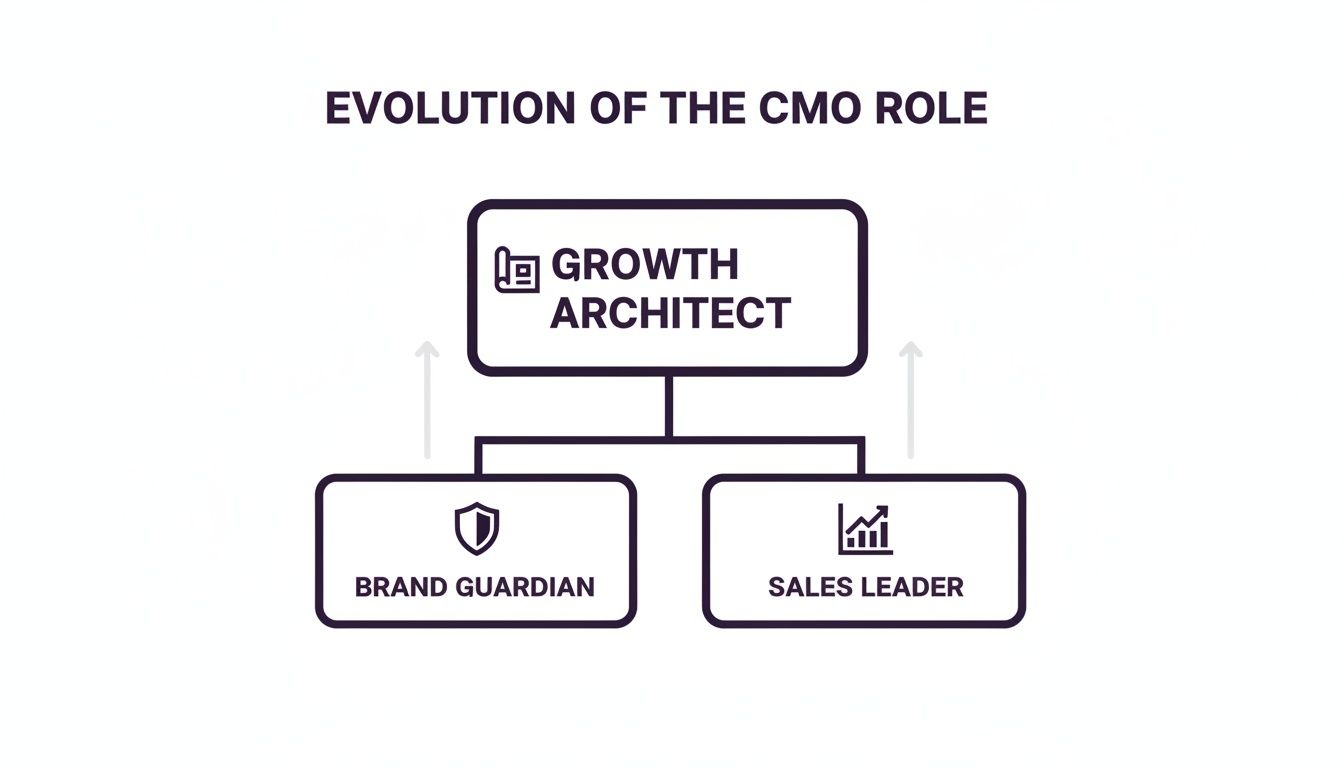
The modern CMO isn't just a brand manager or a sales support function anymore. They're a strategic leader designing the company's entire commercial engine. This trend is so pronounced that fewer than half of Fortune 500 marketing leaders even hold the classic "CMO" title, with many now called Chief Growth Officer. You can discover more insights about the evolving role of the CMO and see how their tenure is now tied directly to strategic wins.
The core challenge for many scaling businesses isn't a lack of marketing tactics; it's the absence of a strategic architect to design a cohesive growth plan. Without this leadership, marketing efforts often remain disjointed, inefficient, and disconnected from revenue.
If your business feels stuck, getting this level of expertise is critical for your next stage of growth. Fractional leadership offers a direct path to embedding this strategic capability into your organization without the six-figure commitment of a full-time executive salary. It provides the architectural vision you need, right when you need it most.
Charting The Course With Strategic Vision
A Chief Marketing Officer’s most important job is to set the direction for everything the marketing team does. They ensure every campaign, every piece of content, and every dollar spent pushes the company toward its biggest goals. Think of them as the captain of the ship, using market research as their map and compass to find the fastest route to profitable growth.
Without that clear direction, marketing quickly becomes a series of disconnected, expensive tactics. The CMO’s job is to define the destination first by answering the big questions: Who are our best customers? Where do they spend their time? What problem do we solve better than anyone else?
This goes way beyond just picking a few marketing channels. It's about building a complete go-to-market (GTM) strategy that becomes the company's playbook for growth.
Defining The Battlefield And The Plan Of Attack
A powerful GTM strategy is the CMO's master plan for winning a market. It’s a detailed roadmap that spells out exactly how the company will reach target customers and carve out a competitive advantage. This isn't just a marketing document; it’s a core business strategy that gets product, sales, and marketing all marching in the same direction.
The key pieces of this strategic plan usually include:
- Market Intelligence: A deep dive into competitors, market trends, and customer pain points to uncover opportunities and threats.
- Customer Segmentation and Personas: Pinpointing and defining the most valuable customer segments so everyone in the company has a crystal-clear picture of who they’re serving.
- Brand Positioning and Messaging: Crafting a unique and memorable brand story that connects with the target audience and defines what the company stands for.
- Channel Strategy: Choosing the right mix of channels—from content and SEO to paid ads and partnerships—to show up where your customers are.
By putting this framework in place, the CMO turns marketing from a reactive cost center into a proactive engine for the business.
Establishing The North Star Metrics
Once the strategy is set, the CMO has to define what success actually looks like. This means establishing 'north star' metrics—key performance indicators (KPIs) that give a clear signal of whether the plan is working. These aren't vanity metrics like social media likes; they are hard numbers tied directly to the health of the business.
For a SaaS company, the north star might be Monthly Recurring Revenue (MRR). For an e-commerce brand, it could be Customer Lifetime Value (LTV).
A CMO’s strategic value comes from their ability to connect marketing activities to financial outcomes. They build a system where a dollar invested in a campaign can be traced directly to revenue, turning marketing from an expense into a predictable growth engine.
This is exactly the clarity founders need to scale. A CMO with a strong strategic vision provides that, making marketing a powerful and predictable force for growth. For businesses needing this direction, connecting with a fractional executive can provide this high-level strategic guidance without the immediate cost of a full-time hire.
Turning Data Into a Competitive Advantage
If your strategic vision is the map, then data is the GPS. It's the real-time feedback telling you whether you’re on course. In today's market, relying on intuition alone is a dangerous game. One of the most critical responsibilities of a chief marketing officer is to cut through the noise of raw data and turn it into a genuine competitive edge.
This goes way beyond vanity metrics like website traffic or follower counts. A data-driven CMO zeroes in on the KPIs that actually measure the health of your growth engine. They put systems in place to track performance, prove marketing's return on investment (ROI), and build a culture where decisions are backed by numbers, not just gut feelings.
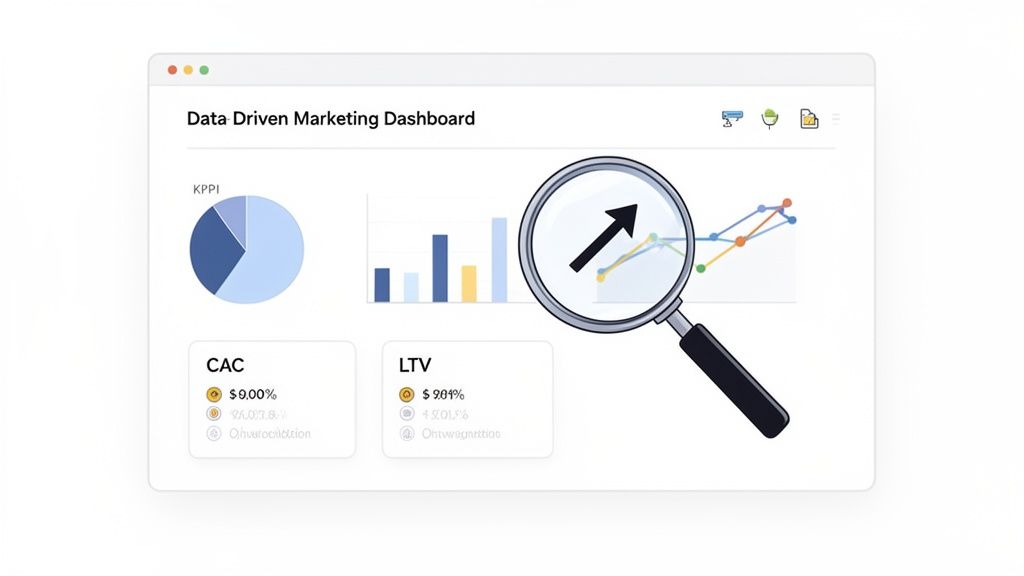
This approach solves one of the biggest headaches for founders: knowing if the money spent on marketing is actually working. By creating a transparent, data-first environment, a great CMO shifts marketing from a perceived cost center to an indispensable—and measurable—driver of business growth.
Building The Marketing Analytics Foundation
A modern CMO doesn’t just look at reports; they architect the entire analytics infrastructure. Often, their first job is to clean up the existing data mess. This means ensuring tracking is set up correctly everywhere, from the website to the CRM, creating a single source of truth for all performance data.
This foundational work is everything. Without it, every report is questionable. The goal is to build a reliable system that draws a straight line from a specific marketing action to a concrete sales outcome.
Think of it this way: a CMO at a SaaS company needs to follow a user's entire journey, from their first click on a Google Ad all the way through to becoming a paying subscriber. That's the only way to calculate the precise ROI of that ad campaign and decide where to invest next. This is how data-driven decision-making becomes a company-wide reality.
From Metrics to Actionable Insights
Once the data is clean and reliable, the CMO’s focus shifts to interpretation. They hone in on the metrics that are truly essential for sustainable growth. While the specifics can vary by business model, they almost always include:
- Customer Acquisition Cost (CAC): The total sales and marketing cost to bring in one new customer. The CMO’s job is to constantly find ways to drive this number down.
- Customer Lifetime Value (LTV): The total revenue you can expect from a single customer. The goal here is to maximize this through retention and upselling.
- LTV to CAC Ratio: This is the magic number. A healthy ratio (usually 3:1 or better) is a strong signal that you have a profitable and scalable marketing model.
- Marketing Qualified Leads (MQLs) to Sales Qualified Leads (SQLs) Conversion Rate: This metric shows the quality of leads and if marketing and sales teams are aligned.
By creating dashboards that make these KPIs visible, the CMO fosters transparency and accountability. The whole company can see what’s working and how marketing is impacting the bottom line.
Recent surveys show 78% of senior marketing executives face demands to achieve more with data, yet budgets have fallen significantly. With 63% of CMOs reporting missed growth opportunities due to unclear data ownership, the CMO's duty is to create clarity and build a collaborative, data-fluent culture. You can discover more insights from the 2025 Pulse Survey to understand these pressures.
This intense focus on data and ROI is a non-negotiable part of the modern chief marketing officer's job. They don't just report numbers; they use them to tell a story about the business and guide strategy forward. For many founders, building this data-driven function from scratch is a massive undertaking. An experienced fractional CMO can step in, quickly establish the right KPIs, and build the dashboards you need to scale with confidence.
Building A High-Performance Marketing Team
A brilliant marketing strategy is just an idea on paper without the right people to bring it to life. This brings us to a core responsibility of a chief marketing officer: they are a team builder, mentor, and coach. Their job isn't just to manage a department, but to architect a high-performance marketing function from the ground up.
This goes way beyond signing off on new hires. The CMO is responsible for spotting talent, structuring the team for maximum impact, and putting specialists in roles where they can shine. They create an environment where creativity and accountability can coexist, ensuring the team is not just busy, but powerfully effective.
Think of them like a coach assembling a championship team. They understand the unique strengths of each player and know exactly when they need a creative content writer, a data-savvy analyst, or a conversion-focused performance marketer. It's their job to build a roster of talent that covers all the necessary bases.
Designing The Modern Marketing Department
The structure of a marketing team is not one-size-fits-all. A great CMO designs the department's architecture to directly support the company's strategic goals. This might mean organizing teams around specific stages of the customer journey, by product lines, or by marketing channels.
This organizational design is a critical piece of the puzzle. A poorly structured team leads to silos and duplicated work. A well-structured team, on the other hand, operates with clarity and purpose.
Common team structures a CMO might put in place include:
- Functional Structure: Specialists are grouped by expertise (e.g., SEO, Content, Paid Ads). This is great for developing deep skills but requires strong leadership to keep everyone collaborating.
- Product-Based Structure: Marketing teams are dedicated to specific products. This works well for companies with diverse offerings, as it fosters deep product knowledge.
- Customer Segment Structure: Teams are aligned around specific customer personas, which allows for highly tailored messaging and campaigns.
The CMO’s choice of structure is a strategic decision that directly impacts the team's ability to execute the go-to-market plan.
Fostering A Culture Of Innovation And Accountability
Beyond the org chart, the CMO sets the cultural tone. They are responsible for building a team that isn't afraid to experiment, take calculated risks, and learn from failure. Innovation doesn't happen by accident; it's the result of a culture that encourages curiosity and psychological safety.
At the same time, this creativity must be balanced with strict accountability. The CMO instills a data-first mindset where performance is measured and results matter more than effort, ensuring even the most creative campaigns are tied to business outcomes.
The CMO's role is to build a system where the team has the freedom to test bold ideas and the discipline to measure their impact. They create an environment where everyone is accountable for moving the company's north star metrics.
This dual focus on innovation and accountability transforms the marketing department into a true growth engine. To dig deeper into this, our guide on how to build high-performing teams provides actionable leadership strategies you can use.
For startups and scaling companies, this team-building function is especially critical. An experienced fractional CMO can provide immense value by stepping in to audit existing skills, identify critical talent gaps, and guide the hiring process. This is a perfect example of how targeted executive leadership can accelerate growth, providing a clear roadmap for building a team that can execute your vision and drive real results.
Crafting An Unforgettable Customer Experience
A modern CMO’s job has expanded far beyond just generating leads. Today, they own the entire customer journey—from the first ad a person sees to the support ticket they submit years later. This end-to-end ownership is about shaping a cohesive brand story and ensuring every interaction is a positive one.
This holistic view is critical because customers don't see separate departments; they just see one company. A disjointed experience, where the sales promise doesn't match the product reality, erodes trust and kills loyalty fast.
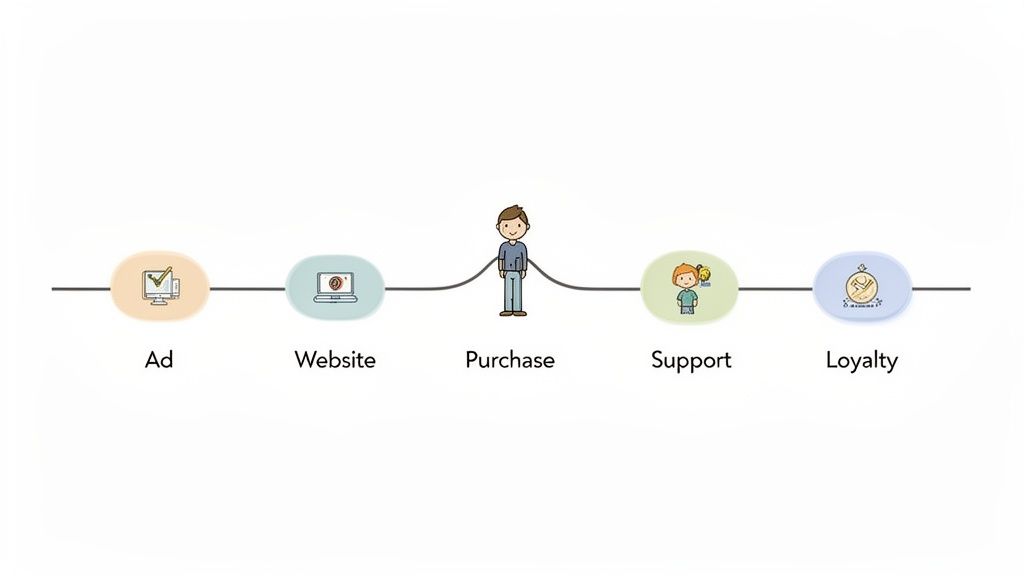
The CMO is the chief architect of this journey, making sure every stage is intentionally designed to build a real relationship with the customer.
From Segmentation To Deep Connection
To create an experience that feels personal, you have to know your customer on a much deeper level. This is where customer segmentation and persona development become foundational. It’s about understanding their pain points, what drives them, and what they're trying to achieve.
Think of it like being a great gift-giver. You wouldn't buy the same gift for your adventurous friend and your homebody cousin. A CMO applies that same logic, using data to build detailed customer personas that guide everything from messaging to product development.
This deep understanding fuels key marketing activities:
- Targeted Content: Creating blog posts, videos, and guides that solve the specific problems each customer segment is facing.
- Personalized Campaigns: Developing email flows and ad campaigns that speak to a customer's unique needs and behaviors.
- Product Feedback Loops: Channeling customer insights back into product development to ensure the product evolves with their needs.
This approach doesn't just make marketing more effective; it makes the entire customer experience more meaningful.
Building A Moat With Brand Loyalty
In a crowded market, an amazing customer experience is one of the few real competitive advantages you can build. When customers feel valued, they become loyal advocates who are far less sensitive to price. That loyalty acts as a powerful competitive moat, protecting your business from the competition.
A CMO is directly responsible for digging that moat. They do this by focusing on two metrics that have a massive impact on long-term profitability: reducing churn and increasing retention.
A positive customer experience is the bedrock of retention. The CMO's job is to move beyond transactional relationships and build a brand that customers want to be a part of, transforming one-time buyers into lifelong fans.
This focus on what happens after the sale is what separates good marketing from great. It’s about making sure the brand lives up to its promises long after the initial transaction. For any growing business, mastering the customer experience isn't just a nice-to-have; it's essential for sustainable growth.
If your customer journey feels fragmented, an experienced marketing leader can bring the strategic oversight needed to build something cohesive and memorable. A fractional CMO specializes in building the systems and stories that create deep customer loyalty.
When Your Business Needs A Fractional CMO
Recognizing you need C-suite marketing leadership is a huge step. But the $300,000+ annual salary for a full-time CMO is a non-starter for most growing companies. This is where the fractional model provides a practical, high-impact way to get elite talent right when you need it most.
How do you know it's time? The signs are usually clear. Maybe you've hit a growth plateau, and the marketing tactics that used to work just aren't cutting it anymore. Or perhaps you're staring down a major product launch and realize you don't have the strategic oversight to succeed. Often, it's the founder who's still wearing the marketing hat, trying to juggle high-level strategy with day-to-day execution—a recipe for burnout.
Signals You Need Executive Marketing Leadership
If any of these scenarios sound familiar, it’s a strong signal that bringing in a fractional CMO could be a game-changer. These are problems that tactical marketing hires can't solve on their own; they require a strategic architect.
A fractional executive doesn't just advise from the sidelines. They step into the leadership vacuum, roll up their sleeves, and start building the systems your company needs to reach its next stage of growth. This model perfectly bridges the gap between needing expert guidance and being able to afford a full-time hire.
The value of a fractional CMO isn't just cost savings; it's about injecting targeted, C-suite experience into your business to solve specific growth challenges. They provide the strategic roadmap and operational rigor needed to build a scalable marketing engine without the long-term financial commitment.
Take the real-world example of a high-growth SaaS startup. After hitting a revenue ceiling, they brought in a fractional CMO who, within 90 days, restructured their go-to-market strategy, realigned the marketing and sales teams, and implemented a data-driven framework. The result was a 40% increase in qualified leads in the next quarter.
A Quick Self-Assessment Checklist
Ask yourself these questions. If you answer "no" or "I'm not sure" to several of them, you likely have a leadership gap that a fractional executive is perfectly suited to fill.
- Strategic Clarity: Do we have a documented go-to-market strategy that aligns marketing, sales, and product?
- Data & ROI: Can we confidently track the ROI of our marketing spend and connect it directly to revenue?
- Team Performance: Is our marketing team structured for scale, with clear roles and accountability?
- Scalable Systems: Do we have predictable, repeatable systems for generating leads and acquiring customers?
- Market Positioning: Is our brand messaging clear, consistent, and effectively differentiating us from competitors?
Answering these honestly shines a light on where the real strategic gaps are. While the full responsibilities of a chief marketing officer are broad, a fractional leader zeros in on the highest-priority areas first. If you're curious to learn more about how this flexible leadership model works, you can dive deeper into what a fractional CMO is and how they drive growth.
Frequently Asked Questions About The CMO Role
Making the leap to hire executive marketing leadership is a major decision. To help, here are straightforward answers to the questions we hear most often from founders and CEOs.
What Is The Main Difference Between A CMO And A Head Of Marketing?
It comes down to strategic scope and business accountability. A Head of Marketing is typically focused on tactical execution—they're in the trenches managing campaigns, leading the team day-to-day, and hitting marketing KPIs. Their world is about the how.
A CMO is a C-suite executive responsible for aligning the entire marketing engine with core business objectives like revenue growth, profitability, and market expansion. They have a seat at the corporate strategy table and are on the hook for proving marketing’s contribution to the bottom line. Their focus is on the "why" and "what."
How Do CMO Responsibilities Differ Between SaaS And Ecommerce?
While the core principles are the same, the day-to-day focus shifts dramatically depending on the business model.
SaaS CMO: This role is all about building a predictable revenue machine. They live and breathe demand generation, obsessing over reducing Customer Acquisition Cost (CAC) and maximizing Lifetime Value (LTV). Their world is full of MQLs, SQLs, and building a pipeline the sales team can count on.
Ecommerce CMO: For an e-commerce CMO, the game is direct response. They're laser-focused on conversion rate optimization (CRO), managing massive advertising budgets, and driving repeat purchases. Their toolkit is packed with sophisticated email, SMS, and loyalty programs designed to get customers to buy again and again.
What Should A New Fractional CMO Accomplish First?
When you bring on a fractional CMO, you need strategic impact, fast. Their first 30-60 days are all about setting the stage for tangible growth.
A great fractional CMO’s initial goal is to move from audit to action. They diagnose the biggest growth blockers, align leadership on a clear set of priorities, and deliver a tangible roadmap that creates momentum from day one.
Here’s what that usually looks like in practice:
- A full-scale audit: They'll dive deep into your current marketing strategy, team capabilities, and tech stack to spot quick wins and critical gaps.
- Stakeholder alignment: They'll meet with the CEO, sales leaders, and product heads to understand the overarching business goals and ensure everyone is rowing in the same direction.
- A strategic 90-day roadmap: This is the key deliverable. It’s a no-fluff plan that outlines clear priorities, defines what success looks like, and establishes a concrete path to measurable results.
Feeling the need for this level of strategic clarity but not ready for a full-time executive hire? Shiny connects you with a marketplace of vetted fractional executives who can provide the exact expertise you need to scale. We help you find the right leader to solve your specific growth challenges. Find your perfect marketing leader today and let's build your future.