Value Based Selling: How Fractional Leaders Drive Bigger Deals
Value-based selling is a sales approach that flips the script—instead of talking about product features, you focus entirely on customer outcomes. It’s about deeply understanding what a buyer needs to achieve and then showing exactly how your solution delivers real, tangible business results, like cutting costs or boosting revenue.
Why Your Product-First Pitch Is Hurting Growth

Does this sound painfully familiar? Your startup has a fantastic product, your team knows every feature inside and out, but you're still consistently missing quota. Deals get stuck in limbo, prospects go dark, and you can't figure out what’s going wrong.
The problem probably isn't your product. It's your sales pitch.
The old-school, feature-first approach to selling is officially broken. For years, sales reps were trained to lead with an exhaustive list of what their product does. This method only worked when buyers had limited information and depended on sellers for their education.
That dynamic has completely flipped.
The Modern Buyer Has Evolved
Today’s B2B buyers are more informed and time-crunched than ever. They do their own homework, compare solutions online, and show up to the conversation armed with data. They don’t need a walking, talking feature list—they need a strategic partner who can help them solve a pressing business problem.
When your pitch revolves around features like “AI-powered analytics” or “seamless API integration,” you’re forcing the buyer to do all the mental heavy lifting. They have to connect those features to their own challenges. Let’s be honest, busy executives don't have the time or patience for that.
They tune out when you talk about what your product is. They lean in when you explain what it achieves.
This isn't just a minor trend; it's a fundamental shift in buyer behavior. Recent reports show B2B win rates are plummeting, with a staggering 69% of sales reps missing quota. The culprit? Buyers are demanding proof of bottom-line impact. In fact, a Salesforce report reveals 86% of buyers are more likely to purchase when sellers clearly understand their business goals.
Feature-Led vs Value-Led Selling
To really nail this down, let’s look at a side-by-side comparison. The old way centers the conversation on your product, while the winning way centers it on the customer’s world. It’s the difference between being a presenter and being a true problem-solver.
| Element | Feature-Led Pitch (The Old Way) | Value-Based Pitch (The Winning Way) |
|---|---|---|
| Focus | "Our software has an automated reporting dashboard." | "You'll save 10 hours a week on manual reporting, freeing up your team for strategic work." |
| Language | Technical specs and product capabilities. | Business outcomes, ROI, and financial impact. |
| Seller's Role | Product tour guide. | Strategic advisor and problem-solver. |
| Buyer's Feeling | "This is generic. I have to figure out if this helps me." | "They get my problem. This is the solution I need." |
This table shows the huge gap between simply listing features and connecting them to what a customer actually cares about—their own success.
The core of value-based selling is simple: stop selling what your product does and start selling what your customer gets. It’s about translating features into financial outcomes and technical capabilities into competitive advantages.
To truly understand this shift, consider these key differences:
- Focus of the Conversation: Feature-led selling talks about product capabilities. Value-based selling talks about the customer's business metrics, like increasing revenue, cutting costs, or mitigating risk.
- Seller's Role: The feature-seller acts like a tour guide, pointing out interesting product attributes. The value-seller acts like a doctor, diagnosing a problem and prescribing a specific, outcome-driven solution.
- The Buyer's Experience: A feature pitch often feels generic and self-serving. A value-based conversation feels consultative and tailored, demonstrating a deep understanding of the buyer's unique challenges.
Moving your team from a product-first mindset to a value-first one isn't just a minor tweak; it's a strategic overhaul. It requires a new way of thinking, questioning, and presenting. An experienced fractional sales leader can diagnose this issue quickly, retraining your team to focus on customer achievement and start winning the deals you've been losing.
Uncovering What Your Customer Truly Values

If you want to win bigger deals, you have to get past the surface-level complaints and dig into the strategic goals that actually drive your customer's business. The entire foundation of value-based selling isn't your product pitch; it's your ability to listen and diagnose. This means turning a standard sales call into a high-impact, consultative session.
Your team can't lead with features anymore. Instead, they need to become masters of discovery, asking the right questions to connect your solution to a C-suite executive's primary objectives—not just a team's daily frustrations.
Think of it like a doctor’s appointment. A good doctor doesn’t just ask, “Where does it hurt?” They dig into your lifestyle, history, and goals to find the root cause. Your sales team needs to adopt that same diagnostic mindset. It’s the only way to move from selling a painkiller to prescribing a long-term wellness plan for their business.
From Pain Points to Strategic Imperatives
Most sales teams are trained to spot pain points, like "Our reporting process is too slow" or "We're buried in manual data entry." These are decent starting points, but they're just symptoms. A value-based approach demands that you keep asking "why" until you hit the real business imperative.
For instance, a slow reporting process isn't the actual problem. The real problem is that slow reporting causes delayed decisions, missed market opportunities, or an inability to forecast revenue—all things that keep an executive up at night.
To get to that level, your team needs a totally different set of questions. They need to steer the conversation toward what leaders actually care about.
Questions That Uncover True Value:
- "If you could solve [stated pain point], what would that let your team accomplish that you can't today?"
- "What is the biggest strategic priority for your department this year, and how is this issue getting in the way?"
- "How does this challenge affect your ability to generate revenue, reduce costs, or manage risk?"
- "When you report to your leadership, which metrics are you held accountable for? How does this problem impact those numbers?"
These questions shift the dialogue from operational gripes to strategic outcomes. This is exactly where a fractional CRO can have an immediate impact, training your junior reps to master these consultative techniques and turn every discovery call into a goldmine of strategic insight.
The Power of Active Listening and Reframing
Once you've asked the right questions, the next step is to actually listen—not just for your cue to pitch, but to genuinely understand. This is a massive hurdle for a lot of companies. Globally, 85% of business leaders say customer value is critical, but they lack the skills to execute. And in B2B markets, 80% of buyers seek discerning value, leaving price-focused sellers in the dust.
For startups, this signals a huge opportunity. A fractional sales executive can implement value strategies that shorten sales cycles and boost upsells, all without the overhead of a full-time hire. You can get more details on these metrics and why they matter in the latest research on quantifying sales value.
One of the most effective techniques in value-based selling is reframing the customer's problem. This is where you take what they've told you and state it back to them in the context of a bigger, more strategic business impact.
Real-World Scenario: A fractional VP of Sales, hired by a SaaS startup, sat in on a call with a mid-sized construction firm. The prospect's stated pain was "communication breakdowns between the field and the office." Instead of letting the junior rep pitch a communication feature, the fractional leader coached them to dig deeper.
Through smart questioning, the rep discovered these "breakdowns" were directly causing project delays. Those delays had resulted in $250,000 in late-delivery penalties on a single major project.
By reframing the conversation, the salesperson was no longer selling a $10,000/year software subscription. They were offering a solution to prevent a quarter-million-dollar loss. The focus instantly shifted from a simple tool to a strategic investment in profitability and risk mitigation. That one insight elevated the deal from a departmental purchase to a C-suite priority, unlocking a much bigger opportunity.
Connecting Product Features to Business Impact
So you've done your discovery calls and you think you know what your customer values. Now for the hard part: translating what your product does into the language of their business. Executives don't write checks for cool features or slick APIs. They invest in outcomes—solutions that either make them money or save them money.
Your job is to draw a straight, undeniable line from your feature set to their bottom line. This is where your sales team stops being product presenters and starts acting like business consultants. You're not just selling software anymore; you're selling a predictable financial result.
From Technical Jargon to Financial Impact
This is where the rubber meets the road. You have to move beyond vague benefits like "improves efficiency" and get down to brass tacks. You need to connect a specific feature to a pain in your customer's workflow and then do the math on its financial impact.
For most startups, this is a huge leap. It’s a mental shift from, “Our feature is awesome,” to, “Our feature will generate $X in new revenue or $Y in cost savings for you.” Without this, your value prop is just a hopeful guess, not a firm business case your champion can confidently take to their CFO.
A value map is your bridge between a technical feature and a business outcome. It’s the formula that turns "AI-powered workflow automation" into "slashing manual data entry by 15 hours per week, saving your business $45,000 annually."
Creating Your Customer Value Map
A value map is a simple but incredibly powerful tool. It forces your team to articulate exactly how your solution creates value in terms that resonate with the people holding the purse strings.
Think of it as a repeatable framework you can use for every single prospect. Here’s how to put one together:
- Our Feature: Start with a specific capability of your product (e.g., "Automated Invoice Reconciliation").
- Customer's Problem: Link it directly to the pain point you uncovered during discovery (e.g., "The finance team spends hours manually matching invoices to POs").
- Business Impact (Qualitative): Describe the operational improvement in their language (e.g., "Frees up the finance team from tedious work and kills the risk of human error").
- Financial Value (Quantitative): This is the money shot. Do the math with your prospect to calculate the real-dollar value.
Here's a simple framework to guide you.
Customer Value Mapping Framework
This table breaks down how to connect the dots from your product to their P&L. Here’s an example for a SaaS company selling into manufacturing.
| Our Feature | Customer's Problem | Business Impact (Qualitative) | Financial Value (Quantitative) |
|---|---|---|---|
| Real-time inventory tracking | Frequent production stoppages due to stockouts of a key component. | Eliminates production downtime and improves on-time delivery rates. | Reduces downtime costs by $20,000 per month and avoids late-delivery penalties of $50,000 per quarter. |
See how that works? This level of detail completely changes the conversation. It's no longer about your price; it's about the cost of their inaction. You’ve reframed your product as an investment, not an expense.
This is the very essence of value based selling. It’s how you escape the commoditization trap and justify premium pricing. As one Oliver Wyman analysis rightly points out, buyers are in a "flight to value," demanding bulletproof ROI. For startups, mastering these calculations is non-negotiable. To get a better handle on the numbers behind the curtain, check out our guide on what unit economics are and why they matter.
Building these ROI models isn't just about crunching numbers; it requires a blend of financial know-how and sales psychology. This is where an experienced fractional executive from a network like Shiny can be a game-changer. A fractional CRO or VP of Sales has done this a hundred times. They can parachute in, implement these value-mapping frameworks, build powerful ROI calculators, and train your team to close bigger deals, faster.
Building Your Value-Based Sales Playbook
Discovering and articulating value is one thing, but it won't scale until you build a system around it. To really drive predictable growth, you need to operationalize your value-based selling approach into a playbook that your entire go-to-market team can run with. This isn't just a sales project; it's a company-wide effort.
Think of this playbook as your single source of truth for value. It’s what ensures your marketing copy, sales conversations, and even your pricing all sing from the same sheet. Without it, reps are left to improvise, which leads to inconsistent messaging and, ultimately, lost deals.
Aligning Pricing and Packaging with Value
One of the most immediate ways to put value into practice is through your pricing and packaging. Instead of just tacking on features or looking at what competitors charge, you should structure your tiers around the different levels of value you deliver. This creates a natural upgrade path for customers as their needs grow.
Here’s a practical way to think about it:
- Tier 1 (Starter): For customers with a specific, immediate pain point. The value is direct and easy to measure—think clear time or cost savings.
- Tier 2 (Professional): For teams aiming for bigger operational wins. The value here is about team productivity, better collaboration, and more efficient processes.
- Tier 3 (Enterprise): Built for organizations looking for a strategic shift. Here, you're tying value to major business goals like revenue growth, market expansion, or significant risk reduction.
When you structure your tiers this way, the upsell conversation becomes a no-brainer. It stops being about "buying more features" and starts being about "unlocking the next level of business impact."
Weaving Value Into Your GTM Messaging
Your playbook needs to translate your value map into every single asset that a customer sees. Your website shouldn't just be a feature list; its headlines need to speak directly to the outcomes your ideal customers are trying to achieve. Your marketing emails have to go beyond generic blasts and highlight specific, relevant business results.
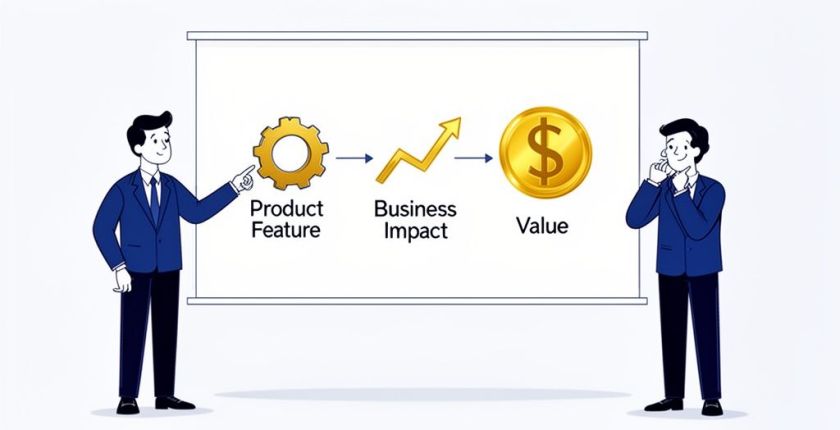
The real goal is to connect a feature to its ultimate business value. It’s a simple but powerful process.

A feature is just the starting point. Its real power comes from the measurable financial impact it can have on the customer’s business, and that’s what your messaging needs to scream from the rooftops.
Equipping Your Team with Outcome-Focused Enablement
The final piece of the puzzle is creating sales enablement materials that help your team have these value-driven conversations consistently. And no, I'm not talking about your standard, feature-heavy datasheets. These are tools designed to build a solid business case.
A value-based sales playbook turns every rep from a product presenter into a business consultant. It gives them the framework to speak the language of the C-suite, justifying your solution as a strategic investment, not just another cost.
Here are the essential outcome-focused materials your playbook needs:
- Value-Based Battle Cards: Don't just list competitor features. Show how your solution delivers better value and ROI for specific use cases.
- Interactive ROI Calculators: Build simple tools that let reps calculate the potential financial impact with the prospect, right on a call. It makes the value tangible.
- Outcome-Oriented Case Studies: Go beyond the typical problem-solution format. Structure your stories around hard metrics, showing a clear "before" and "after." For instance, show how a client slashed costs by 30% or boosted revenue by 15%.
- Discovery Question Guides: Give your reps a set of structured questions designed to uncover strategic business priorities, not just surface-level pain.
Putting together a playbook this comprehensive takes real expertise and focus. For many startups, this is exactly where a fractional VP of Sales from a network like Shiny can be a game-changer. They bring proven frameworks and can build out this entire growth engine in weeks, not months—giving you a scalable system for value-based selling without the long-term cost of a full-time executive.
To dive deeper, check out our guide on sales enablement best practices that actually drive results.
Measuring Success and Avoiding Common Pitfalls
Switching to a value-based selling model is a major upgrade, but a new strategy is only as good as the results it drives. To make sure your efforts are actually working, you need to track the right metrics—and that means looking way beyond simple win rates.
Measuring success the right way helps you spot problems early, double down on what’s effective, and prove the ROI of this new approach to your leadership and board. It’s also a transition filled with potential tripwires that can stall your progress. Knowing these pitfalls ahead of time is the best way to build a resilient sales engine from day one.
Key Metrics to Track Your Progress
Forget vanity metrics. For a value-based selling initiative to stick, you have to monitor KPIs that directly reflect the quality of your deals and the health of your sales process. These numbers tell the real story of whether your team is connecting with customers on value.
- Average Deal Size: Are you closing bigger contracts? A steady climb in average deal size is the clearest sign that your reps are successfully building a larger business case with prospects.
- Sales Cycle Velocity: This one might seem counterintuitive, but deeper discovery can actually shorten your sales cycle. When you qualify deals better and build a strong business case upfront, you sidestep those late-stage objections that cause deals to stall, speeding up the path to close.
- Customer Lifetime Value (LTV): Selling on value builds stronger, more loyal customer relationships. Tracking LTV will show if these customers stick around longer, expand their accounts, and become true partners.
- Discount Rate Erosion: Are your reps giving away less of your margin? When value is the anchor of the conversation, price becomes less of an issue. Heavy discounting should start to disappear.
The goal isn't just to win more deals—it's to win better deals. These metrics give you a clear picture of whether your team is selling on strategic impact instead of just reacting to price pressure.
Common Pitfalls and How to Fix Them
Even with the best plan, startups often stumble when trying to implement a value-driven approach. Here are the most common mistakes and how to get back on track.
Pitfall 1: 'Value Guessing' Instead of Discovery
This is the cardinal sin. Reps get excited about the idea of selling value, but they skip the hard work of actual discovery. They assume they know the customer's problems and rush to pitch a pre-canned "value" narrative that completely misses the mark.
- The Fix: Mandate a structured discovery process. This is where a fractional leader shines by implementing battle-tested discovery templates and enforcing their use. The rule becomes simple: no business case can be presented until the rep can articulate the customer's top three priorities in their own words.
Pitfall 2: Presenting the Business Case Too Late
Too many reps save the ROI calculation for the final proposal, treating it as a last-ditch closing tool. This is a massive mistake. By that point, your solution has already been mentally bucketed as a line-item expense and is being compared on price against competitors.
- The Fix: Introduce the concept of value early and make it a collaborative exercise. A fractional VP of Sales can build and deploy a simple ROI calculator for your team to use during discovery calls. This reframes the entire conversation from cost to investment from the very first call. You can learn more about how this impacts financial planning by exploring our guide on how to create a sales forecast.
Pitfall 3: Lacking Executive-Level Confidence
Your reps might be great at talking features with a manager, but they completely freeze up when the CFO joins the call. They panic and revert to a feature-dump because they lack the confidence and financial fluency to discuss business impact with a senior leader.
- The Fix: This is where a fractional executive is a game-changer. An experienced fractional VP of Sales can mentor your team, run role-playing sessions for C-suite conversations, and even join key calls to model the right behavior. They build the team's confidence by arming them with the language and frameworks to hold their own in any boardroom. A seasoned leader from Shiny can instill this confidence in a matter of weeks, transforming your team's ability to navigate complex deals.
Wrapping Up: Your Path to Predictable Revenue
Making the switch to value-based selling isn't just about learning a new sales pitch. It’s a complete overhaul of how your startup approaches growth—moving from unpredictable revenue swings to a steady, reliable engine.
We've walked through the playbook: getting to the core of what your customers actually care about, putting a real dollar amount on your solution's impact, and making this value-first mindset a part of your company’s DNA. When you stop selling features and start selling financial outcomes, the conversations change. You sidestep the endless price objections and start building a much more resilient business.
Shifting to a value-based model is the single most effective way for a startup to stop competing on price and start winning on impact. The result isn't just bigger deals—it's a stronger, more defensible business.
For startups and scale-ups, making this change can feel daunting. It takes focused leadership and a ton of experience to get right. This is exactly where a fractional executive can be a game-changer. A seasoned leader can jump in, install the right frameworks, train your team, and instill the discipline needed to start closing bigger contracts in weeks, not years.
Ready to build a world-class sales engine without the cost and risk of a full-time hire? See how our network of elite fractional leaders can help you master value-based selling and drive predictable revenue. Schedule a consultation with Shiny today to find the perfect executive to lead the charge.
Frequently Asked Questions About Value Based Selling
Whenever I talk to founders about switching to value-based selling, the same questions always pop up. They’re worried about the timeline, whether their team can handle it, and if it even makes sense for their product. Let's tackle these head-on.
How Long Does It Take To Implement Value Based Selling?
The timeline really depends, but you can see results faster than you might think. We’ve seen small, focused pilot teams lift their average deal size in a single sales quarter.
A full, company-wide rollout is a bigger project. You're talking about new training, building ROI calculators, and overhauling your messaging. That typically takes somewhere between three to six months to really stick.
This is where a fractional sales leader can be a game-changer. By bringing in a proven playbook, they can shrink that timeline dramatically. We've seen teams get initial results in as little as four to six weeks because the fractional exec drives adoption from day one.
Will This Work If We Sell A Highly Technical Product?
Absolutely. In fact, it’s essential for technical products. Your engineers and developers will always want to talk features, specs, and API latency. But the business leaders signing the check? They care about one thing: ROI.
The strategy is simple but powerful:
- First, your sales reps prove the technical fit and earn the trust of the engineers on the other side.
- Then, they arm that internal champion with a rock-solid business case to take up the chain to their manager or the CFO.
The conversation completely changes. It goes from, "Our API has a 5ms latency," to, "This speed will cut your data processing costs by $200,000 a year because you won't need those two extra data engineers."
Can Our Junior Sales Team Learn This Method?
Yes, but they need guidance. Junior reps often fall back on "feature dumping" because it feels safe—it's a script they can memorize. Becoming a business consultant who can talk value is a big leap, and it can be intimidating.
To get a junior team firing on all cylinders, you have to equip them. That means clear discovery question guides, lots of role-playing, and simple ROI calculators they can use on calls.
A fractional VP of Sales is a massive help here. They don't just teach; they mentor. By joining sales calls, they model the right behaviors and give real-time feedback. That in-the-trenches coaching is the fastest way to build your team's confidence and skill set.
Is Value Based Selling Only For Large Enterprise Deals?
Not at all. The core idea works for any B2B sale that isn't a simple, transactional purchase. Sure, the math for a $500,000 enterprise contract is more involved than for a $5,000 annual subscription, but the mission is the same: prove the value is way bigger than the price tag.
For smaller deals, the value might be about saving time or boosting productivity. For a small business owner, giving them back ten hours a week is just as compelling as saving a massive corporation millions of dollars.
The path to a predictable revenue engine starts by changing how you sell. Shifting your team to a value-first mindset isn't easy—it demands real expertise and a focused plan. For startups looking to make this move quickly, the best bet is to partner with a leader who’s done it before.
At Shiny, we connect you with elite fractional executives who have built and scaled value-based sales programs time and time again. They bring the frameworks, mentorship, and hands-on guidance needed to transform your sales team and drive sustainable growth.
Explore our network of vetted sales leaders and schedule a consultation today.