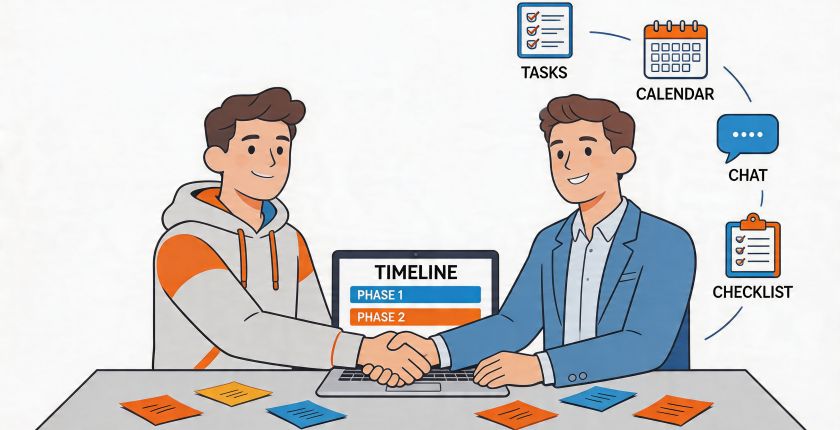
How to Hire a Project Manager for Your Startup
A launch date is slipping. Sales promised a client feature your product team hasn’t fully scoped. The CEO is approving tiny decisions that should never reach the CEO. Slack is noisy, meetings keep multiplying, and nobody can say with confidence what’s on track, what’s blocked, and what changed last week.
That’s the moment many founders start asking whether they should hire a project manager.
Usually, they ask too late. They try to absorb the work themselves, or spread it across an ops lead, a product manager, an engineering manager, and whoever seems “organized.” That can work for a while. Then one important initiative gets bigger than the team’s informal coordination habits, and the cracks turn into delays, rework, and frustrated clients.
Your Project is Chaos. It’s Time for a Project Manager.
Founders often treat project management as overhead. That’s the wrong frame.
If your team is missing handoffs, revisiting decisions, and letting scope drift week after week, you’re already paying for project management. You’re just paying for bad project management through wasted time, missed delivery, and leadership distraction.
According to the Project Management Institute, poor project performance wastes between 9.9% and 11.4% of every dollar invested. For a company spending $1 million on initiatives, that's over $100,000 lost due to preventable issues like scope creep and missed deadlines, as summarized in this breakdown on hiring top-performing project managers.
That number matters because startup waste rarely looks dramatic at first. It shows up as:
- Founders becoming routers: every decision, update, and escalation flows through one person.
- Teams working hard but not landing outcomes: people stay busy, yet milestones slide.
- Clients hearing different stories: sales, delivery, and leadership each describe a different timeline.
- Important work getting crowded out: urgent fixes consume the capacity needed for strategic initiatives.
A good project manager doesn’t “run the task board.” They create order around commitments. They define who owns what, when decisions happen, how risks get surfaced, and what gets deprioritized when reality changes.
Practical rule: If the business depends on one person remembering all the moving parts, you don’t have a system. You have a bottleneck.
The decision to hire a project manager isn’t about adding process for process’s sake. It’s about protecting execution when the company can no longer run on founder memory and goodwill alone.
Recognizing the Tipping Point for Your First PM Hire
The need for a PM rarely arrives as one clean signal. It arrives as a pattern.
One missed deadline isn’t the issue. One confused client call isn’t the issue. The issue is repeated coordination failure across teams that are otherwise competent. At that point, you don’t need more hustle. You need someone accountable for the flow of work.

An early-stage team can operate like a jazz trio. People improvise, adjust fast, and keep context in their heads. A growing company starts behaving more like an orchestra. Without a conductor, strong players still make noise, but the timing falls apart.
The clearest inflection points
The strongest trigger is complexity, not headcount. If your work now crosses product, engineering, customer success, sales, compliance, vendors, or executive stakeholders, coordination has become its own job.
Watch for these signals:
- The CEO is the approval layer for routine work: roadmaps, launch timing, client updates, and resourcing questions all keep coming back to the founder.
- Projects keep changing shape midstream: no one can tell whether the team is responding to valid new information or letting scope creep win.
- Team leads own delivery in addition to their actual roles: engineering managers start acting like schedulers, product leads become traffic coordinators, and nobody has enough time for the work only they can do.
- Big clients are changing the operating rhythm: one enterprise customer, implementation, or regulated workflow introduces complexity your team hasn’t managed before.
- Cross-functional trust is slipping: people begin saying “I thought they had that” more often than they should.
Those aren’t personality issues. They’re operating model issues.
What changes when project management becomes formal
The significance of formal practice emerges. Organizations that use formal project management practices achieve their project goals 73% of the time, compared to 58% for those without. They’re also more likely to finish on time (59%) and within budget (63%), according to project management statistics compiled here.
The point isn’t that you need heavyweight bureaucracy. The point is that consistent planning, ownership, reporting, and escalation produce better outcomes than loose coordination.
When a founder says, “Everyone knows what they should be doing,” I usually ask who owns timeline trade-offs, stakeholder updates, and change control. If the answer is “sort of everyone,” then it’s no one.
A practical checklist for founders
You likely need to hire a project manager if three or more of these are true:
- Deadlines move without formal re-planning
- Meetings exist mainly to recover missing context
- Leads complain about too many surprises
- Customer-facing teams don’t trust delivery dates
- The same blockers recur across projects
- No one maintains a single source of truth
- High-value work depends on manual follow-up
- The founder is still acting as chief coordinator
A PM becomes especially valuable when the company is entering a new phase. Maybe you’re implementing a major system, launching a new product line, onboarding larger clients, or coordinating multiple departments for the first time. Those are moments when informal operating habits break.
Don’t wait for a fire
Reactive PM hiring is expensive in a different way. It usually happens after the team is already overloaded, which means the new hire inherits confusion, urgency, and political tension. That makes the role harder than it needs to be.
A calmer move is to hire when complexity rises, but before execution collapses. That gives the PM room to standardize workflows, set expectations, and create visibility without trying to rescue three failing initiatives at once.
The Modern Hiring Spectrum Full-Time vs Fractional vs Freelance
Once you know you need help, the next mistake is forcing the decision into the wrong binary. Most founders think the choice is full-time hire or contractor. It isn’t.
There are really three models. Full-time, fractional, and freelance. Each solves a different problem.

The right model depends on how much leadership you need, how embedded the person must be, and how much fixed cost the business can responsibly carry.
Full-time PMs fit steady, high-volume complexity
A full-time project manager makes sense when project load is constant, cross-functional coordination is ongoing, and the business needs a permanent internal owner.
That model has real advantages. A full-time PM builds institutional knowledge, develops internal trust, and can shape systems over time. If you run many parallel initiatives every quarter, a permanent PM can be a strong investment.
The trade-off is commitment. The median annual wage for a full-time project management specialist in the U.S. was $100,750 in May 2024, according to the U.S. Bureau of Labor Statistics occupational outlook for project management specialists. That’s before benefits, recruiting effort, onboarding time, and the cost of getting the hire wrong.
For a startup, that fixed cost can be entirely justified. It can also be premature.
Freelancers fit defined execution work
A freelance PM can work well when the scope is contained. Think software migration, event delivery, implementation support, or a single launch with a clear start and finish.
Freelancers are useful when you need someone who can jump in, execute against a narrow brief, and leave when the project ends. They usually provide speed and flexibility.
Where founders get burned is expecting a freelancer to act like an internal leader. Many won’t own cross-functional operating discipline, coach your team, redesign broken workflows, or challenge executive assumptions. That’s not a criticism. It’s just not always the job they signed up for.
Fractional PMs fit companies in transition
A fractional PM sits in the middle. You get embedded leadership without taking on the full-time load of a permanent headcount.
That’s often the right answer for startups and SMBs that have real execution complexity, but not enough consistent demand to justify a full-time PM every week of the year. It’s also useful when the business needs senior judgment quickly. A strong fractional PM doesn’t just manage tasks. They build cadence, clean up communication, install reporting, and create calmer decision-making across teams.
If you’re weighing this model, this view of when a project manager consultancy makes sense is worth reviewing because it maps well to the common startup reality. You need leadership, but not necessarily a permanent hire.
Hiring model comparison
| Attribute | Full-Time PM | Fractional PM (via Marketplace) | Freelance PM |
|---|---|---|---|
| Best for | Ongoing, high-volume delivery across many teams | Growth-stage companies with rising complexity and uneven PM demand | Defined projects with narrow scope |
| Cost structure | Fixed salary plus overhead | Flexible ongoing commitment | Hourly or project-based spend |
| Team integration | Deep internal integration | High integration with bounded time | Usually lighter integration |
| Strategic value | Strong if you hire well | Strong, especially for system-building and leadership | Varies, often execution-first |
| Speed to start | Typically slower | Usually faster than a full-time search | Often fastest for a discrete need |
| Scalability | Good when demand is durable | Good when demand changes over time | Good for one-off bursts |
| Management burden | Higher. Recruiting, onboarding, retention | Moderate. Still needs clear sponsorship | Moderate. Requires precise scoping |
| Knowledge retention | High | Medium to high, depending on engagement structure | Lower unless documented well |
| Best founder use case | You know the role is permanent | You need leverage now but want flexibility | You need output, not operating ownership |
What actually works in practice
A lot of founders overhire or underhire because they focus only on cost.
The better lens is this:
- Choose full-time when PM demand is durable, central to the business, and broad enough to justify deep internal ownership.
- Choose freelance when the project is finite, the brief is clear, and you don’t need the person shaping how the company operates.
- Choose fractional when the company needs senior coordination and process leadership, but the need is still maturing.
The most expensive hiring mistake isn’t always the highest salary. It’s paying for permanent capacity before the business has permanent demand.
The middle ground is often the smartest one. Especially for a first PM hire.
How to Write a Job Spec That Attracts Real Leaders
Most project manager job descriptions are weak because they read like admin checklists. “Manage timelines.” “Coordinate stakeholders.” “Track deliverables.” None of that tells a strong candidate what they’re walking into or what success looks like.
Good PMs want to solve meaningful operating problems. They want clarity on the mandate, authority, and expected outcomes. If your spec sounds generic, you’ll attract generic applicants.

Start with the mess, not the tasks
The best job specs describe the business context first.
Don’t open with a list of software tools and reporting duties. Open with the execution problem the person is being hired to fix. That gives serious candidates something to evaluate. Can they solve this? Have they solved it before? Do they want this kind of role?
A stronger opening sounds like this:
We’re looking for a project manager to bring structure to cross-functional product launches, create a reliable planning cadence, and reduce executive involvement in day-to-day delivery decisions.
That is far better than “seeking an experienced PM to oversee multiple projects.”
Define outcomes for the first stretch of the role
The biggest upgrade you can make is to write the spec around outcomes instead of activities.
Include a short section that spells out what this person should accomplish in their first months. Keep it concrete and tied to business conditions.
For example:
- Create one operating rhythm: weekly project reviews, clear escalation paths, and visible ownership across active initiatives.
- Stabilize launch planning: define scope, dependencies, risks, and decision deadlines before work starts.
- Improve stakeholder communication: executives, team leads, and client-facing teams should receive consistent status updates.
- Reduce founder dependency: routine project decisions should no longer require CEO intervention.
- Document the system: meeting cadences, templates, roles, and reporting should not live in one person’s head.
If you need help shaping an outcome-based role brief, this guide to a job description for executive hiring is useful because it forces the spec toward ownership and impact rather than generic responsibility lists.
Before and after
Here’s the difference in plain terms.
Before
- Manage project timelines
- Coordinate with stakeholders
- Track tasks and deliverables
- Use Jira, Asana, and Slack
- Report progress to leadership
After
- Build a repeatable planning and reporting system for cross-functional initiatives
- Bring discipline to scoping so projects don’t expand without decision-maker approval
- Own executive and team-level communication for active launches
- Identify delivery risks early and force trade-off decisions before deadlines break
- Coach team leads on how to work inside a clearer operating model
The first version describes motion. The second describes value.
Tailor the spec to the hiring model
A full-time PM spec should emphasize institutional ownership, cross-team partnerships, and long-term process development.
A freelance PM spec should be narrower. Focus on project scope, timeline, deliverables, and exact interfaces.
A fractional PM spec should sound different from both. It should emphasize:
- Strategic operating ownership
- System building
- Mentorship for team leads
- Executive communication
- Selective hands-on involvement where needed
That role isn’t “part-time admin.” It’s targeted leadership.
What to leave out
Founders often clutter PM specs with every tool the company has ever touched. That creates noise.
Leave out laundry lists unless a tool is central to the role. Jira, Asana, Monday.com, ClickUp, Notion, and Slack can all be learned. What matters more is whether the candidate can create clarity in a messy environment.
Also avoid inflated language. If every line says “fast-paced,” “rockstar,” or “must thrive under pressure,” good operators will assume the company is disorganized and proud of it.
A sharp job spec sounds calm, honest, and specific. It tells candidates what problem exists, what authority they’ll have, and what success will look like if they do the work well.
Sourcing Screening and Interviewing Your Top Candidate
Once the role is defined, the critical work starts. During this phase, many founders lose time. They source too broadly, screen too loosely, and interview for polish instead of pattern recognition.
A project manager is one of the easiest hires to get superficially right and operationally wrong. Plenty of candidates can talk about organization. Far fewer can walk into a growing company, understand its weak points, and create structure people will follow.

Source where signal is higher
Job boards produce volume. Volume is not the same as quality.
If you post publicly, expect many applicants who can mirror PM language without showing evidence of real operating judgment. Recruiters can help, but only if they understand the difference between someone who has managed a project plan and someone who has led cross-functional execution in an environment like yours.
Curated talent networks and specialist marketplaces often improve speed and fit because they narrow the pool before you ever step in. The best ones screen for practical delivery experience, communication quality, and operating maturity, not just resume keywords.
You should also ask for referrals from founders, operators, and department heads who’ve worked with strong PMs before. PM quality is highly visible to people who’ve lived through both good and bad execution environments.
For a useful framework on cleaner sourcing and assessment design, review these recruiting best practices for startups and growth-stage teams.
Screen for similarity, not prestige
The first screen should answer one question. Has this person solved a similar problem at a similar level of complexity?
That matters more than logo recognition.
A candidate who built calm operating rhythm inside a messy startup can be more valuable than someone from a polished enterprise PMO who mostly inherited mature systems. You want relevance.
Screen for:
- Environment match: startup, SMB, agency, implementation-heavy business, regulated team, or product-led company.
- Complexity match: number and type of stakeholders, level of ambiguity, dependence on executive decision-making.
- Ownership match: did they coordinate tasks, or did they define process, escalate trade-offs, and change team behavior?
- Communication maturity: can they explain a delivery problem straightforwardly, without jargon?
- Tool fluency with judgment: Jira, Asana, ClickUp, Smartsheet, Notion, and Slack matter less than knowing when each becomes clutter instead of control.
Look for evidence in the resume and intake call
Strong PM resumes show outcomes and operating context. Weak ones show activity lists.
Good signs include language about creating planning cadence, standardizing intake, improving handoffs, running launch process, aligning stakeholders, and building reporting systems. Weak signs include a dense block of software names with no clear indication of what changed because they were there.
In the intake call, ask the candidate to describe the most chaotic environment they’ve improved. Listen for structure in the answer. Good PMs naturally separate symptoms, root causes, stakeholders, constraints, and decisions.
A great PM rarely starts by telling you what tool they used. They start by telling you what was broken, who was affected, and how they created clarity.
Interview for stakeholder management first
Technical comfort matters. But project success often rises or falls on how the PM handles people, especially when priorities conflict.
While technical skills are important, success in project management often hinges on stakeholder management. Most hiring guides don’t teach how to assess for this. Focus interview questions on past experiences managing difficult clients, aligning executive expectations, and communicating bad news, as noted in this hiring guide on project managers.
That advice is dead right. In startups, a PM often has to influence people they don’t manage, push back on executives, and communicate delivery risks without causing panic.
High-signal interview questions
Use behavioral and situational questions. Don’t ask, “Are you organized?” Everyone says yes.
Ask things like:
Tell me about a project that looked healthy on paper but was in trouble.
What you want: evidence they can detect hidden risk early.Describe a time an executive wanted a timeline that the team couldn’t support. How did you handle it?
What you want: calm pushback, trade-off framing, and expectation management.Walk me through how you’ve handled scope changes after a project was already underway.
What you want: decision discipline, not blind accommodation.Tell me about a difficult stakeholder. What made them difficult, and what did you change in your approach?
What you want: empathy plus firmness.How do you communicate bad news to a client or leadership team?
What you want: directness, options, accountability.What’s the difference between a late project and a project that was doomed from the start?
What you want: diagnostic thinking.Describe a process you introduced that people resisted at first. How did you get adoption?
What you want: influence without formal authority.If you joined us next week, what would you need to learn in the first two weeks to manage delivery well here?
What you want: thoughtful discovery instincts.
Add one practical exercise
A short exercise tells you more than another hour of conversation.
Give candidates a realistic scenario. For example: a launch is six weeks out, engineering is behind, sales already promised the date, and the CEO wants daily updates. Ask the candidate to outline:
- immediate risks
- first stakeholder conversations
- what they’d put into a status document
- what decisions need escalation
- what they’d do in the first week
You’re not looking for a perfect answer. You’re looking for sequencing, judgment, and communication.
Red flags founders should take seriously
Some warning signs show up fast:
- Tool obsession without operating logic
- Vague ownership language like “supported” and “assisted”
- No examples of pushback or decision escalation
- A style that sounds polished but avoids specifics
- Blaming stakeholders without reflecting on their own role
The right PM candidate makes complexity feel more understandable during the interview itself. You leave the conversation thinking, “This person would reduce noise.”
That’s a strong sign.
Onboarding KPIs and Measuring PM Success
A PM hire fails surprisingly often because the company treats onboarding as access provisioning. Laptop, Slack, Jira, done. That’s not onboarding. That’s setup.
A project manager needs a defined mandate, a sponsor with authority, and a clear way to measure whether execution is getting healthier.
The first month should be diagnostic
In the opening stretch, the PM should learn the business, map active work, and identify where delivery breaks down.
Good onboarding priorities include:
- Understand the current project portfolio: what’s active, what’s late, what’s politically sensitive, and what’s mission-critical.
- Map the stakeholders: who owns decisions, who influences timelines, who gets surprised too often.
- Audit the workflow: where requests enter, how priorities change, where handoffs fail, and which tools matter.
- Observe communication patterns: which meetings create clarity, which ones only create motion.
- Establish a baseline: current status reporting, delivery confidence, and recurring bottlenecks.
The next phase should create operating rhythm
By the second phase, the PM should start installing a repeatable cadence.
That usually means a few simple mechanisms done consistently:
- Weekly project reviews
- A visible risk and dependency log
- Clear owners for each active initiative
- A standard format for status updates
- Defined escalation paths for timeline, scope, and resource trade-offs
Don’t ask a new PM to “own delivery” if you haven’t told the organization what authority comes with that ownership.
What to measure
Most founders measure PM success too narrowly. On-time and on-budget matter, but they’re lagging indicators. A better dashboard includes both delivery outcomes and operating health.
Track measures such as:
| KPI | What it tells you |
|---|---|
| Schedule predictability | Whether planned dates are becoming more reliable |
| Budget adherence | Whether projects stay within agreed constraints |
| Reduction in rework | Whether teams are aligning earlier and changing less late |
| Stakeholder satisfaction | Whether leaders and teams trust the process more |
| Decision turnaround time | Whether blockers are getting resolved faster |
| Team velocity quality | Whether throughput is improving without chaos |
| Risk visibility | Whether issues surface earlier instead of at deadline |
For a fractional PM, add one more lens. Ask whether they’re building capability inside the company, not just personally holding the system together. If the work improves only when they’re in the room, the model is still fragile.
What good looks like
Within the first stretch of the engagement, you should expect clearer ownership, fewer surprise escalations, more disciplined status reporting, and less executive involvement in routine coordination.
You may not see every project suddenly become easy. That’s not realistic. What you should see is a company that understands its commitments better and recovers from change with less drama.
That’s real progress.
Build Your Engine for Scalable Growth
When founders hire a project manager at the right moment, they usually feel two changes quickly. The team gets calmer, and leadership gets time back.
That’s the essential value. A PM isn’t a cost center added to make the org chart look mature. A good PM protects execution, sharpens accountability, and turns scattered effort into a system the company can scale.
For many startups, the smartest first move isn’t jumping straight to a permanent full-time hire or handing everything to a short-term freelancer. It’s finding a middle path that gives the business senior operating discipline without locking in more fixed structure than it needs.
If you’re at the point where launches feel harder than they should, cross-functional work keeps stalling, or too much execution still flows through the founder, it’s probably time to hire a project manager. The only real question is which model fits your stage.
If you want help finding that fit, Shiny connects startups and growing companies with vetted fractional executives who can step in quickly and bring real operating leadership to critical functions. If your team needs experienced project oversight without the weight of a full-time commitment, it’s a practical place to start the conversation.