When a CEO Confirms It: Hiding a Fractional Executive Is the Mistake
In last week’s CEO Masterclass, I laid out the common reasons why fractional executive engagements go sideways. Then one of the CEOs in the room did something that made the lesson land harder than any slide could: he squarely confirmed it. Hiding a fractional executive from the organization is a mistake — and it leads to failure of the assignment.
A software engineer who became CEO, grew his company from one person to 150 employees, and eventually sold it last year — raised his hand to share his own experience:
After a period of mergers, his organization brought in a fractional Head of HR to streamline operations, harmonize policies across the combined entities, and work through the people issues that inevitably surface when companies come together. She was the right skillset at the right moment — exactly what precision leadership looks like on paper.
But the assignment was quietly set up to fail. The organization was never told she was there. She wasn’t introduced as the new HR leader. Employees didn’t know who she was, why she was reaching out, or what authority she carried. In the vacuum, rumors filled in. Communication gaps widened. And the company never captured the value of the expertise they were paying for.
The CEO’s takeaway, offered without prompting, hiding the fractional executive from the organization was the mistake. It doesn’t matter how senior she was, how skilled, or how reduced her hours. If the team doesn’t know she’s a legitimate member of leadership, she can’t lead.
That’s one of five common CEO mistakes I cover in the Masterclass. The other four are just as avoidable — and just as destructive.
· Treating them like consultants. A fractional executive is not there to diagnose and hand you a deck. They own outcomes. When a CEO asks only for advice and withholds the authority to implement, the executive is neutered before they start.
· Micromanaging hours. The value of fractional leadership is expertise and judgment, not a timesheet. CEOs who fixate on whether the executive worked 18 or 22 hours this week miss the point entirely. You hired impact, not attendance.
· Keeping the scope vague. Without clear goals, a fractional executive spends the engagement diagnosing problems instead of solving them. “Help us with sales” is not a scope. Specific outcomes, measurable goals, and a realistic timeframe are.
· Skipping communication. Every fractional engagement I’ve seen fall apart has this in common. Enthusiasm at kickoff, then the weekly check-ins slip, then they stop. The CEO assumes the executive knows the priorities. The executive assumes the CEO sees the progress. No one is a mind reader, and the engagement drifts.
Avoid these five and the odds of a successful fractional engagement rise dramatically. Our current placements meet 94% of original client goals — not (only) because fractional executives are magical, but because the engagements are structured correctly.
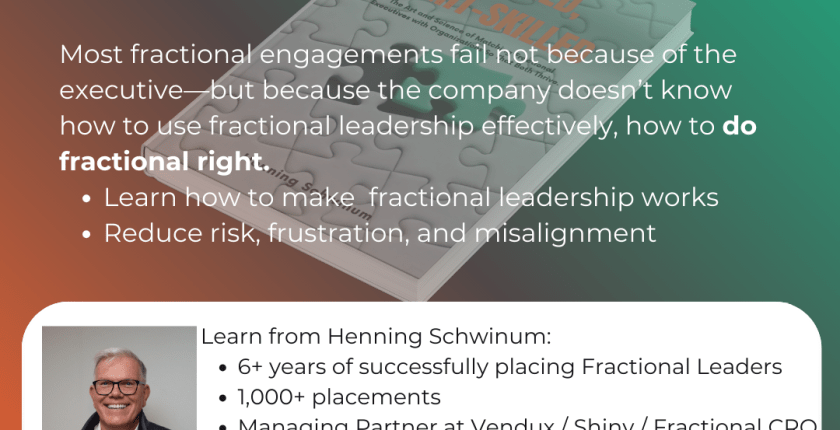
If you’re a CEO considering your first fractional hire — or your next one — and you want to know how to make the assignment succeed, join our CEO Masterclass: Right-Sized, Right-Skilled.