Kotlin vs Java: A 2026 Guide for Modern Tech Teams
A lot of teams hit the Kotlin vs Java decision at an awkward moment. The product roadmap is getting serious, the codebase is about to harden, and what looks like a language preference turns into a multi-year operating decision.
A founder might be asking whether a new backend should start in Kotlin because the team likes the syntax. An engineering manager might be staring at a large Java estate and wondering whether introducing Kotlin will improve delivery or just create a hiring headache. Both questions are valid. Neither gets answered well by a feature checklist alone.
The practical choice isn't about which language wins internet arguments. It's about what your team can build, maintain, hire for, and evolve without unnecessary friction.
The Enduring Choice Between Java and Kotlin

If you're evaluating Kotlin vs Java in 2026, you're probably not making an academic decision. You're choosing the habits your developers will repeat every day, the hiring market you'll depend on, and the maintenance burden you'll carry once the original builders move on.
That matters because both languages are viable. Java remains one of the safest choices in enterprise software. Kotlin is no longer a niche experiment. It has proven itself, especially where teams want modern language features without leaving the JVM ecosystem.
Here's the high-level comparison typically needed early:
| Decision area | Java | Kotlin |
|---|---|---|
| Readability in large codebases | Familiar and explicit | More concise, often easier to scan once the team is fluent |
| Null handling | Developer discipline and framework conventions matter more | Type system pushes safer defaults |
| Hiring depth | Broad market, easier to staff | Narrower market, stronger screening needed |
| Legacy integration | Natural fit for existing Java estates | Strong interop, but mixed-language teams need conventions |
| Android fit | Common in older codebases | Preferred for new Android work |
| Executive risk profile | Lower hiring risk | Potentially higher productivity, but higher talent risk |
Why this decision still stays hard
The easy version of the debate ended years ago. Kotlin proved that it belongs in production. Java kept evolving and remained entrenched. That leaves many teams with a more nuanced problem.
You're often choosing between:
- A modern developer experience that can make code safer and less verbose
- A deeper labor market that reduces hiring friction
- A mixed-language future where interoperability is an advantage, but standards matter
- A long maintenance horizon where readability for the next team matters more than elegance for the current one
Practical rule: If your language decision changes recruiting speed, onboarding cost, or architecture consistency, it's a business decision as much as a technical one.
That's why the Kotlin vs Java conversation is still active. The core question isn't "Which language is better?" It's "Which trade-off profile fits this team, this product, and this stage of growth?"
Understanding the JVM Family Legacy
A team with ten years of Java services does not start from zero just because it wants Kotlin in new modules. That is the underlying significance of the JVM in this decision.
Java and Kotlin run in the same runtime family, use much of the same infrastructure, and fit into many of the same delivery pipelines. For architects and engineering leaders, that changes the risk profile. The choice is rarely between two separate technology stacks. It is usually a choice between two languages inside one operational model.
That distinction matters because language decisions have a long tail. Build systems, test tooling, CI pipelines, production monitoring, dependency management, and deployment practices are expensive to replace. On the JVM, teams can often keep those investments and change the developer experience without rebuilding the platform around it.
Why the JVM matters more than many teams expect
The shared JVM foundation lowers switching costs in ways that affect both engineering and budget planning:
- Library reuse remains practical because Kotlin interoperates directly with Java code and Java libraries
- Adoption can happen module by module instead of through a risky rewrite
- Operations stay familiar because the surrounding build, deployment, and observability model often changes very little
- Mixed-language systems are realistic if teams set conventions for code ownership, reviews, and API boundaries
This is one of Kotlin's biggest strategic advantages. It let organizations improve developer ergonomics without asking them to abandon the frameworks, tools, and production habits they had already paid for.
How Kotlin moved from alternative to standard option
Kotlin's rise was tied to compatibility and timing. Teams already committed to the JVM had a way to reduce boilerplate, improve null-safety, and modernize day-to-day development without leaving the ecosystem that already ran their business systems.
Android accelerated that shift. Once Google endorsed Kotlin and later positioned it as the preferred direction for Android work, the language stopped looking experimental. For technical leaders, that changed the calculation from "Is this safe to adopt?" to "Where does this help enough to justify team standards, training, and hiring adjustments?"
That is an ecosystem story, not just a syntax story. Language adoption becomes easier when IDE support is mature, framework integration is stable, and engineers can move between old Java modules and new Kotlin modules without crossing a platform boundary.
Kotlin gained ground because it fit the existing JVM estate while giving teams a better day-to-day coding model.
The legacy question is really a portfolio question
In practice, many organizations do not make a one-time Java versus Kotlin decision. They manage a portfolio.
Core systems with stable staffing and heavy Java investment often stay in Java for years. New Android work or new backend modules may start in Kotlin where the productivity gains are easier to justify. Both choices can be rational inside the same company.
That flexibility is one of the JVM's biggest business advantages. It gives teams room to modernize selectively, protect existing assets, and avoid forcing every project into the same language policy for ideological reasons.
A Practical Syntax and Feature Showdown
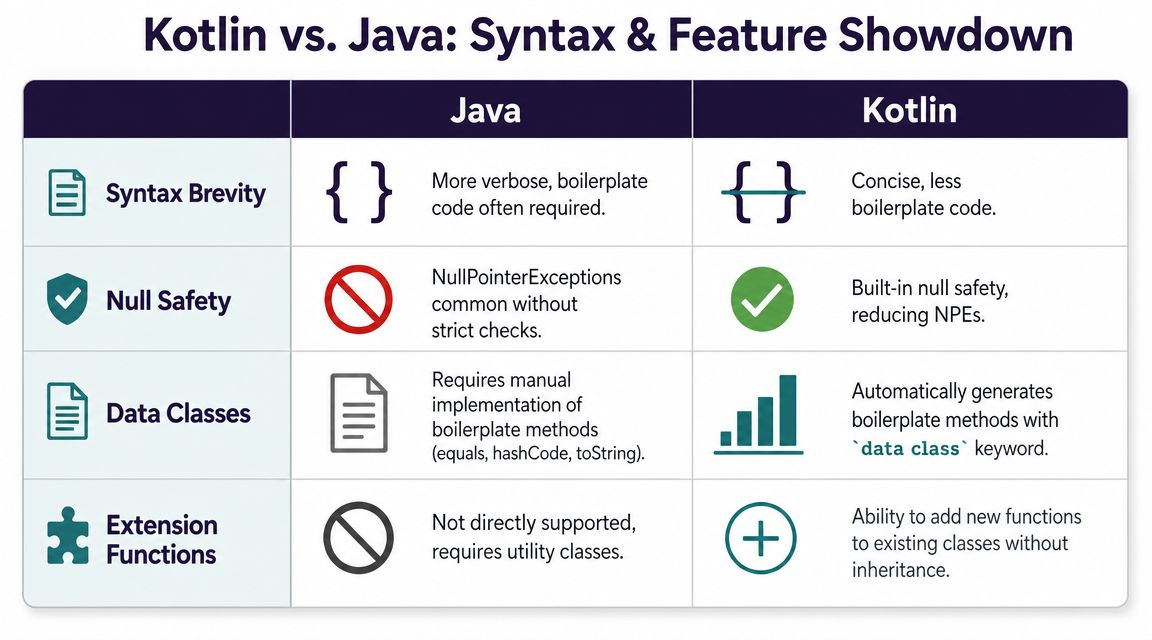
The syntax debate only matters if it changes daily work. In Kotlin vs Java, it does. The biggest differences show up in how much code teams write, how safely they handle nulls, and how naturally they express common patterns without utility-class clutter.
Boilerplate and model classes
A simple data model is where many teams feel the gap first.
Java:
public class User {
    private final String name;
    private final int age;

    public User(String name, int age) {
        this.name = name;
        this.age = age;
    }

    public String getName() {
        return name;
    }

    public int getAge() {
        return age;
    }

    @Override
    public String toString() {
        return "User{name='" + name + "', age=" + age + "}";
    }

    @Override
    public boolean equals(Object o) {
        // omitted for brevity
        return super.equals(o);
    }

    @Override
    public int hashCode() {
        // omitted for brevity
        return super.hashCode();
    }
}
Kotlin:
data class User(val name: String, val age: Int)
That isn't just syntactic sugar. It changes how quickly teams can define stable domain models, DTOs, event payloads, and test fixtures. In Java, teams often lean on Lombok to reduce this pain. In Kotlin, the language itself handles much of it.
Null safety and API design
Null handling is one of Kotlin's clearest practical advantages. According to the official Kotlin comparison with Java, null references are controlled by the type system, raw types are eliminated, arrays are invariant, checked exceptions are intentionally omitted, and Java-style static members are replaced by companion objects or top-level functions.
That changes the shape of ordinary code.
Java:
public String uppercaseName(User user) {
    if (user == null || user.getName() == null) {
        return "UNKNOWN";
    }
    return user.getName().toUpperCase();
}
Kotlin:
fun uppercaseName(user: User?): String {
    return user?.name?.uppercase() ?: "UNKNOWN"
}
The Kotlin version is shorter, but its primary advantage is semantic. The type system forces the team to decide whether something can be null.
Extensions and utility clutter
Java teams often collect static helper classes over time. StringUtils, DateUtils, UserMappers, ValidationHelpers. The pattern works, but it scatters logic.
Kotlin gives developers extension functions, which often make APIs feel closer to the business problem.
Java:
public final class StringUtils {
    public static boolean isInternalEmail(String value) {
        return value != null && value.endsWith("@company.com");
    }
}
Kotlin:
fun String.isInternalEmail(): Boolean = endsWith("@company.com")
This doesn't change runtime architecture by itself. It changes readability and proximity. The intent sits near the type being used.
What Kotlin removes, and why that matters
Kotlin's design decisions help some teams and annoy others. The same feature can be a benefit or a migration cost depending on what your developers value.
- Checked exceptions are omitted. Some teams love the cleaner signatures. Others miss the compiler pressure that documents failure paths.
- Companion objects replace static members. This is consistent once learned, but Java developers often need time to stop thinking in static-utility patterns.
- Declaration-site variance replaces wildcard-heavy generic APIs. This can make APIs cleaner, though mixed Java and Kotlin generics still require care.
- Top-level functions reduce ceremony. They also force teams to define package-level organization standards.
Architect's lens: Concise syntax helps only when the team shares conventions. Without style discipline, Kotlin code can become clever faster than Java code becomes verbose.
A note on concurrency
Kotlin discussions often drift toward coroutines versus Java's thread and future-based patterns. That's a valid topic, but in practice the decision depends heavily on your framework stack and team's familiarity. Coroutines can improve readability in async workflows. They also introduce new debugging and mental-model demands if the team hasn't used them before.
A pragmatic team shouldn't choose Kotlin only for coroutines. It should choose Kotlin because the broader language model improves everyday coding, and then adopt concurrency patterns deliberately.
Performance Tooling and Ecosystem Maturity
One of the least useful ways to approach Kotlin vs Java is to treat it as a benchmark contest. For most production teams, raw runtime speed isn't where the decision gets made.
On the JVM, Kotlin and Java usually deliver broadly comparable runtime performance because Kotlin compiles to the same JVM bytecode model for core constructs. Baeldung's analysis concludes that runtime performance usually isn't a deciding factor when choosing between them in production, as summarized in Baeldung's Kotlin and Java performance comparison.
Where performance actually shows up in decisions
When teams worry about performance, they usually mean one of three things:
- Runtime behavior under production load
- Developer feedback loops like build speed, IDE responsiveness, and test execution
- Operational predictability when debugging memory usage, stack traces, and production failures
The first category is often a wash unless your code leans heavily on specific edge cases. The second and third categories are where engineering teams feel daily friction.
Tooling quality is part of language quality
Java still benefits from decades of ecosystem maturity. Kotlin benefits from fitting into that same world while receiving excellent support in IntelliJ IDEA and strong support in mainstream JVM build systems.
In practical terms, teams can expect both languages to work well with:
| Tooling area | Java | Kotlin |
|---|---|---|
| IDE support | Excellent in IntelliJ IDEA and other major IDEs | Excellent in IntelliJ IDEA, especially for refactoring and inspections |
| Build systems | Mature support in Maven and Gradle | Mature support in Gradle and solid Maven support |
| Frameworks | Deep support across Spring, Jakarta, Micronaut, Quarkus and more | Strong support, especially with Spring and modern JVM frameworks |
| Testing | JUnit, Mockito, Testcontainers and broad ecosystem support | Same ecosystem access, plus Kotlin-native testing preferences where teams want them |
The practical difference isn't whether tooling exists. It's whether your team can use it smoothly and consistently.
Maturity looks different at different layers
Java's biggest ecosystem advantage is historical depth. If you're integrating with older enterprise libraries, vendor SDKs, or long-lived internal frameworks, Java often feels like the path of least resistance.
Kotlin's advantage is ergonomic fit on top of that same ecosystem. Teams can still use Spring Boot, JPA, Jackson, Kafka clients, and Testcontainers, but write service logic in a style many developers find easier to maintain.
That means ecosystem maturity should be evaluated in layers:
Language maturity
Java is conservative and predictable. Kotlin is mature enough for serious use, but it asks teams to adopt a different idiom.
Framework maturity
For mainstream JVM frameworks, both languages are safe choices. The key issue is usually whether your team's internal patterns assume Java-first conventions.
Organizational maturity
In these circumstances, projects frequently fail. If the architecture docs, coding standards, interview process, and onboarding materials all assume Java, introducing Kotlin without updating those assets creates confusion.
A useful way to handle that is to treat language adoption as an engineering operations topic, not just a developer preference. The same mindset used for software development KPIs applies here. Measure build friction, onboarding quality, defect patterns, and review speed instead of relying on anecdotes.
Tooling doesn't rescue weak engineering habits. It amplifies strong ones and exposes weak ones faster.
Analyzing Key Use Cases in Android and Server-Side
A team has to choose a language before the roadmap gets crowded, the hiring plan is approved, and the first maintenance costs start accumulating. That decision plays out very differently on Android than it does on the server. The technical merits matter, but the better question is which choice lowers delivery risk for the kind of system and team you have.
Android teams usually have a clearer answer
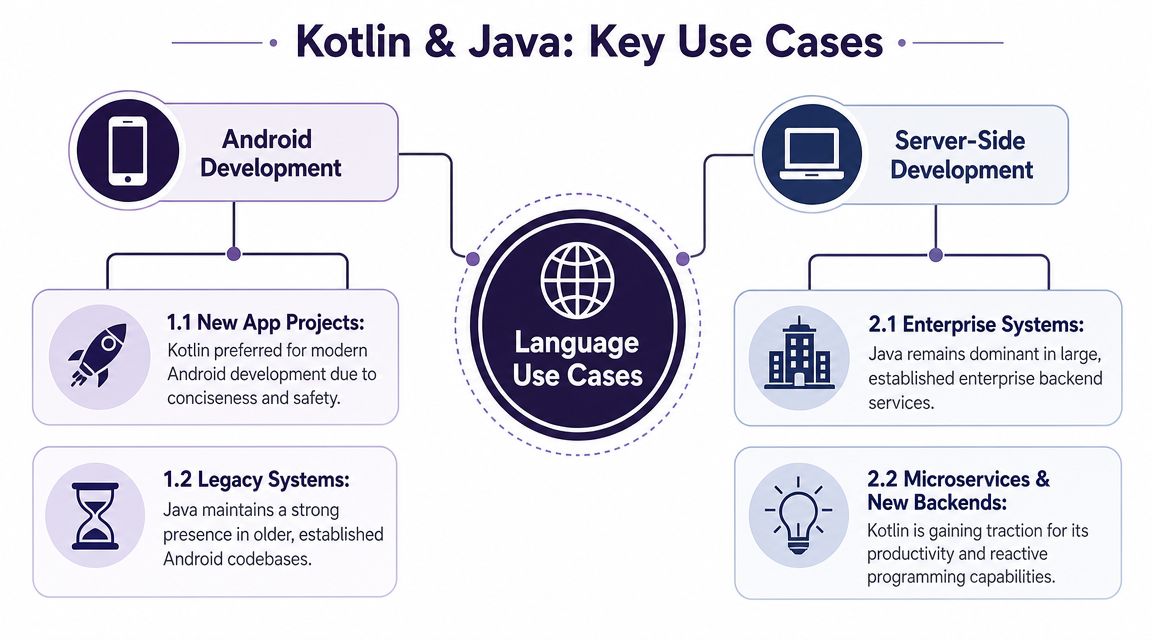
For a new Android app, Kotlin is usually the default choice. It fits current Android guidance, works naturally with Jetpack libraries, and cuts a meaningful amount of boilerplate from UI, state, and domain code. That translates into faster feature work and fewer routine defects around null handling and repetitive model code.
The market direction has reflected that shift for years, as noted earlier. New Android work tends to start in Kotlin, while Java remains common in older apps that grew up before Kotlin became standard.
That creates a practical split inside many mobile teams. Greenfield development often moves fastest in Kotlin. Existing products often end up mixed, with stable Java modules left in place and new features written in Kotlin where the payoff is immediate.
Hypothetical Android example
A product team rebuilding a consumer app around Jetpack Compose, modern navigation, and rapid release cycles will usually get better results from Kotlin. The language matches the framework style, reduces ceremony, and makes it easier to keep mobile code readable as the app expands.
A different team inherits a mature Android app with large Java modules, custom SDK integrations, and release pressure. Full migration is rarely the best first move. A phased approach is cheaper and safer. Write new screens in Kotlin, keep stable Java code running, and migrate only where active development justifies the cost.
Server-side is more contextual
Backend language choice is usually less about syntax and more about operational fit. Java still has an advantage in organizations with shared platform teams, long-lived services, and broad internal standards built around Java conventions. In those environments, the cheapest code to maintain is often the code the next team can understand immediately.
Kotlin is still a credible server-side option. It works well for service layers, domain modeling, and codebases where teams want stricter null handling and less repetitive plumbing. I have seen it work especially well in smaller platforms with experienced engineers who value compact code and are willing to enforce Kotlin-specific conventions in reviews and onboarding.
The trade-off is organizational. Kotlin can improve day-to-day developer experience, but that gain has to be weighed against staffing flexibility, cross-team mobility, and support expectations for shared libraries.
Hypothetical backend example
Consider two service initiatives.
- A startup building a new internal API may benefit from Kotlin because a small senior team can ship quickly and keep service code tight.
- A larger company rolling out dozens of services across several teams may get more long-term value from Java because training, staffing, and operational consistency are easier to scale.
Teams that use external delivery partners should test this choice against sourcing reality too. Language preference affects who you can hire, how quickly partners ramp up, and how much review overhead your staff absorbs. That is one reason technical leads often connect language standardization with broader IT outsourcing for development teams decisions, especially when multiple vendors or distributed teams are involved.
On Android, Kotlin often has the stronger product and productivity case. On the server, the better choice usually depends on who will maintain the system over the next three to five years.
Strategic Considerations for Business and Team Growth

Many Kotlin vs Java articles reach their limit of usefulness. They compare syntax, mention null safety, and assume the better developer experience automatically makes the better business decision.
It doesn't.
A language decision affects recruiting time, compensation pressure, onboarding design, architecture governance, and how easily leaders can reassign engineers between teams. Those costs often outweigh small coding advantages, especially in growing companies.
Hiring depth and delivery risk
A frequently missed issue in Kotlin vs Java is team economics and hiring risk. There are still significantly fewer Kotlin developers than Java developers, which can make Kotlin talent more expensive and harder to recruit, a point highlighted in ShiftMag's discussion of Kotlin hiring and strategic trade-offs.
That single reality changes the decision for many companies.
If you're a startup with a strong lead engineer and a small, high-skill team, Kotlin scarcity may be manageable. If you're scaling quickly, opening multiple teams, or hiring in competitive markets, scarcity becomes operational risk.
What executives should evaluate before choosing
Team shape
A senior-heavy team can usually absorb Kotlin more easily than a broad team with mixed experience. Language flexibility is easier when reviewers are strong and standards are explicit.
Replacement cost
What happens if two key Kotlin advocates leave? If your answer is "we'll probably convert incoming Java developers," then training time becomes part of the language cost.
Internal mobility
Java often wins in organizations where engineers move between products, maintenance teams, and platform groups. A common language reduces transfer friction.
Leadership bandwidth
Mixed-language environments need clearer technical leadership. Someone must define migration boundaries, review rules, interoperability standards, and package conventions. Without that, teams drift.
A language with better ergonomics can still be the wrong choice if it narrows your hiring funnel at the exact moment you need to scale.
Migration is usually where good intentions go sideways
The safest Kotlin adoption pattern is rarely a big-bang rewrite. Better results are often achieved with selective introduction:
- Start with new modules where Kotlin can set the local standard without destabilizing old code.
- Keep interop intentional so mixed Java and Kotlin boundaries don't become awkward or inconsistent.
- Update team standards early for naming, nullability, testing style, and extension-function use.
- Train reviewers, not just authors because code quality drops fast when only a few people can judge idiomatic Kotlin.
This is one of the moments where fractional technical leadership can be valuable. A company may not need a full-time CTO or principal architect to set language strategy, but it often needs experienced guidance on migration sequencing, staffing implications, and engineering governance. That's also why founders often need a clear process for hiring the right CTO profile before they lock in platform-level choices.
Long-term stability isn't only about the language
Java's advantage is depth and continuity. Kotlin's advantage is developer ergonomics on a proven platform. The better strategic choice depends on what failure looks like for your company.
If failure means slow delivery from overly verbose code and poor API ergonomics, Kotlin may help. If failure means unfilled roles, inconsistent team capability, and fragmented standards, Java may be safer.
The right answer is often less ideological than teams expect.
Making the Right Choice for Your Next Project
A sensible Kotlin vs Java decision starts with context, not preference. Teams should choose the language that makes their next three years easier, not just their next sprint cleaner.
Use these questions to pressure-test the choice:
Choose Kotlin when
- You're building a new Android product and want the modern default.
- Your team is senior enough to use Kotlin features well without turning the codebase into a style experiment.
- You can tolerate a narrower hiring market because your current team is stable or your scope is contained.
- You want gradual JVM modernization without abandoning Java libraries and tooling.
Choose Java when
- You're scaling headcount quickly and need the broadest recruiting pool.
- Your system is closely tied to existing Java conventions and the migration cost doesn't buy enough operational value.
- You manage multiple teams with mixed skill levels and need consistency more than expressiveness.
- Your biggest risk is staffing and maintainability, not syntax verbosity.
Choose both, carefully, when
- You have a large Java estate but want Kotlin for greenfield modules.
- You can enforce standards for interoperability, code review, and package design.
- You have technical leadership that can manage a mixed-language environment deliberately.
The best teams don't ask which language is universally superior. They ask which one reduces avoidable risk while keeping the product moving.
A good architect, CTO, or fractional technical leader can save months here by framing the decision around hiring, delivery, migration, and long-term ownership instead of opinion. That's often the difference between a language choice that compounds value and one that compounds cost.
If you're weighing decisions like Kotlin vs Java and need experienced leadership without committing to a full-time executive hire, Shiny can help you connect with vetted fractional technology leaders who can assess team structure, hiring risk, and architecture strategy before those choices become expensive to reverse.