Time Tracking Invoice Software: A Startup’s Guide
You finally bring in the leadership bench your startup needs. A fractional CFO sharpens cash planning. A part-time CMO owns pipeline strategy. A fractional CTO starts cleaning up product delivery.
Then the month ends.
One executive sends a PDF invoice with a short summary. Another shares a spreadsheet with dates and hours. A third bills on a retainer but also adds extra project work in a separate email. You open Excel to reconcile everything, cross-check Slack messages to remember what was approved, and ask yourself a frustrating question: What am I paying for, and is it working?
That's where a lot of growing companies get stuck. They want the flexibility of fractional leadership, but they're still running billing like a tiny freelance shop. The result isn't just admin friction. It's slower approvals, payment mistakes, unclear budgets, and almost no visibility into whether leadership time is going into the right priorities.
If your business relies on flexible talent, especially senior part-time operators, time tracking invoice software isn't a back-office nice-to-have. It's part of how you run the company cleanly.
Why Your Excel Timesheet Is Costing You More Than You Think
A founder hires three part-time executives over one quarter. The setup feels sensible at first. One works on a monthly retainer. One bills hourly by project. One splits time across strategy, hiring, and vendor management.
By month two, the founder has four versions of the truth.
There's the spreadsheet the assistant updates. There are the invoices sitting in email. There's a Slack thread where someone approved extra work. And there's the accounting system, which only shows the final payment, not the work behind it.
The real cost isn't the spreadsheet
Excel looks cheap because you already have it. The hidden cost shows up elsewhere.
- Founder time disappears: You spend time checking math, confirming scope, and asking senior people to clarify what should have been obvious.
- Trust takes a hit: If you question an invoice late or pay the wrong amount, even once, your relationship with a valuable executive gets harder.
- Budget control weakens: You can't tell whether your fractional CMO's time is going into campaign planning, team management, or reporting.
- Profitability gets blurry: You know what you paid, but not whether that work improved the initiative it supported.
Manual billing systems rarely fail all at once. They fail in small ways that force founders to keep making judgment calls from incomplete information.
That's the strategic risk. Administrative chaos forces the founder to become the billing system.
Fractional teams create billing complexity fast
This gets more confusing with part-time executives because their work often crosses functions.
A fractional CFO might spend one week on board prep and another on collections cleanup. A fractional CTO may divide time between roadmap planning, vendor reviews, and interviewing engineering candidates. If all of that rolls into a single monthly invoice with broad labels, you can't evaluate the work properly.
You also can't answer basic operating questions with confidence:
- What work was billable to a client-facing project versus internal overhead?
- Which leader is staying within scope, and which role is expanding unchecked?
- Are you paying for strategic work, or for cleanup that a stronger process should prevent?
Admin debt becomes operating debt
Founders often treat billing mess as temporary. It usually isn't.
Once a company starts relying on flexible senior talent, payment operations affect hiring, planning, and accountability. If the system is loose, every new executive adds another exception. Another format. Another approval path. Another chance for confusion.
At that point, the problem isn't invoicing. It's operating discipline.
Understanding Time Tracking Invoice Software Beyond the Basics
Most founders hear “time tracking” and think of a stopwatch. That framing misses the point.
Good time tracking invoice software acts more like an operating dashboard for talent spend. It connects work performed, approval, billing, and financial review in one workflow. That matters when your team includes people working different schedules, across multiple projects, with different billing arrangements.
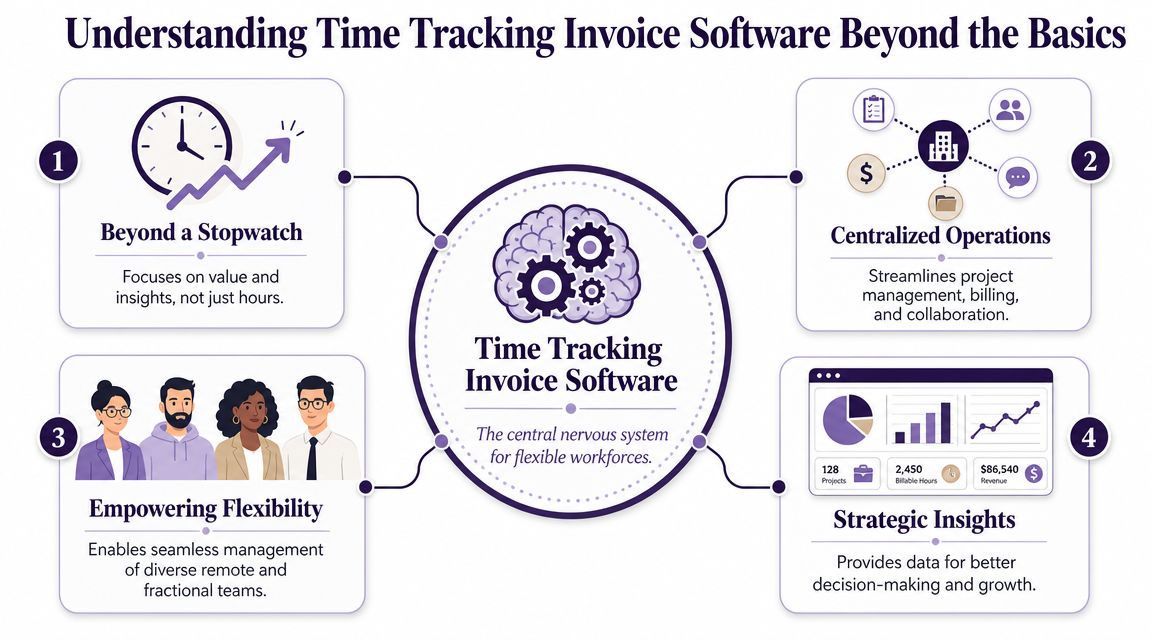
What the software actually does
The core workflow in service businesses is straightforward. Teams track hours by client and project, apply rates, and generate invoices from approved time data. Modern systems connect time capture, billing, project profitability, and accounting in one process, which is why this model became foundational for businesses where billable time is central, as explained in Xero's guide to small business time tracking software.
That's a big step up from “send me your hours by Friday.”
A typical workflow looks like this:
- Work gets logged: The executive records time against a client, initiative, or task.
- A manager reviews it: Someone checks that the time fits scope and context.
- Rates get applied: The system uses the agreed billing rules.
- An invoice is generated: Approved time flows into billing.
- Finance sees the same record: Payment status and accounting stay connected.
Why this matters for fractional leadership
Senior part-time talent shouldn't spend energy defending every invoice. Founders shouldn't spend energy reconstructing what happened.
The right system creates shared visibility. Your fractional CMO can show that this month's time went into launch planning, creative direction, and agency oversight. Your fractional CFO can separate routine cash review from a financing prep sprint. You get clarity without asking people to produce custom billing narratives every month.
Practical rule: Time tracking for executives shouldn't feel like surveillance. It should create a clean record of strategic work, scope, and financial accountability.
The shift from recordkeeping to decision support
This category started with digital timesheets. It became more useful when software linked those records to invoicing and accounting. That shift matters because founders don't just need clean bills. They need to understand where leadership time is going and whether the company is getting benefit from it.
Used well, time tracking invoice software helps you answer questions like:
- Which projects are consuming the most senior time
- Where unbilled or unapproved work is piling up
- Whether a role should stay hourly or move to a retainer
- What future scopes are likely to cost
That's why this software belongs in operations, not just finance. It turns flexible leadership from an informal arrangement into a manageable system.
Essential Software Features for Managing Fractional Executives
The best software for hourly freelancers isn't always the best software for fractional executives. Senior part-time leaders create a different set of operational needs. Their work is more strategic, often less repetitive, and more likely to span departments.
That means your software has to handle nuance without becoming a burden.
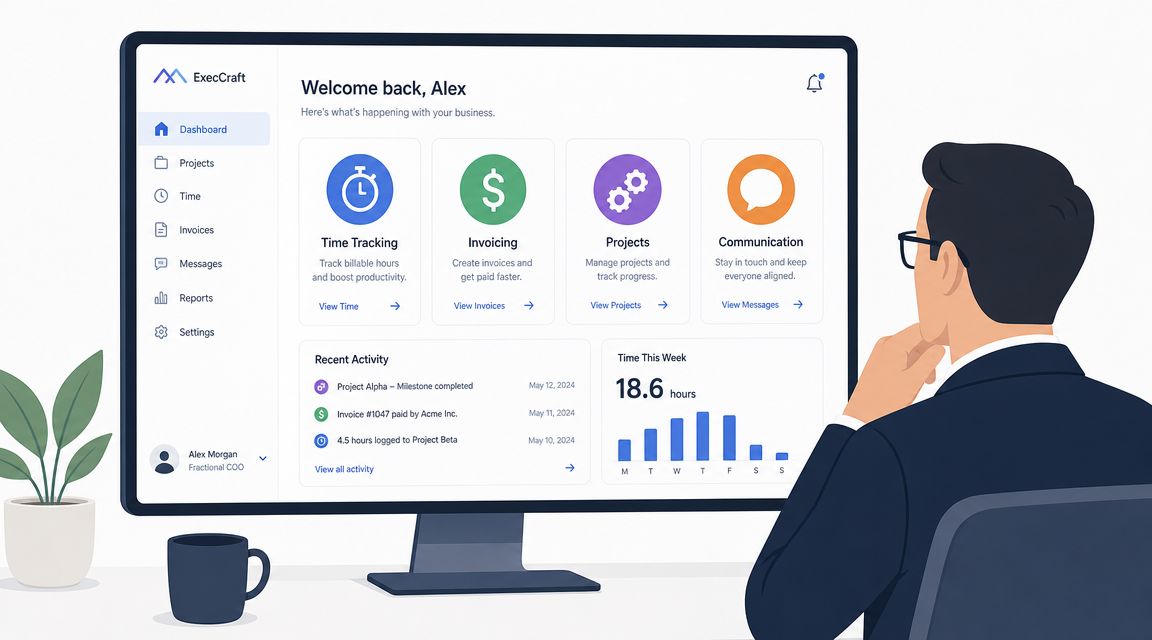
Billing flexibility comes first
A startup rarely uses one billing model for every leader. Your fractional CFO may work on a monthly retainer. Your interim Head of Sales may bill hourly during a short rebuild. A go-to-market consultant might charge a fixed fee for a launch plan.
Software needs to support those variations cleanly. It should also show work-in-progress and unbilled time in real time. That flexibility matters because billing rules often change by client and engagement type, as noted in Bill4Time's guide to legal time tracking and invoicing.
If the platform only works well for hourly billing, you'll end up building workarounds outside the system. That defeats the purpose.
Look for features tied to real operating pain
Here's the checklist I'd use for a startup managing fractional leaders:
- Multiple billing models: You need support for hourly, retainer, fixed-fee, and hybrid arrangements in one system.
- Project and task tagging: A senior operator's time has to be mapped to meaningful work, not vague labels like “strategy.”
- Approval workflows: Someone should be able to review entries before they become invoices.
- Automated invoice generation: Approved records should flow directly into billing.
- WIP and unbilled time visibility: Finance should see what's accumulating before month-end.
- Custom invoice formatting: Clients, boards, or internal stakeholders may need different levels of detail.
- Accounting integration: The billing record shouldn't stop at “invoice sent.”
What these features look like in practice
A good setup lets a founder do more than approve hours.
For example, a fractional CMO might log time under campaign planning, channel review, weekly leadership meeting, and agency management. That lets the founder see where marketing leadership effort is going. If campaign planning keeps shrinking while reporting time grows, that's a useful management signal.
A fractional CTO creates a similar need. If time logs show repeated hours on bug triage, vendor firefighting, and emergency delivery reviews, the founder may have a systems problem, not just a leadership capacity problem.
Better data doesn't just help you pay people correctly. It helps you spot where your company keeps pulling senior talent into avoidable work.
Don't overbuild for the wrong audience
One caution. Executive time capture has to be lightweight.
If the software requires ten fields, multiple screens, and a complicated weekly process, busy leaders won't use it consistently. You want enough structure to make invoices clear and useful, but not so much structure that the tool becomes another layer of friction.
The best platforms make disciplined reporting easy. They don't turn senior operators into clerks.
The Strategic Benefits for Startups and Scale-ups
Founders usually buy software to solve a pain point. The better reason to adopt time tracking invoice software is that it improves how the business runs.
This isn't only about cleaner admin. It's about fewer avoidable mistakes, better decisions, and a more professional operating rhythm for a company that's starting to scale.
Fewer billing and payroll mistakes
When time tracking connects to payroll and billing workflows, the accuracy benefit becomes much clearer. Companies using time tracking software with payroll features are 44% less likely to make errors, according to eBillity's review of time tracking software facts.
For a startup, that matters more than it might seem.
A payment mistake with a fractional executive isn't just an accounting issue. It can delay trust, trigger back-and-forth with someone expensive, and create uncertainty around future work. When your leadership bench is part-time, the process needs to be reliable because there's less room for administrative drag.
Better forecasting and scope control
Once your team logs time consistently, patterns start to appear.
You can see whether your fractional finance leader is spending most of their time on recurring reporting or on one-off cleanup. You can compare planned scope against actual effort. You can decide whether a role should be expanded, narrowed, or restructured.
In this capacity, the software stops being a billing tool and becomes a management tool.
A founder who understands historical effort can scope future projects more carefully. If receivables follow-up keeps consuming leadership attention, for example, stronger systems may matter more than more executive time. That's also why founders working on collections and invoicing operations often benefit from tightening related workflows such as startup receivables management automation.
A more professional experience for your operators
Strong executives notice when a company's back office is loose.
If approvals are inconsistent, invoices get questioned late, or payment timing depends on who remembered what, your company looks less mature than it probably is. That can affect retention and willingness to stretch with you.
By contrast, a clean time-to-invoice workflow signals that your company respects people's time and has a handle on execution. That matters when you're trying to build long-term relationships with part-time leaders who often have options.
The investment isn't just software
What you're really buying is consistency.
You're making it easier for leadership, finance, and operations to work from the same record. That creates better conversations about priorities, scope, and return on talent spend. For an early-stage company, that's often more valuable than the invoice itself.
How to Evaluate and Choose the Right Platform
Most software demos look good for the first ten minutes. The dashboard is clean. The timer works. The invoice template looks polished.
The hard part is figuring out whether the platform fits the way your company runs. If you use fractional executives, that evaluation should focus less on generic feature volume and more on workflow fit.
Start with the operating environment
Before comparing tools, write down how your business currently handles these four things:
- Who logs time
- Who approves it
- How rates are set
- Where invoices and payments are managed
That simple exercise exposes most hidden requirements. You may discover that the main blocker isn't invoice creation. It's that no one owns approval, or that the accounting system isn't connected to project records.
A platform should fit the workflow you want, not the mess you already have.
Use this evaluation checklist
| Criterion | What to Look For | Why It Matters for Startups |
|---|---|---|
| Integration fit | Connects with accounting, payroll, and project tools you already use | Reduces duplicate entry and prevents month-end reconciliation headaches |
| Billing model support | Handles hourly, retainer, fixed-fee, and hybrid work | Fractional leaders rarely fit one simple pricing structure |
| Ease of use | Fast entry, simple approvals, clear reports | Busy executives won't adopt a tool that feels heavy |
| Scalability | Works for a few leaders now and a larger bench later | You don't want to rebuild the workflow every time you add talent |
| Security and permissions | Role-based access, approval controls, invoice visibility by user | Senior work often includes sensitive financial or strategic activity |
| Payment acceleration features | Automated reminders, payment links, status tracking | Clean invoices alone won't solve cash-flow friction |
| Reporting quality | Project, role, and unbilled work visibility | Founders need operating insight, not just invoices |
| Support and implementation | Clear onboarding help and migration guidance | Small teams need a fast, low-drama rollout |
Ask one overlooked question
Late payments create real cash-flow stress for small businesses, and a key evaluation issue is whether the platform improves payment speed through tools like reminders and integrated payment processing, not just invoice accuracy, as discussed in Teamwork's article on time tracking and invoicing.
That question matters even if you aren't billing clients directly for all executive work.
If your company does pass through contractor or executive time to clients, software should help you collect faster, not just send prettier invoices. If you don't bill externally, the same principle still applies internally. You want the shortest path from approved work to completed payment.
Evaluate the system around growth, not today's mess
A founder with two part-time executives may think a simple tool is enough. Maybe it is for now.
But ask what happens when you have a fractional CFO, a part-time COO, a RevOps consultant, and two client-facing specialists all billing differently. That's when systems break.
Questions worth asking vendors include:
- How does the platform handle changing rates over time?
- Can one user work across multiple projects with different billing rules?
- What can a manager approve in bulk, and what requires manual review?
- How are accounting sync errors surfaced and fixed?
- Can we report on unbilled time by project or role?
If your internal team is thin, it can also help to get outside support from billing system specialists who can map process to software selection.
The best platform isn't the one with the longest feature list. It's the one your team will actually use, with enough structure to keep finance, ops, and leadership aligned.
Implementing a Workflow That Empowers Your Team
A good rollout keeps things boring. That's the goal.
Your fractional leaders should know where to log work, how detailed to be, when entries are due, and when they'll be paid. Finance should know what gets reviewed, what gets invoiced automatically, and where exceptions go. Founders should be able to check the dashboard without chasing anyone.
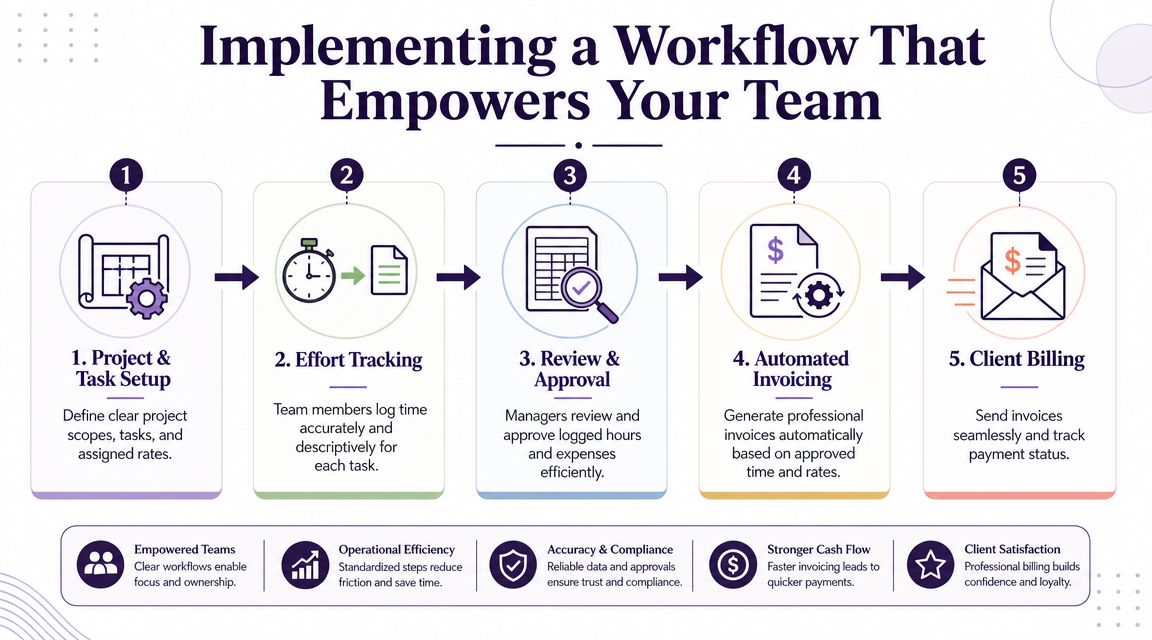
A simple operating rhythm
For most startups, the cleanest workflow looks like this:
Set up projects and billing rules
Create the core categories first. For example, finance, product, marketing, fundraising support, and internal operations. Assign rates or retainer rules at the project or person level.Keep time entry descriptive but short
“Board prep and KPI review” is useful. “Work” is not. You want enough detail to evaluate scope without forcing executives into essay writing.Use a light approval step
A founder, chief of staff, or finance lead reviews entries weekly. That catches mismatched scope before it turns into end-of-month confusion.Generate invoices from approved records
Don't ask contractors to rebuild the invoice manually if the system already has the source data.Track payment status visibly
Everyone involved should know whether an invoice is approved, sent, paid, or pending.
What to set up on day one
If you want adoption, make the initial setup as clear as possible.
- Define categories carefully: Separate strategic work, delivery work, and internal admin so reports are useful.
- Set rate rules in advance: Don't rely on manual calculations at invoice time.
- Choose an approval owner: One person should own the review process, even if others can step in.
- Create examples of good entries: Show executives two or three sample descriptions so expectations are obvious.
- Document payment timing: State when approved work gets invoiced and when payment runs happen.
- Review your rate logic: If you're unsure how to structure contractor pricing, this guide to calculating an hourly rate can help frame the decision.
Keep the workflow respectful
Senior part-time talent responds well to clarity and poorly to bureaucracy.
If your process is simple, they'll use it. If your categories match real work, your reports will mean something. If approvals happen on schedule, invoicing becomes routine instead of awkward.
That combination gives you something more valuable than neat books. It gives you confidence to add more flexible leadership without adding more administrative fragility.
Clean operations make fractional leadership easier to scale because each new executive plugs into an existing system instead of creating a new one.
When the workflow works, founders can stop acting as invoice detective, approval bottleneck, and payment coordinator. They can get back to the job they need to do, which is building the company.
If you're building around flexible leadership and want help finding the right executive talent to plug into a disciplined operating system, Shiny can help. Shiny connects startups with vetted fractional executives across functions, so you can add experienced leadership without committing to a full-time hire. If you're thinking through your next leadership gap, it's a practical place to start a conversation.