9 Marketing Operations Best Practices for Startups in 2026
It starts the same way in early-stage companies. The founder wants a clean answer on pipeline, CAC, or campaign ROI. Marketing pulls numbers from three tools. Sales disputes the lead quality. RevOps is either part-time, overloaded, or missing entirely. By the time anyone agrees on the data, the meeting is over and the decision gets pushed another week.
That is not a marketing problem. It is an operating model problem.
Marketing operations is the system behind execution: ownership, process, data flow, tooling, reporting, budget control, and sales handoffs. If that system is weak, adding headcount rarely fixes anything. It usually multiplies the mess. More campaigns go out, but reporting stays muddy, follow-up stays inconsistent, and waste gets harder to spot.
Startups feel this faster because every inefficient step carries a real cost. A broken lead routing rule wastes paid spend. A messy tech stack adds software cost and manual work. Unclear approvals slow launches and create rework. You pay once in time and again in missed pipeline.
The right approach is to treat marketing operations as a growth discipline, not admin. That does not mean hiring a full in-house team on day one. It means putting senior operational judgment in place early, then building only the processes your stage needs. For many startups, the highest-ROI move is fractional leadership. You get someone who can design the system, set priorities, and keep marketing, sales, and finance working from the same playbook, without taking on the cost and risk of a full-time executive hire.
That is the frame for this guide. Each best practice below is built for a resource-constrained startup that needs better execution now, not a six-month transformation project. The goal is simple: tighter systems, faster decisions, cleaner data, and more revenue from the team and budget you already have.
1. Establish Clear Marketing Operations Governance
Monday morning, your team is already stuck. Paid wants to launch. Sales says the lead rules changed. Product updated the messaging Friday night. Finance is asking who approved the extra spend. The campaign delay is not a talent problem. It is a governance problem.
Governance gives a startup a clear way to run marketing without dragging the founder into every decision. It defines who owns what, who approves what, and which rules cannot be changed casually. If you skip it, your team burns time on internal negotiation instead of pipeline.
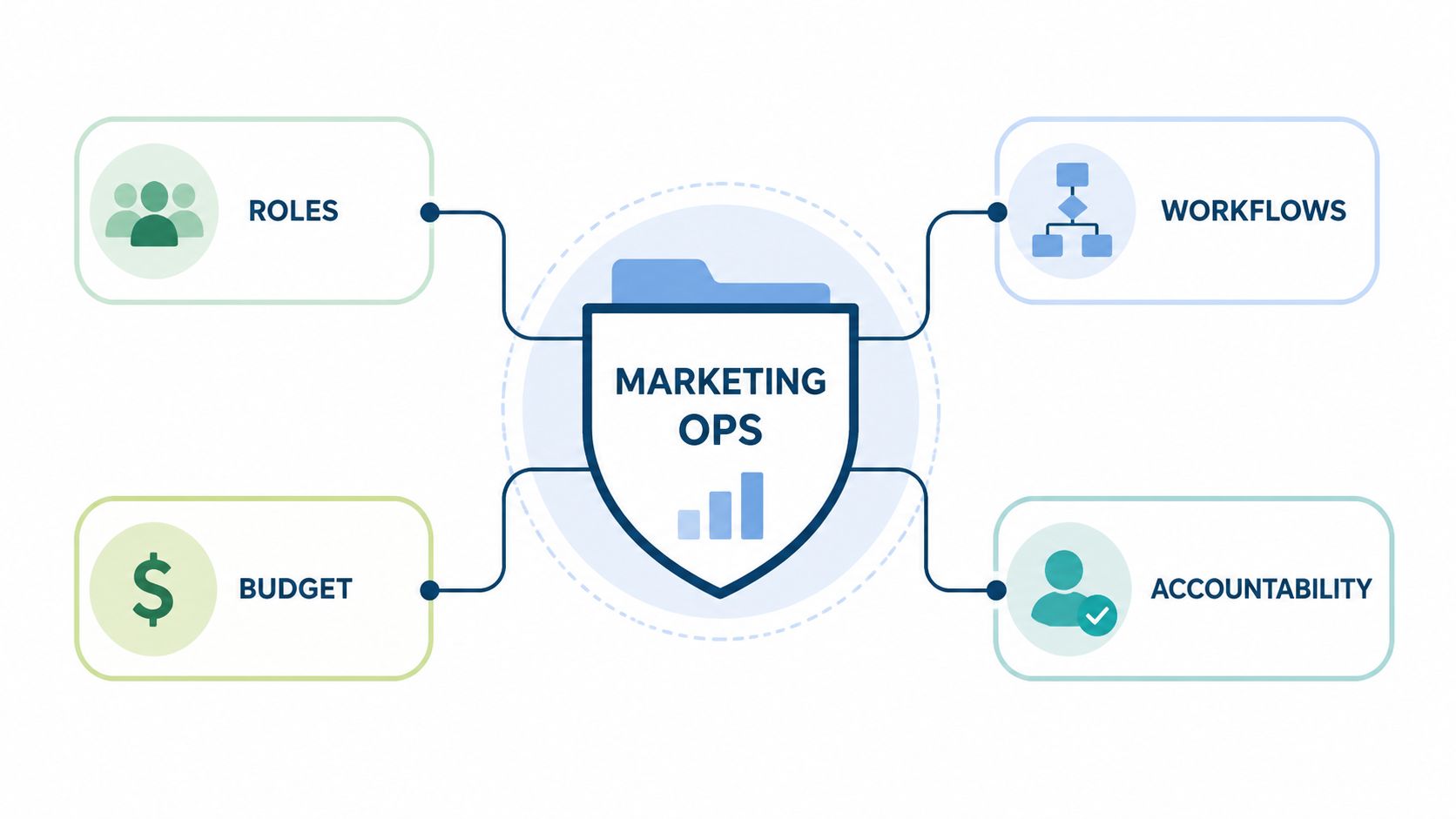
Early-stage companies usually call this “staying flexible.” In practice, it creates repeat confusion. A growth lead launches campaigns without a firm approval path. A product marketer edits positioning midstream. An SDR manager changes lead definitions without warning. Then reporting breaks, handoffs slip, and everyone debates what should have happened after the fact.
Fix that with a simple operating charter. Keep it short enough that people will use it and specific enough that it settles recurring disputes.
What governance should include
- Role ownership: Assign one owner for campaign operations, reporting, budget approval, lead lifecycle stages, and vendor decisions.
- Decision rights: Define who can approve spend, change messaging, modify workflows in HubSpot or Salesforce, and introduce new tools.
- Escalation rules: Set clear thresholds for what goes to the founder, what stays with the marketing lead, and what requires sales or finance input.
- System authority: Name the source of truth for pipeline stages, attribution rules, campaign naming, and forecast inputs.
- Documentation location: Put the charter in one place, usually Notion, Confluence, or your internal wiki.
Use one practical rule. If the same decision gets debated twice, document it and assign an owner.
Good governance protects speed because it reduces rework. Your team stops waiting for ad hoc approvals. Sales stops receiving leads under shifting definitions. Finance gets cleaner budget control. Founders get fewer Slack threads asking for judgment calls that should never have reached them.
For a resource-constrained startup, this is one of the highest-ROI uses of fractional leadership. A fractional CMO or fractional marketing operations leader can set decision rights, clean up ownership, and create a lightweight governance model fast. You get senior operating judgment without paying for a full-time executive before the business is ready.
Keep the model lean. Start with roles, approvals, lead definitions, budget authority, and escalation paths. Run it for 30 days. Fix what creates friction. Then document the final version and enforce it. Governance only works when it is used.
2. Implement Marketing Technology Stack Rationalization
Your team launches a campaign on Monday. By Wednesday, marketing is comparing numbers from three dashboards, sales is questioning lead sources, and someone is exporting CSVs to patch a broken sync between tools. That is not a reporting problem. It is a stack problem.
Most startup martech stacks grow by accident. A founder buys HubSpot or Salesforce. A marketer adds Mailchimp. Then come Typeform, Unbounce, Calendly, a reporting add-on, and a second attribution tool because nobody trusts the first one. Before long, the team is paying for overlap, tolerating bad data, and wasting operator time on work a clean system should handle automatically.
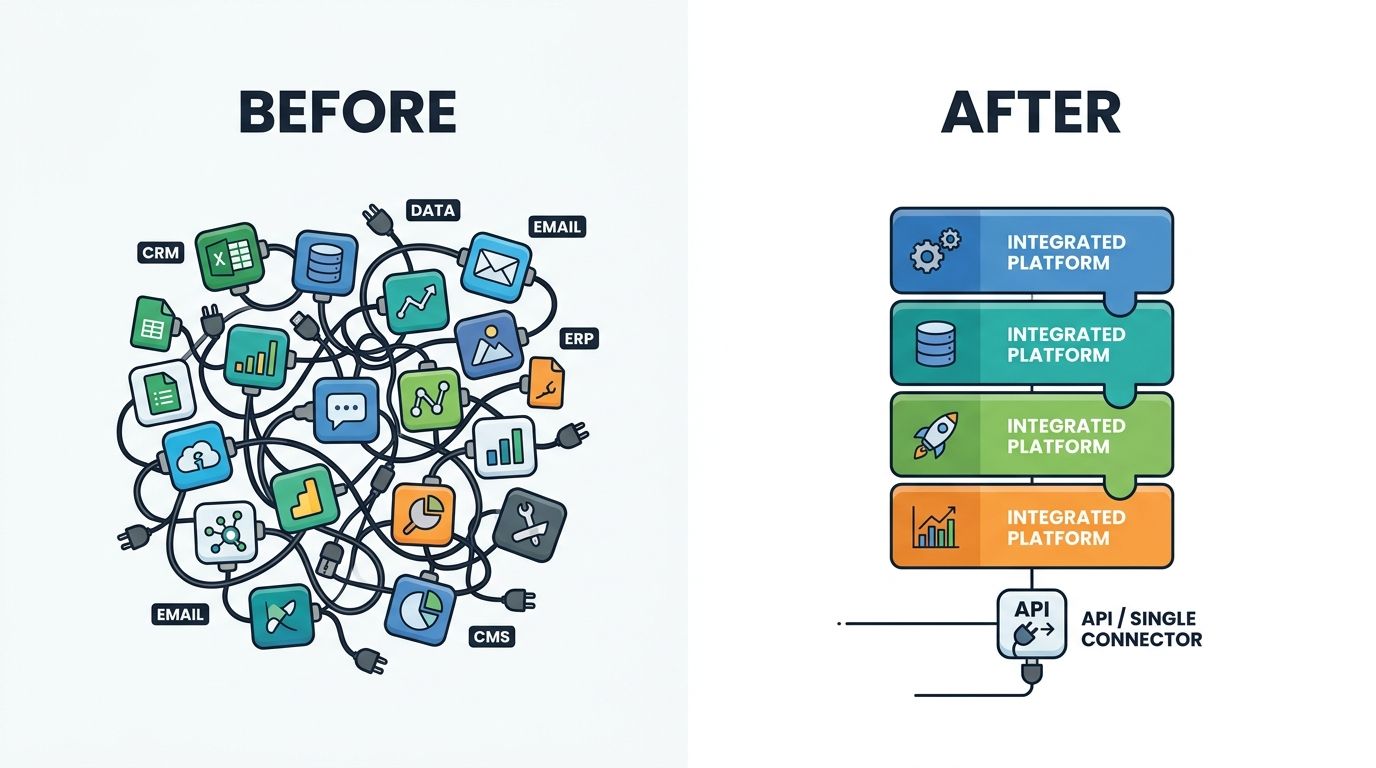
Stack rationalization fixes that. The goal is a smaller, cleaner system that supports execution, reporting, and handoffs without manual patchwork.
Audit the stack like an operator
List every tool in one sheet. Include owner, use case, renewal date, monthly cost, active users, key integrations, and whether revenue work breaks if the tool disappears for a week.
Then ask the questions that expose waste fast:
- What job does this tool own: If two tools solve the same problem, pick one.
- Who used it in the last 30 days: If nobody can answer clearly, cut it or downgrade it.
- What manual work exists because of this tool: Exports, duplicate entry, and cleanup work are operating costs.
- Does it support the core system: CRM, automation, analytics, and campaign execution should work together without custom heroics.
The process discipline matters as much as the software. HubSpot's marketing operations guide points to repeatable processes, clean systems, and consistent execution as the foundation of effective marketing operations. Startups feel the cost of inconsistency faster because they do not have extra headcount to absorb it. That is why tool sprawl hurts smaller teams more.
One useful rule. If a tool creates more admin time than business value, it should not stay.
Simplify the architecture
A rationalized stack usually has a clear center. The CRM holds account and pipeline truth. The automation platform handles nurture and routing. Analytics reports performance from agreed inputs. Project management tracks execution. Everything else has to earn its place.
Use this standard:
- Keep foundational systems: Prioritize CRM, marketing automation, analytics, and project management that connect reliably.
- Remove redundant tools: A point solution that saves one person ten minutes but creates sync issues for the whole team is a bad trade.
- Set a purchase gate: No new software gets approved without an owner, a defined use case, expected ROI, and an integration plan.
- Choose operational fit over feature count: The best tool is the one your team will use correctly every week.
- Tie the stack to company alignment: Tool decisions should support the same operating model discussed in this guide to strategic alignment across teams.
This is high-value work for fractional leadership. A fractional marketing ops leader or fractional CMO can audit the stack, cut waste, clean up integrations, and define a sane purchase process in a few weeks. You get senior judgment, faster implementation, and lower cost than hiring a full-time operator before the business needs one.
Do not chase the perfect stack. Build the one your team can run without friction, trust in reviews, and afford to maintain.
3. Build Marketing and Sales Alignment (RevOps)
Monday morning. Marketing says the quarter started strong because lead volume is up. Sales says the pipeline is weak because half those leads were never worth a call. The founder gets two dashboards, two explanations, and no clear answer.
That is a RevOps failure.
Startups feel this problem faster than larger companies because there is no slack in the system. If lead definitions are fuzzy, follow-up is inconsistent, or attribution lives in separate reports, you waste paid spend, SDR time, and founder attention. Revenue slows down for operational reasons, not market reasons.
Fix the handoff first.
A lead is not "sales-ready" because someone in marketing says it is. Write the criteria down in plain language. Define fit, intent, required fields, routing rules, and the time limit for first follow-up. Put sales leadership, marketing leadership, and the SDR manager on the same definition. If one team disagrees, the definition is not done.
The same discipline applies to process design. Startups get better results when they stop treating handoffs as informal habits and start treating them as repeatable workflows. The same operating principle shows up in this guide to improving repeatable business processes. Remove friction from the work your team does every week, especially the work tied to pipeline creation.
One rule matters here. If marketing and sales cannot open the same CRM record and agree on status, owner, and next action, your funnel is not under control.
Then build a shared operating rhythm that forces decisions.
Use one monthly pipeline review with both teams in the room. Review lead volume, acceptance rates, speed to first touch, meeting conversion, and opportunity creation by source. Work from the CRM. Ban side spreadsheets. If a stage is breaking, assign one owner, one fix, and one deadline.
Founders should insist on a short list of shared controls:
- Shared stage definitions: MQL, SAL, SQL, opportunity, closed won.
- Documented handoff rules: who gets the lead, how routing works, how fast follow-up happens, and what happens when the lead goes cold.
- Shared visibility in the CRM: sales sees source and engagement history. marketing sees follow-up activity and revenue outcomes.
- Closed-loop feedback: reps can flag bad leads with a reason code, and marketing reviews those patterns monthly.
- Escalation path: if SLAs slip or lead quality drops, one leader resolves it fast.
Startups should stop trying to solve an operating problem with more meetings. You need one person with enough authority and enough distance to call the issue correctly, redesign the workflow, and get both teams to follow it. A fractional RevOps leader, fractional CRO, or fractional CMO does that at a fraction of the cost of a full-time executive. For an early-stage company, that is usually the right trade. You get senior judgment, cleaner handoffs, and tighter pipeline management without adding fixed overhead.
Alignment is not culture work. It is revenue control.
4. Create Standardized Marketing Campaign Processes
Your team is three days from launch. Paid says the audience is ready. Content is still waiting on final copy. The landing page has the wrong form. Sales has not been briefed. Tracking is half-set up. Everyone is busy, and nobody is in control.
That is what a weak campaign process looks like in a startup. It wastes cash, burns team time, and makes performance impossible to diagnose after the fact. If you want marketing to scale without adding headcount every quarter, standardize how campaigns get built and launched.
Standardize the campaign motions you repeat
Start with the campaign types you run all the time. Product launches. Webinars. Customer emails. Paid promotions. Content distribution. Event support.
Do not document everything. Document the repeatable work that creates the most operational drag when it goes off track.
Shiny's guide to business process improvement gets the core point right. Teams improve output by removing friction from repeated work.
Each campaign playbook should define:
- Objective: the business outcome the campaign must support
- Audience: the exact segment, list, or account set
- Inputs: copy, creative, landing page, offer, tracking, approvals
- Workflow: milestones, owners, dependencies, and due dates
- Channels: where the campaign runs and what must be adapted by channel
- Success measures: the few results that determine whether it worked
- Post-launch review: what gets documented, by whom, and when
If a campaign type runs more than twice, it should have a template.
Run campaign execution like an operation, not a creative fire drill
The best startup teams do not rely on memory or hustle. They use a defined intake process, a standard brief, a working template, and a launch checklist. That is how you cut errors without slowing the team down.
You also need clear stage gates. Brief approved. Assets complete. Tracking verified. QA passed. Sales notified. Launch approved.
Use the project management tool you already have. Asana, Monday.com, ClickUp, and Jira are all fine. The tool is not the constraint. Sloppy workflow design is.
A simple setup works:
- one request form for new campaigns
- one standard brief per campaign type
- one checklist for launch readiness
- one place where status, blockers, and owners are visible
That structure gives a startup something it usually lacks. Predictability.
Make quality control required
Campaigns should not go live until someone checks targeting, links, UTMs, form routing, suppression lists, approvals, and sales notifications.
This is basic operating discipline. It protects spend and protects data quality. It also gives you a clean record of what happened when results are weak and the team needs to fix the process instead of guessing.
Founders usually underinvest here because campaign process feels tactical. That is a mistake. Poor process shows up as missed follow-up, broken attribution, wasted media spend, and bad handoffs between teams.
A fractional marketing operations leader is often the right answer. They can build the templates, approval paths, QA steps, and launch workflows fast, then train the team to run them without adding a full-time executive salary. For a resource-constrained startup, that is the efficient move. You get senior process design, tighter execution, and fewer expensive launch mistakes.
5. Establish Marketing Metrics and Analytics Dashboards
Monday morning. The founder asks which channels are driving pipeline, sales says lead quality is slipping, and marketing pulls up a dashboard full of traffic, clicks, and form fills. That is not a reporting problem. It is an operating problem.
A startup does not need more charts. It needs a short list of metrics that show whether marketing is producing pipeline efficiently and where execution is breaking.
Track the operating metrics that explain revenue results
Revenue matters. Pipeline matters. But if you only look at outcome metrics, you spot problems late and fix them slowly.
As noted earlier, useful marketing operations metrics include campaign cycle time, throughput, error rate, request turnaround time, data quality, tool adoption, and stakeholder satisfaction. Those measures show where work slows down, where handoffs fail, and where bad data starts contaminating reporting before the revenue number drops.
That is what founders should want from a dashboard. Direction, not decoration.
Build two dashboards with two jobs
One dashboard is for management. One is for the team doing the work. Combining both into a single reporting layer usually creates clutter and weak decisions.
Your management dashboard should stay tight:
- Pipeline contribution: sourced and influenced pipeline by channel
- Lead quality trend: movement in MQL to SQL or lead to opportunity performance
- Conversion by stage: where prospects are stalling
- Cost efficiency: spend relative to qualified pipeline
- Execution reliability: launch timeliness and reporting accuracy
Your operator dashboard should help the team fix issues fast:
- Cycle time by campaign type
- Revision and QA failure rates
- Routing or handoff errors
- Form and attribution issues
- Reporting lag
- Tool usage by function
This split matters because executives need signal. Operators need diagnosis.
Tie dashboards to decisions
Every metric on the page should answer one question. Keep investing, fix the process, or stop wasting money.
If a paid channel is generating leads but none convert, the answer is not “watch it another month.” Check routing, scoring, speed to lead, and stage conversion. If campaign cycle time keeps slipping, do not blame the market. Fix approval delays, asset bottlenecks, or unclear ownership. Dashboards should expose the constraint.
Founders who want better budget discipline should connect this reporting layer to a startup financial forecasting process that ties spend to revenue assumptions. That is how you decide faster and cut waste earlier.
Keep setup lean
Do not build a reporting factory. Start with one source of truth for pipeline, one clear definition for each metric, and one owner responsible for dashboard hygiene.
For a resource-constrained startup, fractional leadership is usually the efficient move here. A fractional marketing operations or analytics leader can define the KPIs, clean up attribution logic, build the dashboards, and train the team to maintain them. You get senior judgment without carrying a full-time executive cost before the business is ready.
6. Develop Marketing Budget Planning and Forecasting
You approve a marketing budget in January. By March, paid CAC is up, one campaign slips, another channel suddenly looks promising, and nobody can tell you what to cut without starting an argument. That is not budget management. That is drift.
A startup budget needs to work like an operating model. Start with the revenue number, convert it into pipeline requirements, map that to realistic conversion assumptions, then assign spend by channel. Anything else turns budgeting into a lobbying exercise where the loudest channel wins.
If you need a practical framework for tying spend to company targets, use a startup financial forecasting model that connects marketing assumptions to revenue outcomes. Founders need one planning language across the business. Marketing does not get its own math.
Build the budget from assumptions you can defend
The sequence is straightforward. Revenue target. Pipeline target. Expected conversion rates. Program mix. Spend limits.
This forces useful conversations early. If the pipeline goal requires lead volume your team has never produced, fix the assumptions before you fund the plan. If a channel only works when sales follow-up is fast, budget for that operational dependency too. A cheap lead source that overwhelms the team is expensive in practice.
Do not approve channel budgets without three things: expected contribution, review cadence, and a kill rule. If performance misses the threshold, reallocate fast.
Reforecast on a fixed cadence
Annual budgets are too slow for startups. Markets shift. Conversion rates change. Sales capacity changes. Your forecast has to keep up.
Quarterly reforecasting should be standard. Monthly is better when spend is rising quickly or performance is volatile. Review actuals against assumptions, update the model, and move money toward programs that are producing pipeline efficiently. Cut weak bets before they absorb another quarter of cash.
Keep the process simple. One budget owner. One shared forecast. One version of planned versus actual spend. Finance and marketing should review the same numbers, not trade competing spreadsheets.
Use senior judgment without adding full-time overhead
Early-stage companies rarely need a full-time marketing finance lead. They do need someone senior enough to challenge bad assumptions, set approval rules, and stop random spend from slipping through.
That is why fractional leadership works well here. A fractional CMO, RevOps leader, or CFO can build the budgeting model, pressure-test the forecast, and set a monthly reforecast process the team can consistently maintain. You get financial discipline and better capital allocation without carrying another executive salary before the business is ready.
7. Create Marketing Resource Planning and Workload Management
Founders usually notice capacity problems too late. Deadlines slip. Campaign quality drops. Team morale gets weird. People look busy, but core work keeps getting delayed.
That's not always a talent problem. Often it's simple overload with no visibility.
Make the work visible first
List every active campaign, recurring task, major request, and internal dependency. Then assign estimated effort and owner. Most startups skip this step because it feels administrative. It isn't. It's how you see whether the team can deliver the plan.
A common example: your demand gen lead owns paid media, webinar setup, reporting, CRM list pulls, and landing page QA. On paper, that's one role. In reality, that's multiple jobs competing every week.
Use simple rules for prioritization
You don't need enterprise software to manage capacity. A spreadsheet can work if the discipline is there. Asana, Monday.com, and ClickUp work well too if you use them to support decision-making instead of task clutter.
Try these operating rules:
- Cap work in progress: Too many simultaneous projects kill throughput.
- Prioritize by business impact: Revenue support beats internal nice-to-have work.
- Reserve buffer time: Teams need room for urgent fixes and unexpected asks.
- Review capacity quarterly: Hiring, outsourcing, and reprioritization should follow a regular cadence.
The case for flexible leadership is especially strong here. Fractional work is growing fast. The number of fractional professionals increased from 60,000 in 2022 to 120,000 in 2024, according to Fractionus. That growth reflects a practical reality. Companies need senior expertise without committing to full-time executive overhead.
Use fractional talent to smooth the bottlenecks
A founder doesn't need to choose between overloading the team and hiring a full executive too early. A fractional COO or fractional marketing ops leader can assess workload, redesign priorities, and add structure before burnout becomes attrition.
This is operational triage. The sooner you do it, the less expensive it is.
8. Implement Vendor and Agency Management Processes
Most startups leak money through vendors long before they notice it on a P&L review.
You hire an agency for paid media, a freelancer for design, a contractor for email ops, maybe a consultant for analytics. Each decision seems reasonable in isolation. Together, they create fragmented ownership, inconsistent output, and spend you can't evaluate cleanly.
Build a vendor system, not a contact list
At minimum, keep one registry with scope, owner, contract term, renewal date, fee structure, and performance notes. If that information lives in inboxes and Slack threads, you're already exposed.
This gets more important when communication quality is weak. In a specialized guide discussed in a YouTube analysis on proving marketing ops as a revenue-generating function, one striking point stands out: 80% of marketers believe they submit good briefs, while only 10% of agencies agree. That gap explains a lot of vendor disappointment.
Bad vendor management often starts with bad briefing.
Run vendors with the same discipline as internal teams
Agencies and freelancers need clear goals, clean inputs, decision timelines, and measurable expectations.
Use a simple scorecard:
- Quality of work
- Speed and responsiveness
- Ability to follow process
- Strategic fit
- Cost relative to value
If a vendor needs constant rescue, they're not saving you time. They're consuming management bandwidth you can't spare.
Fractional leadership can clean this up fast
Experienced fractional operators are usually better at vendor management than early-stage founders because they've negotiated scopes, reviewed performance, and cut underperforming relationships many times before.
This is also a cost-control lever. Replacing a full-time CMO or CTO with a fractional counterpart working two days per week can reduce fixed cash burn by 40% to 60%, according to Umbrex. Part of that benefit comes from getting senior oversight on external spend without carrying full-time executive cost.
9. Build Marketing Compliance, Data Privacy, and Risk Management
A startup usually learns this lesson the hard way. Marketing launches a campaign fast, lead volume looks good, then someone asks a simple question: did these contacts consent, who can access the data, and can you delete it on request?
If your team cannot answer in minutes, you do not have a marketing ops system. You have risk disguised as growth.
Marketing compliance covers routine work. Form language, CRM field mapping, suppression lists, audience uploads, reporting permissions, product claims, and deletion workflows. In regulated categories like SaaS, FinTech, HealthTech, and ecommerce, small process gaps turn into legal exposure, wasted spend, and brand damage.
Build compliance into daily execution
Treat compliance as an operating rule, not a legal cleanup project. Put checks inside the work itself. Every form should have approved consent language. Every new campaign should pass a basic review for data use and claims. Every system that stores customer data should have clear access rules.
As noted earlier, clean data and clear governance reduce both reporting problems and compliance risk. The same discipline that improves attribution also prevents bad consent records, duplicate contacts, overbroad access, and messy deletion requests.
A common failure looks like this. Marketing runs a webinar through one tool, syncs leads into the CRM, pushes them into nurture, and sends a retargeting audience to ad platforms. If consent fields do not map correctly, suppression rules are inconsistent, or old lists stay active, one normal campaign creates multiple avoidable risks.
Start with the controls that lower risk fast
Focus on the few controls that prevent expensive mistakes:
- Map every data entry point: Website forms, demo requests, event tools, CSV imports, partner lists, and app integrations.
- Standardize consent capture: Use approved language by region and store consent status in fields your systems can use.
- Restrict access: Limit exports, edits, and enrichment rights to the smallest group possible.
- Approve marketing claims before launch: Keep documentation for product, pricing, performance, and customer proof points.
- Test deletion and suppression workflows: Make sure your team can remove or suppress records across the systems that matter.
These are operating controls. They protect revenue, too. Dirty consent data inflates list size, weakens targeting, and wastes paid media and sales follow-up.
Early-stage teams should not overbuild this. A lightweight policy set, a clear approval path, and a few enforced system rules will cover far more ground than a bloated compliance document nobody reads. The goal is practical control.
Fractional leadership is often the fastest way to put this in place. A fractional COO, RevOps lead, or privacy-minded legal operator can audit the workflow, fix the highest-risk gaps, and set rules your team can maintain, without adding full-time executive cost.
9-Point Marketing Operations Comparison
| Item | Implementation Complexity 🔄 | Resource Requirements ⚡ | Expected Outcomes 📊 | Ideal Use Cases 💡 | Key Advantages ⭐ |
|---|---|---|---|---|---|
| Establish Clear Marketing Operations Governance | Medium–High, org design + stakeholder alignment | Moderate, leadership time, documentation | Faster decisions; reduced duplication; scalable operations | Scaling startups; multi-product teams needing clear roles | ⭐ Clear accountability, faster time-to-market |
| Implement Marketing Technology Stack Rationalization | High, audits, migrations, integrations | High, engineering, migration costs, vendor fees | Lower tech spend; cleaner data; faster campaign execution | Teams with tool sprawl or heavy manual data work | ⭐ Cost savings (20–35%); improved data accuracy |
| Build Marketing and Sales Alignment (RevOps) | Medium, cultural change, shared processes | Moderate, coordination, shared tooling | Better lead quality; shorter sales cycles; improved forecast | Sales-marketing misalignment; revenue-growth focus | ⭐ Higher sales productivity; predictable pipeline |
| Create Standardized Marketing Campaign Processes | Low–Medium, playbooks and templates | Moderate, templates, training, initial setup | 30–40% faster planning; consistent messaging and quality | Teams running recurring campaign types across channels | ⭐ Faster launches; consistent brand execution |
| Establish Marketing Metrics and Analytics Dashboards | High, attribution, data integration, modeling | High, analytics tools, data engineering, dashboards | Clear ROI visibility; faster optimization; aligned metrics | Companies needing to prove marketing impact to leadership | ⭐ Focus on North Star metrics; data-driven decisions |
| Develop Marketing Budget Planning and Forecasting | Medium, financial modeling and reforecasting | Moderate, finance input, historical data, tools | Better allocation to high-ROI channels; cash-flow predictability | Seasonal businesses; companies needing financial discipline | ⭐ Links spend to revenue; enables scenario planning |
| Create Marketing Resource Planning and Workload Management | Medium, capacity models and prioritization | Low–Moderate, PM tools, regular tracking | Reduced burnout; realistic timelines; hiring signals | Teams stretched thin or scaling headcount | ⭐ Improves retention; clarifies hiring/business cases |
| Implement Vendor and Agency Management Processes | Low–Medium, registry, contracts, scorecards | Moderate, procurement effort, legal review | 10–20% spend reduction; improved partner quality | Organizations with many external partners or high vendor spend | ⭐ Consolidation savings; performance accountability |
| Build Marketing Compliance, Data Privacy, and Risk Management | High, regulatory alignment and audits | Moderate–High, legal/compliance tools and expertise | Reduced legal risk; improved customer trust; safe expansion | Regulated industries; multi-region data processing | ⭐ Avoids fines; protects reputation; scalable controls |
Build Your Growth Engine, One Practice at a Time
Founders get into trouble when they think marketing operations has to be built all at once. It doesn't. You don't need a transformation program. You need to remove the biggest source of friction first, then build from there.
If your campaigns are disorganized, standardize campaign processes. If sales and marketing are fighting, fix the handoff model. If nobody trusts the numbers, clean up governance, data quality, and dashboards. The right sequence depends on where your startup is leaking the most time, money, or pipeline.
That's the practical value of marketing operations best practices. They make marketing more predictable. They reduce wasted effort. They give founders a way to judge whether the function is scaling or just getting busier.
They also provide advantages.
A well-run ops function means your existing team can do more with less confusion. New hires onboard faster. Agencies perform better. Sales gets cleaner inputs. Reporting gets simpler. Budget decisions get sharper. That's how marketing stops looking like a chaotic cost center and starts behaving like a managed growth engine.
For most startups, the challenge isn't understanding that these systems matter. It's finding the time and senior expertise to build them properly. That's where fractional leadership is the smart move.
You get someone who has already built governance, optimized martech, aligned sales and marketing, tightened forecasting, and cleaned up compliance at other companies. They bring pattern recognition you don't have to pay full-time to acquire. They can also move faster because they know which details matter and which ones are corporate theater.
That's especially useful in the messy middle. Maybe you're too large for founder-led marketing operations but not ready for a full executive hire. Maybe your head of marketing is strong strategically but weak operationally. Maybe your team is carrying too many tools, too many vendors, and too many broken workflows. A seasoned fractional leader can stabilize that without forcing a permanent org chart decision too early.
The point isn't to build perfect systems. It's to build reliable ones.
Start with one or two areas. Fix them thoroughly. Then move to the next operational constraint. Over time, that's how startups create a marketing function that launches on time, reports clearly, supports sales, and earns trust from leadership.
If you need experienced help building that foundation without adding a full-time executive salary, it's worth exploring a fractional option that matches your stage, budget, and growth goals.
Shiny helps startups and growing companies find the right fractional executive for exactly this kind of work. If you need a seasoned marketing, revenue, finance, or operations leader for a focused engagement, explore Shiny and schedule a consultation to find a vetted operator who can help you build a stronger growth engine without the cost and risk of a full-time hire.