
Advisor vs Consultant: Choosing Right for Your Startup
You're hiring into uncertainty.
The product is moving, customer demands keep changing, and the gaps in your team are getting expensive. You know you need outside help, but the titles blur together. Advisor. Consultant. Fractional CFO. Fractional CMO. Operating partner. Strategic advisor. Growth consultant.
For a founder, the label matters less than the fit. The wrong hire can drain budget, slow execution, and leave the underlying problem untouched. The right one can steady the business and help you move faster without committing to a full-time executive too early.
The Founder's Dilemma Needing Outside Expertise
A lot of founders reach the same point. Revenue is growing, but planning is messy. Operations feel stretched. Sales needs structure. Finance needs discipline. Marketing needs senior judgment, not just another agency dashboard.

At that moment, teams often start shopping for expertise by title instead of by problem. That's where mistakes happen. An advisor and a consultant can both be valuable, but they solve different kinds of business pain.
If you hire an advisor when you need a builder, you may get thoughtful conversations and no operational relief. If you hire a consultant when you need strategic judgment, you may get a polished deliverable that doesn't answer the deeper question.
Why founders get stuck
The confusion usually comes from three places:
- The need is real, but fuzzy. You know something is off, but you can't yet say whether it's a strategy problem, an execution problem, or both.
- Titles are used loosely. Plenty of people call themselves advisors while acting like consultants, and plenty of consultants drift into advisory work.
- Early-stage budgets are unforgiving. Every outside hire competes with product, hiring, and runway.
Practical rule: Don't start by asking who sounds impressive. Start by asking what kind of problem you actually need solved.
The useful way to think about advisor vs consultant is simple. One helps you decide where to go. The other helps you fix or build something specific. And for many startups today, there's a third option that blends both.
Advisor vs Consultant A Fundamental Difference
The cleanest distinction comes down to certainty of the problem. A verified analysis explains it this way: consultants are brought in when the problem is already defined and has high certainty, while advisors are engaged for ambiguous, longer-term risks where the business knows an issue exists but can't define it precisely. That framing is captured in this discussion of certainty of the problem.
The mental model that actually helps
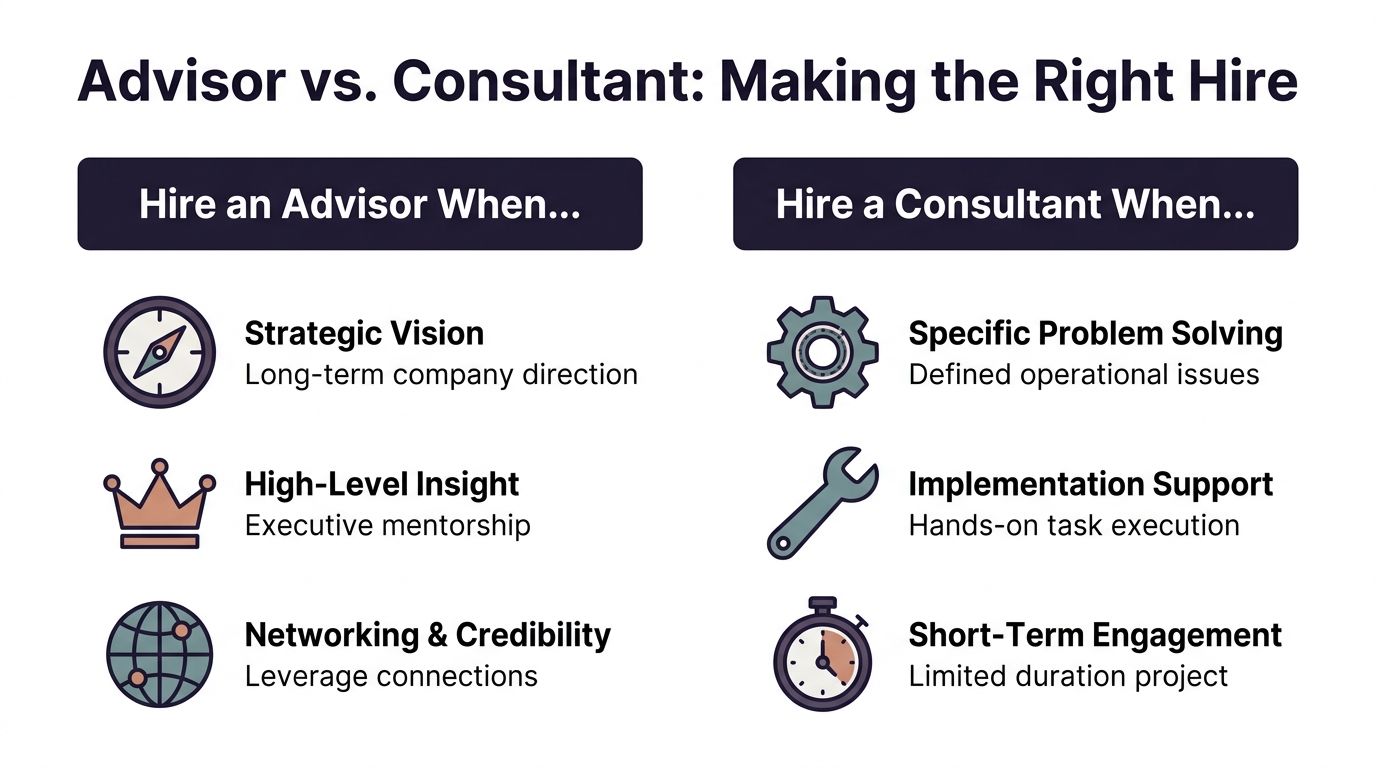
An advisor is like a ship's navigator. The sea is changing, the weather is uncertain, and leadership needs judgment about route, timing, and trade-offs. The advisor helps the captain make better calls over time.
A consultant is like a specialist mechanic. The engine is failing in a known way. The boat needs a fix, a process, or a specific intervention. The consultant comes in with a method, solves the defined issue, and hands the result back.
That's the core of advisor vs consultant. It isn't about prestige. It's about whether the startup needs interpretation or intervention.
What each role is really hired to do
Advisors are strongest when leadership is facing murky decisions. Common examples include entering a new market, shaping a fundraising narrative, tightening financial discipline before a board conversation, or deciding whether to reorganize the executive team. They help founders think, prioritize, and avoid expensive blind spots.
Consultants are strongest when the business can point to a concrete failure or project. That could be a broken CRM rollout, poor handoffs in RevOps, a messy pricing model implementation, or a need to redesign a reporting workflow. They usually work from a scoped problem toward a defined output.
For founders who want a deeper grounding in the advisory role, this breakdown of what a business advisor does is useful.
The practical difference inside a startup
The advisor changes the quality of decisions. The consultant changes the speed and quality of a defined piece of work.
That distinction matters because startups rarely have excess time or management attention. If the team needs direction, execution alone won't fix it. If the team needs execution, more direction can become a stall tactic.
A founder should hire for the bottleneck, not for the title.
Comparing Advisors and Consultants Head to Head
Here's the clearest side-by-side view.
| Criterion | Advisor | Consultant |
|---|---|---|
| Engagement model | Ongoing relationship | Project-based engagement |
| Problem type | Ambiguous, strategic, evolving | Defined, specific, time-bound |
| Primary value | Judgment, perspective, decision support | Analysis, execution, solution delivery |
| Scope of work | Broad business context | Narrower scoped initiative |
| Deliverables | Guidance, recommendations, strategic input | Reports, systems, plans, implementation support |
| Founder involvement | High collaboration and decision ownership | Often lower, with more work pushed through the project team |
| Time horizon | Long-term | Short-term |
| Pricing structure | Usually monthly retainer | Usually hourly or project-based |
Engagement model
The biggest operational difference is how the relationship works.
Business advisory services in the United States typically range from $500 to $10,000 per month, while business consultants are charged $100 to $350 per hour on average, according to this comparison of advisory and consulting pricing structures. That pricing gap reflects the underlying model. Advisors are usually retained for continuity. Consultants are usually brought in to solve a bounded problem.
For a founder, that affects more than cost. It affects how often the person is in the business, how thoroughly they learn the context, and whether they're there to guide decisions over time or deliver against a scoped need.
Scope of work
Advisors usually work across the business rather than inside one tightly defined lane. A finance advisor might shape hiring pace, cash posture, pricing sensitivity, and fundraising readiness in the same quarter because those decisions are connected.
Consultants usually stay closer to the statement of work. If they're hired to fix funnel reporting, redesign onboarding operations, or evaluate vendor systems, that's where they spend their time. That focus is useful when the company needs intensity and specialization.
Deliverables and ownership
Advisors often leave leadership with better choices, sharper priorities, and cleaner thinking. The output might be a planning framework, board prep, scenario guidance, or executive coaching around a strategic shift.
Consultants are more likely to produce visible artifacts and completed work. Think implementation plans, operating models, workflows, process maps, dashboards, or a rebuilt system.
Operator's lens: If you need someone to say, “Here's what I'd do and why,” you're leaning advisory. If you need someone to say, “Here's the workstream, owner, timeline, and deliverable,” you're leaning consulting.
Which one feels cheaper and why that can mislead
A monthly retainer can feel easier to absorb than a fast-moving consulting project. But cost isn't just what you pay. It's what happens after.
An advisor can be poor value if the team can't execute. A consultant can be poor value if the work solves the wrong problem. The better question is whether the engagement structure matches the business need.
Making the Right Hire Real World Scenarios
A founder realizes the outside hire was wrong about six weeks in. The meetings feel productive, the budget is moving, and the original problem is still there.
That usually happens because the company hired for the symptom instead of the job to be done. I see this in startups that are under pressure to show progress fast. They bring in a consultant because something is broken, then discover the underlying issue is poor executive judgment across pricing, hiring, and planning. Or they add an advisor for strategic guidance when what they need is someone to own a defined workstream and get it over the line.
The cost of that mismatch is real. A startup can burn a quarter on smart conversations with no execution, or pay project fees to fix a narrow problem while the broader leadership issue keeps slowing the business.
Hire an advisor when the business needs judgment
An advisor fits when the hard part is choosing well, not building a project plan.
That often looks like:
- Should we raise now or wait? The answer affects burn, headcount, pricing discipline, and how much risk the company can carry.
- Are we ready to move into a new segment or geography? Demand is only part of it. The team also needs the operating maturity to support expansion.
- Why does growth feel harder even though top-line metrics still look decent? That usually points to a strategy issue spread across several functions.
- How should the leadership team change for the next stage? Founders need pattern recognition and honest judgment here, not a task list.
In those situations, an advisor helps the founder make fewer expensive mistakes. The output is better decisions, cleaner priorities, and sharper trade-offs.
Hire a consultant when the issue is concrete
A consultant is the better hire when the company can define the problem, the scope, and the finish line.
Examples include:
- Customer acquisition cost jumped and the team needs a channel-by-channel diagnosis
- The company needs to implement a CRM or redesign RevOps workflows
- Financial reporting is inconsistent and management needs a repeatable process
- A broken accounting integration is delaying the monthly close
- The business needs an audit of a specific tax or compliance issue
These cases need speed, method, and delivery discipline. A strong consultant gives the startup a workplan, owners, timelines, and a finished output the team can use.
Real founder scenarios
A seed-stage SaaS company is preparing for its next fundraise, but the founder is unsure whether growth is efficient enough to support the story. That company usually needs an advisor first. The immediate question sounds financial, but the underlying issue touches positioning, spend, hiring pace, and investor readiness.
A Series A startup has outgrown spreadsheets, sales reporting is unreliable, and the CRM setup is hurting pipeline visibility. That is consulting work. The problem is specific, the success criteria are visible, and the team needs implementation more than reflection.
There is also a third case, and it is becoming more common. The founder needs senior judgment and someone who can still step into execution. That is why more startups are considering fractional leadership for growing companies instead of forcing a pure advisor or pure consultant hire.
A simple founder test
Ask three questions:
- Can I describe the problem clearly in one sentence?
- Do I need better judgment, or do I need work completed?
- Will this person need to help make decisions after the initial project is done?
If the first answer is no, start with advisory. If the second answer is execution, start with consulting. If the third answer is yes and the company also needs hands-on leadership, the old advisor-versus-consultant framing may be too narrow.
The wrong hire rarely fails all at once. It shows up as slower decisions, extra spend, founder frustration, and a team that still lacks direction.
Beyond the Binary The Rise of Fractional Leadership
A founder hits this point fast. The company is too complex for occasional advice, too fluid for a fixed consulting scope, and not ready for another full-time executive salary.
That gap is why the old advisor-versus-consultant debate no longer fits a lot of startups. Many teams need a senior operator who can help set direction, make calls with the founder, and stay close enough to execution to keep the work moving.

Fractional leadership has become the practical middle ground. Instead of paying for insight with no ownership, or paying for delivery with limited strategic continuity, startups get both in one role. The model works especially well when the core problem cuts across functions, which is common in early-stage companies.
A fractional CFO is a good example. They can tighten forecasts, clean up board reporting, pressure-test hiring plans, and help the founder make better cash decisions week by week. A fractional CMO can rebuild planning, clarify positioning, and coach the internal team while campaigns are still running. That work is broader than a consultant's project and more hands-on than an advisor's guidance.
The market is moving in that direction. Growth Market Reports reports that the global fractional executive market reached USD 8.6 billion in 2025 and is projected to grow at a 16.2% CAGR from 2026 to 2034.
That growth makes sense in practice.
Founders want senior judgment without adding a full-time executive cost too early. They also want continuity. A consultant usually leaves when the project ends. An advisor may stay involved, but often from a distance. A strong fractional leader stays close enough to own momentum, spot second-order effects, and adjust the plan as the company changes.
This model tends to outperform both alternatives when a startup has real complexity but still needs to protect cash. It helps when the company needs:
- Cross-functional decision-making instead of one narrow project
- Hands-on leadership without full-time executive overhead
- Consistency between strategy and execution
- Faster progress than a traditional executive search can provide
For founders weighing that option, this guide to fractional leadership for growing companies explains how the role works day to day.
A good fractional executive gives a startup more than advice and more than deliverables. They give the company experienced judgment that stays in the room while the work gets done.
How to Hire an Advisor Consultant or Fractional Leader
Founders often spend too much time debating titles and not enough time designing the hiring process. The interview should test fit for the work, not just résumé quality.
Questions to ask an advisor
When hiring an advisor, test for judgment under ambiguity.
Ask questions like:
- Tell me about a time you helped a founder make a decision with incomplete information.
- How do you challenge a leadership team without becoming noise?
- What signals tell you a startup has a strategy problem rather than an execution problem?
- How do you stay useful after the first few conversations?
A strong advisor should show pattern recognition, restraint, and the ability to influence without taking over.
Questions to ask a consultant
A consultant should be able to translate expertise into a scoped path forward.
Use prompts like:
- How would you diagnose this problem in the first two weeks?
- What would be in scope, and what would be out of scope?
- What deliverables should we expect by the end of the engagement?
- What do you need from our internal team to make this work?
If you're evaluating this route, this practical guide on how to hire a consultant helps clarify what a strong process looks like.
Questions to ask a fractional leader
A fractional executive has to balance altitude and execution. That's a different skill.
Ask:
- How do you decide when to stay strategic versus when to get hands-on?
- How do you build trust with a founder and an existing team quickly?
- What work should remain with internal staff, and what should you personally drive?
- How do you avoid becoming either too advisory or too tactical?
Hiring cue: The best fractional candidates speak fluently about decisions, operating cadence, and team dynamics. They don't hide behind generic strategy language.
What to include in the role brief
Keep the brief practical. It should define:
- The core problem: What's broken, unclear, or stuck
- The expected outcome: Better decisions, a fixed system, stronger leadership capacity, or a combination
- The operating model: Weekly involvement, decision rights, and who they'll work with
- The boundary lines: What this person owns, influences, and won't touch
A vague brief produces vague candidates. A tight brief attracts people who can help.
Find Your Next Growth Partner with Shiny
A lot of founders reach this point after trying to patch the problem themselves. The board wants better numbers. The team wants clearer direction. Cash is tight enough that a full-time executive hire feels premature, but standing still is more expensive.
Choosing between an advisor and a consultant is a hiring decision with real operating consequences. The wrong fit slows decisions, wastes budget, and leaves your team carrying work that outside help was supposed to solve.

The practical question is simple. Do you need perspective, execution, or someone who can own both for a defined stretch of time?
If the gap is strategic judgment, bring in an advisor. If the work is scoped and operational, hire a consultant. If the company needs senior leadership that can set direction, make decisions, and drive the work with your team, the better answer is often a fractional executive. That is the shift older advisor versus consultant comparisons miss. Startups do not always need occasional advice or a one-off project team. They often need accountable leadership without the cost and rigidity of a full-time executive search.
For growth-stage companies, the best outside partner is the one whose working model matches the problem, the timeline, and the level of ownership required.
If you're weighing advisor vs consultant and think a fractional executive may be the better fit, Shiny is built for that exact decision. You can explore vetted senior leaders across functions, compare options based on your stage and goals, or schedule a consultation to find the right growth partner without overhiring.