

Finding a DevOps Services Company: A Founder’s Guide
Your engineers are smart. Your product has demand. Customers keep asking for faster releases, cleaner fixes, and fewer regressions.
But every deployment feels like moving a couch through a narrow stairwell. Someone has to stay up late. Someone forgets a step. A “small release” triggers a production issue. The team spends the next morning patching instead of building.
That's usually the moment founders start looking for a DevOps services company.
Good instinct. Wrong first question.
Most founders ask, “Who can do this cheapest?” The better question is, “Who will make my team ship faster, recover faster, and stay flexible as we grow?” That's the core buying decision. You're not purchasing server help. You're choosing an operating model for how your company builds software.
A strong DevOps partner acts like a traffic engineer for your product team. They don't just pave more road. They remove the intersections that cause jams, put signals in the right places, and make sure one accident doesn't lock the whole city. Done right, DevOps improves business velocity, not just infrastructure hygiene.
When Slow Deployments Stall Your Growth
Slow deployments aren't a developer character flaw. They're usually a systems problem.
You see it in the same pattern over and over. Releases bunch up because the team is afraid to ship. Bugs surface after deployment because testing, handoffs, and rollback processes are inconsistent. Cloud costs drift upward because nobody owns the architecture as a business system. Security gets bolted on late because everyone's chasing feature deadlines.
That mess compounds. Product slows down. Sales starts hearing “your competitor already has that.” Engineering burns time on firefighting. Founders end up dragged into release approvals they should never have to touch.
What founders often misdiagnose
A lot of companies treat this like a hiring gap. They assume they need one stronger backend engineer, one better cloud person, or one more SRE. Sometimes that helps. Often it doesn't.
If your release process is fragile, adding people can make the fragility more expensive.
A DevOps services company should fix the operating system around your team. That means build pipelines, infrastructure patterns, release controls, observability, incident response, and ownership boundaries. This is akin to hiring a general contractor for a renovation. You don't hire them because you lack hammers. You hire them because sequencing, coordination, and quality control matter more than raw labor.
The right partner should reduce friction across the whole delivery chain, not just install a few tools and disappear.
There's a reason this market keeps expanding. The global DevOps market grew from US$4 billion in 2019 to a projected US$25.5 billion by 2028, driven by demand to reduce software development cycles and accelerate delivery speeds, according to Radixweb's DevOps market overview.
What the business actually needs
If you're choosing a partner well, you're not buying “DevOps” as a vague technical label. You're buying outcomes like these:
- Faster releases: Smaller, safer pushes to production.
- Lower risk: Fewer outages tied to deployments.
- Clearer accountability: Teams know who owns what during release and recovery.
- More focus: Developers spend more time building product and less time babysitting infrastructure.
That's why the right partner often looks less like a contractor and more like fractional leadership paired with execution. Founders need judgment, not just keyboard work.
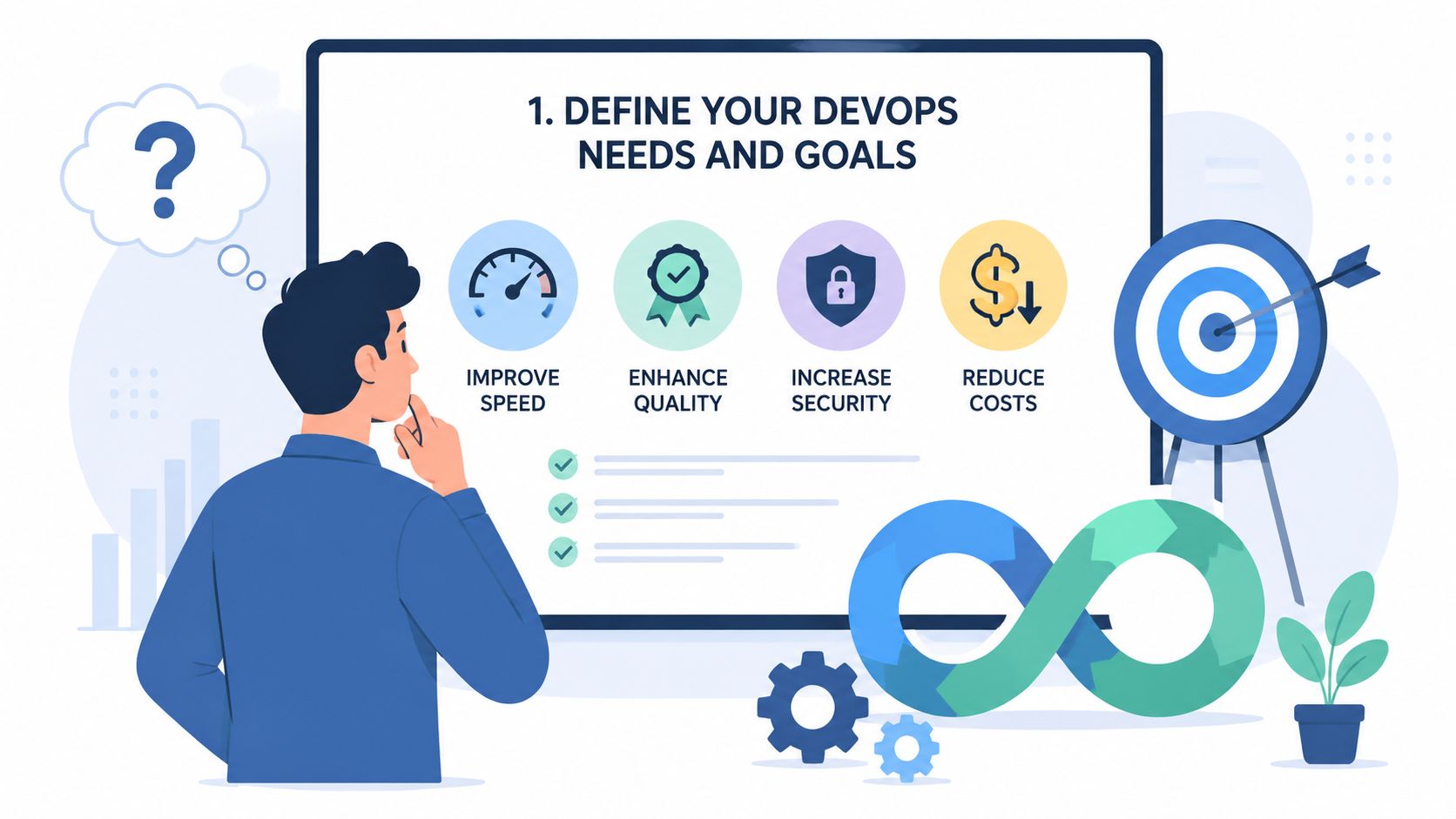
First Define Your DevOps Needs and Goals
Before you evaluate any DevOps services company, get your own house in order. Not technically. Operationally.
Most vendor conversations go sideways because the founder shows up with a shopping list of tools instead of a definition of pain. “We need Kubernetes help” is not a business goal. “We need releases to stop breaking payroll sync on Fridays” is.
A clear scorecard changes the conversation. It tells a serious partner what matters, and it exposes agencies that only know how to sell a prepackaged stack.
Start with business pain, not tool names
Use a quick self-audit. If you answer “yes” to several of these, you have a DevOps problem even if nobody has labeled it that way yet.
- Releases keep slipping: Features are done in code, but production rollout keeps getting delayed.
- Bugs spike after launches: Customer support hears about problems before engineering does.
- Cloud spend feels unpredictable: The bill arrives, everyone winces, and nobody can explain the jump.
- Key people are bottlenecks: One engineer knows the deploy steps, one person understands the AWS setup, one person handles incidents.
- Security is reactive: Checks happen late, exceptions pile up, and nobody trusts the release path.
- Developers are drowning in platform chores: Product work slows because engineers spend their week fixing pipelines, permissions, and flaky environments.
Turn pain into a scorecard
Now translate each pain point into a practical target. Keep it simple. A founder should be able to read it on one page.
For example:
| Current problem | Better goal |
|---|---|
| Releases require manual coordination | Standardize and automate the deployment process |
| Post-release bugs are frequent | Add quality and verification gates before production |
| Cloud costs drift without explanation | Improve visibility and governance around infrastructure use |
| Security reviews block launches | Shift security checks earlier into the delivery workflow |
| Developers lose time to platform support | Reduce developer cognitive load through better tooling and ownership |
A useful way to frame this is through your broader product plan. If your company doesn't already have one, build a simple technology roadmap that ties technical priorities to business goals. DevOps should support revenue, retention, compliance, and delivery speed. It shouldn't exist as a side project for engineering.
Practical rule: If you can't describe the pain in plain English, you're not ready to buy help for it.
Decide what success will look like
Don't stop at “we want improvement.” That's too vague to manage.
Write down:
- What must improve first: release reliability, cloud cost control, security, developer efficiency, or incident response.
- What can wait: a platform rebuild, multi-cloud strategy, or a complete tool overhaul.
- What your team can absorb: some teams can handle process change quickly, others need a lighter touch.
- What knowledge must stay in-house: credentials, architecture decisions, runbooks, and deployment ownership should never become opaque.
This prep work gives you bargaining power. Without it, you're buying whatever the vendor likes selling.
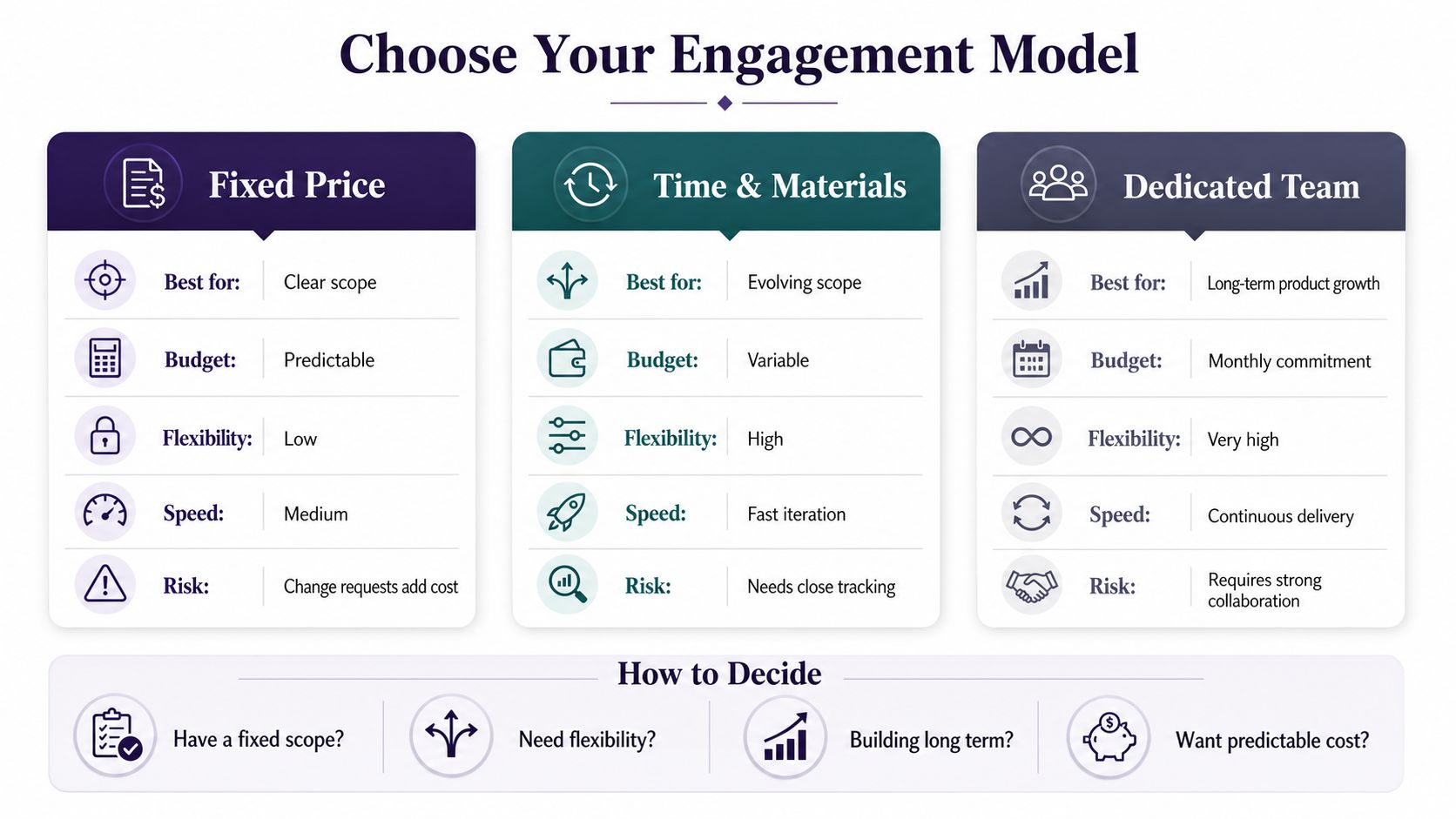
Choose Your Engagement Model
Not every DevOps services company delivers value the same way. Some are mechanics. Some are facility managers. Some behave like a part-time technical executive who also gets their hands dirty.
Pick the wrong model and you'll either overpay for strategy you can't use or underbuy execution and stay stuck.
A simple analogy helps. If your company were trying to get in shape, you'd have three choices. Hire someone for a one-time fitness assessment. Join a gym that handles the routine equipment and classes. Or work with a coach who designs the plan, keeps you accountable, and adapts it as your goals change. DevOps follows the same pattern.
The three models that matter
Some teams need a defined project. Others need steady operational support. Growth-stage companies often need both leadership and execution.
The market is moving this way for a reason. The DevOps talent shortage is persistent, and a fixed monthly DevOps-as-a-Service model can offer better cost predictability than recruiting, which can take over six months for SMBs that can't afford specialists for every niche, as explained in Naviteq's analysis of the DevOps talent shortage and service model.
Project-based consultancy
This works when you need a contained outcome.
Examples include:
- a cloud architecture audit
- a migration from manual deployments to CI/CD
- an infrastructure-as-code rollout using Terraform or Ansible
- a security review of the release pipeline
You hire a specialist team, they deliver the project, and they leave. Good for focused problems. Weak for long-term operating change.
Managed services
This is ongoing support. The vendor runs the machinery.
They might monitor infrastructure, maintain pipelines, handle alerts, patch systems, and keep environments healthy. This model helps if your internal team is small and you need dependable coverage. It can also create passivity if the provider becomes the only one who understands your platform.
Fractional DevOps leadership
This is the most underrated model for startups.
A fractional leader works like a part-time Head of Platform, VP Engineering, or senior DevOps strategist. They set direction, improve process, mentor internal people, and shape vendor decisions. The strong ones also ensure the work gets implemented, whether through your team, their team, or a blended setup.
This model is often the best fit when the actual issue isn't “we need tasks done.” It's “we need judgment, architecture discipline, and an execution plan.”
DevOps engagement model comparison
| Model | Best For | Cost Structure | Level of Integration |
|---|---|---|---|
| Project-based consultancy | One-time audits, migrations, or setup work | Fixed project fee or scoped engagement | Low to medium |
| Managed services | Ongoing infrastructure operations and support | Monthly retainer or service fee | Medium |
| Fractional leadership | Strategy, governance, team enablement, and execution oversight | Monthly retainer, often part-time leadership | High |
If you're weighing outside help more broadly, this breakdown of IT outsourcing development models is useful context. DevOps isn't separate from the rest of your delivery model. It shapes how all of it runs.
My recommendation for most founders
If you're early-stage and chaotic, don't jump straight to a giant managed services contract. You may end up outsourcing confusion.
Start with fractional leadership or a tightly scoped engagement led by someone senior enough to define standards, choose tools with restraint, and teach your team. Then add managed execution where it's useful.
Buy the brain before you buy the body count.
That sequence usually produces a cleaner operating model and less dependence later.
How to Properly Vet a DevOps Partner
Most founders get seduced by the wrong signals. Big logos. Fancy diagrams. A long list of cloud badges. None of that tells you how a DevOps services company behaves when production is broken at 2 a.m. or when your team resists a process change.
You want to know three things. How they think. How they work. Whether they'll leave your company stronger than they found it.
Ask questions that expose operating style
Skip generic prompts like “What tools do you use?” Any vendor can rattle off Jenkins, GitLab, Terraform, Kubernetes, Prometheus, and Grafana.
Ask sharper questions:
- Tell me about a deployment that went badly. What failed, how did you respond, and what changed afterward?
- How do you handle post-mortems? I want the process, not the slogan.
- What would you standardize in our stack, and what would you leave alone?
- How do you transfer knowledge to our team over time?
- Who will do the work after the sale?
- What access do you need, and how do you manage privileged credentials?
- How do you decide whether a team needs more autonomy or more guardrails?
Good partners answer with specifics. Weak ones hide behind methodology jargon.
Watch for tool religion
This matters more than most founders realize.
Startups should evaluate partners on tooling agnosticism and cloud sovereignty to avoid vendor lock-in. The best partners adapt to your ecosystem instead of forcing a monolithic toolset. That's a sign of operational maturity, not just a polished sales process, as discussed in Blackthorn Vision's guidance on choosing DevOps partners.
If a vendor insists every problem requires their preferred stack, be careful. Standardization is good. Forced uniformity is expensive.
A mature partner might say, “You're already invested in GitHub Actions and AWS. We'd improve the workflow around that first.” An immature one says, “We rebuild everything in our preferred platform because that's our method.”
Vendor lock-in in DevOps is like pouring the building's foundation around the contractor's tools. It makes every future renovation harder.
Test whether they can teach
A true partner builds capability inside your company.
Ask them how they document runbooks. Ask whether your engineers will join incident reviews. Ask who owns the final architecture decisions. Ask how they'll reduce dependence on their team over time.
The right answer is not “we handle everything.” The right answer is a shared model where your team gains confidence and clarity.
Pay attention to cultural fit
This sounds soft. It isn't.
DevOps work touches engineering, product, security, and leadership. If the partner communicates poorly, overcomplicates decisions, or talks down to your team, they'll create friction across the business.
Look for signs like these:
- Clear writing: Their proposals and follow-ups are easy to understand.
- Calm incident language: They don't dramatize problems or hide behind vagueness.
- Respect for constraints: They understand budget, team maturity, compliance, and delivery pressure.
- Adaptability: They can work with startup speed without imposing enterprise theater.
A partner should make the company feel more organized within the first few conversations. If they already feel confusing, the engagement won't improve that.
Understanding Costs Contracts and ROI
A lot of founders still buy DevOps the way they buy freelance development. They compare rates, pick the cheaper option, and hope discipline appears later.
That's backwards.
The cheapest partner often creates the most expensive environment. Not because they invoice more, but because they leave you with brittle pipelines, undocumented infrastructure, unclear ownership, and recurring production risk. DevOps economics live in the second-order effects.
Price the outcome, not just the labor
You should understand the commercial model. Fixed-scope projects are easier to budget but easier to underspecify. Monthly retainers are steadier, but only if the deliverables and decision rights are clear. Time-and-materials can work for exploration, but it gets messy fast when nobody defines success.
When you review pricing, ask:
- What is included operationally: strategy, implementation, monitoring, incident support, documentation, training
- What triggers extra fees: after-hours incidents, new environments, security work, cloud migrations
- Who owns vendor relationships: cloud platforms, observability tools, CI/CD systems
- What happens if scope changes: is there a review process or just rolling invoices
If you need a framework for evaluating outside advisory fees, this guide to consultant pricing strategy helps you separate sticker price from actual value.
Define ROI in business terms
ROI isn't just “we spent less on infrastructure.” It's broader than that.
Look at:
- Time-to-market: can the team ship customer-facing improvements with less friction?
- Developer productivity: are your product engineers spending less time on release mechanics?
- Risk reduction: are incidents handled faster and with less chaos?
- Leadership focus: are founders and engineering managers spending less time on operational babysitting?
These are real returns even when they don't show up as one clean line item.
Put the right terms in the contract
A mature contract should be specific about responsibilities and operating expectations.
Include:
- Named deliverables: architecture review, pipeline improvements, documentation, runbooks, onboarding plan
- Communication rhythm: weekly review, incident escalation path, decision owners
- Access controls: who can touch production, who approves changes, how credentials are managed
- Knowledge transfer: required documentation, training sessions, handoff expectations
- Exit terms: what happens to configs, scripts, dashboards, and documentation if the engagement ends
One more point. Don't settle for vague promises like “we guarantee uptime” without meaningful operational definitions. Push for service objectives tied to user experience and recovery expectations, not generic sales-language assurances.
A strong contract doesn't just protect against failure. It creates the conditions for accountability.
Ensuring a Smooth Onboarding and Handoff
The contract is signed. Now the test begins.
A bad start poisons even a smart engagement. A good start creates trust quickly. Treat the first month like the installation of a new operating rhythm, not just vendor onboarding.
What the first 30 days should include
In the first few weeks, make sure these basics happen:
- Secure access setup: grant only the systems they need, and document approvals clearly.
- Shared communication channels: use a dedicated Slack channel, standing check-ins, and one source of truth for tasks.
- Discovery workshops: review architecture, deployment flow, incident history, and current team pain points.
- Priority alignment: decide what gets fixed first and what gets left alone for now.
- Documentation baseline: existing diagrams, runbooks, and environment notes should be collected immediately.
This phase should feel organized, not theatrical. If the provider spends two weeks talking and still hasn't clarified priorities, that's a warning sign.
Plan the handoff before you need it
Founders often forget this part. They assume they'll deal with knowledge transfer later.
Don't.
Ask for a living handoff plan from the beginning. That includes architecture decisions, operating procedures, dashboard ownership, CI/CD workflows, and incident playbooks. Your internal team should become more capable as the engagement matures, not more dependent.
A good partner leaves behind a better machine and people who know how to run it.
Success Metrics and Red Flags to Watch For
If you can't measure the partnership, you can't manage it.
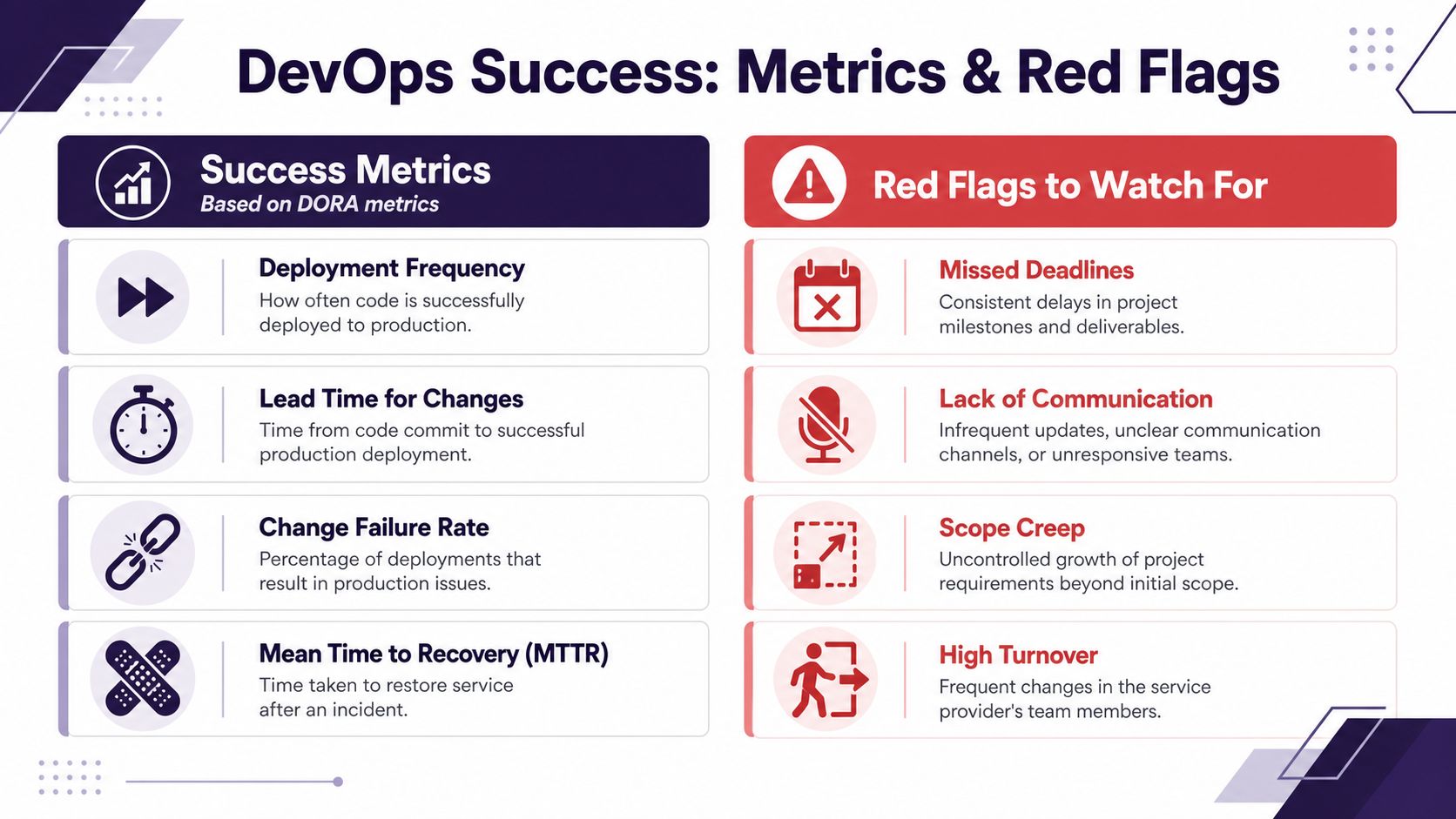
The cleanest way to track DevOps performance is through the four DORA metrics: deployment frequency, lead time for changes, change failure rate, and mean time to recovery. You don't need extensive technical knowledge to use them. They answer simple business questions. How often do we ship? How long does change take? How often does a release break something? How quickly do we recover when it does?
High-performing DevOps organizations achieve a change failure rate of 5% or less and a mean time to recovery under 1 hour, while low-performing teams often exceed a 15% failure rate and take over 24 hours to recover, according to Octopus's DevOps statistics summary citing DORA benchmarks.
What good performance looks like
Watch for signs such as:
- More routine deployments: shipping becomes normal, not a special event.
- Shorter path from code to customer: fewer delays between completed work and release.
- Lower disruption after releases: fewer fixes, reversions, and customer-reported surprises.
- Faster recovery: incidents still happen, but the team restores service calmly and quickly.
Red flags that should worry you
These are the patterns that usually mean the partnership is drifting:
- Everything stays opaque: the vendor reports activity, but your team still doesn't understand the system.
- Tool sprawl keeps growing: they keep adding platforms instead of simplifying operations.
- Communication gets reactive: updates appear only after something slips.
- No proactive recommendations: they execute tickets but never challenge weak process or architecture.
- Your team feels sidelined: engineers resent the partner because knowledge is being hoarded.
A strong DevOps partner should improve your company's reflexes, not just its scripts. If a fractional model sounds like the right fit, the smartest next move is to explore leaders who can shape the system, mentor the team, and keep execution grounded in business reality.
If you're weighing a DevOps services company and suspect you really need strategic leadership, not just another vendor, Shiny is worth a look. Shiny helps startups and growth-stage companies find vetted fractional executives who can step in for a focused number of hours each week, bring senior judgment fast, and help you make the right technical partnership decision without committing to a full-time executive hire.
