
Outsourced Marketing Director Services: A Founder’s Guide
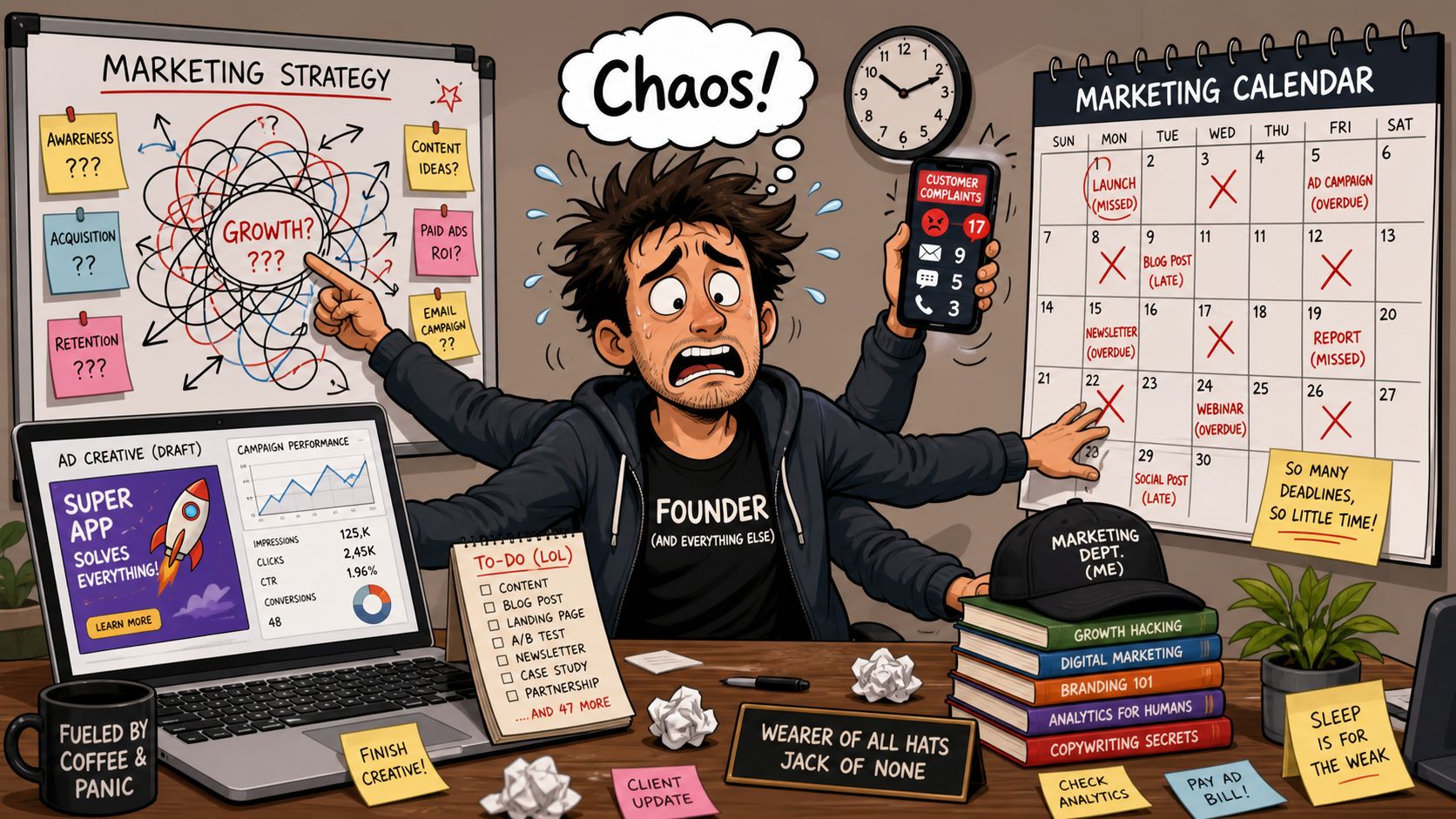
Your pipeline is growing, but your marketing still feels like a group project with no project manager. One person is posting on LinkedIn, another is tweaking landing pages, a freelancer is running paid ads, and you're still the one deciding what matters this quarter.
That's usually the moment founders start looking for leadership, not more activity.
The problem is simple. You need senior marketing judgment, but a full-time executive hire can feel heavy, slow, and expensive. That's why outsourced marketing director services have become such a practical option for startups and growth-stage companies that need strategy, accountability, and execution oversight without committing to a permanent senior hire too early.
When You Need a Marketing Leader Not Just More Marketing
The common founder mistake is assuming the next fix is another channel, another agency, or another specialist. It usually isn't. If your marketing feels scattered, the issue is often leadership.
You can spot it quickly:
- Campaigns keep shipping without a clear theme. The team is busy, but the work doesn't ladder up to one plan.
- Vendors need constant direction. You're acting as the translator between strategy and execution.
- Results are hard to explain. You know what happened, but not why it happened.
- Marketing depends on founder energy. If you stop pushing, momentum drops.
That's where outsourced marketing director services fit. They give you a senior operator who sets direction, aligns people, and creates a repeatable system.
This isn't a niche hiring workaround anymore. The global fractional executive market reached $9.4 billion in 2025 and is projected to expand to $24.7 billion by 2034, while demand for fractional marketing leaders surged by 68% between 2023 and 2024, according to Ancore Partners' review of fractional executive hiring trends.
What founders are really buying
You're not buying extra hands. You're buying clarity.
A strong outsourced marketing director decides:
- what the company should focus on now
- which channels deserve investment
- how internal staff and external partners should work together
- what “good” looks like for the next quarter
Practical rule: If marketing feels busy but not directed, you likely need leadership before you need more execution.
There's also a broader operating shift behind this. Companies are increasingly using outside senior talent because they want access to judgment without carrying the full weight of building an oversized internal department too early. The model is especially useful when the company has enough complexity to need leadership, but not enough scale to justify a permanent C-suite marketing hire.
That's the sweet spot. Most founders reading this are already in it.
What an Outsourced Marketing Director Actually Does
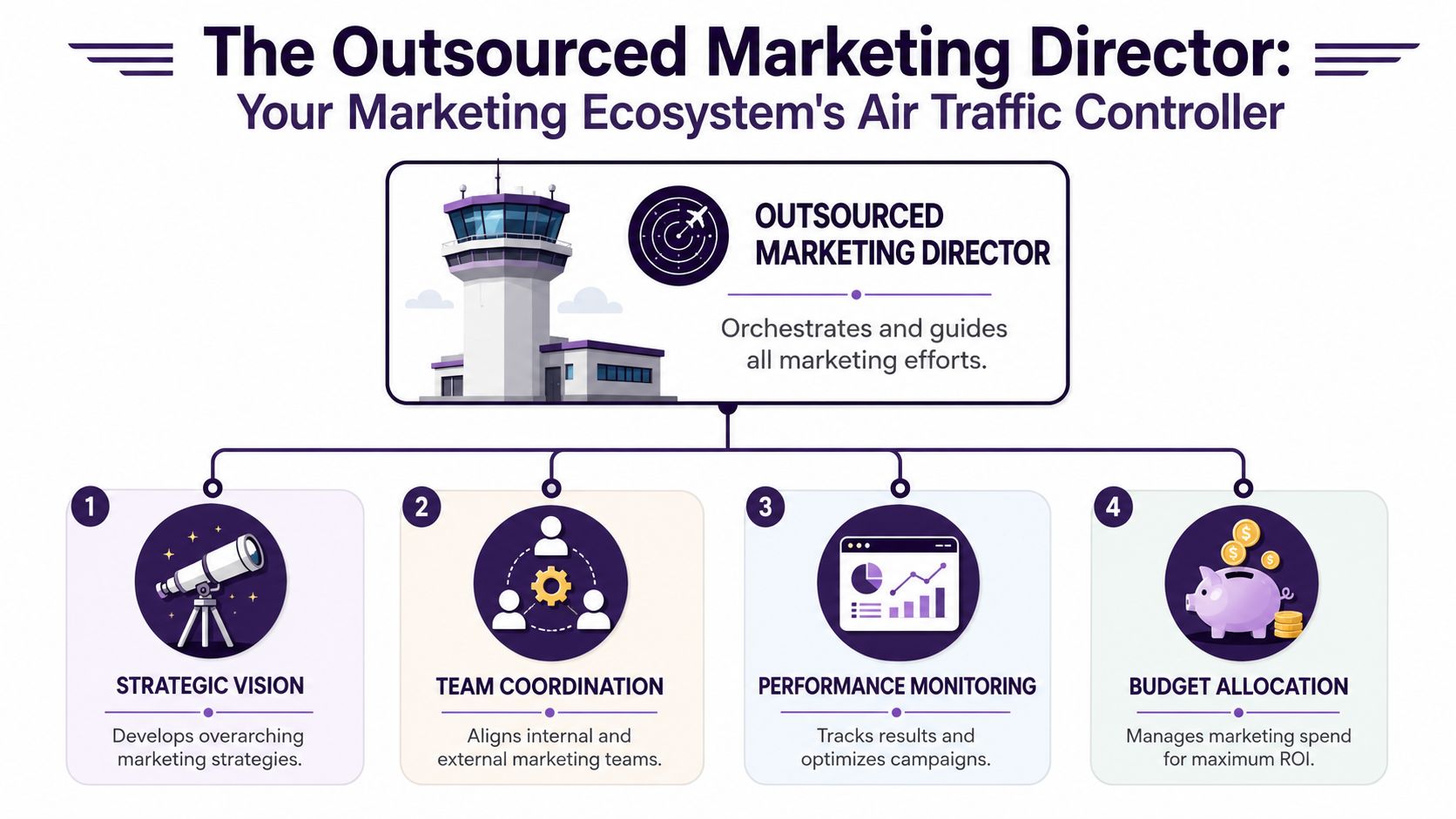
An outsourced marketing director is the air traffic controller for your marketing system. They may not write every ad, design every page, or publish every campaign, but they make sure the right work happens in the right order, with the right priorities.
What they own
A real director-level operator usually takes responsibility for four areas.
Strategic direction
They translate company goals into a marketing plan. That means deciding whether the next quarter should prioritize demand generation, positioning, sales enablement, customer expansion, or channel cleanup.
They also force tradeoffs. That matters because most startups don't fail from lack of ideas. They fail because too many ideas compete for too little focus.
Team alignment
They manage the people doing the work, even if those people don't report to them full time. That might include an internal marketer, a paid media freelancer, a content contractor, a designer, and an SEO agency.
Instead of each person running their own mini-plan, the director creates one operating rhythm.
Budget and priorities
They decide where money should go, what should pause, and what needs proof before getting more budget. This encompasses more than “managing campaigns.” It's resource allocation.
A founder often spreads budget across channels to stay safe. A strong director concentrates spend where the company can learn fastest.
Measurement and decision-making
They define the scoreboard. Not vanity metrics. Decision metrics.
That usually includes questions like:
- Are we attracting the right audience?
- Are leads turning into real pipeline?
- Which channel deserves another month of investment?
- Where is handoff between marketing and sales breaking down?
A junior marketer asks, “What should I post this week?” A director asks, “What market signal are we trying to create this quarter?”
What they don't do
Founders get confused here.
An outsourced marketing director is not the same as:
- A general agency retainer that mainly executes tasks you assign
- A consultant who delivers a slide deck and disappears
- A junior marketing manager who needs constant direction
- A specialist focused on one channel like SEO or paid search
They may still write, review, or jump into execution when needed. Early-stage companies often require that. But their core value is leadership, not task volume.
A simple way to think about it
If marketing were a movie set:
- the freelancers are the camera, lighting, and editing crew
- the agency is a production vendor
- the founder is the studio paying the bill
- the outsourced marketing director is the person making sure everyone is working from the same script
Without that person, you don't get a campaign. You get motion.
Why This Is a Strategic Advantage for Your Startup
Founders often start by viewing outsourced marketing director services as a budget workaround. That undersells the model. A key advantage is that you get senior judgment in a form your company can use.
Four reasons the model works
You spend less while adding leadership
Businesses using outsourced marketing save an average of 25 to 30% on operating expenses, according to Datamatics on outsourced marketing services. The win isn't just lower cost. It's avoiding the fixed weight of a full internal build before your needs are stable.
You solve the skill-gap problem faster
The same source notes that 50% of companies outsource marketing work primarily because of skill gaps, not merely to cut costs. That's a major shift. It means companies are buying expertise on purpose, not treating outsourcing as a compromise.
You get a cleaner strategic lens
An outside director can usually spot waste faster than a founder or internal team can. They're not attached to channels just because someone worked hard on them. They can say, “This webinar series isn't moving revenue,” or “Your sales deck and homepage are telling two different stories,” without internal politics getting in the way.
You can scale involvement with the business
Some months you need roadmap work, team management, and vendor cleanup. Other months you just need steering and review. The model bends with the company, which is useful when growth isn't linear.
Why this matters more in startups
Startups don't usually need a giant marketing department first. They need a senior person who can answer practical questions:
- What should we stop doing?
- Which audience matters most right now?
- Are we ready to invest in demand generation?
- Is our current agency helping or just staying busy?
A founder can answer those questions for a while. Then the company gets too complex.
The hidden gain founders notice later
The biggest improvement is often managerial, not promotional.
When a director takes over marketing leadership, founders stop being the default approver for every campaign, headline, landing page, and vendor disagreement. That frees up attention for hiring, fundraising, product, and sales.
The best outsourced leadership doesn't create dependence. It removes the founder from day-to-day marketing decisions that shouldn't require founder time.
That's why this model works so well in the messy middle. You're beyond random experimentation, but you're not ready for a full permanent executive layer across every function.
Outsourced Director vs Fractional CMO vs Agency
These models overlap, which is why founders lump them together. But they solve different problems.
The biggest distinction is strategic ownership versus execution delegation. Many options can advise. Fewer will own the roadmap and make sure teams implement it. That gap matters because, as noted in WPMU DEV's discussion of outsourced marketing questions, existing guides often miss the need for a built-in execution assurance protocol.
Choosing your marketing leadership model
| Model | Primary Focus | Typical Cost | Best For |
|---|---|---|---|
| Outsourced Marketing Director | Strategic ownership, team coordination, implementation follow-through | Usually structured as an ongoing part-time leadership engagement | Startups that need someone to build the plan and make sure it gets executed |
| Fractional CMO | Executive-level marketing strategy, positioning, planning, leadership at a senior level | Often a monthly fractional leadership fee | Companies that need top-level marketing leadership and board-level thinking. For a deeper breakdown, see what a fractional CMO does |
| Agency | Channel execution, campaign production, specialist delivery | Retainer or project-based service fees | Teams that already know the strategy and need outside execution capacity |
| Full-Time Hire | Embedded in-house ownership across strategy, team leadership, and internal operations | Full salary, benefits, hiring cost, and long-term commitment | Companies with enough scale and stability to support a permanent senior leader |
Where founders usually choose wrong
They hire an agency when the need is for leadership.
That creates a common pattern. The agency asks for direction. The founder gives rough direction. Campaigns go live. Results are mixed. Nobody can tell whether the channel failed or the strategy was weak.
An outsourced marketing director fixes that by sitting above the channel work. They define the plan, assign the work, review the output, and keep everyone aligned.
Outsourced director versus fractional CMO
In practice, these titles can blur. Some companies use them almost interchangeably.
The useful distinction is this:
- A fractional CMO often operates at the highest strategic level. Positioning, growth model, market selection, board conversations, and cross-functional leadership.
- An outsourced marketing director is often closer to the operating layer. They still shape strategy, but they also stay close to implementation and team management.
If your company needs sharper market strategy and executive guidance, a fractional CMO may be the fit. If you need someone to own the plan and make sure the machine runs every week, an outsourced director may be more practical.
A quick litmus test
Ask one question in the sales process:
“Who makes sure the plan gets implemented after the strategy is approved?”
If the answer is vague, you're buying advice, not leadership.
That doesn't make the option wrong. It just means you should know what problem it solves.
How to Find and Hire the Right Marketing Director
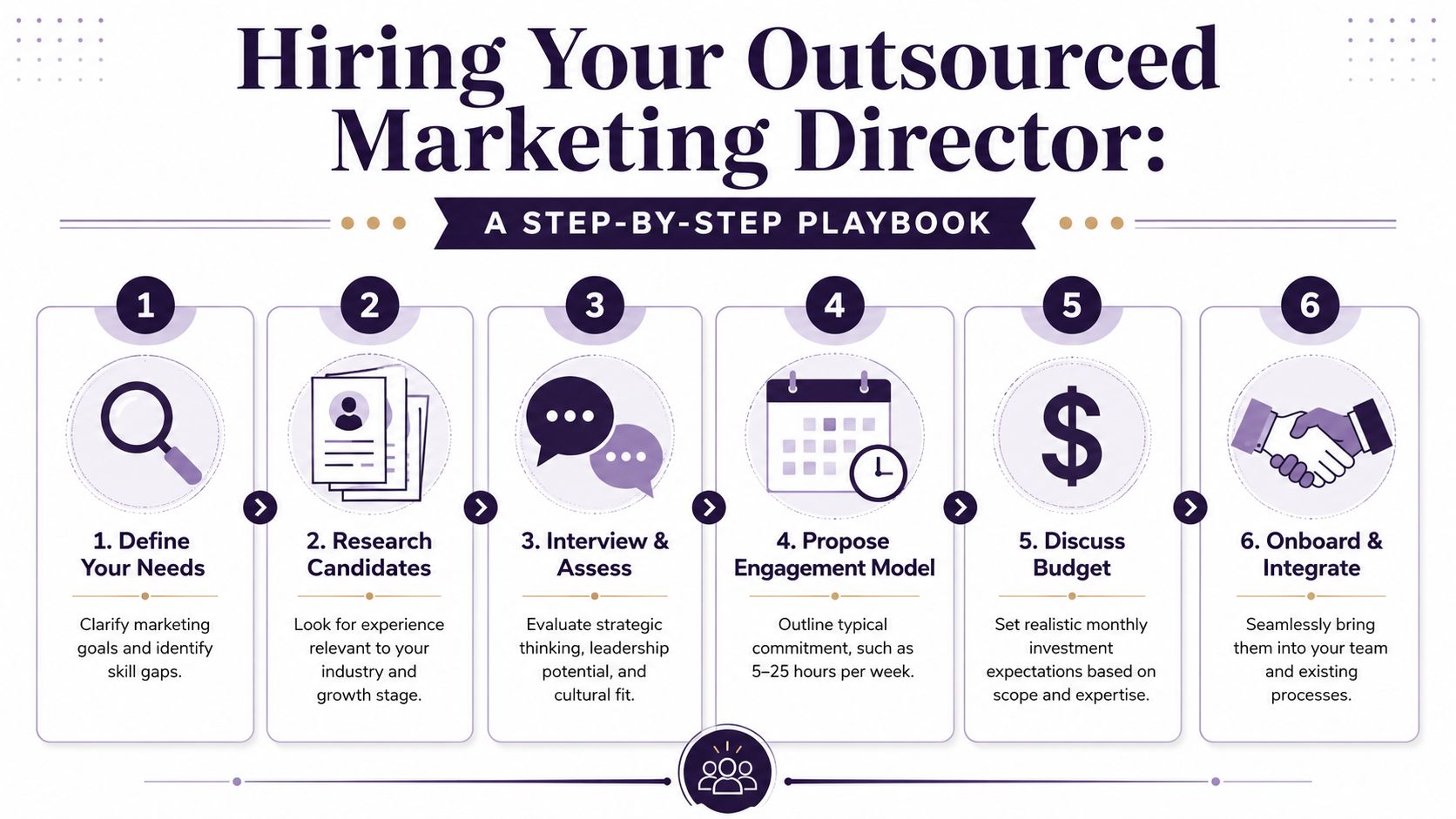
Most hiring mistakes happen before interviews start. Founders begin searching without defining the actual job. Then they meet candidates with polished backgrounds and no fit for the specific need.
The right process is simpler. Start with your business problem, not the title.
Start with the gap, not the resume
Write down what's broken today.
Examples:
- your lead flow is inconsistent
- your agency has no clear owner on your side
- sales and marketing disagree on lead quality
- you have activity in multiple channels but no quarterly plan
- your internal team can execute, but nobody is steering
That list tells you whether you need a strategist, an operator, or both.
Know what a normal engagement looks like
A fractional marketing director typically works 10 to 40 hours per month, with monthly fees ranging from $5,000 to $12,000, according to RSM Connect's explanation of outsourced marketing departments. The same source notes this model can reduce total marketing leadership costs by around 30% compared to a full-time hire, excluding benefits and overhead.
The exact shape depends on the business. Some founders need a few senior hours each week. Others need a more active operator during a repositioning, team rebuild, or channel overhaul.
Shiny is one example of a marketplace model for this category. It connects startups with part-time executives and supports hiring workflows for companies that want structured access to fractional talent.
What to look for in candidates
Don't over-index on brand names in their background. Look for pattern recognition and operating judgment.
Use this checklist:
- Stage fit matters most. Someone brilliant at enterprise brand management may struggle in a startup that needs fast prioritization and messy cross-functional leadership.
- Channel fluency matters, but leadership matters more. They don't need to be the deepest paid media buyer or SEO tactician in the room. They do need to know how to evaluate specialists.
- Ask for decision stories. Have them explain when they killed a channel, changed messaging, or restructured a team.
- Look for implementation habits. Strong candidates talk about cadences, dashboards, owner assignments, and review loops.
- Test how they handle ambiguity. Early-stage companies rarely hand them a clean environment.
Hiring lens: You're not choosing the person with the most ideas. You're choosing the person who can make your team act on the right ideas.
A sample role brief
You don't need a formal corporate job description. A clear operating brief works better.
Role overview
We need a part-time marketing leader to build quarterly strategy, align vendors and internal contributors, prioritize budget, and improve accountability across marketing.
Current environment
We have active marketing efforts, but ownership is fragmented. We need one senior person to define priorities and drive execution.
Key responsibilities
- set the marketing roadmap
- manage external partners and internal contributors
- review channel performance and recommend changes
- improve reporting and planning rhythm
- align marketing work with company goals and sales needs
Success looks like
- clearer priorities
- better cross-functional alignment
- stronger execution discipline
- more confidence in where marketing time and budget are going
Interview questions that expose real capability
Use questions that force candidates to think in systems.
Try these:
- Our team is busy, but marketing feels scattered. What would you audit first?
- How do you decide whether a weak result came from bad strategy or bad execution?
- Tell me about a time you inherited agencies, freelancers, or an internal team that wasn't aligned.
- How do you build a quarterly plan when the founder has too many priorities?
- What should stay with the founder, and what should move to you in the first month?
- How do you keep strategy from becoming a slide deck nobody uses?
If you want a longer screening list, these marketing executive interview questions are a useful starting point.
Red flags that should slow you down
Some warning signs are subtle.
- They only speak in channel tactics. You need leadership, not just platform knowledge.
- They can't describe operating cadence. Good directors know how meetings, reviews, approvals, and reporting should work.
- They promise to do everything personally. That usually signals poor delegation or a misunderstanding of the role.
- They avoid tradeoffs. If every channel sounds important, they may not know how to prioritize under constraint.
A strong hire will sound calm, specific, and slightly ruthless about focus.
Onboarding and Measuring for Success
A good hire can still fail in a bad operating environment. Most outsourced leadership problems come from unclear workflows, weak access, and fuzzy success measures.
That's consistent with Growth Rocket's analysis of outsourced marketing programs, which found that 68% of failed outsourcing engagements stem from a lack of real-time performance metrics and clear workflows, not a lack of talent.
The first 30 days
Give your new director enough context to lead.
Use a checklist like this:
- Grant access early. Analytics, CRM, ad platforms, website tools, dashboards, prior plans, and current vendor contracts.
- Map the people. Introduce sales, customer success, product, founders, and anyone touching marketing execution.
- Show the history. What's been tried, what's still running, what the team believes is working, and what nobody trusts.
- Define the decision rights. Make clear what they can approve, what needs founder sign-off, and where budget authority sits.
- Schedule a working strategy session. Not a presentation. A real decision meeting.
What to measure
Measure a director on leadership impact, not just campaign activity.
A useful review framework includes:
| Review area | What to assess |
|---|---|
| Output quality | Is the work clearer, sharper, and more strategically aligned? |
| Deadline adherence | Are plans, reviews, and deliverables moving on time? |
| Client or business impact | Is marketing becoming easier to manage and more useful to the company? |
| Workflow health | Are approvals, briefs, and ownership clearer than before? |
Good onboarding removes excuses. Good measurement removes ambiguity.
Structured reviews matter because outsourced leaders need feedback loops just as much as internal leaders do. If you want a practical reference point for integration, these executive onboarding best practices for modern leadership success can help shape the first phase.
Keep the reporting simple
You don't need a massive dashboard at the start.
You do need answers to a few recurring questions:
- what did we decide
- what shipped
- what changed in performance
- what needs escalation
- what should stop
That operating rhythm is what turns outsourced marketing director services from a clever hiring model into an actual management advantage.
Frequently Asked Questions
Is an outsourced marketing director just a consultant
No. A consultant usually advises from the outside. An outsourced marketing director should be embedded in decisions, priorities, and team coordination. They don't just recommend. They help drive adoption.
Can they manage my current team or freelancers
Yes. In many companies, that's one of the main reasons to hire them. They can align internal marketers, agencies, designers, writers, and paid media specialists around one plan and one review rhythm.
How long do these engagements usually last
It depends on the company's stage and need. Some founders use the model during a growth phase, repositioning effort, or team transition. Others keep the arrangement in place longer because the flexibility works.
What's the biggest hiring mistake
Choosing someone who can talk strategy but won't own implementation. If the roadmap depends on you to push every next step, you still don't have marketing leadership.
If you're exploring part-time executive support, Shiny offers a fractional executive marketplace where startups can connect with experienced leaders, including marketing executives, for flexible engagements and structured hiring. A short consultation can help clarify whether you need an outsourced marketing director, a fractional CMO, or a different setup entirely.