Executive Background Checks: Secure Your Startup Hires
You're close to making a leadership hire. The candidate interviews well, the references sound polished, and the résumé looks exactly like what your company needs right now.
That's the moment founders get exposed.
At the executive level, a bad hire doesn't just slow a team down. It can distort strategy, hide financial risk, trigger compliance problems, and create board-level damage before anyone realizes what's happening. That risk gets even harder to manage when the hire is fractional and actively serving multiple companies at once.
Why Executive Vetting Is Your Most Critical Hire
A founder can recover from a weak mid-level hire. A startup may not recover cleanly from the wrong CFO, COO, CRO, or fractional operator with access to cash flow, customer data, fundraising conversations, or sensitive board discussions.
The financial gap alone should reset how you think about executive background checks. Executive fraud results in a median loss of $500,000 per incident, compared with a $60,000 median loss from standard employee fraud, according to ACFE-related 2024 data summarized here. That's the difference between an expensive mistake and a company-shaking event.
A standard employment screen is built for volume hiring. It usually answers narrow questions. Is this person who they say they are? Is there a criminal record in the basic search scope? Did they work where they claimed?
That's not enough for leadership hiring.
What founders often miss
Executive vetting is about patterns of judgment, not just isolated records. You're checking whether someone has handled fiduciary responsibility responsibly, whether prior claims line up with reality, and whether old issues were disclosed before you found them yourself.
When founders skip that deeper review, they usually do it for one of three reasons:
- Speed pressure: The company needs leadership now, so diligence gets compressed.
- Social proof: A candidate has a known brand on their résumé, so people assume credibility.
- Reference bias: Backchannel praise substitutes for actual verification.
Practical rule: The more authority a role has over money, people, compliance, or reputation, the less useful a basic background screen becomes.
That applies to full-time executives and it applies just as much to part-time leaders. In some ways, fractional roles require more discipline because founders tend to treat them like contractors when they function like senior officers.
If you're already thinking about how to hire executives, treat vetting as part of the hiring decision itself, not an admin task after you've emotionally committed to the candidate.
What an Executive Background Check Truly Uncovers
Most founders hear “background check” and think criminal search. For executive roles, that's only one slice of the picture.
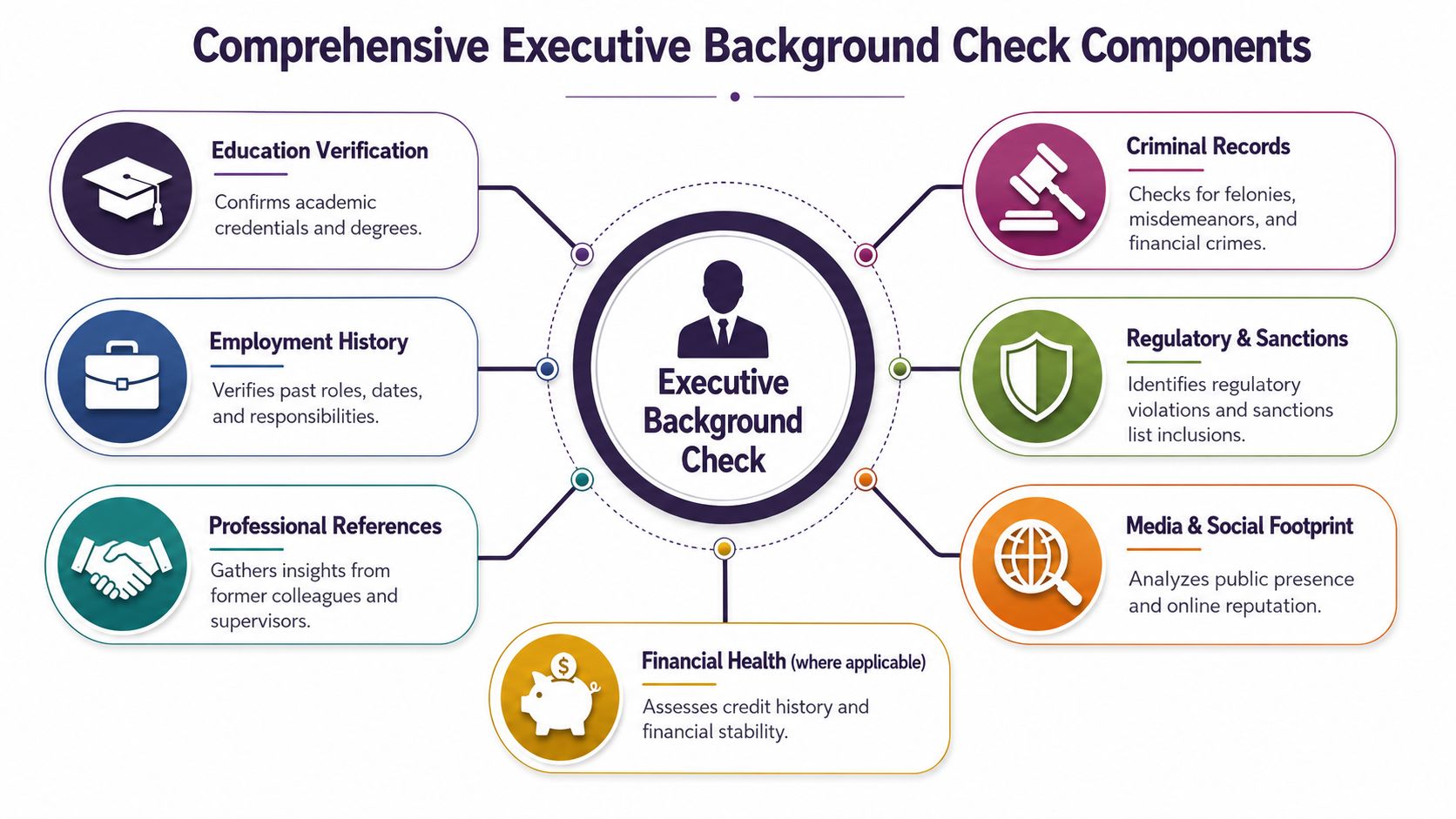
A proper executive screen has seven core components: identity and employment verification, education and license validation, litigation and civil court search, financial and credit analysis, sanctions and politically exposed person screening plus adverse media review, board membership and conflict review, and reputational or digital-footprint analysis, as outlined in this executive screening overview.
The seven areas that matter
Some categories are straightforward. Identity, education, and employment checks confirm the résumé is real.
Others are where executive risk usually hides:
- Litigation and civil court review: This shows whether a leader was repeatedly involved in disputes tied to governance, contracts, fiduciary conduct, or employment matters.
- Financial review: For finance-facing roles especially, you want to understand signs of distress, undisclosed liabilities, or patterns that may affect judgment.
- Sanctions and adverse media: This matters in regulated sectors and for any company that can't afford reputational surprises.
- Board and conflict review: A founder hiring a part-time executive needs this more than most. Concurrent seats, advisory roles, and side ventures can create divided loyalties fast.
- Digital-footprint analysis: Public behavior, published commentary, and online affiliations can reveal judgment issues an interview won't surface.
If you're building any broader risk and fraud management approach, executive screening belongs in that system. It shouldn't sit in a separate HR box.
Standard employee check vs executive screening
| Area of Scrutiny | Standard Check | Executive Screening |
|---|---|---|
| Identity verification | Basic confirmation | Deeper identity validation tied to full career history |
| Employment history | Limited title and date checks | Detailed verification of roles, scope, seniority, and inconsistencies |
| Education and licenses | Degree confirmation if requested | Degree, accreditation, and license validation where applicable |
| Criminal records | Often jurisdiction-limited | Broader criminal review with attention to white-collar risk |
| Civil litigation | Rarely included | Core part of the review |
| Financial analysis | Usually excluded | Considered where role sensitivity supports it |
| Regulatory and sanctions review | Often omitted | Expected for executive-level due diligence |
| Board memberships and conflicts | Rarely examined | Essential, especially for fractional hires |
| Media and reputation review | Minimal or none | Public record, news, and digital-footprint analysis |
What works in practice
The most useful reports don't dump raw data on your desk. They connect findings to the role.
A CFO candidate with a messy civil dispute from years ago may not be a dealbreaker. A CFO candidate who omitted a board role tied to litigation is a different conversation. Context matters. Disclosure matters more.
The real value of executive background checks is rarely a single dramatic discovery. It's catching the mismatch between the story told in interviews and the record left behind.
Navigating the Legal and Compliance Maze
A sloppy executive screen creates a second problem while you're trying to prevent the first one. You reduce hiring risk, then create legal risk.
Consent comes first
If a third-party screening provider is involved, candidate authorization isn't optional. Founders sometimes treat executive candidates differently because the relationship feels more peer-to-peer than employer-to-applicant. That's a mistake.
Document consent clearly. Define scope clearly. Keep the screening relevant to the role. For executive hires, that usually means being explicit about expanded review categories, especially if the role includes fiduciary control, regulatory exposure, or international operations.
FCRA discipline matters
The verified screening benchmarks commonly tie the phased process to Fair Credit Reporting Act compliance, not just investigative thoroughness. That matters because adverse information has to be handled in a defensible way.
In plain terms, if a report affects your decision, your process should be consistent, documented, and fair. Don't make off-the-cuff decisions based on a partial note from a vendor. Review the finding. Confirm relevance. Give the candidate a chance to respond where required.
A practical founder-level checklist looks like this:
- Use a specialized provider: Executive screening isn't the place for a commodity, checkbox-only vendor.
- Keep role relevance front and center: A finding should connect to job risk, governance, trust, or compliance.
- Separate fact from interpretation: Court record, credential mismatch, and sanctions result are facts. Commentary around them needs judgment.
- Coordinate HR and counsel early: Don't wait until a problem appears in the report.
International candidates add complexity
Cross-border hiring complicates privacy, data retention, and verification. Even when a candidate is based in the U.S., parts of their history may not be. That changes how records are accessed and how information can be used.
For founders, the practical takeaway is simple. If the candidate has lived, worked, studied, or served on boards across multiple jurisdictions, use a partner that knows how to manage international compliance and documentation. Don't improvise with web searches and a domestic-only screening flow.
A legally weak screening process can make a good hiring decision hard to defend and a bad hiring decision even worse.
Your Executive Screening Process and Timeline
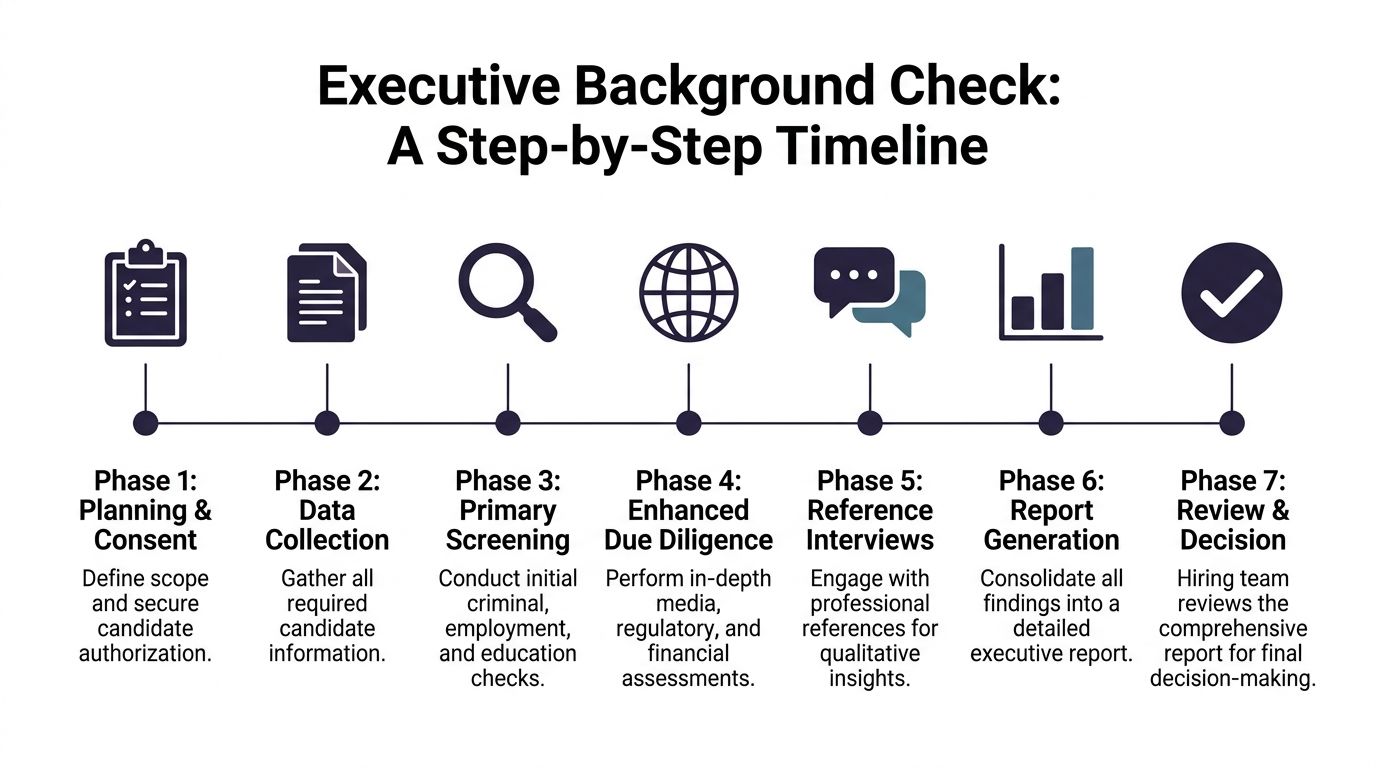
Executive background checks move slower than standard checks because the work is different. You're not validating a simple employment record. You're building a risk profile around a high-authority hire.
The cleanest way to run the process is in phases.
The three-phase timeline
The benchmark model for executive due diligence breaks down like this: Phase 1 takes 5 to 7 business days, Phase 2 takes 10 to 15 business days, and Phase 3 takes 15 to 20 business days, especially for international cases, according to this executive background check guide.
That doesn't mean every hire needs the deepest version. It means founders should stop expecting a same-week answer for a serious executive screen.
What happens in each phase
Phase 1 preliminary screening
This is the foundation.
It typically covers:
- Core identity checks
- Employment verification
- Education confirmation
- Initial criminal-history review
If this phase reveals major résumé inconsistencies, stop and resolve those before paying for deeper work. Founders often waste time and money by pushing ahead while basic facts are still unconfirmed.
Phase 2 enhanced investigation
At this stage, executive vetting starts to earn its name.
Expect work such as:
- Regulatory database searches
- Executive reference interviews
- Expanded media and reputational review
- Conflict and affiliation analysis
This phase is often where hidden issues emerge. Not always misconduct. Sometimes it's omission, overstatement, or poor disclosure around prior roles.
Phase 3 final due diligence
Use this when the role carries heavy trust, board visibility, fundraising sensitivity, or international exposure.
This deeper layer may include:
- Board-level references
- International verification
- Cross-jurisdiction review
- Asset-related or complex diligence where appropriate
A founder-friendly operating model
Don't run the process after the final verbal “yes.” Run it before you've locked yourself in emotionally and politically.
A simple rhythm works well:
- Define the role risk profile
- Get consent and collect candidate data early
- Complete Phase 1 before final compensation negotiations
- Use Phase 2 for finalists
- Reserve Phase 3 for the highest-risk roles or complex histories
- Review findings with HR and counsel before decision
- Document the rationale
One analogy fits well here. Hiring a senior executive without phased diligence is like buying a company after only reading the homepage and the revenue slide. The expensive surprises usually live in the details.
Interpreting Results Red Flags and Gray Areas
A background report doesn't make the decision for you. It gives you evidence. You still have to judge what that evidence means.
That's where founders often swing too far in one direction. Some ignore clear warnings because they like the candidate. Others overreact to anything negative, even when the issue is explainable and irrelevant.
Red flags you should treat seriously
The strongest red flags usually fall into three buckets.
| Risk category | What it often looks like | Why it matters |
|---|---|---|
| Integrity risk | Undisclosed convictions, fake credentials, omitted roles, hidden conflicts | The issue is often the non-disclosure as much as the event |
| Financial stewardship risk | Patterns suggesting poor judgment in money-related matters | High concern for finance, operations, or fundraising roles |
| Reputational and governance risk | Sanctions issues, serious public controversies, repeated litigation themes | These can follow the company after the hire |
A useful test is consistency. Did the candidate tell the same story before the report surfaced? If the answer is no, trust usually erodes faster than the finding itself would suggest.
Gray areas need structured follow-up
Not every issue is disqualifying.
A civil dispute may reflect a hard business breakup, not misconduct. A negative media mention may be old, one-sided, or connected to a company-wide event rather than a personal action. An online reputation issue may be more about tone than ethics.
Use follow-up questions like these:
- What happened, in your words
- What was your role in the matter
- Why wasn't this disclosed earlier
- What changed afterward
- Who can independently verify the context
Ask for explanation before you label a finding. But don't ask in a way that invites a rehearsed rescue story.
The talent pool is large enough to stay disciplined
Founders sometimes lower the bar because they think executive talent is too scarce to be selective. That's less true in the fractional market than many assume. Approximately 80,000 fractional executives operate in the United States and Canada, according to this market overview.
That matters because it provides you with more control. You don't need to rationalize a risky hire just because someone looked good in a founder intro or had a recognizable company on their LinkedIn profile. There are alternatives.
Vetting Fractional Executives The New Frontier
Fractional hiring solves a real problem. You get senior capability without forcing a full-time executive salary into an early-stage budget. For startups and growth companies, that can be exactly the right move.
It also creates a new vetting problem that most hiring guides ignore.

Why static checks fail with fractional leaders
A full-time executive usually has one primary seat. A fractional executive may hold several active roles, advisory relationships, board positions, and client engagements at the same time.
That changes the risk profile in three ways:
- Conflicts can appear after hire: A new client, investor relationship, or board seat may create a conflict that didn't exist during screening.
- Reputational exposure moves faster: If a problem emerges in one portfolio company, every other company connected to that executive may feel the fallout.
- Disclosure drift happens: What starts as a clean conflict picture can become outdated within months.
This is why one-time pre-hire diligence is often insufficient for fractional roles.
Continuous monitoring is the missing control
Most executive screening content still treats vetting as a single event. That misses the operational reality of part-time leadership. Data cited in this guide notes that 40% of executive fraud involves repeat offenders who were previously flagged but not continuously monitored, which is why static checks can miss evolving risk in fractional arrangements, as discussed in this executive scrutiny article.
For founders, continuous monitoring doesn't need to become corporate theater. It needs to be practical.
A workable fractional screening policy often includes:
- Conflict updates on a set cadence
- Re-screening after material role changes
- Fresh disclosure of board seats, advisory work, and ownership interests
- Periodic license or credential checks where relevant
- Targeted media and sanctions review when exposure is high
That's especially important for finance, healthcare, fintech, defense-adjacent, and regulated-market roles.
If you're evaluating the broader fractional C-suite advantage, vetting should be treated as part of the operating model, not a one-time gate.
What founders should ask a fractional candidate directly
Don't rely only on forms. Ask direct questions in conversation.
Try prompts like:
- Which active roles could create confidentiality overlap with us
- Which companies in your portfolio are adjacent to our customers, investors, or competitors
- How do you handle information walls across clients
- What changed in your outside commitments over the last few months
A simple analogy helps. Hiring a fractional executive with only a one-time background check is like approving a vendor once and never reviewing access again, even though their permissions keep expanding.
Choosing Your Partner for Executive Screening
You can gather some signals in-house. You can verify a résumé claim, review public profiles, and ask sharper reference questions. But deep executive screening usually needs a specialized partner.
The wrong vendor gives you one of two bad outcomes. Either they produce a thin report that looks polished but misses real risk, or they swamp you with raw findings and no judgment.
What to evaluate before you sign
Use a short decision framework.
- Role fit: Ask whether the provider screens senior operators, board-level hires, and fractional leaders regularly. Executive work isn't the same as high-volume hiring.
- Industry fluency: A healthcare leader, fintech executive, and manufacturing operator don't carry the same regulatory exposure.
- Cross-border capability: If the candidate's background spans countries, domestic-only providers will leave blind spots.
- Conflict-review depth: For fractional hires, this matters as much as criminal or credential checks.
- Reporting quality: You want a report that separates verified fact, unresolved issue, and risk interpretation.
- Turnaround realism: Fast matters, but false speed is expensive if it cuts corners.
- Compliance process: Consent, documentation, and adverse-action discipline should be built into their workflow.
Questions worth asking a vendor
Before you engage anyone, ask:
- How do you handle active board and advisory role reviews
- What does your process look like for fractional executives with multiple concurrent clients
- How do you distinguish a reputational concern from a verified misconduct issue
- What changes when the candidate has international history
- Who interprets the findings for us
The best screening partner doesn't just find data. They help you decide what deserves concern, what deserves follow-up, and what doesn't matter.
Executive background checks aren't bureaucracy. They're governance. For startups, they're often the last serious control before a founder hands over authority.
Done well, vetting protects capital, culture, and credibility. Done poorly, it creates a false sense of safety.
If you're exploring fractional leadership and want a more efficient path to experienced operators, Shiny helps startups connect with vetted executives for flexible, high-impact roles. If you'd like a second opinion on what to look for in a fractional hire, it's worth scheduling a conversation.