

Interim Chief Technology Officer Guide for Startups
Your CTO quits on a Tuesday, the board wants an update by Friday, and the roadmap is already slipping because no one is making fast technical calls. That's the moment most founders start looking for an interim chief technology officer, not because they want another executive layer, but because they need the tech function to keep moving while they figure out the longer-term seat at the table.
The good news is that interim technology leadership has moved well beyond a stopgap. Business Talent Group reported that demand for interim CIOs, CTOs, and CISOs increased 83% between 2020 and 2021, and later found those roles made up 10% of all C-suite requests from BTG clients in 2023, which shows this is now a meaningful slice of executive demand, not a niche fallback (BTG demand data reported by the WSJ). Boyden then reported another 20% rise in demand between 2023 and 2024, reinforcing the same pattern in a later market cycle (Boyden demand data reported by the WSJ).
If you're in that seat right now, the question is no longer whether interim leadership exists. It's whether you can scope it cleanly enough to get real decisions made without creating a shadow permanent CTO.
Why Startups Are Hiring Interim CTOs Right Now
A founder usually doesn't go shopping for an interim leader on a calm week. The trigger is uglier and more familiar, a CTO leaves, a product release is stuck, and investors start asking why engineering has gone quiet. In that moment, the company doesn't need a long résumé review process as much as it needs someone who can step in, understand the architecture, and start making calls.
That urgency lines up with the market. Demand for interim CIOs, CTOs, and CISOs has climbed in recent years, with the 83% jump reported from 2020 to 2021, the 10% share of C-suite requests in 2023, and the additional 20% rise Boyden reported for 2023 to 2024 (WSJ summary of BTG and Boyden market data). Taken together, that says something simple, leadership gaps are lasting long enough, and appearing often enough, that companies are treating interim technology leadership as a normal operating choice.
This shift matters for startups because technology leadership is tied to every visible business outcome. When engineering stalls, product slips. When product slips, fundraising conversations get harder. When no one owns the technical narrative, the whole company feels less stable.
Practical rule: if the team keeps saying “we just need to get through this quarter,” you probably need an interim CTO, not another round of internal debate.
The other reason this trend keeps growing is supply. The U.S. CTO labor pool is limited, with Zippia counting 26,345 chief technology officers employed in the United States in its 2026 demographic analysis, alongside a demographic imbalance of 8.4% women and 91.6% men (Zippia demographics). For a growth-stage company, that scarcity shows up as slow searches, expensive offers, and too much time spent waiting for the “perfect” full-time leader.
If you're weighing whether this is relevant to your company, that internal guide on interim executive solutions and strategic leadership is a useful companion piece. The pattern is the same across functions, when the business needs decisions now, temporary leadership can be the cleanest bridge.
What an Interim Chief Technology Officer Does
An interim chief technology officer is a temporary executive brought in to stabilize the technology organization during a transition window. The assignment is defined by urgency and a clear end point, not by a long-term redesign of the company. Guidance on interim CTO role guidance puts typical engagements at roughly 3 to 12 months, which is enough time to restore order, reset priorities, and hand off cleanly, but not enough time to pretend the role is permanent.
A fractional CTO is a part-time leader who keeps an eye on the function over time. A full-time CTO is the permanent specialist inside the business. An interim CTO is brought in to solve a specific leadership gap, make the hard calls, and then leave the company in a steadier state. That difference matters in practice, because the company is buying decision-making under pressure, not a diluted version of a permanent hire.
The role is temporary, but the authority has to be real
Interim leadership fails when the company treats the person like a consultant with a title. In practice, they need enough authority to set roadmap priorities, make build-versus-buy calls, and enforce engineering accountability. If they cannot do those things, the seat stays empty in all the ways that matter.
That does not mean they own everything. It means they own the decisions that keep the technology org from drifting. A strong interim CTO usually focuses on:
- Roadmap triage, deciding what gets built now and what waits
- Architecture calls, especially where delays have frozen delivery
- Engineering accountability, so deadlines and ownership are clear
- Risk review, especially security, reliability, and vendor dependence
- Leadership continuity, so the team does not spend weeks guessing who is in charge
The difference with a fractional CTO matters here. Fractional work is part-time and ongoing, with a lighter cadence. Interim work is transitional and outcome-driven, and it should be set up with a sharper mandate. If the company blurs those models, the board hears “temporary executive,” the team hears “new boss,” and the contract ends up serving neither side well.
For a clean internal reference point, the older CTO duties and responsibilities guide is useful, but the interim version is narrower and more time-bound. The essential question is not what a CTO generally does. It is what a CTO must do when the company cannot afford a slow handoff.
Core Responsibilities and KPIs of an Interim CTO
A useful interim CTO contract should start with three buckets, stabilize, decide, and hand off. That structure makes it easier to align the board, the founder, and the engineering team around what success looks like, and it avoids the vague “lead technology” language that leaves everyone guessing.
Stabilize first, then make the hard calls
The first phase is about reducing uncertainty fast. That usually means interviewing the engineering team, reviewing the current roadmap, identifying delivery blockers, and sorting structural problems from noise. If the previous departure left morale damage, the interim CTO also has to keep the team from drifting while the new operating model settles in.
By day 30, a founder should have a clear view of system risks, open decisions, and the practical bottlenecks in the org. By day 60, the roadmap should be rewritten in a way leadership can defend. By day 90, there should be a documented handoff path and a clear plan for who owns what next.
Good interim leadership is visible without being theatrical. The team should feel less confusion, not more meetings.
KPIs that fit the role
A startup can build a straightforward statement of work around outcomes like these:
- Decision velocity, how quickly stalled architecture or platform choices get resolved
- Roadmap approval, whether a refreshed roadmap is signed off by leadership or the board
- Team stability, whether the engineering org stops losing momentum during the transition
- Hiring readiness, whether a scorecard for the permanent CTO role gets documented
- Handoff quality, whether the next leader can take over without redoing the interim work
The strongest interim CTOs also spend time on board communication. That part gets underestimated because it is less visible than architecture work, but it often determines whether the transition feels controlled or chaotic. If board updates are sloppy, the company looks less organized than it is. If they are crisp, the temporary arrangement reads like a deliberate leadership choice instead of an emergency patch.
The hidden failure mode is measuring the interim CTO by volume of output alone. Shipping a lot of changes is not the point. Restoring decision quality is the point.
Interim vs Fractional vs Full-Time CTO Compared
The confusion usually starts because all three roles involve senior technical leadership, but they solve different problems. If you choose based on title instead of operating need, you can overpay for advice, underbuy for accountability, or lock yourself into a full-time structure before the company is ready.
| Dimension | Fractional CTO | Interim CTO | Full-Time CTO |
|---|---|---|---|
| Commitment level | Part-time, ongoing | Temporary, full or near-full responsibility for a transition | Permanent executive role |
| Decision rights | Advises and leads at a lighter cadence | Owns key technical outcomes during the transition | Owns the function long term |
| Typical use case | Ongoing strategic guidance | Vacancy coverage, turnaround, or transition support | Long-term technology leadership |
| Time to start | Often faster than a full search | Often fast, especially through curated marketplaces | Usually slower because of recruiting and negotiation |
| Best fit | Early teams needing senior input without a full seat | Companies with an urgent leadership gap | Businesses ready for a lasting embedded executive |
The practical choice depends on the shape of the problem. A seed-stage company between CTOs usually needs interim coverage because the gap is immediate and the team still needs a decision-maker. A Series A company that's outgrown its technical co-founder often needs a longer-term leader, but may still use an interim CTO to steady the function while the search runs. A growth-stage firm doing a cloud migration, ERP rollout, or security turnaround may need an interim executive because the job is finite and high-stakes.
The economic difference matters too. Fractional CTO work can be right when the company mainly needs judgment, not daily ownership. Full-time CTO hiring makes sense when the company is ready to embed a permanent executive into the operating model. Interim CTOs sit in the middle, but closer to ownership than advice.
A useful shortcut is to ask one question, who needs to make the technical calls next Monday. If the answer is “someone, immediately,” you're in interim territory. If the answer is “someone should advise us while the founders still decide,” that's closer to fractional. If the answer is “we need the person who will build this function for the next several years,” hire full-time.
Cost, Timeline, and the True Economic Tradeoff
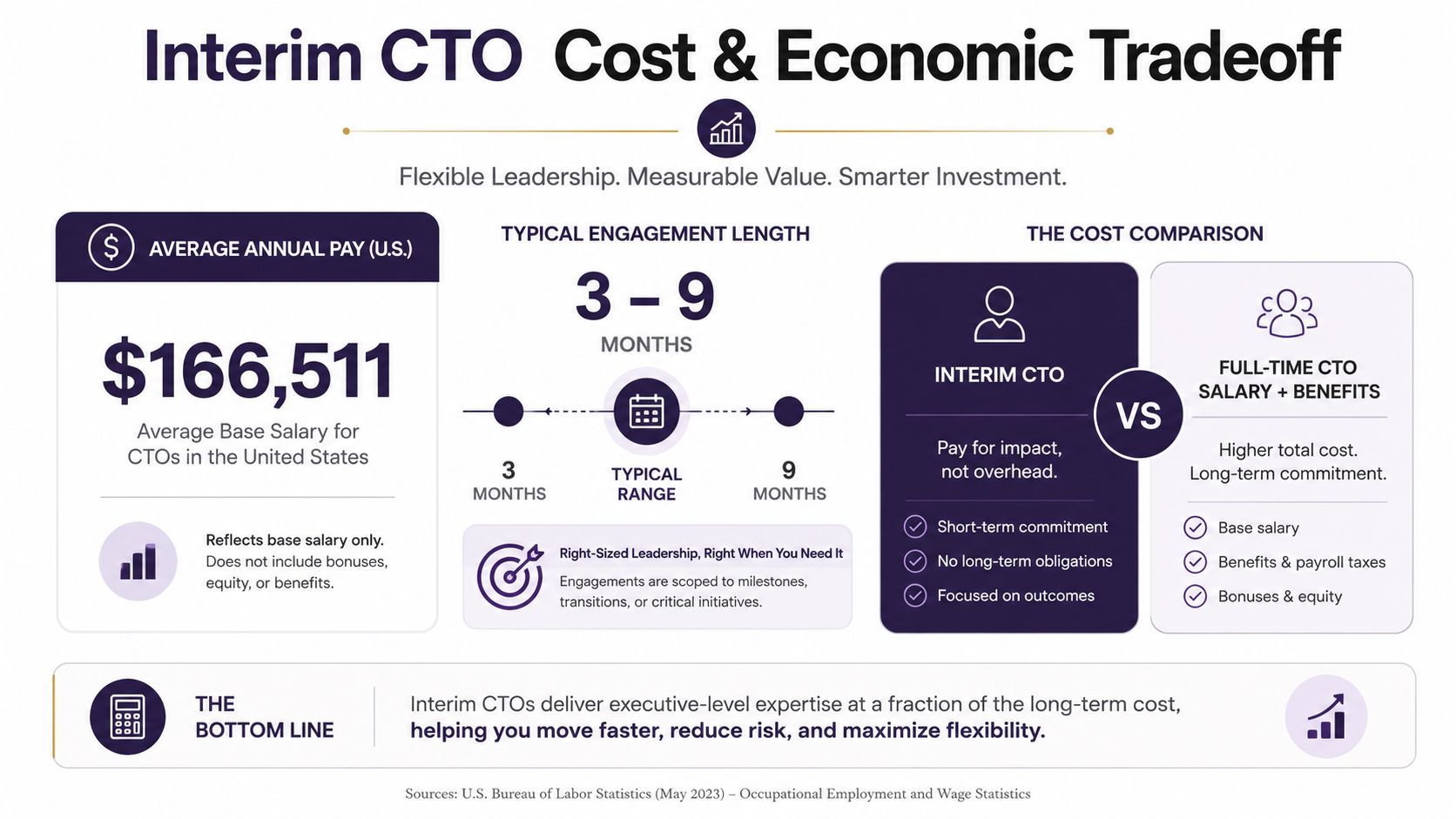
An interim CTO can look expensive on paper until you compare that fee with the cost of leaving the seat empty. In the U.S. job market, ZipRecruiter listed the average annual pay for an interim chief technology officer at $166,511, with most workers earning between $132,000 and $195,000 per year (ZipRecruiter data via Zippia). In the same broader data set, Robert Half listed a national CTO salary reference of $189,500, which helps explain why the market price shifts with scope and employer expectations.
Independent interim CTO firms can quote much higher annualized equivalents, with some sources describing a range around $259,000 to $489,000 depending on scope and location (GoFractional interim CTO overview). That spread is not a contradiction. It reflects a practical split between leaders doing hands-on rescue work and leaders providing narrower advisory coverage.
The timeline gap is often more expensive than the fee
A strong interim engagement can typically start within 2 to 3 weeks according to independent interim-CTO firms, while a traditional full-time search commonly takes 3 to 6 months. That delay matters because a vacant CTO seat rarely stays neutral. Product work slows, technical decisions pile up, and the rest of the leadership team starts making assumptions that should have been made by one accountable owner.
For founders, the useful comparison is not hourly cost versus salary. It is the cost of delay versus the cost of clarity. If the team is blocked on architecture, security, or platform choices, each week without technical ownership can create more rework later. That risk is higher when the search for a permanent leader is still open.
A simple way to think about it
Ask this in the room with your CFO or board:
What does each week of a vacant CTO seat actually cost us in delayed releases, missed decisions, and team drift?
That question usually changes the discussion. A company may decide it cannot justify a full-time executive yet. It may also decide it cannot afford to go without one temporarily.
The market pattern is hard to ignore. Interim CTO demand has risen because companies are trying to avoid a more expensive kind of indecision, the kind that shows up as stalled execution and fading confidence. The chart below lays out the trade-offs in cost, benefits, and engagement length.
Hiring an Interim CTO Through a Marketplace
The easiest way to waste time here is to write a generic job post that sounds like it wants a permanent CTO, a consultant, and a therapist all at once. Strong marketplace sourcing starts with a tight scope. You want transitional leadership, not a job-shopping operator who only wants a long-term role.
Platforms like Shiny are built around that matching problem, connecting companies with vetted executives and helping streamline posting, matching, interviews, and onboarding. In this topic, that matters because the first filter should be stage fit and operating style, not just whether someone has a long resume.
Write the role like an interim assignment
A good job description paragraph should be concrete and temporary. For example, a founder could write:
We need an interim CTO to stabilize engineering leadership during a transition, reset the roadmap, and own critical technical decisions while we complete the permanent search. The right person will work closely with the founder, product leader, and board to improve decision speed, reduce delivery risk, and document a clean handoff.
That language tells candidates three important things. The role has a defined end. It includes real authority. It's about outcomes, not just advice.
Interview for transition skill, not just technical depth
A strong interview process should test how the candidate behaves when they inherit someone else's decisions. Good questions include:
- Past handoff: Describe a time you inherited a team mid-transition. What did you do first?
- Board pressure: How do you handle a board you didn't hire and didn't fully shape?
- Scope discipline: What do you usually choose not to fix in the first 60 days?
- Decision rights: How do you clarify who owns architecture, hiring, and vendor calls?
- Team trust: How do you lead when the team is unsure whether you're staying?
Those questions reveal if the candidate can function amid uncertainty without transforming the position into a personal domain. That is the ultimate evaluation.
Watch for fixation on “cleaning everything up.” The right interim CTO doesn't try to rebuild the entire technology org on day one. They figure out what must be stabilized, what can wait, and what should be handed to the permanent leader.
A short shortlist process works best when it focuses on operating evidence. Ask for examples of prior transitions, the structure of their first 30 days, and what they'd hand back at the end. If a candidate can't explain their exit path, they probably haven't done enough interim work.
Onboarding, Authority, and a Clean Handoff Plan
The most common reason interim CTO arrangements go sideways is fuzzy authority. The founder says the interim leader owns the function, the team still routes decisions around them, and the engagement drifts into a soft version of permanent leadership. That's how you end up with a shadow CTO and a messy exit.
A better approach is to set the rules before day one. The onboarding process should define who the interim CTO can decide for, who they must consult, and what gets documented for handoff. The executive onboarding best practices guide is useful context here, especially if you're designing the transition around clarity instead of improvisation.
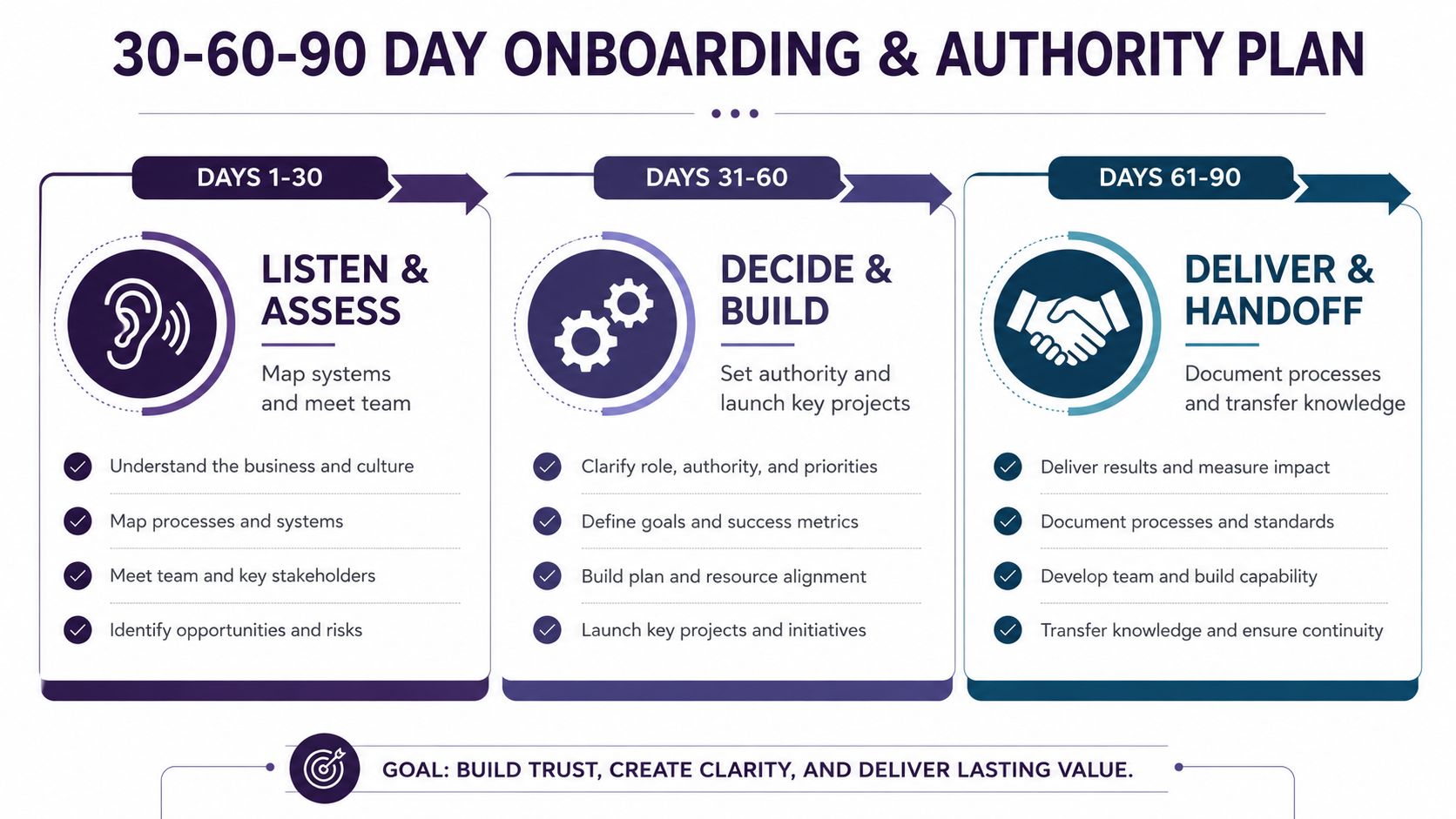
A simple 30-60-90 structure
- Days 1 to 30, listen and assess. Map systems, meet the engineering team, review the roadmap, and identify decision bottlenecks.
- Days 31 to 60, decide and build. Set authority boundaries, resolve the biggest technical blocks, and launch the highest-priority fixes.
- Days 61 to 90, deliver and hand off. Document processes, package open decisions, and transfer knowledge to the next owner or the ongoing fractional arrangement.
The handoff document should capture architecture decisions, vendor status, team structure, roadmap priorities, and unresolved risks. It should also say who owns each item after the interim engagement ends. That part is boring, but it's what keeps the company from re-litigating the same issues three months later.
The cleanest transitions I've seen had one thing in common, the interim CTO was brought in to exit well, not to linger. That mindset makes the role more useful, not less.
Choosing the Right Interim CTO for Your Stage
If your company has a leadership gap, a decision backlog, and a short-cycle problem like a migration, security cleanup, or ERP rollout, an interim CTO is often the right bridge. If what you really need is ongoing strategic guidance, fractional leadership may be enough. If you're ready to embed someone for the long haul, then the answer is probably a permanent hire.
The expensive mistake is using interim leadership as a vague bandage. That happens when the scope is loose, the decision rights are unclear, and no one writes down the handoff plan. It also happens when founders confuse interim and fractional work and expect temporary leadership to behave like a permanent executive without giving it the authority to do so.
If you want to avoid that trap, start with the operating model, not the résumé. Define what must be decided, who owns the decisions, and what clean exit looks like before the engagement begins.
If you're weighing an interim chief technology officer against a fractional or permanent hire, Shiny can connect you with vetted executives who fit the stage, scope, and timeline you need. Explore the marketplace at Shiny or schedule a conversation if you want help thinking through the right leadership model for your team.
