

How to Hire a Cybersecurity Executive for Your Startup
You're probably not sitting around thinking, “We need a cybersecurity executive.” You're staring at a customer questionnaire, a board deck, a security policy request from procurement, or a near miss that made it obvious your current setup is too thin. That's the moment founders stop treating security like a side project and start treating it like executive leadership.
The mistake is assuming this role is only for big companies. It isn't. The key question is whether you need a full-time CISO, a fractional cybersecurity executive, or a vCISO who can stabilize the function without forcing you into a heavyweight hire you can't justify yet.
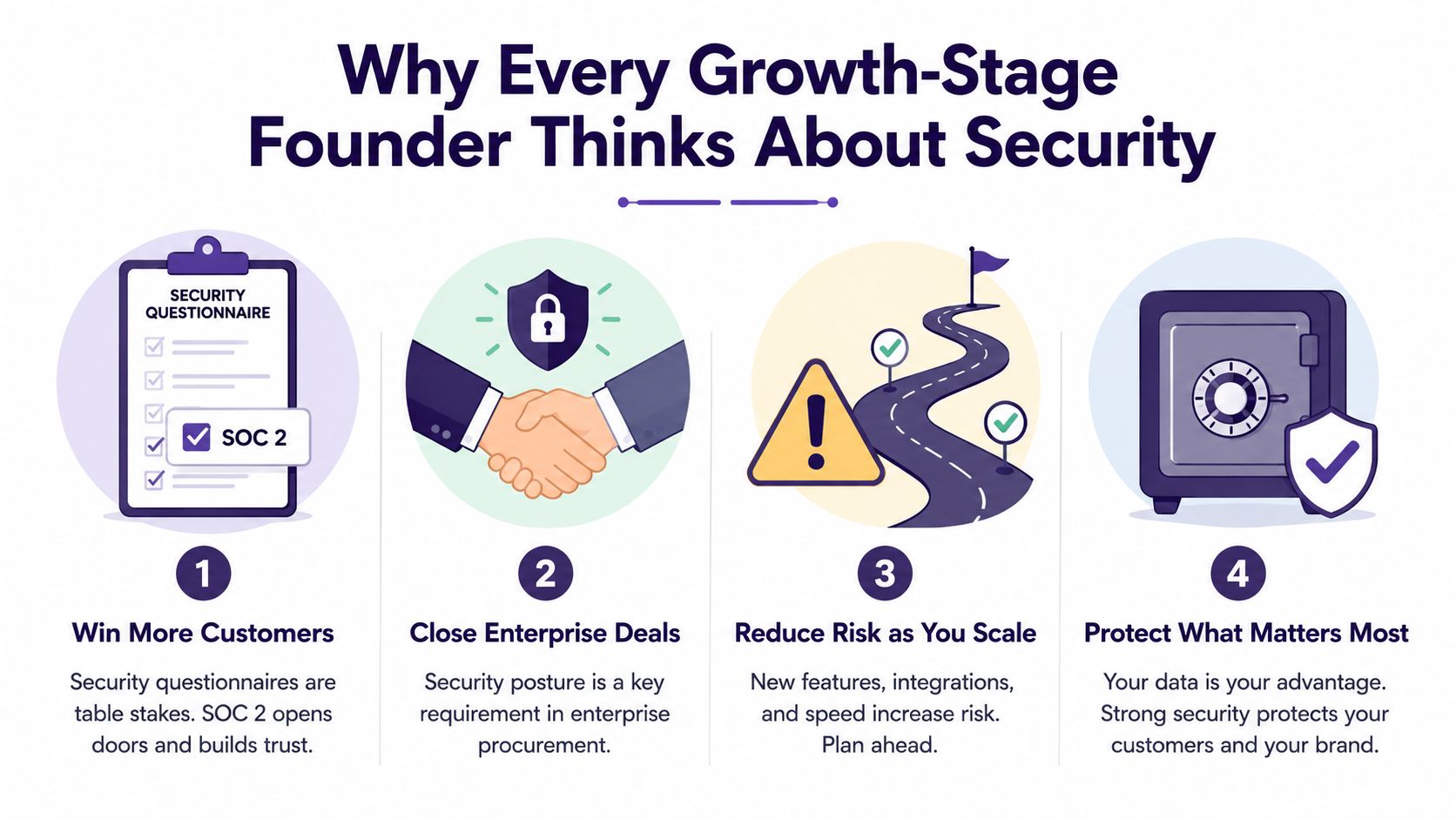
Why Every Growth-Stage Founder Ends Up Thinking About Security
The first sign is usually boring, which is exactly why it catches founders off guard. A prospect sends a security questionnaire, asks for a policy pack, or says procurement won't move until someone credible explains your controls. Then the issue gets real, because security is no longer an internal preference, it's part of the buying process.
A cybersecurity executive becomes relevant when security starts affecting revenue, trust, or leadership bandwidth. You don't hire one because it sounds mature. You hire one because the business keeps running into questions that need an owner, not another task in someone's inbox.
The triggers founders actually recognize
The cleanest trigger is enterprise sales friction. If every serious deal includes security review, the company now needs someone who can speak to controls, risk, and customer trust without turning the conversation into a technical lecture. Another trigger is new exposure from regulated data, because frameworks like HIPAA or PCI turn casual security habits into formal obligations.
Incidents are the loudest signal, but they're not the only one. A phishing attempt that nearly moves money, a vendor issue that exposes weak approval flows, or a failed audit question can show you that no one owns the full picture. That's the point where a strong IT lead stops being enough.
Practical rule: if a security issue needs a cross-functional decision, it's already beyond ad-hoc ownership.
The shortage in the market makes this harder, not easier. The cybersecurity workforce gap is estimated at 4.8 million unfilled roles, while demand is growing 8.1% annually against active workforce growth of only 0.1% (KeySearch report). That's why founder-led companies often do better with a fractional or part-time executive than with a rushed full-time search.
Stage matters more than ego
Seed-stage companies usually need structure, not bureaucracy. Series A firms need someone who can clean up the basics, support deals, and create repeatable policy. By Series B and into growth-stage SMB territory, the role often turns into a real executive seat because the founder can't keep carrying every security conversation personally.
If you're deciding whether the moment has arrived, use this filter:
- Customer pressure: enterprise buyers keep asking for proof, not promises.
- Risk surface: the product, data, or vendor network has gotten more complex.
- Leadership gap: no one can answer board-level security questions with confidence.
- Operational drag: security tasks keep bouncing between engineering, IT, and operations.
- Incident pressure: something happened that exposed how little ownership you really had.
That checklist is what separates “we should probably think about this” from “we need an executive now.” The second category deserves a real leader, even if that leader starts part-time.
Full-Time Executive vs Fractional Cybersecurity Leader vs vCISO
The wrong hire is expensive in a way founders don't always see early. A full-time CISO can be the right move, but only when the company needs constant internal presence, a deep program build, and ongoing board exposure. If you don't need that yet, you're paying for capacity you won't use.
A fractional cybersecurity leader works when you need senior judgment without a full-time payroll burden. A vCISO is better when the need is narrower, like a SOC 2 push, a post-incident reset, or a compliance project that needs strong direction but not daily executive ownership.
Match the model to the problem
The decision should come down to operating reality, not title prestige. If your security backlog is now part of the company's management burden, hire for leadership. If you need one or two specific outcomes, buy expertise in a tighter format.
If the company needs a strategist, a translator, and a steady hand, don't hire an implementer and hope they grow into it.
| Model | Typical Hours | Best-Fit Stage | Cost Approach | Strongest Use Case |
|---|---|---|---|---|
| Full-Time CISO | Full-time | Later-stage growth companies | Salary plus benefits plus recruiting | Continuous executive ownership |
| Fractional Cybersecurity Executive | 5 to 25 hours per week | Seed to growth-stage SMB | Retainer or hourly engagement | Strategic leadership without full-time overhead |
| vCISO | Project-based or contract | Defined security or compliance projects | Consulting engagement | SOC 2, remediation, or post-incident stabilization |
The distinction matters because boards and buyers care about outcomes, not model purity. The right choice is the one that closes the gap between where your company is and where your risk profile has already moved. That's why a fractional leader often beats a full-time hire for startups that need judgment quickly.
For founders who want a deeper lens on executive hiring design, this guide on executive job descriptions is a useful reference point.
Writing a Job Spec That Attracts the Right Cybersecurity Executive
Most security job specs read like someone copied a help desk wishlist into a senior role. That drives away strong executives because it signals confusion about the job. A cybersecurity executive wants to know what business problem they own, how much authority they have, and how success will be judged.
Start with outcomes, not tools. Say the hire owns customer trust, audit readiness, risk reduction, and incident response maturity. If you list products before business goals, you've already told the candidate that the company doesn't know what it needs.
Build the spec around three things
The best specs are simple and specific. They explain the scope of the role, the decisions the executive can make, and what should be true after twelve months. That clarity is especially important for fractional and vCISO models, where the scope must be tighter by design.
Use this structure:
- Business outcomes: define the risks, deals, or controls the executive owns.
- Authority boundaries: spell out what they can approve, escalate, or change.
- Success definition: describe what a strong twelve-month result looks like in business terms.
A fractional role should read differently from a full-time one. The fractional leader may own the framework, roadmap, and executive reporting, while internal teams execute many of the tasks. A full-time role usually carries broader ownership across people, process, and systems.
The best founders also make room for decision rights. If the new leader can recommend controls but can't enforce them, you don't have a real executive hire. You have an advisor with a fancy title.
For a practical benchmark on how executive role descriptions should be framed, this resource on executive job descriptions helps keep the scope focused. The same principle applies here, security leaders need to see that the company is hiring a business operator, not just a technical fixer.
Interview Questions That Reveal Executive-Level Cybersecurity Thinking
A strong cybersecurity executive can talk controls. A great one can explain why those controls matter to sales, finance, customers, and the board. That difference shows up fast in the interview if you ask the right questions.
Ask about translation, not jargon. Ask how they turned risk into decisions at a company with similar complexity. Ask how they handled a breach when pressure was high and information was incomplete. The answers should sound like leadership, not a certification recitation.
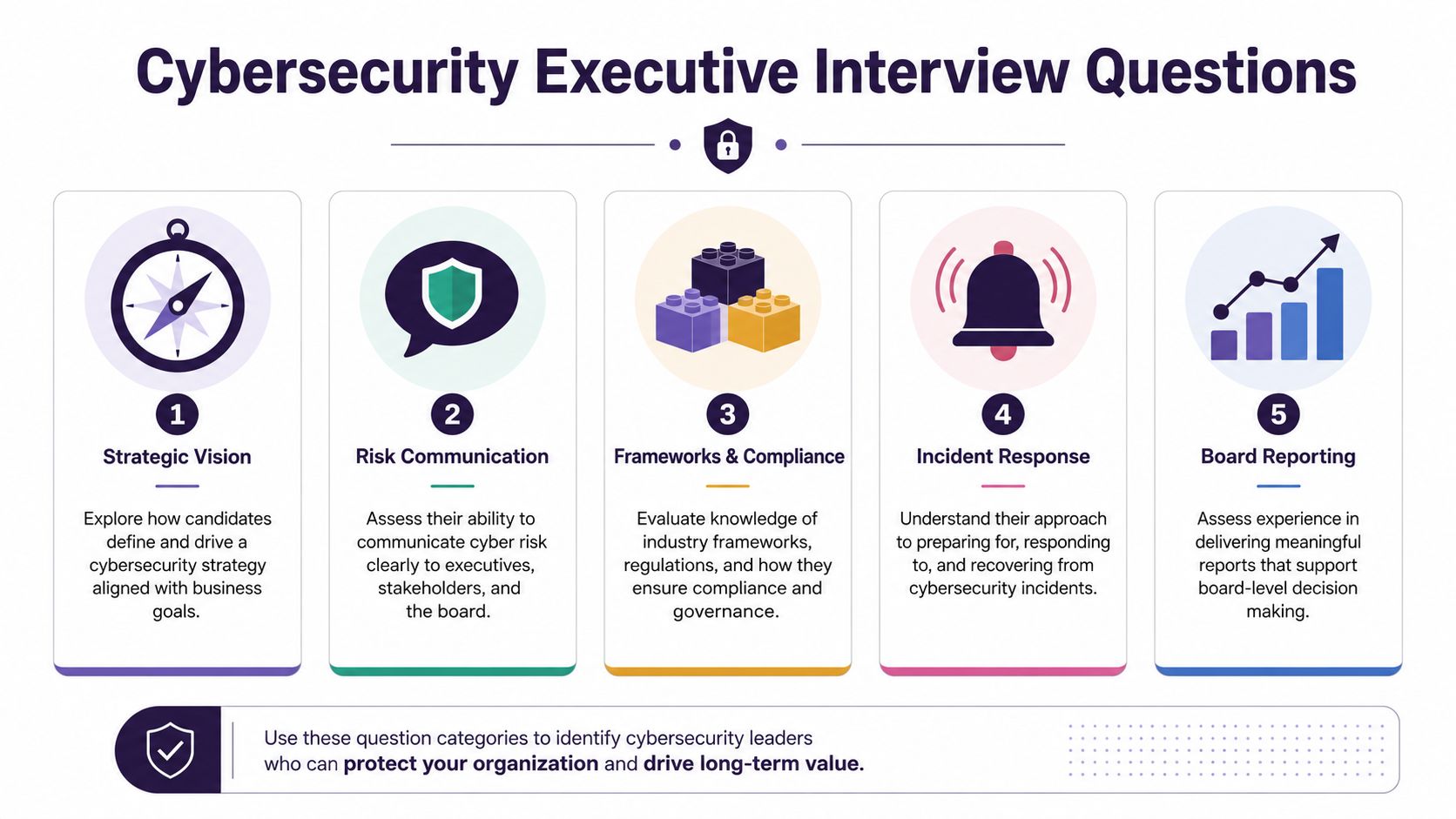
The five question categories that matter
Use a written exercise too. A short risk memo or board update tells you more than a polished resume ever will. You want to see whether the candidate can make a technical issue understandable to non-technical leaders.
- Strategic vision: ask how they would prioritize security work in your company over the next year.
- Risk communication: ask how they explain cyber risk to a CFO or board member without hiding behind technical language.
- Frameworks and compliance: ask how they decide which controls matter versus which ones are just theater.
- Incident response: ask what they do in the first hour after a serious issue is discovered.
- Board reporting: ask what metrics they would bring to leadership and why those metrics would drive action.
A weak candidate spends too long describing tools. A strong one talks about tradeoffs, escalation, and business consequences. That's the mindset you want.
Reference checks matter more than charisma. Ask former peers whether the candidate could lead across functions without creating chaos. For a tighter interview structure, this executive interview guide is worth using as a checklist before you make a decision.
Realistic Compensation and Engagement Pricing for Cybersecurity Executives
Founders get in trouble when they budget for the title and forget the shape of the engagement. A full-time cybersecurity executive is a different financial decision from a fractional leader or a vCISO. The total cost also changes once you account for recruiting effort, tooling, and the time your team spends onboarding the hire.
The right way to think about the spend is simple. Pay for the level of ownership you need, not the most prestigious version of the role you can imagine. That's the discipline that keeps early-stage companies from overbuying before the function is mature.
Budget for the whole package
A full-time hire usually makes sense when the company has enough operational volume to justify a permanent executive seat. A fractional leader usually makes more sense when the company needs senior guidance, board support, and program direction without the fixed cost of a full-time headcount. A vCISO is the cleanest option for focused project work.
A smart budget also includes the hidden pieces. That means recruiting time, any outside assessment support, security tooling, and the internal time it takes to implement changes. A cheap hire that doesn't move the company forward is still expensive.
Bottom line: the best security spend is the one that reduces deal friction, sharpens risk decisions, and keeps the company from buying chaos at scale.
IBM's 2025 Cost of a Data Breach study reported a global average breach cost of $4.4 million, which is why security leadership should be treated as a financial decision, not an IT luxury (benchmark roundup citing IBM's study). That doesn't mean every company needs a large permanent team. It means the cost of being under-led can be much higher than the cost of hiring well.
A 90-Day Onboarding Plan for Your First Cybersecurity Executive
The first ninety days decide whether the new hire becomes a strategic partner or just another person sending status updates. The founder's job is to give them access, clarity, and the authority to act. If you want real progress, don't bury them in tool demos and stale documentation.
The best onboarding starts with listening, then moves to control reality, then ends with visible leadership. A strong cybersecurity executive should leave the first month understanding the business, the second month tightening the baseline, and the third month producing board-ready reporting and a roadmap.
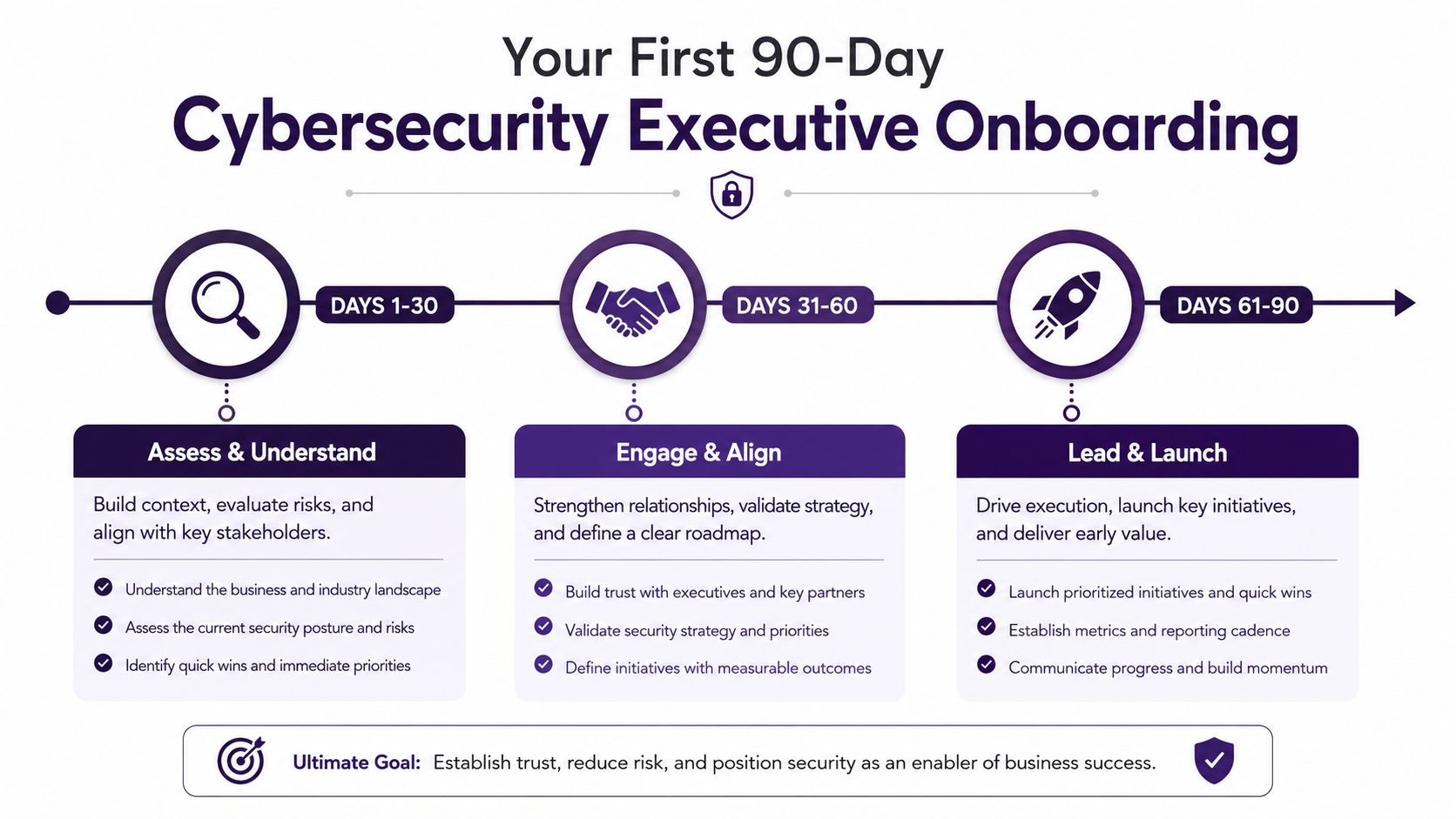
Days 1 to 30
The first month is about facts. The executive should inventory critical assets, identify who owns what, and map the biggest exposure points across product, people, and vendors. They should also learn how the business sells, because security priorities that ignore sales reality usually fail.
Days 31 to 60
The second month is about controls and quick wins. The leader should baseline the current program, identify gaps that matter most, and fix the obvious friction points that slow down operations or create unnecessary risk. The company should see the first practical evidence that the hire understands how to prioritize.
Days 61 to 90
By the third month, the executive should be speaking in leadership terms. The output should include board-ready reporting, customer-trust materials, and a roadmap that names risks, owners, and next steps. If the person still can't explain the state of security without a long technical preamble, the fit is wrong.
Keep the cadence regular after that. Monthly security reviews beat crisis-driven check-ins every time. A founder who treats security as an operating rhythm gets far more value than one who waits for emergencies to create urgency.
How a Fractional Marketplace Like Shiny Changes the Hiring Math
The hardest part of hiring a cybersecurity executive is not deciding that you need one. It's finding the right one without burning months on a search that leads to the wrong shape of leadership. That's where a fractional marketplace changes the equation.
Instead of forcing a full-time commitment up front, you can test fit, scope, and impact with far less risk. That matters for founders who need senior security leadership now, but don't want to lock themselves into a permanent hire before the function is fully defined. This guide on the fractional C-suite advantage explains why that model is so effective for resource-constrained companies.
Why the marketplace model works
A vetted marketplace gives you access to executives who already know how to operate at the right level. That cuts down the noise that usually comes with general recruiting, where most candidates look good on paper but haven't led at your stage. It also gives you a way to compare experience across industries and engagement styles without starting from zero.
The advantage is speed plus fit. You can bring in a cybersecurity executive who understands your scale, your deal cycle, and your risk profile, then decide whether that person should stay fractional or move into a larger role. That is a better hiring sequence than guessing wrong and spending months recovering from the mistake.
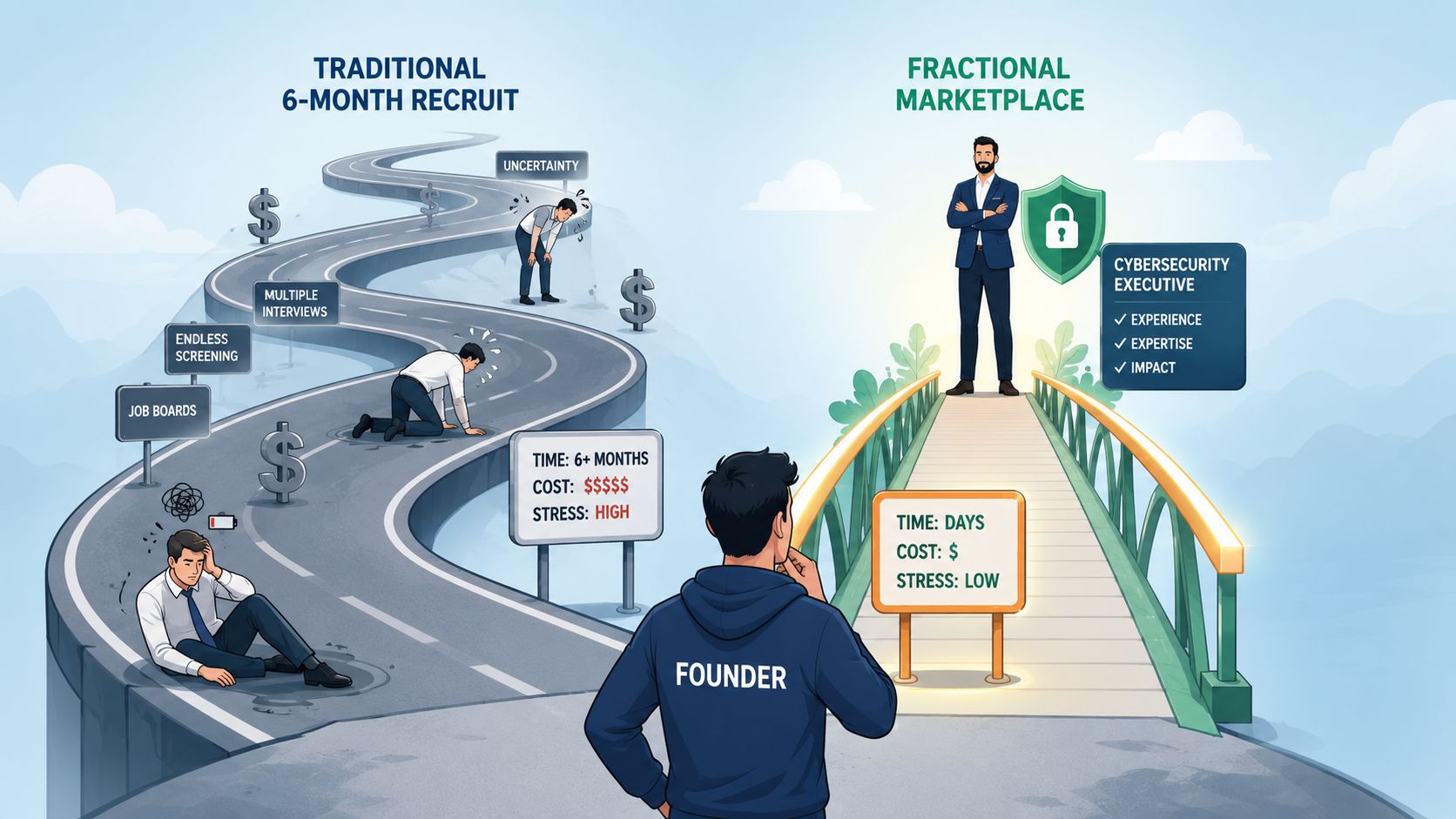
For founders who want a faster path to the right leader, the practical move is to start with the engagement model that fits the company today, not the one that looks best on a slide. A strong marketplace helps you do that with less friction, better matching, and a clearer path to the executive bench you'll need later.
If you're trying to hire a cybersecurity executive without overcommitting to a full-time search, Shiny can help you find the right fractional leader for your stage, your risk profile, and your growth goals. Visit Shiny to explore the marketplace and see whether a fractional cybersecurity executive is the right next move for your company.
