
8 Account Management Interview Questions and Answers
You're in the interview loop, and the conversation is already drifting into vague territory. One candidate sounds polished but generic. Another gives a concrete client story, names the problem, and explains exactly how they kept the account alive. That difference shows up fast in account management interview questions, because the best answers reveal how someone handles pressure, owns outcomes, and earns trust over time.
For founders hiring without a dedicated customer leader, that matters even more. You need someone who can stabilize renewals, spot expansion, and keep internal teams aligned before the book of business grows too messy to manage. Shiny's marketplace of over 3000 vetted executives, available for 5 to 25 hours a week, is one way to add that leadership before you commit to a full-time hire.
The strongest account management interview questions don't reward charm. They reward structure, judgment, and proof. Use the list below as both a candidate prep guide and a hiring scorecard, with the signals interviewers should score, the follow-up probe that separates real experience from theory, and a startup lens for teams that need senior customer leadership without a full-time seat.
1. How would you onboard a new client and build a 30-60-90 day plan?
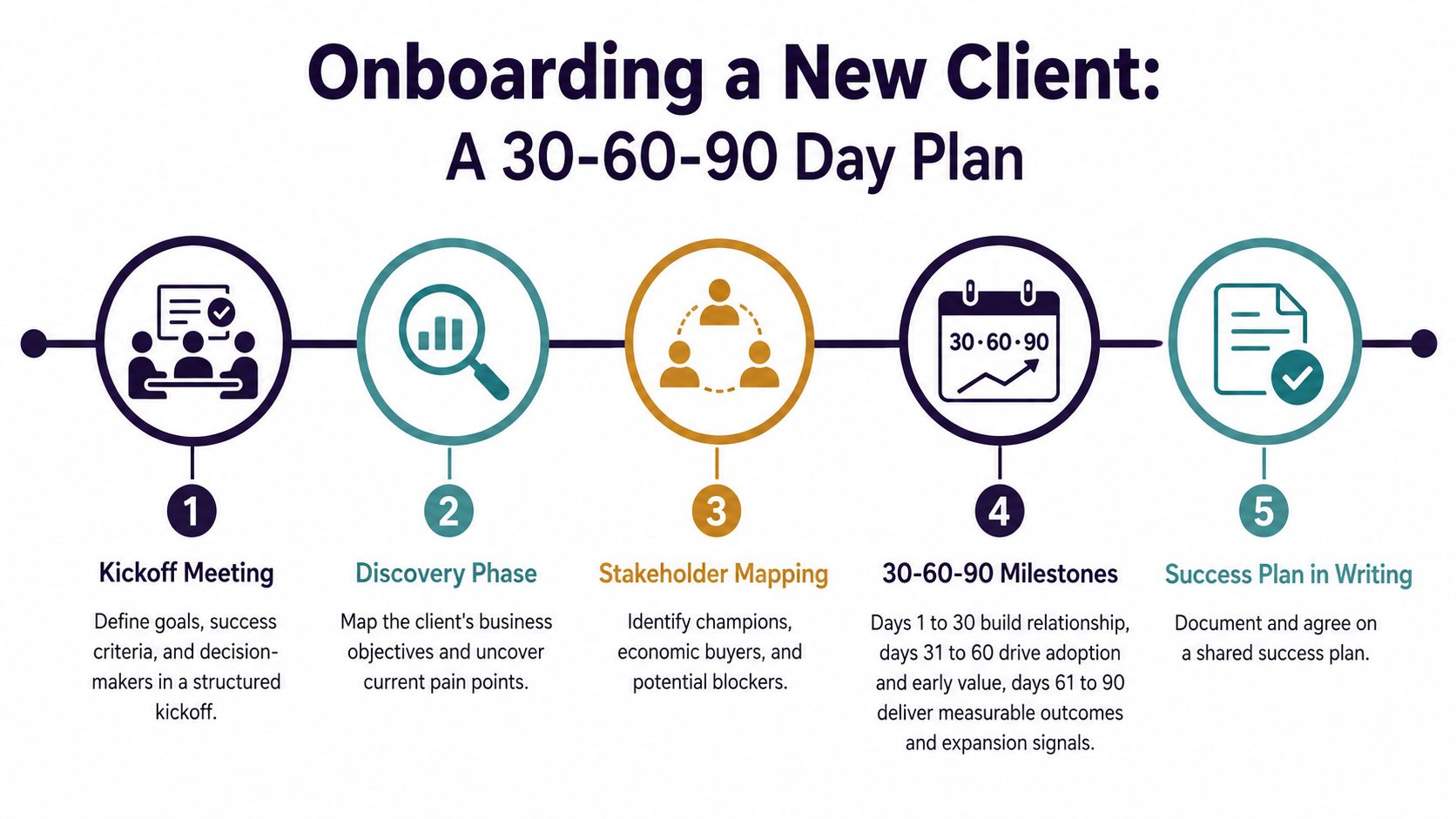
A strong answer sounds organized from the first sentence. The candidate should talk about kickoff, discovery, stakeholder mapping, and early wins, not just “building a relationship.” In a startup, weak onboarding often turns into early churn because nobody defined who owns what, what success looks like, or when the client should expect value.
What the best answers sound like
A practical response usually includes a discovery workshop, a written plan, and a timeline for first value. For example, a SaaS account manager might discover that reporting delays are the client's real pain point, then ship a custom dashboard early so the first renewal conversation starts with proof, not promises. That's much stronger than saying, “I check in regularly.”
Practical rule: If the answer doesn't show how the client moves from signed contract to visible value, it's probably too thin.
Interviewer signals to score:
- Structure of the plan, including kickoff, discovery, and milestones.
- Stakeholder mapping, especially who influences adoption and renewal.
- Early-win thinking, because first impressions shape retention.
- Repeatability, which matters when the company has no formal process yet.
A good follow-up probe is simple, “What discovery questions do you ask first, and how do you know the onboarding worked?” That forces the candidate to show actual operating discipline. If they've never run onboarding at scale, they should be able to describe a smaller project where they set expectations, delivered early value, and kept the client informed.
For founders, this is also where a fractional executive can be useful. A part-time customer leader can install a standard onboarding playbook, align it to your CRM, and keep the process consistent while the team is still small. If you're building that system from scratch, see the practical implementation guidance in this CRM setup guide.
2. Tell me about a time you saved an at-risk account
This is one of the most revealing account management interview questions because it tests diagnosis, empathy, and whether the candidate can recover trust. The strongest stories have a clear danger, a specific action, and a measurable result, even if the result was “we kept the client.” Weak answers usually orbit around discounting, which often hides the core problem instead of solving it.

A strong answer might begin with a client showing signs of disengagement, then explain how the account manager found the root cause and reset the relationship. A part-time customer leader at a manufacturing software company, for example, could identify that the champion had left, rebuild credibility with new stakeholders, and prevent churn by re-establishing the business case. That story works because it shows real work, not just nice communication.
What interviewers should listen for
- Early signals, such as falling usage, missed meetings, or support friction.
- Root-cause diagnosis, not just reactive firefighting.
- Direct communication, especially a candid call instead of an email spiral.
- A postmortem mindset, if the account was still lost.
A useful probe is, “What warning signs did you miss, and what changed after your intervention?” The best candidates own mistakes cleanly. They don't blame the customer for being difficult, and they don't pretend every save was perfect. That honesty matters because account management often means walking into tension before anyone else wants to.
If the story ends in a loss, that can still be a strong answer. What matters is whether the candidate learned something concrete and changed their process afterward. In a small company, that kind of self-correction is often more valuable than a polished rescue story.
3. Which metrics do you use to measure account health, and how do you act on them?
Data-aware candidates talk differently. They don't just name metrics, they explain what each metric tells them and what action it triggers. The best answers connect account health to renewal risk, adoption behavior, and executive attention.
A strong response might include Gross Revenue Retention, Net Revenue Retention, churn, adoption, NPS, and renewal timing, then explain how those signals roll into a simple scorecard. For example, an account manager might build a health model around login frequency, executive engagement, and support ticket volume. When the score goes red, they schedule an executive call quickly and investigate what changed.
A fractional customer leader at an AI startup can use the same logic to make a small portfolio manageable. A three-tier dashboard, even if it starts simple, helps founders see which clients need attention this week instead of waiting for renewals to wobble. That's the difference between a reporting habit and an operating system.
The best metric answers are operational, not decorative. If a number doesn't change how the team acts, it's just noise.
Scoring signals:
- Metric clarity, including whether the candidate can explain the metric in plain English.
- Actionability, meaning they know what to do when the signal changes.
- Validation discipline, because metrics should be checked against actual churn over time.
- Startup pragmatism, especially if they suggest starting with only a few signals first.
A good follow-up is, “What's the first scorecard you'd implement if you joined next week?” That answer should be lightweight, useful, and realistic for a small team. If they jump straight into a complex model, they may understand dashboards better than customer risk.
4. How do you prioritize a portfolio of accounts with limited time?
This question exposes commercial judgment fast. Treating every account the same usually means the candidate hasn't had to make hard trade-offs. Strong account managers know where to spend time, where to automate, and where to communicate clearly so clients don't feel ignored.
One useful way to frame the answer is tiering. A candidate with 35 clients might divide them into strategic, growth, and maintenance tiers, then change the cadence of outreach for each group. That's more credible than claiming every account gets equal attention, because in real life, every account absolutely does not deserve the same amount of time.
What the interviewer should score
- Segmentation logic, based on value and risk.
- Coverage discipline, meaning the candidate knows what gets weekly, biweekly, or periodic attention.
- Client communication, especially how they explain the change in coverage.
- Use of data, not just gut feel.
A growth-stage Ecommerce company might ask a fractional VP of Sales to reallocate coverage after noticing that a small share of accounts drives most revenue. That kind of scenario tests whether the candidate can make portfolio decisions without breaking trust. The right answer doesn't sound like “I focus on my biggest clients,” because that's too vague. It sounds like a system.
Practical rule: If the candidate can't explain how they keep smaller accounts warm without over-investing in them, they probably haven't managed a real portfolio.
A strong follow-up probe is, “How do you tell an account they're moving to a lighter-touch model?” The answer should include transparency, expectations, and a path for escalation. That's especially important in startups, where customers often expect white-glove support long after the team has outgrown it.
5. How do you identify and pursue expansion opportunities within existing accounts, and how do you run a QBR that drives renewals and expansion?
This combined question shows whether the candidate can grow revenue without sounding pushy. The best answers tie expansion to a client outcome, not to the seller's quota. That distinction matters in account management, because clients can tell when a QBR is really just a disguised sales pitch.
A SaaS account manager might notice that a client's marketing team has started using the platform for a second campaign type, then link an add-on to the team's own goal. A different example is a part-time sales leader at a HealthTech company using quarterly business reviews to surface a compliance need, which naturally opens the door to a reporting module. Both examples work because the expansion follows the client's actual use case.
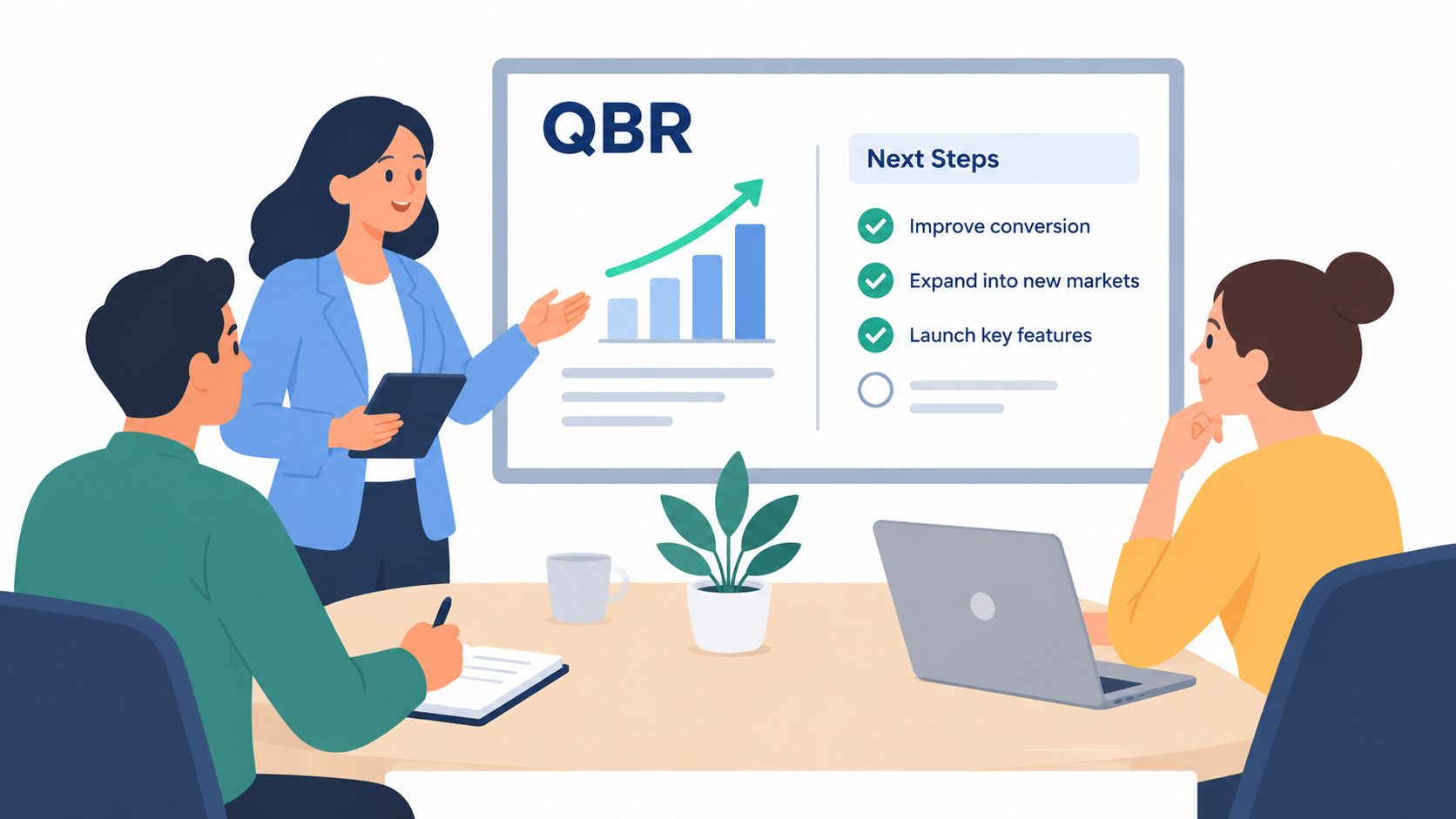
For the QBR itself, the strongest answers are short, focused, and led by client goals. The candidate should talk less than the client, ask better questions, and send a written recap with owners and deadlines after the meeting. If they mention a QBR template, that's a good sign, especially if they can explain how they keep it client-facing rather than internally self-congratulatory.
Use this quarterly business review template if you want a practical structure to compare against candidate answers.
Scoring signals:
- Expansion discovery, not product pushing.
- Client-aligned framing, meaning the value is tied to outcomes.
- QBR discipline, including follow-up and action ownership.
- Executive presence, especially when the room includes finance or leadership.
A strong follow-up question is, “What do you ask the client that helps expansion emerge naturally?” That answer should sound consultative, not rehearsed. Candidates who can balance renewal protection with thoughtful growth usually become the best long-term account owners.
6. Describe how you handle a difficult client conversation or deliver bad news
Tone matters as much as content here. A good account manager doesn't hide behind internal jargon, blame product gaps, or disappear until the heat dies down. They own the message, explain the constraint, and leave the client with a path forward.
A strong answer might describe a client asking for an unplanned feature before renewal. The candidate explains the roadmap limits, offers a phased workaround, and documents the new timeline so everyone knows what was agreed. The relationship survives because the client feels heard, not managed around.
A customer leader in professional services might deliver a project delay, pair it with a revised plan, and keep the client engaged. That's a better signal than pretending bad news can be wrapped in cheerful language. Clients don't need spin. They need clarity, pace, and follow-through.
What to score
- Directness, without defensiveness.
- Empathy, without over-apologizing.
- Documentation habits, because written follow-up prevents misunderstandings.
- Boundary-setting, especially around scope creep.
A useful probe is, “How do you handle the same conversation when the client is angry in real time?” The best candidates stay calm, separate emotion from the issue, and keep the next step concrete. In small teams, that skill matters a lot because a single messy conversation can ripple into renewal risk, internal rework, and more escalations.
7. How do you coordinate with sales, product, and support to serve your clients?
Account management collapses quickly when internal handoffs are sloppy. This question shows whether the candidate can bridge teams without becoming a bottleneck. The best answers show a process, not just a personality trait like “I'm collaborative.”
A strong example is an account manager collecting recurring feature requests from several clients, packaging them into a clear product briefing, and then closing the loop with customers once the top item is scheduled. That's useful because it protects clients from feeling ignored and gives product a cleaner signal. A fractional customer leader at a manufacturing software company might set up a biweekly triage meeting between support and sales to keep escalations from bouncing around.
Scoring signals:
- Process creation, not just informal friendliness.
- Documentation, so internal teams don't lose context.
- Advocacy with restraint, meaning they push for the client without trampling team constraints.
- Cross-functional closure, which means the issue actually gets resolved.
Strong coordination feels boring when it works. That's the point. Clients should experience one company, not three departments arguing through them.
A good follow-up is, “What lightweight process would you create if the company had no formal handoff system?” That answer tells you a lot about startup fit. You want someone who can build enough structure to keep things moving without creating bureaucracy for a five-person team.
8. Why do you want to work in account management, and where do you see yourself growing?
This question sounds simple, but it reveals motivation, emotional fit, and career intent. Good account managers usually enjoy long-term client work, measurable outcomes, and the challenge of balancing relationships with revenue responsibility. Weak answers drift into title chasing or vague interest in “helping people,” which is too soft for a commercial role.
A strong candidate might say they like seeing clients achieve measurable results over time and want to grow into team leadership as the company scales. Another good answer from a startup candidate is wanting to build repeatable processes because the company hasn't formalized the function yet. That shows the candidate understands where the business is, not just where they'd like to be.
The best version of this answer connects personal ambition to company need. If the business is expanding into a new segment, the candidate should show interest in helping shape the account motion there. If the team is light on process, they should sound energized by building structure, not intimidated by it.
What interviewers should listen for
- Real interest in client relationships, not just compensation.
- Alignment with growth-stage work, which usually means ambiguity.
- Career ambition that fits the role, not a detour from it.
- A thoughtful closing question, ideally about how success is measured.
A useful follow-up is, “What would success look like in your first 90 days?” That answer should be specific and measurable in plain language. Good candidates ask how the company defines success because they care about outcomes, not just getting through the interview.
8-Question Account Management Interview Comparison
| Item | Process / Complexity (🔄) | Resource Requirements (⚡) | Expected Outcomes (⭐📊) | Ideal Use Cases (💡) | Key Advantages (⭐) |
|---|---|---|---|---|---|
| How would you onboard a new client and build a 30-60-90 day plan? | Structured multi‑phase workflow; repeatable templates. 🔄🔄 | Cross‑functional time, templates, training. ⚡⚡ | Faster time‑to‑value, measurable milestones, higher retention. ⭐⭐📊 | New clients, startups/SMBs needing repeatable onboarding. 💡 | Reduces early churn; scalable playbook. ⭐⭐ |
| Tell me about a time you saved an at‑risk account. | Rapid diagnostic + escalation; ad‑hoc urgency. 🔄🔄🔄 | Intense short‑term exec & product resources. ⚡⚡⚡ | Retained revenue; restored trust; documented lessons. ⭐⭐📊 | Clients showing engagement loss or churn signals. 💡 | Preserves revenue; demonstrates ownership. ⭐⭐ |
| Which metrics do you use to measure account health, and how do you act on them? | Low–medium: define signals, build dashboards. 🔄🔄 | Data tooling, dashboards, weekly reviews. ⚡⚡ | Predictive risk signals; prioritized actions; better NRR/GRR. ⭐⭐⭐📊 | Ongoing portfolio monitoring and scaling ops. 💡 | Data‑driven prioritization; early warning system. ⭐⭐⭐ |
| How do you prioritize a portfolio of accounts with limited time? | Moderate: segmentation + tiered coverage. 🔄🔄 | Analytics + defined time allocation rules. ⚡⚡ | Optimized time allocation; higher ROI per effort. ⭐⭐📊 | Large portfolios with constrained headcount. 💡 | Focus on high‑value accounts; scalable coverage. ⭐⭐ |
| How do you identify and pursue expansion opportunities / run QBRs? | Recurring prep + cross‑team coordination. 🔄🔄 | Exec time, data prep, sales/product collaboration. ⚡⚡⚡ | Upsell/cross‑sell, improved NRR, stronger exec relationships. ⭐⭐⭐📊 | Renewal cycles, accounts showing usage growth. 💡 | Drives expansion revenue; strategic alignment. ⭐⭐⭐ |
| Describe how you handle a difficult client conversation or deliver bad news. | Low: skill‑based with careful prep and alignment. 🔄 | Time for prep, internal alignment; low tooling. ⚡ | Preserved trust; clarified expectations; fewer escalations. ⭐⭐📊 | Scope creep, missed deadlines, pricing disputes. 💡 | Maintains relationship; reduces misunderstandings. ⭐⭐ |
| How do you coordinate with sales, product, and support to serve your clients? | Moderate‑high: defined handoffs and rhythms. 🔄🔄🔄 | Regular syncs, SLAs, shared docs and triage. ⚡⚡ | Faster resolutions; product improvements; consistent client experience. ⭐⭐📊 | Complex deployments or recurring feature requests. 💡 | Seamless client experience; aligned priorities. ⭐⭐ |
| Why do you want to work in account management, and where do you see yourself growing? | Low: personal narrative + career plan. 🔄 | Minimal prep; research company & role. ⚡ | Signals fit, motivation, and growth potential. ⭐📊 | Interviews and role‑fit evaluation. 💡 | Demonstrates long‑term alignment and ambition. ⭐ |
Turn These Answers Into a Hiring Scorecard
A good interview isn't a vibe check. It's a structured comparison of evidence. Score each answer against the signals tied to the question, ask every candidate for one real example with a measurable result, and keep the same scoring rubric across candidates so you can compare apples to apples.
The reason this works is simple. Structured interviewing has long been shown to produce stronger validity, better rater reliability, greater agreement between interviewers, and less adverse impact than loose conversations, according to guidance from the U.S. Office of Personnel Management in its review of interview methods (structured interview guidance) and historical validity summaries in the U.S. Department of Education report on interview structure (interview structure review). In practice, that means your team should ask the same core questions, use the same scoring anchors, and let follow-ups probe for specifics rather than drift into improvisation.
For founders hiring without a dedicated customer leader, the scorecard matters even more. You're not just choosing an interviewer who sounds good. You're choosing someone who can stabilize onboarding, protect renewals, coordinate across teams, and find expansion opportunities before the portfolio becomes unmanageable. That's why startup teams should look for candidates who can explain how they would build a simple operating rhythm, set expectations early, and scale process without heavy overhead.
Fractional leadership fits that gap well. Market data shows that fractional executives are no longer a niche workaround, and many companies are already using them to add senior capability without committing to a full-time hire (fractional executive trend data). That's especially relevant when you need someone to define the role, coach the first hire, or hold the line on customer outcomes while you're still shaping the function. The right fractional leader can turn interview answers into a working system, not just a good hiring decision.
If you're hiring now, decide which skills matter most before the first interview. For some companies, that's onboarding discipline. For others, it's rescue work, expansion, or cross-functional coordination. Once you know that, the right account management interview questions become much easier to score, and the wrong candidate becomes easier to spot.
Shiny helps startups and growing companies add senior customer leadership without rushing into a full-time hire. If you need help defining the role, finding a fractional executive, or tightening your hiring process around account management interview questions, visit Shiny and explore how the marketplace can fit your next stage of growth.