Agile Product Management: A Practical Guide for Startups
You're three meetings into the week, the roadmap still looks clean on the slide, and the team is already telling you the truth: the plan that made sense last month doesn't fit what customers are asking for now. That's the moment most founders stop treating product work like a document problem and start looking for a better operating system.
Agile product management gives small teams a way to learn, decide, and ship without pretending the future is fixed. It's not a ceremony checklist, and it's not only for software teams. For startups, it's the practical habit of turning uncertainty into short cycles, clear priorities, and better product decisions.
Why Startups Are Turning to Agile Product Management
A founder usually feels the pain before they name it. The team spends weeks shaping a roadmap, sales wants one thing, customers want another, and by the time engineering is ready, the market has already moved. A six-month plan can look smart in January and feel stale by March.
That shift is why agile moved from a software method into a startup operating system. After the Agile Manifesto was published in 2001, the model spread from engineering into product planning, backlog prioritization, and release management. Analysts at XTendedView agile statistics roundup note that a 2025 survey reported 86% of software teams and 63% of IT departments use Agile to manage project delivery, and the same roundup says 48% of Agile practitioners are now in product and R&D teams, up 16% since 2022.
For startups, the main point is not the framework itself. It is the move from trying to predict everything up front to learning in smaller loops. Agile product work turns product management into a decision system, not just a delivery process.
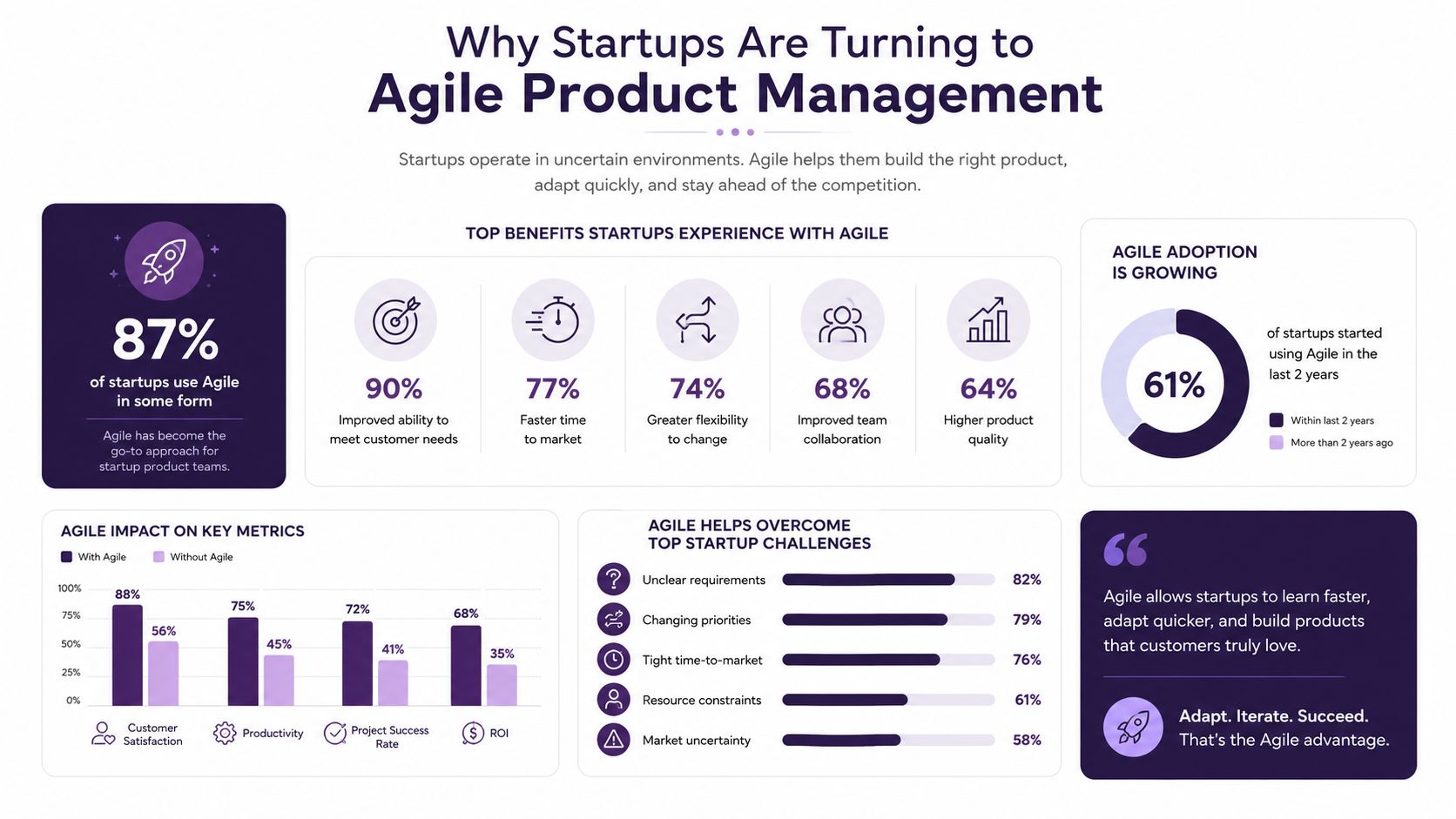
Why the old plan breaks so fast
A startup rarely has stable inputs. Customer feedback changes, hiring shifts capacity, and the first real users always reveal something the team did not expect. Agile helps founders respond to that reality without rebuilding the whole company every time the plan changes.
The clearest sign that agile has become more than a delivery tactic is where it shows up in the org chart. Product and R&D teams are now a major home for Agile practice, which means product management has become a central place where Agile thinking gets applied, not a side office near engineering.
Practical rule: if your roadmap only survives when nothing changes, it is not a roadmap. It is a wish list.
For founders, that difference matters. Agile product management is not about moving faster for the sake of speed. It is about making sure each cycle teaches you something useful before you commit to the next one.
What Agile Product Management Actually Means
At its simplest, agile product management means building the product in small, testable slices while keeping the product goal visible the whole time. Instead of handing engineering a fixed spec months before launch, the product leader keeps refining the next most important problem, based on customer input, product data, and business priority.
That's a very different job from the old plan-driven model. In the traditional version, the team tries to lock the requirements early, then execute against them. In the agile version, the team still needs direction, but the direction gets expressed as a backlog, clear acceptance criteria, and a short feedback loop, not a huge requirements packet.
A good way to think about it is like cooking for a crowded table. The old approach says, “Write the whole menu before the kitchen starts.” The agile approach says, “Serve the first course, watch what people eat, then decide what should come next.”
The backlog and sprint workflow
A workable agile flow usually follows a simple sequence: define the vision, gather customer insights, prioritize the backlog, plan the sprint, build and test, then release and reflect. Airtable describes that flow clearly, including the idea of turning customer feedback into user stories and ranking work by impact, effort, and business alignment (Airtable agile product management). Product School also describes the backlog as a dynamic, prioritized list of features, tasks, bugs, and user stories, with each sprint item needing clear acceptance criteria before work begins.
That gives the startup a rhythm. The product manager isn't just collecting requests. They're deciding which problems deserve attention now, which ones can wait, and which ones should be dropped altogether.
Where the product manager fits
In Agile, the product manager sits between customers, design, and engineering. Atlassian describes product managers as the bridge across those groups, using customer insights, analytics, and market research to validate ideas and guide feature development (Atlassian product management overview). In Scrum, the related title is often Product Owner, which usually means the person who manages user requirements and helps the team make day-to-day priority calls.
A first-time founder often asks the wrong question here. It's not “Should I use Agile jargon?” It's “Who is making the trade-offs, and how often are they being tested against reality?”
The best agile teams don't worship the backlog. They use it to keep the next decision smaller than the last one.
Scrum, Kanban, Scrumban, and Hybrid Models Compared
Founders don't need a framework museum. They need a practical choice that fits team size, product risk, and how quickly customer feedback shows up. The right answer is usually the one your team can follow consistently, not the one that sounds smartest in a pitch deck.
Scrum, Kanban, Scrumban, and hybrid models all solve different problems. Scrum gives you a strong cadence. Kanban gives you flow. Scrumban softens the edges when a team outgrows one model but isn't ready for another. Hybrid models help when the business needs both upfront clarity and agile delivery.
| Framework | Core Structure | Best For | Main Trade-off |
|---|---|---|---|
| Scrum | Fixed-length sprints with defined roles and planning rituals | Teams that need cadence and accountability | More ceremony, less flexibility |
| Kanban | Continuous flow with work-in-progress limits | Teams handling interrupts, support work, or uneven demand | Less built-in predictability |
| Scrumban | A blend of Scrum planning and Kanban flow | Teams evolving out of strict Scrum | Can get vague without discipline |
| Hybrid model | Upfront framing plus agile execution | Startups with higher risk, dependencies, or regulatory pressure | Requires stronger product judgment |
How founders should choose
Scrum is the clearest starting point when a startup needs rhythm and role clarity. A short sprint cadence makes priorities visible, and that helps a small team avoid random work.
Kanban fits better when the team deals with a steady stream of incoming requests or support issues. It's less about sprint commitments and more about visualizing flow and limiting work in progress. That can feel calmer, but it also demands stronger discipline around what enters the system.
Scrumban is useful when a team started with Scrum and wants less ritual without losing visibility. Hybrid models are the more strategic option when a startup can't afford pure experimentation. That's often true when product decisions depend on compliance, integrations, or multiple stakeholders.
For a seed-to-Series-B startup, the decision usually comes down to one thing: how much certainty do you need, and how fast do you get real feedback? If the answer is “fast and messy,” lean toward Scrum or Kanban. If the answer is “slow, risky, and dependent on external constraints,” a hybrid setup is often the safer call.
Metrics That Turn Agile From a Feeling Into a System
A lot of teams say they're agile because they're busy. That's not the same thing. If you're only measuring activity, you can ship a lot and still learn very little.
The first layer of measurement is about delivery health. Lead time tracks the full elapsed time from request to release. Cycle time isolates the active work period. Throughput shows how much work gets completed over a set period. Escape rate shows the percentage of committed backlog items not completed in a sprint, which is one of the simplest ways to see whether plans are realistic.
Those metrics answer a practical question: is the team moving work through the system in a predictable way? If lead time keeps stretching, customers feel the delay. If escape rate stays high, planning is too optimistic or the team is overcommitting.
The outcome layer matters just as much
Delivery health alone can fool you. A team can get faster at shipping features that nobody uses. That's why the second layer has to connect product work to customer and business results.
A useful dashboard can stay small. Atlassian recommends tracking a focused set of product metrics aligned to goals, then reviewing them in retrospectives so changes can be tied to cause and effect (Atlassian product metrics guidance). In practice, that usually means watching a few outcome measures such as activation rate, churn, MRR or ARR, feature adoption, NPS, and CSAT. Keep the set tight enough that the team can act on it.
The most useful pattern is to pair one delivery metric with one outcome metric. For example, if cycle time improves but feature adoption stays flat, the team is getting quicker at building the wrong thing. If activation improves while throughput drops sharply, the team may be trading too much speed for too much caution.
Simple rule: never celebrate shipping speed without checking customer behavior.
For a broader view of what to measure in a product role, these product manager KPI examples are a helpful companion. The point isn't to create a giant dashboard. It's to make sure the team is learning from the numbers it already has.
A Practical Adoption Path for Your Startup
The easiest way to fail at Agile is to make it a transformation project. Founders don't need that. They need a working rhythm that starts small, proves value, and grows only if it helps the business.
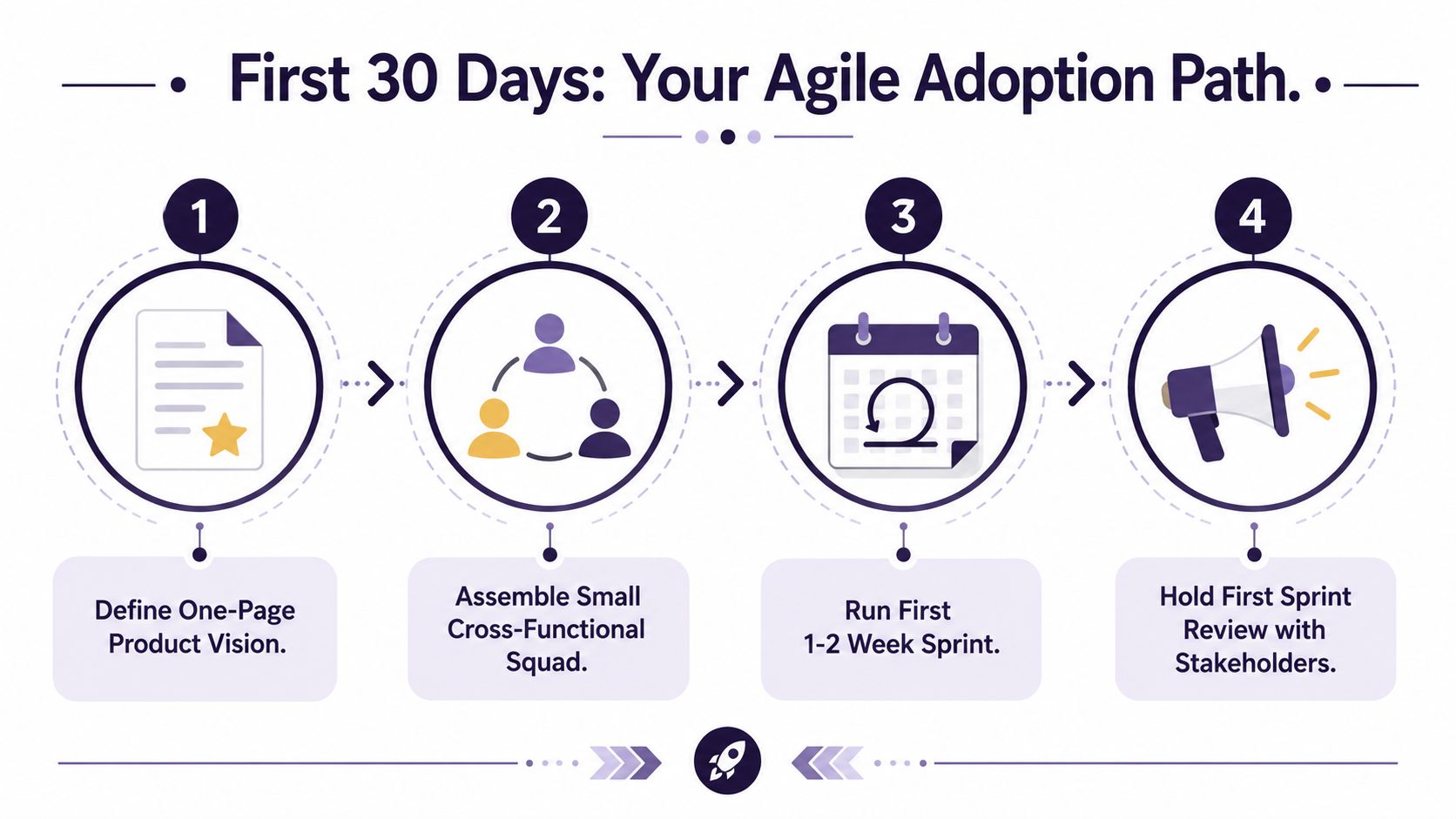
First 30 days
Start with a one-page product vision. Keep it concrete enough that the team can explain who the customer is, what problem matters, and what winning looks like. Then assemble a small cross-functional squad with the people who can move the product forward.
Seed the backlog with real customer problems, not internal opinions. That backlog should be a living list of opportunities, bugs, questions, and experiments. If the input is vague, the output will be vague too.
Next 60 days
Run two-week sprints so the team gets used to a steady planning and review cadence. Add a basic retro after each sprint, not to score people, but to spot friction before it turns into habit.
This is also the right time to instrument two or three outcome metrics. If the team can't explain why those metrics matter, they're probably the wrong ones. Use the roadmap as a decision aid, not a promise sheet, and keep it connected to product bets rather than dates alone. The logic behind this works especially well when paired with sound product roadmap practices.
Next 90 days
Tighten the definition of done so everyone knows what “finished” means. Add lightweight discovery work, like customer calls, prototype tests, or quick concept reviews, before the team commits to the next chunk of delivery.
At this stage, the founder should also ask a hard question. Does this framework still fit the product and the team, or is the process starting to fight the business? That's where maturity shows up. Agile isn't successful because it feels modern. It's successful when it helps the team make better decisions with less confusion.
A simple fractional or first product manager role can look like this:
- Own the product backlog and keep it prioritized by customer value and business impact.
- Run sprint planning, reviews, and retrospectives with a clear decision trail.
- Work with founders, designers, and engineers to turn customer problems into shippable work.
- Track a small metric set and connect it to product decisions.
- Coach the team on cadence and scope control so the process stays useful instead of ceremonial.
When Agile Is the Wrong Fit and What to Do Instead
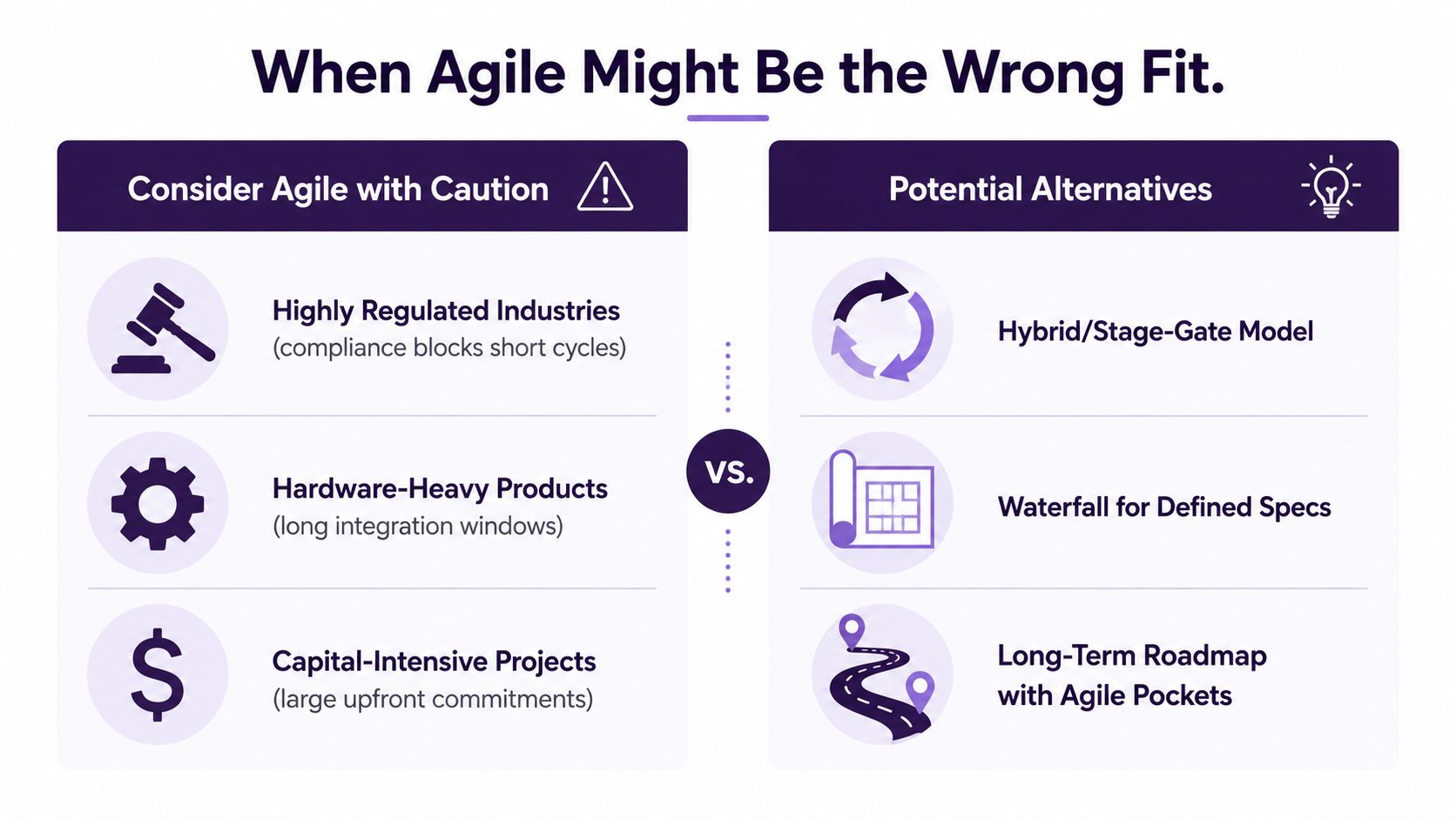
Agile gets oversold when people treat it like a universal upgrade. It isn't. Some products live inside constraints that make short cycles awkward, expensive, or even misleading.
Regulated products, hardware-heavy systems, and capital-intensive projects often have long lead times that don't compress neatly into two-week sprints. Compliance work can block release timing. Physical integration can stretch timelines. Large upfront commitments can make “just iterate” sound easier than it really is. Forcing Agile in those settings can create fake agility, where the team runs ceremonies but still can't change the actual plan.
A quick decision test
Ask three questions before choosing the operating model. How much feedback signal can the team absorb? How reversible are the decisions? What does it cost to change course once work is underway?
If the answers point to low reversibility and high cost of change, the team may need a hybrid setup instead of pure Agile. That might mean stronger upfront problem framing, more explicit decision gates, and an outcome-based roadmap that still leaves room for iterative delivery.
The useful mindset is not “Agile or waterfall.” It's “What blend protects the business while still letting the team learn?” That's especially relevant for early-stage startups that don't have enough data yet to justify a rigid operating model, but also can't afford to improvise every week.
A fractional product leader can help design that blend without forcing the company into a borrowed playbook. The right person won't just copy a SaaS process. They'll look at the product, the market, and the risk profile, then set up a cadence the business can sustain.
How Fractional Product Leaders Accelerate the Transition
Most early-stage founders don't have a product leadership problem because they lack ambition. They have one because hiring a full-time VP of Product too early can be slow, expensive, and risky when the team still needs to learn what the product should become. A fractional leader gives the startup senior judgment without the full-time commitment.
A part-time executive can step in, shape the backlog, coach the first product manager, and make the sprint rhythm usable from the start. That matters because process drift usually begins when nobody owns the operating model. A founder is too busy. Engineering is focused on delivery. Sales is chasing deals. The product function ends up being everyone's side job.
A strong fractional engagement usually starts with a short interview loop, then moves into onboarding inside one sprint. The goal isn't to “install process.” It's to get the team to a place where the product work is visible, sequenced, and measurable.
What good support looks like
Shiny's model is built around 5 to 25 hours a week, which is a useful range for startups that need senior help without hiring a full-time leader. Its marketplace also gives founders a way to access vetted executives across industries, then narrow the search through posting, matching, interviews, and onboarding. For teams trying to move quickly, that structure can shorten the time between “we need help” and “we have someone leading the work” (fractional product manager marketplace overview).
Success should be visible quickly. A stable sprint cadence within four weeks is a good sign. A backlog ranked by impact within six weeks is another. If at least one outcome metric starts moving quarter over quarter, the startup is probably getting real value from the shift.
The best fractional product leaders don't replace the founder. They make the founder's attention count more. That's the point of the model.
Bringing It All Together and Your Next Step
Agile product management works best when you treat it as a startup operating system, not a meeting style. The core pieces are simple: a prioritized backlog, short cycles, and metrics tied to outcomes. The framework you choose should fit the team's stage, the product's risk, and the quality of feedback you can get.
Most startups don't need a full-time product executive on day one to get there. They need someone who can establish the rhythm, keep the team honest about what's learning and what's noise, and adapt the model as the business changes.
If you're ready to make that move, visit Shiny to explore how vetted fractional product leaders work, browse sample roles, or book a consultation to scope a five-to-25-hour engagement that fits where your company is right now.
A CTA for Shiny.