
Board of Directors Structures: A Guide to Building Your Strategic Brain Trust
Don't think of a board of directors as a stuffy, corporate obligation. A better way to picture it is as your company's strategic brain trust—a hand-picked team of experts laser-focused on helping you navigate the chaotic journey of growth. The thing is, the most effective board of directors structures aren't one-size-fits-all; they have to be built for your company's specific stage and goals.
Building Your Company's Strategic Brain Trust

Many founders treat creating a board as just another box to check on a legal to-do list. This perspective misses a massive opportunity. When done right, your board can morph from a simple legal requirement into your most powerful strategic asset, providing guidance that accelerates growth and helps you sidestep costly mistakes.
Get it wrong, though, and a poorly built board can quickly become a source of friction. It can slow down decisions and offer advice that’s five years out of date. The key is realizing the board you need at the seed stage is completely different from the one you'll need for a Series B or as a mature small business.
Why Structure Matters More Than You Think
The architecture of your board has a direct line to its effectiveness. A well-designed structure creates clear lines of communication, accountability, and strategic alignment. It’s not just about who is in the room, but how they work together to push the company's long-term vision forward.
- Decision-Making Speed: The right model makes your company more agile, letting you pivot quickly when the market throws you a curveball.
- Access to Networks: A strategic board opens doors. Think introductions to investors, key hires, and game-changing partnerships.
- Enhanced Governance: A proper structure gives you the oversight needed to keep the company financially healthy and maintain stakeholder trust.
To give you a quick lay of the land, here’s a simple breakdown of the main board models we'll be diving into.
Key Board Structures at a Glance
| Structure Type | Primary Function | Best For |
|---|---|---|
| Unitary Board | Combines management and oversight in a single body. | Startups and SMBs in common law countries (e.g., US, UK) looking for agility. |
| Two-Tier Board | Separates management (Management Board) and oversight (Supervisory Board). | Companies in civil law countries (e.g., Germany, Netherlands) or those needing strict separation. |
| Governing Board | Holds legal fiduciary duty and formal decision-making power. | Any formally incorporated company requiring legal oversight and governance. |
| Advisory Board | Provides non-binding strategic advice without formal power. | Early-stage startups or companies needing flexible, low-cost expert guidance. |
This table is just a starting point. The real magic happens when you understand how to blend these concepts to fit your unique situation.
Research backs this up. The Russell Reynolds Associates Global Board Culture and Director Behaviors Study found that the best boards aren't just defined by their framework. Top-performing boards are built on a foundation of strong leadership and a culture of open, honest dialogue. It’s a mix of structure and human interaction.
Moving Beyond the Traditional Model
Let’s be honest, startups and SMBs often struggle to attract the heavy-hitters needed to fill board seats. The old model of handing out huge chunks of equity to seasoned executives just isn't always practical. This is a business pain point where a more modern approach, like bringing in fractional leadership, can be a total game-changer. By building your board with intention, you can get world-class expertise right when you need it, without breaking the bank.
This guide will demystify the entire process, breaking down the different board of directors structures and what they're for. We’ll give you a clear roadmap to build a board that acts as a real competitive advantage. To get a better handle on what a board actually does, you can explore our detailed article on the purpose of a board of directors.
Understanding Unitary and Two-Tier Board Systems
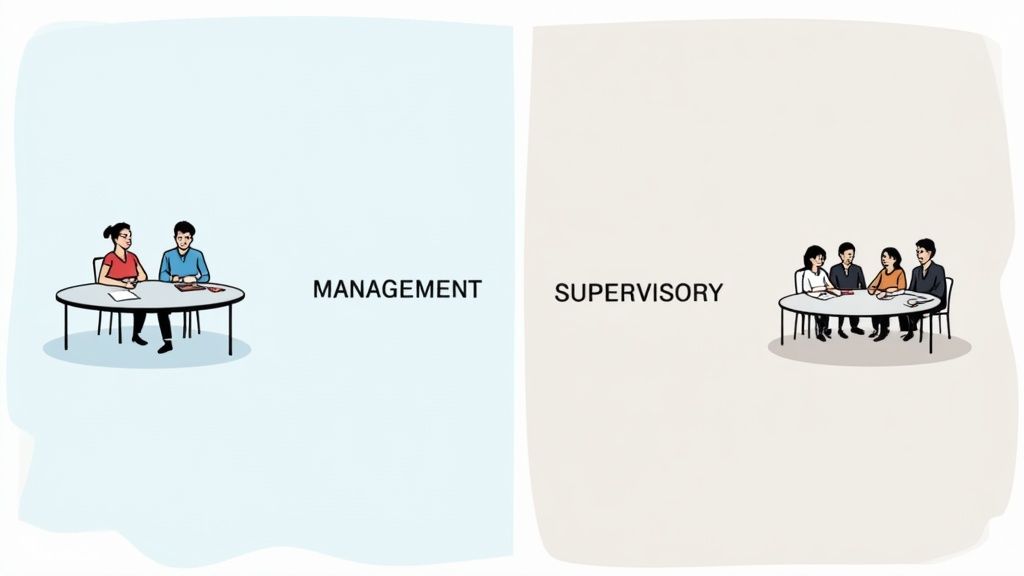
When you start digging into board of directors structures, the first big fork in the road is the legal framework. At the highest level, this splits boards into two camps: Unitary and Two-Tier. Getting a handle on which system you're working with is fundamental—it shapes everything from how quickly you can make decisions to how you communicate with stakeholders.
Often, the choice isn't really a choice at all; it's dictated by geography. Companies in common law countries like the United States, the UK, and Canada almost always run on a Unitary system. On the flip side, the Two-Tier model is the standard in civil law countries, especially Germany, the Netherlands, and Austria.
The Unitary Board: A Single Command Center
Think of a Unitary board as a single, unified command center. In this setup, there's just one board, and it’s a mix of executive directors (like the CEO and CFO, who are in the weeds daily) and non-executive or independent directors. They all sit at the same table, carry the same legal weight, and vote on decisions together.
This integrated structure is built for one thing: speed. When your operations leaders and your oversight folks are in the same room, communication is seamless, and you can make strategic moves fast. For a startup or a growing SMB, that agility can be a massive competitive advantage.
The real magic of a Unitary board is its cohesive nature. It builds a shared sense of ownership for the company's performance, killing any chance of an "us versus them" dynamic between management and supervisors.
But this fusion has a potential downside. The close working relationship between executives and non-executives can sometimes blur the lines of independent oversight. There's a risk the board becomes an echo chamber for management, potentially missing red flags that a more detached group might spot.
The Two-Tier Board: A System of Checks and Balances
The Two-Tier system, in contrast, is like a government with separate branches built for checks and balances. It creates a clear, legally required separation between the people running the company and the people watching over them.
This structure has two distinct boards:
- The Management Board: Made up entirely of senior executives who handle day-to-day operations. They're the ones executing the strategy and running the business.
- The Supervisory Board: A totally separate body of non-executive directors. Their entire job is to oversee and advise the management board. They have the power to appoint (and fire) members of the management board, but they don't get involved in daily decisions.
This strict separation is the system's greatest strength. It guarantees a high level of independent oversight, making it tough for management to go rogue. This is especially useful for protecting the interests of all stakeholders—including employees, who often have seats on the supervisory board in countries like Germany.
The trade-off, however, is that this structure can be slower and more bureaucratic. The formal divide can lead to communication gaps or even friction between the two boards, bogging down critical decisions.
For any business, especially one with global ambitions, understanding these foundational board of directors structures is non-negotiable. It affects everything from governance expectations to investor relations. While most US-based startups will naturally fall into a Unitary system, knowing the Two-Tier model exists is vital for global expansion and for simply appreciating different flavors of corporate governance.
Advisory Board vs. Governing Board: Which Do You Need?
After you get past the big-picture legal structures, a critical early decision for a growing company is choosing between an advisory board and a governing board. This isn't just semantics; it's a choice that defines who gives you guidance and how much power they have. Nail this decision, and you set yourself up for smooth growth. Get it wrong, and you can create friction that slows you to a crawl.
Think of an advisory board as your personal brain trust. They're your go-to mentors for industry insights, warm introductions, and the kind of brutally honest feedback you can't get anywhere else. Here's the key: their role is strictly to advise. They have no legal authority, no votes, and no formal fiduciary duty to the company. This makes them a perfect, low-overhead tool for startups in the early days.
A governing board, on the other hand, is the real deal. These directors have a legal fiduciary duty to act in the best interests of the company and its shareholders. They hold actual power—they can approve budgets, issue stock, and even hire or fire the CEO.
The Advisory Board: Your Secret Weapon for Early-Stage Growth
For most seed-stage startups, a formal governing board is overkill. At this stage, you need speed and wisdom, not bureaucracy. This is exactly where an advisory board shines. It lets you bring world-class expertise into the fold without the heavy legal and financial baggage of a formal board seat.
Imagine you're a founder building a new SaaS product. You could assemble an advisory board with:
- A veteran marketing exec who already scaled a company just like yours.
- A product chief from a big-name tech firm who can poke holes in your roadmap.
- A seasoned founder who’s been through the fundraising wringer a few times.
These folks can give you priceless, on-demand advice, open up their Rolodex, and help you dodge bullets you don't even see coming. Since there are no formal duties, it's often easier to attract top talent, typically compensated with a small slice of equity—somewhere in the 0.1% to 1% range is common.
When a Governing Board Becomes Mandatory
The switch from an advisory to a governing board is almost always triggered by one thing: taking on outside investment. When a VC firm writes you a check, they're buying a piece of your company. As new shareholders, they need a formal way to protect that investment, and that means putting a governing board in place.
A governing board isn't just a friendly suggestion from investors; it’s a requirement. It creates formal accountability and ensures major decisions are made with proper oversight, protecting everyone's interests—yours and theirs.
Once you take that money, your board structure will transform. An investor will almost always take a board seat, and you’ll be expected to bring on one or two independent directors to add an objective voice. This is the moment your board’s role pivots from casual mentorship to formal governance. It's no longer just about advice; it's about making binding decisions that will steer the future of the company.
The Fractional Executive: A Powerful Bridge Between Worlds
Making this transition can feel intimidating. How do you find an independent director who gets your business and has real operational chops? This is where fractional leadership provides a brilliant, actionable solution.
A fractional executive—like a part-time CFO or CMO—can be an incredible addition to either an advisory or a governing board. For an early-stage company, adding a fractional exec to your advisory board gives you immediate, hands-on help without the full-time price tag. They don't just offer ideas; they can help you execute them.
Then, when it’s time to form a governing board, that same fractional leader might be the perfect person for an independent director seat. They already know your company inside and out and bring the exact strategic perspective that investors love to see. It’s a way to build a world-class board with the precise skills you need, right when you need them.
If you’re ready to see how elite, experienced executives can supercharge your board, consider scheduling a consultation to find the right fractional leader for your company's journey.
How to Build Your Board at Every Growth Stage
Your board of directors isn't a "set it and forget it" part of your business. It’s a living entity that must evolve right alongside your company. The scrappy, informal group of advisors that gets you through the seed stage is worlds away from the structured, diverse board you'll need to handle rapid growth. Building the right board at the right time is a core strategic move, not just a box-ticking governance exercise.
This is about more than just filling seats. You're assembling a strategic brain trust, hand-picking the exact skills and experience needed to crush the challenges of your current stage while teeing up the next one. As your company scales, the board of directors structures you rely on must mature to match your ambition.
The Seed Stage: Your Initial Brain Trust
In the very beginning, your board is all about agility, trust, and survival. For most seed-stage startups, the "board" is often just the founders and maybe one or two mentors who truly believe in the vision. Formal governance isn't the priority; finding product-market fit and landing that first check is.
The ideal setup at this point is lean and mean:
- Founders: The heart of the company. You live and breathe the vision.
- A Trusted Advisor: This might be a seasoned entrepreneur who’s been there before or an angel investor who’s offering more than just cash. They're there to provide critical guidance and ask the tough questions nobody else will.
The name of the game is speed and expertise. You need people who can help you sidestep common mistakes without wrapping you up in red tape.
The Series A Board: Adding Structure and Expertise
That Series A check hitting the bank is a massive milestone, and it's the trigger for a major evolution in your boardroom. Your lead investor will almost certainly take a board seat, which officially shifts your group from an informal posse to a formal governing body with real legal duties. This is where strategic oversight starts to matter just as much as tactical advice.
Your board should now grow to include:
- An Investor Director: This person represents your new financial partners. They bring a wealth of experience in scaling venture-backed companies and have a vested interest in your success.
- An Independent Director: This is a big one. It's your first non-founder, non-investor voice in the room. You want a seasoned operator with deep industry knowledge who can bring an objective, balanced perspective to the table.
This infographic nails the typical evolution, showing how a funding event transforms the board from a simple advisory group to a formal governing body.
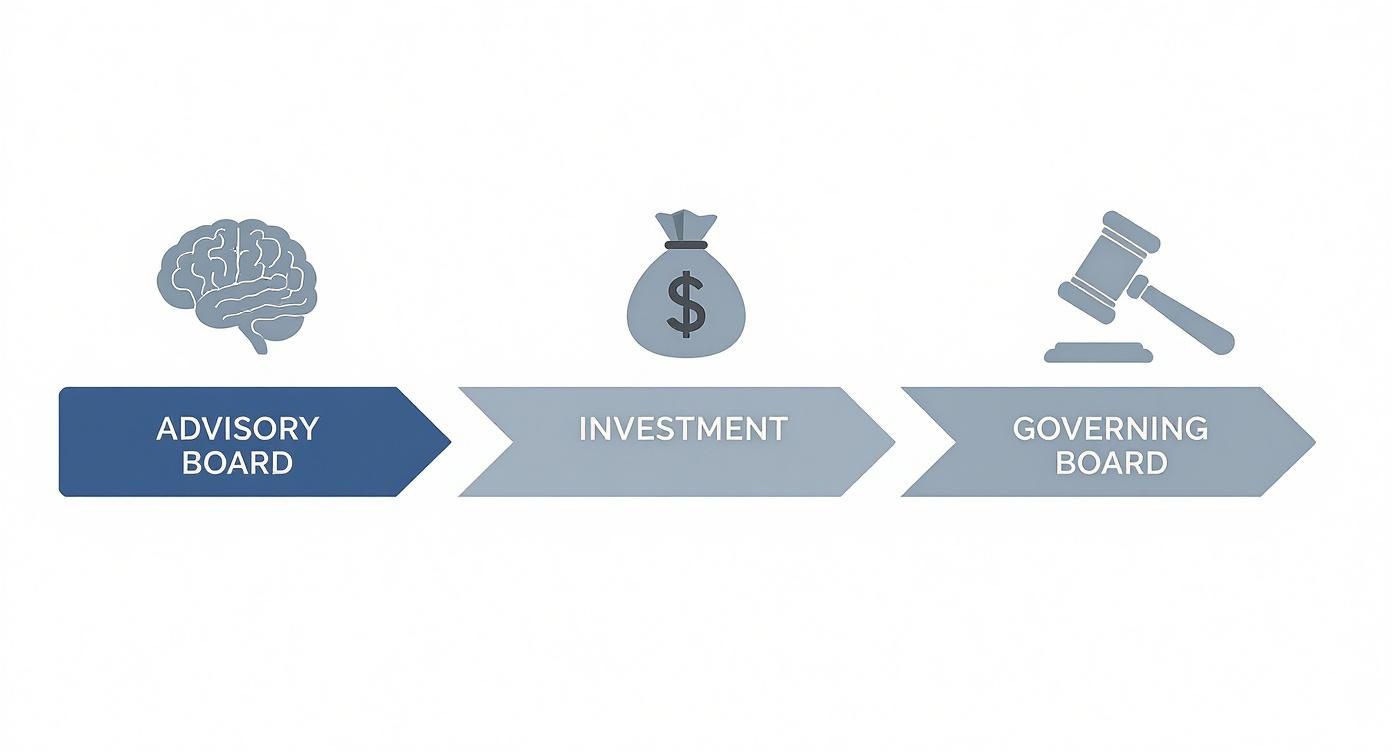
As you can see, funding is the catalyst. It’s what moves the board’s role from just providing guidance to providing true governance.
The Growth Stage: Diversifying for Scale
Once your company hits the growth stage—think Series B and beyond—the complexity of your operations explodes. You’re not just building a product anymore; you're building a scalable business machine. Your board needs to evolve again to help you navigate these new, bigger challenges by adding a diverse mix of functional expertise.
At this point, you should be hunting for independent directors with specific, battle-tested skills in areas like:
- Finance: Someone who’s navigated late-stage financing, M&A, or even taken a company public.
- Operations: An expert who has personally scaled a business from your size to the next level and knows where all the operational landmines are buried.
- Marketing & Sales: A leader who understands how to build a go-to-market strategy that wins at the enterprise level.
Diversity of experience and perspective is no longer a nice-to-have; it's a strategic necessity. A board composed of people with different backgrounds is far better equipped to challenge assumptions, identify blind spots, and drive genuine innovation.
This isn't just startup talk; it's being proven at the highest levels. For instance, among S&P 500 companies, 26.3% of board directors are now racially or ethnically diverse, a number that keeps climbing. This trend shows that the biggest players recognize that diverse boards simply make better decisions—a lesson that growing companies need to learn fast. You can dig into the full report on recent trends on boards of directors to learn more.
This is a key area where fractional executives can be a game-changer. They are perfectly suited for these independent director roles. Hiring a fractional CFO or CMO gives you access to elite, specialized talent to fill a specific strategic gap on your board—at the exact moment you need it most.
If you’re looking to add high-impact, specialized leadership to your board without the full-time cost and commitment, exploring fractional executives could be your smartest move. Schedule a consultation to connect with the right experienced leader for your company’s next chapter.
Breaking Down Essential Board Committees
As your company grows, trying to tackle every critical detail in full board meetings just doesn't work. It's slow and inefficient. The real solution is forming committees. Think of them as special-ops teams that handle specific, vital functions, letting the full board stay focused on high-level strategy and vision.
These committees aren't just about dividing the workload; they're about bringing deep expertise to complex issues. You assign directors with strong finance skills to the Audit Committee and those with HR chops to the Compensation Committee. This way, critical areas get the focused, expert attention they need. This is a hallmark of a mature and effective board of directors structure.
The Audit Committee
The Audit Committee is the guardian of your company’s financial integrity. Its job is to oversee financial reporting, internal controls, and the entire audit process. This is the team that makes sure your numbers are solid and that the company is buttoned up against financial risks.
This committee should be made up entirely of independent directors, with at least one member who qualifies as a "financial expert." Their key responsibilities include:
- Hiring and managing the relationship with your external auditors.
- Reviewing the quarterly and annual financials before anyone else sees them.
- Monitoring the company’s internal control systems to sniff out and prevent fraud.
As you get closer to a major funding round or think about an exit, creating an Audit Committee is non-negotiable. It sends a powerful signal to investors that you take financial discipline and transparency seriously.
The Compensation Committee
The Compensation Committee tackles one of the most sensitive jobs in any company: figuring out how to pay the executive team. The goal is to design packages that attract and keep top-tier talent while making sure their incentives are directly tied to the company's long-term success and shareholder value.
This committee also sets the pay for the board members themselves. If you're curious about what's standard, check out our detailed guide on startup board of directors compensation. Just like the Audit Committee, its members have to be independent to prevent any conflicts of interest when deciding on executive paychecks.
The Nominating and Governance Committee
Think of the Nominating and Governance Committee as the architect of the board itself. This group is in charge of finding, vetting, and recommending new candidates for board seats. They also spearhead everything related to corporate governance, from writing board policies to overseeing the annual evaluation of the board’s own performance.
This committee is crucial for shaping the future of your board. They ensure it has the right mix of skills, experience, and diversity to steer the company through whatever comes next.
This is how the board avoids going stale. The most effective boards today are constantly evolving to meet new challenges. A recent report found that 84% of directors are increasing their investment in board refreshment to make sure they have the right expertise on hand. You can dig into more findings about this trend in the full report on strategic board evolution. When this committee identifies a need for deep, specialized operational experience, bringing in a fractional executive is often the perfect way to fill that critical skills gap quickly.
Using Fractional Executives to Build a World-Class Board
How does a startup get the same kind of strategic brainpower that guides Fortune 500 companies? The answer isn't about raising another round to afford a massive executive salary. It's about a smarter, more modern approach to leadership that fits perfectly with how fast-growing companies actually operate.
Fractional leadership is your secret weapon for leveling up your board's expertise without the crazy cost or long-term lock-in of a full-time hire.
This model lets you plug world-class, specialized talent directly into your most important conversations, right when you need it most. Imagine calling in a specialist for a critical mission. You get immediate access to someone who can solve a specific, high-stakes problem and help you build a truly world-class board, one expert at a time.
Targeted Expertise on Demand
Your challenges change as you grow, and your board needs to keep up. Instead of trying to find one person who knows a little bit about everything, the fractional model lets you bring in a specialist to solve a specific problem.
It’s a practical solution for real-world business pain points:
- Staring down a complex funding round? A fractional CFO who has navigated dozens of term sheets can guide you through financial modeling, investor relations, and due diligence. That kind of experience can be the difference between a successful close and a painful "no."
- Planning a big market expansion? A fractional CMO can hand you the playbook for launching in new territories, building brand recognition, and acquiring customers without burning through your entire budget.
- Feeling the growing pains of scale? A fractional COO can step in to redesign your workflows, implement the right tech, and make sure your business can handle rapid growth without imploding.
When you bring on fractional leaders as advisors or independent directors, you're not just getting advice. You're getting hands-on expertise from someone who has been in your exact situation and won.
The real power of fractional leadership is its surgical precision. You're not hiring a full-time executive for a part-time problem. You're bringing in a seasoned pro with the exact skills needed to solve a specific, make-or-break challenge.
Cost-Effective Access to Elite Talent
Let's be honest: the salary for a C-suite executive from a major corporation is usually out of reach for most startups and SMBs. This reality often forces founders to compromise on experience for their board, leaving a massive knowledge gap right when the stakes are highest.
Fractional executives completely flip this script. They offer a cost-effective way to get the top 5% of talent on your team without the full-time salary, benefits, and equity package. This model is democratizing access to elite strategic minds, leveling the playing field so smaller companies can go head-to-head with the big incumbents.
You can dive deeper into the strategic benefits by reading our guide on the fractional C-suite advantage.
By using this approach, you can build a more dynamic and effective board of directors structure. You can fill critical skill gaps in weeks, not months, and ensure your strategic brain trust is always equipped with the best talent you can find.
Building an exceptional board is one of the highest-leverage things a founder can do. If you know there’s a gap in your board’s expertise that’s slowing you down, the right fractional executive might just be the key to unlocking your company's true potential. Schedule a consultation to tap into our network of vetted, experienced leaders and find the perfect addition to your board.
Your Top Questions About Board Structures, Answered
Alright, let's tackle some of the common questions that pop up when founders start thinking seriously about building a board. It’s easy to get lost in the details, so here are some quick, straightforward answers.
How Should I Compensate Advisory Board Members?
This is a big one. For advisory board members, compensation is almost always equity, not cash. Think of it this way: you want them to be invested in your success, literally.
The typical range is 0.1% to 1% of company stock, usually vesting over one to two years. Where you land in that range depends on the advisor's clout, your company's stage, and how much time they're committing. An early-stage startup will give up more equity than a Series B company for the same level of advisor.
Can Someone Serve on Both Boards in a Two-Tier System?
Nope, and that's by design. The entire point of a two-tier structure is the strict separation between the management board (the doers) and the supervisory board (the watchers).
Allowing someone to sit on both would create an immediate conflict of interest. It would completely undermine the model's core function, which is to provide truly independent oversight. This separation is legally mandated in countries where this system is common.
When Is a Formal Board of Directors Legally Required?
If you’ve incorporated your company (as a C-Corp, for example), you technically need a board of directors from day one. But let's be real—in the very beginning, that "board" is often just you and your co-founders sitting around a table.
Things get official the minute you take on outside capital. Venture capital investors will almost always require a board seat as a condition of their investment. That's the moment your board starts to evolve from an internal formality into a true governance body.
What exactly is a board observer?
A board observer gets a ticket to the show but can't vote. They attend meetings, listen to discussions, and can offer input, but they don't have any formal power. This role is perfect for a major investor who didn't get a board seat or a key mentor whose advice you want in the room. It’s a great way to keep important people in the loop without diluting the voting power of your official directors.
Building the right board with the right experts at the right time can feel like a huge challenge. Shiny connects you with a network of over 3,000 vetted, part-time executives who can fill critical gaps on your advisory or governing board, providing world-class strategic guidance exactly when you need it.
Explore fractional executives to strengthen your board today.