

Business Consultants for Startups: Accelerate Growth with Fractional Leadership
Business consultants offer startups specialized, on-demand expertise. They’re your secret weapon to navigate tricky challenges, hit growth targets faster, and—most importantly—sidestep costly, early-stage mistakes. Think of them as strategic operators, not just advisors. They get in the trenches with you to implement proven systems for everything from fundraising to market entry, giving you a faster path to real results.
When to Hire Business Consultants for Startups

As a founder, you're wired to do everything yourself. Juggling multiple roles is how you stretch every single dollar. But the smartest leaders know this DIY approach has a ceiling. Bringing in a business consultant isn't a sign of weakness; it's a strategic trade-off—swapping a bit of capital for critical speed and expertise.
Imagine you're climbing a treacherous, unfamiliar mountain. You might be a skilled climber, but you'd still hire a sherpa. Why? Because they've been up that exact peak countless times. They know the shortcuts, the hidden dangers, and how to save energy for that final push to the summit. A business consultant is your startup’s sherpa, guiding you past the common pitfalls that regularly trip up early-stage companies.
The Rise of On-Demand Expertise
The global management consulting industry is a behemoth, reaching roughly $1.1 trillion in revenue in 2025. This massive figure tells a simple story: businesses of all sizes desperately need external experts who can solve complex problems, especially around market shifts and innovation.
Thankfully, this has led to far more flexible and capital-efficient models than the old-school, big-retainer consulting projects. Startups don't have to lock themselves into massive contracts to get top-tier help anymore.
A consultant is more than just a source of advice; they are a specialized operator you deploy to solve a specific, high-stakes problem. Their value is measured in outcomes, not hours.
To figure out exactly where you need help, it's useful to match your current pain points with the right kind of expertise.
Matching Startup Challenges to Consulting Expertise
This table breaks down common startup struggles and points you toward the type of consultant who can solve them.
| Startup Challenge | Consulting Expertise Needed |
|---|---|
| "Our cash flow is a mess and we're burning too fast." | Financial Consultant or Fractional CFO |
| "We're struggling to find product-market fit." | Product Strategy or Go-to-Market (GTM) Consultant |
| "Our sales process is inconsistent and isn't scaling." | Sales Operations or Revenue Operations (RevOps) Consultant |
| "We need to raise a seed round but our pitch is weak." | Fundraising or Pitch Deck Consultant |
| "Our internal processes are chaotic and inefficient." | Operations or Business Process Consultant |
| "We can't generate enough qualified leads." | Marketing Strategy or Demand Generation Consultant |
| "Our technology stack can't keep up with our growth." | Technology or IT Strategy Consultant (often a Fractional CTO) |
| "We're entering a new market and don't know the landscape." | Market Entry or International Expansion Consultant |
This self-diagnosis is the first step. Once you know what you need, you can find the right operational expert to fill that gap.
Fractional Leadership: A Modern Solution
One of the best ways for startups to get this kind of help is through fractional leadership. This model is a game-changer. It allows you to embed a seasoned, executive-level pro into your team for a fraction of what a full-time hire would cost.
Instead of a six-figure salary plus benefits, you get a C-suite operator—like a Chief Marketing Officer or Chief Financial Officer—for a set number of hours each week. The benefits are immediate and impactful:
- Cost-Effectiveness: You get top-tier executive experience without the hefty full-time salary, benefits, and equity package.
- Targeted Impact: Bring in hyper-specific skills exactly when you need them, whether it’s for fundraising, scaling sales, or building an operational backbone.
- Flexibility: Easily scale the engagement up or down as your needs change. This agility is priceless in a fast-moving startup environment.
By exploring what fractional leadership entails, you can see how it bridges the gap between needing expert guidance and having a tight budget. When you’re facing a make-or-break challenge, finding the right partner to connect you with these specialized leaders is the smartest investment you can make.
Diagnosing Your Startup's Core Problem

Before you even think about finding a consultant, you need to figure out what’s actually broken. It’s a common story: founders feel a general sense of being stuck—things are slow, clunky, or just not clicking. But "not clicking" isn't a diagnosis. It's a symptom.
Hiring a consultant without a crystal-clear problem definition is like going to the doctor and asking for a prescription without telling them where it hurts. You might get something, but it's probably not what you need. Real clarity is the only foundation for a successful partnership.
This means you have to dig deeper than those vague frustrations to pinpoint the specific gap in your business. This internal deep dive is what ensures you find a business consultant for startups with the exact skills to solve your actual challenge, not just the one that’s most visible on the surface.
Moving from Symptoms to Root Causes
It's time to put on your detective hat. The goal is to isolate the friction points holding you back by asking tough, targeted questions about your operations.
Here are a few diagnostic questions to get you started:
- Sales & Marketing: Is our sales funnel leaking at a specific stage, like lead qualification or demo-to-close? Maybe we're just attracting the wrong customer profile entirely.
- Operations & Scaling: Are our manual processes creating bottlenecks that stop us from handling more customers? Do we have the systems in place to actually double our output if we needed to?
- Finance & Fundraising: Is our financial model solid enough to stand up to investor scrutiny? Do we really understand our unit economics and cash runway?
- Product & Retention: Are customers churning for a specific, identifiable reason? Is our onboarding process failing to show users the product's core value before they give up?
Answering these questions honestly gives you a clear, actionable project scope. This scope becomes the blueprint for your search and the benchmark you'll use to measure the consultant's success.
The Danger of a Misdiagnosis
One of the most common pitfalls for startups is mistaking a symptom for the root cause. It's an easy mistake to make, and it can be incredibly costly in both time and money.
Take the B2B SaaS startup that was bleeding customers. Convinced it was a marketing issue, they burned through a significant budget and three months with a demand-gen consultant to bring in "better" leads. The result? Churn rates didn't budge.
Finally, they brought in a product strategy consultant. It took this new expert less than a week to identify the real problem: a confusing and clunky onboarding experience. New users never got to that "aha!" moment and just gave up.
By refocusing on the first-run user experience, they cut churn by a whopping 40% in a single quarter. The problem was never the lead quality; it was the product's failure to deliver on its promise from the very first login.
This story is a perfect illustration of why a precise diagnosis is non-negotiable. When you have a well-defined problem and a clear vision for what "fixed" looks like, you’re in the perfect position to find a specialist who can deliver real, measurable impact.
Once you’ve nailed down your core challenge, the next step is finding the right expert to solve it. Exploring a network of vetted fractional executives can connect you with leaders who have solved your exact problem before, ensuring you invest in a solution that actually works.
How to Find and Vet the Right Consulting Partner
Finding a great consulting partner isn't about a quick Google search. The best consultants for startups rarely have the flashiest websites. Instead, they're the operators—the ones with proven, relevant track records who have already been in the trenches and solved the exact problems you're facing right now.
Your mission is to find someone who has already navigated your specific challenges, not a generalist with a big corporate name on their resume.
Sourcing this kind of talent requires a targeted approach. Think of it less like casting a wide net and more like using a precision tool. Your time is your most valuable asset, so focusing your search on high-quality channels from the get-go will save you from drowning in a sea of unqualified candidates.
Where to Source Top-Tier Talent
Instead of scrolling through endless search results, you need to tap into curated networks where trust and reputation are already baked in. This seriously de-risks the process and connects you with professionals who come with a built-in stamp of approval.
Here are the most effective places to kick off your search:
- VC and Investor Networks: Your investors have a vested interest in your success. They almost always keep a "black book" of trusted consultants and fractional executives who have delivered real results for other portfolio companies. An intro from a VC is one of the strongest signals of quality you can get.
- Niche Industry Communities: Look for specialized Slack channels, private forums, or industry groups relevant to your startup. A recommendation from a fellow founder who has tackled a similar problem is gold because they get the unique pressures and constraints of the startup world.
- Specialized Talent Platforms: Modern marketplaces are popping up to connect startups with pre-vetted fractional executives. These platforms do the initial heavy lifting, curating a pool of experienced leaders you can tap into. This model gives you access to C-suite talent that would otherwise be out of reach. For a deeper dive, our comprehensive guide to fractional hiring explains how to get the most out of these resources.
Vetting for True Expertise
Once you have a shortlist, the real work begins. This is where you separate the talkers from the doers.
Your goal is to uncover concrete evidence of past performance, especially within companies at a similar stage to yours. A consultant who crushed it at a Fortune 500 company might not have the scrappy, hands-on mindset required for a seed-stage startup.
The most important question isn't "What do you know?" but "What have you done?" Prioritize a consultant's specific, tangible accomplishments in a startup environment over the brand names on their resume.
Move beyond generic interview questions and really dig into their operational experience. You need to understand not just their strategic thinking, but their raw ability to execute.
Essential Vetting Questions
Here’s a checklist of questions designed to reveal true expertise and working style. You're looking for substance, not just smooth answers.
-
"Describe a time you had to pivot a strategy based on new data. What was the situation, what data did you use, and what was the outcome?"
This reveals their adaptability and whether they are genuinely data-driven. -
"Walk me through a project you led for a company at our stage. What were the initial goals, what was your exact role, and what were the measurable results?"
This tests for direct, relevant experience and a focus on tangible outcomes. No fluff. -
"How do you ensure knowledge transfer to our internal team? Can you give an example of how you've upskilled a team in a past engagement?"
A great consultant doesn't create dependency. They should build systems and empower your team for long-term success. -
"What would your first 30 days look like in this engagement?"
This question assesses their ability to create a structured plan and hit the ground running. You want someone with a clear, actionable vision from day one.
By prioritizing consultants from trusted sources and asking these kinds of incisive questions, you dramatically increase your chances of finding a partner who will become a true catalyst for your startup's growth. A curated talent partner can accelerate this entire process, connecting you directly with leaders who have already been vetted for the skills you need most.
Structuring the Engagement for Maximum Impact
Okay, you’ve found the perfect consultant. High-five. But the job’s not done yet. The next, equally critical step is figuring out how you'll actually work together.
The way you structure your consulting engagement is just as important as the person you hire. Get it right, and you’ll see incredible value. Get it wrong, and you’re in for a world of misaligned expectations, scope creep, and a whole lot of wasted cash.
A successful partnership hinges on a clear framework that ties the consultant's work directly to your business goals. It’s all about moving from fuzzy advice to concrete results that actually push your company forward.
Comparing Consulting Engagement Models for Startups
There are a few standard ways to structure a partnership with a consultant, and each one fits a different need. The trick is to match the model to your specific problem, budget, and how hands-on you need them to be.
| Model Type | Best For | Typical Cost Structure |
|---|---|---|
| Project-Based | Discrete, well-defined tasks like building a financial model for a pitch deck or conducting market research for a new product. | Fixed-fee, one-time payment based on a clear scope. |
| Retainer | Needing ongoing access to strategic advice for a specific function, like marketing or HR, but not requiring a hands-on operator. | Fixed monthly fee for a set number of hours or general availability. |
| Fractional Leadership | Embedding an experienced executive (like a fractional CMO or COO) into your team to own a function and drive results from the inside. | Monthly retainer for a set number of hours per week (e.g., 10-20 hours). |
While project-based and retainer models have their place, fractional leadership has become a total game-changer for startups. It's the sweet spot between high-level strategic advice and the dedicated focus of a real team member—without the hefty price tag of a full-time executive.
Think of the whole process as a funnel: you source the right people, vet them thoroughly, and then select the best fit for your specific needs.
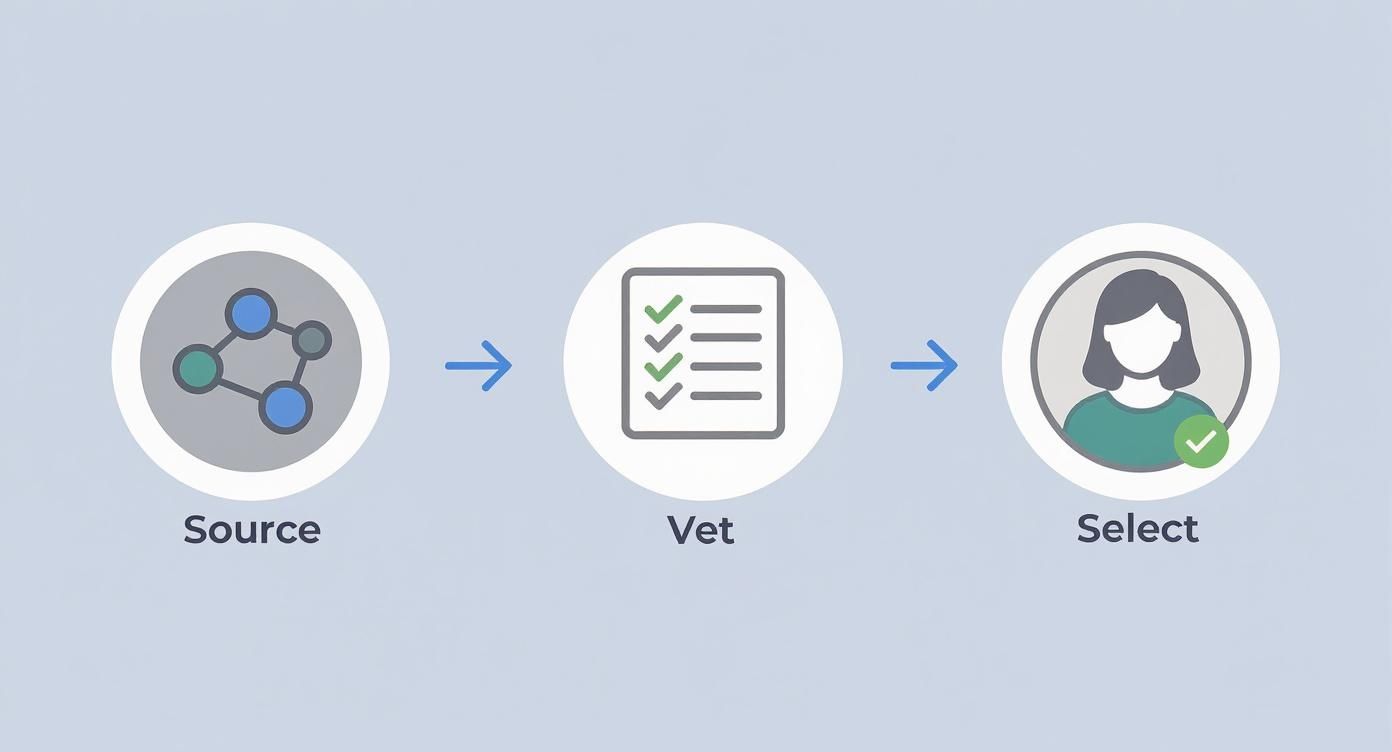
This simple flow highlights why a structured approach is so important. When you’re methodical about sourcing, vetting, and selecting, you set the stage for a partnership that actually works.
The Power of a Watertight Statement of Work
No matter which model you land on, the entire engagement needs to be governed by a detailed Statement of Work (SOW). This document is your single source of truth and the most powerful tool you have for preventing headaches down the road. It’s not just a legal formality; it's your blueprint for success.
A great SOW kills ambiguity. It turns vague goals like "help with marketing" into specific, measurable outcomes like "reduce Customer Acquisition Cost by 15% within 90 days."
A rock-solid SOW should clearly lay out:
- Objectives and Key Results (OKRs): What are the specific, measurable goals of this engagement?
- Scope of Work: What tasks are included? Just as importantly, what is explicitly out of scope?
- Deliverables & Milestones: What tangible things will the consultant produce, and when are they due?
- Communication Cadence: How often will you meet? What will reports look like?
Getting the SOW right is foundational. If you need help framing these high-level goals, check out resources like this strategic roadmap template to make sure your consultant's work is perfectly aligned with your long-term vision.
When you invest the time upfront to structure the engagement properly, you create a partnership that's built for real, measurable impact.
Getting Your New Consultant Plugged In

So, you’ve found the perfect consultant. That’s a huge win. But hiring them is only half the job. The real magic happens when you successfully weave them into the fabric of your team and culture.
Think of it this way: a new consultant can feel like a foreign object inside a living organism. If the body rejects it, nothing gets done, and you’ve just wasted a significant investment.
Those first 90 days are everything. This is where you transform a signed contract into a genuine partnership. As the founder, your most important job now is to be their champion inside the company, clearing roadblocks so their advice can be heard and—more importantly—acted upon.
Set Them Up to Win
To get the best return on your investment, you need to give your consultant the tools and access they need from day one. Treat their onboarding with the same gravity you would for a C-suite executive. This is way more than just a welcome email.
Your goal is to get them up to speed so they can start adding value immediately. Here’s what that looks like in practice:
- Open the Books: Give them full, unfiltered access to all relevant data—analytics, financials, performance metrics. They can’t diagnose a problem they can’t see.
- Make Key Introductions: Personally introduce them to the team members they’ll be working with. Position them as an extension of your leadership, not just some outsider.
- Immerse Them in Your Culture: Add them to your key Slack channels and invite them to important meetings. They need to understand the unwritten rules and communication rhythms to be truly effective.
The Tale of Two Onboardings
The difference between a successful engagement and a failed one often comes down to this initial integration. The world of business consultants for startups is littered with stories that prove this point.
Take the fintech startup gearing up for its Series A. They hired a fractional CFO and, on her first day, gave her access to every financial model and introduced her to the leadership team as a core part of the fundraising mission. The founder’s public support eliminated any friction. She quickly spotted holes in their forecasting, helped rebuild the pitch deck, and they closed a $10 million round.
Now, contrast that with another startup that hired a marketing guru to fix their broken lead gen funnel. They failed to get team buy-in, and the consultant's recommendations were met with instant resistance. Access to key data was slow-walked. The project fizzled out, the money was wasted, and the core problem never got solved.
Creating a Culture of Collaboration
The demand for consultants is massive. North America makes up about 40% of the global consulting market, which is projected to hit nearly $100 billion in 2025. This growth is fueled by startups needing expert guidance to navigate tricky growth stages. You can dive deeper into the numbers with these consulting industry statistics.
To make sure your investment pays off, you have to actively champion your consultant’s role. Frame their presence as a strategic addition of specialized skills, not as a critique of your current team. Encourage open dialogue, welcome their tough questions, and empower your team to collaborate with them.
When your consultant feels like a true partner, their expertise becomes a powerful catalyst for growth. Nail the integration, and you’ll see expert advice turn into game-changing results.
Common Questions About Startup Consulting
When you're running a startup, bringing in outside help can feel like a big leap. You're balancing a tight budget against the burning need for specialized expertise. Let's tackle some of the most common questions founders have when they're thinking about hiring a consultant.
How Much Should We Expect to Pay for a Business Consultant?
This is the big one, and the honest answer is: it varies. A lot. Rates for business consultants for startups depend heavily on their experience, what they specialize in, and how you structure the engagement.
A one-off project, like hammering out a bulletproof financial model for investors, will likely come with a fixed fee. On the other hand, bringing on a fractional executive to run a whole department is usually a monthly retainer.
The real key is to stop thinking, "What does this cost?" and start asking, "What's the potential return?" The right expert should create value that dwarfs their fee. That could mean landing a funding round you otherwise would've missed, sidestepping a catastrophic mistake, or finally cracking the code on customer acquisition.
What's the Real Difference Between a Consultant and a Coach?
It's easy to get these terms mixed up, but their jobs are fundamentally different. A coach is there to help you, the founder, develop your own skills and mindset. Think of them as a guide for your personal and professional growth. A mentor is similar, offering advice drawn from their own specific career path.
A business consultant, especially one in a fractional leadership role, is a doer. They roll up their sleeves and get in the trenches with you. You hire them to execute—to fix a specific problem, build a system that can scale, or run a complex go-to-market strategy. They're hands-on operators, not just advisors.
When Is the Right Time for an Early-Stage Startup to Hire a Consultant?
The perfect moment is when you're staring down a high-stakes challenge that's way outside your team's wheelhouse. These are the make-or-break moments where getting it wrong could be fatal.
The trigger is usually a problem where a wrong turn could set you back six months or even sink the ship. Think gearing up for a crucial fundraise, figuring out why your customer growth has flatlined, or breaking into a new market.
Being proactive and hiring an expert at these inflection points isn't a sign of weakness; it's a strategic power play. You're essentially buying experience and speed when you need them most.
How Can We Actually Measure the ROI of a Consultant?
This is critical. The success of any consulting engagement should be tied directly to the measurable business outcomes you both agree on before a single invoice is sent. This all gets baked into the statement of work (SOW).
Here are a couple of real-world examples:
- Fractional CMO: The goal might be to slash Customer Acquisition Cost (CAC) by 20% or double the number of marketing-qualified leads in the next six months.
- Fractional CFO: Success could be defined as securing a new line of credit or creating a financial model that sails through the toughest investor due diligence.
Define these crystal-clear, quantifiable KPIs from the get-go. It's the only way to make sure the consultant’s work is perfectly aligned with your most urgent business goals.
Making these decisions is a lot easier when you have the right partner. At Shiny, we connect founders with a curated network of over 3,000 vetted executives who are ready to jump in and make an impact. Find the fractional leader your startup needs to hit its next milestone by exploring our talent marketplace at https://useshiny.com.
