

Chief Business Officer Role: Key Skills & Impact
The Strategic Evolution of the Chief Business Officer Role
The Chief Business Officer role, once a supporting position, is now essential in modern leadership. This shift reflects how organizations approach commercial strategy, moving from transactional dealings to a more integrated model. This recognizes the crucial need for a leader who connects high-level business goals with daily commercial activities.
This change is fueled by growing business complexity. Markets shift rapidly, competition intensifies, and technology disrupts traditional models. These factors demand a more strategic approach to business development, partnerships, and revenue. The CBO increasingly navigates these challenges. For example, the role often includes responsibilities previously spread across departments like sales, marketing, partnerships, and even product development.
The rising need for strategic commercial leadership shows in hiring trends. The Chief Business Officer (CBO) position has gained importance, especially as companies integrate commercial activities with broader business goals. In 2024, the technology sector saw a surge in executive positions focused on business development and commercial strategy. 48% of smaller tech companies (under US$100 million in revenue) actively sought executives to oversee business functions. This highlights the growing understanding that commercial success isn’t just closing deals, but aligning commercial activities with the overall strategic vision.
The CBO as a Strategic Architect
The modern CBO acts as a strategic architect, building and executing the commercial framework that supports the organization’s goals. This goes beyond managing sales targets. It involves understanding market dynamics, spotting opportunities, forming strategic partnerships, and creating innovative business models.
The CBO must also anticipate and adapt to the changing competitive landscape. This strategic focus demands a specific mix of skills and experience. CBOs need deep industry knowledge, strong analytical skills, and excellent communication and leadership abilities.
They must collaborate with other C-suite executives to ensure commercial strategies align with business objectives. This teamwork is key for driving sustainable growth and building a competitive edge in today’s market.

Mastering the Core Responsibilities of a CBO
The chief business officer (CBO) role requires a unique combination of strategic thinking and operational execution. A successful CBO shapes the company’s commercial strategy, coordinating various initiatives to achieve sustainable growth. This involves a deep understanding of market dynamics and the ability to turn market insights into actionable plans.
Key Areas of Focus for a CBO
The CBO’s responsibilities span several key areas, often connecting different departments. They oversee business development, creating strategic partnerships and finding new market opportunities. They are also responsible for revenue optimization, constantly looking for ways to improve the company’s financial performance. This might include streamlining existing processes, implementing new pricing strategies, or exploring innovative business models.
CBOs also play a crucial role in aligning commercial objectives with the overall company vision. This ensures that all commercial activities contribute to the company’s long-term strategic goals.
Balancing Strategic Vision With Operational Execution
A defining characteristic of a successful CBO is their ability to balance strategic vision with operational execution. They must be able to think big-picture while also paying close attention to detail. This requires strong analytical skills to assess market trends and identify opportunities, along with the practical knowledge to implement effective strategies. This balance ensures that strategic plans are not only well-designed but also effectively implemented to produce tangible results. For growing businesses, fractional CBOs can provide this expertise at a lower cost. Learn more about how fractional CFOs for startups can benefit your business.
Essential Skills for CBO Success
Effective communication, data-driven decision-making, and strong negotiation skills are essential for CBO success. The following infographic visualizes these core competencies:
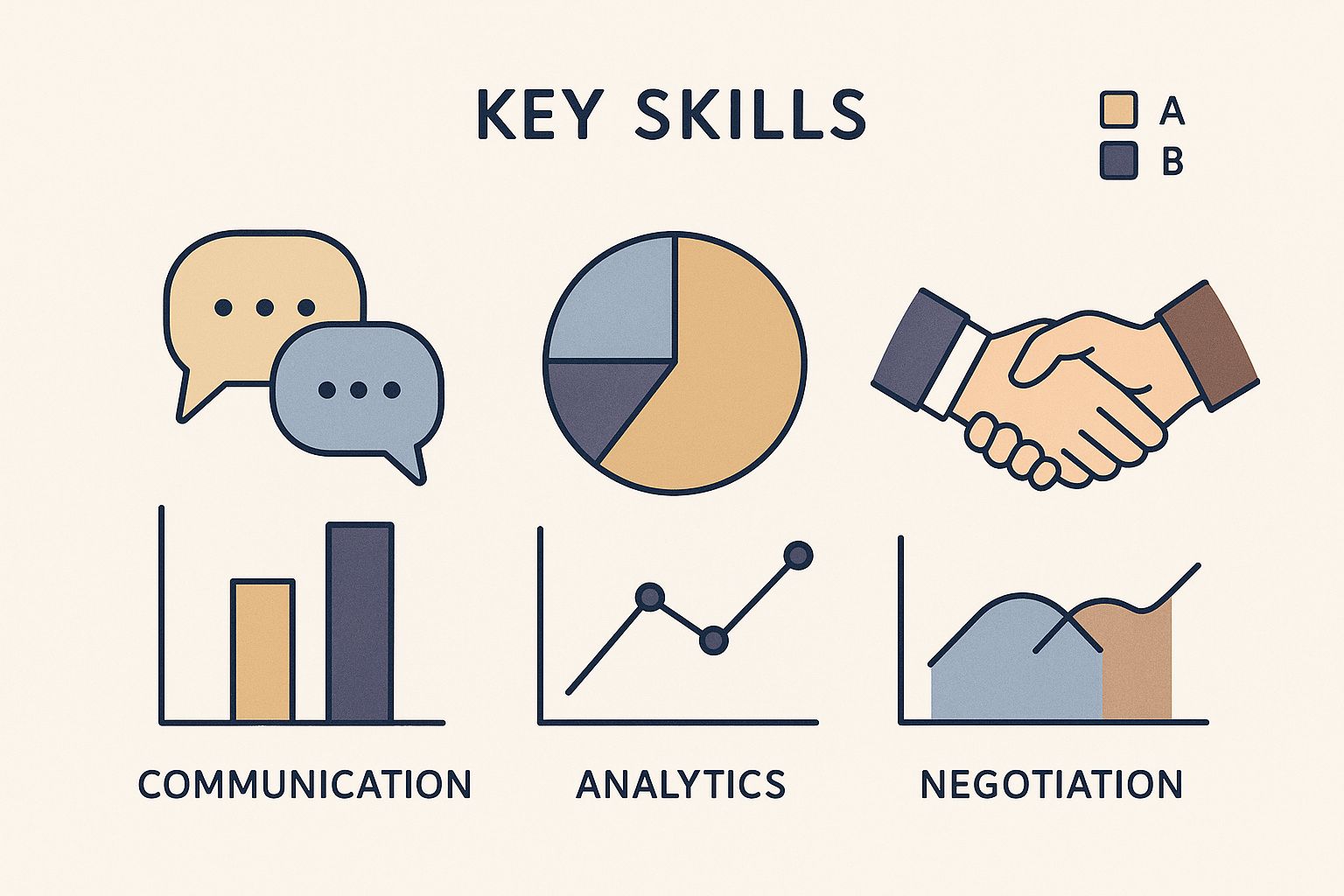
As the infographic shows, these three skill sets are interconnected and crucial for a CBO to effectively navigate the complexities of their role, from building relationships and analyzing market data to securing favorable partnerships.
To further illustrate the CBO’s diverse responsibilities and how they intersect with other C-suite roles, the following table provides a detailed comparison:
Core Responsibilities of a Chief Business Officer
This table outlines the primary areas of responsibility for a Chief Business Officer and compares them to related C-suite roles.
| Responsibility Area | CBO Focus | Related C-Suite Overlap |
|---|---|---|
| Business Development | Identifying and pursuing new business opportunities, strategic partnerships, and market expansion. | CEO, COO, CMO |
| Revenue Optimization | Driving revenue growth through pricing strategies, sales optimization, and new business models. | CFO, CMO, CRO |
| Strategic Alignment | Aligning commercial objectives with the overall organizational vision and long-term strategic goals. | CEO, COO |
| Partnerships | Building and managing strategic partnerships to leverage external resources and expand market reach. | CMO, COO |
| Growth Strategies | Developing and executing growth strategies to drive transformational business growth and market leadership. | CEO, CMO, CRO |
Key takeaways from this table highlight the collaborative nature of the CBO role, often working closely with the CEO, COO, CMO, CFO, and CRO to achieve shared organizational objectives. The CBO plays a central role in connecting various departments and ensuring alignment between commercial activities and overall business strategy.
Navigating the Complexities of Partnerships
Developing and maintaining strategic partnerships is a vital aspect of the CBO role. These partnerships can provide access to new markets, technologies, or resources, creating significant value for the company. Successfully managing these partnerships requires skill and experience. CBOs must be adept at identifying suitable partners, negotiating favorable terms, and maintaining the relationship.
Driving Transformational Growth
The CBO’s main objective is to drive transformational business growth. This goes beyond simply increasing sales or market share. It involves fundamentally changing how the company operates and competes. This can be achieved by developing innovative products or services, entering new markets, or forming strategic alliances. The ability to think strategically, act decisively, and adapt to change is crucial for CBOs who aim to achieve transformational growth. Shiny offers a platform connecting startups with experienced fractional executives. To learn more about fractional executive services, visit their website.
How Top CBOs Drive Transformational Business Growth

Top CBOs are more than operational managers; they’re architects of change. They identify hidden market opportunities, build new revenue streams, and optimize existing business models for peak performance. This proactive approach moves beyond incremental improvements, focusing on significant shifts that redefine a company’s trajectory and drive substantial growth.
Identifying Untapped Market Opportunities
A crucial aspect of the CBO role is a deep understanding of partnerships. Need advice on finding the right collaborator? This guide on how to find a business partner offers valuable strategies.
A skilled CBO excels at spotting market gaps and unmet customer needs. This requires in-depth market analysis, competitive intelligence, and a keen understanding of future trends. For instance, a CBO in the tech industry might identify an increasing demand for a niche software solution not yet addressed by competitors. This ability to anticipate market needs is paramount for maintaining a competitive edge.
CBOs frequently collaborate with other executives to capitalize on identified opportunities. This collaboration can spark the development of new products or services, inform market expansion strategies, or forge strategic alliances. The CBO’s ability to translate market analysis into actionable business strategies is essential for driving growth.
Developing Innovative Revenue Streams
Top CBOs don’t just optimize existing revenue; they actively cultivate new income sources. This can involve developing entirely new products or services, implementing innovative pricing models, or venturing into new markets. This focus on innovation is essential for sustained growth, particularly in highly competitive sectors.
For example, a CBO might investigate the potential of subscription-based services or build strategic partnerships to tap into new customer segments. This forward-thinking approach ensures the company isn’t reliant on a single revenue stream, increasing resilience to market fluctuations. For startups navigating their financial journey, consider this resource on how to master startup finances with a fractional CFO.
Optimizing Existing Business Models
While exploring new avenues for growth, CBOs also refine existing business models. This might involve streamlining operations, enhancing customer experience, or implementing new technologies to boost efficiency. This focus on continuous optimization ensures the company operates at peak performance and maintains its competitive edge.
The connection between technology and business strategy is becoming increasingly critical in this optimization process. The Chief Business Officer role, while less standardized than other C-suite positions, is gaining recognition. Organizations are increasingly valuing growth-focused executives. The IBM 2025 CEO Study highlights that companies with dedicated business transformation roles, often similar to the CBO, report an average ROI of 14% from their AI initiatives. This underscores the significant impact of leaders who effectively integrate technological advancements with business strategy. This constant drive for improvement is key to long-term success in a dynamic market.
Developing the Essential Skills That Define Elite CBOs
The chief business officer role requires a diverse and adaptable skill set. What truly sets exceptional CBOs apart is their ability to not only possess these skills but to master them, combining expertise with practical experience. This powerful combination empowers them to navigate the intricacies of the role and achieve remarkable outcomes.
Strategic Vision and Commercial Acumen
Elite CBOs possess a sharp strategic vision, allowing them to anticipate market shifts and pinpoint hidden opportunities. This foresight is coupled with strong commercial acumen, giving them the ability to transform market analysis into profitable strategies. Together, these skills create a roadmap for sustainable organizational growth.
Relationship Intelligence and Operational Knowledge
Beyond strategic thinking, high-performing CBOs are masters of relationship intelligence. They cultivate strong connections with internal teams, external partners, and key clients. This collaborative approach ensures alignment between commercial strategies and broader business objectives. Furthermore, their operational knowledge bridges the gap between planning and execution, translating strategies into concrete results.
Analytical Precision and Creative Problem-Solving
CBOs constantly face challenges that demand both analytical and creative thinking. Analytical precision empowers them to evaluate data, assess risks, and make data-driven decisions. Meanwhile, creative problem-solving allows them to overcome roadblocks and develop innovative approaches. This dual approach allows them to effectively navigate complex situations and adapt to ever-changing market dynamics. You might be interested in: How to master startup finances with a fractional CFO.
Leadership and Industry Expertise
Exceptional CBOs are strong, inspiring leaders. They possess a unique blend of business development expertise and inspirational leadership, driving their teams toward ambitious goals and exceptional performance. Their deep industry knowledge provides crucial context, allowing them to understand the nuances of their market. This combination equips them to effectively guide their organizations towards success. Their ability to think adaptively ensures they can adjust their approach as circumstances evolve.
Educational Backgrounds and Career Trajectories
While no single path leads to becoming a CBO, certain educational backgrounds and career paths are common. Many successful CBOs hold MBAs or advanced degrees in related business fields. Their career progression frequently involves increasingly senior positions in areas such as business development, sales, marketing, or operations.
To further understand the key competencies required for a successful CBO, the following table offers additional insight:
Essential CBO Skills and Competencies
This table presents the key skills required for chief business officer success, categorized by type and importance level
| Skill Category | Specific Competencies | Importance Level | Development Pathways |
|---|---|---|---|
| Strategic Thinking | Market analysis, strategic planning, forecasting | High | Executive education programs, industry conferences, mentorship |
| Business Development | Sales, marketing, partnerships, revenue generation | High | Sales training, marketing certifications, networking events |
| Financial Management | Budgeting, financial analysis, investment strategies | High | Financial modeling courses, MBA programs, industry certifications |
| Operational Execution | Process optimization, project management, team leadership | High | Project management certifications, leadership development programs, operational experience |
| Communication & Relationship Building | Stakeholder management, negotiation, public speaking | High | Communication workshops, leadership training, networking opportunities |
| Industry Expertise | Market knowledge, competitive analysis, regulatory understanding | High | Industry conferences, research publications, professional organizations |
| Adaptability & Problem-Solving | Critical thinking, decision-making, change management | High | Problem-solving workshops, executive coaching, experience in dynamic environments |
This table highlights the multifaceted nature of the CBO role, emphasizing the critical interplay of strategic thinking, business development, financial acumen, and operational expertise. Developing these competencies through various pathways, like those listed, can significantly contribute to CBO success.
Navigating Complex C-Suite Dynamics as a CBO
The Chief Business Officer (CBO) role exists within a complex web of C-suite relationships. These relationships can greatly influence a CBO’s success, either by encouraging teamwork or creating conflict. Understanding these dynamics is essential for maximizing overall impact and achieving organizational goals. This means recognizing the individual roles and viewpoints of other key leaders, such as the CEO, CFO, CTO, and COO.
Building Strong C-Suite Partnerships
Effective CBOs make it a priority to build strong alliances within the C-suite. Working with the CEO ensures that business strategies align with the company’s overall vision. A solid partnership with the CFO is also key for connecting revenue goals with financial planning. These partnerships aren’t just about avoiding disagreements; they’re about using each executive’s skills and influence to achieve common objectives.
For instance, a CBO partnering with the CTO can ensure that product development matches market demands and is commercially sound. Likewise, working with the COO can streamline operations to support business aims.
Navigating Potential Friction Points
While collaboration is the goal, disagreements can still happen. For example, the CBO and CFO might clash over budget allocation or investment choices. Tension could also arise between the CBO and CMO regarding marketing approaches or brand positioning. This requires leadership that goes beyond simple teamwork and demands proactive communication and a willingness to compromise. Read also: How to master leadership transition planning
Overcoming these hurdles requires clear communication, mutual respect, and a shared focus on results. CBOs must define their unique contributions within the C-suite while steering clear of turf wars.
Influencing Without Authority
CBOs often need to influence decisions without direct control over other departments. This means building trust, promoting open communication, and showing the value of their insights. For example, a CBO might share data-driven analyses with the CEO to support a particular market expansion plan. This ability to persuade and influence is essential for advancing business initiatives.
Executive confidence heavily influences business choices. The Conference Board’s CEO Confidence Index, a measure of global executive sentiment, increased by 9 points to 60 in Q1 2025—its highest in three years. This indicates growing confidence in economic conditions and future opportunities, potentially creating a good setting for CBOs to suggest ambitious growth strategies. Explore this topic further: CEO Confidence Q1 2025.
Creating a Collaborative C-Suite Culture
Ultimately, a successful CBO helps to build a collaborative C-suite culture. This involves supporting open communication, nurturing mutual respect, and linking personal goals with broader company objectives. This collaborative atmosphere is vital for driving innovation, achieving sustained growth, and securing long-term success. By building trust, demonstrating expertise, and fostering productive relationships, CBOs can navigate the complexities of the C-suite and become vital leaders within the company.
How the Chief Business Officer Role Varies Across Industries
The chief business officer (CBO) role isn’t a one-size-fits-all position. It adapts based on the industry, company size, and growth stage. A CBO at a fast-growing tech startup faces different challenges than a CBO in a long-established healthcare company. This section explores these variations and how they influence the CBO’s approach.
Industry-Specific Challenges and Skill Sets
Different industries present unique challenges requiring specific CBO skill sets. For instance, a technology sector CBO might concentrate on developing partnerships, managing rapid growth, and nurturing innovation. As a CBO navigates the complexities of the C-suite, creating a positive work environment is vital. Strategies to improve developer experience can be invaluable in this context. In contrast, a healthcare CBO must tackle complex regulations, build connections with institutional stakeholders, and ensure compliance.
The competitive landscape of each industry also shapes the CBO’s strategic focus. In highly competitive markets, a CBO might prioritize aggressive market share growth and new product development. Conversely, a CBO in a regulated industry might emphasize operational efficiency and forging long-term strategic alliances.
Impact of Company Size and Growth Stage
Company size and growth stage also influence the CBO role. In a young startup, the CBO might wear many hats, managing everything from business development and sales to marketing and fundraising. As the company expands, the CBO role becomes more focused, concentrating on strategic planning, scaling operations, and developing a high-performing team.
In larger, established companies, CBOs typically focus on long-term growth strategies, international expansion, and organizational change. This shift reflects the changing needs of the company as it matures.
Adapting CBO Strategies to Specific Contexts
Adaptability is essential for any CBO. They must tailor strategies to the specific context of their industry, company size, and market conditions. This requires comfort with uncertainty, embracing change, and continually learning and adapting.
The table below summarizes CBO role variations:
| Factor | Tech Startup | Established Enterprise | Healthcare Organization |
|---|---|---|---|
| Focus | Rapid growth, innovation, partnerships | Market leadership, operational efficiency, global expansion | Regulatory compliance, stakeholder relationships, long-term strategy |
| Key Skills | Agility, adaptability, fundraising, product development | Strategic planning, organizational leadership, M&A | Regulatory knowledge, relationship building, policy analysis |
| Challenges | Securing funding, building a team, scaling operations | Maintaining market share, adapting to disruption, managing complexity | Navigating regulations, building trust, managing costs |
| Metrics | User growth, revenue growth, market share | Profitability, ROI, market capitalization | Patient outcomes, regulatory compliance, cost efficiency |
This table illustrates the varied nature of the chief business officer role and the need to adapt strategies. By understanding these differences, organizations can better recruit and empower CBOs to achieve success.
The Future of the Chief Business Officer Role
The chief business officer (CBO) role is constantly adapting. Emerging technologies, shifting markets, and global interconnectedness all contribute to this evolution. As businesses navigate these complexities, the CBO of the future will require new competencies to thrive.
AI Integration and the Evolving CBO
Artificial intelligence (AI) is transforming industries, and the CBO role is no exception. Future CBOs must understand how to use AI to improve decision-making, automate processes, and identify new business opportunities. This includes pinpointing areas where AI can boost efficiency, like sales forecasting or Customer Relationship Management (CRM) and creating strategies to implement these solutions.
This shift also demands new skills in data analysis and interpretation. CBOs will need to assess AI’s potential business impact and make informed decisions about integrating AI tools and strategies. Furthermore, understanding the ethical implications of AI and ensuring responsible use will be paramount.
Digital Transformation and the Need for Agility
The ongoing digital transformation requires a CBO who can expertly lead and manage change. This means embracing new technologies, adapting business models, and cultivating a culture of innovation. The CBO must be comfortable experimenting and taking calculated risks to drive growth.
This agility also applies to decision-making. Future CBOs will need to process information quickly and make informed choices in dynamic environments. Clearly communicating these changes to teams and stakeholders is also essential.
Sustainability and the Rise of Socially Responsible Business
With the growing importance of sustainability, future CBOs will need to integrate environmental, social, and governance (ESG) factors into their strategies. This involves considering the long-term impact of decisions on the environment and society, as well as upholding ethical and responsible business practices.
This shift towards socially responsible business also necessitates stakeholder engagement on sustainability issues. CBOs must articulate the company’s ESG strategy and showcase its commitment to sustainable practices. This builds trust with customers, investors, and the wider community.
Evolving Customer Expectations and the Importance of Customer-Centricity
Customer expectations are always evolving, driven by desires for personalization, convenience, and accessibility. Future CBOs must prioritize the customer, understanding their needs and preferences, and adapting strategies accordingly. This requires strong communication and relationship-building skills.
CBOs will also need to utilize data and analytics to gain deeper insights into customer behavior. This data-driven approach is essential for developing personalized experiences and meeting evolving needs. This customer-centric focus is crucial for fostering loyalty and achieving long-term success.
For startups needing experienced leadership to navigate these changes, Shiny offers a fractional executive marketplace connecting you with vetted professionals. Learn more about how Shiny can help your startup grow.
