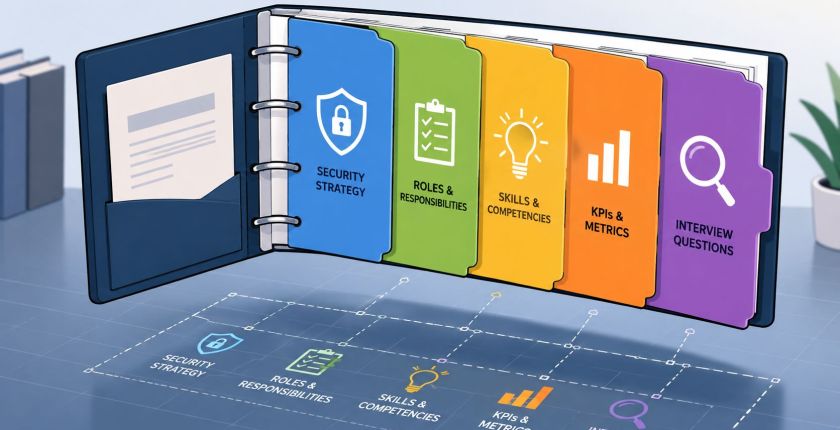
Chief Information Security Officer Job Description
A lot of founders wait too long to define security leadership.
The pattern is familiar. Revenue is climbing, enterprise buyers start asking for security questionnaires, the product stack gets more complex, and one incident, one audit failure, or one customer concern suddenly turns cybersecurity from a technical issue into a board-level problem. At that point, writing a vague posting for a “security lead” won't help much.
A strong Chief Information Security Officer job description does more than list duties. It tells candidates what kind of business you are, how risk decisions get made, and whether you want a strategic executive or a firefighting operator. For startups and scale-ups, that distinction matters because the wrong hire can slow growth, overbuild controls, or leave serious gaps unaddressed.
Your Next Hire Could Save Your Company Or Sink It
A growing company attracts attention. Customers notice. Investors notice. Attackers notice too.
That's why the first real security leadership hire is rarely just about tools. It's about judgment. You need someone who can decide what must be fixed now, what can wait, and how security work supports product velocity, customer trust, and compliance instead of choking all three.

Many job descriptions still miss that reality. Bitsight notes that 68% of modern CISOs now serve as business influencers translating cyber risk to business risk, yet many postings still read like expanded system administrator roles. That mismatch is especially costly in SaaS, FinTech, and AI startups where budgets are limited and the security leader has to move fast.
What goes wrong with generic templates
Founders often copy an enterprise CISO posting and swap in their company name. That usually produces a role that is too broad, too vague, or too unrealistic.
Common failure modes include:
- Overloading the role: The candidate is expected to own strategy, compliance, security operations, vendor risk, legal coordination, training, and hands-on cloud remediation with no support.
- Using enterprise language: The posting assumes a mature team, large budget, and long planning cycles that don't exist in an early-stage company.
- Ignoring business context: It says nothing about buyer pressure, product roadmap risk, fundraising diligence, or regulatory priorities.
- Missing the hiring model: It doesn't clarify whether you need full-time executive leadership or a fractional operator-strategist who can achieve impact quickly.
Practical rule: If your job description reads like you're hiring a security superhero, strong candidates will assume the company lacks clarity, resources, or both.
The right posting starts from the business problem. Maybe you need SOC 2 readiness, cleaner customer trust conversations, incident response ownership, or a security roadmap that won't derail shipping. That's how you define a CISO role that fits a startup, not a Fortune 500 template.
The Modern CISO Role Explained
A founder usually feels the need for a CISO after a trigger event. A large prospect sends a security questionnaire your team cannot answer with confidence. An investor asks who owns cyber risk. A cloud misconfiguration turns into a real incident, or close enough to make the leadership team nervous.
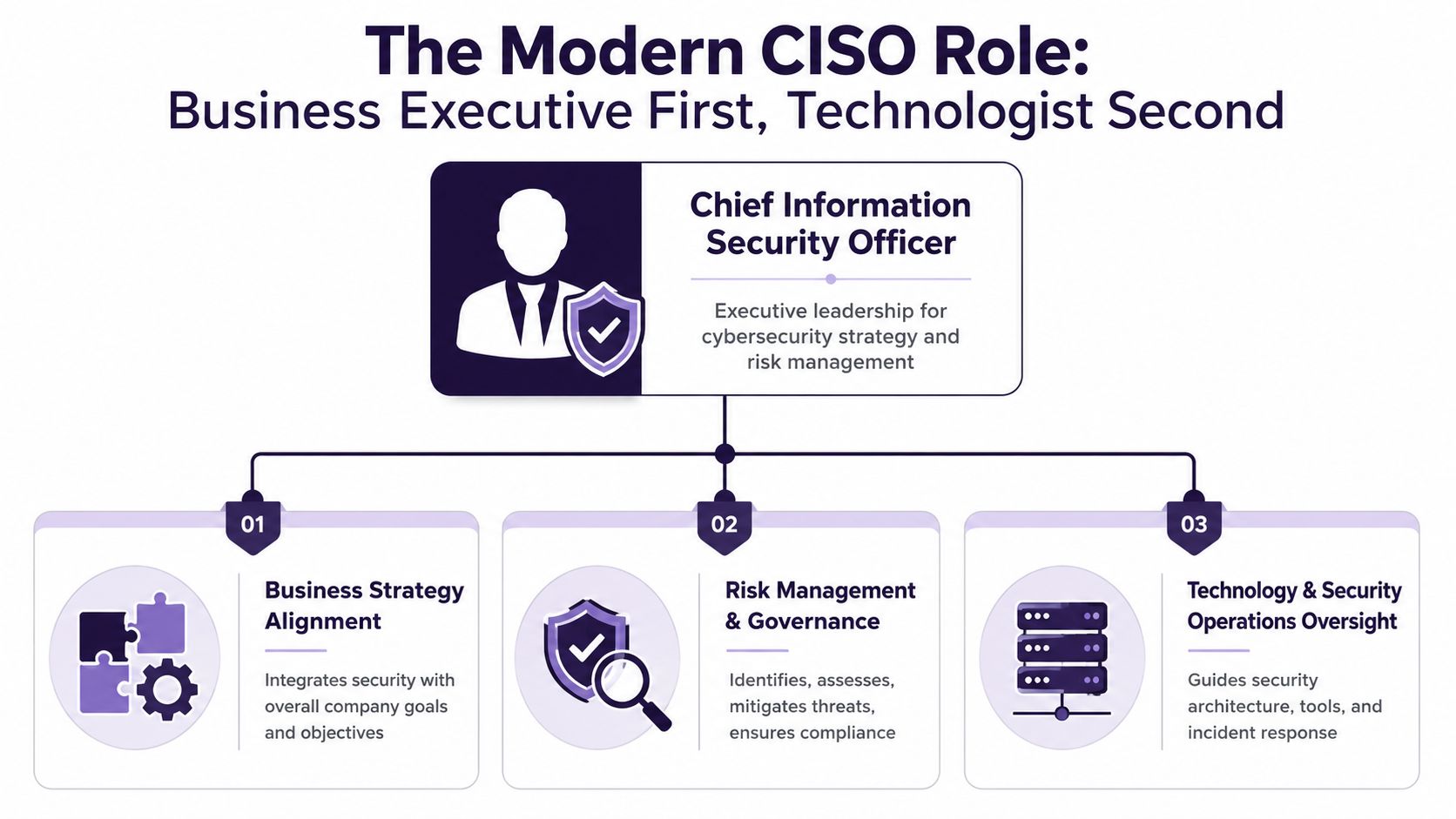
At that point, the role needs to be defined correctly. In a startup or scale-up, a CISO is the executive responsible for turning security from scattered tasks into a business function. That means setting direction, helping leadership make risk decisions, and making sure the company can grow without creating avoidable exposure.
In practical terms, the modern CISO sits between business risk, legal obligations, product delivery, and day-to-day security operations. The job is not to say no more often. The job is to help the company choose where to accept risk, where to reduce it, and where a small security investment prevents a much larger problem later.
Business executive first
Early-stage companies often assume the CISO is the top security engineer with a better title. That hiring logic creates problems fast. If the role is framed too narrowly, security stays buried in tooling, tickets, and audit checklists while nobody owns customer trust, board communication, or risk trade-offs tied to revenue.
A strong CISO works at three levels at once:
| Leadership layer | What the CISO owns |
|---|---|
| Executive level | Security strategy, risk communication, leadership and board updates |
| Governance level | Policies, decision rights, control expectations, compliance alignment |
| Operational level | Security architecture guidance, incident oversight, team direction |
This is also where founders need role clarity across the leadership team. If you're sorting out the boundary between IT ownership and security ownership, this overview of what a Chief Information Officer does helps clarify where broader technology operations end and dedicated security leadership begins.
The distinction matters. A CIO keeps systems and internal technology running. A CISO decides how security risk is identified, communicated, prioritized, and managed across the company.
Reporting structure changes what the role can actually do
Org charts are not cosmetic. Reporting lines tell a candidate how much authority the role will have and whether leadership wants honest risk visibility or quiet problem containment.
Three reporting models show up most often:
- Report to the CEO: Usually the strongest setup when security affects enterprise sales, fundraising diligence, incident decisions, and company-level risk acceptance.
- Report to the CIO or senior technology leader: Can work in smaller companies, especially when budget is tight, but it often creates tension if the same executive is measured mainly on shipping speed and operational efficiency.
- Report with direct board access: Useful when the company faces meaningful regulatory pressure, handles sensitive data, or needs independent escalation during incidents.
The trade-off is straightforward. A CISO buried too far inside engineering may struggle to challenge risky deadlines or underfunded controls. A CISO set too far outside product and infrastructure may lose touch with what teams can realistically deliver.
For startups, the best model is usually the one that gives the CISO direct access to whoever can approve risk, budget, and customer-facing commitments. That can be a full-time executive. It can also be a fractional CISO, if the company needs senior judgment more than a large in-house security org.
Core CISO Responsibilities and Deliverables
A startup usually feels the need for a CISO after something painful happens. A large customer sends a security questionnaire that no one can answer well. An investor asks who owns incident response. Engineering is shipping fast, but no one can say which risks the company is accepting on purpose and which ones are being ignored. The job description should reflect that reality.
Strong CISO roles are built around deliverables the leadership team can see and use. Founders do not need a vague mandate to “own security.” They need someone who can set priorities, reduce avoidable exposure, and help the company make better risk decisions without freezing product delivery.
Strategy and governance
The first responsibility is giving security a business operating model.
That means the CISO should:
- Set a security roadmap: Prioritize work based on revenue impact, customer commitments, product risk, cloud exposure, and likely failure points. In an early-stage company, the roadmap matters because budget is finite and the team cannot fix everything at once.
- Define policy that teams can follow: Policies should support real decisions on access, data handling, vendor use, secure development, and incident escalation. If a policy cannot survive contact with day-to-day operations, it will be bypassed.
- Create a risk register and decision process: Leadership needs a clear record of major risks, who owns them, what mitigation is planned, and which risks the company is choosing to accept.
- Run executive and board-level reporting: The CISO should convert technical findings into business terms. Leaders need to understand exposure, trade-offs, and funding needs without sitting through a tool-level briefing.
For startups and scale-ups, good governance is rarely about adding layers of approval. It is about making risk visible early enough to avoid expensive reversals later.
Risk, compliance, and trust
Many companies hire their first senior security leader because trust has become a revenue issue. Security reviews start affecting sales cycles. Enterprise prospects want proof. Regulators and partners expect discipline. The CISO should turn that pressure into an organized program instead of a string of last-minute scrambles.
Key responsibilities include:
- Assess business risk in the actual environment: Review cloud architecture, identity design, privileged access, third-party dependencies, product changes, and data flows. The point is to find the exposures most likely to hurt the business, not to produce a long list of theoretical issues.
- Lead compliance readiness: Map the company's controls to the frameworks and obligations that matter for its market. For some startups, that means SOC 2. For others, it may mean ISO 27001, HIPAA, PCI, or customer-specific requirements.
- Shape access and internal control practices: Security leadership often has to help define how the company prevents misuse, limits privilege, and detects suspicious behavior. That work is closely tied to risk and fraud management practices for growing companies.
- Review major business and product decisions: New integrations, market expansions, vendors, AI features, and infrastructure changes can all create lasting risk if security is brought in too late.
This part of the role has a direct commercial payoff. A capable CISO shortens the gap between “we want to sell into larger accounts” and “we can defend our security posture under scrutiny.”
Security operations and resilience
Founders often assume the CISO's value shows up only during a breach. In practice, the bigger value is building enough structure that the company is not improvising during one.
Common deliverables include:
- Security architecture standards: Set expectations for identity, logging, endpoint management, network controls, secrets handling, and cloud configuration. In a cloud-native company, architecture discipline usually matters more than buying another point tool.
- Incident response ownership: Define roles, escalation paths, outside counsel or forensics support, evidence handling, customer communications, and decision authority. A plan that exists only in a shared drive is not a plan.
- Security awareness and role-based training: Finance, engineering, support, and executives face different risks. Training should reflect that instead of treating the whole company the same.
- Recovery and continuity planning: Confirm that backups, restoration steps, fallback procedures, and crisis communications work in real conditions. Tabletop exercises often reveal gaps that documentation misses.
- Control validation: Make sure key controls are tested and producing evidence. Founders should be able to ask, “How do we know this is working?” and get a clear answer.
A startup rarely needs a CISO who personally operates every control. It needs one who can decide which controls matter now, assign ownership to the right teams, and prove the company is getting safer as it grows.
That distinction matters even more if you are deciding between a full-time and fractional hire. In many scale-ups, the highest-value CISO deliverables are prioritization, decision support, incident leadership, and trust-building with customers. Those do not always require building a large internal security department on day one.
Essential CISO Skills and Qualifications
Most postings still over-index on tenure. That's understandable, but it's not always useful.
OCERS highlights a real disconnect: 75% of CISO roles still mandate 10 years of experience, while 52% of startups report hiring CISOs with less experience due to cost constraints and the need for niche expertise in emerging tech. For a startup, the better question isn't “How long has this person been around?” It's “Can this person reduce meaningful risk in our environment?”
Hard skills that matter
The technical side still matters. A CISO who can't pressure-test architecture or challenge weak assumptions won't be effective.
Look for candidates who can demonstrate:
- Framework fluency: Practical working knowledge of NIST, ISO, SOC 2, or other relevant governance models.
- Cloud judgment: Experience securing modern environments, especially where infrastructure changes quickly.
- Product risk awareness: Ability to assess security implications of releases, integrations, APIs, and identity flows.
- Incident leadership: Not just technical familiarity, but the ability to organize response under pressure.
Soft skills that separate strong candidates
The best security leaders are rarely the ones with the longest list of tools on their resume. They're the ones who can get a company to act.
Key traits include:
- Executive communication: Can they explain risk to a founder, board member, or investor without jargon?
- Prioritization: Do they know how to sequence work when everything looks urgent?
- Influence across functions: Security has to work with engineering, legal, finance, HR, and customer-facing teams.
- Pragmatism: Strong candidates know when to insist and when to phase controls in over time.
What to avoid in the job description
Don't write a qualification section that reads like a trophy case.
Avoid these mistakes:
- Mandatory laundry lists: Requiring every certification, every cloud platform, and every compliance framework narrows the pool without improving fit.
- Confusing seniority with relevance: Long enterprise experience doesn't always translate into startup execution.
- Ignoring domain need: A FinTech company, AI startup, and manufacturing business won't need the same emphasis.
Hire for pattern recognition, risk judgment, and communication. The best CISO in your context may not be the person with the longest resume.
The Complete CISO Job Description Template
Below is a practical template you can adapt. Keep it tight. Strong candidates want clarity more than buzzwords.
Role summary
Title: Chief Information Security Officer
Company: [Company Name]
Reporting to: [CEO / CIO / Board / Other Executive]
Role summary:
[Company Name] is seeking a Chief Information Security Officer to lead cybersecurity strategy, risk management, and security governance across the business. This executive will align security priorities with [key business objective such as enterprise sales growth, compliance readiness, product trust, or operational resilience]. The CISO will advise leadership on cyber risk, build a practical security roadmap, and oversee the controls, policies, and response capabilities needed to protect company systems, data, and customers.
Responsibilities
- Develop security strategy aligned with business priorities, company growth stage, and risk tolerance.
- Own governance and policy development for information security, access control, and acceptable risk management.
- Assess security risk across infrastructure, applications, third-party vendors, and new product initiatives.
- Lead compliance readiness for relevant customer, regulatory, and contractual requirements.
- Guide security architecture decisions across identity, cloud, endpoint, network, and monitoring environments.
- Oversee incident response and recovery planning including escalation paths, communications, and post-incident review.
- Support executive and board reporting with clear updates on risk, priorities, and remediation progress.
- Partner with engineering, IT, legal, HR, and operations to embed security into everyday work.
- Promote security awareness through training, practical guidance, and leadership across the organization.
Qualifications
Required
- Experience leading information security strategy and risk management in a growing organization
- Strong working knowledge of security and compliance frameworks relevant to the business
- Ability to translate technical issues into business decisions
- Experience partnering with senior leadership and cross-functional teams
Preferred
- Background in [industry such as SaaS, FinTech, HealthTech, AI, or Manufacturing]
- Experience with customer security reviews, audits, or security program maturation
- Familiarity with cloud-native environments and modern development practices
What good customization looks like
Replace generic language with your actual business conditions:
Instead of: “Must ensure best-in-class cybersecurity.”
Use: “Must establish a practical roadmap for enterprise buyer security reviews and improve incident readiness.”
Instead of: “Oversee all security operations.”
Use: “Guide internal teams and external partners on priority controls, monitoring, and response expectations.”
That difference is what turns a generic chief information security officer job description into a hiring tool.
Full-Time VS Fractional CISO Which Is Right For You
For many founders, this is the core decision. Not whether security matters, but what hiring model fits the company right now.
A full-time CISO makes sense when the business already has enough complexity, regulatory load, customer pressure, and internal scale to keep a senior executive fully occupied. A fractional CISO fits when the company needs strong leadership but doesn't yet need, or can't yet support, a permanent executive in seat every day.
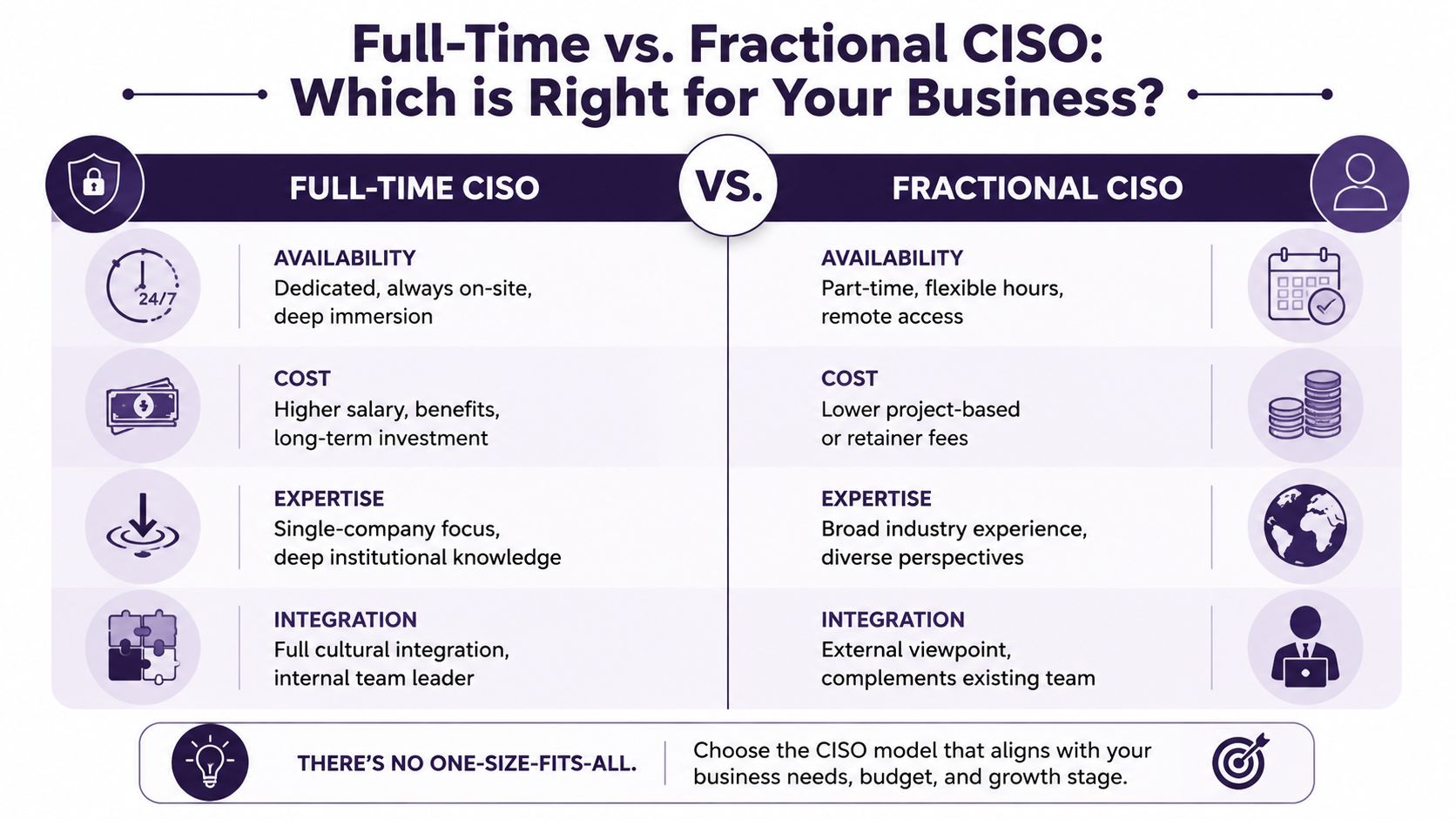
A fractional CISO performs the same core work as a full-time CISO, including strategy, security oversight, and compliance leadership, but on a part-time basis, often in 12-month engagements. That model is often a better match for startups that need executive judgment without full-time executive overhead.
Full-Time CISO vs. Fractional CISO
| Factor | Full-Time CISO | Fractional CISO |
|---|---|---|
| Availability | Embedded daily in the business | Scheduled involvement based on business need |
| Cost structure | Executive salary, benefits, long-term commitment | Part-time or contract-based commitment |
| Best fit | Larger teams, heavier regulatory burden, continuous internal oversight needs | Startups and scale-ups that need strategy, prioritization, and leadership leverage |
| Speed to value | Can take longer if the role is defined too broadly | Often faster when the mandate is tightly scoped |
| Internal management | Better when you need to build and manage an in-house security function | Better when you need to stand up the function or mature it without a large team |
| Perspective | Deep company immersion | Broader cross-company pattern recognition |
Where fractional works especially well
A fractional model is often a smart choice when you need someone to:
- Create a roadmap: Build the company's first coherent security plan.
- Prepare for buyer diligence: Support security questionnaires, customer trust conversations, and audit prep.
- Improve incident readiness: Put structure around response, escalation, and recovery.
- Guide existing teams: Give direction to engineering, IT, compliance, or managed security partners without hiring a full executive staff.
If you're weighing flexible executive models more broadly, this look at fractional executives for VC-backed startups is useful context.
If you only need senior security judgment for a focused set of outcomes, a fractional CISO is often the more disciplined choice.
What doesn't work is hiring fractional leadership while expecting full-time operational management. If you need someone to directly manage a large internal team every day, own constant stakeholder traffic, and sit in every planning cycle, that's usually a full-time role.
Sample Fractional CISO Job Description
A fractional CISO posting should look different from a full-time one. It should focus on outcomes, operating rhythm, and executive influence rather than broad ownership of every security function.
Role summary
Title: Fractional Chief Information Security Officer
Engagement type: Part-time, contract, or advisory executive engagement
Role summary:
[Company Name] is seeking a Fractional Chief Information Security Officer to lead cybersecurity strategy, risk prioritization, and security program maturity on a flexible basis. This executive will help leadership strengthen security posture, improve compliance readiness, and guide incident preparedness while working closely with internal technical and business stakeholders.
Core responsibilities
- Set the security roadmap for the next planning cycle, with clear priorities and ownership.
- Advise leadership on risk acceptance and the trade-offs between speed, cost, and control.
- Assess current-state security posture across infrastructure, systems, process, applications, and compliance needs.
- Guide framework alignment for NIST, ISO, SOC 2, or other relevant requirements.
- Support business continuity and disaster recovery planning with practical expectations and accountability.
- Address insurance and contractual security issues that affect sales, renewals, or vendor relationships.
- Coordinate with internal teams and external providers so security work doesn't stall between meetings.
A strong fractional role usually names the few outcomes that matter most. For example: customer diligence readiness, policy and control maturity, incident response planning, and executive risk reporting.
Qualifications and fit
That doesn't mean you need the most decorated candidate on paper. It means you need someone who has already built order from chaos.
Look for:
- Executive maturity: They should know how to guide founders without overwhelming them.
- Program-building experience: Early-stage companies need structure, not theory.
- Comfort in lean environments: The right candidate can work through internal constraints instead of complaining about them.
- Clear deliverable mindset: Fractional work succeeds when outcomes are explicit.
A weak fractional posting asks for “part-time support” but gives no charter. A strong one states the business context, the expected operating cadence, and the decisions this executive will own.
Top CISO Interview Questions To Ask
The interview should test judgment, not trivia. If you spend the whole conversation on tooling preferences or acronym recall, you'll miss the qualities that matter most.
The best questions force a candidate to show how they think under business constraints.
Questions that reveal strategic fit
Walk me through your first priorities in this company.
A strong answer starts with understanding the business, major assets, customer commitments, and obvious risk concentrations before proposing a giant control rollout.How would you explain our current security posture to the board or investors?
Good candidates can simplify without oversimplifying. They'll frame issues in terms of business exposure, remediation priorities, and leadership decisions.Tell me about a time you had to push back on product or engineering leadership.
You want someone who can hold a line when necessary without turning security into a constant blocker.
The best answers usually show balanced trade-offs, not absolute positions.
Questions that test operating style
What do you need in the first weeks to be effective here?
Strong candidates usually ask for architecture visibility, ownership clarity, incident history, vendor overview, and leadership access.How do you decide what not to fix immediately?
This reveals whether the person understands prioritization or defaults to fear-based decision-making.What would you expect from me as founder or CEO?
A seasoned CISO knows the role only works when leadership is willing to make and own risk decisions.
Questions for fractional candidates
- How do you create momentum when you're not in the company full-time?
- How do you structure handoffs to internal teams?
- What outcomes would you commit to in the first engagement period?
Look for answers that include cadence, documentation, clear owners, and executive communication. Weak answers stay abstract. Strong ones show a repeatable operating model.
A practical interview process also includes a scenario. Give the candidate a simple case: an enterprise prospect is stalled over security concerns, engineering is under deadline pressure, and the company has gaps in policy and access control. Ask what they'd do in the next month. Their sequencing will tell you a lot.
CISO Performance Metrics and Salary Guide
You should define success before the hire starts. Otherwise, the CISO becomes accountable for “security” in the abstract, which usually means everyone is unhappy later.
The most useful performance measures combine operational discipline with business outcomes. They should tell you whether risk is being reduced in ways that support customers, compliance obligations, and internal resilience.
Performance metrics that matter
Use a small set of measures tied to the company's maturity and priorities:
- Risk reduction progress: Are the highest-priority issues being addressed in a visible, accountable way?
- Incident readiness: Does the company know how to respond, escalate, communicate, and recover?
- Policy and control maturity: Are there working standards for access, vendors, data handling, and system changes?
- Audit and diligence posture: Can the company answer customer and partner security questions with confidence?
- Cross-functional execution: Are engineering, IT, legal, HR, and operations aligned on ownership?
A good CISO dashboard for a startup usually has fewer metrics than founders expect. It should be readable in one sitting and lead to decisions, not just status reporting.
Boardroom lens: Measure whether security helps the company make better risk decisions and keep commitments to customers, regulators, and investors.
Salary reality
Compensation needs a reality check early.
According to Splunk's January 2024 salary reference, CISOs had a median annual total salary of $386,000, with some roles reaching up to $585,000 before bonuses. That's one reason many growth-stage companies hesitate to jump straight to a full-time executive hire.
The broader market also signals strong demand. The U.S. Bureau of Labor Statistics projects employment of information security professionals to grow 29 percent from 2024 to 2034, with about 16,000 openings for information security analysts each year on average and a median annual wage of $124,910 for information security analysts in May 2024. CISOs sit above that market level in scope and seniority.
How to think about compensation
For a founder, the practical takeaway is simple:
| Hiring model | Budget logic |
|---|---|
| Full-time CISO | Best when the company has sustained need for executive-level security leadership and can support the compensation, authority, and team structure |
| Fractional CISO | Best when the company needs high-level strategy and accountability without committing to full-time executive cost |
For fractional roles, compensation is usually tied to scope, complexity, and engagement level rather than a standardized salary benchmark. That's why the role definition matters so much. Clear outcomes lead to cleaner pricing and better accountability.
Your CISO Hiring Checklist and Next Steps
If you're hiring your first true security leader, don't start with the job board. Start with the business problem.
A clean hiring process usually matters more than a long candidate list. Strong CISOs want to know whether leadership understands the role, where authority sits, and what success looks like.
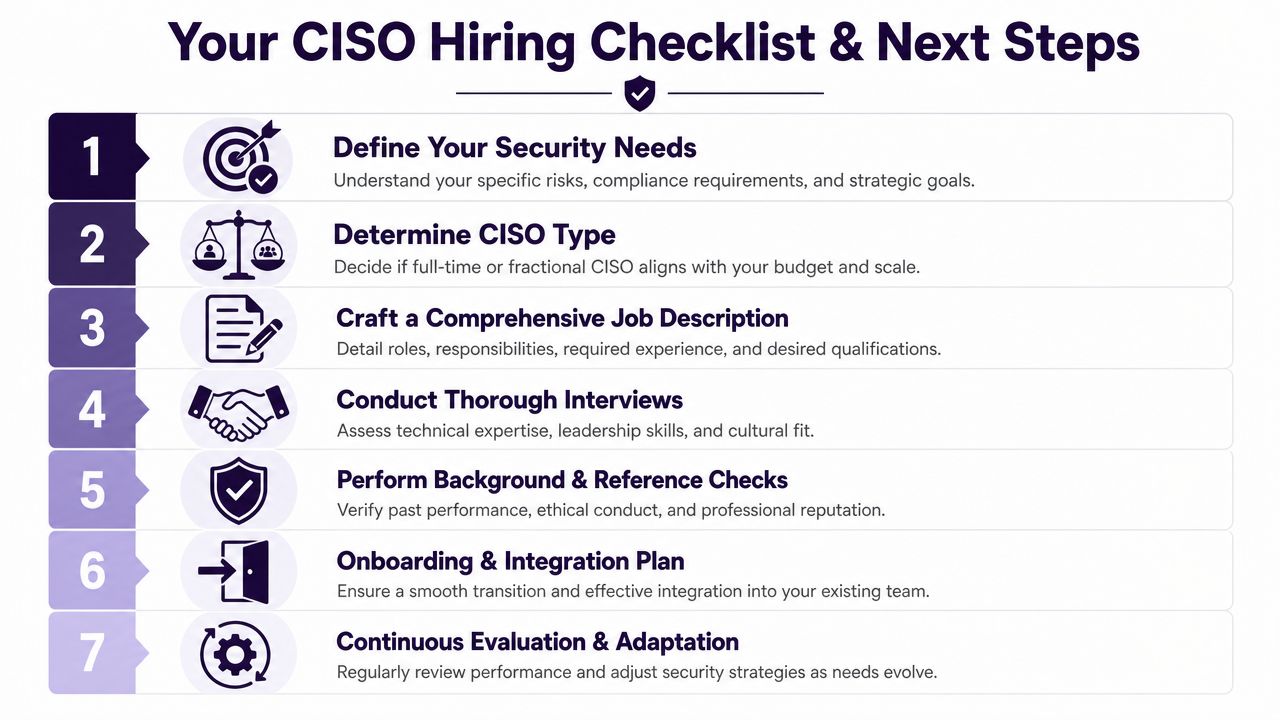
A practical checklist
Define your actual need
Decide whether your driver is customer trust, compliance pressure, incident readiness, cloud risk, or executive governance.Choose the right model
Pick full-time or fractional based on business stage, complexity, and how much day-to-day leadership you really need.Write a focused job description
State business context, reporting line, priorities, and expected outcomes. Cut generic language.Test for judgment in interviews
Use scenarios that force prioritization, communication, and trade-off decisions.Check references for execution style
Ask whether the candidate built momentum, influenced peers, and left a usable program behind.Plan onboarding before the start date
Give the new leader access to leadership, architecture context, incident history, and current obligations.Review progress against business goals
Evaluate whether security leadership is helping the company close risk gaps and operate with more confidence.
What founders often miss
The mistake isn't always hiring too late. Sometimes it's hiring the right level of talent into the wrong role design.
A startup may need a strategic CISO, but not a full-time one. Or it may need operational security management, but not a board-facing executive yet. If you get that distinction right, the rest of the hiring process gets much easier.
A good CISO hire creates clarity. A bad one creates more work for everyone else.
The companies that handle this well usually do one thing consistently. They define the role around business outcomes, not around a borrowed enterprise template.
If you're weighing whether a full-time or fractional security leader fits your stage, Shiny can help you find the right executive without running a long traditional search. For founders who need senior judgment, flexible engagement, and a practical path to stronger security leadership, it's worth exploring a consultation.