
Chief Revenue Officer Job Description: The Definitive Guide
A Chief Revenue Officer (CRO) is more than a senior sales leader—they are the architect of your company's growth engine. This strategic executive is tasked with aligning every revenue-generating function—from marketing and sales to customer success and partnerships—under a single, cohesive strategy. Unlike a traditional sales leader focused on quarterly targets, a CRO builds predictable, scalable growth by optimizing the entire customer lifecycle. This guide breaks down the role to help you craft a compelling chief revenue officer job description and understand if now is the right time to bring this expertise into your business.
What Is a Chief Revenue Officer?

A Chief Revenue Officer owns the entire revenue generation process. Think of them as the executive who ensures that marketing, sales, and customer success are all marching in the same direction, driven by the same goals. A CRO's primary job is to dismantle the traditional silos that create friction, miscommunication, and lost opportunities between departments.
Where a VP of Sales is laser-focused on hitting quarterly targets, a CRO is building the systems, processes, and long-term strategies for predictable revenue. It’s this holistic, big-picture view that really sets the role apart. For example, a CRO might notice that marketing is generating leads the sales team can't close, while the customer success team is struggling with churn from deals that were a poor fit to begin with. The CRO connects these dots and re-engineers the entire process for sustainable growth.
For a quick overview, here's a look at the key attributes that define the CRO role.
CRO Role at a Glance Key Attributes
| Attribute | Description |
|---|---|
| Primary Focus | Creating a predictable and scalable revenue engine. |
| Scope | Oversees all revenue-generating departments: Marketing, Sales, Customer Success. |
| Key Function | Aligns departmental strategies to create a seamless customer journey. |
| Horizon | Long-term strategic growth, not just short-term sales targets. |
| Core Skillset | Strategic planning, data analysis, operational excellence, and leadership. |
| Main KPI | Overall revenue growth, Customer Lifetime Value (LTV), Net Revenue Retention (NRR). |
This table highlights how the CRO acts as the strategic glue holding the entire revenue function together, a far broader mandate than that of a traditional sales leader.
The Strategic Value of a CRO
Are you struggling with misaligned teams, an unpredictable pipeline, or stagnant growth? These are the exact pain points a CRO is hired to solve. Their true value is connecting high-level strategy to on-the-ground execution across the entire business. This boils down to a few key areas:
- Creating a Unified Strategy: A CRO ensures marketing campaigns are built to directly support sales goals, and that the customer success team is fully equipped to retain and grow the accounts that sales brings in. No more misaligned efforts.
- Driving Data-Informed Decisions: They are responsible for implementing and managing the tech stack (think Salesforce or HubSpot) to create a single source of truth for all revenue data. This allows for smarter forecasting, better resource allocation, and fewer gut-based decisions.
- Fostering Accountability: By setting clear, cross-departmental KPIs, a CRO holds every team accountable for its contribution to overall revenue health—not just its own isolated metrics.
The role of Chief Revenue Officer has become a critical C-suite position over the last decade, with its importance really taking off between 2015 and 2025. This shift highlights a global recognition that revenue growth is a distinct strategic function. You can learn more about the rise of the CRO role and see relevant compensation benchmarks.
Finding a leader with this unique blend of strategic vision and operational know-how can be tough. For many businesses, accessing this level of talent on a fractional basis is a powerful alternative to a full-time hire. It gives you top-tier strategic guidance without the long-term cost and commitment. Feel free to explore our network of vetted fractional executives to find the right growth leader for your business.
Core CRO Responsibilities and Functions
A Chief Revenue Officer does far more than just manage a sales team. Their job is to build a cohesive strategy that finally gets sales, marketing, and customer success rowing in the same direction. The ultimate goal? To create a predictable, scalable system for growth.
The CRO role has ballooned in scope. Today’s CROs are expected to oversee pretty much every function that touches revenue—sales, marketing, customer success, and sometimes even bits of product strategy. A job description will list setting revenue targets, managing cross-functional teams, dialing in pricing, and using data to boost customer lifetime value. Built In has some great insights on the modern CRO's expanded duties.
Architecting a Holistic Revenue Strategy
The first thing you’ll see in any chief revenue officer job description is the need to build a unified revenue strategy. The CRO analyzes market trends, keeps an eye on the competition, and digs into internal data to set growth targets that are both ambitious and achievable. They don't just pull numbers out of thin air; they build the entire roadmap to get there.
This means making critical calls that affect the whole customer journey. For instance, a CRO at a SaaS company might use market data to tweak pricing tiers to better land enterprise deals. Or they might implement a customer journey map to find and fix the friction points that are causing churn.
A CRO’s strategic plan is the blueprint for growth. It ensures that every marketing campaign, sales call, and customer interaction is a deliberate step toward a shared revenue goal, eliminating wasted effort and departmental misalignment.
Leading and Unifying Revenue Teams
Beyond pure strategy, a great CRO is a leader and a mentor. They’re responsible for hiring, training, and developing the heads of sales, marketing, and customer success. This leadership is absolutely crucial for breaking down the silos that have traditionally held companies back.
They create a culture of collaboration and accountability by setting up shared KPIs. So, instead of marketing caring only about MQLs and sales focusing on closed deals, the CRO gets both teams measured on pipeline quality and conversion rates. This creates a powerful feedback loop where everyone works together to improve results. While the CRO handles the high-level vision, you can dig into the specifics of a day-to-day manager in our comprehensive sales leader job description guide.
Driving Operational Excellence and Process Improvement
A CRO is obsessed with efficiency and optimization. They own the revenue operations (RevOps) function, which means they’re in charge of the tech stack, refining processes, and making sure the data is clean. Their job is to make the entire revenue engine run smoother, faster, and more predictably.
Some key operational responsibilities include:
- Forecasting and Pipeline Management: Putting rigorous systems in place for revenue forecasting and pipeline management to make growth predictable.
- Technology Oversight: Choosing and managing tools like CRMs (Salesforce, HubSpot) and marketing automation platforms to create a single source of truth for all revenue data.
- Process Optimization: Constantly analyzing and improving the handoffs between marketing, sales, and customer success to create a seamless customer experience.
Building this level of strategic and operational muscle is a massive undertaking. Bringing in a fractional CRO lets you implement these best-in-class processes without the immediate commitment of a full-time executive salary. If you're looking to build a world-class revenue engine, schedule a consultation to connect with a vetted fractional CRO who can guide your growth.
Essential Skills of a High-Impact CRO
A top-tier Chief Revenue Officer brings a rare blend of analytical horsepower and inspiring leadership. They aren't just a senior sales leader with a fancier title; they're a well-rounded executive who can build a data-driven revenue forecast with the same confidence they use to get the entire company to believe in it. When you're putting together your chief revenue officer job description, you have to screen for mastery in both hard and soft skills.
This visual really breaks down the three core pillars of a CRO's world—strategy, performance measurement, and team leadership.
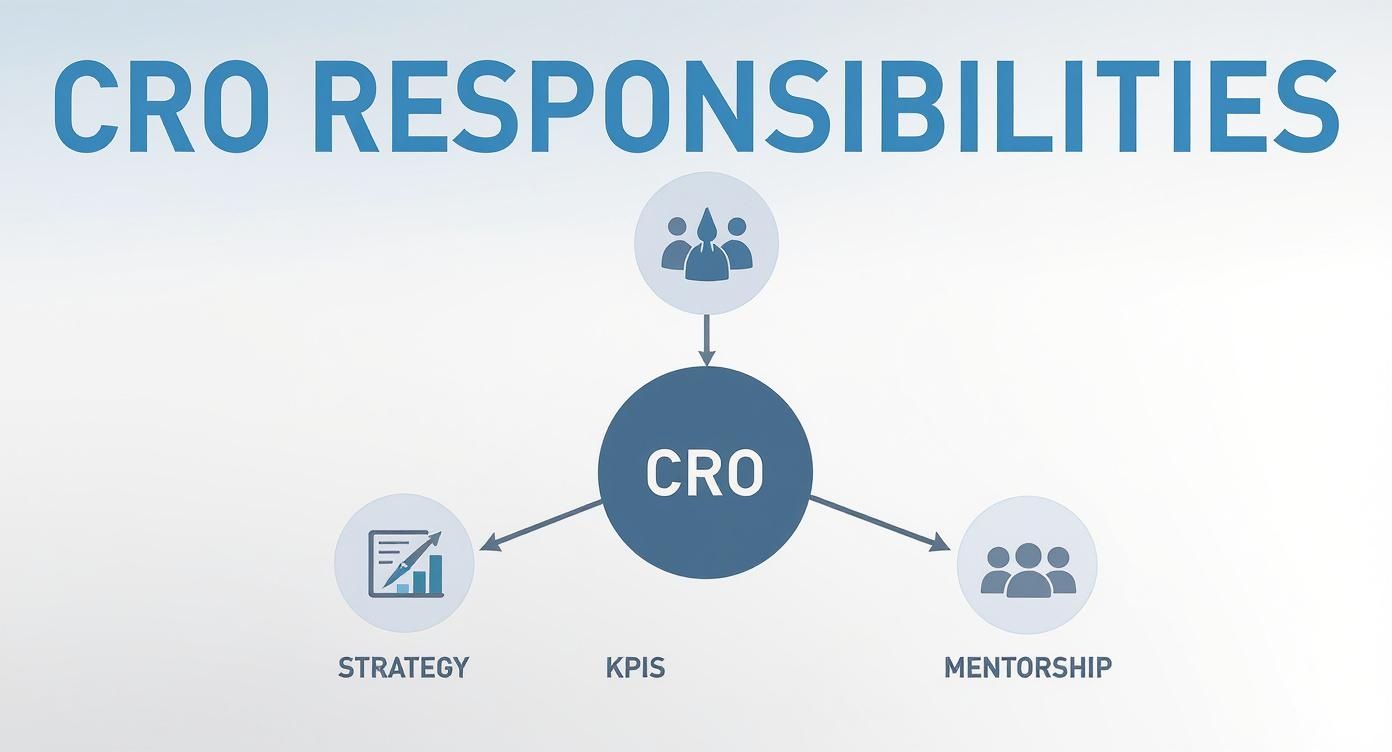
As you can see, the CRO sits at the center of it all, acting as the hub that connects high-level strategy and data-driven KPIs directly to the day-to-day mentorship and development of their teams.
Critical Hard Skills for Revenue Leadership
Hard skills are the technical, measurable abilities that let a CRO actually build, measure, and tune the revenue engine. Think of these as the foundational competencies for making sound strategic calls and keeping the whole operation running smoothly.
- Financial Literacy and Modeling: A great CRO thinks a lot like a CFO. They need to be fluent in financial modeling to create accurate revenue forecasts, manage budgets, and make data-backed decisions on everything from pricing changes to team headcount.
- Data Analysis and RevOps Mastery: Turning raw data into actionable insights is completely non-negotiable. This means deep expertise in CRM platforms like HubSpot or Salesforce and a solid command of revenue operations (RevOps) to create a single source of truth for all revenue metrics and streamline processes.
- Go-to-Market Strategy Development: This is all about designing and executing a comprehensive GTM plan. A skilled CRO knows how to pinpoint target markets, define ideal customer profiles, and align the product, marketing, and sales teams to hit the market hard and shorten sales cycles.
An effective CRO doesn't just manage the revenue process you already have; they re-engineer it. Their real value lies in using data to find the leaks and build a more predictable, scalable system for growth.
Indispensable Soft Skills for Executive Impact
If hard skills build the engine, soft skills are the fuel that makes it run. These are the interpersonal abilities that allow a CRO to lead teams through tough transitions, close high-stakes deals, and get the entire company aligned around a single vision for growth.
- Transformative Leadership and Mentorship: A CRO has to be someone who can inspire and motivate people across different departments. They build a culture of collaboration and accountability, all while mentoring the leaders in sales, marketing, and customer success to get the best out of their teams.
- Strategic Negotiation and Communication: From locking down a massive enterprise contract to getting board approval for a risky new initiative, a CRO's communication skills are always on display. They have to articulate complex strategies clearly and persuasively to all sorts of audiences.
- Change Management: As the one driving the revenue strategy, the CRO is often at the tip of the spear for major organizational changes. They need to be skilled at navigating resistance, getting buy-in from all departments, and steering the company through transitions without dropping the ball.
Finding one executive who has all of these skills is tough. For a lot of scaling businesses, bringing on a fractional CRO is a much more practical way to get this level of expertise without the immediate cost and commitment of a full-time hire. Schedule a consultation to connect with a vetted executive who can help you build the strategic foundation for your next stage of growth.
Measuring Success with Key CRO Metrics

To know if a Chief Revenue Officer is succeeding, you have to look past the obvious sales numbers. A CRO's real impact is measured by a balanced scorecard of key performance indicators (KPIs) that show the true health and efficiency of the entire revenue engine. Make sure these metrics are spelled out in your chief revenue officer job description so everyone's on the same page from day one.
Think of these KPIs as the dashboard of a high-performance car. One gauge, like top-line revenue, only gives you a piece of the picture. A great CRO tunes the whole system for sustainable, profitable growth, which means keeping an eye on metrics across the entire customer lifecycle.
Top-Line Growth and Pipeline Health Metrics
These are the big-picture numbers that show your growth trajectory. They’re often the most visible signs of a CRO's impact.
- Annual Recurring Revenue (ARR) / Monthly Recurring Revenue (MRR): For any subscription business, this is the north star. It's the predictable revenue you can count on. A CRO directly influences ARR by landing new business, expanding existing accounts, and keeping churn to a minimum.
- Pipeline Coverage: This is the simple ratio of your qualified pipeline to your sales quota. A healthy ratio—often 3x to 5x—means the sales team has enough real opportunities to hit their targets. The CRO's job is to get marketing and sales aligned to keep this pipeline full.
- Sales Cycle Length: This metric tracks the average time it takes to close a deal. A CRO is always looking for ways to shorten this cycle by refining the sales process, improving lead quality, and cutting out any friction for the buyer.
Sales and Marketing Efficiency Metrics
Growth is great, but it has to be efficient. These KPIs get down to the brass tacks, measuring the cost-effectiveness of your go-to-market strategy. They ensure you aren't just spending a dollar to make a dime.
A CRO’s ultimate goal is not just growth, but profitable growth. Efficiency metrics like CAC and LTV:CAC ratio reveal whether the revenue engine is a well-oiled machine or a money pit.
A huge part of the CRO role is mastering the economics of customer acquisition.
- Customer Acquisition Cost (CAC): This is the total sales and marketing spend it takes to win one new customer. An effective CRO is constantly working to drive this number down by optimizing spend and improving conversion rates at every stage.
- LTV:CAC Ratio: The ratio of Customer Lifetime Value (LTV) to Customer Acquisition Cost is a vital sign of your business's long-term health. You're looking for a healthy ratio, typically 3:1 or higher. This proves the revenue you get from a customer blows away the cost it took to acquire them.
Customer Health and Retention Metrics
Getting a new customer is just the start. The best CROs know that maximizing revenue from your existing customer base is far more profitable than constantly chasing new logos. In fact, a 5% bump in customer retention can increase profits by 25% or more.
- Net Revenue Retention (NRR): This might be the single most important metric for a modern CRO. NRR tracks the revenue from your existing customers, factoring in upsells, cross-sells, downgrades, and churn. An NRR over 100% means your business is growing even without signing a single new customer. It’s the ultimate sign of a sticky product and happy customers.
- Customer Churn Rate: This is the percentage of customers who leave over a specific period. A CRO works hand-in-hand with customer success to keep this number as low as possible by ensuring a fantastic onboarding experience and proving the product's value.
Building a team that can master these metrics is a serious challenge. A fractional CRO can bring in the strategic oversight you need to establish these KPIs and build the systems to track them, putting your business on the path to predictable success. Schedule a consultation to find an executive who can build your data-driven revenue foundation.
Crafting Your CRO Job Description Template
Let's be honest: a generic job description pulls in generic candidates. If you want to land a high-impact Chief Revenue Officer, your posting needs to be a strategic document. It has to clearly map out expectations, sell your vision, and speak directly to the kind of leader you actually need.
Think of this framework as a starting point. Each section explains the "why" behind the language, helping you build a compelling narrative that's much more than a simple list of duties. A well-constructed job description is your first and most important sales pitch to elite executive talent.
Core Components of an Effective CRO Job Description
A winning chief revenue officer job description must be clear, comprehensive, and inspiring. The trick is to balance the high-level strategic vision of the role with the tactical, hands-on responsibilities required to get the job done.
Here’s a breakdown of the essential elements you can't skip:
- Company Overview: Briefly, what's your mission? This is your chance to get top candidates genuinely excited about what you're doing and the impact they can have.
- Job Summary: Give a high-level snapshot of the CRO role. Explain why this position is open now and how it plugs into the company’s overall growth plans.
- Key Responsibilities: Get specific about the primary duties. Use action verbs and focus on outcomes, not just tasks.
- Required Skills and Qualifications: List the non-negotiables, both hard and soft skills. Be specific about experience (e.g., "Proven track record scaling a B2B SaaS company from $10M to $50M ARR").
- Metrics for Success: How will you measure success? Outline the key performance indicators (KPIs) the CRO will be judged on, like ARR growth, Net Revenue Retention (NRR), and Customer Acquisition Cost (CAC). This sets clear expectations from day one.
Your job description is more than an ad; it’s a direct reflection of your company's strategic maturity. A detailed, outcome-focused posting signals to top candidates that you have a clear vision and know what it takes to win.
Customizable CRO Job Description Template
Use the structure below as your starting point. Just fill in the bracketed information with details specific to your organization. Remember, the goal is to attract a leader who is a perfect match for your culture and growth stage. Crafting effective postings is a real skill, and you can go deeper with our guide to writing impactful executive job descriptions.
Job Title: Chief Revenue Officer (CRO)
Location: [City, State / Remote]
Company Overview: [Insert a compelling 2-3 sentence summary of your company’s mission, product, and unique value proposition.]
Position Summary: As our Chief Revenue Officer, you will be the primary architect and owner of our entire revenue engine. You’ll be responsible for the strategy and execution of all revenue-generating activities, aligning our sales, marketing, and customer success functions to drive predictable, scalable growth.
Responsibilities:
- Develop and execute a cohesive, multi-channel revenue strategy to achieve ambitious growth targets.
- Lead, mentor, and expand our high-performing sales, marketing, and customer success teams.
- Implement and manage a robust revenue operations (RevOps) function to ensure data-driven decision-making across the board.
- Establish, monitor, and report on key performance indicators (KPIs) across the entire customer lifecycle.
- Partner closely with the executive team to shape company strategy, inform product roadmaps, and drive market expansion.
Qualifications:
- [Number] years of progressive executive leadership experience in a high-growth environment.
- Proven success in [mention specific achievements, e.g., scaling revenue from X to Y, building teams from the ground up, entering new markets].
- Deep expertise in [mention specific industry or GTM motion, e.g., B2B SaaS, enterprise sales, product-led growth].
Finding a single leader with this breadth of experience is a major challenge. If your organization needs this level of strategic guidance without the immediate commitment of a full-time hire, a fractional CRO can provide immense value. Explore our network of vetted fractional executives to find the right growth leader for your business.
The Fractional CRO: A Strategic Alternative
For many growing businesses, the path to predictable revenue doesn't have to start with hiring a full-time executive. The six-figure salary, equity package, and months-long search represent a massive commitment, especially when what you really need is elite strategic guidance right now. This is exactly where the fractional CRO model shines as a smart, flexible solution.
A fractional Chief Revenue Officer is a seasoned, C-suite executive who joins your company on a part-time basis. Think of it as plugging a top-tier strategic mind directly into your leadership team for a fraction of the cost. This model gets you the high-level expertise needed to build a real revenue engine, minus the full-time financial weight.
When a Fractional CRO Makes Sense
The fractional model is a game-changer during key transition periods. Bringing in an experienced, unbiased perspective can be the exact push a company needs to smash through a revenue plateau or gear up for its next big growth phase.
Here are a few classic business pain points a fractional CRO can solve:
- Pre-Fundraising Strategy: Investors want to see predictable revenue models and scalable processes. A fractional CRO can build that, making your company significantly more attractive before you seek capital.
- Go-to-Market Refinement: If your GTM strategy is stale or underperforming, an experienced executive can quickly diagnose bottlenecks and implement proven frameworks to get growth back on track.
- Team Mentorship: Perhaps you have a talented but junior team that needs guidance. A fractional leader can provide the mentorship and strategic oversight they need to elevate their performance and take on more responsibility.
Here's a sobering stat: the average tenure for a full-time CRO is just 18 months. This often happens because they're hired to fix broken systems under immense pressure to deliver instant results. A fractional CRO helps you build the right systems first, creating a stable foundation for a future full-time leader to succeed.
Hiring a fractional CRO isn't just about saving money; it’s a strategic play to inject decades of hard-won experience into your business at the precise moment it will have the most impact. You can learn more about this approach in our guide on the fractional C-suite advantage.
Your Top Questions About Hiring a CRO, Answered
Hiring for any executive role brings up a ton of questions. Before you draft that chief revenue officer job description or schedule the first interview, you need clarity. Getting the answers right ensures you're hiring for the role you actually need at the right moment.
Here are the most common questions we hear from founders and CEOs.
What Is the Difference Between a CRO and a VP of Sales?
The biggest difference is scope. A VP of Sales has one primary mission: lead the sales team and hit the number. Their world is pipeline generation, deal velocity, and closing business. It's a hugely important but focused role.
A Chief Revenue Officer, on the other hand, owns the entire customer journey. They’re responsible for weaving sales, marketing, and customer success into a single, cohesive revenue machine.
Here’s a simple analogy:
- VP of Sales: The general on the front lines, leading the troops to win individual battles (deals).
- CRO: The strategist who designs the entire war plan, making sure the supply lines (marketing) are solid and the captured territory (customers) is held and expanded upon.
At What Stage Should I Hire a Full-Time CRO?
Pulling the trigger on a full-time CRO too early can be a very expensive mistake. The sweet spot is usually when your GTM motion has grown too complex for a single-department head to manage effectively. For most B2B companies, this inflection point hits somewhere around the $10M to $20M ARR mark.
Look for these signs that it might be time:
- You're seeing serious friction or misalignment between your sales, marketing, and success teams.
- Your go-to-market strategy needs to evolve, perhaps by adding new channels or targeting new segments.
- You can't seem to nail down a reliable forecasting model, and revenue feels unpredictable.
- Growth has started to flatten out, and you know you need a true strategic leader to architect the next phase of scale.
Can a Fractional CRO Fill the Gap First?
Absolutely. In fact, for many companies, it's the smartest first move. Before you commit to a hefty full-time executive salary and equity package, a fractional CRO can come in and deliver incredible value. You get decades of C-suite experience focused on building the exact infrastructure you need for sustainable growth.
A fractional CRO can step in to:
- Create a unified revenue strategy and establish cross-departmental KPIs.
- Build a proper RevOps foundation and clean up a messy tech stack.
- Act as a mentor and coach for your existing sales and marketing leaders.
- Get your company ready for a fundraise by proving out a scalable, repeatable GTM model.
This approach massively de-risks the eventual full-time hire. When you do bring on a permanent CRO, they'll be stepping into a well-oiled machine, not a chaotic fire fight. It's the perfect way to get top-tier expertise right when you need it most.
Finding executive talent with the right mix of strategic vision and get-it-done operational chops is a significant challenge. We specialize in connecting growing companies with our network of over 3,000 vetted fractional executives who have been there, done that, and can build the revenue engine you need to scale. Schedule a consultation to find the right growth leader for your business.