CHRO Job Description: Templates, Salary, Interview
You probably started with founder-led hiring.
At first, that works. You know every candidate. You sell the vision yourself. You patch people issues in Slack, smooth over manager conflicts in one-on-ones, and let payroll, policies, and performance reviews limp along behind the scenes.
Then growth turns that scrappy approach into a liability.
A manager hires fast and hires wrong. A strong employee leaves because nobody defined a real career path. Compensation gets inconsistent. One team feels energized, another feels ignored. Compliance risk shows up, usually right when you're busy closing revenue or shipping product.
That's the moment founders start searching for a chro job description. Not because they want a fancy title. Because they need someone to bring order, judgment, and structure to the most volatile part of the business: people.
Most advice on this topic is written for enterprise companies with large HR departments and big budgets. That's not your situation if you're building a company in the $1M to $50M range. You don't need an ivory-tower HR executive. You need strategic people leadership that fits your stage, cash constraints, and speed.
That also means the standard corporate CHRO template is usually wrong.
A useful chro job description for a growing business should answer three questions clearly:
- What business problems will this person solve
- What outcomes should they own
- Do you need them full-time
My view is simple. Most growing companies need CHRO-level thinking before they need a full-time CHRO. That distinction matters. A lot.
The Hidden Costs of Growing Without a People Strategy
A company can get away with improvised people management for a while. Then the cracks spread.
One founder I know hit that wall after a strong stretch of growth. Revenue was moving. Hiring was active. On paper, things looked healthy. Underneath, managers were making up interview processes, compensation decisions varied by department, and nobody could explain why some teams retained well while others churned through talent.
That's what growth without a people strategy looks like. It feels busy, but it's not controlled.
The symptoms founders ignore too long
You usually see the same pattern:
- Hiring gets noisy: Everyone is recruiting, but nobody owns workforce planning.
- Culture turns inconsistent: Values exist on a slide, not in hiring, promotion, or manager behavior.
- Managers improvise: Performance issues get handled differently on every team.
- Risk accumulates: Policies lag reality, especially once remote or multi-state hiring enters the picture.
- Founders become the escalation path: Every people problem rolls uphill.
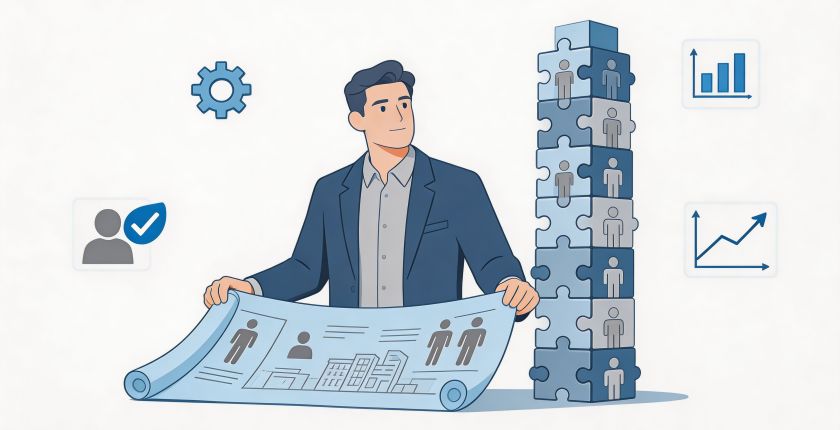
This is why I compare scaling without strategic HR leadership to building a skyscraper without an architect. You can stack floors for a while. Then the weight shifts, the systems don't connect, and the foundation starts absorbing stress it wasn't designed to carry.
You don't feel the cost of weak people systems all at once. You feel it in missed hires, slow decisions, manager confusion, and employee exits that shouldn't have happened.
The market pressure at the top reflects how hard this role has become. In 2024, CHRO turnover among Fortune 200 companies surged to a 15.5% annual rate, which signals how demanding strategic people leadership now is in fast-changing businesses, according to the Talent Strategy Group CHRO Trends 2025 report.
What this means for a growing company
If large companies with full HR infrastructure are struggling to hold steady people leadership, smaller companies should stop pretending a generalist and a founder can cover the same ground indefinitely.
You don't need more admin. You need someone who can make your people model intentional.
That's why a serious chro job description matters. It forces you to define the work before the chaos defines it for you.
Beyond HR Your Business Needs a Chief People Architect
Most founders think "HR" and picture payroll, policy documents, offer letters, and conflict cleanup.
That's not a CHRO.
A Chief Human Resources Officer at a growing company should function as a chief people architect. They design the structure that helps the business hire, retain, organize, reward, and develop talent in a way that supports strategy. They don't just react to issues. They build the system that prevents recurring ones.
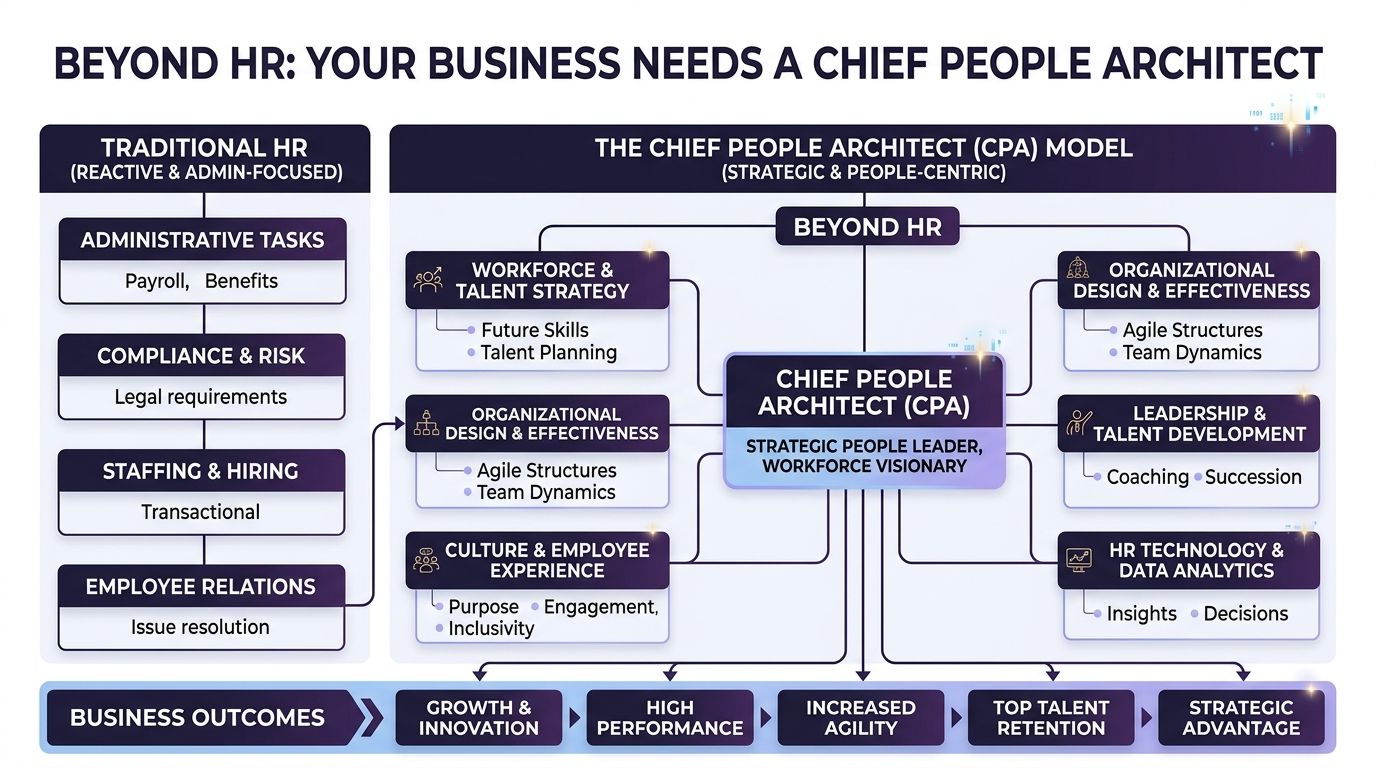
If you want a primer on the role itself, this overview of what a CHRO is is useful. The important point for founders is simpler: the CHRO owns the people strategy behind business execution.
HR manager versus CHRO
This is the distinction that matters most when you write a chro job description.
| Focus area | HR manager | CHRO |
|---|---|---|
| Primary orientation | Operational | Strategic |
| Time horizon | Current quarter | Next stages of growth |
| Core questions | Are processes working | Do we have the right org, leaders, and talent model |
| Typical work | Payroll, policies, employee relations, administration | Org design, executive hiring, succession, compensation philosophy, leadership effectiveness |
| Business role | Function owner | CEO partner |
An HR manager keeps the engine running. A CHRO decides whether you built the right engine.
What a people architect does
The role touches every part of company design.
- Talent strategy: Who you hire, when you hire, and how disciplined your selection process is.
- Org design: Which roles should exist, who should manage whom, and where decision rights sit.
- Leadership development: Which managers can scale, which need coaching, and where leadership gaps will hurt you next.
- Compensation philosophy: Whether pay, equity, incentives, and promotion criteria are coherent or political.
- Culture system: How values show up in performance standards, communication, and accountability.
- Risk management: How you stay compliant without turning the company into a bureaucracy.
Why founders get this wrong
They hire for relief instead of strategic impact.
They look for someone to "own HR" because things feel messy. That usually produces an operator who can stabilize administration, but not a leader who can redesign the system. Then six months later the same founder is frustrated because hiring still lacks rigor, managers still struggle, and the executive team still doesn't have a people plan tied to business goals.
Practical rule: If your people leader can't connect hiring plans, retention risks, manager quality, and compensation decisions to revenue goals, you hired an HR operator, not a CHRO.
For a small or mid-sized company, this doesn't always mean you need a full-time executive. It does mean you need CHRO-caliber judgment in the room.
Core CHRO Responsibilities and How to Measure Success
A good chro job description should define outcomes, not just duties. Founders get in trouble when they post a laundry list of enterprise HR tasks and call it strategy.
The cleaner approach is to define the work in operating areas and attach success measures to each one.
Talent strategy and hiring discipline
Founders often first feel pain in this area, and weak systems spread fastest.
A CHRO should:
- Build workforce plans: Translate company goals into hiring priorities by team, level, and timing.
- Tighten role design: Make sure job scope, leveling, and decision rights are clear before recruiting starts.
- Improve selection quality: Standardize interview loops, scorecards, and final decision criteria.
- Strengthen retention: Identify why strong people leave and intervene before turnover becomes normalized.
The metrics matter because intuition breaks at scale. Modern CHROs use metrics like employee turnover rates and time-to-hire, with 42 days as a typical average benchmark, to spot talent gaps and improve decisions. The same source notes that stronger analytics can help align people strategy with financial outcomes, including potentially boosting revenue growth by 1.5x in tech sectors, according to TechTarget's CHRO definition and role overview.
Useful KPIs
- Time-to-hire for critical roles
- Quality of hire by manager feedback and early performance
- Offer acceptance trends
- New hire retention through the first year
Organizational design and leadership bench
This is the work founders often postpone until it becomes urgent.
A CHRO should look at the business and ask hard questions:
- Are spans of control reasonable?
- Do high-growth teams have the right structure?
- Are managers leading too many people, or too few?
- Who could step into larger leadership roles, and who can't?
A strong people leader doesn't just fill jobs. They reduce organizational drag.
The best CHROs make structure visible. They show you where accountability is muddy, where managers are overloaded, and where growth is exposing weak design.
Useful KPIs
- Internal promotion readiness
- Manager effectiveness through feedback and team health
- Leadership succession depth for key roles
- Time to fill management and executive openings
Compensation and rewards design
Most companies don't have a compensation strategy. They have accumulated compensation decisions.
That's dangerous. Uneven pay practices create trust problems fast.
A CHRO should:
- Define compensation philosophy: Market position, pay bands, promotion logic, equity guidelines.
- Review incentives: Make sure bonus plans reward useful behavior.
- Bring consistency: Similar roles should be compensated with a coherent framework, not negotiation luck.
- Support budget planning: People costs need to line up with growth assumptions.
Useful KPIs
- Offer competitiveness
- Pay band compliance
- Promotion consistency
- Budget accuracy on headcount and compensation
Culture, engagement, and operating norms
Founders talk about culture too vaguely. Culture is what the company rewards, tolerates, and repeats.
A CHRO should make it concrete.
- Translate values into behaviors
- Help managers run effective one-on-ones and reviews
- Build feedback systems that people trust
- Address friction between teams before it becomes political
Useful KPIs
- Engagement trends
- Regrettable attrition patterns
- Manager follow-through on reviews and feedback cycles
- Participation in learning and development programs
HR operations and compliance backbone
This is the floor, not the ceiling. But the floor matters.
A CHRO should ensure:
- Policies match reality
- HRIS and ATS tools support clean workflows
- Employee documentation is consistent
- Labor and people risk is identified early
Tools here are practical, not glamorous. Think HRIS platforms, ATS systems, performance management tools, and compensation planning software. The point isn't to buy more software. The point is to run a cleaner company.
Useful KPIs
- Policy adoption and process completion
- Cycle time for onboarding and offboarding
- Audit readiness
- Issue resolution speed in employee relations cases
The founder takeaway is simple. If your chro job description doesn't tie these responsibilities to measurable business outcomes, it's too vague to hire against and too vague to manage.
The Modern CHRO Skillset What to Look For in 2026
The CHRO role isn't expanding politely. It's changing fast, and founders who hire for an old-school HR profile usually regret it.
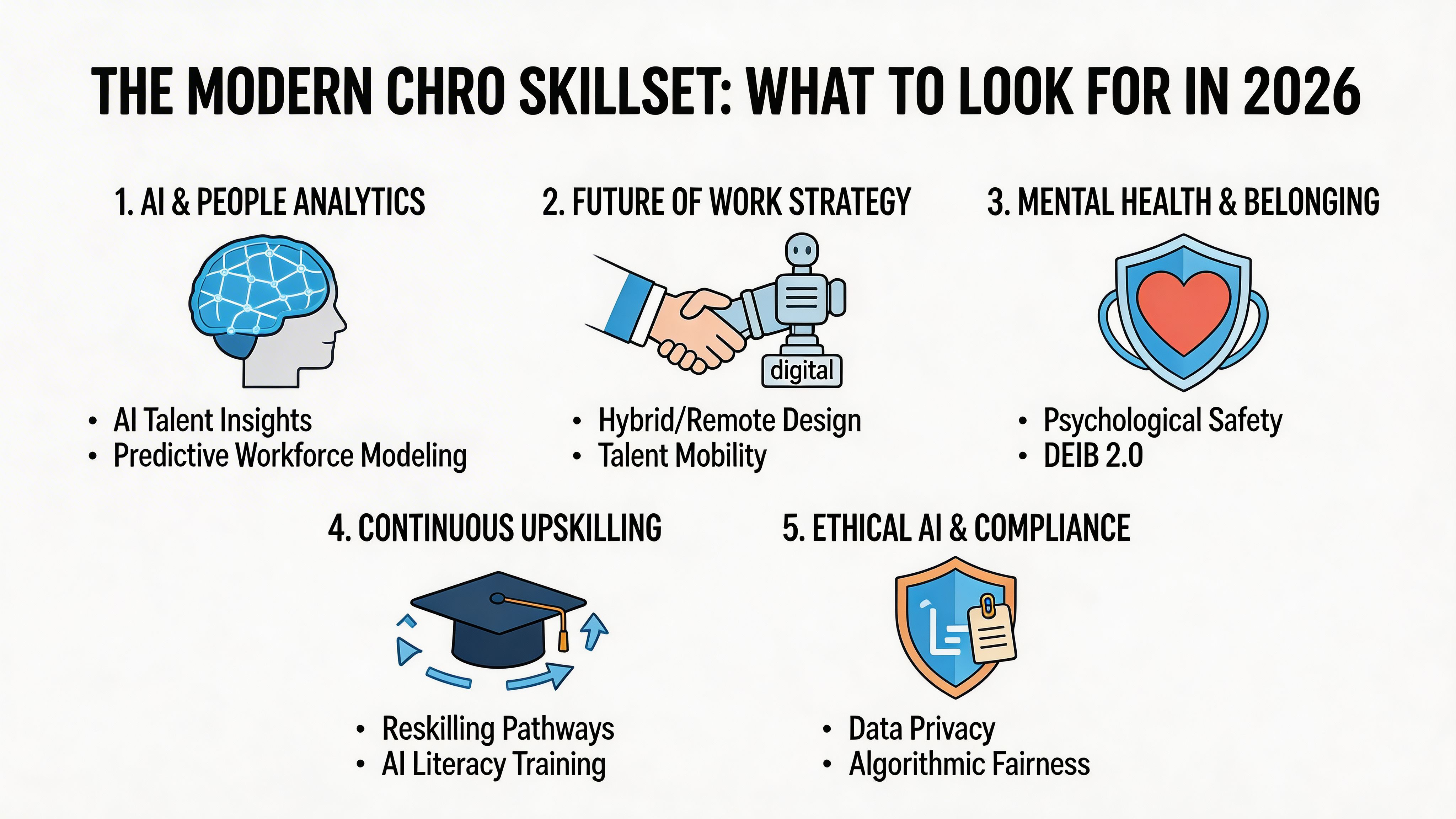
According to Deloitte's analysis of CHRO roles and responsibilities, the role has seen a 23% increase in unique skills required over the past five years, the highest among C-suite positions. That tells you exactly what's happening. The job is no longer centered on process oversight. It now demands business judgment, technical fluency, and strategic range.
Then versus now
The easiest way to evaluate candidates is to compare the old version of the role to the one you need.
| Then | Now |
|---|---|
| Compliance specialist | Strategic advisor who uses compliance as a baseline |
| Policy owner | Org designer and leadership partner |
| People advocate only | Operator who also understands financial trade-offs |
| Tool user | Data-literate builder of systems and dashboards |
| Department head | Cross-functional executive influencing the whole company |
The five skills I'd screen for first
Business acumen
A modern CHRO must understand how your company makes money.
If they can't connect hiring pace, leadership quality, compensation design, and retention risk to revenue execution, they won't influence the CEO or the executive team. You'll get an internal service leader, not a strategic one.
Look for someone who asks about margins, product roadmap, sales productivity, customer concentration, and expansion plans. Those are CHRO questions now.
Data literacy
This role needs someone comfortable with workforce data, not intimidated by it.
They should be able to use HRIS, ATS, and reporting tools to identify patterns, spot risk, and support decisions with evidence. They don't need to be a data scientist. They do need to think analytically.
Change leadership
A lot of founders underestimate this.
Your people leader will often need to influence managers who didn't ask for more structure. They'll need to tighten performance expectations, redesign teams, and introduce processes without slowing the company down. That requires judgment and backbone.
A weak CHRO preserves harmony. A strong one improves execution, even when the conversation gets uncomfortable.
Technology fluency
No, they don't need to be an engineer.
Yes, they need to understand the stack. A strong candidate should be comfortable discussing HRIS, ATS, performance systems, compensation tools, and the practical use of AI in recruiting and workforce planning. If they act like technology is an IT problem, they're behind.
Financial fluency
This is the one founders often forget to test.
Your CHRO will influence one of the largest cost lines in the company. They should be able to discuss headcount plans, compensation trade-offs, budget impact, and executive hiring costs in plain business terms.
What to avoid
Some candidates sound polished and still aren't right for a scaling company.
Watch for these red flags:
- Too much process language: They talk about policies but not outcomes.
- Big-company dependency: They assume large HR teams and slow approval chains.
- No founder empathy: They don't understand speed, ambiguity, or constrained budgets.
- Weak influence skills: They've had authority by title, not by persuasion.
The best modern CHROs are practical, commercially aware, and calm under ambiguity. If you're hiring for a growing business, that profile beats pedigree every time.
Customizable CHRO Job Description Templates
Most chro job description examples are bloated, corporate, and built for companies with layers of HR staff already in place.
That's why founders post a job, get the wrong applicants, and blame the market.
The problem usually starts with the document. A generic enterprise JD attracts candidates who want to manage a mature function. It won't reliably attract a builder who can shape people strategy in a fast-moving business. That gap matters even more for part-time executive roles. Existing CHRO job descriptions are still overwhelmingly built for full-time positions, even though 40% of scale-ups now seek fractional executives to cut costs and increase flexibility, according to SNHU's overview of the CHRO path and role evolution.
Template one for a full-time CHRO
Use this if you're a larger scale-up and need an executive to own the full people function.
Role title
Chief Human Resources Officer
Reports to
Chief Executive Officer
Role summary
We're hiring a CHRO to lead our people strategy and build the systems, leadership practices, and organizational structure required for our next stage of growth. This role will partner closely with the CEO and executive team to align hiring, org design, leadership development, compensation, culture, and compliance with business goals.
Core responsibilities
- People strategy: Build and execute a multi-year people roadmap aligned to company growth objectives.
- Executive partnership: Advise the CEO and leadership team on org design, succession, performance, and workforce planning.
- Talent leadership: Oversee hiring strategy, employer brand, executive recruiting support, and retention initiatives.
- Compensation and rewards: Define compensation philosophy, leveling, promotion standards, and incentive structures.
- Culture and leadership: Improve manager capability, performance management, and employee experience.
- Risk and operations: Ensure compliant, scalable people operations, systems, and policies.
What success looks like
- Hiring plans support business priorities
- Management quality improves across teams
- Retention of strong performers becomes more predictable
- Compensation decisions are consistent and defensible
- HR systems and policies scale without excessive bureaucracy
Candidate profile
You've led people strategy in a growing company, influenced senior leaders, and built practical systems that improved organizational performance. You combine strategic thinking with operational follow-through.
Template two for a fractional CHRO
This is the more useful template for most founder-led companies.
A fractional CHRO job description should not read like a reduced-hours version of a corporate CHRO post. It should focus on priorities, outcomes, and executive effectiveness.
Role title
Fractional CHRO or Fractional Chief People Officer
Reports to
Chief Executive Officer
Expected commitment
Part-time engagement focused on strategic priorities, executive advising, and targeted people systems work.
Role summary
We're seeking a fractional CHRO to help us professionalize our people function without adding a full-time executive cost structure. This leader will work closely with the CEO and managers to improve hiring rigor, organizational design, leadership effectiveness, compensation consistency, and employee experience.
Core mandate
- Build a people strategy that matches our stage and growth plan
- Identify the biggest talent and organizational risks
- Introduce simple, durable systems for hiring, performance, and management
- Coach leaders through growth-related people challenges
- Create enough structure to scale, without slowing execution
First 90 day priorities
- Assess the current state: Review org structure, hiring process, manager capability, retention risks, and people operations.
- Set priorities: Recommend the highest-impact improvements for the next two quarters.
- Fix urgent gaps: Address major issues in hiring, leadership alignment, performance expectations, or compliance.
- Install basic systems: Put in place practical tools, cadences, and decision frameworks managers can use.
What success looks like
- Clearer org decisions from the leadership team
- Better hiring discipline for critical roles
- More confidence and consistency among managers
- Reduced founder involvement in day-to-day people issues
- A realistic people roadmap for the next stage of growth
Ideal candidate profile
You've operated at CHRO or VP People level, preferably in scaling businesses. You know how to prioritize, influence without excess structure, and build systems that fit a resource-constrained environment.
Don't post a vague "strategic HR leader" role and hope the right person interprets it correctly. Spell out the business problems, decision rights, and expected outcomes.
My recommendation
If you're under clear scale-up maturity, start with the fractional version unless your company already has a sizable HR team and broad operational complexity. It's a cleaner bet. You get strategic help where it matters, and you avoid locking in a full-time executive role before you've properly defined it.
How to Interview a CHRO and Find Your Perfect Match
Most founders interview CHRO candidates too narrowly.
They ask about policies, conflict resolution, and recruiting tactics. Those questions matter, but they won't tell you whether the person can think at the company level. You're hiring a business partner with a people lens, not a handbook custodian.
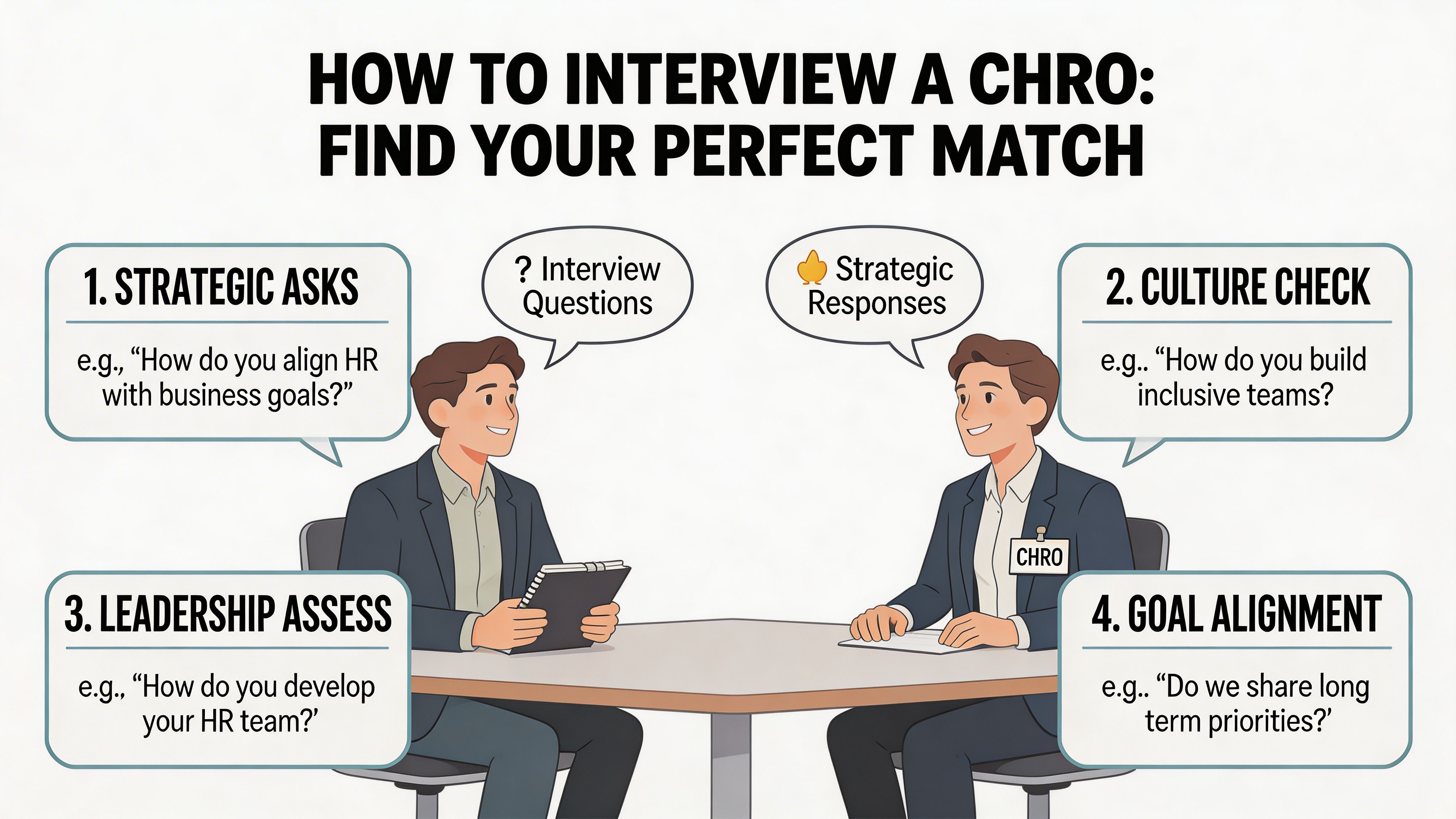
A better process tests how the candidate diagnoses problems, influences leaders, and makes trade-offs. If you want a broader executive framework, these essential executive interview questions for hiring success are a strong companion.
Questions that reveal strategic ability
Business judgment
Ask questions like:
- How would you assess whether our hiring plan is too aggressive, too conservative, or just wrong
- What business inputs do you need before changing org structure
- How have you linked people decisions to growth, margin, or execution
Good candidates answer in business language. Weak ones retreat into HR terminology.
Data and decision-making
Ask:
- Tell me about a time you used workforce data to change a business decision
- Which people metrics do you trust most, and which are commonly misread
- How would you diagnose rising turnover in one function but not others
You're looking for practical reasoning, not dashboard theater.
Leadership influence
Ask:
- Describe a situation where a senior executive disagreed with your recommendation
- How do you tighten accountability without damaging trust
- What's your approach when a founder's instincts conflict with organizational reality
This role requires courage. If the candidate has never pushed back effectively, that matters.
Scale and fit
Ask:
- What kind of company stage brings out your best work
- When does a company need a full-time CHRO versus a fractional one
- What should stay founder-led, and what should move to a people leader
That last question is especially useful. Strong candidates respect founder context. They won't try to turn your company into a large enterprise on day one.
What I'd listen for
The best answers usually have these qualities:
- Specificity: They can explain actions they took, not just principles they believe.
- Range: They understand hiring, org design, compensation, leadership, and risk as connected issues.
- Restraint: They know not every problem requires a process.
- Prioritization: They can tell you what they would fix first.
Why fractional marketplaces make sense
For many companies, the hardest part isn't deciding to hire strategic people leadership. It's finding someone credible without wasting months on a search.
That's where fractional executive marketplaces can be useful. They give founders access to pre-vetted executives and let them structure the role around need instead of title inflation. One option is Shiny, which connects companies with experienced executives for 5 to 25 hours a week from a network of 3000+ executives, based on the company information provided in this brief.
Hire the mind before you hire the seat. If the business needs CHRO judgment but not a full-time CHRO calendar, buy the judgment.
That's the cleaner move for a lot of startups and SMBs.
CHRO Salary Benchmarking and Reporting Structure
A CHRO should report to the CEO. Not to the CFO. Not to legal. Not tucked under operations.
If you want this role to shape hiring plans, leadership quality, compensation philosophy, and organizational design, it needs direct access to the person setting company direction. Anything else weakens the role before it starts.
What full-time really costs
The headline number alone is enough to make most founders pause. The average US CHRO salary is around $318,000 annually, before bonuses and equity, according to Go Fractional's CHRO salary overview. That same source notes a fractional model can offer 70% to 90% cost savings.
That's the core strategic trade-off.
A full-time hire makes sense when the scope is broad, the pace is constant, and the company already has enough complexity to keep a senior people executive fully engaged. Many businesses don't. They still need executive-level people leadership, but not at full-time cost.
For a founder, this is less about cheapness and more about capital allocation. You're deciding whether your company needs a permanent executive seat or targeted senior judgment.
Cost comparison
Cost Comparison: Full-Time vs. Fractional CHRO (Annual Estimate)
| Expense | Full-Time CHRO | Fractional CHRO (10 hrs/week) |
|---|---|---|
| Base cash compensation | Average salary around $318,000 | Lower than full-time due to part-time structure |
| Bonus and equity | Often additional | Typically more limited or structured differently |
| Benefits and employer overhead | Usually included on top of salary | Often avoided or reduced |
| Commitment level | Full-time executive hire | Part-time strategic support |
| Cost efficiency | Highest fixed cost | 70% to 90% cost savings possible |
If you're also reviewing broader leadership pay design, this guide to executive compensation helps frame how salary, incentives, and equity should fit together.
The reporting structure I'd recommend
For most growth-stage companies:
- CEO owns the relationship
- CHRO joins executive team discussions
- Functional HR staff, if any, report into the CHRO
- Board exposure increases as the company matures
That structure keeps people strategy where it belongs. Close to business strategy.
The mistake is hiring someone senior, then isolating them in administration. If that's your setup, you don't have a CHRO. You have an expensive HR manager with a bigger title.
Your Next Move Building a People-First Growth Engine
A strong chro job description does more than fill an opening. It forces you to decide what kind of company you're building.
If your hiring is inconsistent, your managers are improvising, and people issues keep landing on the founder's desk, the problem usually isn't effort. It's missing leadership.
That doesn't automatically mean you need a full-time CHRO. For many startups and SMBs, that's the wrong first move. The smarter move is often to bring in strategic people leadership on a fractional basis, define the systems you need, and build from there.
The decision is simpler than it looks
Ask yourself three questions:
- Do we have people problems that are now affecting execution
- Do we need executive-level judgment, not just HR administration
- Can we justify a full-time senior hire right now
If your answer to the first two is yes and the third is no, the path is pretty clear.
What I'd do in your position
I'd avoid the vanity hire. I'd skip the bloated corporate JD. I'd write a role around outcomes, not prestige.
I'd hire for:
- Organizational clarity
- Hiring rigor
- Manager effectiveness
- Compensation consistency
- Founders spending less time firefighting people issues
That's what strategic HR leadership is supposed to deliver.
The best people leader for your stage isn't the one with the biggest title. It's the one who can make your company easier to scale.
Get the role definition right. Then get the hiring model right. For a lot of companies, that means starting fractional, proving the value, and only going full-time when the business needs it.
If you're weighing whether your business needs a full-time or fractional people leader, Shiny is one way to explore the options. You can use it to connect with experienced fractional executives and see what CHRO-level support could look like before committing to a permanent hire.