
How To Find A Copywriter For Hire In 2026
Your team is ready to launch. The product is solid, the deck looks sharp, and the homepage design finally feels credible. Then the page stays blank because no one can agree on the headline, the offer, or the call to action.
That moment usually sends founders looking for a copywriter for hire. The better move is to treat the search as a leadership decision, not a freelance errand. A strong copywriter does more than draft landing pages and email sequences. They bring part-time marketing judgment to the table. They pressure-test your positioning, sharpen your promise, and help the company speak in one voice.
Founders often struggle here for a predictable reason. You know the product too well. That closeness makes it easy to write for insiders, lead with features, and explain the company before naming the buyer's problem. Clear copy requires distance, prioritization, and the discipline to say one thing well.
Good copy changes more than a page. It affects how prospects understand the business, how sales teams frame the pitch, and how campaigns perform across channels. Website messaging, outbound emails, landing pages, nurture sequences, ads, sales collateral, investor updates, and launch materials all rely on the same underlying message. When that message is weak, every channel works harder than it should.
The best hires in this role do not act like order-takers. They act like fractional marketing leaders with a writing specialty. They spot fuzzy offers, inconsistent claims, weak calls to action, and audience definitions that are too broad to convert. That kind of judgment saves time, cuts rewrites, and often surfaces strategic problems before they spread into paid campaigns and sales conversations.
I've seen founders wait too long on this hire because they assume the issue is execution. In many cases, the issue is message clarity. If conversion is soft, sales calls require too much education, or your team explains the offer three different ways, the words are not a finishing touch. They are part of the operating system.
There is still plenty of noise in the market. Plenty of writers can produce clean sentences. Far fewer can connect customer insight, positioning, and revenue goals. One useful signal shows up early. Outreach that starts with a specific point of view, such as a quick audit that identifies a weak CTA or a muddy value proposition, tends to draw better responses from serious candidates, based on this client acquisition benchmark for copywriters.
A disciplined hiring process helps you find that level of partner before you waste budget on drafts that sound polished and sell nothing.
Introduction Why Your Next Hire Should Be a Copywriter
A founder can survive a rough first website. You can't scale with one.
Early on, many organizations write copy by committee. The founder drafts it, a marketer softens it, product adds detail, and legal removes anything interesting. The final version is safe, accurate, and forgettable. It sounds like a company talking to itself.
That's why hiring a copywriter isn't a cosmetic decision. It's often the first marketing hire that improves how the whole company communicates. A strong copywriter can translate product value into buyer language, tighten the promise, and give your team a repeatable way to talk about the business.
What a strategic copywriter actually changes
The wrong hire gives you deliverables. The right hire gives you alignment.
That shows up in places like these:
- Homepage clarity: Buyers understand what you do without scrolling through jargon.
- Sales support: Reps stop rewriting decks and follow-up emails from scratch.
- Campaign consistency: Ads, landing pages, and email sequences sound like the same company.
- Faster execution: Product launches don't stall because no one owns messaging.
A practical copywriter also forces better decisions. If your offer is fuzzy, they'll expose it. If your audience is too broad, they'll push back. If your CTA asks for too much too early, they'll say so.
Practical rule: If the writer never challenges your assumptions, you probably hired a typist, not a strategist.
Why this hire works well as a fractional role
Most startups don't need a full-time copywriter on day one. They need someone senior enough to solve messaging problems, but flexible enough to plug in where the gaps are.
That's why the fractional model fits so well. You can bring in experienced help for specific workstreams, such as a homepage rewrite, launch messaging, nurture flows, or paid campaign copy, without forcing a full-time scope before the business is ready.
This isn't a downgrade from a traditional hire. In many cases, it's the smarter path. You're buying judgment where it matters most.
First Define Your Needs and Goals
Before you hire anyone, get specific about the job. “We need better copy” is not a useful brief. It doesn't tell you what's broken, what success looks like, or what kind of writer you need.

A startup usually needs one of three things. Positioning help, conversion help, or production help. Those aren't the same hire.
Start with the business problem
Ask these questions first:
- What's underperforming: Is it the website, email, paid ads, sales collateral, or all of it?
- Where does the team get stuck: Are you struggling to explain the product, create campaigns, or maintain a consistent voice?
- What decision should the reader make: Book a demo, start a trial, donate, request a quote, or trust the brand enough to continue?
If your answer is “everything,” narrow it down to the highest-stakes path. Usually that's your homepage, your core landing page, or the email sequence that supports pipeline.
Map the work by funnel stage
A simple audit helps. List what you need at each stage.
| Funnel stage | Copy need | What to look for in a writer |
|---|---|---|
| Top of funnel | Blog posts, thought leadership, educational landing pages | Strong research, voice control, subject fluency |
| Mid funnel | Email nurture, comparison pages, case-study framing | Clear persuasion, structure, buyer empathy |
| Bottom of funnel | Sales pages, demo pages, outbound messaging, ads | Conversion focus, concise writing, offer clarity |
This step matters because many founders hire a writer who's excellent at one format and average at another. A great long-form content writer may not be the person you want shaping ad copy or a product launch page.
Define the audience and the voice
Most copy problems are targeting problems in disguise.
Write down who the buyer is, what they care about, what they already know, and what makes them skeptical. Then document the voice. Not as vague brand adjectives like “forward-thinking” or “friendly,” but in practical terms.
Try prompts like:
- We sound like: direct, informed, commercially aware
- We do not sound like: academic, hype-heavy, overly cute
- We want the buyer to feel: clear on value, safe choosing us, ready to act
This gets even more important in specialized sectors. In nonprofit work, generic messaging can fail badly. Mission-driven organizations often see 40% lower campaign engagement rates when they use generic copywriters who lack mission alignment and donor-focused storytelling, according to this analysis of copywriting specialization gaps.
That's a useful warning for any founder in a niche market. Domain familiarity isn't a bonus. Sometimes it's the difference between resonance and flat performance.
A good brief starts with a business objective. A great brief also names the audience tension the copy has to resolve.
Write a Brief That Attracts Top-Tier Talent
Strong writers can spot a weak brief in seconds. If your posting says “need website copy ASAP,” you'll attract people who are comfortable working from scraps. That's rarely who you want.
A strong brief tells serious candidates that your company is organized, decisive, and worth their time.

What to include in the brief
Your brief doesn't need to be fancy. It needs to answer the questions a seasoned copywriter will ask before they take the work.
Include these pieces:
- Company snapshot: What you sell, who you sell to, and where you are in the market.
- Project context: Why this project exists now. New launch, weak conversion, repositioning, outbound buildout, fundraising support.
- Audience detail: Decision-maker, pain points, objections, urgency, buying context.
- Deliverables: Homepage, product page, email sequence, ad set, messaging framework, brand voice guide.
- Source material: Existing website, sales deck, customer calls, demos, product docs, founder notes.
- Decision process: Who approves the work and how feedback will be collected.
If you're not sure how detailed role expectations should be, it helps to review examples of executive job descriptions for growth-stage companies. The format translates well to high-value fractional marketing hires because it forces clarity around outcomes, scope, and ownership.
Bad brief versus good brief
Here's the difference in practice.
Weak version
Need a copywriter for hire to rewrite our website. We're an AI company helping businesses automate workflows. Looking for someone creative who can write in our voice. Fast turnaround preferred.
Better version
We're a growth-stage AI software company selling to operations leaders at mid-market firms. Our homepage explains features well but doesn't clearly show business value, and sales calls often begin with basic category education. We need a messaging partner to rewrite the homepage and product overview page, sharpen the core value proposition, and create a simple voice guide the team can reuse. Source material includes customer call notes, product demos, and our current sales deck. One founder and one GTM lead will review. We want a writer who can challenge positioning, not just edit language.
That second version does something important. It gives the writer a problem to solve.
Hiring signal: Top-tier candidates are usually more interested in a sharp problem statement than a long list of adjectives about your brand.
Budget language that helps, not hurts
You don't need to publish a perfect number. You do need to show that you understand this is skilled work.
If you hide budget entirely, experienced writers may skip the opportunity. If you anchor the project unrealistically low, you'll screen in the wrong tier of candidates. A range is fine. So is saying you're open to project-based or retainer structures depending on fit.
The brief is your first filter. Treat it like one.
Source and Vet Your Copywriter Candidates
A founder usually feels the hiring risk at this stage. The brief is finally clear, the stakes are real, and now the search widens fast. What looks like a simple freelance hire can turn into a slow review cycle full of decent writers who cannot lead messaging.
That is why sourcing matters. You are not only filling a production gap. You are selecting a fractional marketing leader who can hear scattered founder input, find the core positioning issue, and turn it into copy that helps sales, product, and growth work from the same story.
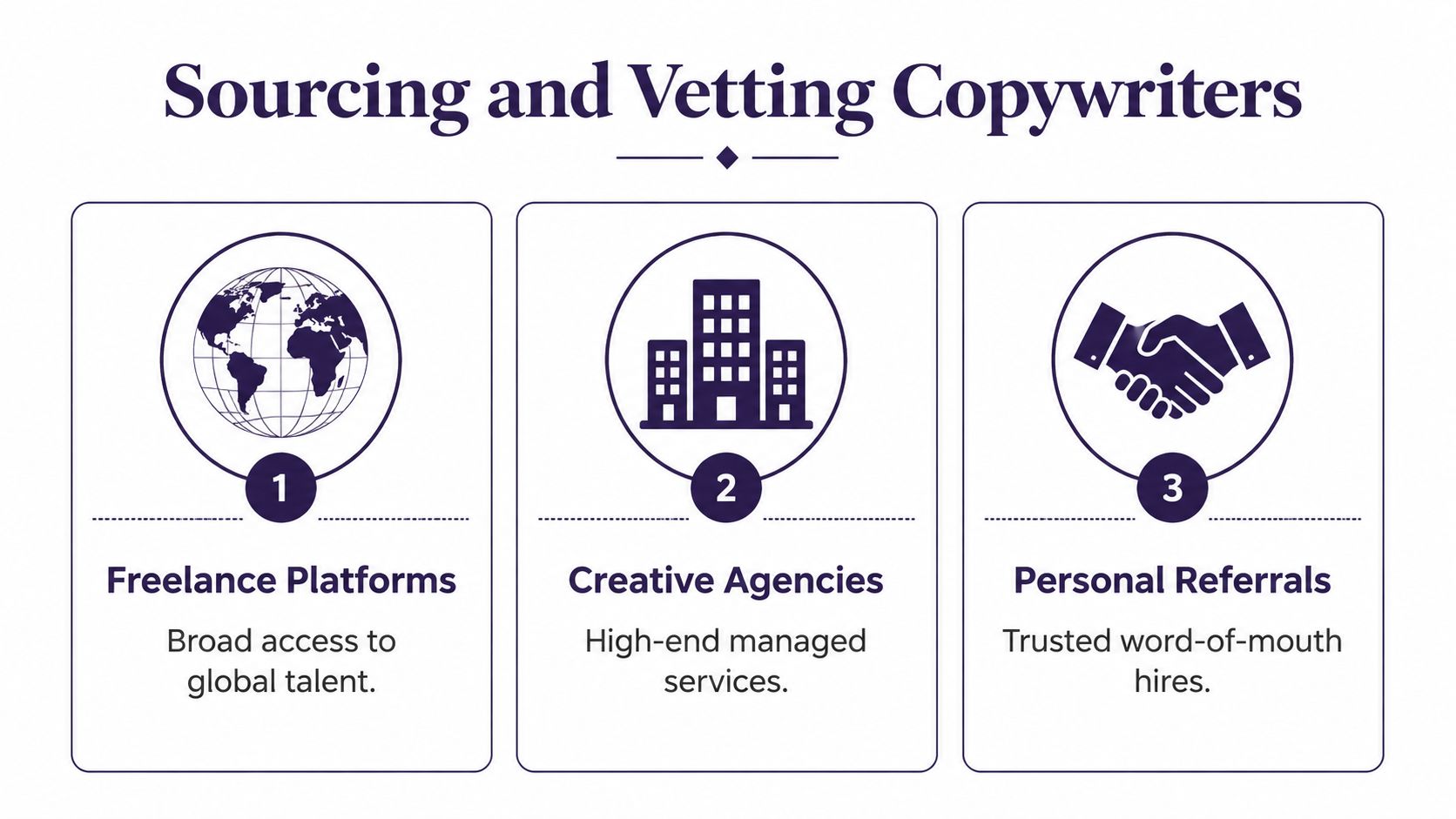
Compare the main sourcing channels
Different channels produce different candidate pools, review burdens, and levels of strategic depth.
| Channel | Strength | Trade-off | Best use |
|---|---|---|---|
| Freelance platforms | Broad reach and fast volume | Heavy screening burden, uneven quality | Well-scoped projects with clear review capacity |
| Creative agencies | Process support and polished delivery | Less direct access to the writer, higher cost structure | Campaigns that need copy plus design or production |
| Personal referrals | Trust and context from people you know | Small pool, shaped by your network | Niche searches where category familiarity matters |
| Curated talent networks | Pre-vetted candidates and faster fit | Fewer options than open marketplaces | Fractional, strategic hires where judgment matters |
The right channel depends on the role you need filled. If you are comparing specialist copy support with broader GTM help, this guide on hiring a digital marketer is a useful reference point.
Screen for judgment before style
Strong copywriters do more than write clean sentences. They diagnose why the current message is underperforming, ask for the right inputs, and push back when a founder is describing product features instead of buyer value.
Start with these signals:
- Strategic framing: They can explain the business problem behind the asset.
- Audience awareness: They know who the buyer is, what that buyer already understands, and what needs to change in the reader's mind.
- Channel fit: They have worked on the types of assets you need, whether that is homepage copy, email sequences, sales collateral, or landing pages.
- Revision maturity: They treat feedback as part of the work, not as a threat.
- Domain familiarity: They can handle your category's complexity, or they can show a repeatable process for learning it quickly.
A polished portfolio alone does not answer those questions.
Ask interview questions that reveal operating range
Founders often get pulled toward charisma here. A candidate sounds confident, drops marketing vocabulary, and seems easy to work with. That can still produce weak copy if the thinking underneath is thin.
Use questions that force candidates to explain choices:
- How would you approach a homepage that gets traffic but stalls in conversion?
- What inputs do you need before writing a first draft, and what do you do if those inputs are incomplete?
- Tell me about a time you disagreed with a client's messaging direction. How did you handle it?
- How do you work with founders, sales leaders, and product teams when each group describes the customer differently?
Listen for process, not performance. Good candidates talk about interviews, message hierarchy, objections, offer clarity, and stakeholder alignment. Weak candidates stay at the level of tone, creativity, and wordsmithing.
If the hire matters, use a paid test. Keep it small and close to the assignment. A homepage section rewrite, a messaging critique, or a short email sequence is enough to see how they think, how they ask questions, and how they handle constraints.
Paid tests also set the right tone. Serious candidates see that you respect their time, and you get a cleaner read on how they would operate as a partner, not just as a vendor.
Evaluate Portfolios and Understand Pricing
Portfolio review is where many founders drift into guesswork. They read a few samples, like the tone, and assume they've found the right person.
That's not enough. Good copy isn't just pleasant to read. It moves a buyer toward a decision.
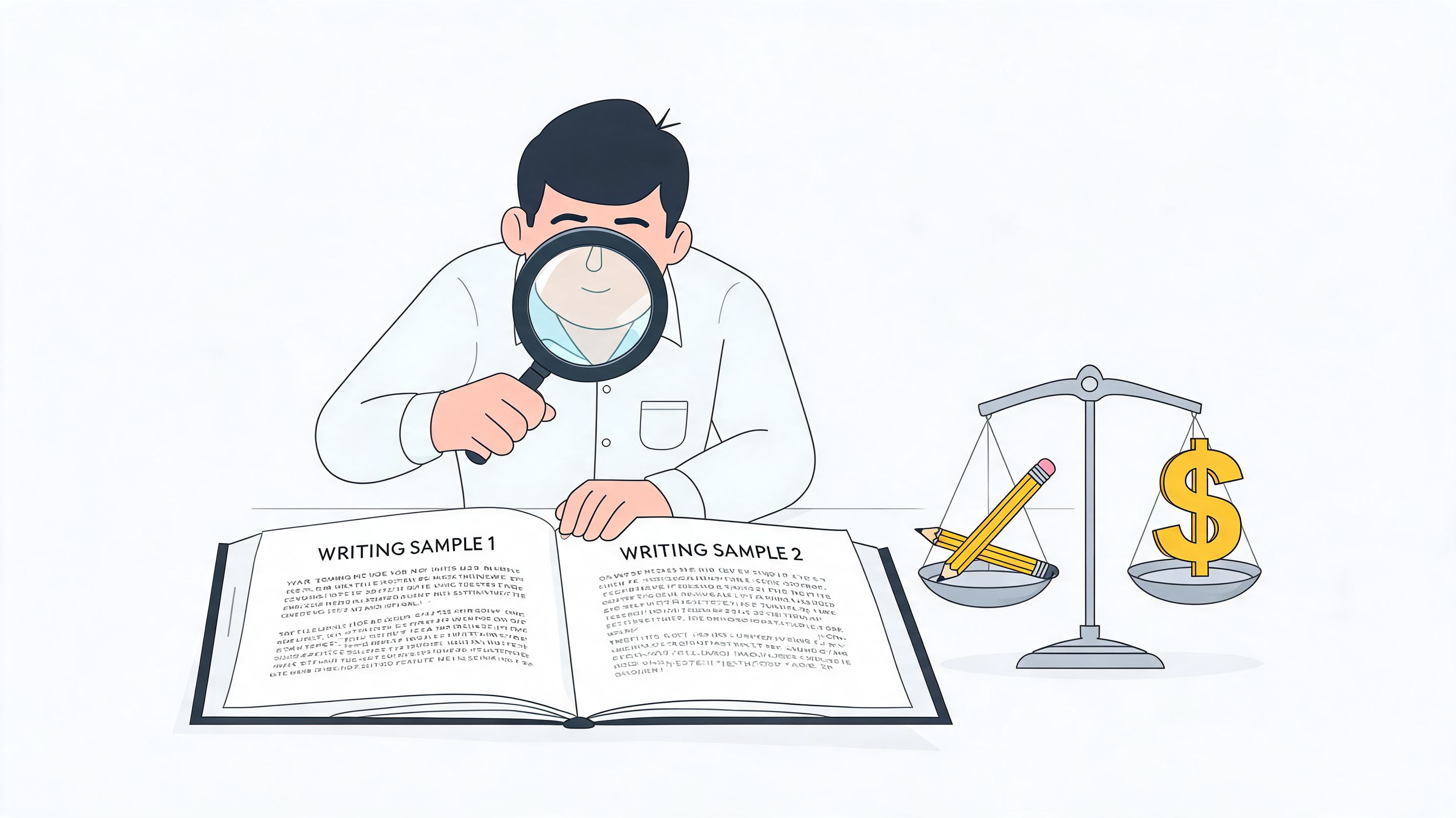
How to read a portfolio like an operator
Look for these signals:
- Range without shapelessness: Can they shift voice across industries while still sounding intentional?
- Commercial instinct: Do headlines, structure, and CTAs show an understanding of persuasion?
- Process evidence: Do they mention research, interviews, or message development?
- Problem solving: Can they explain what the copy was trying to fix?
- Restraint: Strong writers know when not to overwrite.
A portfolio full of clever taglines may impress. It doesn't tell you whether the writer can rebuild a messy SaaS homepage, create a donor email sequence, or support a founder with limited time and scattered inputs.
Pricing models and when each one fits
Copywriters usually price in one of three ways.
| Model | When it works | Watch out for |
|---|---|---|
| Hourly | Ongoing collaboration, advisory work, rolling edits | Open-ended scope |
| Project-based | Defined deliverables with clear review rounds | Scope creep if the brief is fuzzy |
| Retainer | Repeated support across channels | Misalignment if priorities shift monthly |
For startups, the best structure depends on the maturity of the work. If you need a clear package like a homepage rewrite, project pricing is clean. If you need a strategic partner across several channels, a retainer often works better.
For a rough benchmark, experienced copywriters often calculate hourly pricing by taking a target annual salary, dividing by 2,080 hours, then multiplying by 1.5 to cover overhead. Using a $100,000 salary example produces an hourly rate of about $72, and specialized niches such as FinTech may command a 20% to 50% premium, according to this copywriter rate methodology.
If you want to sanity-check an hourly proposal against role economics, a contracting hourly rate calculator helps frame the relationship between salary targets, overhead, and freelance pricing.
Don't buy on price alone
Cheap copy often becomes expensive in revision rounds, missed deadlines, and weak messaging decisions.
A better way to judge value is to ask:
- Will this person reduce decision fatigue for the team?
- Can they extract useful input from founders who are short on time?
- Do they improve messaging quality across multiple assets, not just one deliverable?
That's where the idea of a copywriter for hire shifts upward. You're not only purchasing words. You're buying clarity, speed, and better commercial communication.
Some of the most valuable copywriters spend less time “writing” than founders expect. They spend that time diagnosing what the business actually needs to say.
Onboard Your New Partner for Long-Term Success
The hire is only half the decision. The other half is whether you set this person up to contribute like a strategic partner instead of a pair of hands.
That matters more with copy than founders expect. A good copywriter can act like fractional marketing leadership in disguise. They hear weak positioning fast, spot gaps between sales and marketing, and turn scattered founder input into a message the market can understand. None of that happens if the engagement starts with vague requests, scattered feedback, and missing context.
Lock down the working agreement
Start with a clear statement of work. Keep it practical.
It should define:
- Scope: exact deliverables, channel coverage, and what falls outside the engagement
- Process: milestones, draft stages, revision limits, and turnaround times
- Payment terms: invoicing schedule, deposit or retainer terms, and kill fee if needed
- Ownership: when intellectual property transfers to your company
- Access: who supplies source material, who reviews work, and who gives final approval
This protects both sides. It also prevents two expensive startup habits: treating every draft like a fresh strategy discussion and letting too many stakeholders rewrite the same piece.
Give them the inputs they actually need
Strong copy depends on strong source material.
Share the documents and conversations that reveal how the business really sells:
- Brand fundamentals: positioning, voice guidelines, messaging hierarchy, past campaigns
- Customer insight: sales calls, objections, testimonials, churn reasons, win-loss notes
- Commercial context: offer structure, pricing logic, funnel stages, launch calendar, campaign goals
- Internal access: one main point of contact, access to decision-makers, and the tools they need to work
Product demos, Gong clips, proposal decks, onboarding calls, and founder notes all help. The goal is simple. Give the writer enough context to make good decisions without dragging your team into constant clarification.
Run the first 30 days with a clear rhythm
The first month should establish trust, speed, and decision quality.
A workable cadence usually looks like this:
- Week one: kickoff call, document review, stakeholder interviews
- Week two: messaging diagnosis, angle options, or first-draft direction
- Week three: consolidated feedback, revisions, unresolved questions
- Week four: final deliverable, performance notes if applicable, and next-priority recommendations
That final recommendation is one of the clearest signs you hired well. A strategic copywriter should show you what needs attention next, whether that is homepage messaging, lifecycle emails, paid landing pages, or founder-led content.
Keep feedback centralized. One decision-maker with one consolidated set of comments will save days of churn and protect the quality of the work.
The strongest relationships feel less like outsourcing and more like adding senior marketing judgment to the business for a defined slice of time each week.
If you're looking for more than a generic freelancer, Shiny helps startups hire vetted fractional executives for 5 to 25 hours a week, including experienced marketing leaders who can bring the strategy behind the words. It's a practical option when you need senior judgment, flexible engagement, and a faster path to the right fit.