
10 Actionable Customer Success Best Practices to Drive Retention and Growth
In the relentless pursuit of growth, startups often fixate on acquiring new customers. Yet, the real engine for sustainable revenue is already on your books: your existing customer base. Turning those customers into advocates who stay longer, spend more, and refer others is the core function of Customer Success (CS). For many growth-stage companies, however, building a world-class CS function feels like an overwhelming task. The strategy, processes, and leadership required are often out of reach.
This isn't just another generic list of tips. This is an actionable blueprint detailing 10 essential customer success best practices that directly impact retention, expansion, and profitability. We’ll move beyond theory and provide concrete steps for implementing structured onboarding, proactive health monitoring, and data-driven playbooks. Each point is a building block for a powerful, revenue-generating CS organization.
Crucially, we'll address the execution gap many founders face. How do you implement these systems without a seasoned, full-time executive? We'll explore how a fractional customer success leader provides the C-suite expertise needed to build and scale these practices efficiently. They implement these strategies, establish the right KPIs, and build a high-performing team on a flexible basis, delivering immediate impact without the overhead of a full-time hire. You’ll learn not just what to do, but how to get it done faster and more effectively.
1. Proactive Customer Health Monitoring
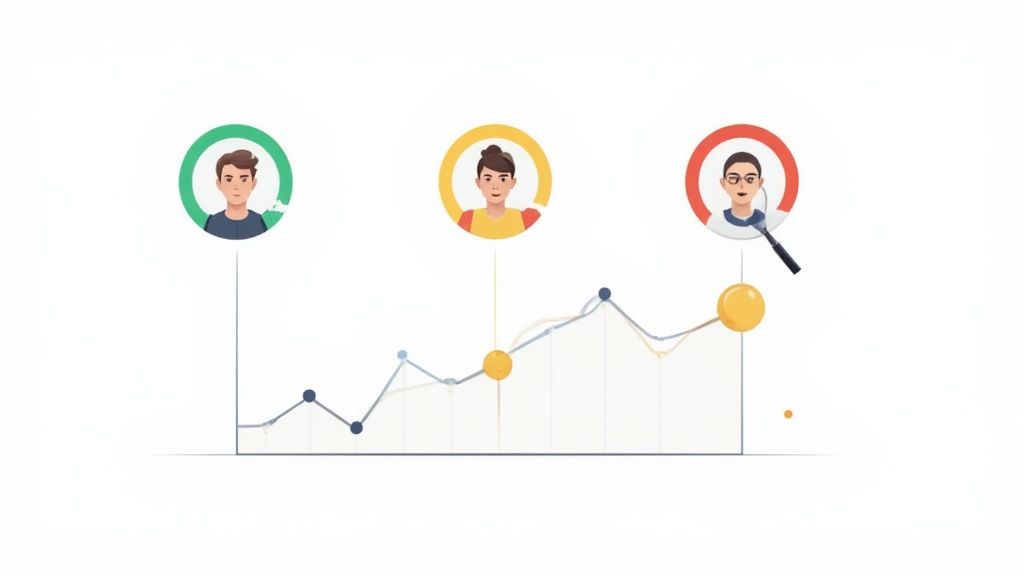
Instead of reacting to fires, the best CS teams prevent them. Proactive customer health monitoring is a foundational best practice that involves systematically tracking usage data, engagement patterns, and feedback to predict which accounts are at risk of churning and which are primed for growth. Think of it like a doctor monitoring a patient's vital signs to catch issues before they become critical.
By establishing a customer health score, you create a single, easily understood metric that summarizes an account's well-being. This score helps your team prioritize their efforts, focusing on customers who need immediate attention or those showing signs of being ready for an upsell.
Why It's a Top Practice
Proactive monitoring shifts the entire dynamic of customer relationships from reactive to strategic. It enables early intervention when a healthy customer starts to show signs of disengagement, like a sudden drop in login frequency. Companies like HubSpot and Zendesk integrate health dashboards directly into their platforms, allowing CSMs to see at-a-glance which customers require a check-in, turning potential churn events into retention opportunities.
How to Implement It
Getting started doesn't require a massive investment. A fractional CS leader can help implement a lightweight but effective system.
- Define Key Metrics: Start with 3-5 indicators that correlate with success. This could include product usage (feature adoption), engagement (support ticket volume, login frequency), and feedback (NPS scores).
- Set Trigger Alerts: Create automated alerts for your CS team when a customer’s health score drops below a certain threshold. An immediate playbook should be triggered if a key account's usage drops by 50%.
- Visualize the Data: A clear dashboard is crucial. Make health scores actionable with visual tools. You can find inspiration from these executive dashboard examples.
- Combine Data with Human Insight: A score is a conversation starter, not a verdict. A low score should prompt a strategic business review to realign on value.
2. Dedicated Customer Success Managers (CSMs)
While automation is essential for scale, the human element remains a cornerstone of high-value customer relationships. A top-tier customer success best practice is assigning dedicated Customer Success Managers (CSMs) to key accounts. A CSM acts as the customer's strategic partner and internal advocate, guiding them from onboarding to renewal to ensure they achieve their goals with your product.
A dedicated CSM's role is fundamentally strategic, focusing on value realization and long-term partnership rather than transactional support. They are the voice of the customer internally and the face of your company externally, fostering deep relationships that competitors can't easily replicate.

Why It's a Top Practice
Dedicated CSMs transform the customer experience from a vendor relationship into a true partnership. This is crucial for complex products or high-value accounts where generic support falls short. For example, Salesforce assigns dedicated managers to its enterprise clients to drive adoption, navigate organizational complexity, and secure long-term loyalty and expansion revenue.
How to Implement It
Building an effective CSM function requires a clear strategy. A fractional CS leader can architect this model efficiently, ensuring it aligns with your company's growth stage.
- Segment Your Customer Base: Not every customer needs a dedicated CSM. Segment accounts by revenue, growth potential, or strategic importance to determine who receives high-touch (dedicated), low-touch (pooled), or tech-touch (automated) coverage.
- Establish Clear Responsibilities: Define the CSM's role. This includes conducting Quarterly Business Reviews (QBRs), monitoring health scores, creating success plans, and identifying upsell opportunities.
- Equip CSMs with the Right Tools: A robust CRM is non-negotiable for tracking customer interactions. If you're building this capability, learn more about how to implement a CRM system to support your team.
- Invest in Onboarding: Your CSMs need to be experts in your product, your customers' industries, and customer success principles. A thorough onboarding program sets them up for success.
3. Structured Onboarding Programs
The first 90 days of a customer's journey are the most critical in determining long-term retention. A structured onboarding program is one of the most vital customer success best practices because it guides new clients from purchase to their first "aha!" moment of value. Instead of leaving them to figure things out alone, this provides a clear roadmap to achieve their desired outcomes quickly.
This process involves a deliberate sequence of training, implementation planning, milestone tracking, and defining success metrics from day one. It formalizes the crucial handoff from sales to customer success, setting a positive tone for the entire relationship.
Why It's a Top Practice
A well-designed onboarding program dramatically reduces "time to first value." When customers see an early return on their investment, they become stickier and more engaged. For instance, collaboration tools like Asana and Slack excel at this by providing role-based onboarding paths and interactive product tours. This structured approach helps users integrate the tool into their daily workflows, accelerating adoption.
How to Implement It
Building an onboarding program doesn't have to be overly complex. An experienced fractional executive can help design a scalable process that fits your customer needs.
- Segment Your Onboarding: Create distinct onboarding tracks for different customer segments or user personas. An enterprise power user needs a different path than a small business owner.
- Use a Multi-Channel Approach: Combine live training sessions with self-serve documentation, in-app guides, and pre-recorded video tutorials to cater to different learning styles.
- Define "Graduation": Establish clear, measurable criteria that signal a customer is successfully onboarded. This could be completing a specific project or achieving a key usage metric.
- Schedule Proactive Check-ins: Don't wait for the customer to reach out. Schedule check-ins at 30, 60, and 90-day marks to review progress and address roadblocks.
- Gather Feedback Continuously: Treat your onboarding program as a living process. Actively solicit feedback from new customers to identify friction points and continuously refine the experience.
4. Regular Business Reviews (QBRs/EBRs)
A cornerstone of strategic customer success best practices is implementing a regular cadence of business reviews. These scheduled meetings—often quarterly (QBRs) or bi-annually for executives (EBRs)—provide a structured forum to move beyond day-to-day support. They allow you to assess performance against goals, demonstrate ROI, and strategically align on future direction. It's the moment the relationship transitions from vendor to strategic partner.
Conducting these reviews consistently demonstrates your commitment to the customer’s long-term success. It creates a powerful feedback loop that uncovers expansion opportunities, mitigates churn risk by tackling issues head-on, and solidifies your role as a trusted advisor.
Why It's a Top Practice
Regular business reviews formalize the value conversation and ensure alignment between your product and the customer's evolving business objectives. This practice is critical for retention in high-value accounts. Major SaaS companies like Salesforce use QBRs to cement relationships with enterprise customers, using the sessions to showcase delivered value and map out future collaboration.
How to Implement It
A fractional executive can help establish a scalable and repeatable process for conducting impactful reviews.
- Prepare with Data: Never go into a review unprepared. Compile a data-driven story of the customer's progress, usage, and ROI.
- Create a Standardized Agenda: Develop a consistent agenda covering past performance, goal achievement, new challenges, and future planning. For a detailed guide, explore this quarterly business review template.
- Involve Key Stakeholders: Ensure you have decision-makers in the room. When appropriate, bring in experts from your product or engineering teams to discuss relevant roadmap items.
- Document and Assign Actions: End every meeting by summarizing key takeaways and assigning clear, time-bound action items to both teams. Schedule the next review before the current one ends.
5. Customer Segmentation and Tiered Support
Not all customers have the same needs or potential. A highly strategic customer success best practice is implementing customer segmentation and tiered support. This involves categorizing your customer base into distinct groups and tailoring your engagement strategies to meet the unique needs of each segment. This ensures your most valuable resources are allocated to your most valuable accounts.
This approach allows you to move away from a one-size-fits-all model, which often under-serves top-tier clients and over-serves smaller ones. By creating different service levels, you can efficiently scale your efforts, providing high-touch guidance to premium customers while leveraging tech-touch workflows for lower-tier segments.
Why It's a Top Practice
Effective segmentation is the foundation of scalable customer success. It ensures your high-potential accounts receive the white-glove treatment they need to grow, while still providing value to your entire customer base. For example, HubSpot provides dedicated CSMs for its enterprise clients, while its smaller customers are supported through a robust knowledge base, community forums, and automated check-ins.
How to Implement It
A fractional leader can quickly analyze your customer base and design a segmentation model that aligns with your business goals.
- Define Clear Criteria: Segment customers based on factors like Annual Recurring Revenue (ARR), growth potential, or product usage. Start with 3-4 distinct tiers (e.g., Enterprise, Mid-Market, SMB).
- Create Segment-Specific Playbooks: Develop unique engagement playbooks for each tier. Your top tier might get a dedicated CSM with QBRs, while your lower tier receives automated onboarding emails.
- Use Automation for Lower-Touch Segments: Leverage your CRM to automate communications, health checks, and resource sharing for your high-volume, lower-revenue segments.
- Establish Upgrade Paths: Clearly define the triggers and processes for a customer to move from a lower tier to a higher one, creating a clear growth pathway.
6. Product Adoption and Enablement Programs
A key pillar of customer success best practices is moving beyond basic onboarding to actively drive product adoption. This means implementing strategies to ensure customers not only use your product but also leverage its full range of features. It's about empowering users through continuous education, reducing friction, and making value realization an ongoing process.
By investing in enablement, you transform users from passive consumers into proficient advocates. These programs directly combat feature blindness and underutilization—silent killers of customer retention. When customers feel competent and see a clear path to mastering your product, their loyalty and lifetime value increase exponentially.

Why It's a Top Practice
Effective enablement programs turn your product from a simple tool into an indispensable part of your customer's workflow. Salesforce has mastered this with its Trailhead platform, which gamifies learning and offers valuable certifications. This proactive education prevents frustration, reduces support ticket volume, and creates a stickier product experience.
How to Implement It
Building a robust enablement program is a scalable effort. A fractional executive can guide your strategy, helping you prioritize initiatives that deliver the highest impact.
- Create Role-Specific Learning Paths: Develop training tracks tailored to different user roles, such as admins, end-users, and managers, to ensure the content is relevant.
- Combine Learning Modalities: Cater to diverse learning styles by offering a mix of on-demand videos, interactive in-app guides, live webinars, and written documentation.
- Gamify and Certify: Motivate users by incorporating gamification elements like badges and leaderboards. Offering official certifications provides a tangible incentive to deepen product knowledge.
- Measure and Iterate: Track key adoption metrics like feature usage rates and completion rates for training modules. Use this data to continuously refine your enablement strategy.
7. Voice of Customer Programs and Feedback Loops
Truly understanding your customers requires more than analyzing usage data; it means actively listening to them. A vital customer success best practice is implementing a Voice of the Customer (VoC) program. This involves systematically collecting, analyzing, and acting on customer feedback from various channels to guide product development and refine services.
A VoC program formalizes the feedback process, ensuring that valuable insights from surveys, interviews, and support tickets aren't lost. It creates a direct line between customer needs and business strategy, preventing your roadmap from becoming disconnected from the people it's meant to serve.
Why It's a Top Practice
Implementing a feedback loop makes customers feel heard and valued. When users see their suggestions come to life, they become more invested in the product's success. For instance, Notion famously maintains a public roadmap where features are prioritized based on user votes, creating a transparent and collaborative development process.
How to Implement It
A fractional executive can establish a scalable VoC program that turns feedback into a strategic asset.
- Systematize Feedback Collection: Implement regular CSAT and NPS surveys at key points in the customer journey (e.g., post-onboarding, post-support ticket resolution).
- Go Beyond Surveys: Conduct regular user interviews and usability sessions to gather deep qualitative insights. Monitor social media and review sites to understand public sentiment.
- Centralize and Analyze: Funnel all feedback into a central repository. Use tools to tag and categorize comments to identify recurring themes and feature requests.
- Close the Loop: This is the most critical step. When you act on feedback, communicate it back to the customers who provided it. A simple "We built this because you asked for it" email can turn a happy customer into a vocal advocate.
8. Data-Driven Decision Making and Analytics
To truly scale customer success, intuition and anecdotal feedback aren't enough. A core tenet of modern customer success best practices is embedding data-driven decision making into your team's DNA. This means leveraging a rich set of customer data and usage analytics to make strategic, informed decisions.
This practice involves creating a systematic framework for measuring the impact of your CS initiatives. By using data, you can answer critical questions like "Which onboarding activities lead to the highest long-term retention?" This transforms your customer success function from a cost center into a predictable growth engine.
Why It's a Top Practice
Making decisions based on data removes guesswork and aligns your CS team’s efforts with business objectives. It allows you to prove the ROI of your programs and advocate for more resources. Companies like Gainsight and Mixpanel have built their platforms around this concept, empowering CS teams to visualize customer journeys, pinpoint friction, and proactively identify opportunities.
How to Implement It
Getting started requires a clear strategy for what to measure. A fractional executive can help design a measurement framework tailored to your business goals.
- Define Core KPIs: Identify key performance indicators that link to customer value, such as Net Revenue Retention (NRR), Customer Lifetime Value (CLV), and product adoption rates.
- Create Role-Based Dashboards: Build specific dashboards for different stakeholders. CSMs need to see their portfolio health, while executives need a high-level view of overall retention trends.
- Combine Quantitative and Qualitative Data: Numbers tell you what is happening, but qualitative feedback tells you why. Combine both to get a complete picture.
- Establish a Review Cadence: Schedule regular meetings with your team and leadership to review analytics, discuss trends, and adjust your strategy accordingly.
9. Cross-Functional Collaboration and Alignment
Customer success doesn't operate in a silo. An effective CS strategy relies on deep integration with other key departments, including Product, Sales, Engineering, and Support. This involves creating systematic communication channels and feedback loops to ensure that customer insights directly influence product development and sales processes. It’s about creating a unified front where every team shares ownership of the customer experience.
When these teams are aligned, the entire customer lifecycle becomes smoother. Sales hands off well-qualified customers with proper expectations. Product builds features that solve real user problems. This holistic approach ensures that from the first touchpoint to renewal, the customer feels understood and valued by the entire organization.
Why It's a Top Practice
Cross-functional alignment transforms customer feedback from a passive data point into an active driver of business strategy. Companies like HubSpot excel at this by integrating their Sales, Success, and Support workflows for a seamless customer journey. This prevents departmental echo chambers and ensures everyone is working toward shared customer outcomes.
How to Implement It
Building these bridges requires deliberate effort. A fractional executive can quickly establish the necessary frameworks to facilitate collaboration.
- Establish Clear Communication Protocols: Create dedicated Slack channels (e.g., #feedback-product) for sharing customer insights. Document the process for how feedback is escalated and addressed.
- Hold Regular Cross-Functional Syncs: Schedule monthly or bi-weekly meetings with leaders from Product, Sales, and CS to review customer health trends and align on priorities.
- Create Joint OKRs: Set shared Objectives and Key Results that require collaboration. For example, a joint OKR could be to reduce churn caused by a specific product gap by 15%.
- Centralize Customer Data: Use a CRM or a CS platform to create a single source of truth for all customer interactions, giving every team a 360-degree view of the customer.
10. Personalized Communication and Customer Experience
Moving beyond generic, one-size-fits-all messaging is a cornerstone of modern customer success best practices. Personalized communication involves delivering tailored interactions based on a customer's unique segment, usage patterns, and goals. This practice transforms the customer journey from a standardized process into an individualized experience, making customers feel understood.
This includes everything from personalized onboarding flows to targeted feature recommendations. When done right, personalization shows you are not just a vendor, but a strategic partner invested in their specific outcomes. It’s the difference between a mass email and a timely, contextual message that solves a real problem.
Why It's a Top Practice
Personalized experiences drive deeper engagement and loyalty. Companies that excel at this, like Netflix with its recommendation engine or Spotify with its "Discover Weekly" playlists, create an incredibly sticky user experience. For B2B SaaS, this could mean sending a user a proactive tip about a feature they haven't used but that aligns with their goals. This level of relevance builds trust and reduces churn.
How to Implement It
A fractional executive can help build a personalization strategy that scales. The key is to start small and leverage data effectively.
- Segment Your User Base: Group customers based on meaningful criteria like industry, company size, or use case to create targeted communication campaigns.
- Leverage First-Party Data: Use in-app behavior, support ticket history, and survey responses to inform your messaging. If a user has repeatedly accessed help docs for a feature, send them a proactive guide on that topic.
- Automate with Triggers: Set up automated emails or in-app messages based on user actions, such as celebrating a milestone when a user invites their 10th team member.
- Balance Automation with a Human Touch: While automation is crucial for scale, always provide an easy way for customers to connect with a human. Personalization should enhance, not replace, the human relationship.
10 Customer Success Best Practices Compared
| Strategy | Implementation Complexity 🔄 | Resource Requirements ⚡ | Expected Outcomes ⭐📊 | Ideal Use Cases 💡 | Key Advantages ⭐ |
|---|---|---|---|---|---|
| Proactive Customer Health Monitoring | High — data pipelines, scoring models, alerting | Medium–High — analytics tools, engineers, integrations | Early churn detection; improved retention and LTV | SaaS with rich usage telemetry and medium→large customer base | Scalable, data-driven early intervention |
| Dedicated Customer Success Managers (CSMs) | Medium — org design, role definitions, SLAs | High — headcount, training, ongoing management | Deeper relationships; higher expansion and retention | Enterprise or strategic accounts requiring high-touch service | Personalized guidance and internal advocacy |
| Structured Onboarding Programs | Medium — playbooks, milestone tracking, training | Medium — trainers, implementation resources, tools | Faster time-to-value; higher initial adoption and satisfaction | New customers or complex products needing guided setup | Consistent, repeatable adoption ramp |
| Regular Business Reviews (QBRs/EBRs) | Medium — agenda prep, data synthesis, coordination | Medium — executive time, analytics support | Identifies expansion opportunities; aligns strategy; accountability | Strategic accounts near renewal or growth planning | Executive alignment and clear action items |
| Customer Segmentation & Tiered Support | Medium — segmentation rules, workflows, SLAs | Medium — automation, playbooks, tooling | Efficient resource allocation; scalable support model | Mixed customer base with varying value and complexity | Optimizes ROI and focuses attention on high-value accounts |
| Product Adoption & Enablement Programs | Medium — content development, in‑app guides, certifications | Medium–High — content team, LMS/in‑app tools, maintenance | Increased feature usage, product ROI, and NPS | Feature-rich products and customers at risk of underuse | Drives usage, expertise, and expansion potential |
| Voice of Customer & Feedback Loops | Medium — multi-channel collection, analysis, closing loop | Medium — research staff, feedback tools, prioritization process | Product improvements; roadmap alignment; higher satisfaction | Product development and prioritization, customer-centric orgs | Reduces development risk; signals customer needs |
| Data‑Driven Decision Making & Analytics | High — data integration, governance, modeling | High — BI platforms, data engineers, analysts | Objective insights; measurable CS impact and forecasting | Scaling companies wanting measurable CS outcomes | Quantifies impact; reveals hidden patterns |
| Cross‑Functional Collaboration & Alignment | Medium — processes, shared KPIs, cultural change | Medium — coordination time, collaboration tools | Faster resolution; better product-market fit; consistent CX | Organizations with product, sales, engineering silos | Breaks silos; accelerates delivery of customer requests |
| Personalized Communication & CX | High — segmentation logic, personalization engine, content | High — CDP, messaging platforms, content ops | Higher engagement, conversion, and retention | High-volume or high-value customers needing tailored journeys | Increases relevance and upsell effectiveness |
The Challenge of Implementation—And the Solution
Knowing these customer success best practices is one thing; implementing them effectively is another challenge entirely. For most growth-stage companies, the primary obstacles are bandwidth and expertise. Your team is likely lean and juggling multiple priorities. The idea of building a sophisticated customer segmentation model or a data-driven playbook from scratch can feel daunting.
This is often where momentum stalls. Without a seasoned leader to architect the strategy, define the KPIs, and champion cross-functional alignment, even the best intentions can fall flat. You might recognize the need for a Chief Customer Officer (CCO) to build this function, but the time and cost associated with a full-time executive search can be prohibitive.
Accelerate Your Success with Fractional Leadership
This is precisely the gap that fractional leadership is designed to fill. Instead of putting your customer success initiatives on hold while you search for the perfect full-time hire, you can engage an experienced, C-suite leader on a part-time basis. A fractional CCO doesn't just offer advice; they roll up their sleeves and execute.
Imagine bringing in a seasoned executive for just 10-15 hours a week who can:
- Build your foundation: Develop your customer journey map, segmentation strategy, and health scoring model.
- Implement the playbooks: Create and document the onboarding, adoption, and renewal processes your team needs to scale.
- Establish a data-driven culture: Select the right CS tools and define the core metrics that truly matter.
- Mentor your team: Coach your first CSMs, providing them with the guidance and structure needed to excel.
This approach provides immediate strategic impact at a fraction of the cost of a full-time salary. It allows you to build a world-class customer success function methodically, proving its ROI every step of the way. By leveraging a fractional leader, you're not just adopting customer success best practices; you are embedding them into your company's DNA, creating a durable competitive advantage that transforms customers into your most powerful advocates for growth.
Ready to turn customer success into your primary growth engine? Explore our network of vetted, fractional executives who can build and scale your CS function. Find the perfect part-time leader on Shiny and start driving immediate, measurable impact for your business.