Your Guide to Hiring an Ecommerce Business Consultant in 2026
An ecommerce business consultant is a seasoned expert you bring in to solve tough growth problems, iron out your operations, and ultimately, make your business more profitable. Think of them as a strategic partner, offering senior-level guidance on everything from your marketing and customer experience to your supply chain and tech stack. They help you punch through ceilings your team can't break on their own.
But today, the most effective consultants aren't just advisors—they are fractional leaders. They step in not just to recommend a strategy, but to roll up their sleeves and help you execute it, providing C-suite level leadership on a part-time basis.
When Is It Time to Hire an Ecommerce Business Consultant?
Every founder hits a point where pure grit isn't enough to keep the growth engine running. The very strategies that got you from zero to your first million in sales often become the things holding you back from hitting the next milestone. It’s a normal—and frustrating—part of the journey. Spotting these growing pains is the first step.
Hiring an expert isn't about admitting defeat. It’s a smart, strategic move to inject specialized knowledge exactly where you need it most. It’s about recognizing you can’t be an expert in everything and that bringing in an outside perspective is a sign of mature leadership.
Your Growth Has Stalled or Reversed
One of the most glaring signs you need help is when your key performance indicators (KPIs) start trending the wrong way. You might be working harder and spending more, but the results are flat or, even worse, declining.
Sound familiar? These are common business pain points:
- Rising Ad Spend, Flat Sales: Your customer acquisition cost (CAC) is through the roof, but revenue is stuck. You're pouring cash into Google Ads and social media, but your return on ad spend (ROAS) keeps shrinking.
- Declining Conversion Rates: Your website traffic is solid, maybe even growing, but fewer people are actually buying. This usually signals issues with your site's user experience (UX), pricing, or product presentation.
- High Cart Abandonment: Shoppers add products to their cart but disappear before checking out. This is a classic symptom of friction in the buying process—think unexpected shipping costs or a clunky checkout form.
Analogy: A stubbornly high cart abandonment rate is like a leaky pipe in your revenue stream. An expert consultant acts as a plumber, quickly finding the source of the leak—whether it's a technical glitch, a trust issue, or a hidden cost—and patching it to stop the financial drain.
Operational Bottlenecks Are Hurting Your Brand
As your business grows, simple processes start to crack under pressure. These operational issues don't just cause internal chaos; they directly impact your customer experience and can damage your brand reputation.
For example, imagine a skincare brand that goes viral. Orders flood in, but their manual fulfillment process can't keep up. Soon, they're dealing with shipping delays and a wave of angry customer support tickets. The brand's reputation, once sky-high, takes a nosedive. An ecommerce business consultant specializes in finding these bottlenecks and implementing scalable systems to prevent them.
You Lack the Expertise for the Next Growth Phase
Your next big opportunity might demand skills your team just doesn't have yet. Whether you're expanding into international markets, launching a new product line, or rebuilding your tech stack, going into uncharted territory without a guide is a huge risk. This is where an ecommerce business consultant brings the playbook.
The concept of fractional leadership is incredibly powerful here. Instead of taking on the massive cost and commitment of a full-time executive, you can bring in a seasoned expert for a fraction of the time and price. They provide the C-suite level strategy needed to lead a specific project, build out a new function, and even train your existing team—then step away once the job is done. This flexible model gives you access to world-class talent without the long-term financial weight.
Defining Clear Goals and Measuring Consultant Success
Hiring an expert without a clear mission is a recipe for a wasted investment. Before you even start looking for an ecommerce business consultant, you need to turn your business headaches into a clear scope of work with measurable goals. This separates a successful consulting project from one that fizzles out.
The goal is to move past wishful thinking. "I want to increase sales" isn't a goal; it's a hope. You have to dig into why you’re facing challenges and put real numbers on where you want to be.
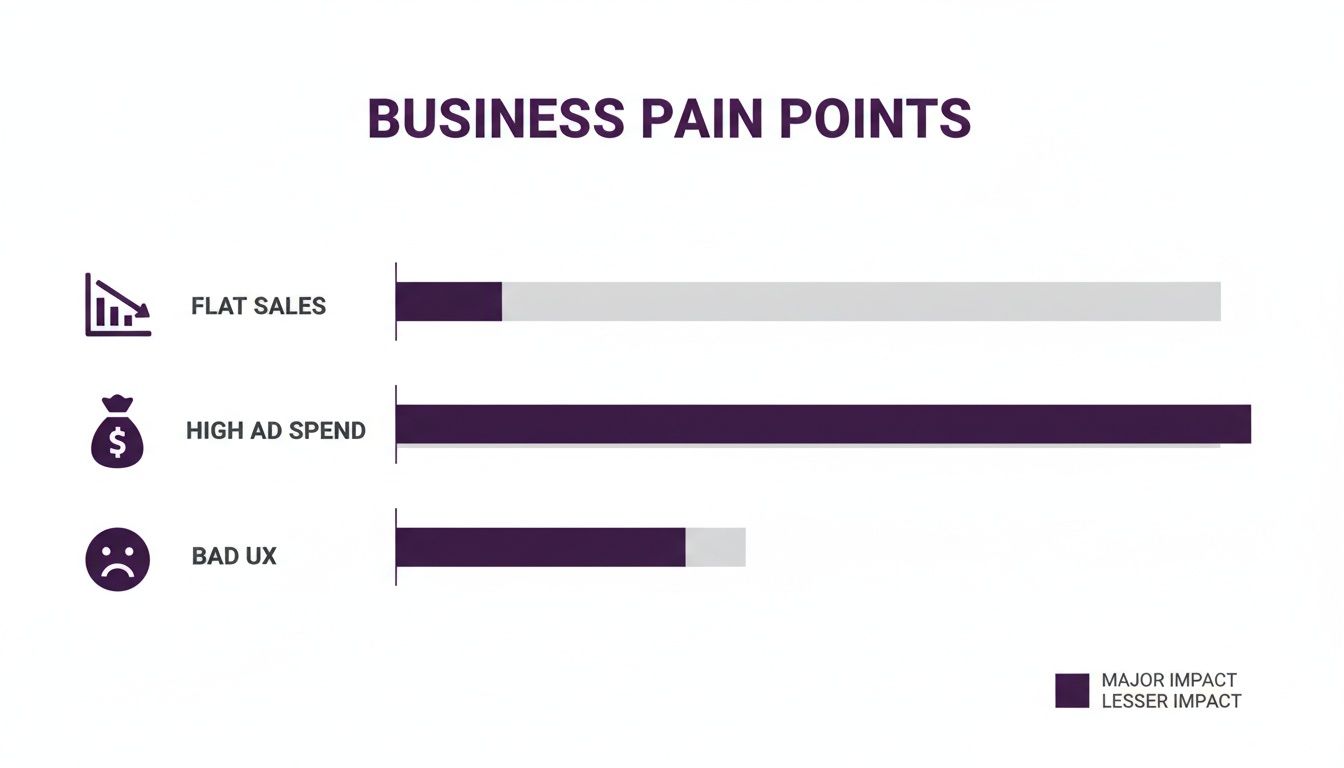
Things like flat revenue or high ad costs are just symptoms. An experienced consultant is trained to find the root cause—whether it's a strategic misstep or an operational bottleneck—and fix it for good.
From Vague Problems to Specific KPIs
Think of it like going to the doctor. You don’t just walk in and say you "feel bad." You give them specifics: a headache, a cough, a fever. The doctor uses that info to diagnose the issue and create a treatment plan. Your consultant needs the exact same level of detail.
Here’s how to turn common ecommerce frustrations into specific, measurable goals a consultant can work with:
-
Instead of: "We need more sales."
-
Try: "Increase our website conversion rate from 1.5% to 2.5% within the next six months."
-
Instead of: "Our ad spend is too high."
-
Try: "Reduce our customer acquisition cost (CAC) by 20% on our main social channels next quarter, without hurting our lead volume."
-
Instead of: "We need to improve customer loyalty."
-
Try: "Improve our customer lifetime value (LTV) by 30% over the next 12 months by launching a new email retention series."
By defining success with precise metrics right from the start, you're creating a shared language for what "done" looks like. It gets both you and your consultant aimed at the same target and gives you a clear way to measure their impact.
Aligning Goals with Consultant Expertise
Once you have your KPIs nailed down, you can outline the project deliverables. This clarity is everything when it comes to attracting the right person. A logistics and fulfillment guru isn't going to be much help if your real goal is to overhaul your brand's creative.
For instance, if your main KPI is to lower your CAC, the deliverables might look something like this:
- A full audit of your current ad campaigns and audience targeting.
- A new framework for testing ad creative and landing pages.
- A 90-day plan to move your ad budget to more profitable channels.
Getting this specific in your project brief acts as a filter, ensuring only consultants with the right hands-on experience apply. You can learn more by checking out our guide on how to measure business growth and apply those ideas to your consultant search.
Creating a Powerful Project Brief
The final piece is to pull all this information into a clear, concise project brief. A well-written brief instantly signals that you’re an organized, serious client who respects a consultant’s time and expertise.
Make sure your brief clearly lays out:
- The primary business problem you're trying to solve.
- The specific, measurable KPIs you’ll use to track success.
- The key deliverables and expected outcomes.
- The estimated timeline and type of engagement (e.g., a 90-day project or a 6-month fractional role).
When you define your goals upfront, you're setting the stage for a productive partnership. You're no longer just hiring an ecommerce business consultant; you're bringing on a strategic partner who is completely aligned with your vision.
How to Find and Vet the Right Ecommerce Expert
Finding a genuine ecommerce business consultant can feel like panning for gold. The market is flooded with self-proclaimed "gurus," making it tough to tell the real strategists from those who just talk a good game. To find an expert who will actually move the needle for your business, you need a smart way to source and validate them.
Your search can't just start and end with a quick LinkedIn query. While professional networks are a starting point, they’re incredibly noisy and offer zero quality control. The real talent is usually found in more curated, focused environments.
Where to Find Pre-Vetted Talent
To cut through the noise, you need to look where the experts themselves gather. Focusing your search on platforms that specialize in high-caliber, pre-vetted professionals will save you countless hours.
Here are the best places to start your search:
- Specialized Fractional Marketplaces: Platforms like Shiny are built specifically to connect companies with seasoned, fractional executives. Candidates are thoroughly vetted for their track record and strategic expertise, giving you a curated pool of top-tier talent from the get-go.
- Industry-Specific Job Boards: Keep an eye on job boards focused on ecommerce or direct-to-consumer (DTC) roles. True experts often scan these for interesting project-based or fractional gigs.
- Niche Communities and Masterminds: High-level consultants are active in private communities. A referral from a trusted peer in one of these groups can be a goldmine.
Pro Tip: The fastest way to find a great ecommerce consultant is to go where they already are. Bypassing generic platforms for specialized marketplaces dramatically increases your odds of finding the perfect strategic partner for your brand.
Asking Interview Questions That Reveal True Expertise
Once you’ve got a shortlist, the real vetting begins. The goal is to get past the surface-level resume questions and dig into their strategic thinking. A great consultant won't just tell you what they did; they’ll break down why they did it and what the actual business impact was.
Don't be afraid to get specific with situational and behavioral questions.
Here are some powerful questions to ask:
-
"Walk me through a time you scaled a brand past a major revenue plateau. What were the key levers you pulled, and what were the biggest obstacles you had to overcome?"
This reveals their problem-solving process and how they handle real-world challenges. -
"Describe a situation where a strategy you implemented failed. What did you learn from it, and how did you pivot?"
You want someone who is honest about their failures. An expert who has never failed is an expert who has never taken a real risk. -
"Given our current challenge of [insert your specific problem here], what would be the first three things you would investigate in your first 30 days?"
A great consultant will respond with more clarifying questions. A less experienced one will jump straight to offering generic solutions.
Assessing Their Track Record and Platform Expertise
Beyond the interview, you need to validate their experience. An ecommerce business consultant who has only ever worked with $100M+ retail giants might be out of their element in the scrappy world of a startup.
- Verify Experience with Similar Businesses: Ask for case studies or references from companies of a similar size and niche. For startups, finding a consultant with relevant early-stage experience is critical. Our article on business consultants for startups is a great resource.
- Confirm Platform-Specific Knowledge: If your store runs on Shopify Plus, you need someone who knows its ecosystem cold. The same goes for Magento, BigCommerce, or any other platform. A mismatch in platform expertise can lead to expensive, ineffective advice.
By combining a targeted search with a tough but fair vetting process, you can confidently hire an ecommerce business consultant who is the right strategic partner to help you grow.
The Strategic Power of a Fractional Ecommerce Executive
For many growing businesses, hiring a C-suite executive feels like a pipe dream. The six-figure salary and long-term commitment are often out of reach. But what if you could get that same level of strategic firepower without the massive overhead? That’s exactly where fractional leadership comes in.
Hiring a fractional executive is a game-changer for brands that need top-tier guidance but aren’t ready for a full-time hire.
Analogy: Think of a fractional executive as bringing in a specialist surgeon for a complex, high-stakes operation. You don't keep them on the payroll forever; you bring them in for their specific, world-class skills to fix a critical problem and get your business back to peak health.

This model lets you tap into the hard-won experience of a seasoned ecommerce business consultant who has spent years scaling brands just like yours.
Gain C-Suite Expertise Without the C-Suite Price Tag
The most obvious win with a fractional executive is financial. A full-time Head of Ecommerce or CMO can easily run you $200,000+ per year.
A fractional executive, however, delivers that same high-level strategic thinking for a fraction of the cost. You get their dedicated focus for a set number of hours each week or month, aimed squarely at your biggest challenges.
When you engage a fractional leader, you're not paying for their time in endless meetings or daily admin. You're investing purely in their strategic output, their problem-solving ability, and the direct impact they can make on your bottom line.
This approach delivers a much higher ROI and frees up capital you can pour back into inventory, marketing, or other critical growth drivers.
Inject Specialized Skills Exactly When You Need Them
Modern ecommerce is incredibly complex. Your next big growth opportunity might hinge on skills your current team simply doesn't have. A fractional executive becomes your strategic weapon.
Consider these real-world examples:
- International Expansion: An ecommerce brand hires a fractional executive with deep experience in cross-border logistics and localized marketing to build and execute a solid go-to-market plan for Europe.
- AI Implementation: A DTC company brings in a fractional consultant to develop an AI roadmap, focusing on high-impact areas like personalized product recommendations and AI-powered customer service.
- Marketplace Launch: A business with a strong DTC site hires a fractional expert who lives and breathes Amazon to optimize listings, manage PPC campaigns, and navigate complex logistics.
In every case, the business gets the exact expertise it needs, for exactly as long as it's needed.
Maintain Focus While Driving Growth
As a founder or CEO, your most valuable asset is your time and focus. Getting pulled into the weeds of managing a department can distract you from steering the ship.
A fractional ecommerce executive can take complete ownership of a key business function—like marketing, operations, or technology. They don't just advise; they lead. This person can manage your team, set the strategy, and be held accountable for department-level KPIs. To dig deeper into this, you might want to read our detailed look at the benefits of a fractional executive.
This structure allows you to elevate your own role from day-to-day manager to true visionary. It's a powerful way to scale your leadership and your business simultaneously.
Onboarding Your Consultant for Immediate Impact
You’ve hired a sharp ecommerce consultant. Great. But how you handle the first few weeks will make or break the engagement. A structured onboarding process is designed for immediate impact. It’s how you get your new expert from outsider to integrated strategist—fast.
Think of it less like a traditional HR welcome and more like giving a detective the complete case file on day one.
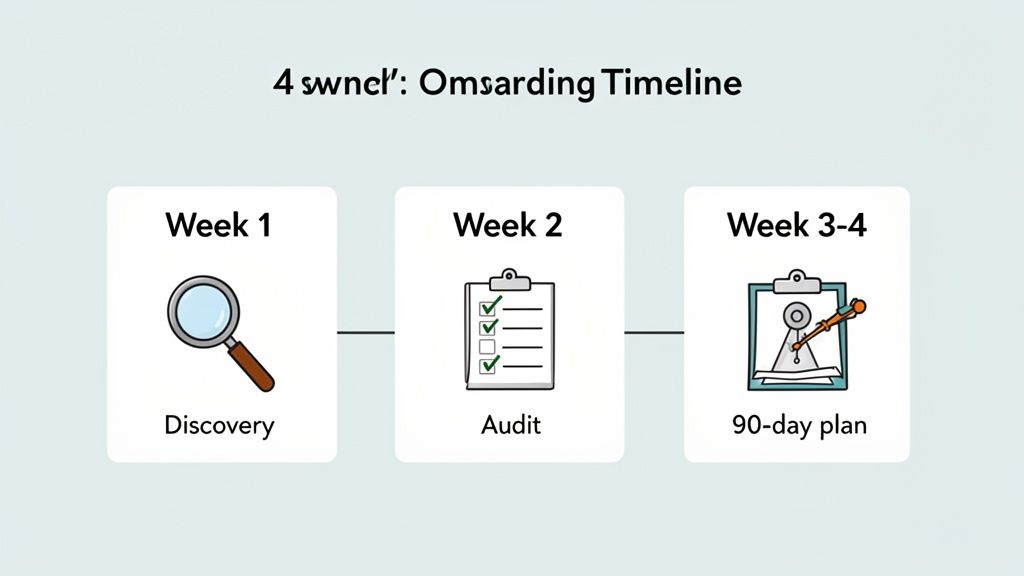
The First Week: Deep Dive and Immersion
The first week is all about discovery. Your consultant’s main job is to listen and absorb everything they can about your business.
Your role here is to be an open book and a facilitator.
- Grant Unfettered Access: The moment they start, give them the keys to the kingdom. This means full access to Google Analytics, your ecommerce platform backend (like Shopify or Magento), all ad accounts, and crucial financial reports.
- Schedule Deep Dives: Block out dedicated time for them to interview you and other key players on your business model, customer journey, and historical performance.
- Make Key Introductions: Get them face-time with your leads for marketing, operations, and customer service to understand internal workflows.
Weeks Two to Four: Audit, Strategy, and the 90-Day Plan
Once your consultant has a handle on the business, their focus shifts from listening to analyzing. By week two, they should start performing audits to identify low-hanging fruit and quick wins.
The greatest value a consultant brings in the first month is a fresh perspective. They aren’t biased by "the way things have always been done" and can quickly spot inefficiencies or opportunities your team may have overlooked.
By weeks three and four, their work moves from tactical to strategic. This is when they should deliver the key asset you've been working toward: a high-impact 90-day strategic roadmap. This plan should be a direct response to the goals you set, complete with specific initiatives, measurable outcomes, and a clear timeline.
Finally, set up a communication rhythm. A weekly check-in call is a good start, but also agree on a tool for day-to-day questions, like a shared Slack channel. Most importantly, give your ecommerce business consultant the autonomy to do what you hired them for.
Frequently Asked Questions About Hiring a Consultant
Bringing in a consultant is a big move, and it’s smart to have questions. Here are some of the most common questions we hear from founders.
What Is the Typical Cost of a Fractional Ecommerce Consultant?
The cost for a top-tier fractional ecommerce consultant will vary, but most work on a monthly retainer. For senior-level strategic guidance, you can expect to invest somewhere between $5,000 to $15,000 per month. This fee typically gets you 10 to 20 hours of their focused expertise each week, delivering high-impact leadership for a fraction of a full-time executive salary.
How Do I Ensure a Consultant Understands My Brand's Unique Challenges?
A great consultant starts by acting more like a detective than a doctor. They should kick things off with a deep discovery phase, asking sharp, insightful questions about your business model, customer data, and past hurdles. If they're more interested in pitching a pre-packaged solution than understanding your specific problem, they aren't the right fit.
The most effective consultants act like detectives before they act like doctors. They gather all the evidence—your analytics, customer feedback, and team insights—to form a complete picture before they ever suggest a course of action.
Should I Hire a Consultant or a Marketing Agency?
This is a critical distinction. The right answer boils down to one question: do you need strategy or execution?
- An ecommerce business consultant is a strategic leader. You hire them to build your growth engine, set the high-level direction, and answer the "what" and "why."
- A marketing agency is an execution team. You hire them to handle the "how"—running your Google Ads, managing social media, or executing email campaigns.
If you have a solid strategy but just need more hands on deck, an agency is a great fit. But if you’re staring at a wall, unsure of what to do next or how to scale, you need a consultant.
How Long Should a Typical Consultant Engagement Last?
There’s no one-size-fits-all answer, but a 3-6 month engagement is a very common and effective starting point. It's enough time for the consultant to understand the business, implement meaningful changes, and start delivering measurable results. Often, these initial projects evolve into longer, value-driven partnerships as new growth opportunities are uncovered.
Finding the right senior-level expertise is one of the biggest challenges for growing companies. At Shiny, we specialize in connecting businesses like yours with a curated network of over 3,000 vetted fractional executives. These leaders can provide the strategic firepower you need without the cost and commitment of a full-time hire. If you're ready to break through your growth ceiling, exploring our services is the perfect next step.