
Eight Principles of Design for Startup Growth
Your startup has capable people, a promising product, and more ideas than the team can realistically execute. Yet progress keeps slowing because priorities are unclear, ownership overlaps, departments operate from different assumptions, and customers experience a different brand or workflow at every touchpoint. The problem often isn't a lack of talent. It's a lack of structure.
The eight principles of design, balance, contrast, emphasis, movement, pattern, proportion, repetition, and unity, provide a practical way to diagnose that structure. Designers use them to organize visual elements. Startup leaders can use them to organize decisions across product, UX, branding, marketing, finance, sales, and operations.
The list isn't a single historical doctrine. Contemporary design education commonly groups these eight ideas together, while other references substitute concepts such as hierarchy, alignment, white space, color, rhythm, or proximity. That variation makes the framework more useful, not less. You can select the principles that fit your medium, stage, and business problem.
Each principle below includes a definition, a startup scenario, trade-offs, and actions a fractional executive can put into a four-week implementation plan. Fractional leadership gives a company experienced guidance for a specific gap without requiring a full-time executive structure. That flexibility can help a founder add senior direction while keeping the organization appropriately sized.
1. Balance Creates Stability and Harmony in Leadership Structure
In visual design, balance distributes visual weight so a composition feels stable. The elements don't need to mirror each other perfectly. A large, dark shape can balance several smaller, lighter elements if the overall arrangement feels deliberate.
Leadership needs the same discipline. A founder who owns product, sales approvals, hiring, customer escalations, and financial decisions becomes the organizational equivalent of an overloaded page. Work may continue, but every major decision waits for one person.
A balanced structure distributes responsibility without creating ambiguity. A SaaS startup might use a fractional CMO for brand strategy while a fractional VP Sales leads revenue development. A FinTech company might separate strategic financial planning under a fractional CFO from operational accuracy under a fractional Controller. The exact arrangement should follow the company's gaps, not a standard org chart.
Organizational design helps founders examine how responsibilities, authority, and workflows fit together rather than treating each hire as an isolated decision.
Where balance can fail
Too little balance creates bottlenecks, burnout, and single points of failure. Too much balance can produce unnecessary layers, duplicated authority, or slow decisions because every function expects equal attention.
The practical question is whether each critical function has an owner, a decision boundary, and a reliable handoff.
Practical rule: Balance authority around decisions, not just titles. Every leader should know what they own, what they influence, and when they must involve someone else.
A fractional executive can establish this within four weeks by:
- Mapping functions: List product, growth, sales, finance, people, and operations responsibilities.
- Finding bottlenecks: Mark decisions that repeatedly return to the founder.
- Defining handoffs: Document how part-time leaders share context, decisions, and follow-up work.
- Reviewing the structure: Revisit the arrangement as priorities and company demands change.

2. Contrast Highlights Critical Functions and Decision Points
Contrast places different elements beside one another so their differences become clear. A headline contrasts with body text. A primary button contrasts with a secondary action. Without contrast, users struggle to tell what matters.
Startups also need visible differences between strategic and tactical work, urgent and routine decisions, and decision makers and implementers. If every task receives the same priority, the team can't tell where senior attention belongs.
Consider an AI startup that gives a fractional VP Engineering responsibility for product development while a fractional Operations Manager handles HR and logistics. The distinction tells the team where technical judgment is central and where operational support keeps the company functioning. A manufacturing business might give greater leadership attention to sales while using a smaller advisory role for HR because its immediate growth constraint is market demand.
Contrast shouldn't become disrespect for less prominent functions. Finance, people, compliance, and operations may receive less executive bandwidth at one stage while remaining essential to responsible growth.
Make investment logic visible
Founders often know which function matters most but fail to explain the reasoning. Team members then interpret uneven investment as favoritism or neglect. A clear contrast between business-critical work and supporting work makes resource decisions easier to understand.
Use questions such as:
- Name the priorities: Which functions most directly affect revenue, product quality, or customer trust?
- Match attention to impact: Give more executive time to the areas with the greatest current consequence.
- Clarify role differences: Separate strategy ownership from task execution.
- Reassess the hierarchy: A function that matters less during an early phase may become central during scale.
A fractional executive can turn this into a four-week exercise by interviewing functional owners, ranking constraints, documenting decision rights, and presenting the allocation logic to stakeholders. The trade-off is straightforward. Strong contrast creates focus, but excessive separation can create silos. Leaders must distinguish roles while keeping the company connected.

3. Emphasis Directs Attention to Strategic Priorities
Emphasis creates a focal point. In a product interface, it might make the main action more prominent than supporting options. In branding, it might direct attention to the central promise. In leadership, emphasis determines where the company spends its best attention.
A professional services firm focused on growth may place a fractional VP Business Development at the center of its leadership agenda while retaining a fractional CFO for financial oversight. A HealthTech company entering a regulated market may give concurrent attention to regulatory affairs and product development because both capabilities support market entry.
The mistake is treating every initiative as equally strategic. If the leadership team has ten top priorities, employees receive a long task list without a clear signal about what deserves trade-offs.
Convert emphasis into operating choices
Write the priority in language people can use to make decisions. “Improve growth” is broad. “Build a repeatable partner-led pipeline” gives marketing, sales, and operations a shared direction. The chosen emphasis should appear in meeting agendas, resource allocation, hiring decisions, and product discussions.
A fractional leader can create a practical emphasis system by:
- Selecting the focus: Define the most important business outcomes for the next planning period.
- Connecting expertise: Choose executive support that directly addresses those outcomes.
- Removing distractions: Identify projects that compete with the central priority.
- Scheduling review points: Revisit the focus when market conditions, customer needs, or company capacity changes.
Emphasis has a clear trade-off. A strong focal point improves alignment, but overemphasis can cause a team to ignore foundational risks. A growth push without operational readiness can create customer problems. A product push without commercial learning can delay revenue. The executive's role is to keep the primary priority visible while ensuring supporting functions remain healthy.
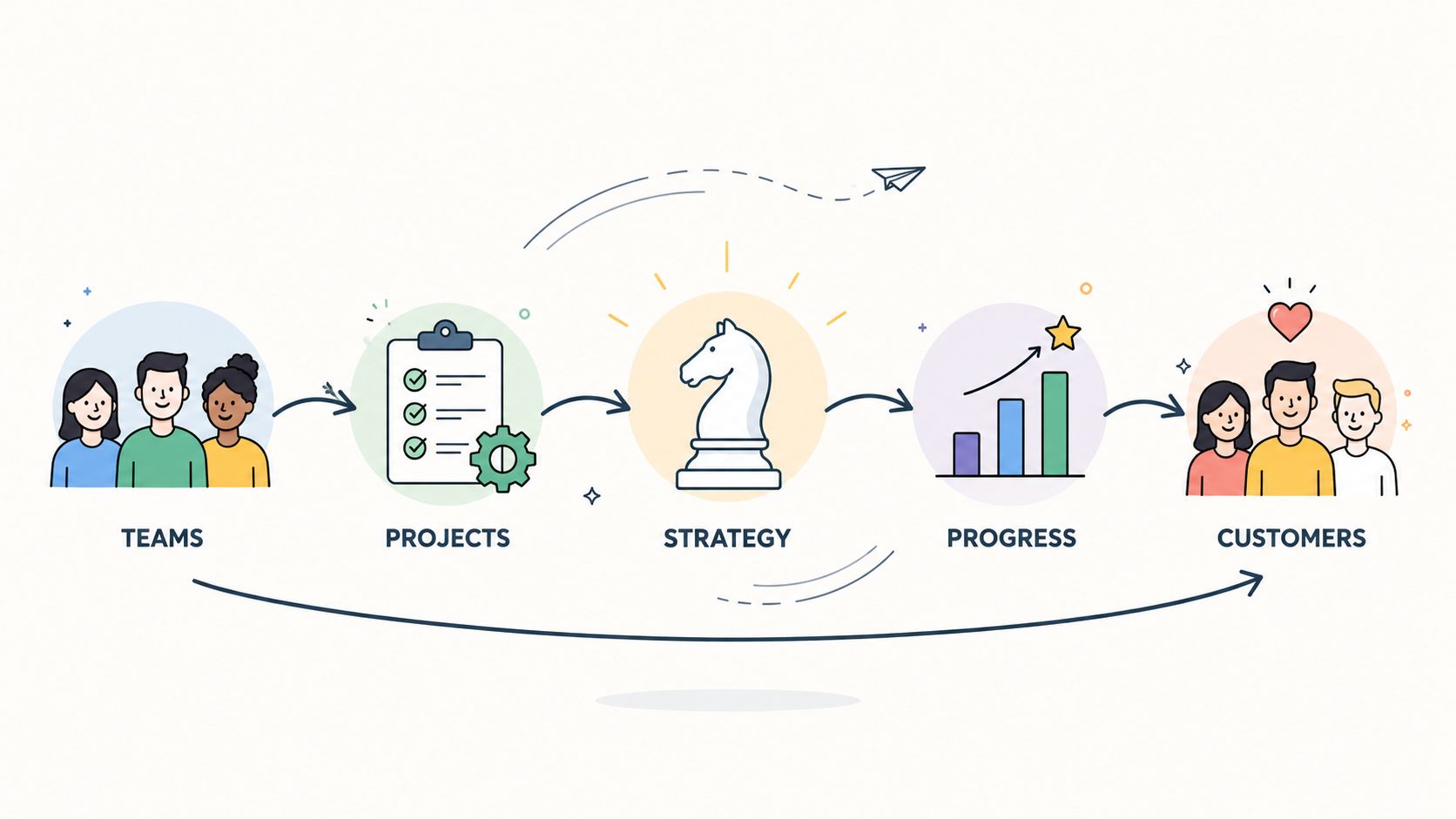
4. Movement Creates Flow and Momentum in Organizational Change
In a composition, movement guides the eye through a deliberate path. In a digital product, sequencing, navigation, and motion can show users what happens next. In a startup, movement describes how information, decisions, feedback, and initiatives travel through the organization.
A SaaS company may bring in a fractional VP Revenue Operations to connect marketing, sales, and customer success. That leader can clarify how a prospect moves through the funnel, where ownership changes, and which feedback returns to product. An ecommerce brand might use a fractional Chief of Staff to coordinate product, supply chain, and marketing around launches and seasonal campaigns.
The goal isn't activity for its own sake. Movement means work advances with fewer stalled approvals, missing handoffs, and repeated conversations.
Find the friction in the flow
Start with one important workflow, such as launching a feature, converting a qualified lead, resolving a customer issue, or approving a purchase. Draw each step, name the owner, and mark where information disappears or decisions wait. This process often reveals that the bottleneck isn't a person. It's an unclear sequence.
A fractional executive can improve movement by:
- Mapping decisions: Show who proposes, approves, executes, and reviews each major action.
- Bridging silos: Create shared rituals between teams that depend on one another.
- Making progress visible: Use a project management system to show status, blockers, and ownership.
- Creating cadence: Hold weekly or biweekly meetings only when they move decisions forward.
For a broader operating approach, founders can use these ideas alongside practical change management best practices. The trade-off is that faster movement can expose weak judgment. Speed without guardrails produces rework, so the executive should pair momentum with explicit approval limits and feedback loops.

5. Pattern Builds Systems and Consistency in Leadership
Pattern uses structured repetition to create predictability. In product design, repeated card layouts, navigation structures, or interaction conventions help users understand what to expect. In operations, patterns take the form of recurring meetings, decision frameworks, reporting cycles, and playbooks.
A manufacturing company could establish monthly business reviews led by a fractional COO, with department heads presenting performance against agreed targets. A professional services firm might use a fractional VP PMO to standardize project delivery, risk reviews, staffing decisions, and client handoffs.
Patterns reduce the need to reinvent basic management practices. They also make problems easier to spot because the team reviews comparable information in a consistent format.
Build patterns that support judgment
A pattern shouldn't become a ritual that survives after its purpose disappears. A weekly meeting without decisions, a dashboard no one uses, or a review that produces no action creates administrative weight rather than operating strength.
A fractional executive can build useful patterns by documenting:
- Recurring decisions: Record how the team evaluates pricing, hiring, launches, and customer exceptions.
- Core meetings: Define the purpose, participants, preparation, and expected output.
- Reporting standards: Use consistent definitions for performance, risk, and progress.
- Exception handling: Explain when a team can depart from the normal process and who reviews the exception.
Pattern and repetition overlap, but they aren't identical. Pattern creates a system of related structures. Repetition reinforces a specific behavior or model. The distinction helps leaders decide whether they need a new operating framework or just better consistency within an existing one.
The four-week implementation can begin with an audit of existing routines, followed by a redesign of one management cycle, a documented playbook, and a review with the people who use it. Keep the pattern light enough for the current stage. A startup needs dependable coordination, not bureaucracy designed for a much larger company.
6. Proportion Right-Sizes Resources and Executive Investment
Proportion describes the relationship between elements and the whole. A product page feels confusing when a minor feature receives more visual space than the primary action. A startup encounters the same problem when leadership capacity is heavily concentrated in one department while the company's constraints sit elsewhere.
A company that dedicates nearly all senior attention to product while sales remains founder-dependent may have a product capability issue, but it may also have a proportion problem. Another business might overbuild internal operations before demand justifies that investment. The right allocation depends on the business model, stage, risk profile, and immediate constraint.
Allocate attention, not just headcount
A fractional executive makes proportion adjustable. Instead of committing immediately to a permanent structure, the company can add experienced leadership where the need is concentrated, observe the operating effect, and refine the arrangement.
Use a simple review:
- Compare needs: List the decisions that currently consume founder and team capacity.
- Trace value: Identify which functions influence revenue, product quality, customer retention, compliance, or resilience.
- Expose neglected work: Look for areas that receive little attention because no senior owner exists.
- Adjust deliberately: Shift leadership time as the company's priorities and constraints change.
A startup might need product leadership during one phase, commercial leadership during another, and stronger operations after demand becomes more complex. Proportion doesn't mean every function receives equal investment. It means the investment reflects the company's actual situation.
The trade-off is measurement. Founders shouldn't reduce executive work to a simplistic return calculation because some roles prevent risk rather than produce immediate revenue. A fractional CFO, compliance leader, or people executive may create value through better decisions, stronger controls, and reduced exposure. Evaluate the role against the problem it was hired to solve.
Fractional hiring allows leaders to fine-tune this balance without locking the company into a full-time executive structure before the need is clear.
7. Repetition Scales Through Consistent Execution Models
Repetition reinforces important elements until people recognize and use them naturally. In business, it turns a successful but informal behavior into a model that multiple people can follow.
A SaaS company with a fractional VP Sales might document a sales process from qualification through discovery, proposal, and close. An ecommerce brand might create campaign playbooks covering launch timing, creative briefs, channel responsibilities, and performance reviews. These systems help teams deliver consistently without requiring the original founder or executive to explain every step.
Repetition isn't about making every situation identical. It's about preserving the parts that work while leaving room for informed adaptation.
Turn tribal knowledge into teachable work
Many startups have strong execution hidden in conversations, personal habits, and one person's memory. That knowledge becomes a risk when the company adds employees, enters a new market, or operates across functions.
A fractional executive can help the team:
- Capture successful workflows: Document the actions, decisions, and quality standards behind recent wins.
- Create job aids: Turn complex processes into templates, scripts, briefs, or review prompts.
- Train through practice: Let team members use the model on live work and identify gaps.
- Review quality: Check whether repetition preserves outcomes or merely increases activity.
Repetition can become harmful when the team follows an outdated process without questioning its assumptions. A sales playbook may need revision when the buyer changes. A product discovery process may need adaptation when the company enters a regulated segment. Build review points into every playbook so the system can learn.
The strongest fractional leaders don't impose their old operating model. They help the startup identify what already works, make it visible, and improve it without stripping away the context that made it effective.
8. Unity Creates Alignment and Cohesive Organizational Culture
Unity means that separate elements work together as a coherent whole. In a brand, the voice, visual identity, product experience, and customer communication should feel related. In a startup, product, marketing, sales, operations, and people practices should support a shared direction.
A FinTech startup might align a fractional Chief People Officer, fractional VP Marketing, and fractional VP Product around the same quarterly objectives. A manufacturing company might connect its fractional VP Operations with its fractional VP Sales so production capacity reflects pipeline expectations and customer commitments.
Unity doesn't require identical opinions. It requires shared priorities, compatible decisions, and a clear way to resolve conflicts.
Integrate fractional leaders into the team
A fractional executive should not operate as a remote specialist who delivers recommendations and disappears. The leader needs access to context, relationships with full-time staff, and a clear understanding of the company's values. The team also needs to know how this person participates in decisions.
Founders can support unity by:
- Using shared objectives: Give fractional and permanent leaders common outcomes rather than disconnected departmental targets.
- Showing the work: Invite fractional executives to appropriate all-hands and cross-functional meetings.
- Building joint teams: Pair experienced fractional leaders with internal owners who will carry the work forward.
- Onboarding for culture: Explain how the company communicates, decides, handles disagreement, and serves customers.
A practical company culture approach should connect stated values to daily behavior. Otherwise, unity remains a slogan while teams optimize for competing goals.
The trade-off is constructive tension. Too much unity can discourage dissent and make a company slow to notice problems. Preserve a common mission while encouraging leaders to challenge assumptions, surface risks, and propose better options.
8-Point Leadership Design Comparison
| Principle | Implementation Complexity 🔄 | Resource Requirements ⚡ | Expected Outcomes 📊 | Ideal Use Cases 💡 | Key Advantages ⭐ |
|---|---|---|---|---|---|
| Balance: Creating Stability and Harmony in Leadership Structure | Medium 🔄, needs role mapping and coordination | Medium ⚡, multiple fractional roles, ongoing communication | Stable leadership, fewer bottlenecks, scalable structure 📊 | Startups avoiding executive single points of failure; growth phases | ⭐⭐⭐⭐, Resilience, even workload, scalable without big hires |
| Contrast: Highlighting Critical Functions and Decision Points | Medium-High 🔄, requires clear role differentiation | Variable ⚡, concentrate hours on high-impact roles | Clear priorities, faster decisions, measurable focus 📊 | When product or go‑to‑market focus must be prioritized | ⭐⭐⭐⭐, Clarity of focus; optimizes fractional allocation |
| Emphasis: Directing Attention to Strategic Priorities | Low-Medium 🔄, identify top priorities and align resources | Targeted ⚡, concentrated exec hours on key areas | Accelerated progress on strategic goals; visible momentum 📊 | Growth or scaling phases needing targeted leadership investment | ⭐⭐⭐⭐, Rapid impact on chosen priorities |
| Movement: Creating Flow and Momentum in Organizational Change | Medium 🔄, design of communication and handoffs | Medium ⚡, coordination roles, regular syncs | Faster execution, smoother handoffs, reduced rework 📊 | Product launches, cross‑functional initiatives, rapid scaling | ⭐⭐⭐⭐, Improves flow and execution velocity |
| Pattern: Building Systems and Consistency in Leadership | Medium-High 🔄, systems and playbooks need design | Upfront investment ⚡, time to document and train | Predictable delivery, lower decision fatigue, consistent quality 📊 | Scaling operations, repeatable services or project delivery | ⭐⭐⭐⭐⭐, Consistency and scalable quality across teams |
| Proportion: Right-Sizing Resources and Executive Investment | High 🔄, needs data-driven benchmarking and analysis | Optimized ⚡, right-sized hours across functions | Better ROI, aligned leadership to stage and revenue targets 📊 | Budget‑conscious startups; stage‑specific resource planning | ⭐⭐⭐⭐, Efficient allocation of leadership investment |
| Repetition: Scaling Through Consistent Execution Models | Medium 🔄, codify successes into repeatable playbooks | Moderate ⚡, training and documentation effort | Scalable replication of wins; faster onboarding and growth 📊 | Rapid expansion, hiring ramp, repeatable GTM or delivery models | ⭐⭐⭐⭐⭐, Enables scale without dependence on individuals |
| Unity: Creating Alignment and Cohesive Organizational Culture | Medium 🔄, ongoing communication and cultural work | Continuous ⚡, onboarding, OKRs, cross‑functional rituals | Aligned teams, higher engagement, coherent customer experience 📊 | Teams balancing full‑time and fractional leaders; culture building | ⭐⭐⭐⭐, Reduces silos; improves retention and alignment |
Turn Design Principles Into a Four-Week Leadership Plan
The eight principles work best as a decision framework, not a poster on the office wall. You don't need to apply every idea at once. Choose one measurable business problem, such as stalled sales decisions, inconsistent product launches, unclear ownership, weak forecasting, or a founder bottleneck, then use the principles to organize a focused intervention.
A fractional executive can translate that diagnosis into a plan that fits the company's current capacity. The work should create operating clarity and leave the internal team stronger, not dependent on an outside leader for every decision.
Week one diagnoses imbalance and bottlenecks
Begin with balance and movement. Interview the founder, functional leads, and people closest to the customer or workflow. Map who owns major decisions, where work waits, which handoffs fail, and which responsibilities still depend on one person.
Review a real workflow rather than relying only on an org chart. Follow a feature request, sales opportunity, customer escalation, or financial forecast from beginning to end. Record the decisions, missing information, duplicated work, and points where ownership becomes unclear.
The output should be a short problem statement and a current-state map. For example, “Product launches wait for founder approval because marketing, engineering, and customer success have no shared readiness process” gives the executive a more useful starting point than “we need better alignment.”
Week two identifies priority and bandwidth
Use contrast, emphasis, and proportion to decide what deserves senior attention first. Separate the business-critical constraint from work that can remain with existing managers. Then define the executive responsibility, decision rights, expected availability, and relationship with internal owners.
Fractional leadership is useful here because the company can address a specific gap without immediately constructing a full-time C-suite. The broader market has moved beyond a niche model. A 2026 market report estimated the global fractional executive market at $5.7 billion in 2025 and reported 14% annual growth. The same report said the active professional base grew from 60,000 in 2022 to 120,000 in 2024. Those figures are reported in the fractional work market report.
Executive hiring also carries meaningful financial and execution risk. One source cites recruitment costs of about $28,000 per executive hire before salary, while another says replacing an executive can cost up to 213% of annual salary once direct and indirect losses are included, as outlined in this analysis of the hidden cost of executive hiring. These figures don't make a fractional arrangement automatically right, but they explain why right-sizing deserves careful consideration.
Week three establishes operating patterns
Use pattern and repetition to make the intervention repeatable. Create a meeting cadence, decision log, reporting format, launch checklist, sales playbook, or cross-functional review that directly addresses the selected problem.
Keep the system visible in the tools the team already uses. A decision log in a shared workspace is more useful than a document no one opens. A launch checklist should name owners and approval points. A sales playbook should show how a representative applies the process to a real opportunity.
Measure both execution and experience. Usability research treats performance and satisfaction as related but distinct metrics, so teams should assess whether people complete the intended work and how confidently or easily they experience the process. The design principles and usability reference explains why task performance and user sentiment shouldn't be treated as substitutes. For internal operations, that means reviewing completed tasks alongside team feedback.
User-centric practices also connect to satisfaction. One cited survey found that over 80% of respondents reported positive effects on user satisfaction when their organizations applied user-centric practices, with a statistically significant relationship between adoption and satisfaction measures in the survey on user-centric design. Apply the lesson carefully. A process isn't successful merely because it exists. The people who use it should be able to complete their work and understand why it helps.
Week four creates unity and ownership
Finish by aligning the team around shared outcomes, responsibilities, and review points. The fractional executive should present the new operating model with the internal leaders who will maintain it. Clarify what changes, what stays the same, and how the team will raise exceptions.
Choose a small set of signals for the selected problem. A sales intervention might examine pipeline movement and decision delays. A product intervention might review launch readiness and customer feedback. An operations intervention might track unresolved handoffs and forecast reliability. Don't create an oversized dashboard that recreates the original lack of emphasis.
The framework's history supports this flexible approach. The phrase eight principles of design is a modern synthesis, not one fixed historical doctrine. Contemporary sources commonly name balance, contrast, emphasis, movement, proportion, repetition, white space, and unity, while other educational references use closely related terms and lists. A history and overview of design principles connects these ideas to long-running practices in classical Greek and Roman architecture, Renaissance art, and later design movements. Another discussion of the eight principles across media emphasizes that digital products increasingly adapt movement into animation and motion design.
That variation is the final leadership lesson. Don't memorize a universal list and force it onto every startup. Select the principles that clarify the problem, bring in the right expertise, and create a four-week plan the team can sustain. If your company needs senior direction in sales, marketing, finance, product, operations, or people leadership, explore Shiny's fractional executive marketplace or schedule a consultation to find an experienced leader suited to your stage and immediate priorities.
Shiny connects startups with experienced fractional executives who can contribute 5 to 25 hours a week across functions such as sales, marketing, finance, product, and operations. Visit Shiny to explore flexible executive support and find a leader who can turn your most urgent design and operating principles into practical action.