

Unlock Growth with Fractional Executive Services
The Strategic Advantage of Fractional Executive Services

Fractional executive services are changing the way businesses think about leadership. Instead of relying exclusively on traditional, full-time executives, companies are increasingly utilizing fractional executives to gain a competitive advantage. This provides access to high-level expertise on a flexible, part-time basis, giving businesses C-suite experience without the hefty price tag. This model is especially appealing to startups and growing businesses that need experienced guidance but aren’t ready to commit to a full-time executive.
Understanding the Fractional Executive Model
A fractional executive is a seasoned professional who typically works with several clients. They provide specialized expertise for a fraction of the cost and time commitment of a full-time hire. This model offers several key benefits.
Businesses can adjust their leadership resources as needed, aligning support with project requirements or growth phases. Fractional executives also bring a breadth of experience from various industries, offering new perspectives and solutions.
This approach differs from hiring interim executives or consultants. Interim executives usually fill a temporary vacancy, while fractional executives work alongside existing leadership for ongoing strategic support. Consultants, conversely, concentrate on specific projects and deliverables. Fractional executives often take on broader operational roles.
The Rise of Fractional Leadership
The growing popularity of fractional executive services is more than a passing fad. Demand for fractional executives has seen impressive growth, with a nearly 20% increase year over year. This rise is largely due to small and mid-sized companies seeking flexible, on-demand executive talent.
This shift highlights the growing recognition of fractional executives as valuable assets. They help businesses access expert leadership without the financial strain of a full-time executive team. The evolution of these services is closely linked to the increasing importance of using data for strategic decision-making and experienced executives to put those strategies into action. You might also be interested in this article: How to master fractional executive services.
Why Choose Fractional Executives?
Several factors contribute to the strategic advantages offered by fractional executive services:
- Cost-Effectiveness: Businesses reduce overhead by paying only for the expertise and time needed.
- Flexibility: Companies can easily scale leadership resources up or down to meet evolving business requirements.
- Specialized Expertise: Gain access to a broader range of skills and experience than possible with a single full-time hire.
- Objective Perspective: Benefit from unbiased insights and strategic guidance from an external expert.
- Faster Time to Value: Seasoned fractional executives integrate quickly and make immediate contributions to your organization.
By embracing fractional leadership, businesses can achieve strategic goals more efficiently and effectively. This model provides a valuable tool for navigating today’s business environment and setting organizations up for lasting success.
High-Impact Fractional Roles Transforming Businesses
Fractional executive services offer a diverse range of expertise to address various business needs. This flexible model allows companies to access specialized C-suite level talent without the commitment of a full-time hire. For example, a rapidly scaling startup might engage a Fractional CMO to develop and execute a go-to-market strategy, while a company undergoing restructuring could benefit from the guidance of a Fractional COO to optimize operations.
Key Fractional Roles and Their Impact
Several key fractional roles are driving significant impact across businesses:
- Fractional CFO: Provides financial leadership, manages cash flow, secures funding, and develops financial strategies. You might be interested in: How a Fractional CFO can benefit startups.
- Fractional CMO: Develops and implements marketing strategies, builds brand awareness, and drives revenue growth.
- Fractional COO: Streamlines operations, improves efficiency, and manages day-to-day business activities.
- Fractional CIO: Oversees technology strategy, manages IT infrastructure, and ensures data security.
- Fractional CHRO: Develops and executes HR strategies, manages talent acquisition and retention, and fosters a positive work environment.
Each of these roles brings a wealth of experience and expertise, allowing companies to address specific challenges and achieve their business objectives more effectively.
Measuring the ROI of Fractional Executives
The infographic below visualizes a comparison of three key metrics – cost savings, time saved, and revenue growth – for fractional versus full-time executives.
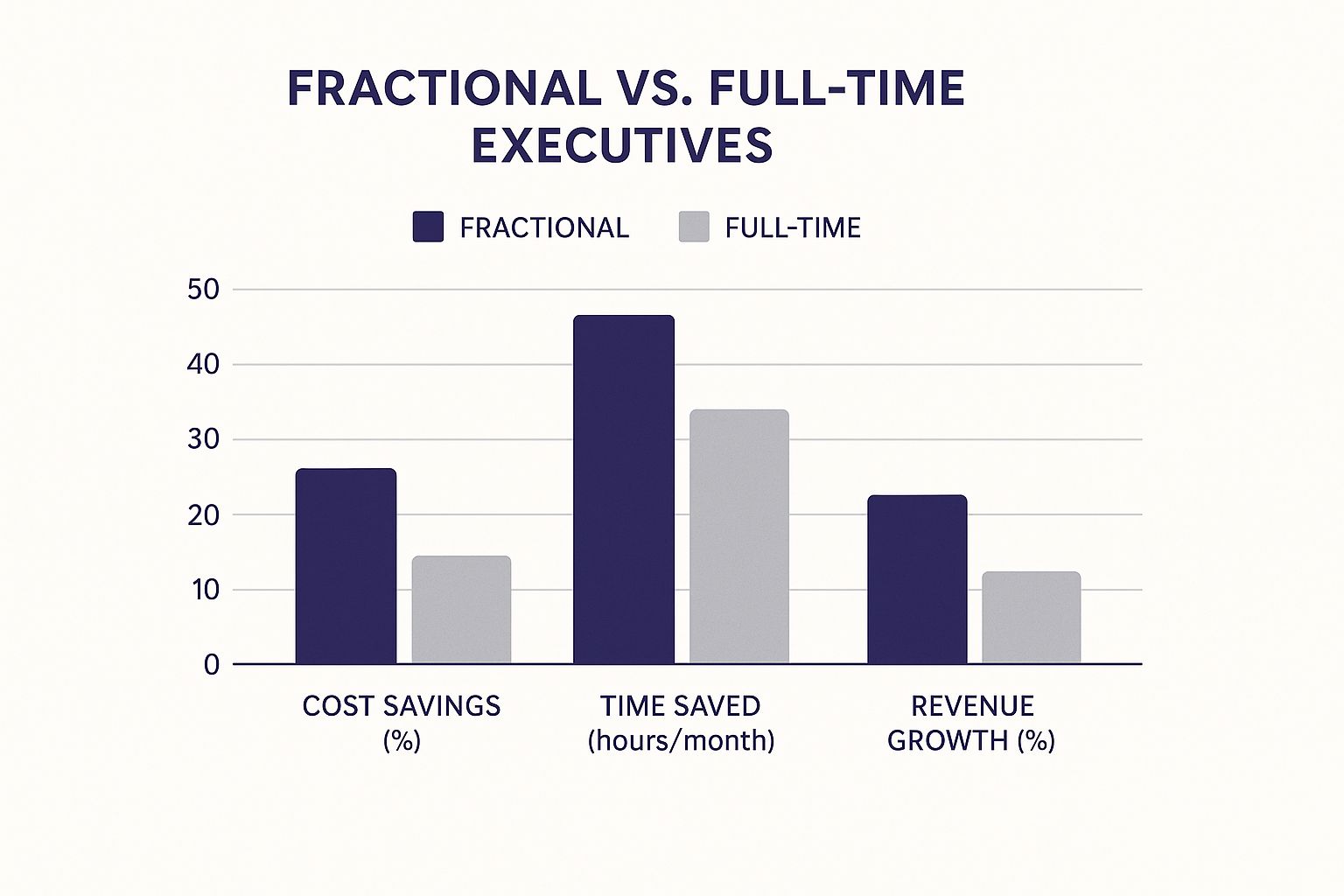
As illustrated, fractional executives offer significant cost savings, free up valuable time for internal teams, and can contribute significantly to revenue growth. This data clearly demonstrates the financial benefits of engaging fractional leadership.
Additionally, fractional executives work across various functional roles, with significant concentrations in finance, marketing, and operations. For instance, about 25% of fractional executives are focused on finance, particularly as Fractional CFOs, providing financial leadership. Marketing follows closely, with about 20% serving as Fractional CMOs. Operations, with around 15%, also plays a crucial role.
To further illustrate the strategic impact of these roles, let’s examine the following table:
The table below, “Strategic Fractional Executive Roles and Their Business Impact,” highlights the most valuable fractional executive positions, their strategic contributions, and the business scenarios where they deliver exceptional ROI.
| Executive Role | Strategic Impact Areas | Ideal Business Scenarios | Engagement Structure |
|---|---|---|---|
| Fractional CFO | Financial planning, fundraising, cash flow management | Startups seeking seed funding, companies experiencing rapid growth or financial distress | Project-based, monthly retainer, or hourly |
| Fractional CMO | Marketing strategy development, brand building, lead generation | Businesses launching new products, expanding into new markets, or needing to revitalize their brand | Project-based, monthly retainer, or hourly |
| Fractional COO | Operational efficiency, process improvement, scaling operations | Companies undergoing rapid growth, restructuring, or needing to improve efficiency | Project-based, monthly retainer, or hourly |
| Fractional CIO | Technology strategy, IT infrastructure management, cybersecurity | Businesses implementing new technologies, upgrading systems, or needing to enhance data security | Project-based, monthly retainer, or hourly |
| Fractional CHRO | Talent acquisition and retention, HR strategy, employee engagement | Companies scaling their teams, experiencing high turnover, or needing to improve company culture | Project-based, monthly retainer, or hourly |
As shown in the table, various engagement structures allow businesses to tailor the fractional executive’s involvement to their specific needs and budget.
Choosing the Right Fractional Executive for Your Business
Selecting the right fractional executive is crucial for maximizing impact. This involves identifying your organization’s specific needs and aligning them with the expertise of a potential fractional leader. Consider factors like industry experience, leadership style, and track record. This careful selection process will ensure a successful partnership and drive significant returns for your business.
Industry Leaders Leveraging Fractional Executive Talent

Fractional leadership isn’t a one-size-fits-all approach. Its effectiveness differs across various sectors. Some industries are seeing more significant changes by strategically using fractional executives. Let’s explore how these industries utilize this model to address specific hurdles and capitalize on new possibilities.
Tech Startups and Fractional Leadership
The tech startup environment is known for its rapid pace. It often demands specific skills that can be both costly and challenging to obtain with full-time hires. Fractional executives offer a valuable solution. They bring essential knowledge in crucial areas such as product development, marketing, and finance, without requiring long-term contracts.
This adaptability allows startups to respond quickly to market fluctuations and scale their operations efficiently. For instance, a startup introducing a new SaaS platform could hire a Fractional CMO to spearhead marketing initiatives and establish brand recognition.
Healthcare’s Adoption of Fractional Executives
The healthcare sector navigates complex regulatory environments and constantly shifting patient needs. Fractional executives offer valuable experience in managing these intricacies. A Fractional COO, for example, can improve operational efficiency and streamline procedures. This allows healthcare providers to prioritize delivering excellent patient care.
Other Industries Embracing Fractional Leadership
Beyond tech and healthcare, several other sectors benefit from fractional leadership. Manufacturers can use fractional expertise in supply chain management. Non-profits might hire a Fractional CFO to oversee finances and ensure compliance with grant requirements.
This flexible model empowers organizations across diverse industries to access high-level talent tailored to their unique requirements.
To understand how fractional executive services are distributed across industries, let’s take a look at the following table:
Fractional Executive Services Across Industry Sectors
This table presents data on industry adoption of fractional leadership, highlighting which sectors are gaining the most significant competitive advantages and which executive roles are driving results.
| Industry Sector | Adoption Rate (%) | High-Impact Roles | Strategic Outcomes |
|---|---|---|---|
| Marketing & Communications | 30.4 | Fractional CMO, Content Strategist | Brand building, lead generation, market penetration |
| Operations | 16 | Fractional COO, Project Manager | Efficiency improvements, cost reduction, process optimization |
| Finance | 7.6 | Fractional CFO, Controller | Financial planning, fundraising, risk management |
| Technology | 12 | Fractional CTO, Product Manager | Software development, product launch, tech strategy |
| Healthcare | 8 | Fractional COO, Compliance Officer | Regulatory compliance, operational efficiency |
| Manufacturing | 5 | Supply Chain Manager, Operations Director | Supply chain optimization, production efficiency |
| Non-profit | 4 | Fractional CFO, Grant Writer | Financial management, grant compliance, fundraising |
| Other | 17 | Varies based on need | Specialized expertise in various areas |
This data illustrates how common fractional services are in important business functions, emphasizing the model’s versatility. It also highlights potential growth areas, like research and development, where fractional leadership could offer valuable support. The current distribution of fractional executives shows a strong emphasis on marketing and communications, operations, and finance. In particular, 30.4% of fractional leadership roles are in marketing and communications, with operations and finance representing 16% and 7.6%, respectively. This reveals opportunities for growth in other functions.
Breaking Down ROI: The True Economics of Fractional Leadership
Beyond straightforward salary savings, what’s the real financial impact of fractional executive services? This model presents a transparent and often more manageable approach to leadership, particularly for startups and expanding businesses. Let’s explore the economic advantages and how they stack up against traditional executive hiring.
Cost Structures: Fractional vs. Full-Time
A major benefit of fractional executive services is cost-effectiveness. Instead of purchasing a full cable package, think of it as subscribing to a streaming service for only the shows you want. You only pay for what you use. Businesses using a fractional executive bypass the considerable expenses associated with full-time salaries, benefits, bonuses, and office space. This can result in significant savings, sometimes reaching 60% less than a full-time equivalent.
Engagement Models and Their Impact
Fractional executive services offer a range of engagement models to fit your specific requirements. These models typically include retainers for ongoing support, project-based fees for defined scopes, or even performance-based compensation. This adaptable structure empowers you to manage costs and link spending directly to business goals. A startup, for instance, might select a project-based engagement for a new product launch, while a growing company might prefer a monthly retainer for continuous strategic advice. Learn how Shiny connects you with vetted executives for flexible engagements.
Case Studies: Achieving Cost Efficiencies
Many companies have successfully reduced expenses and boosted leadership quality through fractional executive services. Consider a company experiencing stagnant growth that hired a fractional CMO for a fixed-term project. Within six months, the company achieved a 20% increase in leads and a 15% rise in sales, all while investing considerably less than hiring a full-time CMO. Such results demonstrate the potential for fractional leadership to deliver a substantial ROI.
Calculating Tangible and Intangible Returns
Assessing the ROI of fractional leadership means considering both tangible and intangible returns. Tangible returns, like direct cost savings, revenue increases, and greater market share, are easier to quantify. Intangible returns, though harder to measure precisely, offer significant value. These include access to specialized knowledge, greater strategic adaptability, and improved team morale.
Avoiding Common Pitfalls
While fractional executive services offer numerous advantages, it’s essential to be mindful of potential drawbacks. Clearly defining objectives, setting realistic expectations, and establishing clear communication are crucial for success. Furthermore, ensuring smooth integration with the existing team is vital for the fractional executive to contribute effectively. This thoughtful planning and execution can maximize the returns on your fractional leadership investment.
Seamlessly Integrating Fractional Executives Into Your Team

Successfully integrating a fractional executive is key to maximizing your return on investment. Even the most seasoned executive needs proper onboarding and integration to thrive. This section offers practical guidance on seamlessly embedding fractional leaders into your team and overall organizational structure.
Defining Clear Objectives and Expectations
First, establish clear objectives for your fractional executive. What specific goals do you aim to achieve? What key results do you anticipate?
For instance, if you’re onboarding a Fractional CMO, a clear objective could be a 20% increase in leads within the first quarter. This clarity helps both you and the executive understand the desired outcomes and track progress effectively.
Also, clearly define the scope of their role and their decision-making authority. This prevents confusion and empowers them to take action.
Establishing Effective Communication Protocols
Open and consistent communication is essential. Decide on the frequency and methods of communication.
- Will you have weekly check-in meetings?
- Will updates be shared via email or a project management platform?
Establishing these protocols early ensures everyone stays informed.
Don’t forget to create a communication strategy that includes the existing team. This keeps everyone in the loop and minimizes potential friction.
Aligning With Your Company Culture
Even though a fractional executive isn’t full-time, they still become a part of your team. So, it’s crucial they understand and align with your company culture.
Share your company values, mission, and working style. This fosters a sense of belonging and promotes collaboration. Simple gestures like inviting the fractional executive to team-building activities or introducing them to key team members can go a long way. You might be interested in: How fractional CFOs can scale with turn-key platforms.
Addressing Common Integration Challenges
Integrating any new leader, even fractional, can present challenges. Team resistance, authority conflicts, and decision-making bottlenecks can occur.
However, proactive planning and clear communication can mitigate these issues. If team members resist the new fractional leader, involve them in the onboarding process. Explain the rationale and how it benefits everyone. This transparency can build buy-in.
Addressing authority conflicts requires clearly defining roles and responsibilities upfront. Outline who is responsible for which decisions and communicate this clearly.
Decision-making bottlenecks can be avoided by establishing clear processes and timelines.
Maximizing Value From Day One
By proactively addressing these key areas, businesses can maximize the value of their fractional executives from the start. This fosters a collaborative environment where the fractional executive can contribute effectively and drive results.
Remember, successful integration leads to successful outcomes. Building strong relationships and a shared understanding of goals sets the stage for a productive partnership.
The Evolution of Fractional Executive Services
Fractional executive services are not a new idea. They represent a fluid and adaptable approach to leadership, meeting the ever-changing demands of today’s businesses. This evolution is fueled by a number of factors, including evolving technology, shifting employee preferences, and the growing need for specialized skills. Understanding these trends is key for companies looking to effectively utilize fractional leadership.
Emerging Trends Shaping Fractional Leadership
One notable trend is the rise of hybrid leadership models. These models combine fractional and traditional roles to build a more nimble and responsive leadership structure. A company, for instance, might keep a full-time CEO but bring on a fractional CFO and CMO to manage specific financial and marketing projects. This gives organizations access to specialized expertise without the long-term financial commitment of multiple full-time executive hires. For smooth integration of fractional executives, understanding strategies that improve developer experience and the overall work environment is crucial.
In addition, new fractional positions are emerging across various sectors. The increasing importance of data analytics, for example, has driven demand for Fractional Chief Data Officers (CDOs). Likewise, the growing emphasis on cybersecurity has created opportunities for Fractional Chief Information Security Officers (CISOs). These specialized fractional roles address particular business requirements and offer concentrated expertise.
The Impact of Digital Transformation
Digital transformation is also broadening the reach and impact of fractional executives. Cloud-based tools like Slack and virtual communication platforms such as Zoom enable fractional leaders to collaborate effectively with teams regardless of location. This expands the talent pool and provides companies with access to diverse viewpoints. Moreover, digital tools give fractional executives the resources needed for rapid integration and immediate contributions.
Pioneering New Approaches
Several organizations are adopting innovative leadership structures by fully embracing fractional models. Some companies are even forming entire leadership teams composed primarily of fractional executives. This approach maximizes flexibility and cost-effectiveness, enabling businesses to react quickly to market shifts and scale operations efficiently. This trend underscores the growing acceptance of fractional leadership as a practical, and often preferred, alternative to traditional executive structures.
Positioning Your Business for the Future of Fractional Leadership
How can your company take advantage of these trends? Begin by pinpointing your organization’s specific needs and challenges. Then, explore how fractional leadership can help you address these areas and achieve your strategic goals. Think about which fractional roles would provide the most value and how you can best integrate these leaders into your existing team. By recognizing and adapting to the evolving landscape of fractional executive services, your business can gain a competitive advantage and prepare for long-term success.
Ready to explore the benefits of fractional leadership for your startup? Shiny offers a network of over 650 vetted executives spanning over 40 industries, ready to assist you in scaling your business effectively. Visit Shiny today to find out more and connect with top-tier fractional talent.
