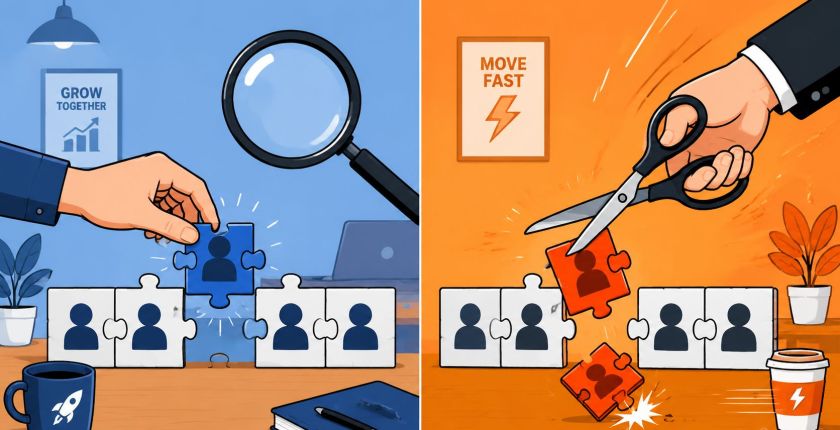
Hire Slow Fire Fast: A Startup’s Guide to Smart Hiring
A founder realizes a key role is empty only when the gap starts hurting. Sales follow-ups slip. Financial reporting gets messy. Product decisions stall because nobody owns the cross-functional work. Then the pressure sets in. You need someone now.
That's when bad hiring decisions happen.
The pattern is familiar. A startup rushes to fill a head of sales, finance lead, or operations role because the company can't keep waiting. The candidate interviews well, says the right things, and starts fast. A few weeks later, the warning signs pile up. They can't prioritize. They create confusion instead of clarity. Strong employees start working around them. By the time the founder admits it isn't working, the business has already paid the bill.
The phrase Hire Slow, Fire Fast exists for this exact problem. It's not a slogan for hard-nosed managers. It's a way to protect the company from costly decisions made under stress. But for startups, the traditional version of that advice often clashes with reality. If you have a short runway, a long executive search can create a second problem while trying to solve the first.
That tension matters. The answer isn't to abandon the principle. It's to apply it in a way that fits how startups operate.
The High Cost of a Desperate Hire
A desperate hire rarely looks desperate in the moment.
It usually looks reasonable. The company is behind plan. Investors want traction. The founder is covering too many functions. A candidate appears who has the right title on paper and enough confidence to calm the room. Everyone wants the problem to be over, so the business turns hope into a hiring decision.
A few months later, the actual cost shows up.
The person you hired hasn't built trust with the team. Priorities keep changing. Meetings multiply, but decisions don't improve. The founder starts stepping back into the role informally, which defeats the whole point of hiring in the first place. Nobody says “we made a desperate hire” out loud, but everyone feels it.
What the damage looks like in practice
The damage from a weak hire usually lands in four places at once:
- Execution slows down: Projects drift because the wrong leader creates hesitation instead of momentum.
- Good people lose confidence: Strong team members stop bringing ideas forward when they don't trust the person in charge.
- The founder gets pulled back in: Instead of delegating, the founder becomes the safety net again.
- Culture gets noisier: Misalignment creates side conversations, workarounds, and frustration.
That's why experienced operators treat hiring as risk management, not just talent acquisition.
A rushed executive hire doesn't only miss targets. It changes how the rest of the team behaves.
Founders often think the biggest risk is leaving a role open. Sometimes that's true. But an ill-fitting leader can be worse than an empty seat because they consume salary, management attention, and organizational trust at the same time.
Why this principle still matters
Hire slow fire fast is best understood as a counterweight to urgency. It forces a company to ask harder questions before making a commitment. Is this person equipped for the work ahead? Can they operate in your stage, with your constraints, and with your team?
When startups ignore those questions, they don't save time. They borrow against the future and pay interest in confusion, rework, and turnover.
What Hire Slow Fire Fast Really Means

The phrase 'hire slow fire fast' often leads to a focus on the second half. That's a mistake. The first half carries most of the value.
Hire slow means being deliberate enough to test for competence, judgment, and fit before you hand over real responsibility. Historically, the idea gained visibility through a 2000 Harvard Business Review article by Mark Adams of Vitsoe, who advocated an “absurdly selective” approach that included trial work days to identify “natural” fits.
Hire slow means structured selectivity
Slow hiring doesn't mean endless interviews or indecision. It means using a process strong enough to expose weak fits before they become expensive problems.
In practical terms, that usually means:
- Defining the role clearly: What must this person own in the next stage of the business?
- Testing real work: Don't rely on polished interview answers alone.
- Checking for stage fit: A leader who succeeds in a large company may struggle in a startup where systems are still messy.
- Looking for trust signals: How they communicate, handle ambiguity, and respond to challenge matters.
The economics behind this discipline are hard to ignore. According to data cited by the U.S. Department of Labor, the financial cost of a single bad hire is at least 30% of the employee's first-year earnings, including lost wages, recruiting expense, onboarding time, and reduced productivity.
That number still understates the mess. It doesn't fully capture the distraction, morale damage, or client-facing fallout a bad hire can create.
Fire fast means act when the evidence is clear
The second half of the phrase is often misunderstood as aggression. It should mean decisiveness, not cruelty.
If expectations are clear, support has been offered, and the person still can't perform or damages the team, waiting usually makes the situation worse. Slow firing is often disguised as kindness, but it tends to spread uncertainty to everyone around the role.
Here's the cleaner interpretation:
| Principle | What it should mean | What it should not mean |
|---|---|---|
| Hire slow | Careful vetting before commitment | Endless interviewing with no decision |
| Fire fast | Prompt action once poor fit is established | Impulsive termination with no process |
Practical rule: Move slowly before commitment. Move clearly after evidence.
The point isn't to create a harsh workplace. The point is to build a team where standards are real, roles are earned, and problems don't linger until they infect everything around them.
The Startup Dilemma Benefits Versus Reality

For startups, hire slow fire fast is both smart advice and incomplete advice.
The smart part is easy to see. Careful hiring raises the quality bar. It protects culture early, when one wrong leader can distort an entire function. It also helps founders avoid the exhausting cycle of replacing people they never should have hired in the first place.
The incomplete part is timing.
A startup with tight cash, open leadership gaps, and customers waiting doesn't always have the luxury of a traditional executive search. That's where founders start to resist the mantra, not because they disagree with the principle, but because they can't afford the classic version of it.
Why the philosophy is still attractive
The appeal of deliberate hiring is real. Mark Adams of Vitsoe helped popularize this thinking with an “absurdly selective” approach that included trial work days and a strong preference for “natural” fits. That philosophy resonates because startups feel every leadership miss more sharply than larger companies do.
When the right person joins early, several things usually improve at once:
- Decision quality gets better: Teams spend less time revisiting the same issues.
- Standards rise: A strong hire often sharpens the performance of everyone around them.
- Culture becomes easier to defend: Clear values are easier to uphold when leadership embodies them.
- Future hiring gets easier: Good leaders attract stronger people.
Where the real-world startup constraint hits
The problem is that deliberate hiring can collide with operating reality.
A founder may know the company needs a thoughtful process, but the business still has to ship product, close deals, and report numbers this quarter. If the role stays open too long, the cost shifts from hiring risk to execution risk. The company starts missing windows it can't easily get back.
That's where the mantra breaks down in practice. It asks a startup to behave like a business with time, bench depth, and hiring infrastructure. Most early-stage companies have none of those.
Startups rarely fail because they didn't believe in quality. They struggle because they had to choose between quality and momentum.
The trade-off founders actually face
The decision usually looks like this:
| Option | Upside | Downside |
|---|---|---|
| Rush the hire | Immediate coverage for a painful gap | High risk of expensive misfit |
| Wait for the perfect hire | Better long-term alignment | Slower execution in the near term |
That's why founders need a more practical operating model. The principle remains sound. The application needs to change.
How to Implement a Deliberate Hiring Process
A deliberate hiring process doesn't need to be bloated. It needs to be sharp.
The best founders I've worked with don't begin with a job description. They begin with a scorecard. They define what this person must achieve, what decisions they'll own, and what failure would look like. Without that clarity, interviews drift into personality tests and resume theater.
Start with a role scorecard
Before you post anything, write down four things:
- Outcomes: What must this person deliver in the role?
- Responsibilities: What decisions and functions will they own?
- Capabilities: What skills are essential at your stage?
- Failure flags: What behaviors or gaps would make the hire unworkable?
A startup hiring a fractional finance leader, for example, shouldn't just ask for “strategic finance experience.” It should define whether the role owns forecasting, board reporting, cash planning, lender communication, or cleanup of messy books. Precision improves interviews immediately.
Use interviews to test judgment, not charm
Many weak hires happen because founders overvalue confidence and undervalue evidence.
A good interview loop should include multiple perspectives. A founder may assess strategic range, while a functional peer tests operating depth and a cross-functional stakeholder evaluates communication. If everyone asks some version of “tell me about yourself,” you don't have a process. You have repetition.
A stronger loop often includes:
- A short screen to confirm relevance and communication basics.
- A deep operating interview focused on decisions they've made.
- A work sample or paid project tied to the role.
- A final fit discussion with key stakeholders affected by the hire.
For a more detailed breakdown of structured recruiting, this guide to startup hiring best practices is a useful companion.
Test the work in a real context
Work samples beat polished stories.
If you're hiring a sales leader, ask them to review your pipeline and present what they'd change. If you need an operations executive, give them a messy process and ask for a ninety-day stabilization plan. If the role is marketing, have them critique your funnel, messaging, or spend allocation.
Don't ask candidates whether they can do the work. Put a version of the work in front of them.
Treat references like decision inputs
Reference checks aren't a formality. They're often the only place where pattern recognition shows up clearly.
Ask references what context brought out the candidate's best work. Ask where they needed support. Ask whether they'd hire them again for the role you're filling now, not just in general. That last question tends to cut through polite praise.
A deliberate hiring process isn't slow because it adds bureaucracy. It's slower because it replaces wishful thinking with evidence.
Navigating the Fire Fast Mandate Safely and Humanely

A founder finally makes the call they should have made six weeks earlier. The hire is missing targets, creating friction, and pulling senior people into constant cleanup. By then, the problem is bigger than one person. The team has watched leadership hesitate, standards have blurred, and the exit feels more charged than it needed to be.
That is the core risk in the "fire fast" half of the phrase. The principle is right. The sloppy version is expensive.
Acting quickly after a poor fit becomes clear protects the business. Acting abruptly, without clear expectations or a fair process, creates a second problem on top of the first. It can expose the company to legal headaches, damage trust inside the team, and leave everyone guessing what standards matter.
Why careless speed backfires
Fast termination decisions usually go wrong for familiar reasons. The employee was never given a clear definition of success. Concerns were raised in scattered conversations but never documented. Similar issues were handled differently with other employees. Or leadership waited until frustration took over, then tried to compress months of missed feedback into one final conversation.
None of that is humane, and none of it is good management.
For startups, this gets harder under cash pressure. Founders often tolerate a bad fit too long because they cannot afford another failed search. Then, once the pain becomes obvious, they overcorrect and force an exit without enough structure. That pattern is one reason the traditional hire slow, fire fast advice can break down in early-stage companies. The business needs speed, but the team still deserves fairness.
Build a safe, defensible process
A better standard is straightforward. Decide quickly once the evidence is there. Be specific about why. Handle the exit with respect.
Start by naming the issue accurately. Separate a skills gap from a behavior problem, a trust issue, or a role that outgrew the person. "Not a fit" is too vague to help anyone make a sound decision.
Then document facts. Missed commitments. Repeated errors. Failed handoffs. Breakdown points tied to actual expectations. Good notes protect the company, but they also force leaders to test whether the problem is real or just emotional buildup.
Direct communication matters just as much. The employee should know where they stand before the decision is final, unless the issue involves misconduct or a clear breach of trust. If improvement is unlikely, do not stage a fake recovery plan just to make the paperwork look cleaner.
A practical protocol includes:
- Write down expectations early: goals, scope, and decision rights should be clear from the start.
- Address gaps in real time: waiting for a formal review usually makes the problem harder to fix.
- Record patterns, not impressions: specifics hold up better than broad labels.
- Prepare the exit conversation: keep it direct, respectful, and brief.
- Stabilize the team afterward: explain coverage, ownership, and what happens next.
For leaders working to keep strong people engaged after a tough exit, these talent retention best practices are useful.
Humane exits protect the people who stay
Every termination sends a message to the rest of the company.
If leadership delays obvious underperformance, strong operators start to wonder whether standards are real. If leadership handles exits carelessly, those same people start to wonder whether they are safe. Good companies avoid both outcomes. They make decisions on time, explain them clearly, and treat the departing employee with dignity through the process.
That balance matters even more in startups because every hiring mistake carries more weight. One bad executive hire can consume cash, management attention, and team trust faster than a larger company can absorb. That is also why many founders need a more practical path than the old all-or-nothing version of hire slow, fire fast. The answer is not lower standards. It is reducing the cost of getting leadership decisions wrong in the first place.
The Fractional Executive Alternative to Hiring Slow

The old hiring philosophy receives a modern fix.
The classic version of hire slow fire fast assumes you're choosing between two options. Wait for the right full-time leader, or hire quickly and accept the risk. For startups, that's often the wrong frame. There's a third option. Bring in a fractional executive who can create immediate strategic movement while you keep vetting for the longer-term fit.
That changes the equation completely.
Why fractional leadership solves the timing problem
A startup doesn't always need a full-time executive right away. It often needs senior judgment, functional leadership, and accountability at the level the business can currently support.
That's why fractional models fit so well. Fractional executives working 5 to 25 hours per week can reduce startup leadership costs by 60% to 70% compared to full-time hires, making experienced leadership more accessible for companies in the $1M to $50M annual revenue range.
This model gives founders room to breathe. You don't have to force a permanent decision just to get traction in sales, finance, operations, or marketing.
What this looks like in practice
Think of a fractional executive as a bridge with real authority, not an interim placeholder.
A company might bring in a fractional CFO to stabilize reporting, improve forecasting, and prepare for investor conversations while deciding whether the business needs a full-time CFO yet. A startup might hire a fractional VP of Sales to install pipeline discipline, coach reps, and clarify ICP strategy before making a long-term leadership commitment.
That's different from hiring a consultant who hands over a slide deck and disappears. A good fractional leader owns outcomes, works with the team, and leaves the function stronger.
The practical advantages over a rushed full-time hire
The strongest argument for fractional hiring isn't just lower cost. It's lower commitment risk paired with immediate value.
Here's the comparison founders should care about:
| Hiring path | What you gain | What you avoid |
|---|---|---|
| Full-time executive hire | Dedicated long-term leader | Harder-to-reverse commitment if fit is wrong |
| Fractional executive | Immediate expertise with flexible scope | Pressure to make a permanent bet too early |
There's also a strong operational benefit. Startups using part-time executives from vetted pools report 45% faster onboarding time and 38% lower turnover in leadership roles, because the model allows performance evaluation before a longer commitment.
That's the modern version of hiring slow. You can observe the leader in real operating conditions instead of trying to predict everything from interviews.
For founders exploring this model in more depth, this comprehensive guide to fractional hiring gives a useful framework.
The smartest startups don't always hire slower. They commit slower while still moving the business forward.
Where this model works best
Fractional leadership is especially useful when:
- A function is too important to leave unmanaged
- The business isn't ready for a full-time C-suite salary
- The founder needs senior oversight now, not after a long search
- The company wants to test role scope before locking in a permanent structure
It's also a strong fit when the business is changing quickly. A company may need one kind of executive today and a different one a year from now. Flexible leadership lets the org adapt without forcing every need into a full-time box.
The old mantra still holds. Be selective. Don't tolerate ongoing misfit. But for startups, the best way to hire slow is often to avoid making an oversized permanent hire too early.
Building Your A-Team Without the Risk
Hire slow fire fast still belongs in the founder playbook. The principle is sound because it protects team quality, culture, and operating discipline.
What's changed is the way smart companies apply it.
For startups and growth-stage businesses, the practical version isn't always a drawn-out search for a perfect full-time executive. It's often a staged commitment model. Bring in senior leadership where it's urgently needed, evaluate performance in practice, and keep your options open until the company is ready for a bigger fixed bet.
That approach is more than convenient. Startups using part-time executives from vetted pools report 45% faster onboarding time and 38% lower turnover rate for leadership roles, which is exactly what founders need when they're trying to protect momentum without lowering the bar.
The goal isn't to hire cautiously for its own sake. The goal is to build an A-team without creating avoidable damage along the way.
If you're filling a leadership gap, the question isn't whether you believe in hire slow fire fast. It's whether your hiring model lets you practice it without stalling the business.
If you need senior leadership without the cost and risk of a premature full-time hire, Shiny is worth exploring. It connects growing companies with vetted fractional executives for 5 to 25 hours a week, so you can add strategic depth, keep momentum, and make better long-term hiring decisions. If that sounds like the right fit for your stage, schedule a consultation and see what the right executive could make possible.