
How to Become a COO: Your Path to Executive Leadership
To become a Chief Operating Officer, you need a mix of sharp strategic execution, genuine empathetic leadership, and a healthy obsession with data-driven decision-making. It's a journey of mastering operational efficiency, getting your hands dirty across different departments, and proving you can turn a CEO's vision into tangible results.
This path is all about translating big-picture goals into day-to-day reality.
The Modern COO: A Strategic Partner, Not Just an Operator
Forget the old stereotype of a COO buried in spreadsheets and process maps. Today's Chief Operating Officer is the CEO's strategic partner—the architect who turns ambitious vision into something the company can actually build and measure. The role has evolved far beyond pure operational management; it’s about being the master of execution who gets the entire organization rowing in the same direction.
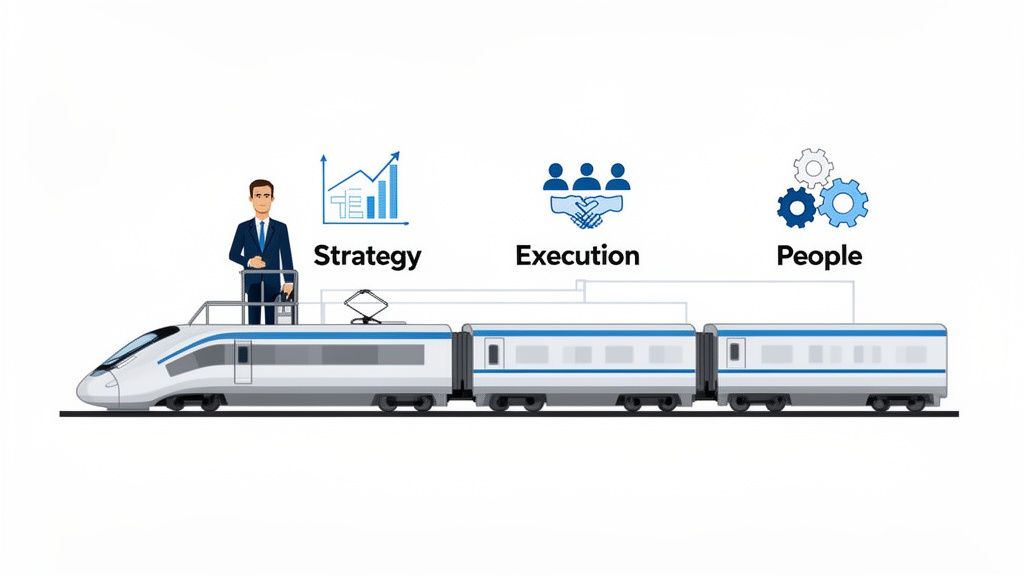
Think of the COO as the chief engineer on a high-speed train. The CEO charts the destination, but it's the COO who makes sure every car is coupled, every system is humming, and the train gets where it's going on time and on budget. That requires a ground-up, intimate understanding of the entire business.
The Three Pillars of a Modern COO
The road to the COO chair is paved with mastery of three core pillars. These aren't just buzzwords; they're the real competencies CEOs look for when hiring their second-in-command.
- Strategic Execution: This is where the rubber meets the road. It's the ability to take a lofty goal like "increase market share by 15%" and break it down into concrete, cross-departmental projects. This means allocating resources smartly, managing timelines, and clearing roadblocks before anyone even knows they exist.
- Empathetic Leadership: A great COO builds bridges, not walls. They cultivate a culture where sales, marketing, product, and finance aren't operating in silos but as one cohesive team chasing shared objectives.
- Data-Driven Decision-Making: Modern operations run on data, period. A top-tier COO uses metrics and KPIs to spot inefficiencies, anticipate challenges, and make a compelling case for strategic shifts. They speak the language of results, not just effort.
A successful COO isn't just managing processes; they're fine-tuning the entire business engine for growth and resilience. A deeper dive into the Chief Operating Officer duties and responsibilities shows just how central this role is to scaling a company effectively.
The most effective COOs are masters of context-switching. They have to be.
One minute they're diving deep into financial models with the CFO, and the next they're brainstorming a product launch with the marketing team. This versatility is their greatest asset.
To help clarify what this looks like in practice, here’s a breakdown of the key competencies that define the modern COO role.
Core Competencies of the Modern Chief Operating Officer
| Core Competency | Key Responsibilities | Required Mindset |
|---|---|---|
| Strategic Execution | Translating CEO's vision into actionable plans. Overseeing cross-functional projects. Managing resource allocation and budgets. | "How do we make this happen?"—A focus on implementation and results over pure theory. |
| Empathetic Leadership | Building alignment between departments. Fostering a collaborative culture. Mentoring department heads and high-potential leaders. | "Are we all on the same team?"—Prioritizing organizational health and shared success. |
| Data-Driven Decision-Making | Defining and tracking key performance indicators (KPIs). Using data to identify operational bottlenecks. Justifying investments and pivots with quantitative evidence. | "What does the data tell us?"—An objective, evidence-based approach to problem-solving. |
| Process Optimization | Streamlining internal workflows for efficiency. Implementing scalable systems and technologies. Driving continuous improvement initiatives. | "Is there a better way to do this?"—A relentless drive to improve how the business runs. |
Ultimately, what these competencies show is that aiming for the COO role means learning to see the entire business landscape, not just your specific functional area. It’s about building a reputation as the person who gets things done—not by command, but by fostering alignment and inspiring excellence across the board. This guide will give you the roadmap to develop these skills and navigate your career toward the C-suite.
Building Your Foundation with the Right Skills and Experience
The road to becoming a COO isn't paved with a specific degree. It’s forged by building a versatile toolkit of skills and experiences that prove you can get things done. While your education opens the first door, it’s how you apply that knowledge—turning theory into real-world results—that gets you a seat at the C-suite table.
The most valuable operations leaders are the ones who can be both analytical and inspirational.
Sure, a traditional background helps. The data shows that 65% of current COOs hold a bachelor's degree, but the trend is leaning toward advanced credentials. A significant 21% now have master's degrees, an investment that often boosts earning potential and signals a deeper business acumen that CEOs look for. You can dig into more COO demographics and salary insights from Zippia.
Mastering the Hard Skills
Hard skills are the bedrock of any effective COO. These are the measurable, technical abilities that let you take the business apart, find what’s broken, and put it back together better than before. If you're serious about this path, you need to be proficient in a few key areas.
These aren't nice-to-haves; they're non-negotiable for anyone who wants to manage the operational health of an organization.
- Financial Literacy and Modeling: You don't need to be a CFO, but you absolutely have to speak their language. That means understanding P&L statements, building budgets, and creating financial models to show the impact of operational shifts. For example, a Director of Operations who can accurately model the ROI of a new logistics software is seen as a strategic partner, not just a manager.
- Process Optimization: Frameworks like Lean and Six Sigma are your best friends here. They give you a structured way to slash waste, boost quality, and make every process more efficient and ready to scale.
- Technology Stack Management: A modern COO gets their hands dirty with the tech that powers the business—from ERPs and CRMs to the project management tools the teams use every day. Your job is to make sure these systems talk to each other and actually make people's lives easier, not harder.
Cultivating the Essential Soft Skills
If hard skills are the engine, soft skills are the oil that keeps everything from grinding to a halt. These interpersonal abilities are what separate a good manager from a true executive leader. They’re tough to measure on a resume, but they become glaringly obvious when the pressure is on.
A COO’s real influence comes from their ability to align people, not just processes.
The most effective COOs are master communicators and problem-solvers. They build consensus where there is friction and create clarity out of complexity, ensuring every department understands its role in the bigger picture.
Think of it this way: a COO without strong soft skills is like a brilliant engineer who can design a perfect engine but can't convince anyone to actually build it. To make the leap from a department head to a C-suite executive, you have to nail these critical skills.
- Persuasive Communication: This isn't just about being a smooth talker. It's the ability to articulate a vision, make a data-backed case to the board, and get your entire team fired up to tackle a project they were dreading.
- Complex Problem-Solving: COOs are the company's designated troubleshooters. You'll be handed the most tangled operational knots and be expected to unravel them with a calm, methodical approach.
- Empathetic Leadership: You can't get the best out of your people if you don't understand what drives them—or what’s holding them back. Empathetic leaders build trust and create a culture where people feel safe enough to take risks and do their best work.
Be honest with yourself about where you have gaps. For instance, if you're a wizard at process optimization but stumble when presenting to leadership, enroll in a public speaking course or actively volunteer for those presentation opportunities. This kind of proactive self-improvement shows the self-awareness and drive every great COO needs.
Navigating Your Career Path to the C-Suite
There’s no single, straight line to the COO’s office. Forget about a neat, predictable ladder. The journey is more like climbing a mountain with a dozen different trails to the summit—some are steep and technical, others are longer and more gradual, but they all demand a strategic ascent.
Successful COOs rise through the ranks of operations, finance, and even sales and marketing. The specific department matters less than the mindset you adopt along the way.
The key is to start thinking like a 'COO-in-training' long before that title is anywhere near your business card. You have to proactively hunt for cross-functional projects that drag you out of your departmental silo. It’s all about proving you can see the entire business ecosystem, not just your little corner of it.
From Individual Contributor to Department Head
Your journey probably starts here, as an individual contributor or maybe a team lead. At this stage, your mission is simple: mastery. You need to become the go-to expert in your functional area, whether that's supply chain logistics, financial planning, or software development. Your reputation is built on execution and rock-solid reliability.
But the moment you step into a manager or director role, the game changes completely. Your focus flips from doing the work to leading the people who do the work. This is where you really cut your teeth on the tough stuff—resource allocation, budget management, and team building. You're no longer just on the hook for your own output, but for the collective success of your entire department.
This is your training ground. Volunteer to lead an initiative that forces the sales and product teams to collaborate. Get your hands dirty understanding their competing priorities and finding common ground. This is a core function of any good COO.
Ascending to the Vice President Level
Making it to Vice President of Operations (or a similar VP title) is the final major stepping stone. You’re not just managing a team anymore; you’re managing managers and steering an entire business unit. Your perspective has to elevate from departmental tactics to the company's overarching business strategy.
This is where your blend of hard and soft skills is put to the ultimate test. It's not enough to be a spreadsheet wizard or a process guru. You have to inspire, negotiate, and influence across the organization.
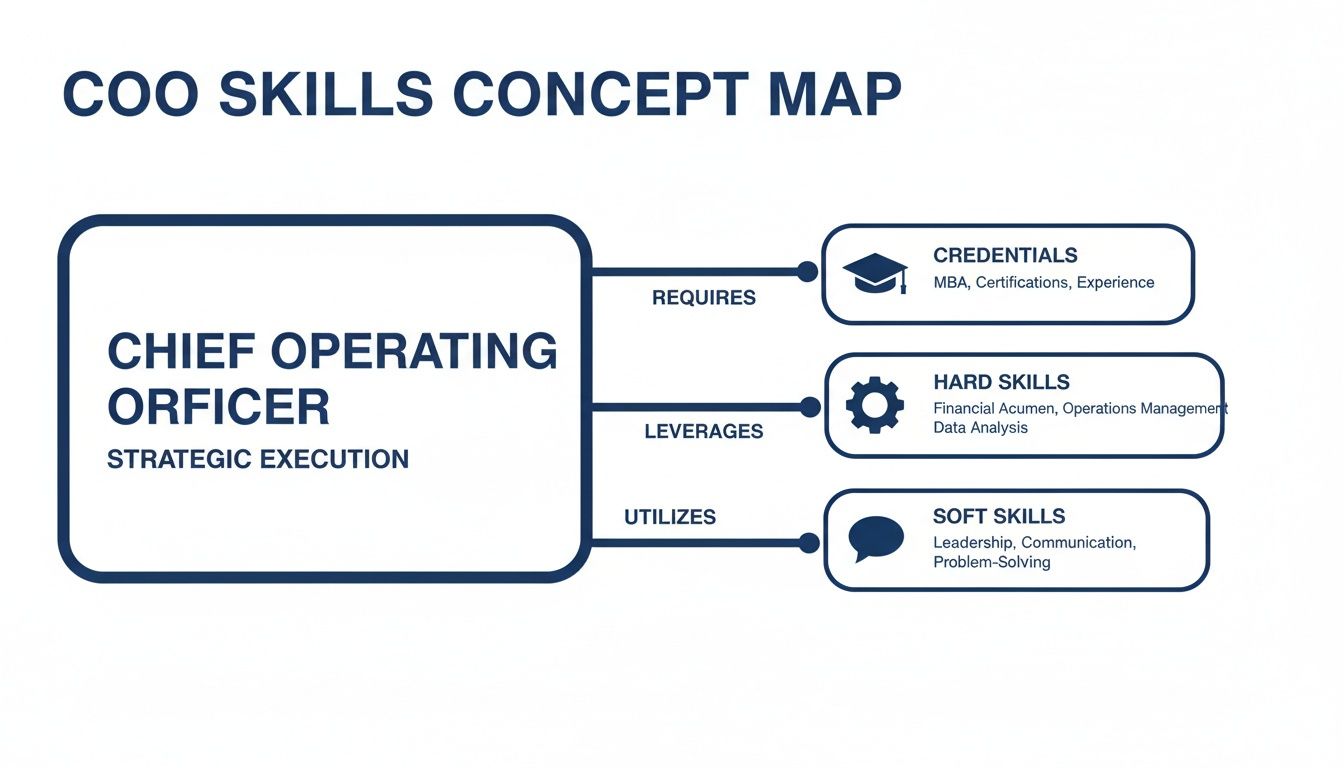
As you can see, credentials might get you in the door, but it’s the powerful combination of operational expertise and genuine leadership that defines a C-suite-ready executive. Success at the VP level means you’re constantly asking how your division moves the needle for the entire company.
The COO as the Next CEO
Here's something many aspiring COOs overlook: the role isn't just an operational endpoint. It's often a direct launchpad to the top job.
The numbers don't lie. A staggering 45.3% of CEO vacancies in large companies are filled by executives who previously served as COO. That stat alone shows you how critical operational leadership has become in succession planning. The role is also making a comeback, with the number of companies having a COO rebounding to 40% by 2022. As businesses get more complex, the need for a strong operator only grows. You can discover additional insights on COO facts from DigitalDefynd to see the full picture.
A great VP of Operations doesn't just report on what happened last quarter. They build the systems and lead the teams that will determine what happens next year. They are proactive, not reactive.
This forward-looking mindset is exactly what boards are looking for. They want leaders who can see around corners, spot opportunities to scale, and build resilient operational frameworks that don't crumble when the market gets shaky.
To truly stand out, you have to prove you can connect the dots across the entire organization.
- Financial Acumen: Get tight with the CFO. You need to intimately understand the financial impact of every operational decision and be able to build a rock-solid business case for new investments using ROI projections and risk analysis.
- Customer-Centricity: Don't hide in the back office. Spend real time with the sales and marketing teams. Understand customer pain points and see firsthand how your operational efficiency—or inefficiency—impacts their experience.
- Product and Innovation: You have to collaborate with the product and R&D folks. A deep understanding of the product lifecycle is non-negotiable, as it ensures operations can actually support new launches and scale effectively.
Every step on this path is about widening your scope of influence and deepening your business knowledge. Consistently crush your functional goals while building bridges to other departments. That’s how you build a compelling story that screams you're ready for the C-suite.
Proving Your Worth with KPIs That Get You Noticed
If you want to make the jump to COO, you need to learn the native language of the C-suite—and that language is data. CEOs and board members don't just care about what you did; they care about the impact it had. They think in terms of growth, efficiency, and return on investment.
This means generic resume bullets describing your day-to-day responsibilities just won't cut it anymore. You have to build a rock-solid business case for yourself. It’s the difference between saying you "managed inventory" and proving you "Reduced carrying costs by 18% by implementing a JIT inventory system, freeing up $1.2M in working capital." One is a task; the other is a strategic victory. This is what separates a good operator from a COO-in-waiting.
Moving Beyond Responsibilities to Results
Your entire career is a goldmine of data points. The real trick is learning how to dig them up and present them in a way that resonates with an executive team. Every single project, initiative, or process tweak you've ever led has a quantifiable outcome. Your job is to connect those actions to the bottom-line results that matter.
Think about the core operational levers you pull every day—people, processes, and technology. How has your leadership in these areas directly moved the needle on the company's financial health or strategic goals? Did you refine a workflow that cut down on customer churn? That’s a revenue metric. Did you renegotiate a vendor contract? That’s a cost-saving metric.
The most compelling candidates don't just list what they did. They prove the tangible value they created, transforming a simple responsibility into a powerful, data-backed achievement that no CEO can ignore.
KPIs by Functional Area
To get you started, let's look at how to frame your achievements with specific, hard-hitting KPIs, broken down by common functional areas. Use these as a model to rethink your own accomplishments.
-
Operations and Supply Chain: Don't just talk about daily management; highlight the efficiency gains. Instead of, "Oversaw daily logistics," try this: "Decreased average order fulfillment time by 2.5 days by redesigning warehouse workflows, boosting our on-time delivery rate to 99.2%."
-
Finance and Budgeting: Frame your work in terms of its impact on the company's financial health. Rephrase "Managed departmental budget" to something like, "Cut departmental operating expenses by 14% year-over-year—without sacrificing output—by optimizing software licenses and renegotiating key vendor contracts."
-
Team Leadership and HR: Connect your leadership skills to tangible outcomes like talent retention and productivity. "Led a team of 25" becomes, "Reduced employee turnover by 30% in 12 months by introducing a new professional development program, saving an estimated $250K in annual recruitment costs."
-
Customer Success and Support: Show how your operational improvements directly impacted the customer experience. "Handled customer escalations" can be transformed into, "Improved Customer Satisfaction (CSAT) scores by 20 points by implementing a tiered support system that reduced average ticket resolution time by 48%."
Transforming Responsibilities into Executive-Ready Achievements
Once you start thinking in terms of KPIs, it changes everything. It reframes how you talk about your work in interviews, performance reviews, and even casual networking conversations. You're no longer just listing tasks; you're presenting a portfolio of undeniable success stories.
To see this in action, let’s compare some standard resume descriptions with their powerful, KPI-driven counterparts.
| Standard Resume Bullet | KPI-Driven Achievement Statement |
|---|---|
| Managed the company's call center. | Boosted call center productivity by 22% and reduced average handle time by 90 seconds through the rollout of a new CRM and targeted team training. |
| Responsible for project management. | Successfully led a cross-functional team to launch a new product line two weeks ahead of schedule, resulting in an additional $750K in Q4 revenue. |
| Worked on improving internal processes. | Streamlined the internal reporting process, reducing man-hours by 40 per week and enabling faster, data-driven decisions for the leadership team. |
This shift in framing is absolutely crucial. It proves you understand that operations aren’t just about keeping the lights on. They're about fueling growth, driving profitability, and building a scalable foundation for the company’s future. Mastering this skill shows you're not just ready for the next level—you're already thinking on it.
Shortcut Your Path to the C-Suite with a Fractional COO Role
The traditional climb up the corporate ladder can feel like a long, slow grind. But if you're ambitious and wondering how to become a COO faster, there’s a powerful career accelerator that can shave years off the typical timeline: taking on a fractional COO role.
Think of it as a strategic shortcut to the C-suite. A fractional engagement throws you into high-stakes environments where you gain invaluable expertise, work with diverse business models, and build an influential network—all on an accelerated schedule.
Instead of waiting for a promotion that might be years away, you step directly into an executive role on a part-time basis. This lets you prove your C-suite capabilities in real-world scenarios, making you a top-tier candidate when you decide to go for a full-time position. It's like a leadership incubator, compressing years of learning into a much shorter timeframe.
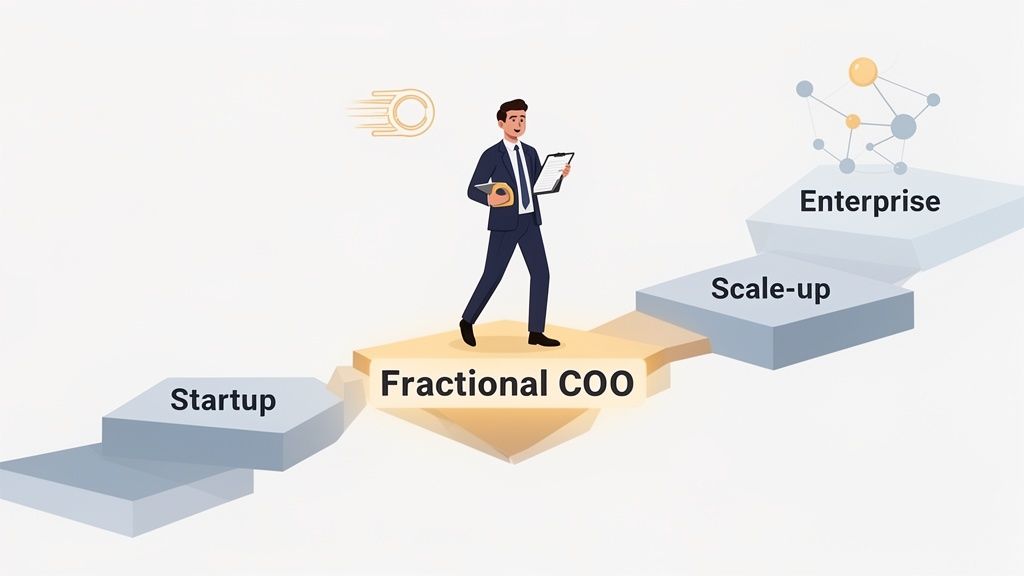
Gain C-Suite Experience on Your Terms
Let’s play out a common scenario. Say you're a talented VP of Operations at a large, established company. The path to the COO chair is there, but it’s probably a five to seven-year journey. A fractional engagement completely changes that dynamic.
By taking on a part-time COO role for a fast-growing tech startup, you could suddenly find yourself leading a major digital transformation project. That’s an opportunity you might not get for another decade in your current job.
This kind of work exposes you to challenges and leadership styles you’d never encounter otherwise. You’re not just managing a department; you're in the trenches with a CEO, helping them navigate rapid growth, secure funding, and build scalable systems from the ground up.
These are precisely the experiences that boards and recruiters drool over. They demonstrate your adaptability and prove you have the strategic vision to lead an entire organization. Many aspiring COOs are now using these roles to build a portfolio of C-level achievements. A deeper look at fractional COO services shows just how these engagements are structured to deliver maximum impact for both the executive and the company.
The Strategic Advantages of Going Fractional
The benefits of a fractional role go far beyond a new title. It’s about strategically developing your career to become a seasoned, versatile executive who's ready for any operational challenge.
- Diverse Industry Exposure: Working with companies in different sectors—from SaaS to manufacturing—dramatically broadens your understanding of various business models and market dynamics.
- Rapid Network Expansion: You get direct access to CEOs, investors, and board members, building a powerful professional network that can unlock future opportunities you didn't even know existed.
- Enhanced Problem-Solving Skills: Every fractional role presents a unique set of operational puzzles. This constant challenge sharpens your ability to diagnose issues and implement effective solutions on the fly.
This path is all about becoming a more well-rounded leader. You learn to adapt your leadership style to different company cultures and scales, a skill that is incredibly valuable in any full-time executive position.
The compensation for Chief Operating Officers reflects how critical the role is, and this holds true for fractional work. The average tenure in a full-time COO role has actually increased to 3.9 years from 3.3 years, indicating growing stability at the top. For professionals using fractional arrangements to get there, the compensation data from platforms like PayScale/Salary/18fa9837/Leadership) shows this tier offers substantial earning potential while providing the exact expertise modern companies need.
Ultimately, finding the right fractional opportunity can be one of the most impactful moves you make. It's a deliberate strategy to gain the specific experience you need to make that final leap to the C-suite. For companies, it’s a way to access top-tier talent without the full-time commitment. For you, it’s a direct path to the executive suite.
Landing the Role: Your Interview and Negotiation Strategy
You’ve built the skills, tracked the right KPIs, and earned your seat at the executive table. Now for the final hurdle: mastering the COO hiring process.
A COO interview is a different beast entirely. You’ll be under a microscope, facing intense scrutiny from the CEO, board members, and even your potential direct reports. They're not just ticking boxes on your resume—they're testing your executive presence and strategic mind in real-time.
Expect questions designed to see how you think on your feet. A CEO might lean in and ask, "How would you scale our operations for 3x growth in 18 months?" Your answer needs to be a mini-playbook, blending high-level strategy with grounded, practical steps. The goal is to project a calm, data-driven confidence that makes them feel they're in safe hands.
Preparing for High-Stakes Conversations
Your prep work has to go way beyond standard interview advice. This is about weaving a compelling story that directly connects your biggest wins to the company's future needs.
- Deep-Dive on the Leadership: Get inside the CEO’s head. What’s their vision? What are the board's top priorities? Speaking their language from the get-go will instantly set you apart.
- Arm Yourself with Case Studies: Come prepared with three to five detailed examples of your biggest operational achievements. Frame them using the STAR method (Situation, Task, Action, Result), but lean heavily on the quantifiable results you drove.
- Anticipate the Tough Questions: You know they're coming. Role-play challenging scenarios, from mediating a conflict between department heads to navigating a sudden budget crisis. Our guide on the top interview questions for a COO is a great place to start building your playbook.
The goal isn’t just to answer questions correctly; it's to start leading the conversation. You want to walk out of that room having shown them you're not just another candidate, but a future partner in their success.
Securing Your Value Through Negotiation
When the offer finally lands on the table, the real test begins. Don't get tunnel vision on salary. A strong COO negotiation covers the full picture: the scope of your responsibilities, your equity stake, and the resources you'll need to actually deliver on your promises.
This isn't just about what you're paid; it's about setting the stage for your success from day one.
Whether you're targeting a full-time role or a fractional COO position, a confident, clear strategy is non-negotiable. When you're ready to find opportunities that match your ambition, having a trusted partner can make all the difference. Explore our fractional executive marketplace to connect with companies actively seeking your level of operational leadership.
Burning Questions on the Path to COO
As you navigate your way toward an executive role, a few practical questions always seem to pop up. Let's tackle some of the most common ones we hear from aspiring COOs.
How Long Does It Really Take to Become a COO?
The typical journey to the COO chair takes about 10-15+ years, but that’s far from a hard-and-fast rule. Your timeline can shrink or expand based on the industry you're in, the size of the companies you work for, and how quickly you climb the ladder.
But you can absolutely speed things up. Strategic moves, like taking on fractional leadership roles, let you pack diverse, high-stakes experience into a much shorter period. This makes you a compelling candidate way ahead of schedule.
If You Had to Pick One, What’s the Most Important Skill for a COO?
It's the rare ability to marry high-level strategic vision with down-to-earth, practical execution. A great COO can listen to the CEO’s grand three-year plan and, almost in the same breath, translate it into a concrete operational roadmap for the next 90 days.
This means you have to be a dual-threat thinker: you need to see the entire forest while also knowing the details of every single tree. It’s all about making sure the small, daily tasks are always pushing the big, long-term goals forward.
Can I Make It to COO Without an MBA?
Absolutely. While an MBA can give you some useful frameworks and a solid network, nothing beats a proven track record. When it comes down to it, CEOs and boards care most about your real-world experience—leading teams, scaling complex operations, and delivering results they can measure.
Your ability to walk into a messy situation and solve tough operational problems will always speak louder than any credential on a piece of paper.
A portfolio of tangible wins—like slashing operational costs by 20% or spearheading a successful expansion into a new market—is undeniable proof of your value. It’s the kind of thing that makes people sit up and take notice, degree or not.
How Does a Fractional Role Get Me Ready for a Full-Time Gig?
Think of it as a career accelerator. Stepping into a fractional COO engagement is one of the quickest ways to build genuine C-suite credibility. You get direct, hands-on experience working side-by-side with CEOs and boards across different industries, which expands your network like crazy.
More importantly, it lets you build a portfolio of C-level achievements in a fraction of the time. This kind of experience makes you a much more compelling—and less risky—candidate when you’re ready to land that top-tier, full-time position.
Ready to fast-track your journey to the C-suite or find the perfect operational leader for your team? Shiny is the marketplace connecting ambitious executives with growing companies that need top-tier fractional talent. Explore opportunities or schedule a consultation to find the expert you need to scale. Visit https://useshiny.com to learn more.