How to Calculate Hourly Rate: The Fractional Leader’s Guide
Figuring out an hourly rate seems like simple math. The classic formula is to take a target salary—say, $150,000—and divide it by 2,080 working hours in a year. This gives you a baseline of $72 per hour.
But if you stop there, you’re leaving money on the table and risking burnout. That number is just the beginning. A true professional rate must account for the hidden costs of running a business, the value of your expertise, and the non-billable time spent winning clients.
Why Your Hourly Rate is a Strategic Decision
Setting your hourly rate is a critical strategic move, whether you’re an experienced executive transitioning to fractional work or a founder looking to hire one. It’s the foundation of a healthy partnership where both sides feel they're getting exceptional value.
For fractional executives, your rate is more than a number; it's a reflection of decades of experience and the tangible results you deliver. It must cover not only your target income but also everything an employer would normally provide:
- Health insurance and retirement contributions
- Self-employment taxes (a significant 15.3% haircut)
- Professional development, software, and tools
- Non-billable time for marketing, sales, and administration
For founders, understanding this calculation from the other side is key to budgeting for elite talent without the crippling overhead of a full-time hire. Imagine a $250,000 annual CFO salary. That breaks down to about $120 per hour ($250,000 / 52 weeks / 40 hours).
When you engage a fractional executive for just 10 hours a week, you access that same strategic mind while sidestepping benefits, equity, and payroll taxes—slashing total compensation costs by 75% or more.
A thoughtfully priced engagement aligns value with cost. It’s the sweet spot where the executive feels their expertise is respected and the company sees a clear, immediate return on its investment. This transforms the relationship from a simple transaction into a true strategic partnership.
Achieving this alignment is everything. Startups in sectors like SaaS or FinTech can bring on vetted leaders for 5-25 hours a week at rates that typically fall between $150-$300/hour. That’s a world away from a $500k+ full-time executive package. For more context, it's always good to check out the latest data on median hourly earnings to see how private sector wages are trending.
Take a look at how the numbers stack up. The savings are dramatic.
Full-Time Salary vs. Fractional Executive Cost
| Cost Factor | Full-Time Executive ($250k Salary) | Fractional Executive (10 hrs/week @ $150/hr) |
|---|---|---|
| Annual Salary/Fee | $250,000 | $78,000 |
| Benefits (Health, 401k) | $30,000 – $40,000 | $0 |
| Payroll Taxes (FICA) | ~$19,000 | $0 |
| Bonus & Equity | $50,000 – $100,000+ | $0 |
| Recruiting & Onboarding | $25,000 – $50,000 | $0 |
| Total Annual Cost | ~$374,000 – $459,000+ | $78,000 |
The fractional model gives startups access to the same strategic brainpower for a literal fraction of the cost, freeing up precious capital for growth.
Ready to find the right fractional executive for your team? Explore our network of vetted leaders and see how affordable top-tier talent can be.
Calculating Your Rate as a Fractional Executive
When you transition to fractional leadership, setting your rate is one of the first, most critical challenges. It's tempting to simply divide your old salary by 2,080 hours, but that's a mistake that leaves talented executives underpaid and overworked.
Your rate needs to do more than replace your old paycheck. You're a business owner now. Think of your target income as the foundation of a house. To build a sustainable business, you also need to account for the walls (taxes), the roof (insurance), and all the utilities (software, marketing, etc.).
Building Your "Fully Loaded" Rate
To arrive at a rate that truly sustains your business, you must build what’s called a "fully loaded" rate. This starts with your desired income and layers on all the expenses that are now your responsibility.
Here’s a breakdown of the key costs you must factor in:
- Self-Employment Taxes: This is the big one. As a 1099 contractor, you’re responsible for both the employer and employee sides of Social Security and Medicare. That’s a hefty 15.3% right off the top.
- Health Insurance & Benefits: Without an employer subsidy, health, dental, and vision insurance premiums can be a shock. Don't forget to price out disability and life insurance, too.
- Retirement Contributions: Your 401(k) matching days are over. You’ll need to fund your own retirement vehicle, like a SEP IRA or Solo 401(k).
- Professional Tools & Development: The software you used to take for granted—from CRMs to project management tools—is now on your dime. This also includes industry memberships and conferences that keep your skills sharp.
- Non-Billable Time: This is the silent killer of profitability. A significant chunk of your time—often 20-30%—will be spent on essential, unpaid work like marketing, networking, and admin. Your hourly rate must cover this.
This visual gives you a simple look at the basic math, but remember it's just the starting point.
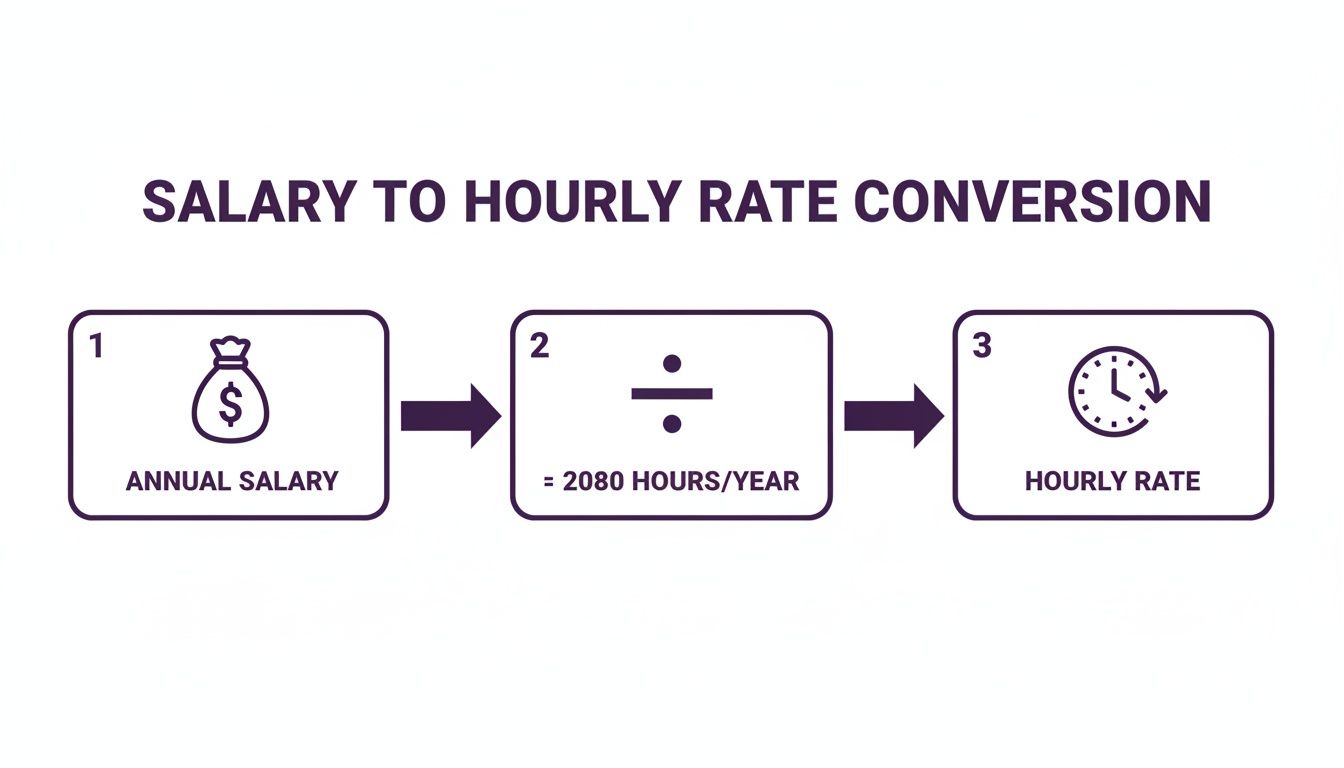
The real work isn’t just dividing your old salary; it’s adding all these other costs back in to find a rate that truly sustains your business.
A Real-World Example
Let's walk through this with Sarah, a former Chief Marketing Officer targeting a $200,000 personal income.
First, Sarah estimates that 25% of her time will be non-billable. That means out of 2,080 work hours in a year, only 75% are actually billable. Her total billable hours are 1,560 for the year.
Next, she tallies up her new business expenses:
- Self-Employment Taxes: $30,600 (15.3% of $200k)
- Health Insurance: $18,000
- Retirement Savings: $20,000
- Business Expenses (software, marketing, etc.): $5,000
Total Overhead: $73,600
To hit her income goal and cover all these costs, Sarah’s total annual revenue target needs to be $273,600 ($200,000 + $73,600).
Now she can finally calculate her hourly rate: $273,600 / 1,560 billable hours = $175.38 per hour. She’ll likely round that up to a clean $180 per hour for proposals.
Getting a firm grasp on the full picture of fractional executive compensation is absolutely essential. It's the only way to set a rate that not only pays the bills but builds a profitable, long-term business.
How Startups Can Budget for Top-Tier Talent
For founders, the question isn't what to charge—it's what to pay. Budgeting for a fractional executive is a strategic balancing act. You need to attract world-class talent while preserving the capital efficiency that makes the fractional model so powerful.
The process begins by benchmarking what a full-time leader in your industry would cost. If you were hiring a full-time CFO in FinTech, what would their total compensation package look like? Start with the base salary—let's say $300,000—and then add all the "fully loaded" costs like benefits, bonuses, and recruiting fees.
This total cost is your baseline. A fractional executive should command a higher hourly rate than their full-time equivalent because they're covering their own overhead. Even so, your total cash outlay will be significantly lower.
Translating Salaries to a Smart Budget
Once you have that full-time benchmark, you can translate it into a realistic hourly range. A common mistake is simply dividing the salary by 2,080 hours. A much better approach acknowledges the executive's loaded costs and the premium for their specialized expertise.
A good rule of thumb is to expect a fractional executive's hourly rate to be 1.5x to 2.5x the straight salary-to-hourly conversion.
Here’s how that plays out:
- Full-Time Salary: $300,000
- Simple Hourly Conversion: $144/hour ($300,000 / 2080)
- Expected Fractional Rate Range: $216 – $360/hour
This range becomes your budgeting framework. It allows you to offer an attractive rate while still achieving massive savings compared to a full-time hire, as you skip paying for benefits, equity, and payroll taxes. Grasping the different components that make up the cost of a part-time CFO can give you a clearer picture of these savings.
Focusing on Outcomes Over Hours
The most effective way to budget for a fractional executive is to shift your focus from hourly cost to expected ROI. What critical business outcome will this person drive? Don't just hire a "fractional CMO"; invest in an expert who will increase your qualified leads by 50% in six months.
The real value of a fractional executive isn't measured in the hours they log, but in the strategic goals they achieve. Budgeting for outcomes ensures you're investing in tangible business growth, not just renting someone's time.
Define the specific, measurable goals for the role before you begin your search. For instance, a fractional Head of Sales might be tasked with building a repeatable sales process and closing your first $1 million in enterprise deals. With that goal in mind, an investment of $15,000 per month for that expert feels far more tangible than getting hung up on a $250/hour rate. This outcome-based approach turns an expense into a high-leverage investment.
Using Market Benchmarks to Refine Your Rate
Your calculated rate—based on income goals and business expenses—is a solid starting point. But it exists in a vacuum. You need to test it against the real world, and that’s where market benchmarking comes in. It's the key to an hourly rate that's both sustainable for you and competitive in the market.
Your expertise has a different market value depending on the industry and the specific role you're targeting. A fractional CTO steering a HealthTech startup through HIPAA compliance operates in a different market than a fractional Head of Marketing scaling a D2C brand.
Finding Your Industry's Sweet Spot
Start by gathering market intelligence. What are full-time executives with your skillset earning in your target industries?
For example, recent figures show average hourly earnings for wholesale trade roles hover around $39.34. Of course, you're not an "average" employee. Let's say a comparable full-time role earns a $200,000 salary. That breaks down to about $96 per hour ($200k / 2080 hours). As a fractional leader, your rate must be significantly higher to cover your overhead, but this baseline gives you a concrete market anchor. The latest private sector wage data is a great place to see where your industry stands.
Market data doesn't dictate your rate, but it absolutely defines the conversation. Use it to understand what companies are used to paying for top-tier talent. This helps frame your rate as premium, yet completely reasonable.
This research prevents you from accidentally pricing yourself out of the market or, even worse, undervaluing years of hard-won expertise.
Adjusting for Scope and Complexity
Not all fractional work is created equal, and your rate should reflect that. Is the client seeking high-level strategic guidance, or do they need hands-on implementation?
Consider these two scenarios:
- Strategic Advisory: Your role is to develop a growth strategy, advise the board, and coach the leadership team. This is high-impact work that justifies a premium rate because the ROI is tied directly to massive business outcomes.
- Hands-On Implementation: This role involves managing day-to-day operations, running campaigns, and leading a team. It's still incredibly valuable work, but it might align with a rate closer to the standard market benchmark.
By assessing the scope, you can fine-tune your rate to match the exact value you're delivering, finding the perfect balance between your experience, costs, and market demand.
Finding the right fractional executive at the right price can feel complex. At Shiny, we connect you with pre-vetted leaders whose rates are already benchmarked for their industries. Schedule a consultation to find the perfect match for your budget and goals.
Moving Beyond the Numbers to Finalize Your Rate
You've crunched the numbers and benchmarked your rate against the market. Now, it's time for the final step: negotiation. This is where your calculated figure becomes an agreed-upon price.
The goal is to shift the conversation away from cost and anchor it firmly on value. This isn't just about agreeing on a number; it's about building mutual confidence that the partnership will be a win-win.

If you're an executive, tie your rate directly to the tangible ROI you deliver. Don't just state a number—present a solution for their biggest pain points.
The Art of Value-Focused Negotiation
Confident negotiation isn't about playing hardball; it's about clearly communicating the value you bring. Startups aren't just buying your hours. They're investing in your experience, network, and strategic vision to shortcut their path to growth.
For founders, the objective shouldn't be haggling for the lowest price. The real win is finding a partner whose value proposition aligns with your most critical business goals. Paying a premium for an executive with direct, relevant experience in your niche is almost always a smarter investment.
It helps to have historical context. Average hourly wages have steadily climbed from just $2.50/hour in 1964 to over $37/hour today. Understanding these long-term trends, which you can explore through historical wage data, provides a more informed foundation for the discussion.
Negotiation is the final calibration of your hourly rate. It should be a collaborative process where both parties build a foundation for a long-term partnership based on shared goals and mutual respect, not a battle over dollars and cents.
A crystal-clear scope of work is your best friend in these conversations, setting expectations perfectly and preventing scope creep.
Solidifying the Agreement
A formal contract is non-negotiable. This document protects both parties by clearly laying out the terms of the engagement. To avoid future misunderstandings, ensure your contract specifies:
- Specific Deliverables: What exact outcomes are expected?
- Payment Terms: How and when will you be paid?
- Scope Adjustments: What is the process if project needs change?
- Termination Clause: Under what conditions can either party end the agreement?
Getting this detail on paper ensures everyone is on the same page. You can dig into the specifics of this process with our handy contracting hourly rate calculator. Ultimately, a solid contract is the bedrock of a successful partnership.
Ready to find an executive who can deliver exceptional value? Schedule a consultation with Shiny to connect with our network of vetted leaders.
Common Questions About Fractional Executive Rates
Even with a solid formula, a few practical questions always come up when it's time to set or agree to an hourly rate. Let's tackle the most frequent questions we hear from founders and fractional leaders.
How Often Should I Re-Evaluate My Hourly Rate?
As an executive, your value isn't static—and neither is your rate. It's smart to review your pricing annually, or after completing a project that significantly enhances your professional portfolio.
Specific moments that justify a rate increase include:
- Acquiring a new, high-demand certification.
- Gaining deep, proven experience in a sought-after niche like AI integration.
- Consistently delivering exceptional ROI for clients, with case studies to prove it.
When you raise your rate, be prepared to explain the why, clearly showing how your growing expertise delivers more value.
What Is the Biggest Mistake Startups Make?
The most common pitfall is chasing the lowest hourly rate instead of the highest potential value. A cheaper, less experienced hire might seem like a budget win today but often leads to costly strategic mistakes down the road. Another error is failing to define the scope of work clearly. A vague scope almost guarantees unmet expectations and friction.
The most successful fractional partnerships are built on a foundation of value, not cost. Investing in the right expert to solve a critical business problem delivers a far greater return than saving a few dollars per hour on a less-than-perfect fit.
Should My Rate Change for Different Types of Work?
For most fractional executives, a single, value-based rate is the cleanest approach. Your rate reflects the total sum of your experience, strategic insight, and ability to execute. Creating tiered rates for "strategy" versus "execution" can complicate billing and devalue your hands-on work. Instead, consider offering different engagement models, like project-based pricing or a monthly retainer.
How Does a Retainer Model Work?
A retainer is a great way to structure a fractional engagement, offering stability to both sides. In this model, the client commits to paying for a set number of your hours each month—say, 40 hours per month—at your agreed-upon rate. This gives you a predictable income stream and guarantees the client dedicated access to your expertise. A solid retainer agreement should always specify what happens to unused hours and outline the rate for any work that goes beyond the monthly block.
Finding the right executive at the right price is what unlocks sustainable growth. At Shiny, we specialize in connecting innovative companies with a network of over 3,000 pre-vetted fractional leaders. We help you find the perfect match for your budget and strategic goals, ensuring a partnership built on value and a clear path to success.
If you're ready to leverage fractional leadership to accelerate your growth, Schedule a consultation today and let us connect you with the right executive for the job.