How to Conduct SWOT Analysis: A Practical Guide for Strategic Growth
Conducting a SWOT analysis is about getting the right people in the room to have an honest conversation about your business. You'll dig into your internal Strengths and Weaknesses, then scan the horizon for external Opportunities and Threats. The goal isn't just to make a list—it's to forge those insights into a concrete strategic plan that drives real, sustainable growth.
Why a SWOT Analysis Is a Powerful Strategic Tool
Before diving into the "how-to," let's ground ourselves in the "why." A SWOT analysis is far more than the four-quadrant box you remember from business school. When done right, it's a dynamic tool that separates companies that thrive from those that get left behind. It provides a clear, structured snapshot of where your business stands today and illuminates the path forward.
For most leaders, the real challenge isn't a lack of information; it's organizing it all into a coherent strategy. A well-executed SWOT analysis cuts through the noise. It forces an honest look at uncomfortable truths and, just as importantly, helps you recognize powerful advantages you might be overlooking.
Moving Beyond a Static Framework
The magic of this framework isn't in filling out boxes. It’s in the conversations and "aha!" moments that surface during the process. You start connecting isolated data points—a sales figure here, a competitor’s move there—into a cohesive story about your business. This is precisely why it remains a cornerstone of strategic planning.
Decades after its development, the technique is as relevant as ever. In fact, over 80% of Fortune 500 companies build SWOT into their annual reviews. It's not just a big-company game, either; 65% of startups use quarterly SWOT reviews to stay nimble. You can dig into more SWOT analysis statistics to see how top companies put this method to work.
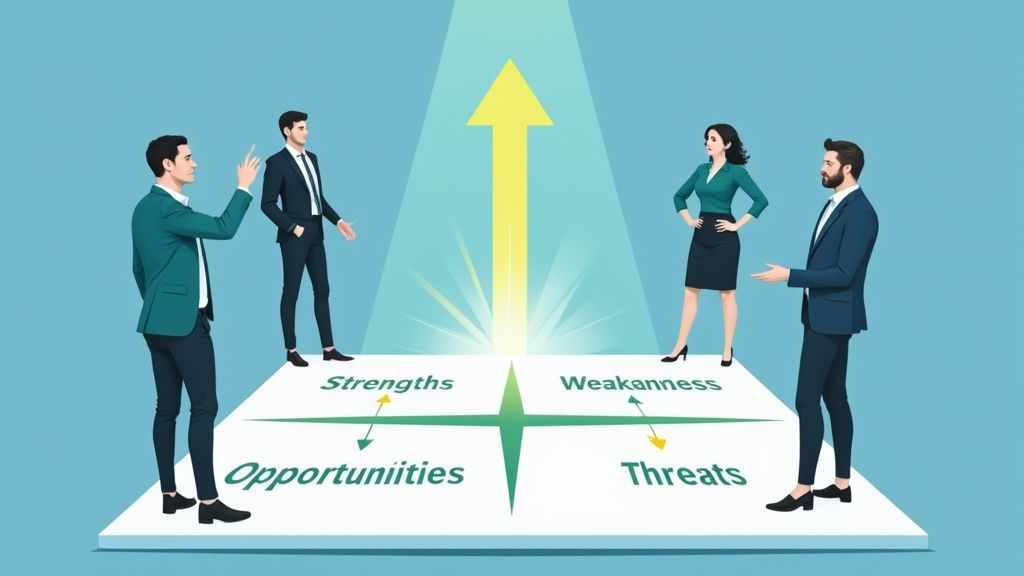
The Core Value of a SWOT Analysis
At its heart, a SWOT analysis is about achieving clarity and alignment. It serves several critical functions:
- Identifies Core Competencies: It forces you to pinpoint what you do exceptionally well—your secret sauce—and figure out how to leverage it.
- Exposes Vulnerabilities: It shines a bright light on internal weaknesses like skill gaps, operational bottlenecks, or outdated tech. This lets you address them before they become crises.
- Highlights Growth Avenues: It helps you spot and prioritize external opportunities—emerging markets, new technologies, or shifting consumer behaviors—before your competitors do.
- Prepares for External Risks: It systematically identifies potential threats on the horizon, from regulatory changes to new competitors, so you can build your defenses.
A great SWOT analysis doesn't just give you a list; it tells a story. It clarifies where you are, where you could go, and what might stand in your way.
Ultimately, learning how to conduct a SWOT analysis is about building a repeatable process for strategic thinking. It’s your blueprint for making smarter decisions. Without this clarity, even talented teams can end up reacting to problems instead of proactively building the future.
The Four Pillars of SWOT at a Glance
| Component | Focus Area | Key Question to Ask | Example Data Sources |
|---|---|---|---|
| Strengths | Internal, Positive | What do we do better than anyone else? What unique assets do we have? | Customer testimonials, employee feedback, performance metrics, patents |
| Weaknesses | Internal, Negative | Where are we falling short? What resource gaps or limitations do we have? | Churn reports, negative reviews, internal process audits, skill gap analysis |
| Opportunities | External, Positive | What market trends can we capitalize on? Are there underserved customer segments? | Market research reports, competitor analysis, tech trend publications, economic forecasts |
| Threats | External, Negative | Who are our emerging competitors? What regulatory changes could impact us? | Industry news, legislative updates, supply chain analysis, market volatility reports |
Keep this table handy. It's a simple way to stay focused on asking the right questions and pulling information from the right places.
Laying the Groundwork for a Powerful Analysis
An effective SWOT analysis doesn’t just happen. It requires intentional preparation. Rushing into the process without a plan is like trying to build a house without a blueprint—you'll end up with something, but it won't be stable or what you actually need. This prep phase sets the stage for genuine, actionable insights.
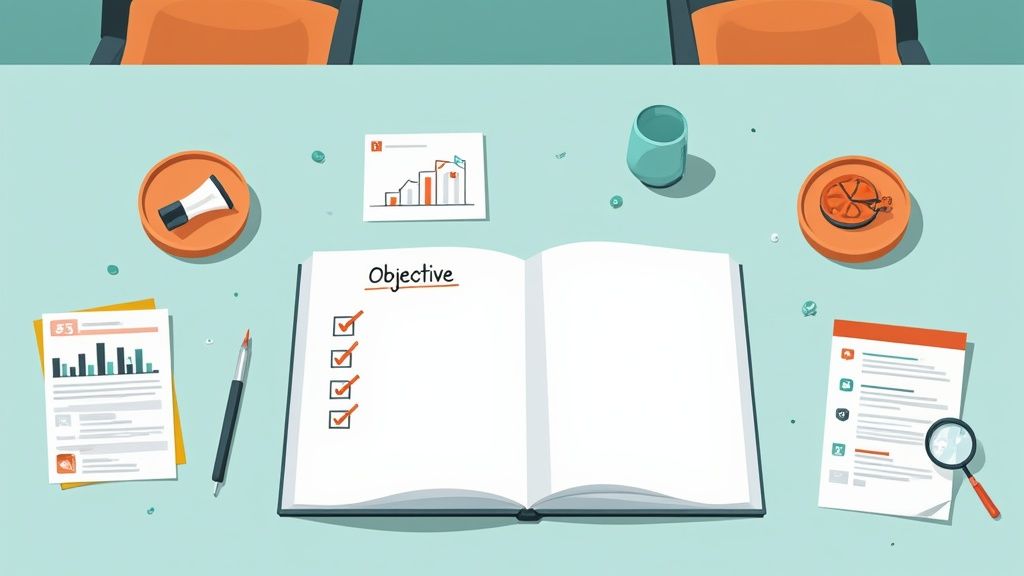
Define a Crystal-Clear Objective
First, figure out why you're doing this. Without a sharp, specific objective, your analysis will devolve into a sprawling, unfocused brainstorm. You’ll leave with a long list but no real direction.
Think of your objective as a lens that focuses your team's attention.
- For a new product launch: "Should we invest in developing our new mobile app this year?"
- For market expansion: "Is entering the European market a viable growth strategy for the next 18 months?"
- For a quarterly health check: "What are the primary factors impacting our customer retention rate this quarter?"
A specific question transforms the exercise from a vague corporate ritual into a targeted problem-solving tool. This focus is a critical part of any successful strategic planning process.
Assemble Your Cross-Functional Team
Once you know your "why," you need the right people in the room. A SWOT analysis conducted by a single department is doomed to have blind spots. Inviting perspectives from across the business isn't just about inclusivity; it’s your best defense against groupthink.
Your team should include key contributors from:
- Sales: They understand customer objections, competitor tactics, and market demand.
- Marketing: They know your brand perception, campaign performance, and audience sentiment.
- Product/Operations: They know your technical capabilities, production limits, and internal process pain points.
- Finance: They bring the crucial context of budget constraints, profitability, and financial health.
A diverse team ensures a 360-degree view. The sales team's insight on competitor pricing (a Threat) might be a blind spot for the product team.
Gather Your Data Beforehand
The best SWOT sessions are grounded in facts, not just opinions. Ask your team to come prepared with relevant data to elevate the conversation from subjective feelings to evidence-based analysis.
Essential data points to collect include:
- Internal Performance Reports: Sales trends, marketing analytics, customer churn rates.
- Customer Feedback: Survey results, online reviews, support ticket themes.
- Competitor Benchmarks: Analysis of your top competitors’ products, pricing, and marketing.
- Market Research: Industry reports, trend forecasts, and articles on tech or regulatory shifts.
A Deep Dive into Internal Factors: Strengths & Weaknesses
Now that you have an objective and the right team, it’s time for an honest look in the mirror. This part of the process focuses on internal factors—the things you can control. We're digging into what makes your business tick and, just as importantly, what makes it stumble.
Identifying Your True Strengths
First up: your Strengths. The trick is to push past obvious answers. A "great product" is often just table stakes. Real, durable competitive advantages are more specific. Ask probing questions to uncover what makes your business genuinely unique and hard to copy.
Consider these areas:
- Unique Assets: Do you hold patents, proprietary technology, or exclusive partnerships? A tech startup’s strength might be an algorithm that processes data 50% faster than any competitor.
- Human Capital: Is your culture a magnet for top talent? Perhaps your engineering team has deep expertise in a rare specialty.
- Operational Excellence: Have you perfected a hyper-efficient supply chain or a customer service process with a 98% satisfaction rate?
These are tangible advantages that directly contribute to your market position.
Confronting Your Weaknesses with Honesty
Now for the tough part: Weaknesses. Radical honesty is non-negotiable. A weakness is any internal factor that puts you at a disadvantage. Ignoring them won’t make them go away; it just leaves you vulnerable.
Your cross-functional team is crucial here, as the finance head will see resource gaps that marketing might miss. The goal isn't to point fingers; it's to identify areas that need fixing before they become critical failures.
A common weakness for growing businesses is a lack of executive depth. A founder might be a brilliant product visionary but lacks the financial strategy experience to secure the next round of funding. This is a skills gap that must be addressed.
For startups, a structured internal review is especially critical. A thorough SWOT analysis can demonstrate data-driven foresight to investors. You can learn more about how SWOT analysis benefits startups and why it’s so valued.
Ask your team these questions to get a balanced internal snapshot:
- Resource Gaps: Are you chronically underfunded in a key department like R&D?
- Skills Deficiencies: Does your team lack the expertise needed for the next growth stage?
- Brand Perception: Is your brand recognition lagging, or are you fighting negative reviews?
- Operational Bottlenecks: Are clunky processes or outdated systems holding you back?
A SaaS startup with brilliant developers (Strength) but no dedicated sales team (Weakness) is a classic example. Recognizing this imbalance is the first step toward building a sustainable growth engine.
Scanning the Horizon: Opportunities & Threats
Once you have a handle on your internal reality, it’s time to look outward. The second half of a SWOT analysis shifts focus to external forces—the things you can’t control but must anticipate and react to. This is what separates proactive businesses from those constantly caught off guard.
Internal vs. External Factor Analysis
Let's quickly clarify the difference between the factors you just analyzed (Strengths/Weaknesses) and the ones we're about to tackle (Opportunities/Threats). It boils down to control.
| Factor Type | Definition | Control Level | Example (Tech Startup) |
|---|---|---|---|
| Internal Factors | Attributes inherent to your organization, like your team, IP, and company culture. | High. You can directly influence and change these factors over time. | A proprietary algorithm that gives you a performance edge (Strength). |
| External Factors | Forces and trends in the broader market, industry, or world. | Low. You cannot control these, but you can anticipate and respond to them. | A sudden surge in demand for AI-powered analytics tools (Opportunity). |
Understanding this distinction is key. You build on internal strengths to seize external opportunities, and you shore up internal weaknesses to guard against external threats.
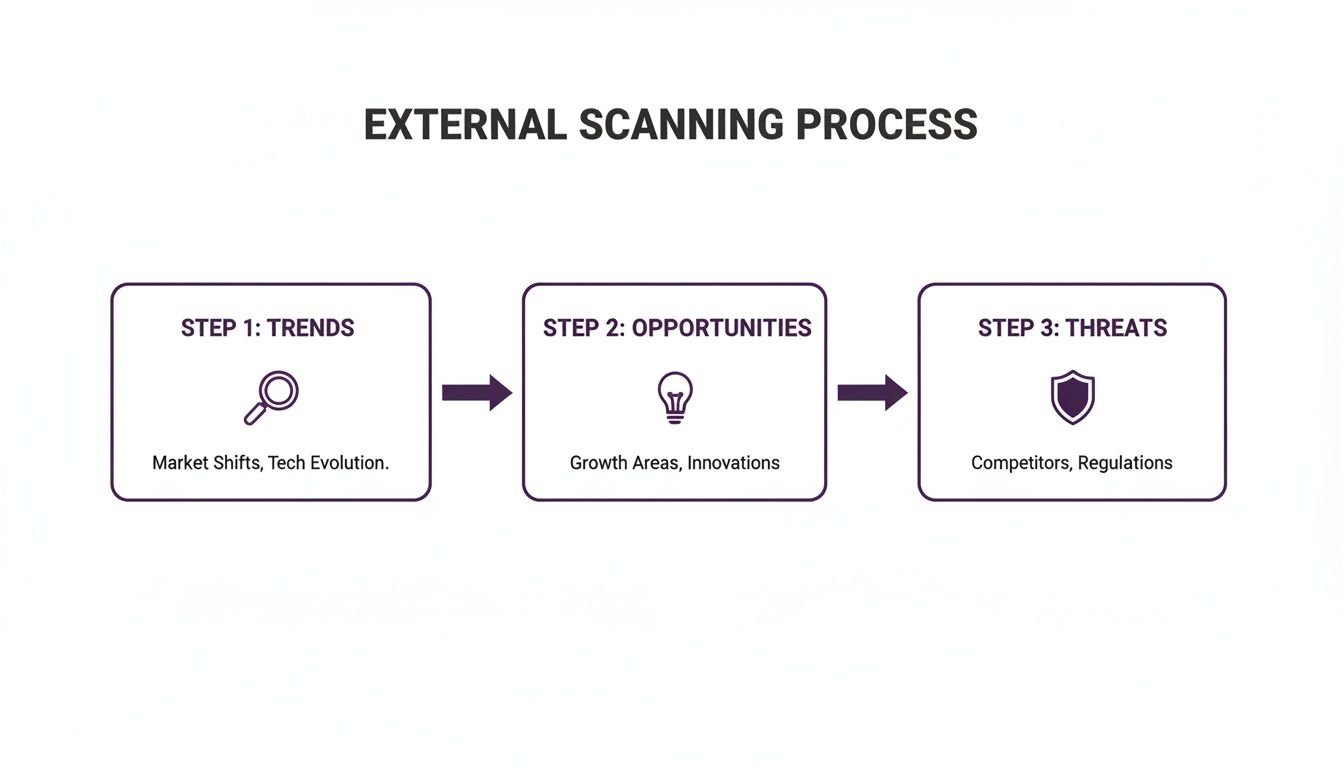
How to Identify Market Opportunities
Opportunities are the winds of change blowing in your favor. They’re the gaps your competitors miss or the emerging trends that align perfectly with your strengths. Finding them requires relentless observation.
Here’s where to look:
- Market Trends: The rise of remote work created huge opportunities for collaboration software. What waves are building in your industry right now?
- Technological Shifts: The explosion of generative AI offers concrete opportunities for businesses to automate tasks, personalize experiences, or invent new products.
- Competitor Gaps: Are there customer segments your rivals ignore? Are there common complaints they fail to address? Learning about different competitive analysis frameworks gives you a methodical way to spot these weaknesses and turn them into your openings.
Identifying an opportunity is only half the battle. The other half is having the right leadership and expertise in place to seize it. A brilliant market opening is useless without the strategic mind to build a plan and the operational skill to execute it.
Spotting and Preparing for Threats
Just as opportunities can slingshot you forward, threats can stop you in your tracks. Threats are external factors that could harm your business, from subtle shifts to sudden shocks. Your job is to see them coming.
Common threats include:
- Emerging Competitors: A new, well-funded startup could enter your market with a disruptive model.
- Regulatory Changes: New privacy laws or environmental regulations could force you to overhaul operations.
- Economic Headwinds: A recession could tighten customer budgets, making sales and retention harder.
To ensure your scan is thorough, use the PESTLE framework. This model forces you to consider external factors across six key areas: Political, Economic, Social, Technological, Legal, and Environmental. Using a framework like PESTLE prevents tunnel vision and helps you build contingency plans, making your business far more resilient.
Turning Your SWOT Matrix into an Actionable Game Plan
You've done the heavy lifting—organized your business reality into four SWOT quadrants. But a list of insights isn't a strategy. The magic happens when you connect the dots and turn that raw material into a concrete game plan.
This is where most teams drop the ball. They nail the analysis but fail to build the bridge to action, leaving a brilliant document to collect digital dust.
From Analysis to Strategy with the TOWS Matrix
The most effective way to build this bridge is by using a TOWS Matrix. While it seems like a simple reversal of the SWOT acronym, it’s a powerful shift in thinking. SWOT catalogues what is; TOWS connects those internal and external factors to create four distinct, forward-looking strategies.
Building Your Four Core Strategies
Let's break down the four types of strategies you'll build by pairing an internal factor with an external one.
- Strength-Opportunity (SO) Strategies: Your "attack" plan. How can you use your core strengths to seize market opportunities?
- Weakness-Opportunity (WO) Strategies: How can you use a market opening to fix an internal weakness? This turns an external tailwind into a catalyst for internal improvement.
- Strength-Threat (ST) Strategies: Your defensive plan. How can your key strengths help you neutralize an external threat?
- Weakness-Threat (WT) Strategies: This is about risk mitigation. How do you minimize a vulnerability to sidestep a looming threat?
Your goal is to create specific, prioritized initiatives that directly link back to your SWOT findings. This is how you build a plan with true strategic integrity.
For example, imagine a B2B SaaS company identifies its strong customer relationships as a Strength. A major Threat is rising churn due to a new, cheaper competitor. An ST Strategy would be to leverage those relationships to upsell clients on a new premium service tier, increasing switching costs and directly mitigating the threat.
This process transforms abstract ideas into tangible actions. As you map these out, you are building the foundation of your plan for the next quarter or year. For a deeper dive into organizing these actions, check out our guide on creating a strategic roadmap template.
Common Questions About Doing a SWOT Analysis
Even with a clear plan, some questions always pop up. Getting these sorted out upfront will help you sidestep common pitfalls and ensure this exercise leads to real action.
How Often Should My Company Do a SWOT Analysis?
The old-school annual strategy session no longer cuts it. The market moves too fast. For most businesses, a SWOT analysis conducted quarterly or bi-annually hits the sweet spot. It keeps you agile without getting bogged down.
For fast-moving industries like tech or high-growth startups, quarterly is non-negotiable. You should also trigger a fresh SWOT analysis after any major event, like:
- The emergence of a new, disruptive competitor.
- A significant shift in technology or regulations.
- Plans for a major product launch or new market entry.
What Is the Biggest Mistake People Make?
Hands down, the single biggest mistake is being vague. Listing "good customer service" as a Strength is useless. Get specific and use data. "A 95% customer satisfaction score and a 24-hour average ticket resolution time" is a tangible strength you can build a strategy around.
The runner-up mistake? Failing to act on the findings. A finished SWOT matrix is a diagnostic tool, not the strategy itself. You must connect your findings to concrete actions with assigned owners and deadlines.
Can I Use SWOT for My Own Career Planning?
Absolutely. The framework is surprisingly versatile for personal and professional growth.
- Strengths: Your skills and certifications ("Proficient in Python and data modeling").
- Weaknesses: Areas for improvement ("Limited public speaking experience").
- Opportunities: Industry trends that benefit you ("New job roles emerging in AI ethics").
- Threats: Factors that could put your role at risk ("Automation is handling parts of my current job").
Thinking through these strategic questions often highlights gaps—especially the need for senior leadership experience that your company hasn't hired yet. If your SWOT analysis reveals a critical weakness in your executive team, a fractional leader can provide the targeted expertise needed to turn your insights into action without the cost of a full-time hire.
Shiny connects you with a vetted marketplace of top-tier fractional executives ready to help you seize opportunities and navigate threats. Explore our talent at https://useshiny.com to find the right leader for your next stage of growth.