
How to Improve Profit Margins: A Founder’s Guide to Sustainable Growth
Before you can improve profit margins, you need a clear picture of where your money is going. Jumping into new strategies without this baseline is like trying to navigate a new city without a map—you're moving, but you have no idea if you're getting closer to your destination.
Think of it as a quick, practical financial health check. This is the essential first step to understanding the story your numbers are telling.
This isn't about getting bogged down in complex accounting theory. It's about calculating three key metrics that reveal your company's true performance. Each one tells a different part of the story, from how efficiently you make your product to how much cash you actually pocket after all the bills are paid.
The Three Core Profit Margins
Think of your profit margins as a set of diagnostic tools. Each one gives you a unique lens through which to view your business's health.
Gross Profit Margin: This reveals the profitability of your core product or service, stripped of all other business expenses. It answers the fundamental question: "How much do we make from each sale before paying for overhead?" A low gross margin is often a red flag for issues with pricing or production costs.
Operating Profit Margin: This metric assesses your company's earning power from its day-to-day business operations. It factors in costs like marketing, salaries, and rent but leaves out interest and taxes. A healthy operating margin signals that your core business functions are being managed efficiently.
Net Profit Margin: This is the ultimate bottom line. It’s the percentage of revenue left after every single expense—including taxes and interest—has been paid. It’s the clearest indicator of your overall profitability.
This visual flow shows how each margin builds on the last, giving you a complete picture of your financial health from top to bottom.
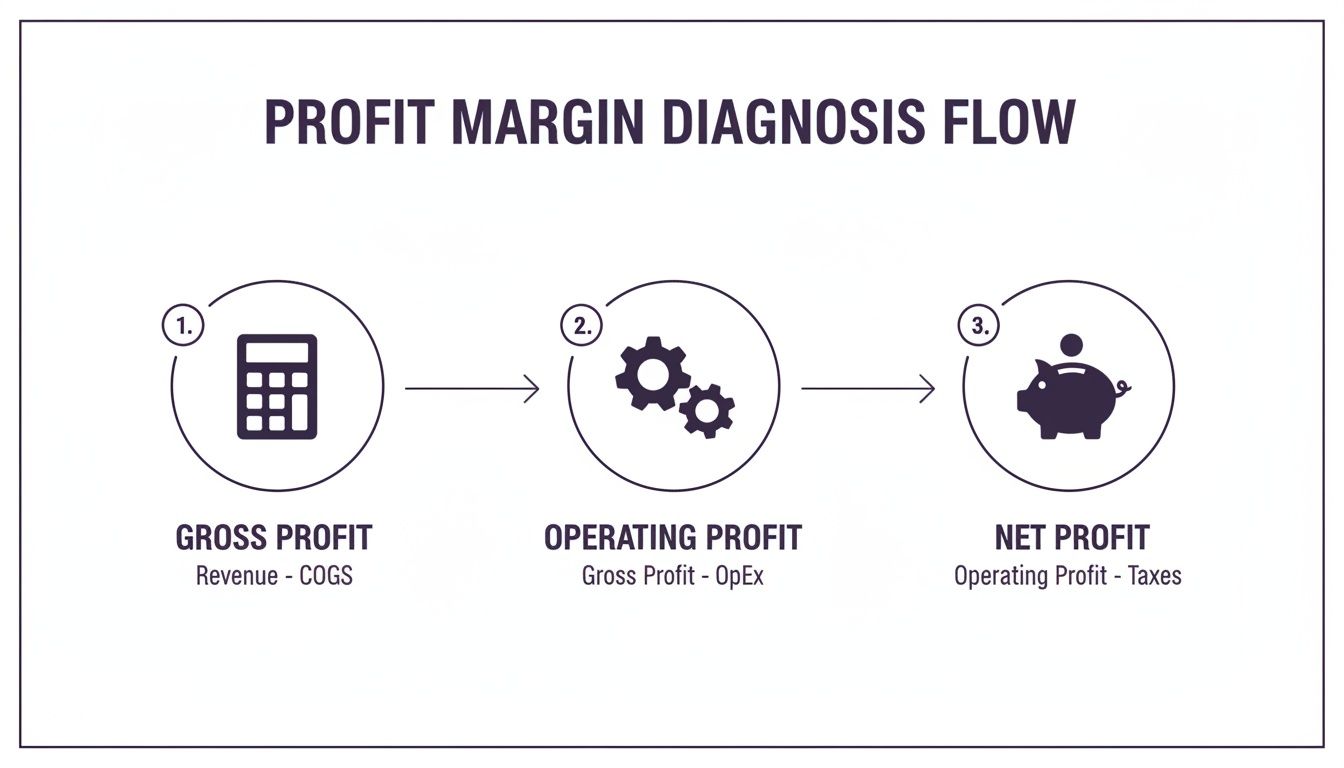
This process helps you pinpoint exactly where your profits are eroding. Is it in your production costs (gross), your operational spending (operating), or somewhere else entirely (net)?
Key Profit Margin Diagnostic Checklist
This quick checklist can help you interpret what your margins are telling you and what might be going wrong.
| Margin Type | What It Reveals | Warning Sign | Potential Action |
|---|---|---|---|
| Gross Profit | Core product profitability and production efficiency. | A declining or consistently low percentage. | Review pricing strategy, renegotiate with suppliers, or streamline production. |
| Operating Profit | Efficiency of day-to-day business operations. | A significant drop from gross margin. | Audit operating expenses (marketing, rent, salaries) for inefficiencies. |
| Net Profit | Overall financial health after all expenses. | A low single-digit percentage or negative value. | Analyze non-operating expenses like interest payments and tax strategies. |
By regularly checking these vital signs, you can catch problems early before they spiral out of control.
Benchmarking Your Performance
Once you have your numbers, the next question is obvious: are they any good? Context is everything. Comparing your margins to industry averages helps you set realistic goals and spot where you're falling behind the competition.
Looking at the total U.S. market, the average gross profit margin is around 37.76%, with net margins hovering at 9.74%. But top performers, especially in tech and services, often hit 50% or more by ruthlessly optimizing operating expenses. This is exactly the kind of high-impact tactic that fractional executives help businesses execute.
NYU Stern research backs this up, showing that pre-tax operating margins for most firms average between 11.75% and 12.82%. You can explore the full dataset on margins by industry to see how you stack up.
The goal isn’t just to calculate these numbers once. The real value comes from tracking them over time. A declining gross margin, for instance, is an early warning sign that your Cost of Goods Sold (COGS) is creeping up and needs immediate attention.
By establishing this clear baseline, every strategy we discuss next can be measured for its direct impact on your bottom line. You're no longer guessing; you're turning raw data into a powerful roadmap for growth. For a deeper dive into the fundamental calculations that drive profitability, check out our guide on understanding unit economics.
Rethinking Your Pricing to Amplify Margins
Many businesses leave money on the table by clinging to outdated pricing models. If your strategy is to simply add a markup to your costs (cost-plus pricing) or match whatever your competitors are charging, you are almost certainly undervaluing your offer.
It’s time to stop thinking of pricing as a necessary evil and start seeing it for what it is: your single most powerful lever for improving profit margins.
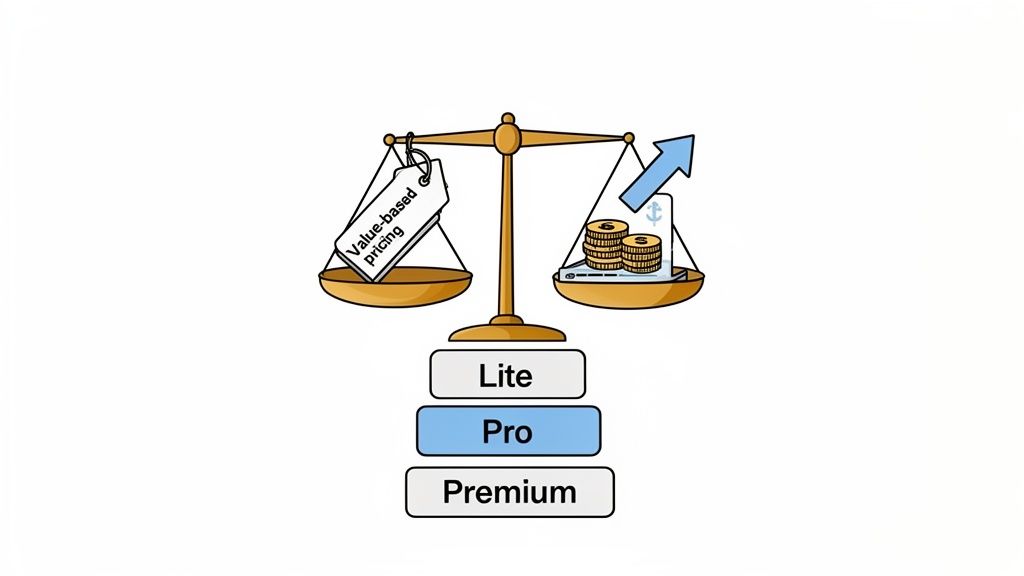
The game changes when you shift from what your product costs you to what it's worth to your customer. This is the core of value-based pricing. Instead of letting internal costs dictate the price, you anchor it to the tangible results and return on investment (ROI) you deliver. This requires getting inside your customers' heads to truly understand their pain points and how your solution nails them.
Moving Beyond Cost-Plus Pricing
To execute value-based pricing, you must quantify the value you create. Do you save clients time? Help them make more money? Reduce their operational risk? Putting a dollar figure on these outcomes gives you a defensible foundation for your price tag.
Think of it like this: a high-end software company doesn't price its product based on the cost of code. The price reflects the millions in efficiency gains or new revenue it unlocks for a client. Your pricing should capture a fair slice of the value you create for your customer.
This is a mindset shift that moves the sales conversation from cost to investment. When a customer sees a clear line from your price to a major business goal, the price itself becomes a smaller hurdle.
Tactical Pricing Models That Work
Once you adopt a value-based philosophy, you can use more sophisticated pricing structures to boost your average revenue per customer. These models align your price with the value different types of customers receive.
Here are a few proven approaches:
Tiered Pricing: Common in SaaS but effective for services, too. Create distinct packages (e.g., Basic, Pro, Enterprise) with more features and higher price points. This captures revenue from smaller customers while maximizing what you earn from large clients.
Usage-Based Models: This links price directly to consumption. A customer who uses your service more pays more—a perfect alignment of cost and value. It's ideal for cloud computing, API access, or consulting retainers based on hours used.
Strategic Bundling: Package complementary products or services together for a single price. This can increase the perceived value, encourage customers to use more of your offerings, and make your solution stickier, resulting in a larger average transaction size.
For instance, a marketing agency could ditch its flat monthly retainer for a tiered model. A "Growth" tier might cover basic SEO and social media. A "Scale" tier could add paid ad management and advanced analytics for a higher price, capturing more value from clients who need a more powerful solution.
Key Takeaway: The goal isn't just to raise prices. It's to build a pricing structure that grows with your customers. As they get more successful using your product or service, your revenue and margins should scale right alongside them.
Communicating Price Changes Effectively
Raising prices is nerve-wracking. The fear of customers leaving is real, but a smart communication plan can manage it. The trick is to demonstrate a clear increase in value that makes the new price a no-brainer.
When you roll out a price increase, consider grandfathering existing customers at their current rate for a limited time. This rewards their loyalty and smooths the transition.
Frame the change around new features, better service levels, or other upgrades that directly benefit them. When you focus on the "what's in it for them," you can successfully raise prices and improve your margins without burning your customer base.
Pulling off these kinds of changes takes financial and operational savvy that can be tough to manage internally. For many growing companies, this is where fractional leadership shines. An experienced, part-time executive can analyze your business, design a new pricing strategy, and manage the rollout to ensure you capture more value and drive profitability. If you're ready to see how an expert could reshape your pricing, exploring fractional talent might be your next best move.
Finding Savings by Tackling Costs Systematically
Pricing is a powerful lever, but sustainable profit margins must be built on a foundation of smart, systematic cost management.
This isn't about panicked, across-the-board budget cuts that kill morale and innovation. It’s a deliberate, two-pronged attack: first, reducing your Cost of Goods Sold (COGS), the direct costs of what you sell. Then, diving into the equally important world of operating expenses (OpEx).
Dissecting Your Cost of Goods Sold
Every dollar you spend creating and delivering your product or service is your COGS. Even small inefficiencies here compound over time, silently eroding your gross margin. A systematic review can uncover serious savings that flow straight to your bottom line.
Think of your supply chain like a river. An inefficient process or a poor vendor relationship slows the flow and drives up costs. Your job is to find those snags and clear them out.
Start with these key areas:
- Vendor Contract Renegotiation: Don't treat vendor agreements as "set it and forget it." As your order volume grows, so does your negotiating power. Regularly benchmark your rates and ask vendors for better terms or bulk discounts.
- Supply Chain Analysis: Map out every step, from sourcing to delivery. Where are the bottlenecks? Are you overpaying for shipping? Could a different supplier offer better quality for a similar price, reducing waste or returns?
- Strategic Automation: Hunt down repetitive, manual tasks in your production or delivery process. Investing in technology to automate these functions can dramatically reduce labor costs and minimize human error.
For example, a small e-commerce business was manually fulfilling every order. By implementing a simple inventory and shipping management software, they slashed fulfillment time by 60% and reduced shipping errors to near zero. The software paid for itself in three months, and the ongoing savings were a direct boost to their COGS.
Auditing Your Operating Expenses
While COGS is tied to sales, operating expenses are what it costs to keep the lights on—sales, marketing, admin salaries, rent, and software. This is often where "expense creep" lives, as small, recurring costs pile up unnoticed.
A thorough OpEx audit almost always reveals surprising waste. This is where a fresh, objective perspective is invaluable. It’s tough for someone on the inside to question a tool or process they’ve gotten used to.
The power of consistent cost management is clear when looking at major industries. In the S&P 500, the average gross profit margin held steady around 43% for over two decades by optimizing direct costs. High-margin sectors like Information Technology (62%) and Health Care (74%) excel at this, proving that minimizing COGS is a cornerstone of profitability. For startups, this underscores a vital strategy for growth. You can discover more insights about industry profit margins to benchmark your own performance.
Where to Find Hidden OpEx Savings
Look for savings in these common areas:
- Marketing Spend: Are you tracking the ROI on every campaign? It’s easy to pour money into channels that feel busy but don't generate profitable customers. Cut the losers and double down on what works.
- Software Subscriptions: "SaaS sprawl" is a real problem. Audit all your monthly software subscriptions. You'll likely find redundant tools, licenses for former employees, or premium features you're paying for but not using.
- General & Administrative (SG&A) Costs: Review everything from office supplies and travel expenses to professional service fees. Are there opportunities to consolidate services or negotiate better rates?
This process requires focus and expertise. For many growing companies, this is the perfect time to bring in specialized help without committing to a full-time salary. A fractional COO can dive deep into your supply chain to find efficiencies, while a fractional CFO can lead a comprehensive OpEx audit and renegotiate key contracts.
By turning a fixed executive salary into a flexible, high-impact investment, you get top-tier expertise focused squarely on improving your profit margins. To dig into more ways to trim the fat without cutting into muscle, check out our guide on 10 effective cost-reduction strategies for startups.
Optimize Your Product and Customer Mix for Profit
Chasing top-line revenue at all costs is a classic trap. Many businesses focus so intently on making more sales that they miss a critical truth: not all revenue is created equal. They pour resources into products and customers that are barely profitable—or worse, actively losing them money.
Improving your profit margins isn't just about cutting costs or hiking prices. It's about working smarter. This means taking a hard look at what you sell and who you sell it to, then aligning your operation around your most profitable activities.
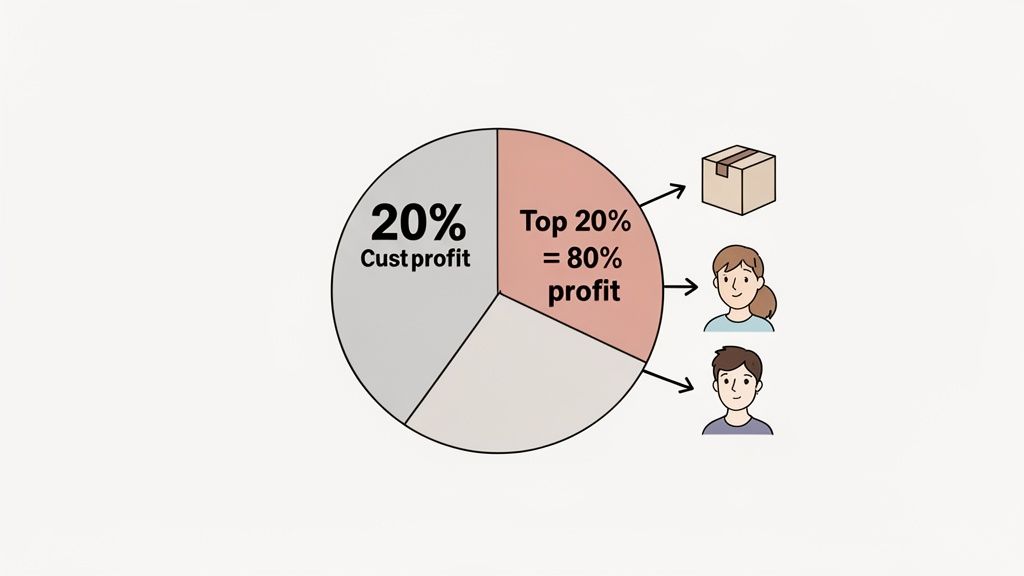
This brings us to the 80/20 rule, or the Pareto Principle. The idea is powerful: roughly 80% of your profits come from just 20% of your customers or products. Your mission is to identify that vital 20% and focus your efforts there.
Conduct a Ruthless Product Margin Analysis
First, rank every product or service you offer by its individual profit margin. This isn't just about subtracting direct costs (COGS). Factor in "soft costs" like specialized support, unique marketing spend, or high return rates that eat into profitability.
Once you have this ranked list, the path forward becomes clear. You’ll likely find a few star performers carrying the team and a surprising number of laggards dragging down the average.
For each item, especially low-margin ones, you have three core options:
- Re-engineer: Can you streamline production or delivery to lower its cost base without sacrificing quality?
- Re-price: Is the product simply undervalued? A strategic price increase can make it profitable.
- Retire: This is the tough one. But if a product consistently underperforms and drains resources, cutting it loose frees up capital and focus for your winners.
A B2B software company I know discovered one of its legacy products had a dismal 5% margin but was responsible for 30% of customer support tickets. By phasing it out, they not only boosted overall profitability but also freed up their support team to provide stellar service to their core, high-margin customers.
Identify and Double Down on Your Ideal Customers
The same thinking applies to your customer base. Some clients are great partners, while others demand excessive support, negotiate every invoice, and pay late. That extra effort directly erodes your margins.
Many agencies and service businesses find that a small number of clients are actually subsidizing the rest of the company, while several other projects are actively costing them money. Becoming aware of client-level profitability is the first step to fixing this imbalance.
To get to the bottom of this, calculate customer lifetime value (CLV) and customer acquisition cost (CAC) for different client segments. The goal is to find customers with a high CLV-to-CAC ratio who don't drain your support resources.
Once you know what your best customers look like, you can build an Ideal Customer Profile (ICP). This profile becomes the North Star for your sales and marketing, ensuring your team is laser-focused on acquiring more high-value clients.
This strategic shift gets your entire organization rowing in the same direction—towards profitable growth.
Of course, conducting this kind of deep-dive analysis is a massive undertaking for a leadership team already stretched thin. This is where bringing in a fractional CFO or COO can be a game-changer. They have the dedicated expertise to perform this analysis quickly, identify profit drains, and create an actionable plan to optimize your product and customer mix.
Driving Real Change with Fractional Leadership
A brilliant strategy for boosting profit margins is just a piece of paper without execution. For busy founders and CEOs, trying to lead a complex cost-cutting project or a full-blown pricing overhaul on top of everything else is a recipe for stalled initiatives and missed opportunities.
This is where fractional leadership becomes a game-changer. You bring the vision; a fractional executive brings the dedicated expertise and bandwidth to make it a reality. They aren't consultants who drop off a plan and disappear. They're part-time members of your leadership team, rolling up their sleeves to own the results.
Deploying Targeted Expertise Where It Matters Most
Imagine trying to build a real-time financial dashboard to track margin KPIs. Or redesigning an entire supply chain that's bleeding cash. These are massive undertakings that demand specialized skills your current team may not have. A fractional leader plugs that gap instantly.
Instead of launching a costly search for a full-time executive, you get immediate access to seasoned talent. You get C-suite expertise without the six-figure salary and long-term commitment. It's a flexible model that deploys a specific skill set precisely when and where you need it.
This mirrors how the big players operate. Over the past few decades, S&P 500 companies dramatically expanded their net profit margins from an average of 5.85% to 9.75%. How? Primarily by slashing Costs of Goods Sold (COGS) through globalization and shifting to service-based models. An analysis from T. Rowe Price shows this nearly 400-basis-point surge was driven by a 450-basis-point drop in COGS. Smaller businesses can replicate this playbook by bringing in fractional executives to spearhead similar strategic moves. You can read more about how large firms became profit giants and borrow from their strategies.
Matching Fractional Executives to Margin Improvement Goals
The key is matching the right executive to your most pressing margin challenge. This table connects common business pain points to the ideal fractional role, showing where you'll get the fastest and most significant return.
| Margin Challenge | Key Initiative | Ideal Fractional Executive | Expected Outcome |
|---|---|---|---|
| Declining Gross Margins | Overhauling the supply chain & renegotiating vendor contracts. | Fractional COO | Reduced COGS and improved production efficiency. |
| Stagnant or Low Prices | Developing and implementing a value-based pricing strategy. | Fractional CMO / CRO | Increased Average Revenue Per Customer (ARPC) and higher transaction values. |
| Bloated Operating Costs | Conducting a full audit of OpEx, including software & SG&A. | Fractional CFO | Lowered overhead and elimination of wasteful spending. |
| Unclear Profit Drivers | Analyzing product/customer profitability to focus resources. | Fractional CFO / COO | Strategic focus on high-margin activities and clients. |
This isn't just about hiring an executive; it's about hiring a targeted solution to a problem that's draining your profitability. To get a better handle on the different roles and their impact, take a look at our in-depth guide on the core principles of fractional leadership.
A fractional executive’s greatest asset is their objectivity. Unburdened by internal politics or historical baggage, they can ask the tough questions, challenge the status quo, and make the difficult decisions required to drive meaningful financial change.
Hiring a fractional executive simply gets things done faster. A part-time CFO can build the financial models you need in weeks, not months. A fractional COO can start streamlining your operations from day one. That speed is critical for turning strategic goals into measurable improvements on your bottom line.
If you know you need to make a change but lack the internal bandwidth or specific expertise, it’s a clear sign that fractional leadership should be your next move.
Answering Your Toughest Questions on Profitability
Getting serious about profit margins always brings up tough questions. Here are straight, actionable answers to the most common ones.
What Is a Good Profit Margin for a Small Business?
A "good" profit margin depends entirely on your industry. A retail business might thrive with a 2-5% net margin, while a healthy software company should aim for 20% or more.
Your first move should be to benchmark your numbers against industry averages. But the real indicator of health is your own trendline. If your margins are consistently improving, that's the best sign of strong financial management.
Focus on continuous improvement, not a single static number. A business hitting a 5% margin that was at 2% last year is often in a much stronger position than one sitting at a stagnant 15% for the past three years.
How Can I Increase Prices Without Losing Customers?
The secret is tying the price increase directly to an increase in value. Before you announce a change, you need to be able to clearly explain the "why"—is it new features, better service, or some other tangible improvement?
This simple shift changes the conversation from being about cost to being about investment.
A battle-tested tactic is to introduce the new pricing for new customers first. For your loyal customers, you can soften the blow by:
- Grandfathering their current rate for a set period as a thank-you for their loyalty.
- Offering an exclusive discount if they upgrade to a more valuable plan.
This approach respects your existing relationships while still steering the business toward a more profitable future.
Where Should I Start Looking to Cut Costs?
When you need to trim the fat, start with your operating expenses (OpEx). These are usually the lowest-hanging fruit—the easiest to cut without hurting your core product.
A full audit of your software subscriptions is a great place to begin. It's common to find businesses paying for redundant tools or unused licenses. Next, review all your vendor contracts for things like marketing, IT support, or professional services. These are prime candidates for renegotiation.
Analyzing your Cost of Goods Sold (COGS) is critical for long-term impact but is a more complex job. A fractional CFO can provide the expert eye needed to quickly pinpoint the biggest savings opportunities across both OpEx and COGS.
When Is the Right Time to Hire a Fractional Executive?
The perfect time to bring in a fractional executive is when you've pinpointed a clear problem or opportunity but lack the specific in-house expertise or leadership bandwidth to tackle it. If your margins are flatlining and you've tried the obvious fixes, that's a huge sign you need a fresh, expert perspective.
Another key trigger is rapid growth. Scaling fast often creates new inefficiencies that quietly eat away at your profits. A fractional leader proactively embeds strategic oversight into your operations, ensuring your profitability grows alongside your revenue. It's an investment in smarter, more sustainable scaling.
Turning a margin improvement plan into reality takes focused expertise. If you're ready to see how a seasoned expert can transform your bottom line, our network of vetted fractional leaders can help you achieve your goals.
Schedule a consultation with our team to find the right fractional leader for your business.