Integrity as a Core Value: Your Startup’s Growth Engine
A founder promises a key customer a feature by quarter-end. Product knows the timeline is shaky. Sales wants the deal closed. The engineering lead stays quiet because nobody wants to be the person who slows momentum. Three months later, the feature slips, the customer loses confidence, and the team spends more energy managing fallout than building.
That situation rarely starts with fraud or obvious misconduct. It starts with small breaks between what a company says and what it does. In startups, those breaks spread fast. A vague pipeline update becomes an unrealistic forecast. A rushed hire becomes a cultural problem. A “temporary workaround” becomes standard operating behavior.
That's why integrity as a core value matters more in a growth company than in a slide deck. It protects execution. It sharpens decision-making. It tells employees, customers, and investors what kind of company they're dealing with when pressure rises.
The financial stakes are not abstract. The cost of dishonesty is materially high. The Association of Certified Fraud Examiners' 2024 Report to the Nations found that a typical organization loses 5% of revenue to fraud each year, with a median loss of $145,000 per case and a median fraud duration of 12 months before detection, as summarized in this breakdown of integrity as a core value. For an early-stage or mid-market company, that kind of drag can change hiring plans, product timelines, and runway.
Beyond the Buzzword Why Integrity Matters Now

Most founders say integrity matters. Fewer build it into how work gets done.
That gap gets expensive when a company is moving fast, operating hybrid, and relying on distributed teams or outside leaders. If your head of finance is fractional, your sales leader is remote, and your product team spans time zones, you can't rely on hallway visibility. You need operating rules people can follow when nobody is watching.
Where startups usually get this wrong
Early teams often treat integrity as a character trait instead of a management system. They assume good people will make good choices. Sometimes they do. But pressure exposes ambiguity.
Common failure points look like this:
- Unclear decision rights: Two leaders think they own the same call, so they tell different stories to the team.
- Optimistic reporting: A founder keeps “stretching the truth” on revenue, hiring, or delivery because an accurate answer feels too risky.
- Selective transparency: Bad news travels slowly upward, while good news travels instantly.
- Values without enforcement: The company says it cares about accountability, but nobody faces consequences for missed commitments.
Integrity is what your company does when a truthful answer costs you something.
The startups that scale cleanly don't eliminate hard trade-offs. They make those trade-offs visible. They state what happened, who owns the next move, and what standard applies.
Why this matters even more with fractional leadership
A full-time executive can build trust over months of repetition. A fractional executive has less time and fewer touchpoints. That changes the job. Every meeting, decision, and follow-up has to reinforce reliability.
If integrity is weak, fractional leadership becomes harder. People second-guess motives. Teams hoard information. Founders keep work on their own plate because delegation feels unsafe.
If integrity is strong, the opposite happens. People know how decisions get made. They know what gets escalated. They know bad news won't be punished just for being bad news. That's not soft culture work. It's an operational force multiplier.
Defining Your North Star What Integrity Actually Is
Integrity isn't just honesty. Honesty matters, but by itself it's too narrow for a business that has to hire, forecast, negotiate, ship, and recover from mistakes.
A better way to think about integrity is as the foundation slab under the company. You don't see it in every meeting, but you feel it whenever pressure hits. If the foundation is weak, every floor above it shifts.
A strong definition comes from the U.S. National Academies' report Fostering Integrity in Research, which frames integrity around six core values: objectivity, honesty, openness, accountability, fairness, and stewardship, and treats integrity as a system-level requirement, not just a personal virtue, in the National Academies framework.
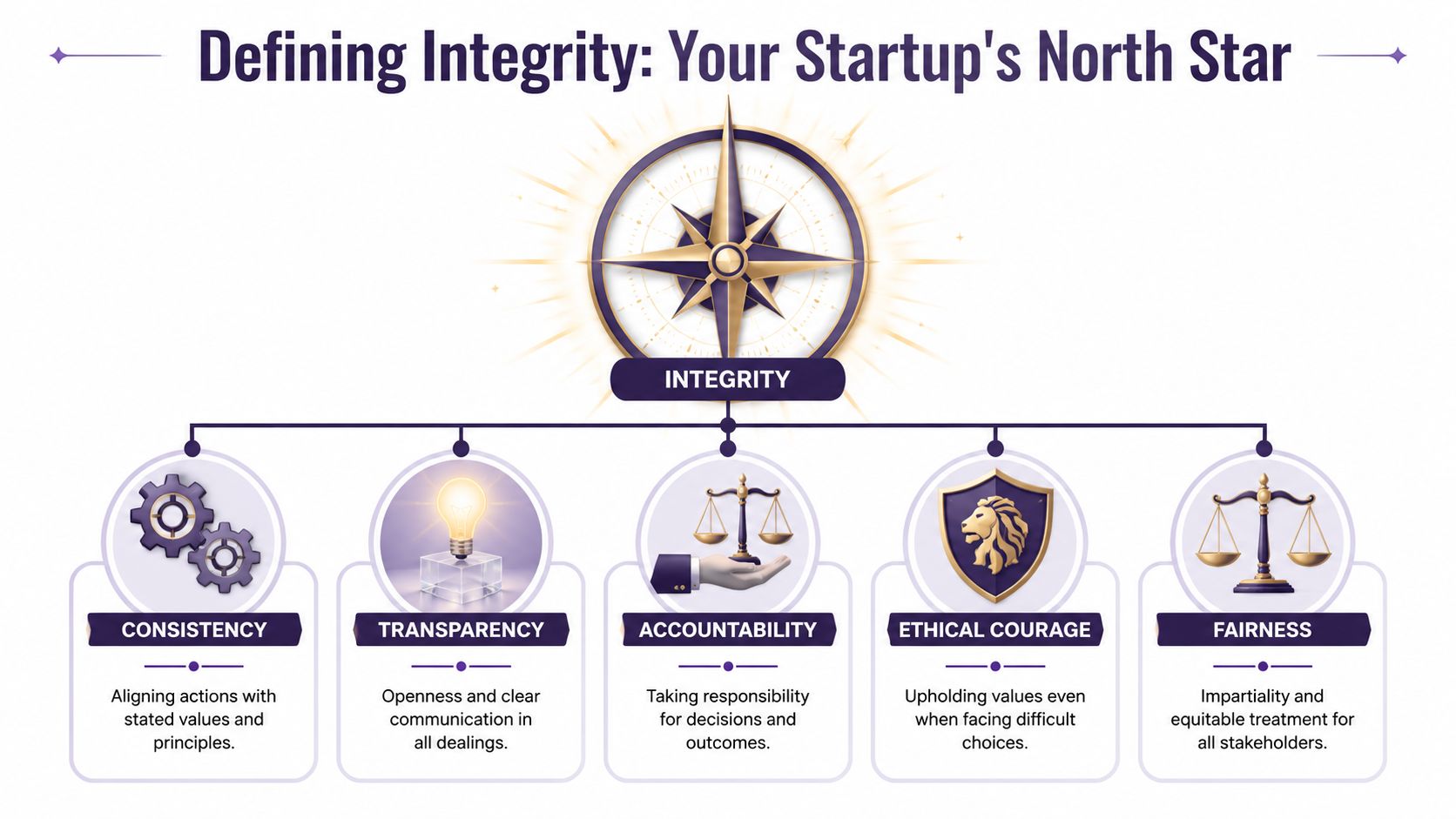
What those values look like in a startup
These ideas only matter if they show up in real operating choices.
- Objectivity: Your leadership team reviews pipeline, churn, margin, or hiring data without twisting it to support a preferred story.
- Honesty: Sales doesn't promise product capabilities that don't exist. Finance doesn't hide cash constraints. Founders don't pretend certainty where there isn't any.
- Openness: Teams share context early enough for others to act on it. A delayed launch isn't buried until the all-hands.
- Accountability: Leaders own outcomes in public. They don't disappear when a bet fails.
- Fairness: Performance standards apply across roles and personalities, not just to the people with the least political capital.
- Stewardship: Leaders treat budget, brand, systems, and team energy as assets they're responsible for preserving, not resources to burn through casually.
Why values fail in practice
Most companies don't struggle because their values are missing. They struggle because their values are vague.
“Be honest” sounds good, but it doesn't tell a sales leader how to handle a shaky forecast. “Do the right thing” doesn't help a COO decide whether to disclose an operational miss before a board meeting or after it.
That's why founders need translation, not slogans. If you're refining your company's value system, this guide on core values in business is useful because it pushes values out of branding language and into operating behavior.
A value becomes real when two managers facing the same dilemma make the same kind of decision for the same reason.
That's the north star. Not inspirational wording. Repeatable judgment.
Integrity as a Strategic Advantage for Startups
Startups don't get many free passes. Customers are evaluating whether to trust a smaller vendor. Candidates are deciding whether leadership is credible. Investors are testing whether numbers can be believed. In that environment, integrity isn't defensive. It's strategic.

One practical way to view it is this. Integrity reduces friction in the same way clean code reduces engineering drag. You still have complexity, but you spend less time fixing avoidable messes.
A business-focused view makes this clear. Integrity acts as a compounding trust asset and a risk-reduction parameter. For part-time executives who need to establish decision rights quickly, integrity lowers the “trust establishment time,” which enables faster delegation and less managerial overhead, as described in this business perspective on honesty and integrity.
Trust moves faster than process
Founders often try to solve trust problems with more approvals, more meetings, and more reporting layers. Some controls help. Too many create sludge.
Integrity works differently. It gives people confidence that:
- Commitments mean something
- Escalations won't be politicized
- Mistakes will be addressed instead of hidden
- Decision criteria will stay stable under pressure
That's a major advantage when a startup adds fractional leadership. A part-time CMO, CFO, or COO doesn't have the luxury of weeks spent decoding hidden agendas. They need to enter a system where expectations are legible.
Where integrity creates measurable leverage
You can see the strategic upside in several areas.
| Business area | What integrity changes |
|---|---|
| Customer relationships | Buyers hear a consistent story across founder, sales, and delivery teams |
| Hiring | Strong candidates see a company that won't bait-and-switch on role scope or expectations |
| Execution | Teams spend less time re-checking decisions and more time moving |
| Crisis response | Leaders can correct course quickly because people trust the facts being shared |
This is one reason experienced operators often look beyond compensation when evaluating a company. They want to know whether leadership tells the truth early, handles conflict directly, and follows the same rules it asks others to follow.
If your team needs a decoder ring to understand what leadership really means, integrity is weak.
The startup trade-off nobody likes to name
Sometimes integrity costs you speed in the short term.
You may lose a deal because you refuse to overpromise. You may delay a hire because references reveal inconsistency. You may reset a plan because the original forecast wasn't credible.
Those moments feel expensive. But the alternative usually costs more. Teams lose trust in leadership. Customers stop believing timelines. Founders start managing around people instead of through them.
That's when growth gets noisy. Revenue may still come in, but the operating system starts to crack.
How to Embed Integrity in Your Company Culture
Integrity depends on consistency between beliefs and behavior. One practical explanation breaks it into two parts: consensus, meaning a shared moral framework, and consistency, meaning those values show up repeatedly in real decisions. When consistency is missing, integrity weakens even if the value is stated clearly, as explained in this reflection on integrity attributes.
That's the core problem founders have to solve. Not writing better values. Building repeatable behavior.
Start with leadership habits
Culture copies the worst tolerated behavior of senior people faster than it copies the best stated intention.
If the founder says “speak openly” but punishes dissent in staff meetings, silence is the underlying value. If the leadership team says “we own mistakes” but blames execution whenever a plan fails, self-protection is the underlying value.
A few habits matter more than posters or town hall language:
- Say what changed: If a target moved, explain why it moved and what assumption broke.
- Correct in public when needed: When leaders reverse a bad call openly, they teach accountability better than any handbook.
- Separate bad news from bad performance: Missing a target can be acceptable. Hiding the miss usually shouldn't be.
- Keep commitments small and concrete: Teams trust leaders who do what they said they'd do by Friday, not leaders who give stirring speeches about excellence.
Make policies visible and usable
A company with real integrity doesn't leave important decisions to folklore.
Policies should be easy to find, plain enough to understand, and specific enough to guide action. That applies to hiring, promotions, expense approvals, performance management, compensation reviews, and customer escalations.
Useful policies answer questions like:
- Who can approve exceptions?
- What gets documented?
- When does an issue move from manager to executive owner?
- How do we handle conflicts of interest?
- What happens when a leader breaks the standard?
If you're rebuilding the environment around your values, this resource on how to build company culture can help translate broad principles into team rituals and manager behavior.
Practical rule: If a policy only works when the founder explains it live, it isn't embedded yet.
Build psychological safety without lowering standards
Some founders hear “safe culture” and worry it means lower accountability. It doesn't.
Psychological safety means people can raise concerns, admit uncertainty, and surface mistakes without fear of humiliation or political retaliation. It does not mean all behavior is acceptable.
A practical way to build this is to run short dilemma reviews in leadership or team meetings. Use recent situations, not hypotheticals. Ask:
- What was the tension?
- What value applied?
- Where did we act consistently?
- Where did we drift?
- What should we do next time?
That kind of review creates shared judgment. It builds consensus. Over time, people stop guessing what the company stands for because they've seen it applied.
Hiring Executives Who Live Your Values
Hiring a senior leader is not just a capability decision. It's a values transfer.
A founder can survive one mediocre manager. A company often struggles for a long time after the wrong executive hire. Senior leaders set tone, create exceptions, and teach the organization what “acceptable” looks like when targets are under pressure.
The challenge is that most executive candidates know how to talk about integrity. The weak ones use polished language. The strong ones describe trade-offs, consequences, and moments where telling the truth had a cost.
What to listen for in interviews
The best integrity interviews sound less like philosophy and more like postmortems. Ask for specifics. Ask what was at stake. Ask who disagreed. Ask what happened after the decision.
Use questions like these:
| Question Category | Example Question |
|---|---|
| Bad news delivery | Tell me about a time you had to deliver bad news to a client, board, or team. How did you handle it? |
| Pressure and trade-offs | Describe a situation where hitting the target conflicted with doing what you believed was right. What did you choose? |
| Accountability | What's a decision you made that backfired? How did you communicate it and what did you change afterward? |
| Consistency | Have you ever inherited a team using practices you disagreed with ethically or operationally? What did you do first? |
| Transparency | When have you chosen to share uncertainty instead of projecting confidence? |
| Fairness | Tell me about a time you had to apply the same standard to a high performer that you'd apply to anyone else. |
Strong answers usually include tension, ownership, and a clear decision standard. Weak answers drift into abstractions, blame, or self-congratulation.
Reference checks should test behavior, not biography
Many founders waste reference calls by confirming dates and titles. That tells you almost nothing.
Ask former peers, managers, and direct reports questions that reveal pattern:
- When this person was under pressure, did they become more transparent or less?
- Did they tell hard truths early?
- Were they consistent across different stakeholders?
- Did they create trust, or did people route around them?
A good search process also matters. If you want a better structure for identifying and vetting senior talent, this guide on how to hire executives is a practical starting point.
The signal most founders miss
Watch how the candidate handles ambiguity during the process itself.
Do they oversell their availability? Do they dodge uncomfortable questions? Do they change their story between interviews? Do they treat coordinators and junior staff with the same respect they show the CEO?
Those signals often tell you more than a polished final-round presentation.
Find Your Values-Aligned Fractional Leader with Shiny
For startups, integrity becomes real when it changes how decisions are made, how issues get surfaced, and who gets trusted with authority. That's especially important when you bring in senior talent on a fractional basis. A part-time executive can create outsized value, but only if the founder and team can trust their judgment quickly.
That means integrity should be measured in operations, not admired in theory.
What to track in practice
You don't need a complicated scorecard to know whether integrity as a core value is alive in the business. You need observable signals.
Look for patterns such as:
- Commitment reliability: Do leaders do what they said they'd do, when they said they'd do it?
- Escalation quality: Does bad news reach decision-makers early enough to act?
- Cross-functional consistency: Do sales, finance, product, and operations tell the same truth about reality?
- Exception discipline: Are rules applied consistently, especially to senior people and top performers?
- Reference quality in hiring: Do former colleagues describe the candidate as trustworthy under pressure, not just competent?
What good looks like
A healthy company doesn't eliminate conflict. It shortens the gap between issue and response.
People speak up sooner. Forecasts get more credible. Customers hear cleaner communication. Founders delegate more because they aren't compensating for hidden risk in the system. Fractional leaders ramp faster because expectations are visible and stable.
That's the payoff. Less drama. Fewer surprises. Better judgment at speed.
Companies rarely lose trust all at once. They lose it through repeated moments where stated values and lived behavior no longer match.
If you're serious about scaling without carrying unnecessary leadership overhead, the right executive partner matters as much as the strategy itself.
Shiny helps founders find fractional executives through Shiny who can contribute at a senior level without the cost and rigidity of a full-time hire. If you need a values-aligned leader in finance, operations, sales, marketing, or another key function, it's worth exploring the network or scheduling a consultation to find the right fit.