A Founder’s Guide to Interim Executive Recruitment
Think of your business like a high-performance race car. Sometimes, you don't need a whole new engine; you just need a world-class pit crew chief for a few crucial laps. That's interim executive recruitment in a nutshell: hiring a seasoned leader for a temporary, mission-critical assignment.
This approach gives you immediate access to specialized expertise without the long-term financial handcuffs of a full-time hire. It’s an incredibly powerful tool for navigating big changes, plugging leadership gaps, and seizing growth opportunities with confidence.
The Strategic Power of Interim Executive Recruitment

Imagine your company is navigating a tricky market. Hiring a permanent executive is like building a new car from scratch—a massive, expensive, and time-consuming overhaul.
On the other hand, interim executive recruitment is like bringing in a specialist to fine-tune your engine for a specific race. These pros diagnose issues on the fly, optimize performance, and get you back in the lead faster and more affordably. They aren't just placeholders; they are strategic catalysts brought in to drive growth and stability.
A Modern Approach to Leadership
Historically, interim leaders were seen as a stopgap solution—someone to just keep the seat warm. Today, that perception has completely flipped. Fast-growing companies now see on-demand executives as a strategic lever for agility, not just a temporary fix.
This model is especially powerful for businesses staring down specific challenges that demand immediate, specialized knowledge. A few scenarios where this approach shines include:
- Navigating market shifts: An interim expert can steer your company through unexpected industry changes or economic turbulence.
- Leading critical projects: When launching a new product or expanding into a new market, an experienced leader ensures you hit your goals.
- Filling critical skills gaps: Need to professionalize your finance or marketing department? Bringing in a seasoned CFO or CMO for a short period gets it done without long-term overhead.
This strategic shift is reflected in the numbers. The global interim executive market is projected to hit $11.8 billion by 2027, with usage jumping to 78% of companies. This surge shows just how appealing the model is for filling critical gaps without long-term commitments. You can explore more about how short-term leaders drive long-term results to dig deeper into this trend.
Gaining a Competitive Edge
Ultimately, interim leadership is about getting immediate access to seasoned expertise. It allows founders to tackle their biggest challenges with confidence. Whether it’s scaling a sales team, locking down a new round of funding, or managing a complex business transformation, the right interim executive delivers impact from day one.
By embracing this flexible approach, companies can keep their momentum, de-risk critical projects, and build a more resilient organization. It’s all about getting the right talent, at the right time, for the right mission.
When to Hire an Interim Executive
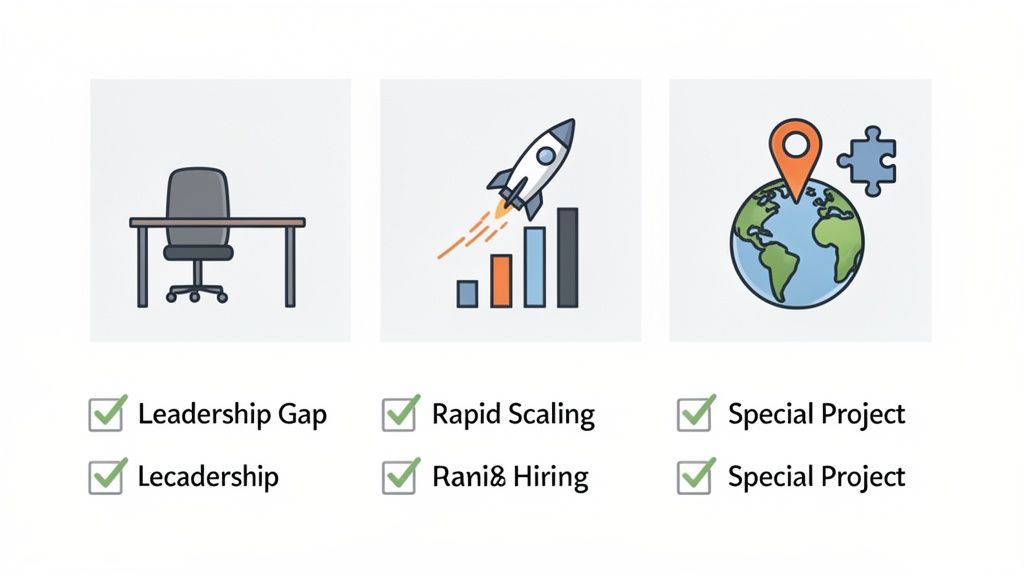
Knowing the right moment to bring in an interim leader is a critical skill. It’s not about a specific date, but about recognizing business triggers—those sharp pain points that signal an urgent need for seasoned, high-caliber expertise.
Think of these triggers less as problems and more as inflection points where the right leadership can unlock massive growth. Knowing the signs helps you act decisively, turning a potential crisis into a strategic advantage. It’s the difference between reacting to a fire and proactively fireproofing your organization.
The key is to see interim executive recruitment as an offensive strategy, not just a defensive patch.
Responding to Sudden Leadership Voids
The most obvious trigger is a sudden departure. A key executive resigns or takes unexpected leave, and suddenly there’s a leadership vacuum. Operations can stall, team morale can plummet, and strategic momentum can evaporate.
A traditional executive search can take four to six months—a timeline most fast-moving companies can't afford. An interim executive can be in the door within weeks, ensuring business continuity. They are often overqualified, allowing them to stabilize the team, maintain performance, and give you the breathing room to find the perfect permanent hire without rushing a bad decision.
Navigating Periods of Rapid Scaling
Growth is exhilarating, but it can stretch your leadership team to its breaking point. When you’re scaling quickly, you’ll inevitably face challenges your current team has never seen before. This is a classic signal that it's time to bring in outside help.
For instance, a fast-growing startup might need to professionalize its finances for a Series A round. An interim CFO with deep fundraising experience can be a game-changer. They build financial models, establish investor-ready reporting, and guide you through due diligence—a highly specific mission your current team might not be equipped to handle.
"The Interim model offers the client organisation access to a skilled and experienced work force that avoids the legal commitments and risks entailed through permanent employment contracts.”
This flexibility is exactly what you need during intense growth. You get the precise expertise required, for the exact duration it’s needed, without the long-term fixed cost of a C-suite salary. It's a lean, effective way to manage the financial pressures of scaling.
Leading Specialized, Mission-Critical Projects
Sometimes, the need isn’t for a permanent role at all. You just need a temporary specialist to lead a high-stakes, one-off initiative. These projects demand deep domain knowledge that simply isn’t necessary for your business in the long run.
Think about these common scenarios:
- International Expansion: An interim executive with experience launching in a new market can navigate the complex legal, cultural, and logistical hurdles.
- Digital Transformation: Rolling out a new ERP system or overhauling your tech stack requires a leader who has done it before and can manage the change without derailing the business.
- Mergers & Acquisitions: An interim leader can take the reins on the integration process, ensuring a smooth transition and minimizing disruption.
By recognizing these triggers, you can strategically use interim executive recruitment to solve specific problems and jump on new opportunities.
Leveraging the Fractional Leadership Advantage
While a traditional interim executive is powerful, the fractional model brings a new level of flexibility and cost-efficiency. This modern approach is a game-changer for ambitious startups and growing businesses. It's less about filling a full-time gap and more about getting precise, surgical expertise exactly where—and when—you need it most.
Imagine having a top-tier Chief Marketing Officer on your team, but only for 10 hours a week. They sharpen your strategy, mentor your team, and oversee key campaigns, all for a sliver of a full-time executive salary. This is the heart of the fractional advantage: it makes elite talent accessible to companies that would otherwise be priced out.
The fractional model is different from a standard interim role. You're not just getting a full-time, temporary placement. Instead, a fractional executive integrates into your team on a part-time, ongoing basis. It’s the perfect fit for roles that don't yet demand a 40-hour-a-week commitment but absolutely require senior-level strategic guidance.
The Strategic Value of On-Demand Expertise
The biggest benefit of fractional leadership? It helps you sidestep the common startup mistake of over-hiring. Founders often feel pressure to build out a complete C-suite, but dropping a six-figure salary on a role that truly only needs 15 hours of high-level work can incinerate precious capital. A fractional executive fills that strategic void without the crippling financial weight.
This approach lets you stay lean while tapping into a diverse pool of highly specialized experts. For instance, you could have a fractional CFO professionalizing your financial reporting while a fractional CRO builds out a scalable sales process. You get the right expert at the right time.
A fractional executive isn’t a consultant who just doles out advice from the sidelines. They are an operator who rolls up their sleeves and gets things done. They take ownership of outcomes, manage team members, and drive real results, becoming a genuine part of your leadership team.
This hands-on approach ensures that brilliant strategies actually get implemented, and in the process, they transfer invaluable knowledge to your permanent staff.
A Modern Model for Scalable Growth
The fractional model is a perfect match for the needs of today's agile businesses. In fact, fractional executives have already captured 23% of the traditional interim market in just 18 months by delivering 40-60% cost savings over their full-time interim counterparts. For entrepreneurs running companies between $1M and $50M, this model provides the on-demand strategic firepower needed to slash C-suite costs.
This shift empowers founders to build their dream leadership team piece by piece. Instead of making one massive, high-stakes hiring decision, you can bring on multiple fractional leaders to cover different functions.
Here’s how a fractional approach supports different growth stages:
- Early-Stage Startups: Get foundational strategic direction in marketing, sales, or finance without the crushing cost of a full-time hire.
- Growth-Stage Companies: Scale specific departments with seasoned leaders who have already navigated the challenges of rapid expansion.
- Established Businesses: Launch new products or enter new markets with specialized expertise you don't need on the payroll forever.
Ultimately, fractional leadership is more than a hiring trend—it's a strategic move to build a more resilient, adaptable, and capital-efficient company. You can dive deeper into this powerful approach in our strategic guide to the fractional C-suite advantage.
How to Navigate the Hiring Process
Hiring an interim or fractional executive is all about speed and precision. The entire mindset is different from a traditional search. You're not just filling a role; you're zeroing in on a specific, high-stakes mission that needs an immediate solution.
Forget the generic job description. Instead, define a critical problem that's holding you back. This shift ensures you land a leader who isn't just warming a seat but is geared up to deliver tangible results from day one.
Define the Mission and Success Metrics
Before you even look at a single profile, create a sharp, outcome-focused brief. Think of this as your North Star. It’s not about listing day-to-day duties; it’s about defining the problem and what winning looks like in 30, 60, and 90 days.
Your brief should answer a few key questions:
- The Core Problem: What specific challenge is blocking our growth? Is it a messy sales process, unreliable financial reports, or a fast-approaching product launch?
- Key Deliverables: What are the non-negotiable outcomes? This could be "implement a new CRM" or "secure three enterprise pilot customers."
- Success Metrics: How will you measure success? Be specific. "A 20% reduction in customer churn" or "securing $5 million in a seed extension."
This focused approach attracts leaders who live for solving complex problems and hitting measurable targets. For more on this, check out our guide to the executive search process.
The diagram below breaks down the core value drivers behind fractional leadership, which are often at the heart of these mission-based engagements.
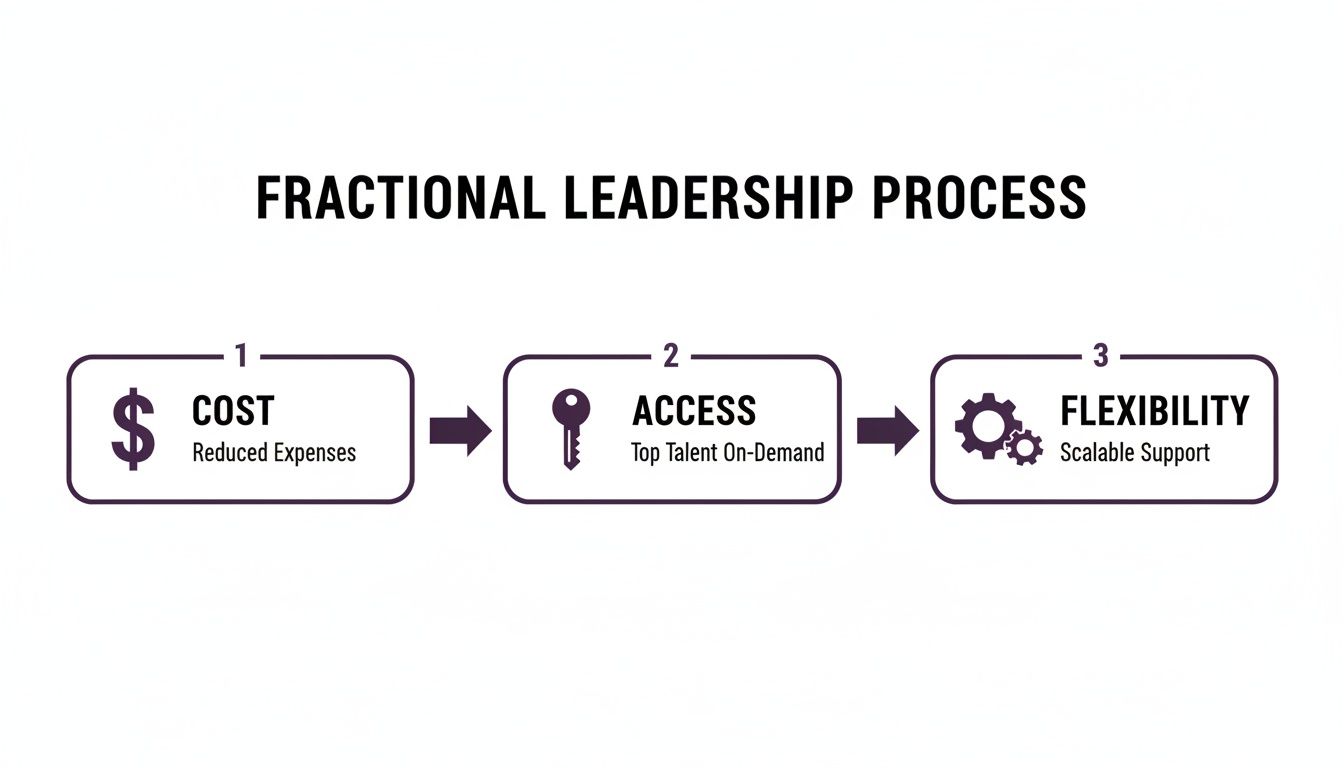
This process shows how companies can slash costs, tap into top-tier talent, and stay nimble by bringing on interim and fractional leaders.
Simplify the Search and Vetting
Once your mission is locked in, modern marketplaces completely change the game. Forget about tapping out your personal network or shelling out for expensive retained search firms. You get instant access to a huge, pre-vetted talent pool.
These platforms use your mission brief to match you with candidates whose track records are a perfect fit for your specific needs. This data-driven approach cuts the time-to-hire down dramatically. You're no longer buried under hundreds of irrelevant resumes; you get a curated shortlist of pros ready to make an immediate impact.
Master the Interview Process
Interviewing an interim candidate is different. You’re not trying to gauge long-term cultural fit. The focus is laser-sharp: have they delivered results in situations just like yours?
Ditch the "Where do you see yourself in five years?" questions. Instead, focus on past performance. Ask, "Tell me about a time you scaled a sales team from $1M to $5M ARR."
You're hiring a problem-solver on demand. Their past wins are the best predictor of their future performance. A huge chunk of these leaders are seasoned pros; in fact, 54% are baby boomers who choose flexible gigs over full retirement, with over 53% having served in top roles like CEO, CFO, or VP. That deep well of experience is exactly what you’re paying for.
Accelerate the Onboarding
Getting an interim executive up to speed has to be fast and efficient. There’s no time for a slow ramp-up. The goal is to empower them to start making an impact from the moment they walk through the door.
A solid onboarding plan looks like this:
- Immediate Access: Get them access to all the systems, documents, and data they'll need before their official start date.
- Key Stakeholder Meetings: Line up introductions with the leadership team and direct reports within the first 48 hours.
- Mission Brief Review: On day one, walk them through the outcome-focused brief to align on goals and confirm the 30-60-90 day plan.
By following this streamlined process, you can hire and onboard a high-impact leader in a fraction of the time it takes to fill a permanent role.
Measuring the ROI of Your Interim Executive
So, how do you actually measure the value of an interim executive? It’s not just about plugging a hole in the org chart. It’s about the direct, measurable impact they make. Fast.
Unlike a full-time hire where success can be a slow burn, an interim engagement is a high-impact sprint. To justify the investment, you need a clear way to measure their return on investment (ROI).
This starts before they even walk in the door. The key is to define crystal-clear Key Performance Indicators (KPIs) tied directly to their mission. Without these, you're just crossing your fingers. With them, you have a blueprint for success.
Setting Quantifiable KPIs
Think of your interim leader as a specialist brought in to solve a very specific problem. You should measure their success against tangible results that are directly linked to that problem.
For example, if you’re using interim executive recruitment to turn around a struggling sales team, the KPIs need to reflect that mission.
- For an Interim Head of Sales: A 20% increase in qualified leads within 90 days or chopping the sales cycle by 15%.
- For an Interim COO: Rolling out a new ERP system on time and on budget, or finding a 10% reduction in operational costs.
- For an Interim CFO: Closing a specific funding round or getting the books investor-ready by the end of the quarter.
When you set these kinds of clear, time-bound goals, the value they deliver becomes undeniable. It changes the conversation from "What did they do all day?" to "Here's the exact financial and operational impact they delivered."
Looking Beyond the Numbers
While hard metrics are critical, the full ROI of an interim executive almost always includes powerful qualitative benefits that create long-term value. These leaders are seasoned operators who do more than just check boxes; they elevate your entire organization.
An interim executive is a catalyst for change. They are brought in to be hands-on operators, not just advisors, which means their impact is designed to be immediate and lasting. They solve the immediate problem while simultaneously strengthening your team for the future.
Capturing Qualitative Success
Think about the ripple effect of having a world-class operator embedded in your team. These "softer" returns often lay the foundation for future growth and can be just as valuable as hitting a revenue target.
Common qualitative wins include:
- Knowledge Transfer: Your permanent team soaks up best practices from a seasoned expert, creating a lasting upgrade in your team's capabilities.
- Improved Team Morale: A strong, decisive leader can stabilize a department, provide clear direction, and re-energize a drifting team.
- Enhanced Strategic Clarity: An outside perspective can cut through internal politics and bring the clarity needed to make tough calls.
By tracking both the numbers and the narrative, you get the complete picture of the value your interim executive delivers. If you're ready to find a leader who can deliver this kind of measurable impact, our platform connects you with vetted executives ready for their next mission.
Find Your Next Leader with a Trusted Partner
Finding and hiring an interim executive can feel like a full-time job. The traditional path—sourcing, vetting, and interviewing—eats up time and pulls your focus from what really matters: running your business. It's a process loaded with risks, from maxing out your personal network to the massive financial sting of a bad hire.
But what if you could sidestep all that chaos? The right partner transforms a painful task into a strategic advantage. A modern, curated marketplace becomes your dedicated recruitment engine, connecting you with the exact leadership you need, right when you need it.
Overcoming Common Hiring Hurdles
Founders usually run into two big roadblocks when hunting for executive talent: limited reach and sky-high risk. Your immediate network is a great start, but it's finite. Too often, this leads to settling for the "best available" person in your small circle, not the best possible person for the job.
On top of that, the pressure to fill a critical leadership gap can force a rushed decision. Without a solid vetting process, you risk bringing on a leader who doesn’t have the specific experience to solve your unique problem. That’s a mistake that can set you back months, both financially and strategically.
A trusted platform is designed to eliminate these barriers by giving you instant access to a deep, pre-vetted talent pool.
Instead of hoping for a lucky connection, you tap into a curated ecosystem of proven operators. This de-risks the entire process. You can be confident that every candidate you meet is not only qualified but also laser-focused on the mission-critical goals of your business.
The Power of a Vetted Talent Marketplace
Imagine you need a fractional Chief Revenue Officer who has scaled a SaaS company from $5M to $20M ARR. A specialized marketplace doesn't just hand you a generic sales leader. It connects you with executives who have a documented track record of hitting that exact milestone.
That’s the real value of a partner in interim executive recruitment. These platforms deliver:
- Instant Access to Top-Tier Talent: Get connected with thousands of vetted executives across every key function—from finance and marketing to operations and technology.
- Automated Matching: Simply post your specific needs and get a shortlist of perfectly matched candidates, saving you from endless hours of manual searching. You can learn more about how specialized platforms stack up against traditional recruitment agencies for professionals in our detailed guide.
- A Streamlined Process: Everything from scheduling interviews to handling onboarding is designed to be fast and frictionless, so you can lock in your ideal leader and get back to work.
When you use a dedicated marketplace, you're not just hiring one person. You're plugging into a proven system built for precision, speed, and success, empowering you to find the fractional or interim leaders who will drive your next chapter of growth.
Answering Your Questions About Interim Executives
Jumping into the world of interim executive recruitment can feel like a big step. Founders and leaders usually have a few practical questions about speed, cost, and how these roles are really different from other types of help. Getting straight answers is the only way to feel confident you're making the right move.
Let’s tackle the most common questions we hear.
How Quickly Can I Actually Hire an Interim Executive?
This is where the model really shines: speed. A traditional C-level search can easily drag out for four to six months. An interim leader? We've seen them sourced, interviewed, and getting to work in just a few weeks.
This isn't an accident; the entire process is built for urgency. Marketplaces and specialized firms have pools of pre-vetted executives ready to go. You’re not starting from scratch; you're connecting with qualified candidates almost immediately. For businesses facing a challenge where every day counts, that speed is a game-changer.
What’s the Real Difference Between an Interim Executive and a Consultant?
This one is critical. Think of a consultant as an advisor. They come in, analyze a problem, and hand you a strategic roadmap or a set of recommendations. Their job is to deliver the "what" and the "why."
An interim executive is a hands-on operator. They don't just advise—they do. They join your leadership team, take full ownership of a department, manage people, and are held accountable for hitting specific goals. They roll up their sleeves and get in the trenches with your team to drive results.
Aren't Interim Executives Just for Big Companies?
That's a myth that’s long been busted. Today, startups and fast-growing companies are some of the biggest fans of interim and fractional talent. The model is so flexible and cost-effective that it’s a perfect match for businesses trying to stay lean while punching above their weight.
For example, we see startups use interim leaders all the time to:
- Quickly scale a sales or marketing function without taking on a massive long-term salary.
- Professionalize their finance department to get ready for a crucial funding round.
- Bring in hyper-specialized knowledge for a single, critical project they couldn't possibly afford full-time.
It’s less about company size and more about ambition.
How Does Compensation for an Interim Executive Work?
Interim executives are typically paid a daily or monthly rate. If the role is fractional (part-time), it's often structured as an hourly or project-based fee.
This setup is deliberately designed to strip out all the extra costs of a full-time employee—no benefits packages, annual bonuses, or equity grants. While a senior executive's day rate might look high at first glance, the total cost for a short-term, high-impact engagement is almost always significantly less than a permanent hire's fully-loaded annual compensation package.
Ready to find the right leader to drive your company forward? Shiny connects you with a curated network of vetted executives ready to make an immediate impact. Explore our services and schedule a consultation to find your perfect match today.