

Top Interim Executive Solutions to Scale Your Startup
Scaling Your Startup with Interim Executives
Need top-tier leadership without the hefty price tag? This listicle reveals six proven interim executive solutions to propel your startup’s growth. Learn how fractional executives, specialized search firms, online platforms, advisory boards, professional service firms, and turnaround specialists can provide the expertise you need, when you need it. Interim executive solutions offer a flexible, cost-effective approach to navigating critical growth stages, from SaaS to FinTech and beyond. Stop struggling with recruitment and start scaling with seasoned professionals.
1. Fractional Executive Services
Fractional executive services offer a compelling interim executive solution for organizations seeking high-level expertise without the commitment of a full-time executive. This approach provides access to seasoned C-suite professionals who work part-time, typically 1-3 days a week, for multiple clients concurrently. This model allows small and mid-sized businesses (SMBs), startups, and even larger enterprises to leverage executive-level talent in a cost-effective and flexible manner. Learn more about Fractional Executive Services
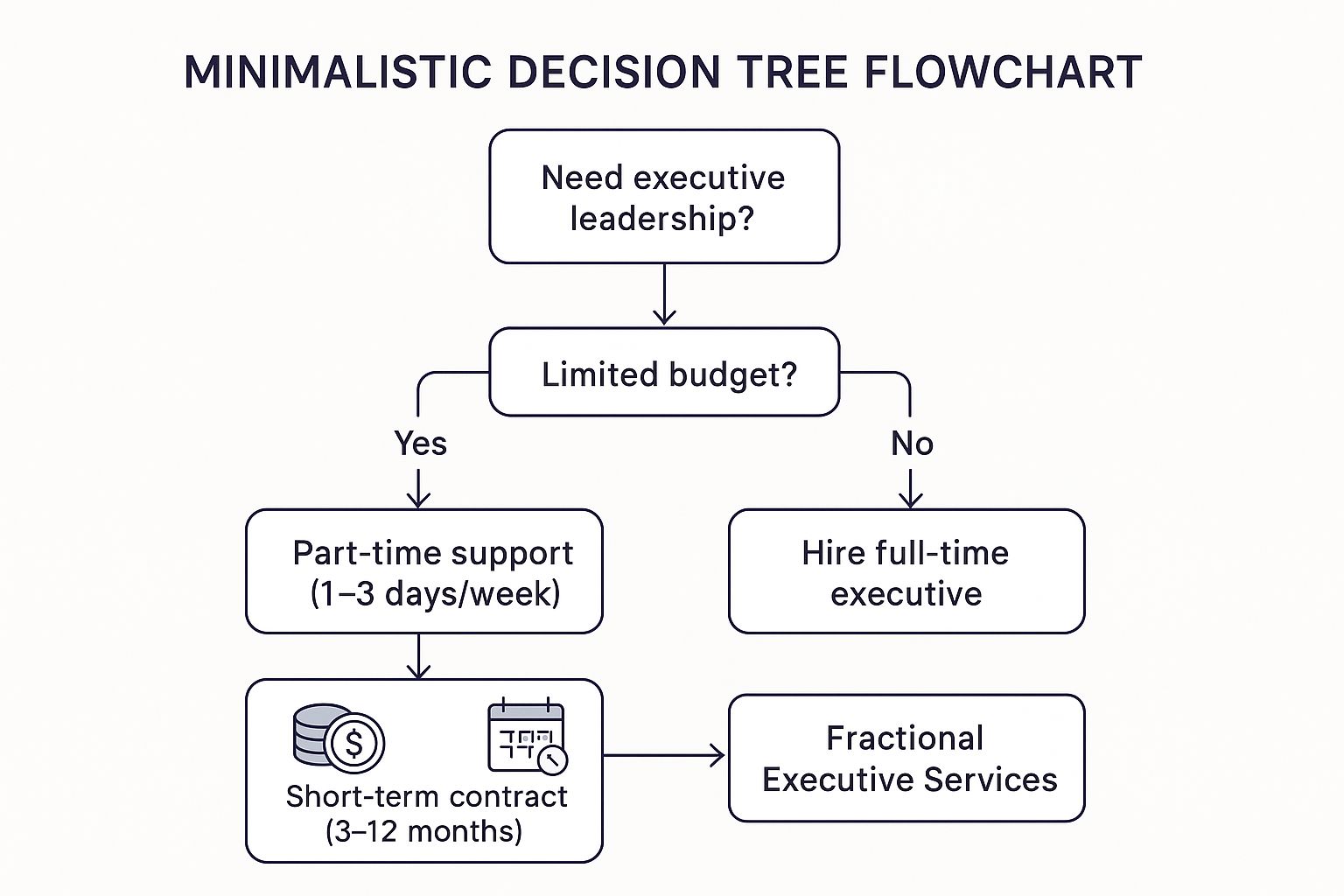
The infographic above presents a decision tree to help determine if fractional executive services are the right fit for your organization. It starts by asking if you need senior executive expertise. If yes, it then considers your budget and time constraints. If you have limited budget or need flexibility, fractional services are highlighted as a likely solution. If your needs are more extensive and budget isn’t a constraint, a full-time executive might be a better fit. The infographic visually guides you through key considerations when choosing between fractional and full-time executive talent.
Features of fractional executive services include flexible engagement terms (often 3-12 month contracts), access to specialized expertise without full-time salary commitments, industry-specific knowledge, and the potential for performance-based compensation. This model provides a valuable alternative to traditional executive search and hiring processes, offering a more agile and adaptable solution.
When and Why to Use Fractional Executive Services:
This approach is particularly beneficial for:
- Startups and SMBs: Gain access to C-suite experience without the high cost.
- Rapidly growing companies: Scale executive resources up or down as needed.
- Companies undergoing transitions: Navigate change with expert guidance.
- Projects requiring specific expertise: Leverage specialized skills for a defined period.
- Organizations exploring new markets or initiatives: Benefit from experienced leadership for strategic projects.
Pros:
- Cost-effective: Access top-tier talent without the full-time price tag.
- Flexibility: Scale resources up or down as your needs change.
- Fresh perspective: Gain insights from executives with diverse experience.
- No long-term commitment: Engage executives for specific projects or periods.
- Immediate impact: Experienced professionals can hit the ground running.
Cons:
- Limited availability/bandwidth: Fractional executives juggle multiple clients.
- Potential divided attention: Ensure clear communication and expectations.
- Initial learning curve: May take time to develop company-specific knowledge.
- Cultural integration: Part-time presence can pose integration challenges.
- Relationship building: Requires intentional effort to build trust with the team.
Examples of Successful Implementation:
- Fractional CMOs helping SaaS startups optimize marketing spend and improve ROI.
- Growth-focused companies using fractional CFOs to secure funding rounds.
- Family businesses employing fractional COOs to manage succession planning.
- Tech companies leveraging fractional CTOs to lead digital transformation initiatives.
Tips for Effective Engagement:
- Clearly define the scope, deliverables, and KPIs before the engagement begins.
- Establish clear communication protocols and a regular meeting cadence.
- Introduce the fractional executive to the team and establish their authority.
- Develop a knowledge transfer plan for when the engagement concludes.
- Consider a 3-month trial period before committing to a longer-term contract.
Popularized By: FractionalLeadership.io, Chief Outsiders, GrowthX, The Alternative Board
Fractional executive services deserve a prominent place on the list of interim executive solutions due to their cost-effectiveness, flexibility, and ability to bring high-caliber leadership to organizations of all sizes. By carefully considering the pros and cons and following the tips outlined above, businesses can maximize the benefits of this valuable resource.
2. Executive Search and Placement Firms
When your company needs seasoned leadership quickly and efficiently, executive search and placement firms offer a potent interim executive solution. These specialized recruitment agencies excel at connecting organizations with highly qualified interim executives for temporary leadership roles. They maintain extensive networks of pre-vetted executive talent ready to step in and provide immediate leadership across various industries and functions, bridging critical gaps during transitions, special projects, or unexpected vacancies. This approach offers a streamlined path to securing experienced leadership, making it a valuable component of a comprehensive interim executive solution strategy.

These firms operate by leveraging their established networks and rigorous screening processes. They delve deep into candidate qualifications, experience, and references, ensuring a strong pool of potential interim leaders. This pre-vetting drastically reduces the time and resources you’d otherwise spend on recruitment, allowing you to focus on your core business operations. Their industry and function-specific expertise allows them to quickly understand your unique needs and match you with executives possessing the right skillset. Furthermore, they often offer ongoing support throughout the interim placement, ensuring a smooth transition and successful outcomes. For a deeper dive into the world of executive search, you can learn more about Executive Search and Placement Firms.
Several success stories highlight the value of these firms. Heidrick & Struggles, for example, placed an interim CFO at a Fortune 500 company navigating a complex fraud investigation. Korn Ferry provided interim leadership during a challenging post-merger integration, ensuring business continuity and a unified organizational culture. Similarly, Robert Half Management Resources has a strong track record of supplying interim financial leadership during IPO preparation, a critical period for companies. Odgers Berndtson has demonstrated expertise in placing interim healthcare executives during organizational restructuring, providing stability and direction in times of change.
Features and Benefits:
- Extensive databases of pre-vetted executive talent: Access to a broader pool of qualified candidates than you might find through direct hiring.
- Rigorous screening and qualification processes: Reduced risk and time spent on candidate vetting.
- Industry and function-specific expertise: Ensures a better fit for your specific needs.
- Rapid placement capabilities (often within 1-3 weeks): Addresses urgent leadership needs quickly.
- Ongoing support throughout the interim placement: Facilitates a smooth transition and maximized effectiveness.
- Success-based fee structures available: Aligns incentives and provides cost flexibility.
Pros:
- Access to a large pool of qualified executives
- Reduced time-to-hire
- Risk mitigation through pre-vetting and references
- Expertise in matching executive skills to organizational needs
- Ability to find specialized industry or functional experience
Cons:
- Higher costs compared to direct hiring (typically 20-35% of annual compensation)
- Potential misalignment if firm doesn’t fully grasp company culture
- Quality can vary significantly between firms
- Less direct control over the selection process
- Potential prioritization of placement speed over perfect fit
Tips for Choosing and Working with Executive Search Firms:
- Choose firms with demonstrable expertise in your industry.
- Clearly articulate your company culture, values, and the specific situation requiring interim leadership.
- Request multiple candidate options to ensure a broader selection and a better fit.
- Thoroughly check the firm’s track record and experience with similar placements.
- Clearly define and negotiate fee structures and any guarantees before engaging their services.
When to Use This Approach:
Executive search and placement firms are particularly valuable when:
- Time is of the essence: When you need leadership in place rapidly.
- Specialized expertise is required: For specific projects, industry knowledge, or functional expertise.
- Objective, external perspective is needed: During organizational change or crisis management.
- Internal resources are limited: When your HR team lacks the capacity for extensive executive searches.
By carefully considering these factors, you can leverage the power of executive search firms to effectively address your interim executive needs and maintain momentum towards your organizational goals. This makes them a crucial element within the broader context of interim executive solutions.
3. Interim Executive Marketplaces & Platforms
Interim executive marketplaces and platforms offer a modern, technology-driven approach to finding interim executive solutions. These digital platforms connect organizations with experienced interim executives through sophisticated matching algorithms and curated talent networks. They streamline the process, making it faster and often more cost-effective than traditional executive search methods. This approach leverages technology to match specific project needs with the skills and experience of available executives, creating a more efficient and transparent hiring process.

These platforms offer a range of features designed to simplify the engagement process. Algorithm-driven matching technology analyzes project requirements and executive profiles to identify the best fit. Digital profiles showcase verified credentials, experience, and often include reviews from previous clients, providing greater transparency. Simplified contracting and payment processing reduces administrative burden. Many platforms also include rating systems for both executives and hiring organizations, fostering accountability and building trust. Options for self-service matching or assisted support cater to different preferences. Finally, integrated virtual collaboration tools and progress tracking features facilitate seamless project management.
This approach deserves its place on this list because it offers a compelling alternative to traditional interim executive search methods, particularly for organizations prioritizing speed, cost-effectiveness, and access to a broader talent pool. For instance, Catalant connects Fortune 500 companies with interim strategy executives, while Business Talent Group places interim operations leaders for Private Equity portfolio companies. Toptal provides interim tech leadership for critical product launches, and Communo specializes in placing interim marketing executives for rebranding initiatives. These examples demonstrate the versatility of these platforms across various industries and executive functions.
Pros:
- Faster matching process through technology: Algorithms quickly identify suitable candidates, significantly reducing search time.
- Greater transparency through reviews and ratings: Access to peer reviews and ratings provides valuable insights into executive performance and suitability.
- Lower fees than traditional executive search firms: The platform model typically offers more competitive pricing structures.
- Wider talent pool across geographic boundaries: Access to a global network of executives expands the available talent pool.
- Data-driven matching based on multiple parameters: Sophisticated algorithms consider a wide range of factors for optimal matching.
Cons:
- Quality control can be inconsistent: While platforms implement vetting processes, the level of scrutiny can vary.
- Less personalized service than boutique firms: The automated nature of the platform may limit personalized guidance.
- Limited deep vetting compared to traditional firms: Background checks and reference checks might not be as comprehensive.
- Relationship-building aspects may be diminished: The digital interface may reduce opportunities for in-depth relationship building.
- Platform fees or subscription costs may apply: Understand the platform’s fee structure before engaging.
Tips for Utilizing Interim Executive Marketplaces & Platforms:
- Build a comprehensive company profile: Clearly define your company and project needs to improve matching accuracy.
- Review executive ratings and case studies critically: Don’t solely rely on ratings; thoroughly evaluate experience and expertise.
- Conduct video interviews before finalizing selections: Personal interaction is crucial for assessing cultural fit and communication style.
- Start with smaller projects to test the platform’s capabilities: Gain experience with the platform before committing to larger engagements.
- Understand the platform’s dispute resolution processes: Familiarize yourself with the platform’s policies for handling potential conflicts.
Interim executive marketplaces and platforms are particularly well-suited for startup founders, small to medium-sized businesses seeking cost-effective leadership, and industries like SaaS, FinTech, and HealthTech that require specialized expertise. Entrepreneurs facing challenges in executive recruitment and companies interested in flexible, part-time executive roles can also benefit from this approach. These platforms empower organizations to access top-tier interim talent quickly and efficiently, driving growth and navigating critical business challenges.
4. Executive Advisory Boards & Peer Networks
Executive advisory boards and peer networks offer a unique approach to interim executive solutions, providing access to a collective of experienced leaders without the commitment of hiring full-time executives. This model is particularly valuable for organizations seeking guidance and support through specific challenges, transitions, or strategic initiatives. Instead of relying on a single interim executive, companies leverage the diverse expertise of a group, fostering a collaborative problem-solving environment. This makes them a powerful interim executive solution for businesses seeking strategic guidance and peer-to-peer learning.
How They Work:
These networks typically operate through structured engagements. Member companies present specific business challenges or opportunities to their advisory board or peer network. The group then collaboratively discusses the situation, leveraging their diverse experiences and perspectives to offer advice, insights, and potential solutions. Regular meetings ensure consistent progress and accountability.
Features and Benefits:
- Access to diverse executive expertise: Gain insights from multiple industry veterans in a group setting.
- Regular structured advisory meetings: Maintain consistent progress and accountability through scheduled sessions.
- Peer-to-peer learning opportunities: Learn from the experiences and challenges of other business leaders.
- Industry-specific knowledge sharing: Benefit from the collective wisdom within your specific sector.
- Collaborative problem-solving approach: Leverage the diverse perspectives of the group to find innovative solutions.
- Cost-effective: Compared to hiring multiple full-time executives, this solution provides significant cost savings.
When to Use This Approach:
Executive advisory boards and peer networks are ideal interim executive solutions when:
- Navigating complex challenges: Facing a significant business challenge requiring diverse perspectives.
- Seeking strategic guidance: Developing long-term strategies or navigating significant transitions.
- Limited budget for full-time executives: Requiring senior-level guidance without the expense of full-time hires.
- Valuing peer-to-peer learning: Seeking opportunities for collaboration and knowledge sharing with other leaders.
Pros:
- Multiple perspectives: Gain a broader range of insights compared to a single executive’s viewpoint.
- Cost-effective: A significantly more affordable option than hiring multiple executives.
- Cross-industry best practices: Exposure to innovative ideas and strategies from diverse sectors.
- Reduced risk: Collective decision-making can mitigate risks associated with individual biases.
- Built-in accountability: The structured nature of these engagements promotes accountability and follow-through.
Cons:
- Lacks day-to-day operational execution: Primarily focused on strategic guidance, not daily operations.
- Potential for conflicting advice: Managing differing opinions among advisors requires strong facilitation.
- Limited direct implementation support: Requires internal teams to execute on recommendations.
- Requires internal leadership to act: The effectiveness depends on the company’s ability to implement the advice received.
- May lack deep company-specific knowledge: Advisors may require time to fully understand the nuances of the business.
Examples of Successful Implementation:
- Vistage CEO groups: Guiding companies through market expansions and strategic planning.
- Young Presidents’ Organization (YPO) forums: Supporting executives during organizational restructuring and leadership transitions.
- The Alternative Board (TAB): Providing strategic direction during succession planning and business growth initiatives.
- Entrepreneurs’ Organization (EO) members: Collectively advising on digital transformation initiatives and innovation strategies.
Actionable Tips:
- Present specific challenges: Clearly define the issues you want the board to address.
- Implement a structured process: Establish a framework for evaluating and acting on advice.
- Assign internal champions: Designate individuals responsible for executing recommendations.
- Balance industry-specific and cross-industry advisory groups: Leverage both specialized and diverse perspectives.
- Rotate meeting locations: Expose the group to different business environments and stimulate fresh thinking.
Popularized By:
Vistage, Young Presidents’ Organization (YPO), The Alternative Board (TAB), Entrepreneurs’ Organization (EO), Chief Executive Boards International
Executive advisory boards and peer networks offer a valuable interim executive solution, providing access to a wealth of experience and diverse perspectives. By leveraging this collective intelligence, companies can navigate complex challenges, develop robust strategies, and achieve sustainable growth, making them a valuable addition to the arsenal of interim executive solutions.
5. Professional Services Firms with Interim Executive Practices
When facing complex business challenges requiring both strategic vision and hands-on leadership, engaging professional services firms with dedicated interim executive practices can be a powerful interim executive solution. These firms, often large management consultancies, offer a blended approach, deploying experienced executives alongside their consulting teams to guide and implement critical initiatives. This model goes beyond simply placing an individual executive; it provides a comprehensive solution integrating advisory services with leadership execution.
How it Works:
These firms maintain a roster of seasoned executives with diverse industry backgrounds and functional expertise. When a client engages their services, they assemble a team comprising both consultants and an interim executive, typically at the C-suite or senior management level. This team collaborates closely with the client organization, leveraging the firm’s methodologies, resources, and research capabilities to develop and execute strategic initiatives. The interim executive provides on-the-ground leadership, driving implementation and managing day-to-day operations while the consulting team provides strategic support, analysis, and project management.
Examples of Successful Implementation:
- Alvarez & Marsal frequently leads corporate restructurings, deploying interim C-suite teams to stabilize finances, optimize operations, and navigate complex legal and regulatory landscapes.
- FTI Consulting often provides interim leadership during regulatory investigations or crises, ensuring compliance and managing communication with stakeholders.
- McKinsey RTS (Recovery & Transformation Services) might deploy an interim COO during an operational transformation, streamlining processes, improving efficiency, and driving performance improvement.
- PwC’s Deals practice often places interim management teams post-acquisition to integrate operations, manage cultural transitions, and achieve synergy targets.
When and Why to Use this Approach:
This interim executive solution is particularly valuable in situations requiring:
- Complex Transformations: Large-scale organizational change, operational overhauls, or digital transformations.
- Turnaround Situations: Addressing financial distress, restructuring operations, or navigating crises.
- Specialized Expertise: Requiring specific industry knowledge or functional expertise for a limited time.
- Post-Acquisition Integration: Managing the complexities of merging businesses and cultures.
- Interim Leadership Gaps: Filling critical leadership vacancies quickly while searching for a permanent replacement.
Features and Benefits:
- Integrated Approach: Combines strategic consulting with hands-on executive leadership.
- Access to Resources: Leverages the firm’s extensive knowledge base, research capabilities, and industry benchmarks.
- Structured Methodologies: Employs proven methodologies for specific situations like turnarounds and transformations.
- Implementation Support: Provides dedicated teams to support the interim executive and ensure successful execution.
Pros:
- Comprehensive Solution: Goes beyond just executive placement, offering a more holistic approach.
- Global Reach: Suitable for multi-national situations requiring international expertise.
- Structured Methodologies: Proven approaches refined through experience across multiple clients.
- Built-in Quality Control: Rigorous oversight and quality assurance processes.
Cons:
- Higher Cost: Significantly more expensive than standalone interim executive solutions.
- Potential Over-reliance on Standardized Approaches: May not always be tailored to unique client needs.
- Firm Priorities: The consulting firm’s priorities might occasionally overshadow client needs.
- Potential Dependency: Can create a dependency on the consulting firm’s services.
Actionable Tips:
- Clearly Define Roles: Distinguish between the responsibilities of the interim executive and the consulting team.
- Knowledge Transfer: Negotiate mechanisms for knowledge transfer to internal teams.
- Direct Reporting: Establish clear reporting lines to maintain control and accountability.
- Specific Deliverables: Define specific, measurable deliverables beyond time-based commitments.
- Internal Counterparts: Assign internal counterparts to work alongside the interim team and maximize knowledge retention.
This approach, popularized by firms like Alvarez & Marsal, FTI Consulting, McKinsey RTS, PwC Deals, Deloitte Consulting, and EY-Parthenon, provides a robust interim executive solution for complex business challenges. While it comes at a premium cost, the integrated approach, access to resources, and structured methodologies can deliver significant value in specific situations, making it a worthwhile consideration for organizations seeking comprehensive interim leadership support.
6. Turnaround & Restructuring Executive Specialists
When your company faces critical financial distress, operational failures, or requires rapid change management, standard interim executive solutions may not suffice. This is where turnaround & restructuring executive specialists become invaluable. These specialized interim executive firms, a crucial subset of interim executive solutions, focus exclusively on distressed situations, turnarounds, and corporate restructuring. They deploy seasoned executives, often referred to as “crisis managers,” with proven track records in navigating complex and high-stakes scenarios. These experts bring specialized expertise in crisis management, bankruptcy, financial restructuring, and operational turnarounds to stabilize struggling companies and implement effective recovery plans. Learn more about Turnaround & Restructuring Executive Specialists
These firms operate by rapidly deploying experienced executives who can quickly assess the situation, develop and implement a strategic turnaround plan, and manage the complex stakeholder environment that often accompanies distressed situations. Their features include crisis management expertise and rapid deployment capability, experience with bankruptcy proceedings and creditor negotiations, sharp cash management and liquidity preservation skills, and deep legal and regulatory compliance expertise specifically for distressed situations. Critically, they possess highly developed stakeholder management capabilities for navigating the often-complex constituencies involved in a restructuring. Furthermore, their performance-based fee structures often tie compensation directly to successful outcomes, aligning incentives with your company’s recovery.
Examples of successful implementations include:
- CR3 Partners providing CRO leadership during a Chapter 11 reorganization.
- Ankura placing an interim CFO during a financial restatement and restructuring process.
- Carl Marks Advisors leading the operational turnaround of a struggling manufacturing company.
- AlixPartners deploying an interim management team during a retail bankruptcy situation.
Pros of engaging turnaround & restructuring specialists:
- Specialized expertise in high-pressure situations: These experts are specifically trained to handle crises and make critical decisions under pressure.
- Experience navigating complex stakeholder environments: They excel at managing relationships with creditors, lenders, investors, employees, and other stakeholders.
- Objective third-party perspective: They offer an unbiased view of the situation, often crucial in emotionally charged circumstances.
- Credibility with creditors, lenders, and investors: Their involvement can signal a commitment to recovery and instill confidence in external stakeholders.
- Willingness to make difficult decisions quickly: They’re prepared to make tough choices necessary for stabilization, even if unpopular.
Cons to consider:
- Higher cost reflecting specialized expertise: Their specialized skills and experience come at a premium.
- May prioritize financial stabilization over long-term health: While essential in the short-term, an intense focus on immediate financial stability can sometimes come at the expense of long-term growth initiatives.
- Potential reputation for aggressive cost-cutting approaches: Their focus on efficiency can sometimes lead to perceptions of aggressive cost-cutting, potentially impacting employee morale.
- Cultural resistance from employees fearing changes: Significant restructuring can create anxiety and resistance among employees.
- Typically shorter-term focus than other interim solutions: Their engagement is usually focused on navigating the immediate crisis and may not extend to long-term strategic planning.
Tips for successful engagement:
- Engage early: Don’t wait until the situation becomes dire. Early intervention is key to successful turnarounds.
- Be transparent: Provide the executive with a complete and accurate picture of the company’s financial and operational challenges.
- Provide complete access to data: Ensure the executive has access to all necessary financial and operational data to make informed decisions.
- Establish clear communication channels: Maintain open and consistent communication with all stakeholders throughout the process.
- Create incentives aligned with successful restructuring outcomes: Tie compensation to measurable performance goals related to the turnaround plan.
Firms like AlixPartners, Ankura, Carl Marks Advisors, CR3 Partners, Conway MacKenzie, and Zolfo Cooper have popularized this specific approach within the broader field of interim executive solutions. Turnaround & restructuring specialists offer a targeted and powerful solution when your business faces existential threats, offering the expertise and experience necessary to navigate complex challenges and achieve successful outcomes. This specific approach deserves a prominent place on this list because, for companies facing critical challenges, it can be the difference between recovery and failure. This makes them an invaluable option amongst the broader set of interim executive solutions.
Interim Executive Solutions Comparison
| Solution / Strategy | Implementation Complexity 🔄 | Resource Requirements ⚡ | Expected Outcomes 📊 | Ideal Use Cases 💡 | Key Advantages ⭐ |
|---|---|---|---|---|---|
| Fractional Executive Services | Medium – Part-time execs; flexible contracts | Moderate – Part-time executives, no full-time salary | Immediate leadership impact; flexible scaling | SMBs needing high-level expertise without full-time cost | Cost-effective; flexible engagement; diverse exec experience |
| Executive Search and Placement Firms | High – Rigorous vetting, firm-dependent process | High – Premium fees, agency reliance | Fast interim placements; access to vetted talent | Companies needing rapid interim execs during transitions | Large qualified talent pool; reduced time-to-hire; risk mitigation |
| Interim Executive Marketplaces & Platforms | Low to Medium – Technology-enabled matching | Low to Moderate – Platform fees, self-service | Faster matching; transparent reviews; flexible hiring | Organizations seeking fast, tech-driven interim hires | Faster process; transparent ratings; lower fees |
| Executive Advisory Boards & Peer Networks | Low – Group meetings, no direct exec role | Low – Membership or engagement fees | Collective guidance; diverse perspectives | Firms seeking strategic advice without operational execs | Multiple viewpoints; cost-effective; cross-industry insights |
| Professional Services Firms with Interim Practices | High – Integrated consulting & exec leadership | High – Premium fees; large firm resources | Comprehensive strategic and operational support | Complex transformations, turnarounds, multi-national challenges | End-to-end solutions; proven methodologies; global reach |
| Turnaround & Restructuring Executive Specialists | High – Specialized crisis management | High – Expertise commands premium fees | Stabilization and recovery in distressed scenarios | Companies in crisis needing rapid financial/operational recovery | Specialized expertise; rapid deployment; stakeholder credibility |
Find the Perfect Interim Executive Solution
Navigating the world of interim executive solutions can feel overwhelming, but finding the right fit for your business is crucial for success. From fractional executives offering specialized expertise to executive search firms providing comprehensive recruitment, and from interim executive marketplaces to advisory boards offering strategic guidance, this article has explored a range of options to address your leadership needs. Remember, choosing the best interim executive solution depends heavily on factors like your company’s size, industry, specific challenges, and growth stage. Mastering these concepts allows you to quickly adapt to changing market conditions, fill critical skill gaps, and drive your business forward with experienced leadership, all while maintaining cost-effectiveness and flexibility.
Whether you’re a startup founder looking for strategic guidance, a growing business in need of specialized expertise, or a larger enterprise facing a temporary leadership gap, understanding the nuances of interim executive solutions empowers you to make informed decisions that can significantly impact your bottom line. Embracing this flexible approach to leadership allows you to access top-tier talent and navigate challenges with confidence, ultimately positioning your organization for long-term success.
Ready to unlock the power of flexible, on-demand executive talent? Shiny offers a unique fractional executive marketplace, connecting startups and businesses with experienced executives for 5 to 25 hours a week. Explore a curated network of vetted professionals and find the perfect interim executive solution to propel your business forward. Visit Shiny today to learn more and get started.
