
10 Crucial Interview Questions for Executive Management
Hiring senior leadership is one of the most critical decisions a founder can make. Get it right, and your company accelerates. Get it wrong, and you lose precious time, capital, and momentum. The stakes are even higher when you don't need—or can't afford—a full-time executive.
This is where fractional leadership comes in. A fractional executive is a seasoned leader who joins your team for a fraction of the week, bringing C-suite expertise without the C-suite cost. Think of it like this: you wouldn't hire a full-time general contractor to fix a leaky faucet. You bring in an expert plumber for a few hours to solve the specific problem. A fractional executive does the same for your business, providing targeted expertise precisely when and where you need it.
But how do you find the right one? Traditional interview questions often fall short. They assess past accomplishments but fail to predict performance in a part-time, high-impact environment. This guide provides a structured set of interview questions for executive management designed specifically to vet leaders for fractional roles. It's a framework for identifying the precise leadership your business needs to scale, without the risk of a full-time hire.
1. Tell me about your experience scaling a company from $X to $Y revenue. What were the key challenges?
This is a foundational question that cuts directly to a candidate's practical, hands-on experience with growth. It’s not about theory; it’s about execution. For companies poised to scale, this question reveals whether a candidate has navigated the specific type of growth journey you are about to undertake.
A strong response tells a compelling story of identifying growth levers, overcoming obstacles, and leading a team through the turbulence of expansion. This is particularly crucial when hiring a fractional executive, who must deliver impact quickly without a long ramp-up period.
What to Listen For
A standout candidate will provide a structured narrative, detailing the initial situation, the specific actions they took, and the measurable outcomes. For instance, a fractional CMO might describe scaling a SaaS company from $2M to $10M ARR by revamping the demand generation engine and navigating early product-market fit issues.
Look for answers that demonstrate:
- Specific Challenges: They should articulate the primary obstacles faced. Common startup scaling challenges include hiring the right talent, managing cash flow, and evolving company culture.
- Personal Contribution: The candidate must clearly distinguish between what they personally owned versus what the team accomplished.
- Metrics-Driven Approach: Listen for key performance indicators like Customer Acquisition Cost (CAC), Lifetime Value (LTV), and churn rates. This shows they manage by the numbers.
Follow-Up Questions
- "What was the single most difficult decision you had to make during that growth phase?"
- "How did you adapt your leadership style as the team grew from 10 to 50 people?"
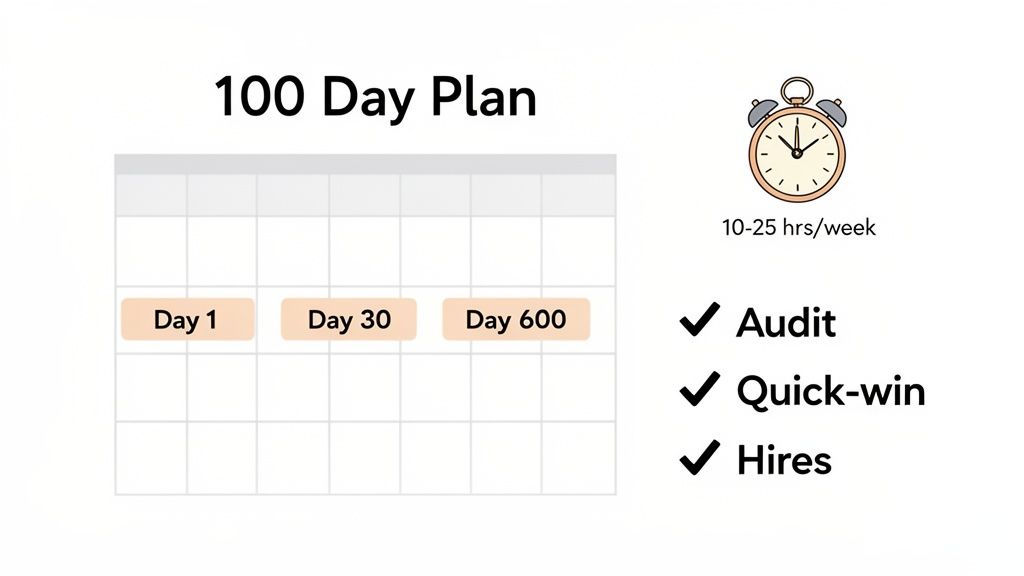
2. How would you prioritize your first 100 days working with our company on a part-time basis?
This question is essential for fractional executive roles. It directly assesses a candidate's grasp of the unique constraints and opportunities of part-time engagement. It reveals their ability to diagnose issues quickly and create immediate value despite limited hours.
An effective fractional leader understands that their time is a precious resource and must be deployed with surgical precision. A strong answer demonstrates that the candidate has done their research, understands your business pain points, and has a clear, actionable framework for making an impact from day one.
What to Listen For
A standout candidate will present a structured 30-60-90 day plan tailored to your company's needs. For example, a fractional CFO might outline a plan to first stabilize cash flow reporting (first 30 days), then build a financial model for fundraising (60 days), and finally implement scalable accounting processes (90 days).
Look for answers that demonstrate:
- A Phased Approach: They should break down their plan into distinct phases like learning, planning, and execution.
- Realistic Scope: Their plan must align with a part-time schedule. Promising a complete operational overhaul in 10 hours a week is a red flag.
- Focus on Impact: The candidate should prioritize activities that deliver the highest value, such as identifying major revenue leaks or fixing critical process bottlenecks.
Follow-Up Questions
- "How would you measure success at the 30, 60, and 90-day marks?"
- "Given you'll only be working 15 hours a week, how will you ensure alignment and communication with the full-time team?"
3. Describe your experience building or managing high-performing teams. How would you do this remotely or part-time?
This question probes one of the most fundamental executive responsibilities: building and nurturing talent. An executive's ability to achieve results is directly tied to the strength of their team. For a fractional leader, this question adds a critical layer, testing their ability to inspire and manage culture without constant physical presence.

An effective answer reveals a candidate's philosophy on leadership and delegation. A great response will provide concrete examples of how they’ve built a high-performing culture, particularly highlighting their strategies for doing so with limited hours—a key challenge for part-time executive roles.
What to Listen For
A superior candidate will discuss their methodology for team building, not just the outcomes. For example, a fractional VP of Sales might describe building a remote sales team by establishing a rigorous hiring process, implementing a highly structured onboarding program, and using a transparent, data-driven system for performance reviews.
Look for answers that demonstrate:
- A Clear Framework: They should explain their system for setting expectations (like OKRs) and fostering communication (e.g., async updates, structured check-ins).
- Adaptability to Part-Time: The candidate must show they have specific strategies for overcoming the challenges of distributed work, such as building trust and preventing silos.
- Focus on Development: A strong leader invests in their people. Listen for examples of mentoring direct reports, a core element of building high-performing teams.
Follow-Up Questions
- "How do you handle underperformance or conflict on a remote team?"
- "What specific tools and rituals do you use to maintain team cohesion when you're not in the office full-time?"
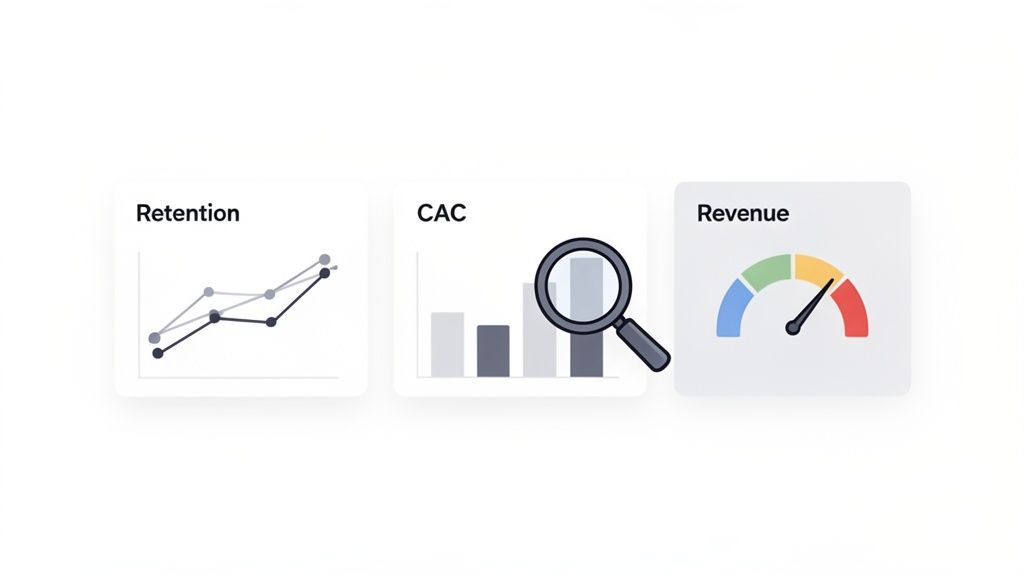
4. What KPIs and metrics do you track religiously? How would you establish these for our company?
This is one of the most revealing interview questions for executive management because it instantly separates candidates who manage by intuition from those who manage by data. A leader's relationship with metrics reveals their strategic priorities and commitment to accountability. For fractional executives, this is non-negotiable; you need a leader who can define success and deliver a quantifiable ROI.
A great answer shows they can move beyond vanity metrics to identify the key performance indicators (KPIs) that truly drive growth and profitability. Their plan for establishing these at your company will highlight their diagnostic skills, proving they can build a system for success, not just operate within one.
What to Listen For
A superior candidate will not just list metrics; they will explain the why behind each one. For example, a fractional VP of Sales might focus on pipeline coverage ratio as a leading indicator for future revenue, while a fractional CFO would emphasize cash runway and unit economics.
Look for answers that demonstrate:
- Role-Specific Acumen: Their chosen metrics should be highly relevant to their function. A VP of Marketing should discuss CAC by channel, not just website traffic.
- A Diagnostic Approach: They should ask clarifying questions about your business model and goals before prescribing a specific set of KPIs.
- Systemic Thinking: The candidate should describe how they would create a "metrics cascade," ensuring team goals align with company-level objectives.
Follow-Up Questions
- "Describe a time a key metric was trending negatively. How did you diagnose the root cause and what actions did you take?"
- "Walk me through how you would build a dashboard for the leadership team. What would be on it and why?"
5. Tell me about a time you failed as an executive. What did you learn, and how did you apply those lessons?
This is a critical behavioral question that measures self-awareness, humility, and a growth mindset. Startups are volatile environments where setbacks are inevitable. You need leaders who don’t just survive failure, but actively learn from it.
An executive’s response reveals their character. A defensive or vague answer is a major red flag. A strong answer, however, demonstrates accountability and the ability to turn a negative experience into a valuable lesson. This is especially important for fractional executives, who must quickly build trust without a long history with the company.
What to Listen For
A standout candidate will own the failure without making excuses. They will provide a specific story detailing the situation, their flawed decision-making process, the negative impact, and the concrete lessons learned. For instance, a fractional CFO might describe missing the cash flow implications of a rapid expansion, which led them to implement more rigorous forecasting models in all subsequent roles.
Look for answers that demonstrate:
- True Accountability: The candidate should clearly state "I made a mistake" and explain their specific role in the outcome.
- Specific, Tangible Lessons: The learnings shouldn't be generic clichés like "I learned to communicate better." They should be specific and actionable.
- Application of Learning: The most crucial part is how they used that lesson to achieve a better outcome in a subsequent situation. This proves the learning was internalized.
Follow-Up Questions
- "How did this failure impact the business financially and culturally?"
- "How did you communicate this failure to your team and to the board?"
6. What is your experience with fundraising, investor relations, and board management?
This is a critical question, especially for startups and growth-stage companies. An executive’s ability to navigate the complex world of investors and board dynamics can directly impact a company's ability to secure capital. For founders preparing for Series A or B funding, an executive who has been through these processes is an invaluable asset.
The answer reveals whether a candidate can provide strategic support beyond their core functional role. A fractional executive is often hired to fill a specific strategic gap, such as preparing the company for its next capital raise.
What to Listen For
A strong candidate will provide specific examples of their involvement in the fundraising lifecycle. They should articulate their precise role, whether as a primary decision-maker or a key supporter who prepared materials and managed processes.
Look for answers that demonstrate:
- Specific Contributions: A fractional CFO might describe building the financial models for a Series A round and managing the due diligence data room.
- Understanding of Key Concepts: The candidate should be comfortable discussing valuation, dilution, and term sheets, even if they weren't the lead negotiator.
- Board-Level Communication: They should be able to describe their experience preparing board decks and communicating performance against key milestones.
Follow-Up Questions
- "Describe your specific role in the last fundraising round you were part of. What did you own?"
- "How do you approach balancing investor expectations with the operational realities of the business?"
7. How do you approach strategic planning, and how have you adjusted strategy based on market changes?
This question probes a core executive competency: strategic agility. In today’s volatile markets, a static five-year plan is obsolete. This question assesses a candidate's ability to create a robust yet flexible strategic framework and, more importantly, their decisiveness in pivoting when necessary.
A great answer isn’t just about the planning process; it’s a story of foresight and data-driven decision-making. For a fractional executive who must deliver impact under pressure, this ability to adapt and execute is paramount.
What to Listen For
A superior candidate will describe a structured yet dynamic approach to strategy. They will explain their preferred cadence (e.g., annual planning with quarterly reviews) and the triggers for re-evaluation. For instance, a fractional VP of Product might detail a pivot from a broad B2B GTM to a niche SMB focus after analyzing customer feedback and early market signals.
Look for answers that demonstrate:
- A Clear Framework: They should reference specific methodologies like OKRs, Balanced Scorecard, or Scenario Planning.
- Proactive Adaptation: The candidate should provide concrete examples of when they adjusted a strategy. Did a new competitor or changing customer behavior prompt the change?
- Data-Informed Pivots: Listen for how they use market intelligence and internal metrics to justify a strategic shift.
Follow-Up Questions
- "What was the specific data point or event that triggered your last major strategy pivot?"
- "How do you communicate a significant strategic change to your team to ensure buy-in?"
8. Describe your experience managing P&L and making cost/investment trade-off decisions.
This is one of the most critical interview questions for executive management because it measures a candidate’s financial acumen. Startups operate with constrained resources, meaning every dollar must be strategically allocated. This question assesses an executive's ability to balance aggressive growth investments with the need for sustainable unit economics.
A leader’s answer reveals their understanding of the fundamental drivers of a business. It shows whether they can make tough, data-backed decisions that prioritize long-term health over short-term gains. For a fractional executive, who must quickly align with a company's financial realities, this skill is non-negotiable.
What to Listen For
A strong candidate will provide concrete examples of their P&L responsibility. They will articulate a clear framework for making trade-off decisions, demonstrating an understanding of ROI and opportunity costs. For example, an operations leader might describe investing $200K in automation to achieve a 30% cost reduction over 18 months.
Look for answers that demonstrate:
- Specific P&L Ownership: They should detail the exact revenue, budget, and headcount they managed.
- A Disciplined Process: The candidate must explain how they decide between investing in a new initiative versus cutting costs. What data do they use?
- Impact on Unit Economics: Listen for their ability to connect P&L decisions to core business metrics like gross margin and customer acquisition cost (CAC).
Follow-Up Questions
- "Walk me through a significant budget decision you made that turned out to be wrong. What did you learn?"
- "Describe a time you had to cut costs. How did you decide what to cut, and how did you manage the impact on the team?"
9. What is your experience in your functional area with companies in our industry or similar markets?
While strong executive skills are transferable, deep industry expertise can be a powerful accelerator. This question helps you determine if a candidate can hit the ground running with an intrinsic understanding of your market's customers, competitors, and common pitfalls.
For a fractional executive, this domain knowledge is even more critical. You are hiring for immediate impact, not for a six-month learning curve. An executive who already speaks your industry's language can start adding value from day one, whether that means leveraging an existing network or navigating complex regulations.
What to Listen For
A compelling answer goes beyond just listing past employers. The candidate should connect their industry experience directly to the challenges your company faces. They should demonstrate a nuanced understanding of the competitive landscape and articulate how their past experiences have prepared them to succeed in your environment.
Look for answers that demonstrate:
- Deep Nuance: They should discuss specific industry challenges, like managing CAC/LTV ratios in a competitive SaaS market.
- Relevant Network: A strong candidate might mention key relationships with partners or influencers within the industry that they can leverage.
- Strategic Insight: Listen for their perspective on where the industry is headed and how your company can position itself to win.
Follow-Up Questions
- "Who do you consider our top three competitors, and what is their key vulnerability?"
- "What is the biggest market trend you see impacting our industry in the next 18 months?"
10. How do you define success in your current/previous role, and how would you measure success in this fractional position?
This is one of the most critical questions, especially when hiring for a fractional role. The answer reveals a candidate’s grasp of value creation and their willingness to be held accountable for measurable results. It’s a direct window into how they translate business goals into specific, actionable outcomes.
For a fractional executive, who operates on a limited schedule, defining success upfront is non-negotiable. Their impact must be clear, swift, and aligned with your most urgent business priorities. This question separates candidates who talk about strategy from those who deliver tangible results.
What to Listen For
A strong candidate will pivot from past success stories to concrete, future-oriented metrics for your business. They should propose specific KPIs relevant to the role. Their definition of success should be quantifiable and tied to a realistic timeline.
Look for answers that demonstrate:
- Outcome-Oriented Thinking: They focus on results, not just activities. Instead of "implement a new CRM," they say "increase sales-qualified leads by 30%."
- Role-Specific Metrics: A fractional VP of Sales might propose targets like "$500K in new ARR and a 3x pipeline-to-quota ratio within six months."
- Understanding of Constraints: They should acknowledge the part-time nature of the role and set ambitious but achievable goals within that framework.
Follow-Up Questions
- "What do you consider the single most important success metric for this role in the first 90 days?"
- "What resources or support would you need from us to achieve these outcomes?"
From Questions to Confidence
Navigating the high-stakes process of hiring an executive is one of the most critical challenges a growing business faces. This list of interview questions for executive management is more than a script; it's a framework designed to reveal a candidate's leadership capabilities, strategic thinking, and cultural fit.
Moving beyond generic inquiries to ask pointed, evidence-based questions is the key to differentiating a competent manager from a truly transformative leader. The goal is not merely to fill a seat but to find a strategic partner who can deliver immediate impact within a part-time framework.
Key Takeaways for Hiring Fractional Leaders
- Prioritize a Bias for Action: A brilliant full-time executive may not thrive in a fractional capacity. Your questions must probe a candidate's ability to prioritize ruthlessly, communicate with clarity, and drive results without the benefit of 40-plus hours a week.
- Measure What Matters: A top-tier executive speaks the language of data. Dig deep into their understanding of metrics, their process for establishing reporting, and how they use data to make difficult trade-off decisions.
- Past Performance Predicts Future Success: The most reliable indicator of a candidate's ability to scale your company or manage a P&L is their proven track record of having done it before. Ground the conversation in tangible evidence.
Mastering this interview process will not only save you from a costly mis-hire but will increase your odds of finding a leader who can propel your business to its next stage of growth. It transforms hiring from a gut-feel gamble into a calculated, strategic investment in your company's future.
Asking the right questions is the first step, but finding the right candidates to ask is often the biggest hurdle. Shiny provides a vetted marketplace of over 3,000 fractional executives, connecting you with proven leaders who have the specific scaling experience and industry expertise you need.
Ready to find the right executive without the full-time commitment? Schedule a consultation with our team to explore our network of world-class fractional talent.