
7 Key Performance Indicators Examples for Startups in 2025
In the fast-paced startup world, metrics are everything. But which ones actually matter? It’s easy to get lost in a sea of data, tracking vanity metrics that look good on paper but do little to drive sustainable growth. The real challenge is identifying the key performance indicators (KPIs) that provide actionable insights, guide strategic decisions, and align your entire team toward common goals. This is where strategic leadership, like that provided by fractional executives, becomes invaluable. A fractional CMO or CFO brings the expertise to not only select the right KPIs but also to interpret them, turning raw data into a powerful roadmap for success.
In this guide, we’ll break down seven critical key performance indicators examples, providing deep analysis and tactical advice on how to implement them effectively. You won’t find surface-level definitions here. Instead, we offer a strategic breakdown of what each KPI truly measures, how to influence it, and the behind-the-scenes details that connect it to your bottom line. Whether you’re a founder wearing multiple hats or looking to bring in specialized expertise, mastering these KPIs will be your compass for navigating growth, securing funding, and building a resilient business.
1. Customer Lifetime Value (CLV)
Customer Lifetime Value (CLV or LTV) is a crucial metric that moves beyond single-transaction thinking. It forecasts the total revenue a business can expect from a single customer throughout their entire relationship with the company. For startups and growing businesses, understanding CLV is fundamental, as it provides a clear, long-term perspective on profitability and sustainability. It’s one of the most powerful key performance indicators examples because it directly influences decisions across marketing, sales, product, and customer success.

A fractional executive, such as a CMO or CFO, leverages CLV to make high-impact strategic choices. By knowing what a customer is worth over time, they can justify investments in acquisition channels, retention programs, and product improvements that might otherwise seem too costly. It answers the critical question: how much can we afford to spend to acquire a new customer and keep them happy?
Strategic Application & Analysis
Leading companies build entire strategies around this KPI. For instance, Starbucks uses its rewards program not just to encourage loyalty but to meticulously track purchasing habits, increasing visit frequency and average order value, thereby boosting CLV. Similarly, Shopify merchants rely on CLV data to segment their customer base, identifying high-value shoppers to target with exclusive offers and personalized marketing campaigns.
Strategic Insight: The most powerful use of CLV is when it is compared against Customer Acquisition Cost (CAC). A healthy business model typically shows a CLV to CAC ratio of 3:1 or higher. This means for every dollar spent acquiring a customer, you generate at least three dollars in lifetime value.
Actionable Takeaways for Founders
A fractional executive will implement CLV analysis to drive immediate value. Here are actionable steps you can take:
- Segment Your CLV: Don’t rely on a single, blended CLV. Calculate it for different customer segments based on acquisition channel, first product purchased, or demographic. This reveals your most profitable customer sources.
- Set CAC Guardrails: Use your CLV to establish a maximum allowable CAC. This prevents overspending on marketing channels that attract low-value customers.
- Inform Retention Efforts: A rising CLV indicates successful retention strategies. A declining CLV is a red flag, signaling a need to invest more in customer success and loyalty initiatives before churn becomes a critical issue.
2. Net Promoter Score (NPS)
Net Promoter Score (NPS) is a widely adopted customer loyalty metric that gauges how likely a customer is to recommend your company, product, or service. Its power lies in its simplicity, boiling down complex sentiment into a single, actionable score derived from the question: “On a scale of 0-10, how likely are you to recommend us to a friend or colleague?” This metric is one of the most insightful key performance indicators examples because it provides a direct line into customer satisfaction and serves as a leading indicator of future revenue growth and potential churn.
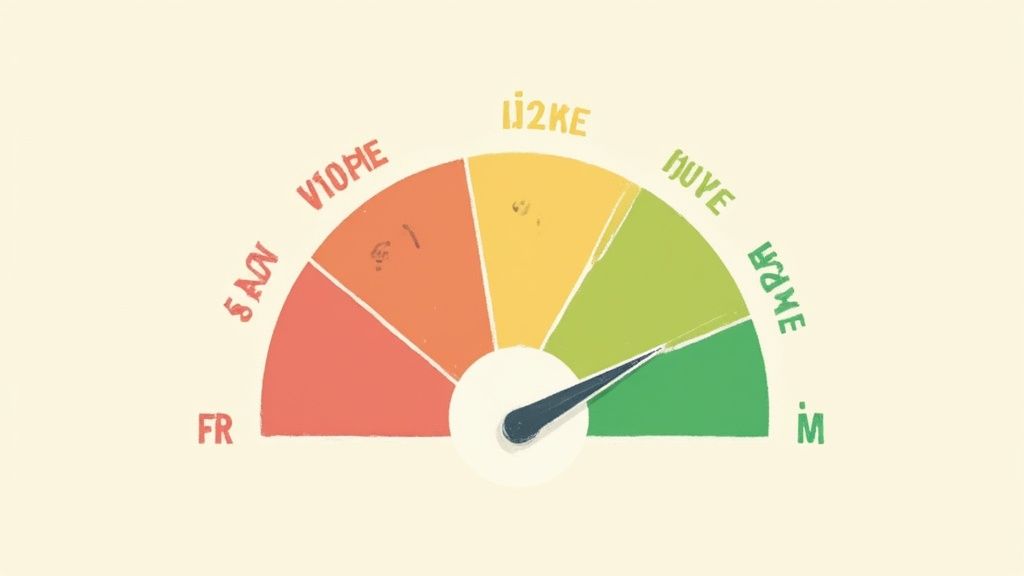
A fractional executive, especially a Chief Operating Officer (COO) or Chief Customer Officer (CCO), uses NPS not just as a score to track but as an operational tool. It helps them diagnose the health of the customer experience at scale. By understanding the “why” behind the score, they can prioritize initiatives that fix core issues for Detractors (scores 0-6), learn from what delights Promoters (scores 9-10), and find opportunities to convert Passives (scores 7-8) into advocates.
Strategic Application & Analysis
World-class companies integrate NPS into their operational DNA. Tesla, for instance, has famously achieved industry-leading scores by creating a superior product and ownership experience, turning customers into a powerful marketing force. Similarly, Apple leverages its consistently high NPS (often above 70) as a competitive moat, fueling brand loyalty that translates directly into repeat purchases and a robust ecosystem. These companies don’t just measure NPS; they act on the feedback immediately.
Strategic Insight: The real value of NPS is unlocked when you analyze the qualitative feedback that follows the core question. Asking “What is the primary reason for your score?” separates high-performing companies from the rest. This feedback is a goldmine for product development, service improvements, and strategic planning.
Actionable Takeaways for Founders
A fractional executive can implement a robust NPS program to drive customer-centric growth. Here are actionable steps you can take:
- Segment Your NPS Data: Analyze NPS scores by customer lifecycle stage, product line, or geography. This reveals specific friction points or areas of excellence within your business that a blended, company-wide score would otherwise hide.
- Create Closed-Loop Feedback: Establish automated workflows to respond to feedback. A manager should personally contact high-value Detractors within 24 hours, while Promoters can be invited to a referral or case study program. This turns the metric into a conversation.
- Track Both Relational and Transactional NPS: Measure relational NPS (overall brand perception) quarterly and transactional NPS (after specific interactions like a support ticket or purchase) to get both a macro and micro view of customer satisfaction.
3. Monthly Recurring Revenue (MRR)
Monthly Recurring Revenue (MRR) is the lifeblood of any subscription-based business, from SaaS platforms to subscription commerce. It measures the predictable and recurring revenue a company expects to receive every month, providing a clear pulse on financial stability and growth trajectory. Unlike one-time sales revenue, MRR offers a forward-looking view of business health. This makes it one of the most vital key performance indicators examples for founders, investors, and fractional executives aiming to build a scalable and sustainable company.

A fractional CFO or CRO uses MRR not just as a historical record but as a dynamic tool for strategic planning. It helps model future cash flow, determine hiring capacity, and set realistic growth targets. By understanding the components of MRR change, a leader can pinpoint exactly what is driving or hindering growth, whether it’s new customer acquisition, up-sells, or customer churn. This insight is critical for making informed decisions on where to allocate resources.
Strategic Application & Analysis
Top-tier SaaS companies are built on the meticulous tracking and optimization of MRR. For example, Slack famously grew its MRR from $1M to over $100M in under three years by focusing on a viral, bottom-up adoption model that quickly converted free users to paying teams, driving new MRR. Similarly, HubSpot strategically analyzes MRR across its different product hubs (Marketing, Sales, Service) to identify which offerings are resonating most with customers, guiding its product development and cross-selling priorities.
Strategic Insight: The real power of MRR is unlocked when you deconstruct it. Analyzing New MRR (from new customers), Expansion MRR (from upgrades), and Churned MRR (from cancellations) provides a complete narrative of your company’s growth engine. A high Expansion MRR can often signal strong product-market fit and a healthy, loyal customer base.
Actionable Takeaways for Founders
A fractional executive will immediately implement a sophisticated MRR tracking system to reveal growth levers. Here are actionable steps you can take:
- Break Down Your MRR: Don’t just look at the top-line number. Implement tracking that separates MRR into its core components: New, Expansion, Contraction, and Churn. This reveals if your growth is coming from new sales or existing customers.
- Track MRR Cohorts: Analyze MRR on a cohort basis, grouping customers by the month they signed up. This helps you understand how customer value evolves over time and if recent product or pricing changes are improving long-term value.
- Monitor Net MRR Churn Rate: Aim for a negative Net MRR Churn Rate. This occurs when your Expansion MRR from existing customers is greater than the MRR you lose from churned customers, meaning your business is growing even without acquiring new customers.
4. Customer Acquisition Cost (CAC)
Customer Acquisition Cost (CAC) is the total expense a business incurs to gain a new customer. It encompasses all marketing and sales costs, from ad spend and content creation to sales team salaries and software tools. Calculating CAC is essential for evaluating the efficiency of your growth engine and is a foundational metric for financial planning and a cornerstone among key performance indicators examples. It tells you exactly how much you are spending to put your product or service into the hands of a new user.

A fractional executive, especially a CFO or CMO, uses CAC to ensure the business is growing sustainably, not just quickly. By meticulously tracking this KPI, they can allocate marketing budgets to the most effective channels and cut spending on those that fail to deliver a positive return. It directly informs how scalable a business model is and whether the current growth strategy is profitable. Understanding your CAC is also crucial for managing cash flow, as a fast-growing company can quickly run out of money if its acquisition costs are too high and the payback period is too long; you can explore ways to manage this by understanding how to automate your startup’s receivables management.
Strategic Application & Analysis
The most innovative companies master their CAC to outmaneuver competitors. For example, Dropbox achieved an incredibly low CAC early on by engineering a viral referral program that rewarded both the sender and the receiver with extra storage space. Warby Parker blended digital and physical strategies, using targeted online ads to drive customers to physical showrooms, which created a cost-effective, high-conversion acquisition loop.
Strategic Insight: A critical element of CAC analysis is the “payback period” – the time it takes to recoup the cost of acquiring a customer. For most SaaS businesses, a payback period of under 12 months is considered excellent, as it allows capital to be reinvested into growth more rapidly.
Actionable Takeaways for Founders
A fractional leader will prioritize CAC optimization to improve profitability. Here are immediate actions you can implement:
- Calculate CAC by Channel: Don’t use a single blended CAC. Break it down by each marketing channel (e.g., Google Ads, content marketing, social media) to identify your most and least efficient sources of new customers.
- Include All Costs: Ensure your CAC calculation is comprehensive. Include often-overlooked expenses like employee salaries, software subscriptions, and creative agency fees for an accurate picture of your true acquisition cost.
- Focus on Conversion Rate Optimization (CRO): Reducing CAC isn’t just about spending less; it’s about converting more. Invest in improving your landing pages, checkout process, and user onboarding to make every marketing dollar work harder.
5. Employee Net Promoter Score (eNPS)
Employee Net Promoter Score (eNPS) is a powerful internal metric that gauges employee loyalty and engagement. It adapts the customer-centric NPS framework by asking employees a single, crucial question: “On a scale of 0-10, how likely are you to recommend this company as a place to work?” Based on their responses, employees are categorized as Promoters (9-10), Passives (7-8), or Detractors (0-6). For any business, especially startups where culture is paramount, eNPS provides a fast, quantifiable pulse check on workplace health. This is one of the most insightful key performance indicators examples for understanding the link between employee happiness and business performance.
A fractional executive, particularly a Chief People Officer or COO, uses eNPS as a leading indicator for potential retention issues and operational friction. A low or declining score signals underlying problems that can lead to higher turnover, lower productivity, and difficulty attracting top talent. By monitoring eNPS, leadership can proactively address issues before they escalate, fostering a resilient and motivated workforce. It directly answers the question: are we building a company where our best people want to stay and thrive?
Strategic Application & Analysis
Forward-thinking companies integrate eNPS into their core operational rhythm. For example, Salesforce tracks eNPS by team, department, and manager, allowing them to pinpoint specific areas of disengagement and provide targeted support. Tech giant Google famously uses eNPS alongside other comprehensive surveys to continuously monitor employee sentiment, using the feedback to refine its management practices and benefits programs, ultimately protecting its reputation as a top employer.
Strategic Insight: The real power of eNPS is unlocked when you analyze the “why” behind the score. The quantitative score is a starting point; the qualitative feedback from follow-up questions provides the actionable roadmap for improvement. Detractors are not just a problem to be solved; they are a source of critical, unfiltered feedback on your company’s biggest weaknesses.
Actionable Takeaways for Founders
A fractional executive will use eNPS to build a stronger organizational foundation. Here are actionable steps to implement this KPI effectively:
- Segment Your Data: Analyze eNPS scores by tenure, department, and management level. This segmentation can reveal if new hires are struggling with onboarding, if a specific team is facing leadership challenges, or if mid-level managers feel unsupported.
- Follow Up with Qualitative Questions: After the scoring question, always ask open-ended questions like “What is the primary reason for your score?” or “What is one thing we could do to improve your experience?” This context is where the most valuable insights lie.
- Act and Communicate: Address Detractor feedback transparently and promptly. Communicate the key themes you’ve identified and the action plans you’re implementing. This closes the feedback loop and shows employees their voices are heard, which is essential for building high-performing teams.
6. Gross Profit Margin
Gross Profit Margin is a fundamental profitability metric that reveals how efficiently a business is producing and selling its core products or services. It calculates the percentage of revenue left after subtracting the Cost of Goods Sold (COGS), showing the direct profit from sales before accounting for any operating expenses, interest, or taxes. For founders, this KPI provides a clear, high-level view of operational health and pricing strategy effectiveness. It’s one of the most critical key performance indicators examples because it forms the bedrock of a company’s financial viability.
A fractional CFO uses Gross Profit Margin as a primary diagnostic tool. This KPI directly informs strategic decisions related to pricing, production costs, and supplier negotiations. By analyzing margin trends, an executive can pinpoint inefficiencies in the supply chain or opportunities to increase prices, ensuring the core business model is not just generating revenue but is genuinely profitable. It answers the foundational question: are we making money on the things we sell?
Strategic Application & Analysis
Leading companies masterfully manage their gross margins to drive overall profitability. For example, Apple consistently maintains high gross margins (often over 40%) through premium brand positioning, component cost control, and supply chain mastery. In contrast, a company like Tesla showcased a strategic journey, improving its automotive gross margins from negative figures to over 20% by scaling production, automating manufacturing, and optimizing its battery technology costs. This demonstrates a direct link between operational improvements and financial health.
Strategic Insight: The most powerful analysis comes from segmenting Gross Profit Margin. Instead of a single company-wide number, calculate it by product line, service tier, or even geographic region. This reveals which parts of your business are truly driving profitability and which may be draining resources.
Actionable Takeaways for Founders
A fractional executive will use Gross Profit Margin analysis to steer the company toward sustainable growth. Here are actionable steps you can implement:
- Benchmark Against Your Industry: Compare your gross margin to industry averages. If you are significantly lower, it signals a potential issue with either your pricing strategy or your cost structure that needs immediate attention.
- Identify Profit Drivers: Calculate margins for each product or service. This helps you identify your most profitable offerings, informing decisions on where to focus marketing spend and R&D investment.
- Monitor Margin Trends: Track your Gross Profit Margin over time (monthly and quarterly). A declining trend is an early warning sign of rising production costs or pricing pressure, allowing you to react before it impacts your bottom line.
7. Website Conversion Rate
Website Conversion Rate is the cornerstone of digital marketing performance, measuring the percentage of website visitors who complete a desired action. This action, or “conversion,” can be a macro-goal like a purchase or a micro-goal like a newsletter signup. For any business with a digital presence, this metric is a direct reflection of website effectiveness, user experience (UX), and campaign success. It is one of the most fundamental key performance indicators examples because it connects marketing traffic directly to business outcomes.
A fractional executive, especially a CMO, will obsess over conversion rates because they represent the efficiency of the entire marketing funnel. A high volume of traffic is meaningless if visitors don’t convert. By optimizing this KPI, a leader can dramatically increase revenue and lead generation without spending an extra dollar on advertising, making it a powerful lever for profitable growth. It helps answer the question: is our website effectively turning visitors into customers?
Strategic Application & Analysis
Top-tier companies build their digital experiences around conversion optimization. For example, Amazon relentlessly tests every element of its product and checkout pages, using personalized recommendations and a one-click purchase process to remove friction. E-commerce giant Booking.com masters urgency and social proof, using tactics like “Only 2 rooms left!” and “Booked 15 times in the last 24 hours” to drive immediate decisions and achieve industry-leading conversion rates.
Strategic Insight: True optimization comes from segmentation. A blended website conversion rate is a starting point, but the real insights emerge when you analyze rates by traffic source, device, new vs. returning visitor, or landing page. This reveals which channels deliver high-intent traffic and which pages are underperforming.
Actionable Takeaways for Founders
A fractional marketing leader will use conversion rate analysis to generate immediate returns. Here are actionable steps to implement:
- Implement A/B Testing: Don’t guess what works. Continuously test variations of your headlines, calls-to-action (CTAs), page layouts, and images. Even small, incremental improvements can compound into significant revenue gains.
- Focus on Mobile Optimization: With mobile traffic often exceeding desktop, a poor mobile experience is a major conversion killer. Prioritize a mobile-first design with simple navigation and fast-loading pages.
- Analyze User Behavior: Use tools like heatmaps and session recordings to see where users are clicking, scrolling, and getting stuck. These insights reveal hidden barriers in the user journey that you can fix to improve flow and boost conversions. By closely tracking this, you can better measure business growth.
Key Metrics Comparison of 7 KPIs
| Metric | Implementation Complexity 🔄 | Resource Requirements ⚡ | Expected Outcomes 📊 | Ideal Use Cases 💡 | Key Advantages ⭐ |
|---|---|---|---|---|---|
| Customer Lifetime Value (CLV) | High – requires extensive historical data and predictive modeling | High – data collection, analytics tools, and ongoing updates | Forecasts future revenue and profitability tiers | Long-term customer value optimization, marketing ROI | Guides marketing budget, identifies valuable segments, improves retention strategies |
| Net Promoter Score (NPS) | Low – simple single-question survey | Low – survey tools and minimal data processing | Measures customer loyalty and likelihood to recommend | Customer loyalty tracking, benchmark comparison | Easy to implement, industry benchmarking, tracks sentiment over time |
| Monthly Recurring Revenue (MRR) | Medium – requires revenue tracking and segmentation | Medium – billing systems, subscription data management | Tracks recurring revenue and growth trends | Subscription businesses, revenue forecasting | Accurate cash flow forecasting, investor reporting, growth insight |
| Customer Acquisition Cost (CAC) | Medium – involves tracking marketing and sales spend | Medium – comprehensive cost tracking across channels | Measures cost efficiency of acquiring customers | Marketing efficiency, budget allocation | Optimizes marketing spend, evaluates profitability, supports investor evaluation |
| Employee Net Promoter Score (eNPS) | Low – simple engagement survey format | Low – survey software and minimal analysis | Assesses employee loyalty and engagement | Employee satisfaction and retention | Quick to implement, predicts turnover, cost-effective engagement measure |
| Gross Profit Margin | Medium – requires accurate revenue and cost data | Medium – financial reporting tools and accounting data | Indicates production efficiency and core profitability | Financial analysis, pricing strategy | Clear profitability indicator, cost optimization, comparative benchmarking |
| Website Conversion Rate | Medium – requires tracking website interactions | Medium – analytics platforms and A/B testing setups | Measures effectiveness of website in driving actions | Digital marketing optimization, UX improvements | Directly impacts ROI, identifies high-performing channels, supports continuous optimization |
From Measurement to Mastery: Activating Your KPIs
You’ve now explored a curated set of powerful key performance indicators examples, from the financial bedrock of Monthly Recurring Revenue (MRR) and Gross Profit Margin to the customer-centric pulse of Customer Lifetime Value (CLV) and Net Promoter Score (NPS). Each metric we’ve detailed offers a unique lens through which to view your business, revealing critical insights into health, efficiency, and growth potential.
However, understanding these individual metrics is just the starting point. The true competitive advantage doesn’t come from merely tracking data points in a spreadsheet; it comes from weaving them into a cohesive narrative that guides your strategic decisions. Mastery is achieved when you move beyond isolated measurement and begin to understand the intricate relationships between these numbers.
Connecting the Dots for Strategic Growth
The real power of KPIs emerges when you analyze them in context. A rising CLV is fantastic, but if it’s driven by a Customer Acquisition Cost (CAC) that’s growing even faster, your business model is on a countdown to failure. Similarly, an impressive Website Conversion Rate loses its impact if the customers you’re converting have a low NPS and churn quickly.
This interconnectedness is where strategic leadership becomes non-negotiable. It requires an experienced eye to see the full picture, asking critical questions like:
- How does our eNPS correlate with our customer-facing NPS? Are happy employees creating happier customers?
- What is the payback period for our CAC, and how does it align with our CLV?
- Is our MRR growth coming from sustainable sources, or are we sacrificing Gross Profit Margin for short-term gains?
Strategic Insight: KPIs are not just report cards; they are a navigation system. An executive-level leader knows how to use this system to identify which levers to pull, turning complex data into a clear, actionable roadmap for sustainable scaling.
Your Actionable Path Forward
For founders and small business leaders, translating these insights into action can feel overwhelming, especially when you’re already stretched thin managing day-to-day operations. This is precisely where fractional executives provide immense value. Instead of bearing the cost and commitment of a full-time C-suite hire, you can embed a seasoned, part-time leader into your team.
This expert can immediately help you build a robust KPI framework, diagnose underlying issues revealed by the data, and execute strategies to drive meaningful improvement. They bring the high-level experience needed to not just track these key performance indicators examples but to activate them as a core part of your growth engine, ensuring every decision is informed, strategic, and aligned with your ultimate business goals.
Ready to transform your data from a simple report into a powerful strategic asset? A fractional executive from Shiny can provide the expert guidance you need to master your KPIs and accelerate your startup’s journey. Explore our network of vetted, world-class leaders and find the perfect partner to drive your growth at Shiny.