
Manufacturing Industry Challenges and How to Fix Them
If you run a manufacturing business today, the hard days rarely arrive one at a time.
A supplier misses a promised ship date. Two operators call out. Supervisors authorize overtime to keep orders moving. The new automation cell is technically installed, but no one has fully stabilized the process, so production keeps falling back to manual workarounds. Finance sees margin pressure. Operations sees schedule pressure. Engineering sees a queue that never gets shorter.
That's why manufacturing feels harder than it used to. Most problems no longer stay in their lane. A sourcing issue becomes a scheduling issue. A labor issue becomes a quality issue. A technology project becomes a leadership issue.
Growth-stage manufacturers often respond with familiar moves. Push expediting harder. Add more overtime. Delay nonessential projects. Ask managers to stretch. Those steps can help for a week or a quarter, but they usually don't solve the underlying problem. They shift stress from one part of the plant to another.
The manufacturers that regain control usually do something different. They stop treating each symptom as a separate fire and start looking at the operating system as a whole. They ask where throughput is really breaking, which constraints are structural, and whether the business has enough leadership capacity to coordinate the fix.
That last point matters more than many leaders expect. A plant can have decent people, decent equipment, and decent demand, yet still struggle because no one has the time or senior experience to connect supply chain decisions, workforce planning, engineering priorities, and technology rollout.
Introduction Why Manufacturing Feels Harder Than Ever
A mid-sized manufacturer can have a full order book and still feel stuck.
One week, resin or metal stock arrives late. The next, a key customer wants a design variation that sounds small but forces a routing change, a tooling review, and a supplier check. At the same time, supervisors are covering absenteeism with overtime, and the automation upgrade that was supposed to reduce labor pressure keeps slipping because maintenance, engineering, and production don't have one owner driving the transition.
None of those issues is unusual on its own. The problem is how quickly they stack.
Why separate problems now collide
Manufacturing used to give leaders more room to isolate issues. A material delay could stay a purchasing problem. A staffing gap could stay an HR problem. A machine issue could stay a maintenance problem.
That separation is weaker now.
When a plant runs tighter schedules, wider product mixes, leaner teams, and more connected systems, one weak link affects the rest. A late part changes the plan. The changed plan creates overtime. Overtime increases fatigue. Fatigue raises quality risk. Rework consumes engineering attention that should have gone into process improvement or new product launch support.
Most manufacturing industry challenges aren't isolated events. They're chain reactions.
Many smaller and mid-sized firms get trapped. Leadership teams know something is off, but the pain shows up in different dashboards. Purchasing sees premium freight. HR sees turnover. Finance sees margin erosion. Production sees missed schedules. Everyone is right, but no one is looking at the same constraint.
Why cost cutting alone doesn't solve it
A lot of operators still reach first for cost control. That's understandable. When margins tighten, spending discipline matters.
But cost cutting works poorly when the issue is unstable throughput. If a plant keeps changing schedules, retraining replacements, and firefighting supplier problems, trimming budget lines won't restore flow. It can make the business more brittle.
What helps is a more practical diagnosis:
- Where does work stall most often
- Which problems come from external volatility
- Which problems come from internal operating design
- Which fixes require hands-on senior leadership, not just policy changes
That's where this topic gets useful. Once leaders separate productivity pressure, supply chain complexity, labor instability, and technology risk, the path forward gets clearer. Not easy, but clearer.
Understanding the Core Manufacturing Industry Challenges
Manufacturing performance is easiest to understand if you think of a plant like an engine.
An efficient engine turns fuel into motion with minimal waste. A healthy plant turns labor, materials, machine time, and engineering effort into sellable output with minimal delay, rework, and disruption. When the engine starts losing efficiency while fuel gets more expensive, the operator feels pressure from both sides.
That's what many manufacturers are facing now.
In the United States, manufacturing labor productivity fell 1.0% between Q2 2022 and Q2 2023, and total factor productivity dropped 3.2% from 2022 to 2023. Over the same five-year period, manufacturing total factor productivity posted a compound annual growth rate of -0.7%. Earlier data shows this isn't a short-term dip. U.S. manufacturing multifactor productivity declined by an average of 0.3% per year from 2004 through 2016, and 53% of manufacturing industries experienced multifactor productivity declines in that period, according to the NIST analysis of manufacturing productivity trends.
Why this matters on the plant floor
Lower productivity doesn't stay an abstract economic term for long. It shows up in everyday operating pressure.
If output per labor hour weakens while wages, energy, logistics, and compliance costs rise, managers lose room to absorb mistakes. A late shift handoff matters more. A small batch change matters more. A rushed engineering revision matters more.
That's why manufacturing industry challenges tend to compound. Plants don't only need demand. They need stable conversion of effort into output.
For leaders trying to improve that conversion, this guide on manufacturing operations management is a useful companion to the strategic issues covered here.
The three forces that usually compound each other
A lot of confusion comes from treating every challenge as separate. In practice, most plants deal with three overlapping pressures:
- Flow pressure: Material timing, production scheduling, and changeovers interrupt output.
- Capability pressure: The team doesn't always have the technical depth to maintain systems, launch new processes, or sustain standards.
- Decision pressure: Senior leaders are stretched thin, so priorities drift and fixes arrive late.
Practical rule: If your plant feels busy all the time but output doesn't move smoothly, the issue usually isn't effort. It's conversion efficiency.
This is why broad advice like "invest in automation" or "reduce waste" often disappoints. Without stable planning, enough engineering bandwidth, and clear leadership ownership, those moves can add complexity before they add results.
Operational and Supply Chain Pressures Slowing Throughput
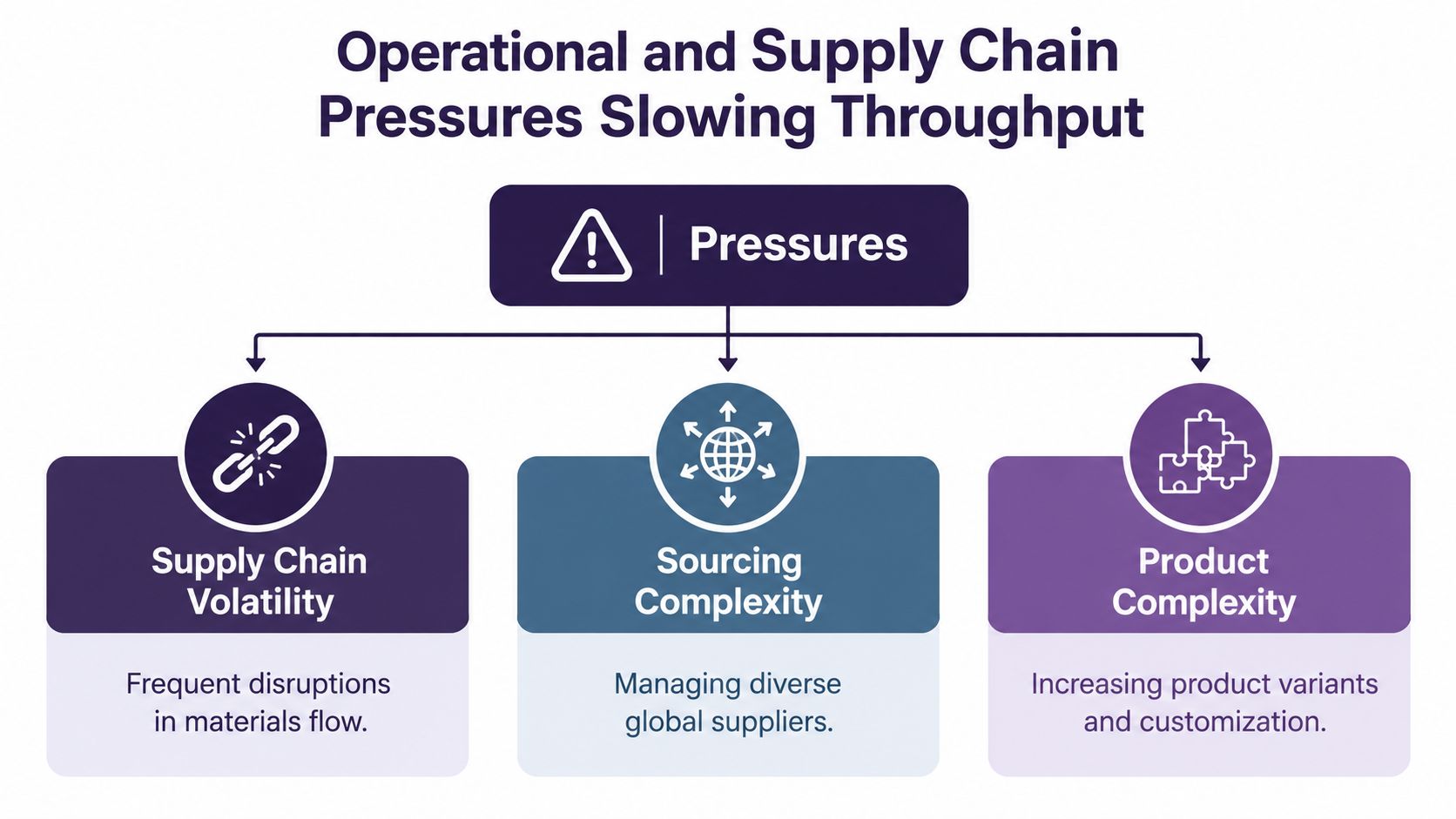
Many leaders still talk about manufacturing problems as if the main issue is cost. Cost matters, but throughput often breaks first.
A plant can survive expensive inputs for a while if operations stay predictable. It struggles much faster when material timing, sourcing decisions, and product variation keep disrupting execution. The modern challenge isn't just buying cheaper. It's producing reliably while conditions keep changing.
A 2026 manufacturing report described volatility from geopolitics, tariffs, and material costs as a permanent operating condition, while engineering capacity constraints and growing sourcing complexity made it harder for companies to move quickly and reliably. In the same period, a separate 2026 outlook found product complexity reached a four-year high as manufacturers struggled to scale mass customization. Trade uncertainty also remained a leading concern, with more than three-quarters of manufacturers in one survey citing it as their top issue, according to the 2026 State of Manufacturing report from Fictiv.
Where throughput actually breaks
The breakdown usually happens in one of three places.
First, planning teams struggle to re-sequence work when material availability changes. Second, engineering teams become the bottleneck when customer variation or redesign requests outpace available capacity. Third, sourcing teams inherit too many supplier relationships, alternate part paths, and quality trade-offs to manage cleanly.
This is why some plants look loaded with activity yet still miss dates. The issue isn't a lack of motion. It's too much motion in the wrong places.
For teams tightening these handoffs, these supply chain management best practices are useful when paired with stronger operating governance.
The real shift is from cost optimization to response capability. Plants that can't redesign, re-source, or re-plan quickly lose time before they lose margin.
Signals leaders should watch
You don't need a massive transformation program to spot operational strain. You need pattern recognition.
Look for signals like:
- Schedule churn: The weekly plan keeps changing because inputs or priorities don't hold.
- Engineering queue buildup: Small customer requests take too long because specialists are buried in support work.
- Launch drag: New products or variants enter production before routings, instructions, and supplier readiness are stable.
- Sourcing sprawl: Buyers spend more time juggling alternates, exceptions, and expediting than improving resilience.
A simple analogy helps here. Think of the plant as an airport. If one flight is delayed, the system can recover. If gates, crews, aircraft, and weather all change at once, the schedule starts rippling across the whole network. Many factories now operate in that ripple state.
Workforce Gaps and Skills Shortages on the Factory Floor
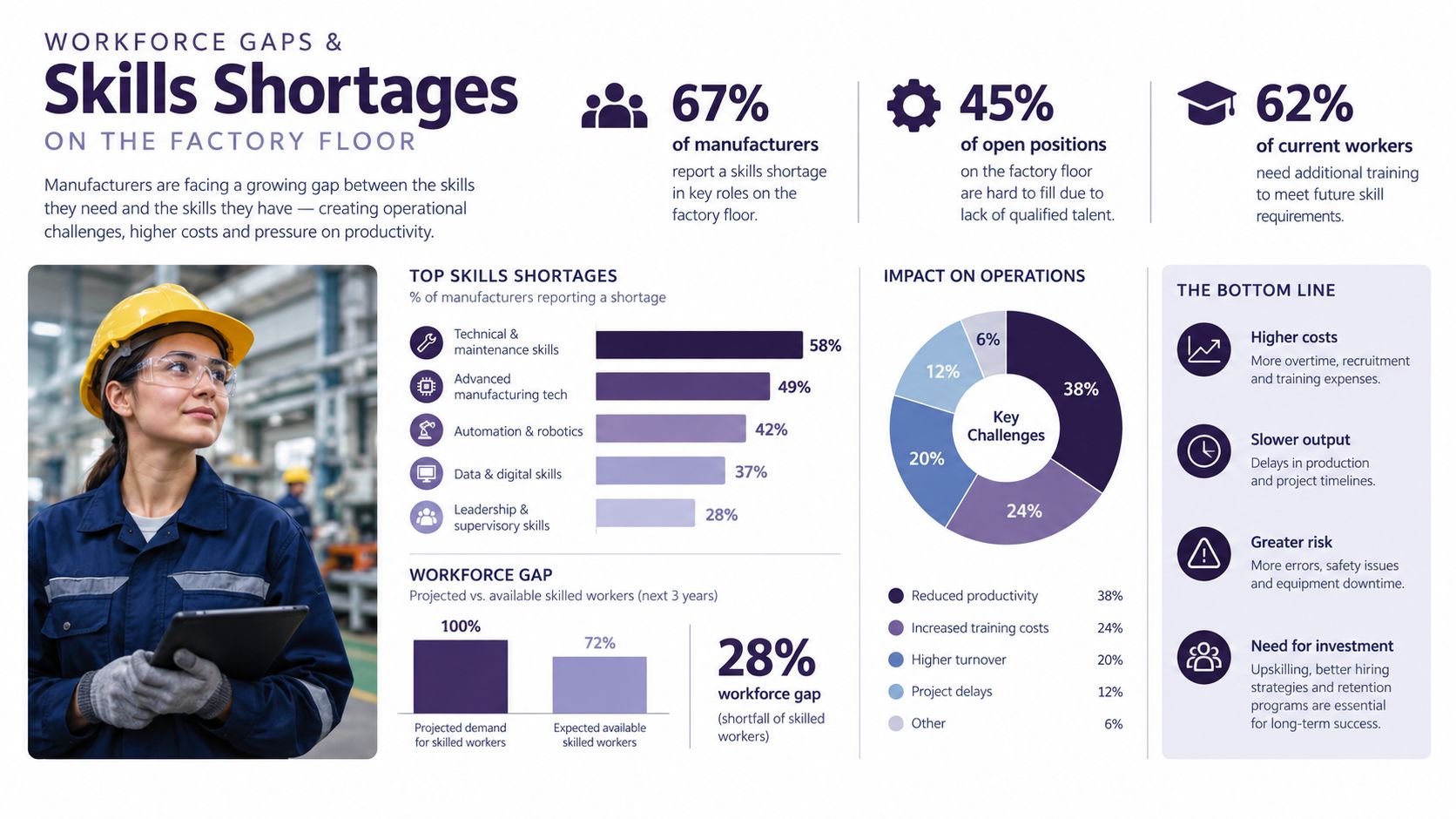
Workforce issues in manufacturing aren't just about finding more people. They're about sustaining the right level of capability every shift, every week, without quality slipping.
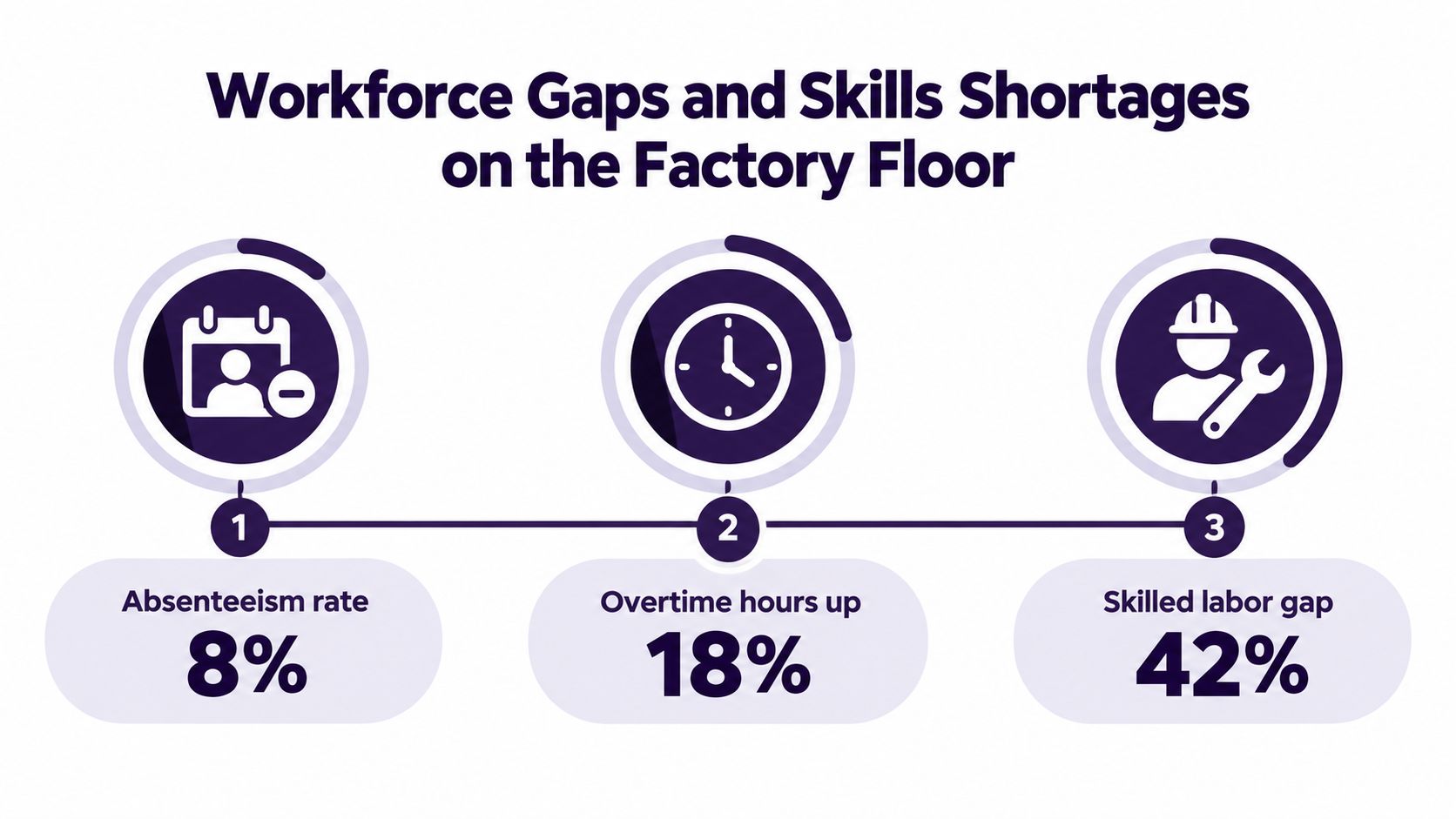
That distinction matters. A plant can technically be staffed and still be underpowered if absenteeism is high, overtime is constant, supervisors are training replacements, and technical roles stay open too long. On paper, headcount looks acceptable. In practice, throughput is unstable.
In a 2025 manufacturing survey, 88% of manufacturers said compliance costs affected the bottom line, 88% said overtime costs were a financial burden, and 90% said frontline absenteeism hurt profitability, according to the UKG manufacturing workforce report.
Headcount is only part of the problem
Independent research shows 36% of manufacturing vacancies are hard to fill because applicants lack the required skills, qualifications, or experience, versus 24% across all industries. The same research found 59% of manufacturers say automation is already changing job and skill requirements, while 50% cite wider digitalisation, according to the Make UK skills gap report.
That changes the conversation.
If a plant needs controls knowledge, maintenance diagnostics, process engineering support, or digitally enabled troubleshooting, adding bodies without upgrading capability won't fix the bottleneck. It may even increase the burden on your strongest people, who now have to train, supervise, and troubleshoot more frequently.
For companies trying to separate training needs from role design problems, this guide on how to identify skill gaps is a useful starting point.
The turnover loop that hurts quality and output
Workforce instability creates a loop many leaders recognize but don't always quantify clearly.
McKinsey reported U.S. manufacturing turnover reached 36.6% in 2023, and other manufacturing workforce research indicated that roughly 80% of manufacturers reported a skills shortage inside their factories, as cited in the Babbage workforce report.
That loop often looks like this:
- Turnover rises. Experienced operators and technicians leave.
- Supervision load increases. Frontline leaders spend more time onboarding and checking work.
- Standardization weakens. Processes drift because newer workers haven't internalized best practice.
- Defect and downtime risk increase. Teams rely more heavily on overtime and heroics.
- Automation becomes harder to implement well. The plant needs technical talent most when it's hardest to find.
If your team keeps saying, "We have people, but not enough people who can own the work," you're looking at a capability constraint, not just a recruiting problem.
What to diagnose first
Before launching another hiring push, leaders should ask three blunt questions:
- Is the main issue attendance volatility
- Are we overusing overtime to cover a planning or retention problem
- Which roles create the biggest downstream disruption when vacant
The answers usually point to a narrower fix than "hire more." Sometimes the problem sits in shift structure. Sometimes it sits in training ownership. Sometimes it sits in the absence of a senior operator, plant, or supply chain leader who can align staffing, process discipline, and technology rollout.
Technology Adoption and Cybersecurity Risks for Modern Plants
A lot of manufacturing firms still treat technology and cybersecurity as support functions. That view is outdated.
In a modern plant, connected machines, production software, vendor portals, remote access tools, and shared operational data all affect uptime. If those systems fail or get compromised, the impact lands on schedules, customer delivery, and margin. This is not just an IT discussion. It's an operations discussion.

Why smaller manufacturers should pay special attention
The risk profile isn't identical across the sector. Company size and maturity change what hurts most.
In a 2026 UK manufacturing survey, cybersecurity was the top concern for firms under £100m turnover, cited by 38% of respondents. Supply chain challenges were top overall at 35%, and skills shortages were most cited by mid-sized firms at 35%. The same reporting noted manufacturing accounted for 27.7% of all cyberattacks in 2025, the highest of any industry, and public-facing application exploitation was the most common intrusion path at 32% of cases, according to the MHA manufacturing report.
That's a useful correction to the usual narrative. A large global manufacturer may absorb some disruption with deeper bench strength and more formal controls. A smaller plant often can't. One incident can halt shipping, scramble scheduling, and consume management attention for weeks.
OT and IT now share the same risk surface
A simple analogy helps. A connected plant is like a house where every renovation added another door. One door goes to the office network. One to vendor access. One to machine monitoring. One to customer systems. One to cloud reporting. If no one tracks which doors exist, which locks matter, and who holds keys, the house becomes harder to protect.
At the same time, many firms are still underprepared for advanced digital work. One 2026 market report noted that only 28% of manufacturers felt adequately prepared for Industry 4.0 skills demands, according to The Education Echo summary of 2026 manufacturing skills findings.
Cyber resilience in manufacturing is really uptime protection. If a system failure can stop production, the risk belongs on the operations agenda.
For smaller and growth-stage firms, the practical starting point is usually modest. Clarify system ownership. Limit unnecessary access. Review which plant processes would fail if key digital tools went down. Make sure operations, engineering, and IT are solving the same continuity problem, not working from separate assumptions.
Strategic Fixes and How Fractional Leaders Accelerate Results
Once leaders see the mix of manufacturing industry challenges in front of them, the next question isn't "Should we act?" It's "What kind of leadership do we need to act well?"
Many businesses lose momentum. They know they need stronger operations, supply chain, or production leadership, but they're stuck between three imperfect options. Hire a full-time executive. Bring in a consultant. Or use a fractional leader who can own outcomes without the overhead of a permanent senior hire.
Each model has a place.
Choosing the right leadership model for manufacturing fixes
| Leadership Model | Cost and Commitment | Speed to Impact | Flexibility and Continuity |
|---|---|---|---|
| Full-time executive | Highest commitment. Makes sense when the role is permanent, broad, and the business is ready to support it. | Often slower because search, hiring, and onboarding take time. | Strong continuity if the hire is right, but harder to adjust if needs change. |
| Consultant | Usually scoped around analysis or a project. Useful for diagnosis, benchmarking, or specialist work. | Can start quickly, especially for narrow problems. | Flexible, but continuity can drop once the engagement ends. Ownership may stay with internal teams. |
| Fractional executive | Lower commitment than a full-time hire, with more operating ownership than a typical consultant. | Often faster than a full-time search because the leader steps into an active need. | High flexibility. Useful when the company needs senior judgment, cross-functional coordination, and execution for a defined stage. |
When fractional leadership fits best
Fractional support is particularly useful when the challenge is cross-functional and urgent, but not yet large enough to justify another full-time executive.
Examples include:
- An operations reset: The plant needs better production discipline, clearer KPIs, and stronger daily management.
- A supply chain redesign: The company must stabilize sourcing, improve planning, or reduce schedule volatility.
- A technology transition: Automation or digital initiatives need operational ownership so they don't stall between departments.
- A scale-up phase: Revenue is growing, complexity is rising, and founders or general managers can't keep absorbing executive work.
A seasoned fractional COO, VP of Operations, or supply chain leader often brings something many firms are missing: pattern recognition from multiple environments. They've seen what causes launch drag, where planning breaks, how engineering bandwidth gets consumed, and what realistic process redesign looks like under budget pressure.
What good fractional leaders actually do
The strongest fractional leaders don't arrive with generic playbooks. They usually start by narrowing the constraint.
They might:
- Map the bottleneck: Is throughput limited by planning, engineering, staffing stability, or supplier coordination?
- Set operating cadence: Daily and weekly routines often matter more than another software purchase.
- Align talent and technology: Automation only helps when training, maintenance, and process ownership move with it.
- Create decision clarity: Plants improve faster when someone senior can force trade-offs and sequence the work.
One option for companies that need this kind of support is Shiny, which connects businesses with fractional executives across roles such as COO and operations leadership for part-time engagement.
Good leadership intervention doesn't add activity. It removes friction and gives the business a clear owner for the fix.
A practical rule helps here. If the business needs sustained ownership, cross-functional alignment, and execution over several months, a fractional executive often fits better than a consultant. If the role is clearly permanent and broad enough to fill the calendar year-round, a full-time hire may be the better answer.
Moving Forward With Confidence in Manufacturing
Manufacturing hasn't become impossible. It has become less forgiving.
A plant can no longer assume that labor pressure is separate from technology readiness, or that supply chain volatility is separate from engineering capacity. Smaller firms feel this first because they have less slack. Mid-sized firms feel it next because growth adds complexity faster than systems and leadership often mature.
A practical way to move forward
The manufacturers that regain footing usually keep the response simple at first.
Start with a short list of questions:
- Which problem is hurting throughput most right now
- Is that problem operational, workforce-related, technology-related, or a mix
- Where does leadership ownership feel unclear
- Which fix protects margin by improving flow, not just by reducing spend
Then build in sequence.
Don't launch five initiatives because five departments are uncomfortable. Stabilize the biggest constraint. Protect the handoffs around it. Give one senior person clear ownership. Measure fewer things, but measure the ones tied directly to output reliability.
Confidence comes from clearer ownership
Many manufacturing firms don't need more advice. They need enough experienced leadership capacity to turn scattered effort into coordinated action.
That might mean a stronger plant operating rhythm. It might mean someone senior enough to align engineering and sourcing. It might mean a part-time executive who can lead the fix while the business keeps its overhead flexible.
The common thread is clarity. When leaders understand which challenges come from company size, which come from maturity, and which come from missing executive bandwidth, the path gets more manageable. Not because the environment gets easier, but because the business starts responding with the right level of control.
If your manufacturing business needs stronger operational, supply chain, or executive leadership without committing to another full-time hire, Shiny offers a fractional executive marketplace that can help match you with vetted leaders for the stage you're in. It's a practical option when throughput, complexity, or transformation work has outgrown the capacity of the current team and you need experienced hands to steady the system.