
Market Analysis Consultants: The Founder’s Hiring Guide
You have a product customers like. Revenue is moving. A few competitors are getting louder. A new segment looks promising. At the same time, your team is stretched, your budget is watched closely, and every strategic mistake feels expensive.
That's when founders start looking at market analysis consultants.
Not because they want a thick report. Because they need clarity. They need to know which customer to target first, whether a new market is worth entering, why growth has flattened, or why a competitor is suddenly winning deals that used to be yours.
The hard part is that “hire a consultant” can feel vague and risky. You may not know what good work looks like, how to test it before committing, or whether there's a better option than a traditional consulting engagement. If you're running a company between early traction and real scale, those questions matter as much as the analysis itself.
Navigating Growth in the Fog of Uncertainty
Most founders hit a stage where instinct stops being enough.
Early on, you can talk to customers directly, watch demos, and make decisions from the front lines. Later, the picture gets messier. You have more channels, more customer types, more competitors, and more opinions inside the company. The result is familiar. Everyone has a theory, but nobody has proof.

A good market analysis process works like headlights in fog. It doesn't predict everything. It helps you see what's directly ahead, what's changing around you, and which route is safer than the others.
That matters in a business environment where outside expertise has become a major part of how companies make decisions. The global consulting services industry reached approximately USD 355.2 billion in 2024 and is projected to grow to USD 604.3 billion by 2033, driven by digital transformation and the need for specialized expertise to interpret complex market data, according to Growth Market Reports' consulting services industry analysis.
What uncertainty usually looks like
Founders rarely say, “I need market analysis.” They say things like:
- We have traction, but growth feels less predictable.
- We're debating two customer segments and can't tell which one is stronger.
- A larger competitor just changed pricing, and our team is reacting emotionally.
- We want to launch something new, but we don't know if demand is real or just noise.
Those are market analysis problems.
Why gut feel starts to break
A founder's instincts are useful. They're just limited by sample size.
If five customers ask for a feature, that tells you something. It doesn't tell you whether the broader market values it, whether competitors already satisfy that demand, or whether the feature would attract profitable buyers. Market analysis consultants help separate a loud signal from a meaningful one.
Practical rule: If the decision affects hiring, pricing, positioning, or expansion, it deserves more than a hunch.
Value isn't “research.” It's better bets. When the work is good, you stop debating abstractions and start deciding from evidence.
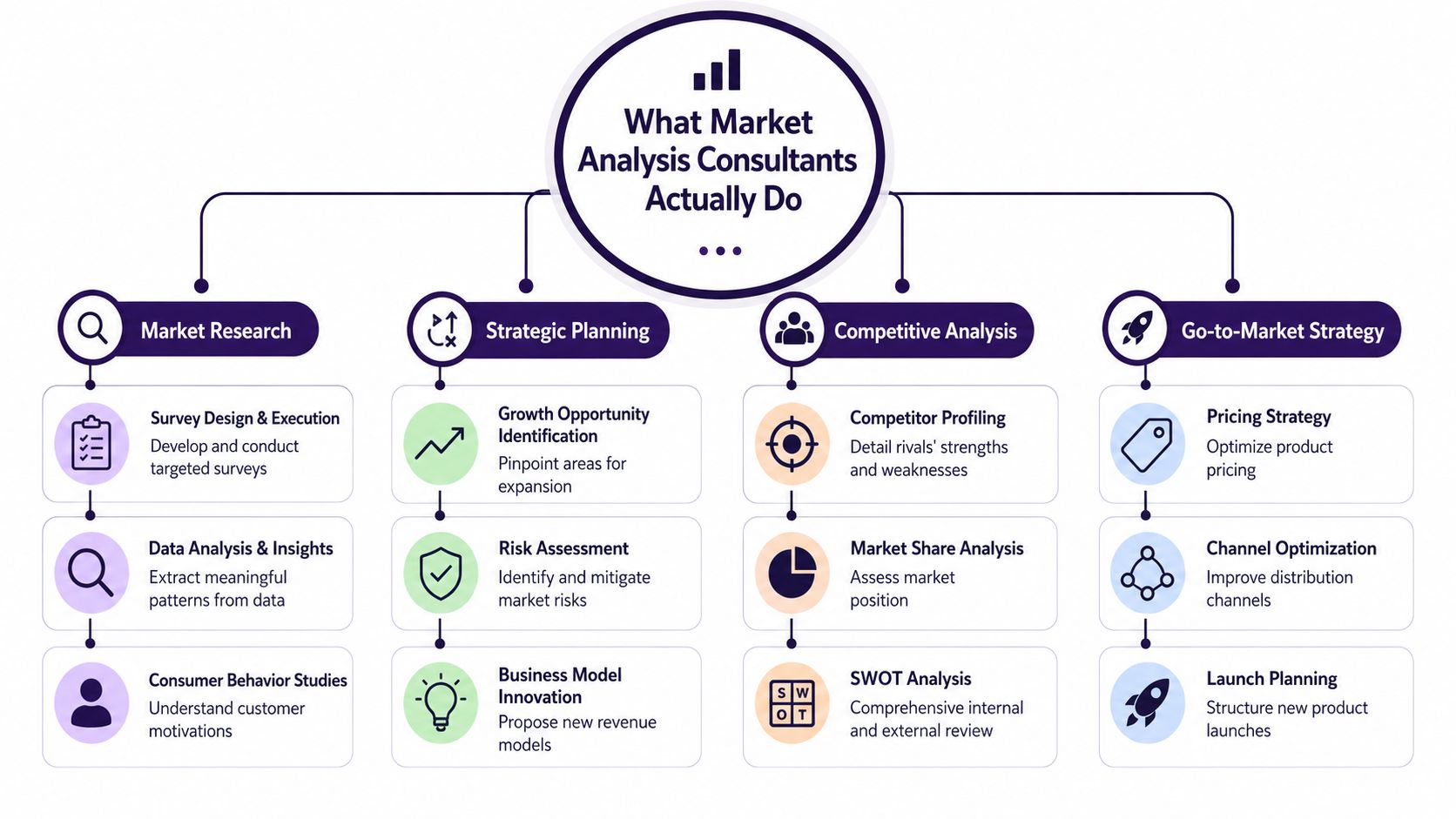
What Market Analysis Consultants Actually Do
Many founders assume market analysis consultants mainly gather data. That's only the first layer.
A better analogy is a doctor. The raw data is the symptom list. The analysis is the diagnosis. The recommendation is the treatment plan. If a consultant only hands you spreadsheets, they haven't finished the job.
They define what market matters
The first job is usually narrowing the question.
A founder may ask, “How big is our market?” A useful consultant asks better follow-ups. Which segment? Which buyer? Which geography? Which use case? Which buying motion? A market that looks huge on paper can be tiny once you filter for the customers you can serve and win.
That's why strong consultants don't just chase broad opportunity. They map the part of the market your business can realistically reach.
They break down competitors in a usable way
Competitive analysis isn't just a list of rival logos. It's a structured look at who you're really up against, how they position themselves, where they're strong, and where buyers still feel friction.
For example, a B2B SaaS company might think its main problem is feature parity. A consultant may find the core issue is packaging. Competitors make purchasing easier for mid-market buyers, while the client's pricing page creates friction for anyone outside enterprise procurement.
If you want a practical way to think about that process, this guide to a competitive analysis framework for growing companies is a useful companion.
They turn performance into benchmarks
Good market analysis consultants compare your business against external reality, not just your internal targets.
According to Aura's benchmarking guide, effective consultants benchmark against 10 core KPIs, including revenue growth rate, net profit margin, and customer retention, using data from industry associations, government bodies, and commercial reports to ensure global relevance.
That matters because founders often judge progress in isolation. A retention number can look fine until you compare it with the norm for your model. A margin problem can look operational until a benchmark shows your pricing strategy is the underlying issue.
Common outputs you can expect
A solid engagement often leads to deliverables like these:
- Customer segmentation map that shows who buys, why they buy, and which group is most attractive first
- Competitive positioning brief with pricing, messaging, strengths, and weak spots
- Market entry recommendation for a region, vertical, or adjacent product
- Product-market fit validation that tests whether demand is broad, urgent, and repeatable
- Go-to-market guidance on channels, offers, and launch sequencing
A useful consultant doesn't just answer “What's happening?” They answer “What should we do next Monday?”
What the work should feel like
You should feel more focused, not more overwhelmed.
The best market analysis consultants reduce complexity. They help your team stop arguing over assumptions. They identify the few factors that matter most, then connect those findings to pricing, product, sales, and expansion choices your team can act on.
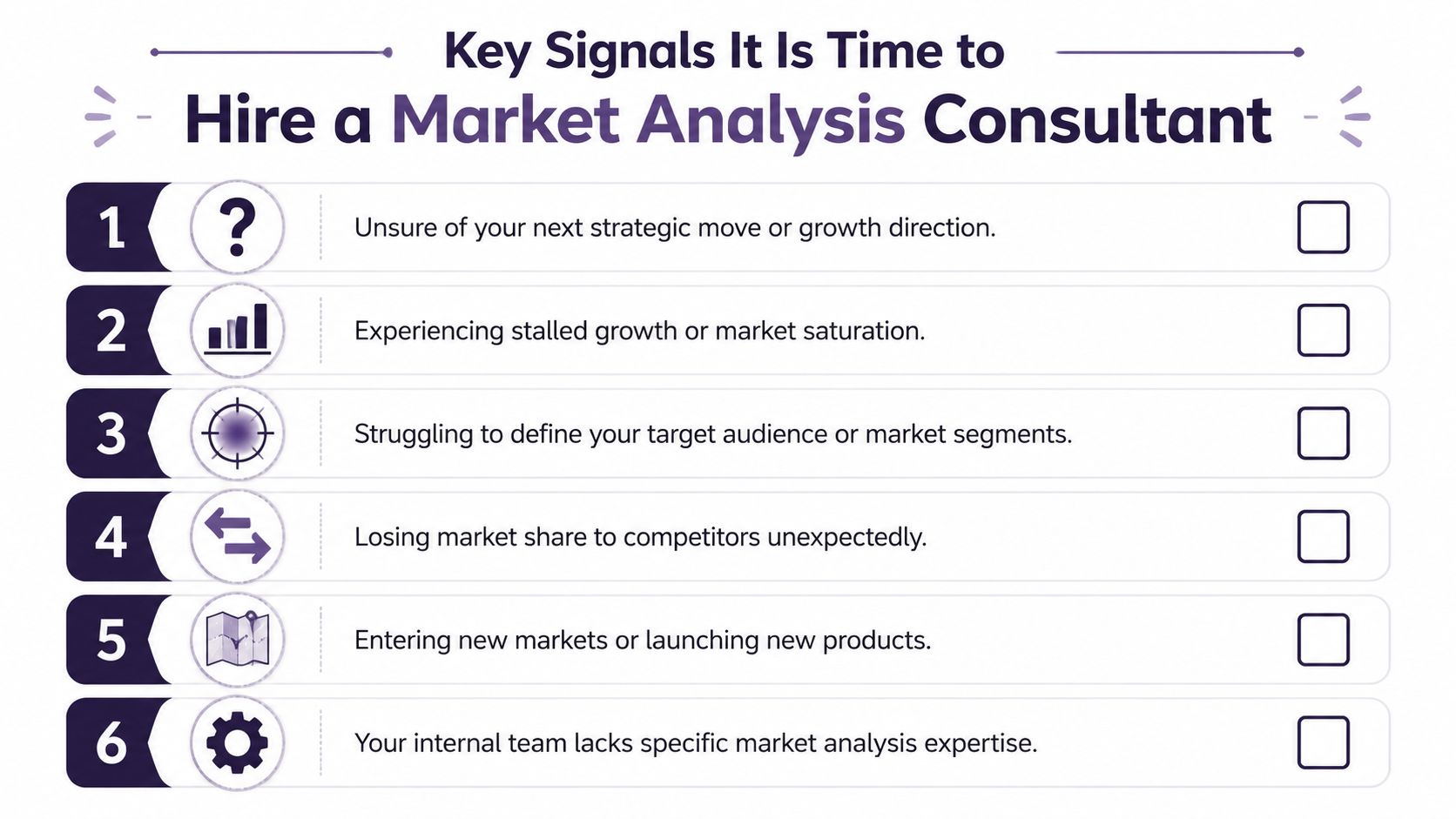
Key Signals It Is Time to Hire a Consultant
Some companies hire market analysis consultants too late. They wait until revenue dips, a launch stalls, or a competitor has already taken ground that's hard to win back.
Others hire too early and ask for broad research when they really need sharper customer conversations or a cleaner sales process. The right timing usually appears as a set of business symptoms.
Your next move feels bigger than your current visibility
If you're deciding whether to enter a new geography, move upmarket, launch a new product line, or change pricing, your margin for error shrinks. Internal opinions get louder exactly when objectivity matters most.
An outside expert helps. They're not trapped by team assumptions or old narratives.
Growth has slowed, but the cause isn't obvious
Stalled growth is one of the clearest signals.
The problem might be market saturation. It might be weak segmentation. It might be a competitor shift, poor positioning, or a mismatch between your offer and the buyers you're targeting now. Without analysis, teams often fix the wrong problem.
You're hearing conflicting stories from the market
Sales says buyers care about price. Product says they care about missing features. Marketing says messaging is off. Customer success says expectations are misaligned.
All four could be partly right.
A consultant's value here is synthesis. They gather enough evidence to sort recurring truth from department-specific bias.
You're launching without enough proof
New product launches falter when founders rely on enthusiasm from current users and mistake that for broader demand.
Before a launch, market analysis consultants can help answer:
- Who is this for first
- What job are they hiring it to do
- Which alternatives already solve the problem
- What objections will block adoption
- Where should the offer be priced and positioned
If the launch plan depends on “we'll learn after release,” the risk is probably higher than it looks.
Your team lacks this specific skill set
A strong internal team doesn't always include market research design, segmentation analysis, benchmarking, or competitive synthesis. That's normal.
Hiring outside help isn't a verdict on your team. It's often the fastest way to give them a clearer map.
You need validation before a larger commitment
This signal matters most for founders in the $1M to $50M revenue range. They often need market insight, but they don't want to commit to a full engagement without seeing whether the work will be actionable.
That concern is common for a reason. According to The Leveraged Years briefing on underserved consulting demand, 68% of small business owners hesitate to hire consultants due to uncertainty about deliverable quality, while only 12% of consultative content addresses pilot-based or outcome-based validation frameworks. That gap explains why many founders ask a practical question first: can we test this expert with a small pilot before paying for a full project?
Your Framework for Hiring the Right Expert
Hiring market analysis consultants gets easier when you stop treating it like a search for credentials and start treating it like a search for fit.
A consultant can be brilliant and still wrong for your stage, your pace, or your operating style. The best hire is usually the person who can connect analysis to decisions your team will make.
Start with the business decision, not the job title
Don't begin with “we need a market analyst.”
Begin with the decision in front of you. Maybe you need to choose between two customer segments. Maybe you need to validate a market entry thesis. Maybe you need to understand why your pipeline quality slipped.
Write the assignment in plain language:
- Decision to make
- What you already know
- What's uncertain
- What a useful output would look like
- What happens if you delay or guess wrong
This immediately filters out consultants who sell generic research.
If you're still shaping the search itself, this guide on how to hire a consultant for your business stage can help frame the process.
Look for pattern recognition, not polished slides
A sleek deck is easy to fake. Sharp judgment is harder to fake.
Ask candidates to walk through how they approached a prior market question. Listen for how they defined the market, challenged assumptions, chose sources, and translated findings into action. You want someone who can say, “This looked like a pricing issue, but the evidence pointed to onboarding friction,” not someone who just lists deliverables.
Interview for strategic courage
Good consultants don't just confirm what founders hope is true. They test it.
Ask questions that reveal how they think under tension:
- Tell me about a time your analysis contradicted a client's core belief. What did you do?
- How do you decide when there's enough evidence to recommend action?
- What would make you advise us not to pursue this market?
- How do you validate findings before turning them into recommendations?
- Which stakeholders should be involved so the work doesn't die in a slide deck?
The answers should sound practical. Not academic.
Hiring lens: If a consultant can't explain their approach in plain English during the interview, your team probably won't trust the output later.
Use a low-risk validation model
Many founders get stuck, yet ought to be more demanding at this stage.
Instead of signing a large, open-ended engagement first, ask for a narrow test. Examples include a focused competitor scan, a segmentation hypothesis review, or a short diagnostic on pricing and positioning. The point isn't to get all the answers. The point is to test how the consultant thinks, communicates, and prioritizes.
A good pilot should answer three questions:
| Validation question | What to look for |
|---|---|
| Can they find signal fast | They identify the core issue without hiding behind jargon |
| Are the insights actionable | Your team can make at least one real decision from the output |
| Can they work with your team | Communication is direct, organized, and commercially grounded |
Check whether they can work inside constraints
Most growth-stage companies don't have unlimited data, time, or stakeholder alignment. Your consultant needs to function in that reality.
Ask how they handle:
- Incomplete data
- Conflicting stakeholder views
- Fast deadlines
- Founder-led companies where strategy changes quickly
- Teams that need recommendations tied to execution
The strongest candidates won't promise certainty. They'll explain how they build enough confidence to move.
Understanding Consultant Pricing and Scopes
Pricing gets confusing because founders often compare unlike-for-like proposals.
One consultant may offer a strategy project that ends in a report. Another may include stakeholder interviews, benchmark analysis, and implementation support. Another may work like an ongoing advisor. The fee structure only makes sense when you connect it to scope.
The three common pricing models
Hourly work is the most flexible. It's useful when the problem is narrow, the scope is still evolving, or you want an expert to pressure-test your team's own thinking.
Project-based pricing works well when the question is clear. Think market entry analysis, competitive positioning, or product launch validation. You know what answer you need, and the consultant prices the work around that outcome.
Monthly retainer support fits businesses with ongoing strategic questions. This can be valuable when your market is shifting quickly and you need repeated analysis, not a one-time study.
Cost matters, but so does engagement design
For founders with tight budgets, the fractional model is often the most relevant benchmark. According to Fractionus research on fractional work statistics, the majority of fractional executives (69.5%) charge between $5,000 and $10,000 per month, with average hourly rates of $213. That gives startups access to senior expertise in a structure that's often easier to absorb than a large traditional consulting commitment.
That doesn't mean fractional is always better. It means you should compare models by access, depth, and decision value, not just invoice format.
Consulting Model Cost Comparison
| Model | Typical Monthly Cost | Best For |
|---|---|---|
| Hourly consultant | Varies by scope and hours | Narrow questions, short reviews, second opinions |
| Project-based consultant | Varies by deliverables and timeline | Defined questions like pricing, segmentation, or market entry |
| Retained consultant | Varies by ongoing scope | Repeated strategic support across multiple initiatives |
| Fractional executive | Most commonly $5,000 to $10,000 per month | Companies that need ongoing senior insight without a full-time hire |
Match the scope to the decision
A focused scope often produces better value than a broad one.
For example:
- Competitive analysis project might compare direct rivals, pricing structures, positioning, and customer gaps.
- Market entry scope might include segment selection, channel considerations, buyer risks, and launch sequencing.
- Product-market fit validation might test whether a proposed offer solves a high-priority problem for a reachable customer group.
The biggest pricing mistake founders make is paying for breadth when they need clarity. If your actual question is “Should we target healthcare clinics before enterprise systems?” don't buy a giant market overview.
Buy the narrowest scope that helps you decide.
The Fractional Alternative A Smarter Way to Get Insights
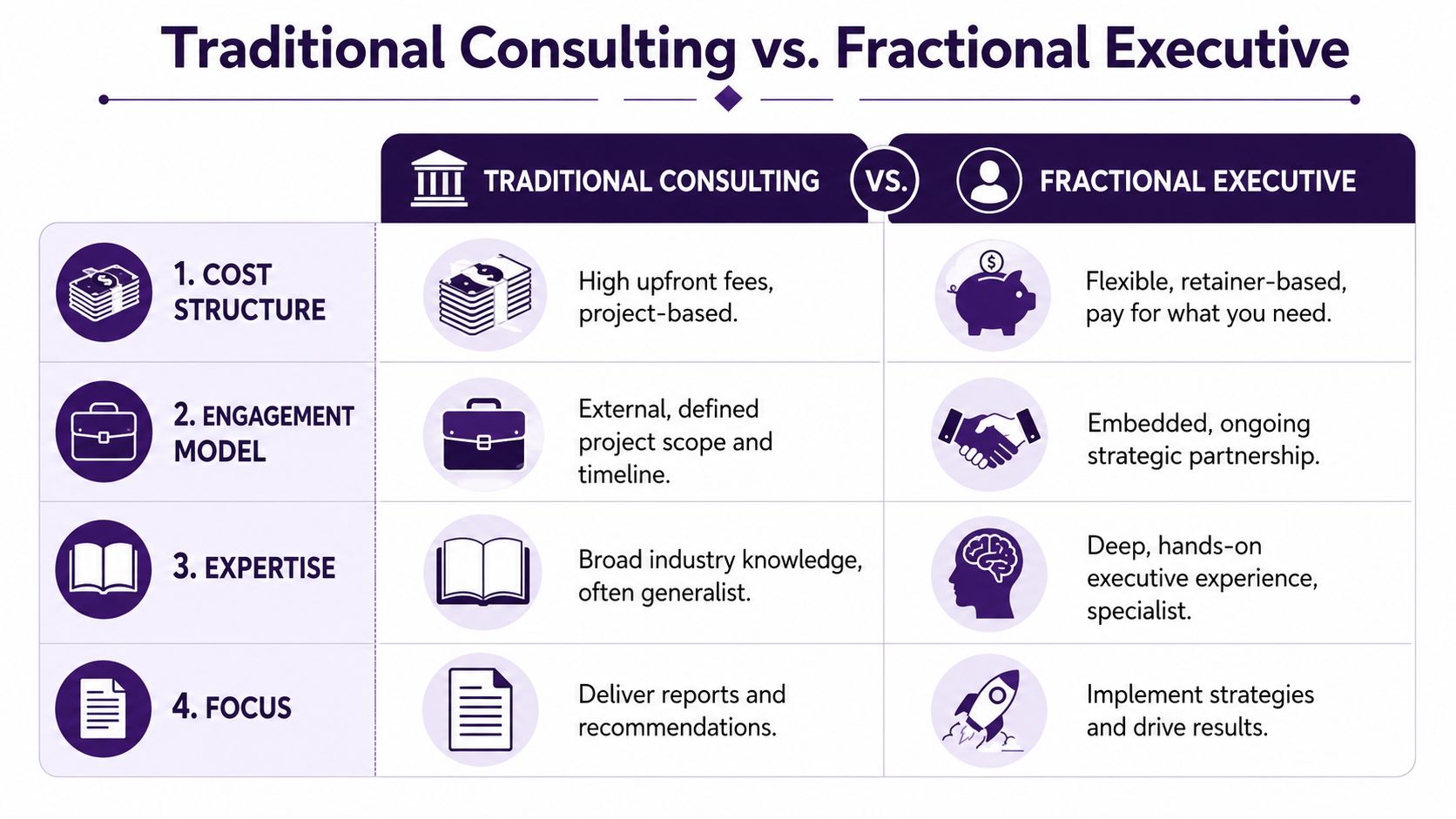
Traditional consulting can work. It can also be expensive, episodic, and disconnected from execution.
That's why more growth-stage companies are turning to fractional leaders for market insight. Instead of hiring an external advisor who studies the business from the outside and exits after the deck is delivered, you bring in a senior operator part-time to help diagnose, prioritize, and guide action from inside the company rhythm.
Why the model is gaining traction
The fractional approach has moved well beyond a niche hiring tactic. According to Ancore Partners' analysis of fractional executive growth, the global fractional executive market is projected to expand from $9.4 billion in 2025 to $24.7 billion by 2034.
That growth makes sense. Startups and SMBs often need senior-level thinking, but not another full-time executive salary or a long consulting engagement with unclear implementation.
What makes fractional different in practice
A traditional consultant often answers a question.
A fractional executive helps your team live with the answer.
That difference matters. If your market analysis shows you should reposition for a new buyer segment, someone still has to reshape the messaging, guide the sales team, adjust the roadmap, and revisit success metrics. Fractional leaders can stay close enough to help that happen.
Where founders see the advantage
Fractional support is often a better fit when you need both judgment and continuity.
Consider these situations:
- You need a senior market lens, but not full-time. A few hours each week may be enough to guide segmentation, pricing, and competitor response.
- You want embedded context. A part-time executive can absorb internal realities that a one-off project may miss.
- You want lower commitment risk. Fractional arrangements are usually easier to test, refine, or end than a major consulting project.
- You need insight tied to execution. This is often the biggest benefit. The same person who helps interpret the market can help operationalize the response.
Fractional works well when the problem isn't just “What should we do?” but also “Who will help us do it without overbuilding the org chart?”
A practical comparison
Think of traditional consulting like hiring an architect to draw the renovation plans. Fractional leadership is closer to bringing in an experienced builder who can review the plans, adapt them to the house you have, and guide the work room by room.
Both have value. But if your company is changing fast, the builder often creates more near-term ROI.
How to validate a fractional fit
For founders who worry about wasting budget, the fractional model supports a cleaner test.
Start with a small mandate. Ask the executive to assess one market question, align with your team, and produce a short decision memo. If they can sharpen your thinking quickly, you expand the scope. If not, you've learned at lower cost and lower disruption.
That validation-first approach is especially useful for growth-stage firms that need real strategic help but can't afford to gamble on a large engagement.
From Data to Decisive Action
Market analysis only matters if it changes what you do.
That's the standard founders should use when evaluating market analysis consultants, pricing models, and hiring options. Not whether the deck looks polished. Whether the work helps you choose a market, refine positioning, price with confidence, respond to competitors, or avoid a costly expansion mistake.
For many smaller and growth-stage companies, the best answer won't be a traditional consulting project. It may be a narrower pilot. It may be a consultant with a sharply defined scope. It may be a fractional leader who combines analysis with day-to-day strategic guidance.
If you're weighing expansion, product direction, or positioning, use a framework before you use budget. Define the decision. Test the expert. Start small if needed. Then build from evidence. A practical market entry strategy framework for growth-stage teams can help you pressure-test that thinking before you commit.
If you want senior market insight without committing to a full-time executive hire, Shiny can help you find vetted fractional leaders who fit your stage, budget, and business goals. It's a practical way to explore experienced talent, validate the fit quickly, and schedule a conversation around the market questions that matter most right now.