
Part Time CFOs: Guide for Startups & SMBs
$2,000 to $15,000 per month is the common cost range for a part-time CFO. Early-stage startups typically pay $1,400 to $4,000 monthly, while growth-stage businesses often pay $5,000 to $12,000.
That range makes sense when the alternative is hiring a full-time executive before the business has enough complexity, cash flow, or decision volume to justify one. The question isn't whether a fractional CFO costs less. It's whether the engagement gives you better visibility, stronger controls, and more confidence before your next major financial decision.
Many founders reach this point after a familiar sequence. The bookkeeping is technically up to date, but nobody can explain why cash keeps tightening. Hiring plans live in spreadsheets. Investor reporting takes too long. A revenue forecast changes every time the founder opens the books.
A part-time CFO can solve those problems, but only if the engagement starts with the right foundation. Strategic advice built on inconsistent data creates polished reports and unreliable decisions. The strongest fractional CFO relationships first establish what the numbers mean, who owns them, and how the company will use them.
What Part Time CFOs Actually Do
A growing company often reaches a point where the founder is still approving payments, the bookkeeper is recording transactions, and the accountant is preparing compliance work. Yet nobody is building a reliable view of what the business can afford next month.
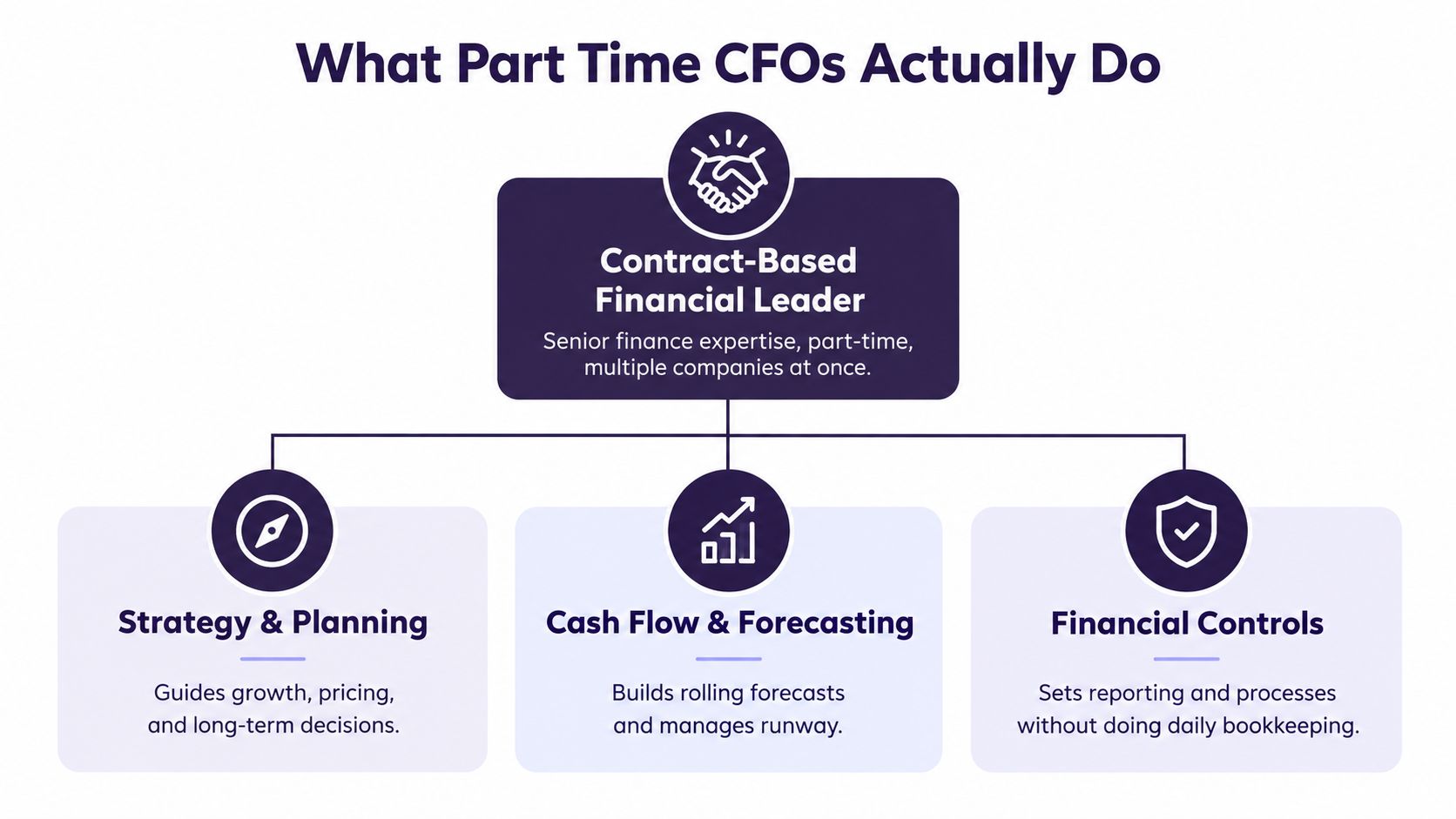
A fractional CFO fills that leadership gap. This is a contract-based financial executive who works with multiple companies at once, bringing senior judgment without requiring one company to fund a permanent executive schedule.
The difference becomes clear in a practical example. A software company may have enough cash for current payroll, but the founder is considering accelerated hiring while two large customers are paying late. A bookkeeper can show what has already been invoiced and paid. A CFO models the timing of collections, payroll, vendor commitments, and the proposed hires, then shows which decision protects liquidity.
The work behind the title
Part time CFOs typically own high-value work such as:
- Cash-flow forecasting: Building a rolling view of expected cash receipts and payments.
- Scenario planning: Testing delayed customer payments, accelerated hiring, pricing changes, or new investment.
- Fundraising preparation: Connecting operating assumptions to investor-ready financial models and reporting packages.
- Financial controls: Establishing approval rules, reporting definitions, and accountability for sensitive transactions.
- Management reporting: Turning accounting outputs into information that helps the leadership team decide what to do next.
The bookkeeper records the transaction. The CFO asks what the transaction means for liquidity, margin, runway, and the next operating decision. That forward-looking layer is the reason companies use fractional leadership after basic bookkeeping stops being enough but before a full-time CFO makes economic sense.
Practical rule: If the founder still has to translate every financial report before the leadership team can act, the business needs decision support, not simply more reports.
Why Startups and SMBs Need Flexible Finance Leadership
A founder can manage cash from bank statements and accounting reports until payroll, hiring, customer terms, products, or debt make the picture harder to read. At that point, the first question is often overlooked: are the underlying data and systems ready for CFO-level decisions?
The market need is clear. The United States has approximately 33.3 million small businesses, and approximately 73% operate without a dedicated CFO, according to industry reporting on fractional and full-time CFO models. Many rely on owners, bookkeepers, or external accountants for financial management.
That approach can work while decisions stay simple. As complexity grows, historical accounts may remain accurate while cash timing, margins, customer exposure, and hiring capacity remain unclear. A fractional CFO may need to reset reporting definitions, connect disconnected systems, or clean inconsistent data before providing useful strategy. That infrastructure work is different from advising on expansion, fundraising, pricing, or investment.
External accountants still serve an important purpose. Compliance, tax, and transaction recording address one group of risks. Finance leadership uses reliable information to decide what the company can afford and which choice improves its position.
Why the timing matters
A permanent CFO creates a fixed commitment. A fractional executive provides defined leadership capacity that can expand during fundraising, restructuring, or an acquisition, then reduce when the pressure passes. Research on the strategic advantages of a fractional C-suite describes this broader access to experienced leadership without requiring every executive role to be full-time.
Demand for interim finance leadership supports the model. CFOs represented 51% of interim C-suite requests, requests for interim CFOs increased 14% year over year, and overall interim C-suite demand rose 151% since 2021, according to the industry reporting cited above.
Evaluate the engagement by measurable outcomes, not hourly rate alone. The right comparison includes improved cash visibility, fewer surprises, faster decisions, protected runway, and a clear return from the finance work. The model fits when financial complexity is meaningful, but the workload is not yet steady enough to justify a permanent CFO.
The Core Deliverables of a Fractional CFO
A credible engagement produces tangible financial assets. It shouldn't end with a monthly meeting where someone summarizes last month's profit and loss statement.
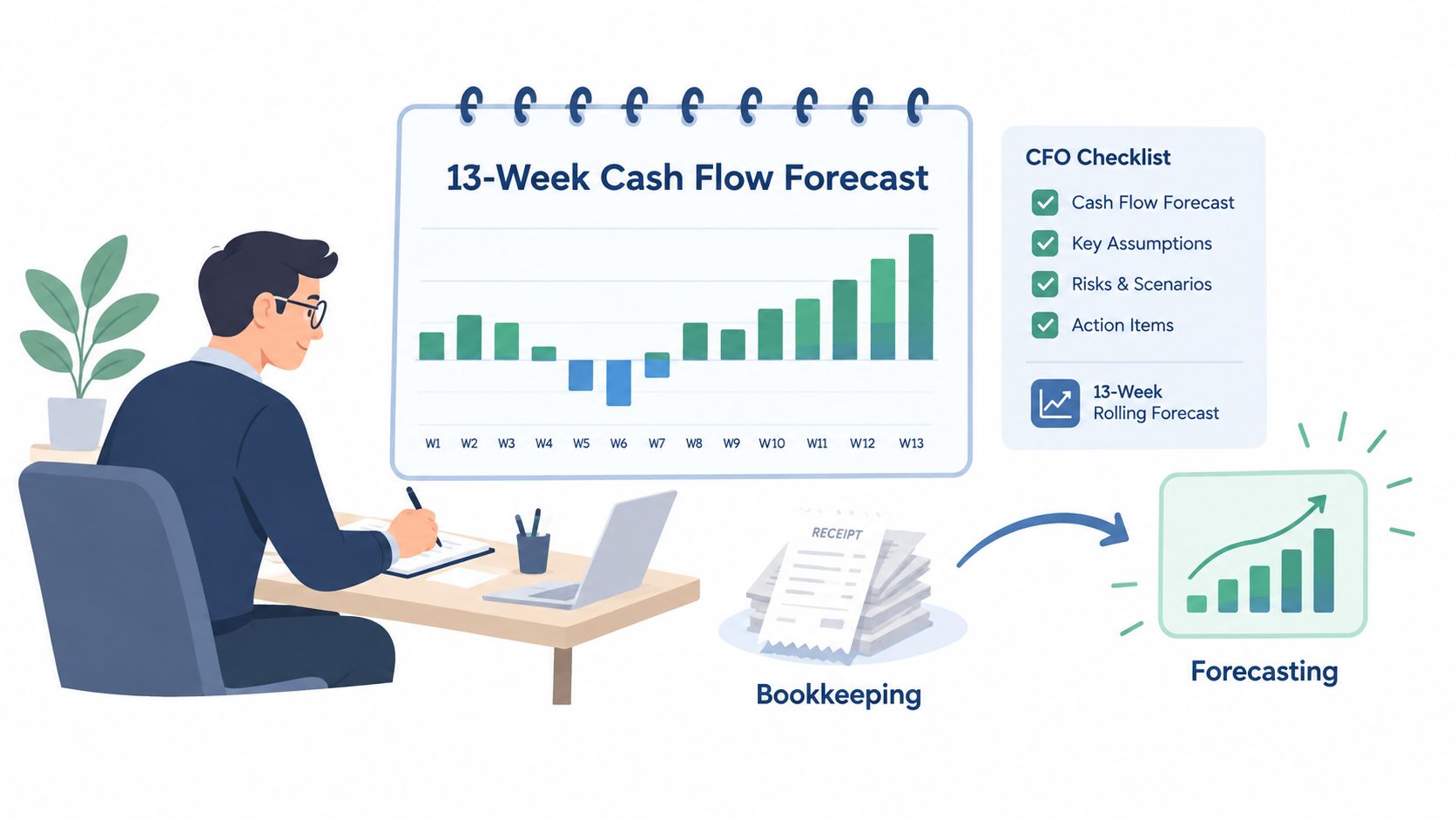
The first essential deliverable is a rolling 13-week cash-flow forecast. The CFO maps expected collections, supplier payments, payroll, debt service, taxes, and capital expenditures across weekly periods. The forecast then moves forward every week as actual transactions replace assumptions.
What the company should receive
A useful first engagement usually includes:
- Cash visibility: A current cash position, expected inflows, committed outflows, and a defined minimum-cash threshold.
- Receivables analysis: An accounts-receivable aging report that identifies overdue invoices, collection owners, and timing assumptions.
- Scenario models: Alternative cases for delayed payments, accelerated hiring, supplier changes, slower sales, or a major customer loss.
- Operating metrics: Reporting that connects revenue, gross margin, contribution margin, headcount, and working capital.
- Variance management: A weekly comparison between forecast cash movements and actual cash movements, with corrective actions assigned to named owners.
The ownership detail matters. If a forecast assumes that a customer pays by a certain date, somebody should own that assumption. If the hiring plan assumes a new employee starts in a particular period, the responsible manager should confirm it. A CFO coordinates those inputs and creates a process for challenging them.
A CFO also establishes the rhythm around the numbers. That may include a close calendar, monthly reporting deadlines, cash review meetings, and an escalation process when actual results move outside an agreed tolerance.
Industry guidance reports that stronger financial controls and forecasting correlate with 23% higher profitability, while practitioners report double-digit improvements in cash-flow visibility and cycle times within six months. Those figures should be treated as directional benchmarks, not guaranteed outcomes, as explained in this discussion of fractional CFO services and business challenges.
The practical test is simple. After the engagement begins, can the leadership team answer what changed, why it changed, and what decision follows?
Understanding Engagement Models and Pricing
Part-time CFO engagements work because companies can purchase decision capacity instead of a full-time calendar. The right structure depends on the company's stage, the condition of its financial systems, and the decisions approaching over the next several months.
A limited monthly retainer can suit an early-stage company that needs cash planning, management reporting, or preparation for a financing conversation. A growth-stage business may need more regular involvement because it has multiple departments, more complex working capital, or a larger hiring and investment plan.
Published pricing guidance places common fractional CFO engagements between $2,000 and $15,000 per month. Early-stage startups typically use 8 to 15 hours monthly, while growth-stage businesses often use 20 to 40 hours monthly, according to professional accounting guidance on CFO services for growing businesses.
Compare the commitment, not just the rate
| Engagement approach | Works well when | Main risk |
|---|---|---|
| Limited monthly retainer | The company needs a recurring cash review, board package, or financial model | Important issues may wait between scheduled sessions |
| Expanded monthly retainer | The CFO must lead reporting, forecasting, controls, and planning | Scope can drift unless deliverables are written clearly |
| Project-based support | The business has a defined fundraising, acquisition, cleanup, or restructuring need | The company may lose continuity after the project ends |
| Full-time hiring | Financial decisions require daily executive ownership and constant cross-functional involvement | The business carries recruiting, salary, benefits, and long-term commitment before demand is proven |
The monthly figure alone doesn't tell you whether the arrangement is economical. Ask what hours are included, which deliverables are guaranteed, how quickly the CFO responds to urgent matters, and whether the engagement can scale up or down.
A fundraising process may justify more support for a period. A stable reporting cycle may require less. The flexibility only creates value when the contract reflects those changing needs instead of becoming an unlimited advisory obligation.
A low-cost engagement can also be a false economy if it produces reports nobody uses. The buyer should define the decisions the CFO must improve, then connect the scope to those decisions.
Calculating ROI Through Cash Runway and Burn Rate
Runway is often treated as a single formula, but founders need it to function as an operating process. The basic calculation is current cash divided by monthly net burn. That number changes whenever collections move, hiring accelerates, vendors increase prices, or the company delays an investment.
The urgency is visible in startup finance data. The median funded startup holds approximately 12 to 15 months of runway, while pre-seed companies average monthly cash burn of $25,000 to $75,000 and Series A companies burn $200,000 to $600,000, according to this startup runway and burn-rate summary.
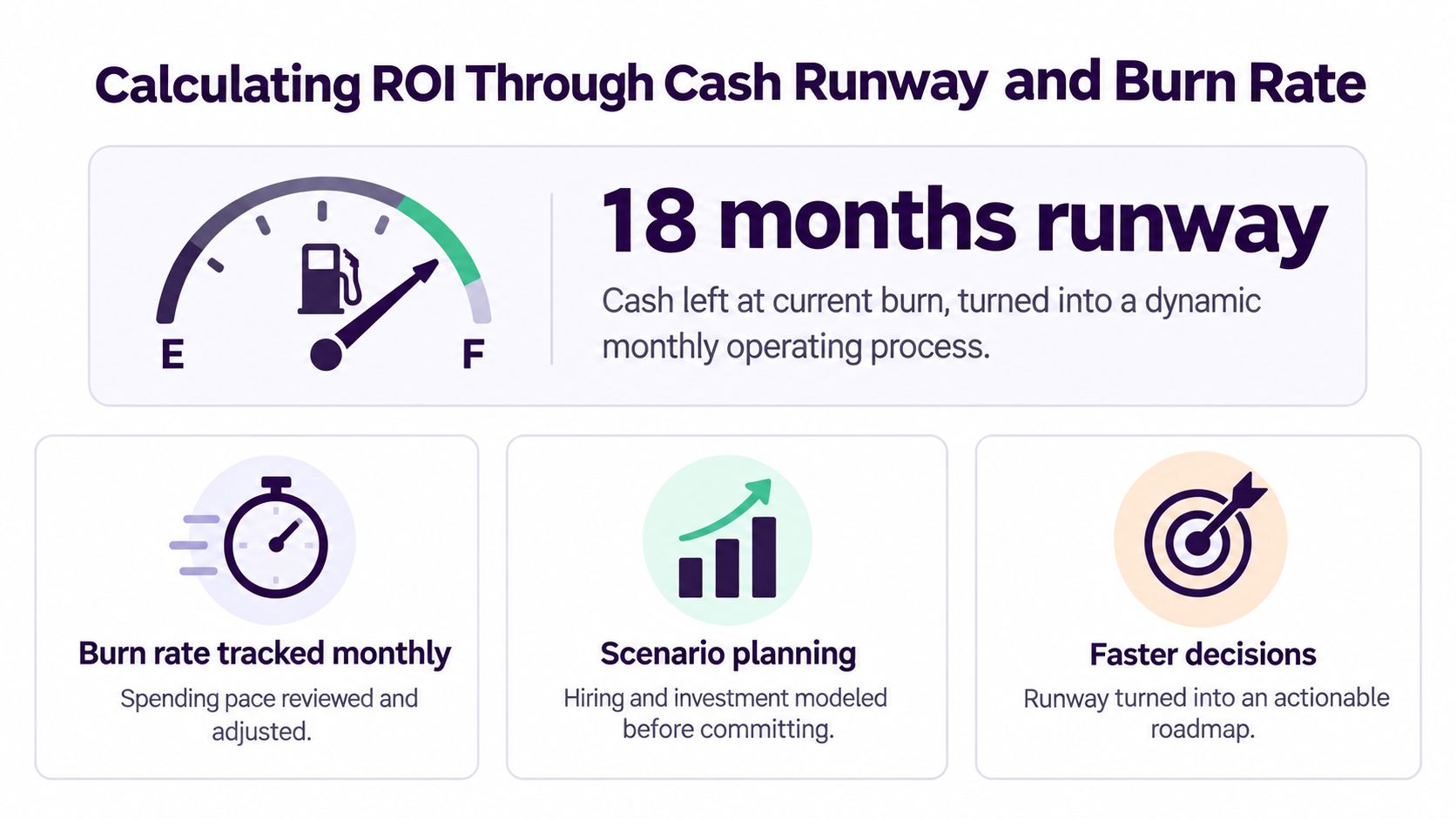
Consider a company with $1.2 million in cash and $100,000 in monthly net burn. Its gross runway is 12 months. If the company reduces net burn by $20,000, monthly burn falls to $80,000 and runway extends to 15 months, assuming the cash balance remains constant.
That isn't an argument for cutting indiscriminately. A CFO should identify which expenses support revenue, which commitments can move, and which hiring decisions should wait for stronger evidence.
Turn the calculation into a cadence
A fractional CFO can make runway useful by maintaining:
- A monthly burn review: Compare actual spending with the approved operating plan.
- Downside scenarios: Model slower collections, lower sales, higher costs, or delayed financing.
- Decision triggers: Define the cash or performance conditions that require hiring pauses, pricing changes, or fundraising action.
- A linked operating model: Connect headcount, customer payment timing, vendor terms, and investment decisions to the cash forecast.
The ROI may not appear as additional revenue. It may appear as a financing decision made before urgency removes negotiating power, a hiring plan adjusted before payroll becomes a constraint, or an expansion delayed until the company can support it.
Founders can also use practical guidance on managing cash flow to create operating discipline around the forecast. The CFO's value comes from making that discipline part of weekly management, rather than leaving runway as a number reviewed only when cash feels tight.
Overcoming the Data Readiness Challenge
Many founders delay hiring a fractional CFO because the books aren't clean enough. That concern is understandable, but waiting for perfect data can leave the business without the person who knows how to make the data usable.
The first phase may be an infrastructure reset, not immediate strategy. The CFO reviews the chart of accounts, reconciles reporting definitions, checks the monthly close, maps financial-system integrations, and identifies where revenue, margin, or customer economics are being measured inconsistently.
That work doesn't mean the CFO has become the bookkeeper. It means the CFO is defining the information architecture that management needs and assigning execution to the appropriate accounting or finance owner.
Separate foundation work from executive judgment
A practical diagnostic asks:
- Are monthly accounts closed on a consistent schedule?
- Can management see cash obligations and expected collections?
- Do teams use the same definitions for revenue, gross margin, and contribution margin?
- Can the company report customer or product economics with reasonable confidence?
- Do financial systems transfer information reliably?
- Are bookkeeping, controller, and CFO responsibilities clearly separated?
If the answers are weak, the engagement should include a documented reset. The CFO can establish segregation of duties, approval thresholds, close deadlines, and reporting ownership while the accounting team cleans historical issues.
This foundation also improves the quality of later strategic work. A pricing decision based on inconsistent product margins is not strategic. It's a guess presented in a spreadsheet.
A published review found that 56% of surveyed businesses claimed cost reductions of 10% to 30% compared with recruiting a full-time executive, but the source also makes clear that results vary with initial data quality and engagement scope. Treat that figure as a benchmark hypothesis, not a promised saving, as described in the review of fractional CFO use.
Companies that need better reporting should also consider the role of business intelligence for startups. The key question isn't whether the company has perfect information. It's whether the CFO has a clear mandate to improve the information before relying on it.
How to Hire and Onboard Your Fractional CFO
Start with the business problem, not the title. “We need a CFO” could mean the company needs cash forecasting, fundraising preparation, margin analysis, reporting discipline, or an interim executive while it evaluates a permanent hire.
Write the problem down in operational terms. For example, the CFO may need to deliver a rolling forecast, rebuild management reporting, prepare lender materials, or create controls around purchasing and payment approvals.
Traditional executive recruitment can take time. Median time-to-fill for executive positions is roughly one and a half months, and 60% of finance professionals report that hiring finance personnel is harder than in previous years, according to SHRM's recruiting research.
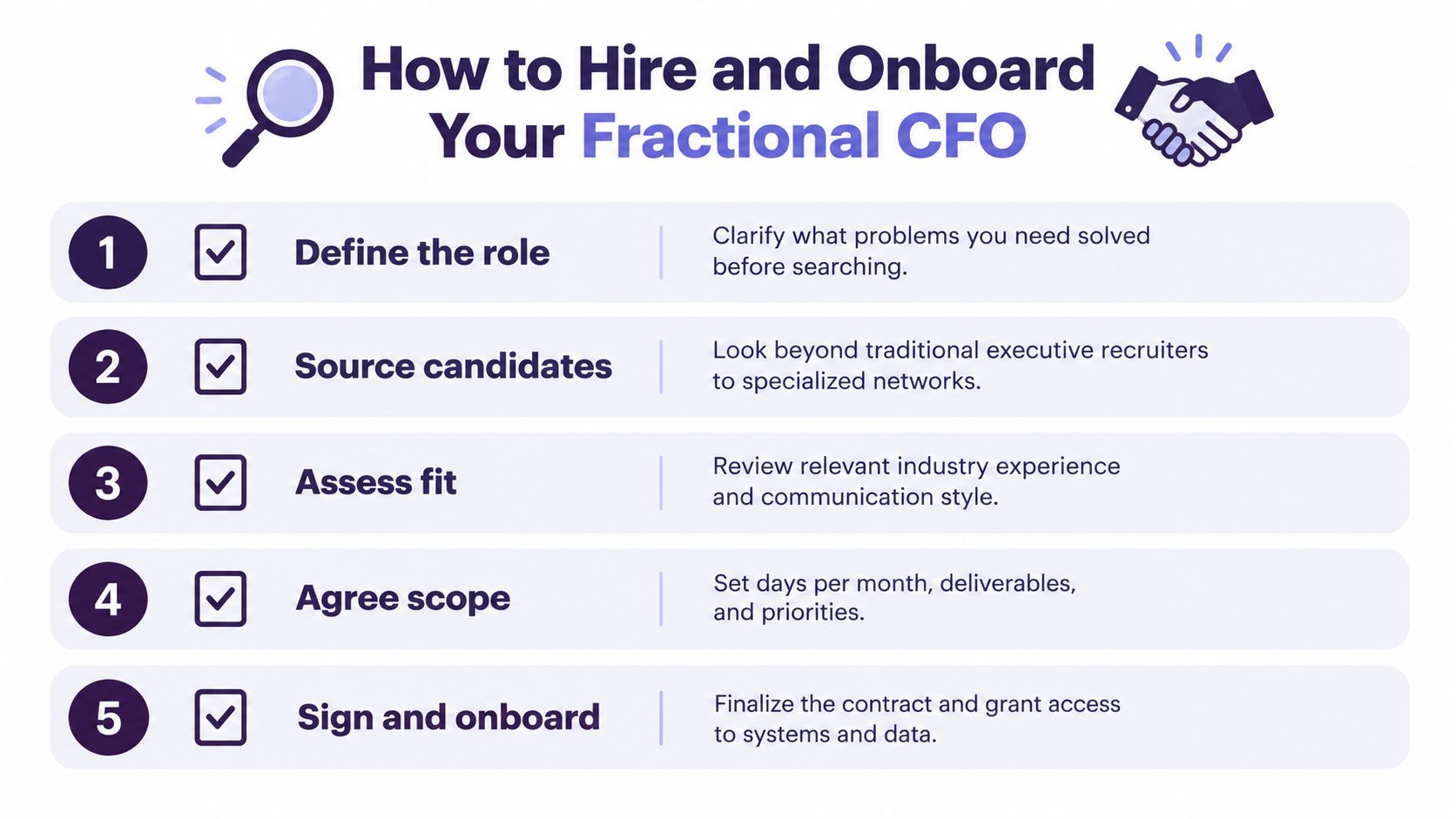
A practical hiring checklist
- Define the role. List the decisions and deliverables the CFO must own. Avoid vague goals such as “improve finance.”
- Source candidates. Look beyond general executive recruiters. Consider specialist networks, referrals, and professionals with experience in businesses at a similar stage.
- Assess fit. Ask candidates to explain how they would diagnose your reporting, build cash visibility, and communicate an unfavorable forecast.
- Agree scope. Confirm hours, meeting cadence, deliverables, response expectations, systems access, and the conditions that would expand or reduce the engagement.
- Sign and onboard. Grant access to accounting, banking, payroll, contracts, budgets, and operating metrics. Schedule the first data review and define the initial reporting rhythm.
The interview should test judgment, not just credentials. Give the candidate a real decision, such as whether to hire ahead of revenue or extend payment terms to a major customer. Strong candidates explain the assumptions they need, the downside they would model, and the action they would recommend if the assumptions fail.
Onboarding should produce an early baseline. Within the initial period, the company should know which data is reliable, which gaps require repair, and what the CFO will deliver first.
Choosing the Right Partner for Sustainable Growth
A part-time CFO works best when the company needs senior financial judgment but doesn't need a permanent executive schedule. That distinction matters. Fractional leadership isn't a cheaper way to postpone every difficult decision. It's a way to bring the right level of expertise to the decisions that carry the most financial risk.
The strongest partners do more than provide an impressive résumé. They can explain how they'll work with the existing bookkeeper, accountant, controller, founder, and department heads. They can distinguish a reporting problem from a business-model problem and a temporary cash issue from a structural margin issue.
Evaluate the relationship on outcomes
Look for a partner who will:
- Create decision-ready information: Reports should clarify actions, not just add detail.
- Work with imperfect systems: The CFO should know how to reset definitions and controls without taking over every accounting task.
- Make assumptions visible: Forecasts should show who owns each input and what happens when it changes.
- Communicate directly: Founders need clear explanations when the answer is inconvenient.
- Scale with the company: The engagement should accommodate fundraising, growth, restructuring, or a later transition to a permanent executive.
A fractional CFO can also bring perspective from other companies and operating environments. That outside view helps a founder challenge assumptions about pricing, hiring, working capital, and the reporting package investors or lenders expect.
The right arrangement may begin with a focused infrastructure reset, expand into regular forecasting and management reporting, and later become a bridge to a full-time CFO. It may also remain fractional for the long term if the company's executive finance workload stays variable.
The decision should come down to whether the partner can make financial information more reliable and management decisions more deliberate. If the answer is yes, fractional leadership becomes a growth tool, not merely a way to reduce payroll.
Shiny connects startups and growth-stage businesses with experienced fractional executives, including finance leaders who can support forecasting, cash-flow management, fundraising, and financial strategy. Visit Shiny to explore flexible executive support and find a partner suited to your company's next financial decision.