Part Time Executive Services: A Practical Guide for Founders
Tuesday morning starts with a pipeline review over coffee. By ten, you've approved payroll. By eleven, you're in an operations standup. The afternoon disappears into investor updates, while pricing decisions, hiring questions, cash planning, and customer escalations wait for the CEO who's already doing three other jobs.
That pattern is common in a growing company. The problem isn't effort. It's structure. Part time executive services can give a founder experienced leadership capacity without forcing the business into a full-time executive commitment before the company is ready.
This guide focuses on the mechanics that determine whether the model works, including hours, decision rights, cost, integration, measurement, and the point where fractional leadership stops being enough.
The Founder Bottleneck That Part Time Executive Services Solve
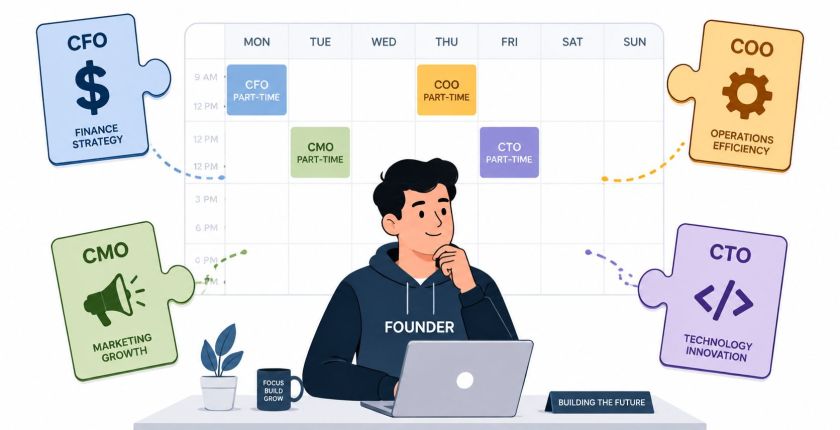
A Series A founder I've worked with once described their week as “three executive jobs wearing one hoodie.” They were acting as the VP of Sales during pipeline reviews, the head of finance during cash planning, and the COO during delivery meetings. None of those functions had a real owner, so every unresolved decision returned to the founder.
That arrangement can survive for a while. It fails when the company needs consistent judgment across months, not occasional bursts of founder attention. Sales forecasting requires operating discipline. Finance requires reliable models and controls. Operations requires systems, vendor decisions, and follow-through. The founder can cover each task, but can't provide deep context and sustained accountability across all three indefinitely.
A practical guide to delegation for startup founders makes the underlying issue clear. Delegation isn't about removing work from your calendar at random. It's about transferring ownership of decisions that no longer belong with the CEO.
Practical rule: If the company stalls whenever you're unavailable, you don't have a workload problem. You have an ownership problem.
Hiring three full-time executives may be the wrong answer at this stage. Their salaries, benefits, payroll obligations, equity expectations, and recruiting costs can put unnecessary pressure on burn and runway. Yet leaving the functions founder-owned creates a different cost, slower decisions, inconsistent execution, and a leadership team that waits for permission.
A fractional CFO, CMO, COO, CTO, or other senior operator solves a narrower problem. They take responsibility for a defined executive function, work with the team on a predictable cadence, and give the founder room to remain CEO. The value isn't cheaper access to talent. It's placing the right decision-maker in the right seat before a full-time hire makes financial or organizational sense.
What Part Time Executive Services Actually Are
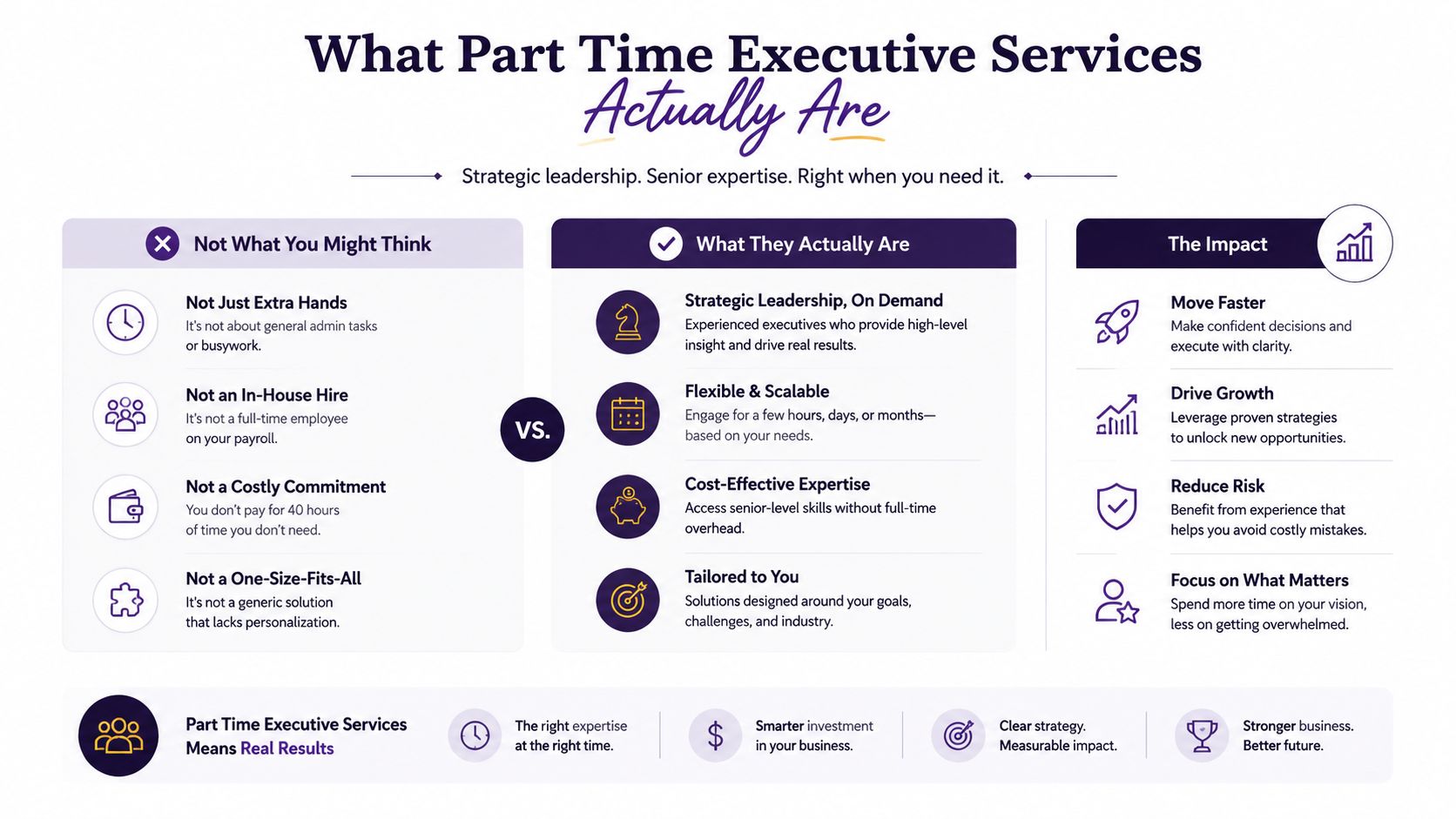
Part time executive services provide access to an experienced senior leader for a defined scope, usually through a monthly retainer. Fractional leaders commonly work one to three days per week, and the arrangement may involve one or multiple clients, as described in this guide to fractional and interim leadership.
The executive isn't being hired to attend a few meetings and send recommendations. Within the agreed domain, they may own decisions, manage team members, prepare board reporting, oversee vendors, and drive a strategic initiative. The founder retains company direction, but the executive takes responsibility for execution in their function.
A workable week might look like this:
- Monday: Review metrics, priorities, risks, and decisions needed from the executive team.
- Wednesday: Lead the functional meeting, coach direct reports, and resolve operational blockers.
- Friday: Prepare board materials, update forecasts, or review progress against the operating plan.
The exact schedule matters less than the operating agreement. Everyone should know when the executive is available, what they own, how quickly they respond, and which decisions still require CEO approval.
Three engagement shapes
Fractional means an ongoing, embedded part-time role. The executive has recurring responsibility and may work across multiple companies.
Interim means full-time leadership for a limited period. It fits a leadership vacancy, turnaround, or transition that demands daily presence.
Project-based means a bounded assignment, such as a pricing reset, fundraising sprint, financial-control rebuild, or architecture review. The executive leaves when the defined work is complete.
That distinction prevents a frequent mistake: hiring a consultant when you need an owner. A consultant typically advises and delivers recommendations. A fractional executive joins the operating team, makes decisions within a mandate, and remains accountable for whether the work gets done. For a broader view of this leadership model, see this strategic guide to the fractional C-suite.
The Roles Founders Hire Part Time Most Often
Titles can mislead you. Start with the function that breaks when the founder steps away, then choose the executive role that can own it.
Common part time executive roles and their ownership
| Role | Day-to-Day Ownership | Typical Hours/Week |
|---|---|---|
| Fractional CFO | Cash forecasting, runway modeling, board financial reporting, fundraising preparation | 1 day per week is common after a funding round |
| Fractional CMO | Positioning, channel strategy, brand direction, and oversight of marketers or agencies | Defined by growth priorities |
| Fractional CRO | Pipeline reviews, account executive hiring, forecast accuracy, and quota planning | Defined by sales complexity |
| Fractional COO or Head of Operations | Operating systems, vendor decisions, contracts, delivery capacity, and cross-functional execution | Defined by operational load |
| Fractional CTO | Architecture, engineering hiring, technical debt, security posture, and technology priorities | Defined by product and infrastructure risk |
| Fractional CPO or Head of Product | Roadmap ownership, customer research, product management, and prioritization | Defined by product maturity |
The fractional CFO is usually the right answer when the founder can't explain cash movement, runway assumptions, or the financial story to the board. This leader turns finance from historical reporting into an operating system for decisions.
A fractional CMO should do more than review ad creative. They need to clarify positioning, choose channels, establish measurement, and manage the internal or external people doing the work. If marketing feels busy but directionless, this is a leadership gap.
A fractional CRO owns the commercial machine. They should challenge pipeline quality, improve forecast discipline, coach sales leaders, and make quota planning credible. Don't hire one if you only want someone to inspect a CRM. Hire one when revenue execution needs an accountable executive.
The operations, technology, and product roles require similar clarity. A COO owns how work moves. A CTO owns technical direction and engineering risk. A CPO owns what gets built and why.
Decision test: Hire the role that currently breaks the company if you disappear for two weeks.
How Pricing and Total Cost Compare to a Full-Time Hire
A founder comparing only a monthly retainer with salary will understate the decision. Compare the fractional engagement with the full cost of assigning executive ownership to a full-time hire.
A current benchmark cited in a fractional executive cost analysis places average U.S. base pay for a full-time C-suite hire at about $225,000 to $230,000. Benefits, payroll taxes, and related employer costs can raise the annual total to roughly $270,000 to $320,000. Traditional executive search agencies may also charge 20% to 30% of first-year compensation for fractional placements.
A fractional retainer reduces fixed payroll exposure, but it does not remove the other costs. Budget for onboarding, management time, software access, recruiting support, and work outside the agreed scope. Price the operating model, not just the executive's invoice.
| Cost Component | Full-Time Executive | Part Time Executive (Fractional) |
|---|---|---|
| Compensation | Annual salary, often with equity or other incentives | Monthly retainer tied to scope and availability |
| Benefits and payroll costs | Employer-funded | Usually handled through the engagement structure |
| Search fees | May equal 20% to 30% of first-year compensation | May apply through a search firm or marketplace |
| Onboarding | Larger organizational commitment | Smaller, but still requires context and access |
| Capacity | Full-time availability | Reserved hours and defined response windows |
| Exit cost | Potential severance and replacement hiring | Contractual notice or off-ramp terms |
Use a planning assumption rather than treating every engagement as identical. A Series A company might allocate roughly 25% to 35% of a full-time executive's loaded cost for a leader working one to two days per week. That is a budgeting reference, not a universal market rate. Role, experience, scope, urgency, and provider fees determine the actual budget.
Before approving the engagement, calculate:
- Loaded compensation: Include salary-equivalent cost, benefits, payroll obligations, equity, and incentives for the full-time alternative.
- Search friction: Add placement fees and the founder's time spent sourcing and interviewing.
- Integration cost: Estimate the hours needed to transfer context, configure systems, and introduce the executive to the team.
- Tooling: Include dashboards, finance systems, CRM access, project-management seats, and other required tools.
- Output value: Define the decisions, risks reduced, and operating improvements the executive will own.
- Break-even point: Revisit the model when the function needs daily presence or the fractional retainer approaches the value of a permanent seat.
The fractional model fits when the company needs senior judgment without continuous executive capacity. Set a weekly hour limit, define response expectations, and tie renewal to measurable operating results. The model breaks down when the company pays for part-time access but expects full-time availability.
How Startups Work With a Part Time Executive Day to Day
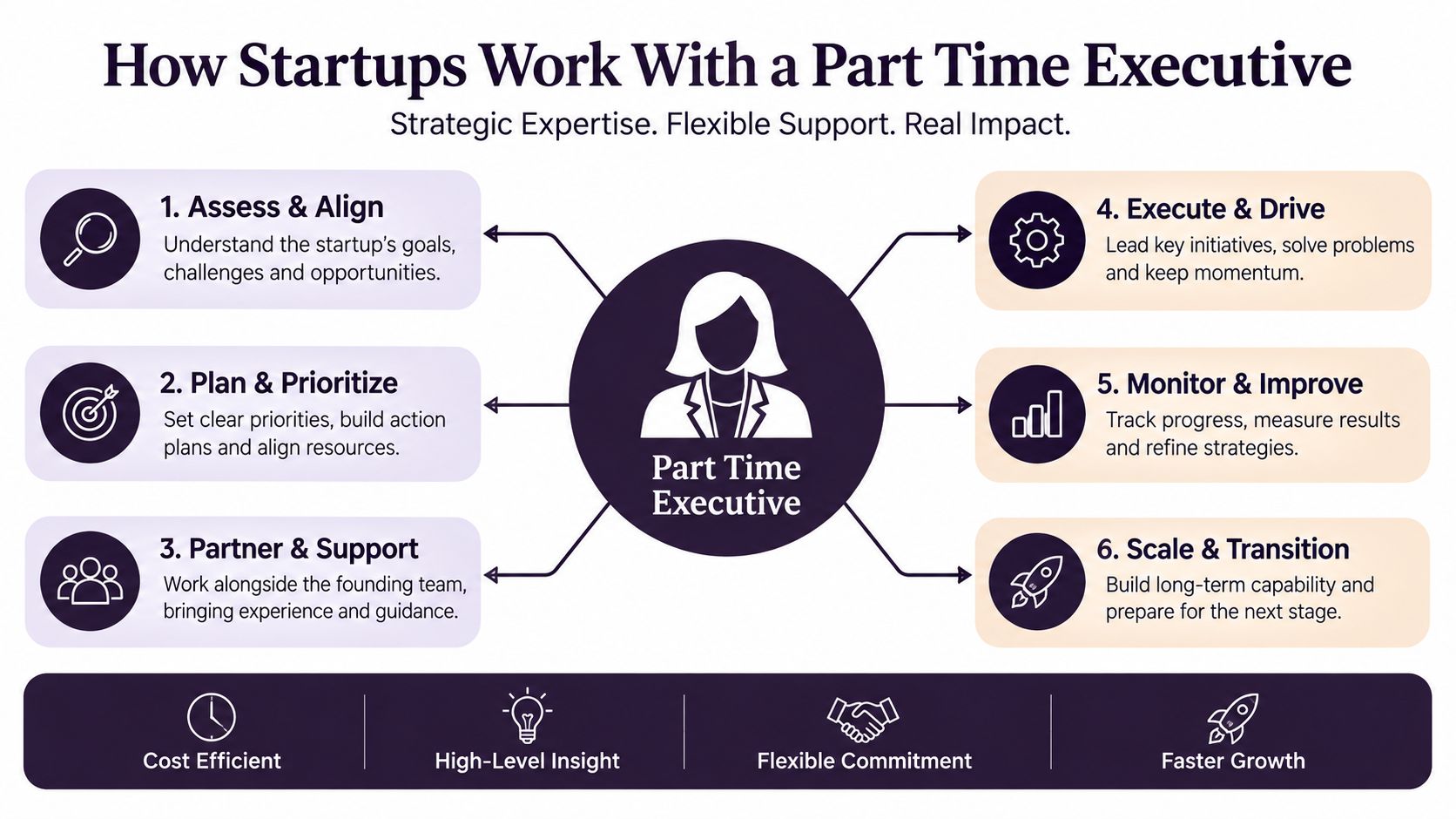
Start with the bottleneck, not the job title. A founder should be able to state the problem in one sentence, such as, “Our cash forecast can't support hiring decisions,” or, “Our sales team has activity but no reliable forecast.” The executive should then turn that problem into deliverables, decision rights, and a weekly time requirement.
The operating range is often five to twenty-five hours per week, depending on the role and scope. Those hours shouldn't float across the calendar. Anchor them to recurring activities such as leadership standups, metrics reviews, customer calls, board preparation, hiring interviews, and quarterly planning.
Write the mandate before the contract
A useful mandate answers five questions:
- What does this executive own?
- Which decisions can they make without the founder?
- Which decisions require CEO or board approval?
- What metrics show progress?
- What happens when the engagement ends?
For example, a fractional COO might own vendor selection, delivery workflows, and operating meetings, while the founder retains authority over strategy, executive hiring, and major financial commitments. Put that boundary in writing. Ambiguity creates delays, and delays make a part-time executive look ineffective even when the role was never properly designed.
Build the cadence into existing rituals
Don't create a parallel company for the fractional leader. Add them to the meetings that already govern the business. A shared dashboard in tools such as Notion, Asana, HubSpot, or a finance platform should show commitments, owners, blockers, and decisions.
A 30-60-90 day plan gives the executive a sequence of priorities. An explicit off-ramp clause protects both sides if the scope changes or the model fails to create enough benefit.
By week three, red flags should be visible. The executive may be attending meetings without making decisions, asking for unlimited access without producing a plan, or sending vague updates that describe activity rather than outcomes. Those aren't minor communication issues. They signal that the mandate, operator, or engagement structure needs to change.
Misconceptions That Keep Founders From Making the Hire
The first misconception is that fractional means junior. Strong fractional executives often have the experience to take full-time roles, but choose a portfolio model because they prefer working across different operating environments. The vetting question isn't whether the person works part time. It's whether they've solved your specific problem and can make decisions without constant supervision.
The second belief is that a part-time leader will be unavailable. Availability should never be implied. Define the working days, response windows, meeting commitments, escalation process, and async communication channel before work begins. A leader who is unavailable outside reserved hours can still be highly effective. A leader who promises to be “always reachable” usually has an engagement design problem.
Cost is not the same as value
Fractional leadership isn't automatically cheap. It's a way to buy defined executive scope without taking on the full fixed cost of a permanent hire. A narrow engagement can be financially sensible, while an under-scoped engagement can waste money at any price.
The fourth misconception is that the founder loses strategic ownership. That only happens when the founder delegates direction instead of execution, or when decision rights remain unwritten. Keep the company strategy, values, and major capital decisions with the CEO. Give the fractional executive authority over the functional work they were hired to lead.
The model breaks down when the business needs daily presence, immediate responses throughout the working day, constant team management, or sensitive board and investor relationships that require one continuously embedded owner. It also fails when the founder can't define what success looks like. No engagement structure can rescue an undefined mandate.
How to Evaluate and Choose the Right Provider
You have three practical sourcing paths.
A fractional talent marketplace can help you compare candidates and manage the workflow. A boutique advisory firm may provide deeper role design, assessment, and backup coverage. A senior operator found through referral can be excellent when someone you trust has seen their work directly, but you'll carry more responsibility for vetting, contracting, and continuity.
Use the same test across all three.
- Relevant track record: Ask for work in your industry, business model, and stage, not just an impressive title.
- Committed capacity: Get a specific hour band and working cadence rather than vague statements about availability.
- Comparable references: Speak with references from two engagements that resemble your situation.
- Clear legal terms: Review confidentiality, intellectual property, conflicts, data access, and termination provisions.
- Short trial: Start with a 30- to 60-day trial before signing a longer retainer.
- Defined metrics: Agree on the measures that will show whether the work is creating value.
Your brief should include the business context, the bottleneck, current team structure, tools, expected decisions, required availability, and the first outcomes you need. Candidates should respond to the actual operating problem, not send a generic executive biography.
Ask three direct questions:
- Who specifically will do the work?
- How do you handle coverage if that person becomes unavailable?
- What metrics will we review together?
The single disqualifier overrides everything else: the provider can't tell you who your day-to-day lead will be. A marketplace such as Shiny's part-time executive positions can be one route to evaluate fractional candidates, but the named operator, mandate, and accountability still need to be clear.
Deciding If Part Time Executive Services Are Right for You
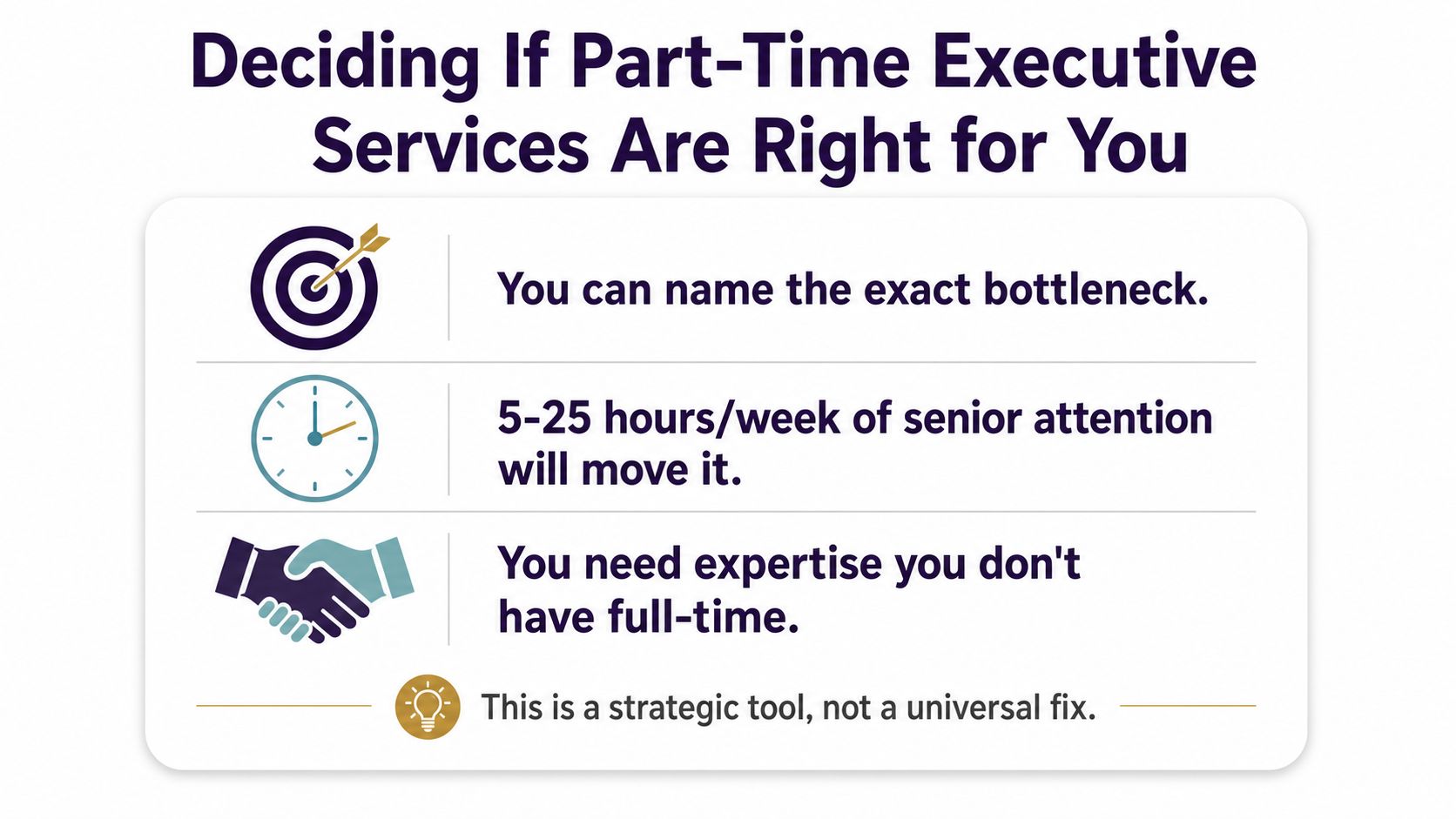
The decision is operational, not fashionable. Part time executive services fit when you can name the bottleneck, when five to twenty-five hours of senior attention per week can move it, and when your leadership team can absorb another decision-maker without creating political confusion.
They're a poor fit when the role requires daily presence, the executive must be available at all times, or the work depends on relationships that need constant continuity. A fractional leader also won't fix a company that hasn't decided what the function is supposed to accomplish.
Use this checklist before you start conversations:
- Bottleneck named: You can describe the problem without hiding behind a title.
- Hours scoped: You know which meetings, decisions, and workstreams require senior attention.
- Success measured: You've defined the metrics or observable outcomes that matter.
- Off-ramp agreed: You can end, expand, or redesign the engagement without drama.
The academic research on fractional CEO architecture reinforces the practical point. Outcomes depend on how the company designs time allocation, decision authority, embeddedness, accountability, governance coupling, and the transition pathway, not just on whether an executive is present part time (academic research on fractional CEO architecture).
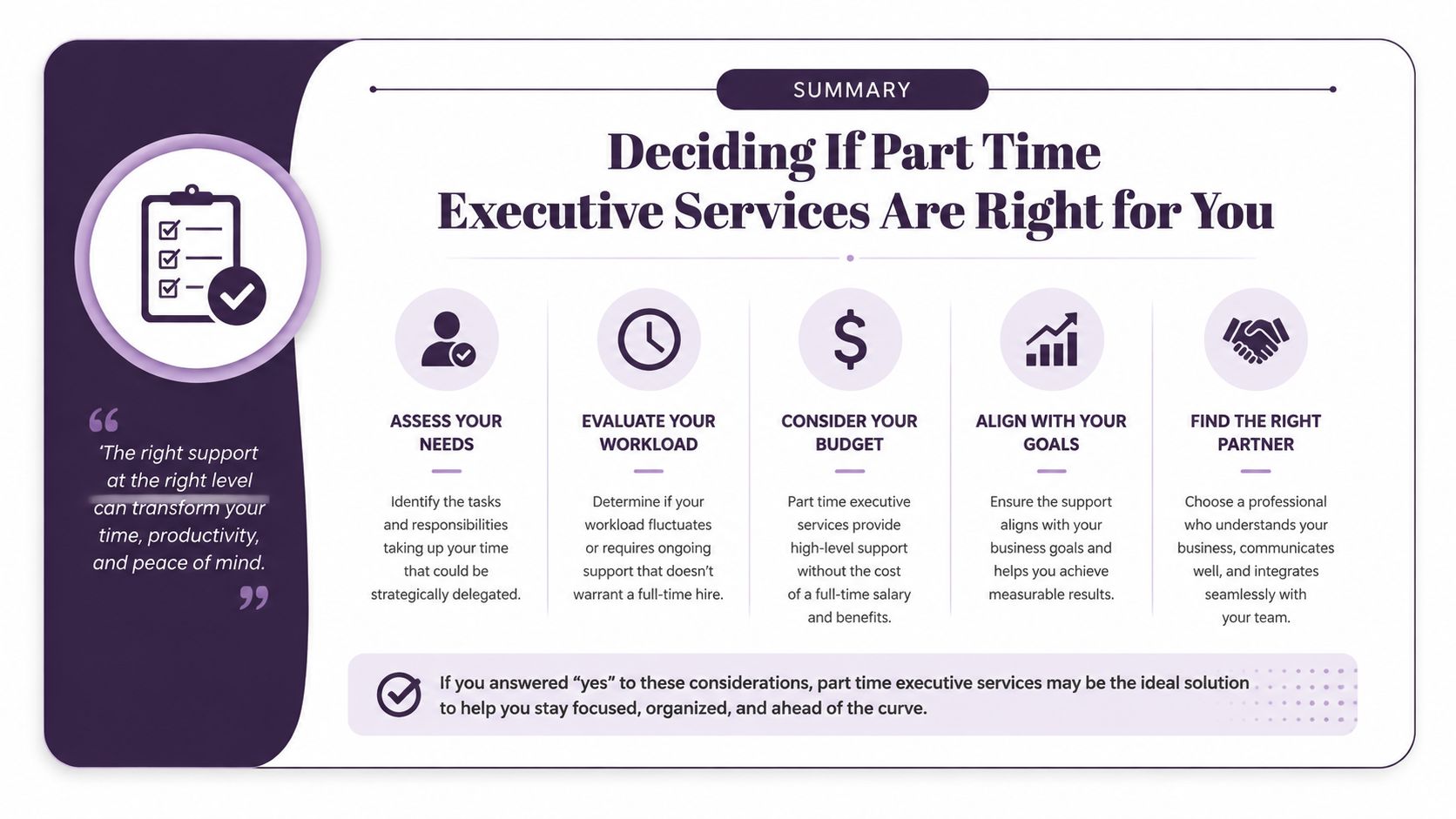
If you can answer the four checklist questions, a consultation is a sensible next step. The right partner should help you sharpen the role, match you with an executive who fits the bottleneck, and establish the operating terms before anyone starts attending meetings.
Shiny connects companies with experienced fractional executives for five to twenty-five hours per week, including leaders across finance, sales, marketing, technology, operations, and other functions. Visit Shiny to explore a focused match or schedule a consultation about the leadership capacity your company needs now.