
Part Time Sales Executive: The Ultimate Hiring Guide 2026
You've got revenue coming in. Customers like the product. A few deals close because you're relentless, not because the sales system works.
Then growth stalls.
Your reps are active but inconsistent. Forecasts feel fictional. The CRM is full of stale notes, half-qualified leads, and wishful close dates. You know you need senior sales leadership, but a full-time executive feels expensive, premature, and risky.
That's where a part time sales executive makes sense. Not as a compromise. As a sharper operating choice.
The right fractional sales leader gives you the missing layer between founder-led selling and a real sales machine. They don't just “help with sales.” They build the motion, install accountability, tighten pipeline discipline, coach the team, and force hard decisions on positioning, pricing, and process. If you hire well and onboard correctly, you gain advantage fast.
The Rise of the Part-Time Sales Executive
A common founder mistake is treating sales leadership like an all-or-nothing hire. Either you keep doing it yourself, or you wait until you can afford a full-time VP of Sales. That thinking slows growth.
A better path is to bring in the right operator for a focused slice of time and a very specific mandate.
The broader market has already moved this way. The global fractional executive market was valued at $9.4 billion in 2025 and is projected to reach $24.7 billion by 2034, with an 11.3% CAGR, according to fractional executive market projections from DataIntelo. That's not a niche experiment. It's a structural shift in how companies buy leadership.
What founders are actually buying
You're not buying hours. You're buying judgment.
A strong part time sales executive sees the gaps fast:
- Positioning drift: The team pitches features instead of outcomes.
- Pipeline fiction: Reps count activity, not deal quality.
- Process failure: Stages exist in the CRM, but nobody follows them.
- Founder bottlenecks: Key deals still depend on you to rescue them.
That leader comes in, audits the motion, decides what matters, and stops the noise.
This strategy resembles bringing in a special operations officer instead of building a large army too early. Early-stage companies don't need headcount for its own sake. They need precision.
Why this model fits the current labor market
Part-time work is no longer unusual. In 2025, almost 28.6 million people were employed part-time in the United States, up from 20.13 million in 1990, based on U.S. part-time employment data compiled by Statista. That matters because founders aren't fishing in some tiny talent pool. There's a large and growing market of professionals comfortable with fractional work.
Practical rule: Don't ask, “Can I afford a sales executive?” Ask, “What's the cheapest way to stop wasting qualified demand?”
For many startups and SMBs, the answer is a part time sales executive with a tight brief, clear metrics, and enough authority to change the system.
The Strategic Advantage of Fractional Sales Leadership
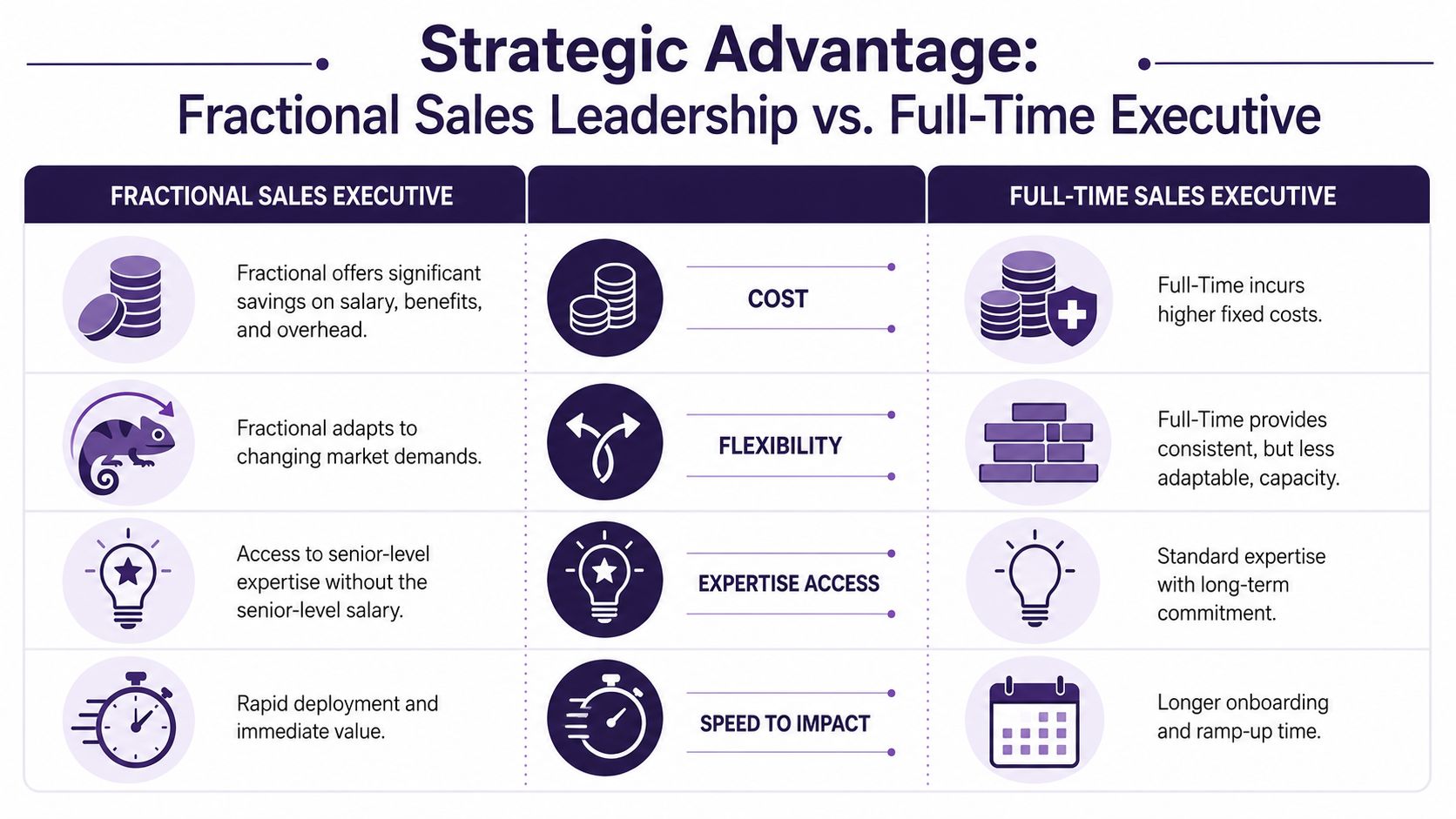
Hiring a full-time sales executive too early creates a different kind of risk. You lock in fixed cost before you've clarified the role, proven the motion, or built enough internal support for that leader to succeed.
A fractional leader gives you senior capability without forcing a full organizational commitment on day one.
Why fractional often beats full-time at this stage
The strongest argument isn't cost alone. It's fit.
A full-time executive needs enough scope, budget, and internal maturity to justify the seat. Many companies between founder-led selling and true scale don't have that yet. They need a builder, not a bureaucrat.
Demand reflects that. Fractional sales leaders in the US and Canada grew from 5,000 in 2020 to 9,000 in 2024, an 80% increase, according to FractionUS data on fractional work growth. Sales leadership is one of the fastest-growing categories in the fractional market for a reason. It solves a specific scaling problem.
If you want a deeper view of where this role fits, this breakdown of a fractional VP of Sales is useful.
The real ROI comes from speed and clarity
A junior sales team without leadership usually creates motion without progress. You get more calls, more demos, more CRM updates, and no reliable engine.
A seasoned fractional sales leader can usually do four things faster than an inexperienced full-time manager:
| Decision area | Fractional advantage | Why it matters |
|---|---|---|
| Sales process | Installs a cleaner pipeline fast | Reps stop pushing bad deals forward |
| Forecasting | Calls risk earlier | You make hiring and cash decisions with less guesswork |
| Coaching | Fixes call quality and qualification habits | Team output improves without adding headcount |
| GTM alignment | Forces clarity with marketing and product | Less wasted pipeline, better messaging |
This is the “special forces” model. You don't need a broad command structure. You need a capable operator who can stabilize, design, and coach.
A part time sales executive should create leverage for the founder within weeks, not absorb the founder's time indefinitely.
Cost matters, but flexibility matters more
When the company is still testing segments, pricing, or sales roles, flexibility has direct ROI. A fractional leader can work around the business's actual needs. That might mean hands-on pipeline triage now, then recruiting and enablement later. A full-time executive often arrives expecting a complete org chart and a cleaner mandate than you can realistically offer.
That mismatch is expensive.
The better move is to buy exactly the leadership layer you need, for the period you need it, and expand only when the system proves it deserves more investment.
Core Responsibilities and Key Performance Indicators
A lot of founders hire a sales leader with a vague mandate like “own revenue.” That's lazy management. It guarantees confusion.
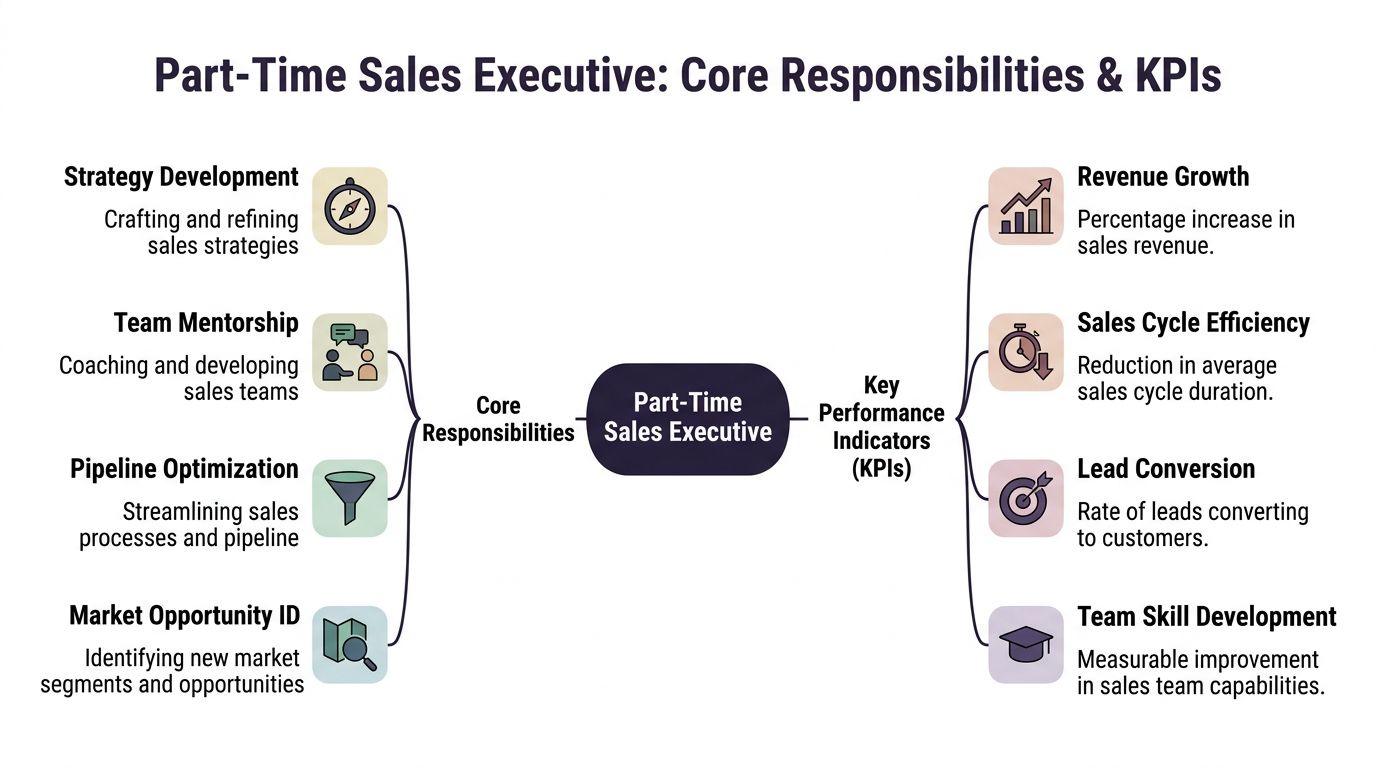
A part time sales executive needs a narrow charter tied to operating outcomes. The role usually spans strategy, process, and execution, but the weight of each depends on your stage.
Strategy responsibilities
This leader should decide what the team will sell, to whom, and with what message.
That includes:
- ICP refinement: Tighten the ideal customer profile based on real wins, not founder intuition.
- Offer packaging: Simplify pricing or commercial structure when deals stall in late-stage conversations.
- Territory and segment focus: Stop the team from chasing every possible buyer.
Useful KPIs here are mostly directional:
- Lead-to-opportunity quality
- Average sales cycle length
- Pipeline stage conversion consistency
Process responsibilities
Most value is created here. Sales teams rarely fail because they lack enthusiasm. They fail because nobody built the operating system.
A modern benchmark is clear. CRM proficiency and data-driven prospecting are essential for sales executives, according to this sales representative skills guide from emlyon business school. If your candidate can't run clean reporting, inspect pipeline data, and turn CRM activity into decisions, they're not a senior hire. They're just experienced.
Core process work usually includes:
- CRM hygiene rules
- Pipeline stage definitions
- Qualification framework
- Deal review cadence
- Sales playbook creation
Operating principle: If it isn't defined in the CRM, coached in one-on-ones, and reviewed in pipeline meetings, it isn't part of the sales process.
Execution responsibilities
A part time sales executive should still stay close to live deals. Not forever, but enough to influence outcomes and coach in context.
Execution often looks like this:
- Join selected discovery and late-stage calls.
- Review top deals weekly.
- Coach reps on messaging, objections, and deal strategy.
- Handle a few strategic accounts personally when needed.
A clean KPI set for this area looks like:
| Responsibility | KPI to watch |
|---|---|
| Rep coaching | Call quality improvement in manager reviews |
| Pipeline management | Deal age by stage |
| Forecast discipline | Gap between forecasted and actual closed business |
| Team enablement | Time to ramp for new reps |
| Account support | Progression rate on strategic deals |
The point isn't to build a dashboard with endless metrics. It's to choose the few measures that reveal whether the sales motion is becoming more predictable.
Crafting Your Job Description and Compensation
Most job descriptions for sales leaders are bloated wish lists. They read like a company wants a strategist, recruiter, player-coach, RevOps lead, and miracle worker for one budget line.
That repels serious candidates.
A strong brief for a part time sales executive should define outcomes, constraints, and authority. Keep it direct.
A job description template that actually works
Use this structure.
Role summary
You're hiring a part-time sales executive to build and improve the sales operating system, coach the team, and increase revenue predictability. The role owns process quality, pipeline discipline, and commercial execution, not every administrative task inside the department.
Core outcomes in the first phase
- Audit the current sales motion
- Improve CRM discipline and reporting
- Define or tighten pipeline stages
- Coach reps and support key deals
- Deliver a practical sales playbook
- Improve forecast quality
What success looks like
- Cleaner pipeline reviews
- Better qualification
- Faster ramp for new reps
- Clearer accountability for each seller
- Stronger handoff between founder, marketing, and sales
Candidate profile
- Has led sales teams before
- Can operate inside HubSpot, Salesforce, or another CRM without drama
- Comfortable working part-time and asynchronously
- Strong in coaching, deal inspection, and process design
- Can challenge a founder without becoming political
If you want a fuller reference point, this guide to a sales leader job description is a solid starting point.
How to think about compensation
Don't anchor on junior sales salaries. You're buying senior judgment.
The median annual wage for sales managers was $138,060 in May 2024, based on the U.S. Bureau of Labor Statistics profile for sales managers. That's the baseline that makes prorated executive contracts sensible. You can access real leadership for a defined weekly scope instead of carrying the full annual burden.
A practical compensation structure usually falls into one of these models:
| Model | Best for | Watch-out |
|---|---|---|
| Monthly retainer | Ongoing leadership and team management | Scope creep if deliverables aren't defined |
| Hourly advisory | Audits, strategy, and selective coaching | Easy to underutilize |
| Retainer plus performance variable | Growth-stage teams with clear targets | Incentives can distort behavior if metrics are weak |
A blunt compensation recommendation
Use a retainer with explicit deliverables for the first engagement period.
That gives you stability without pretending you can perfectly forecast every need. Add variable comp only if the pipeline, attribution, and close ownership are clear. If they aren't, performance pay turns into an argument.
One more rule. Don't hire a part time sales executive to “close a few deals” while hiding the fact that the underlying problem is bad positioning, weak qualification, or a broken sales process. Senior leaders can help close business, but their main value is building a system that keeps closing after they step out of the call.
How to Find and Interview Your Ideal Candidate
The worst place to start is a broad, public search with a fuzzy brief. You'll attract polished resumes, generic leadership talk, and people who mostly know how to interview well.
You need evidence of operating skill.
That means your hiring process should screen for three things fast: can they diagnose, can they build, and can they coach.

Ask interview questions that force specificity
Skip soft prompts like “Tell me about your leadership style.”
Use questions that expose how they think:
- Diagnosis: “You open our CRM and see inflated pipeline, low stage discipline, and founder-owned late-stage deals. What do you check first?”
- Prioritization: “What would you ignore in the first month because it looks important but isn't?”
- Coaching: “How do you handle a rep who has strong activity numbers and weak close quality?”
- Commercial judgment: “When would you change messaging versus changing the target segment?”
- Part-time fit: “How do you create momentum when you're not in the business full-time?”
Good candidates answer with sequences, examples, and trade-offs. Weak candidates answer with slogans.
Use a practical work test
Don't overcomplicate it. Give them a light operating exercise.
For example:
| Test | What you learn |
|---|---|
| Review a sample pipeline | Whether they can spot deal risk and stage inflation |
| Rewrite a short sales process | Whether they can simplify and clarify |
| Audit a mock forecast | Whether they understand inspection, not just reporting |
| Outline a first 30 days plan | Whether they can operate with limited time |
Hire the candidate who makes your current sales mess easier to understand. Not the one with the most polished title history.
Where to find better candidates faster
Traditional recruiting works poorly here because the role itself is nontraditional. Standard job boards over-index on active job seekers. Executive recruiters can help, but they're often too slow and too expensive for this type of hire.
Fractional executive marketplaces are usually a better fit because the candidates are already oriented to scoped leadership work. They understand limited hours, compressed timelines, and outcome-driven engagements.
That matters. A great full-time sales leader isn't automatically a great fractional one. Fractional work requires sharper prioritization, stronger communication habits, and less dependence on company bureaucracy.
The best hiring path is the one that reduces founder time, shortens screening, and gives you candidates who have already chosen this model on purpose.
Onboarding for Maximum and Immediate Impact
Hiring the right person and then giving them weak onboarding is how founders waste good talent.
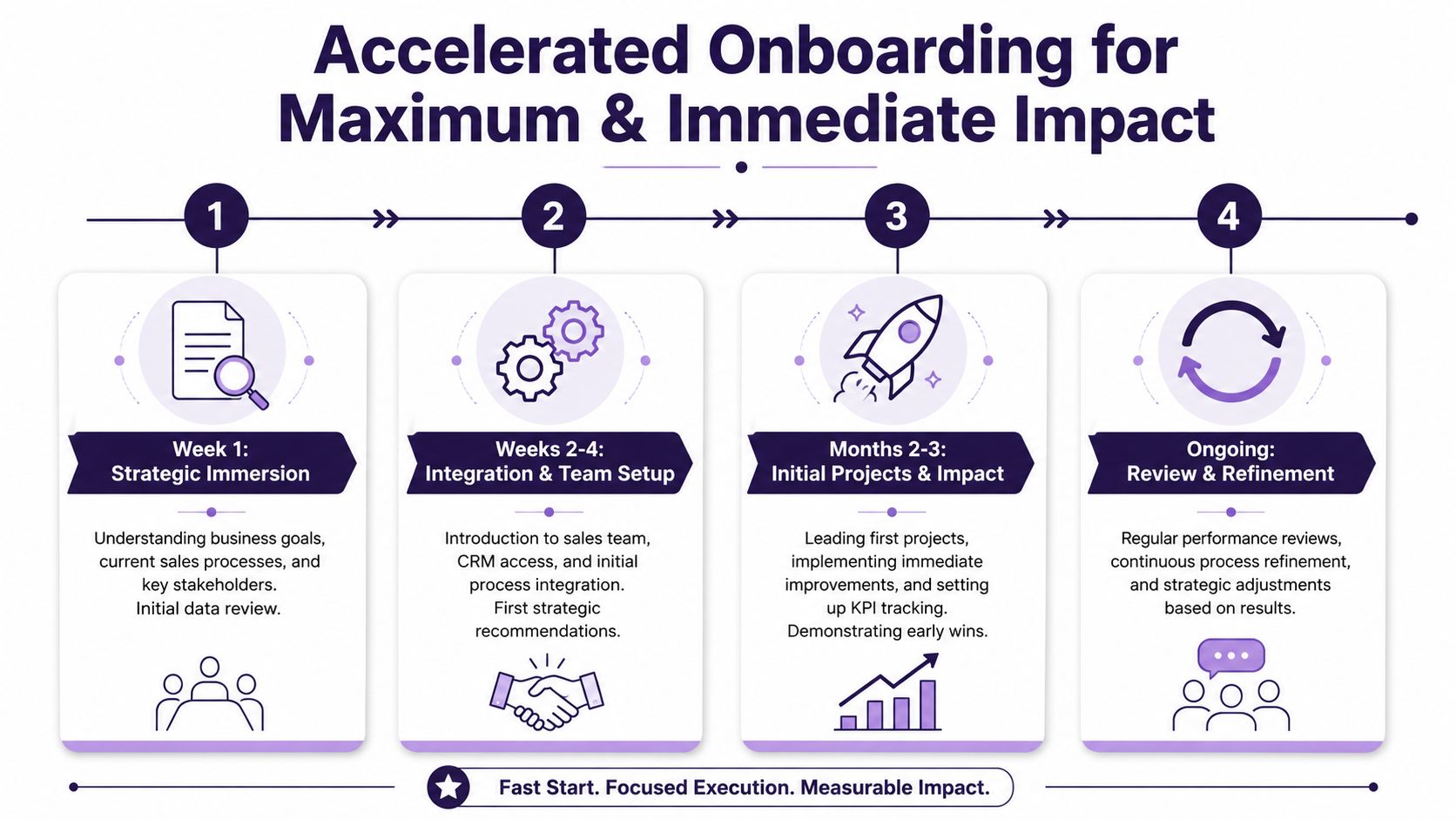
A part time sales executive has less room for drift than a full-time hire. Limited hours mean every handoff matters. If you make them chase context for three weeks, you've already cut the return on the engagement.
Why structure matters more in a fractional role
This challenge is real. Part-time sales reps have 40% fewer touchpoints to establish trust, and 68% of startups face the challenge of compressing sales cycles without sacrificing rapport, according to ZipRecruiter's discussion of part-time sales representative challenges. That's why casual onboarding fails. You need a deliberate high-impact touchpoint framework.
This guide to executive onboarding best practices for modern leadership success is useful if you want a broader leadership lens.
A practical 30-60-90 day plan
Use this as your starting structure.
Days 1 to 30
- Audit the sales motion: Review pipeline, CRM setup, funnel stages, call recordings, and current forecast method.
- Map the people: Meet founder, top reps, marketing lead, and whoever owns RevOps or CRM administration.
- Find quick wins: Remove obvious stage confusion, deal clutter, and weak meeting cadence.
Days 31 to 60
- Implement process changes: Tighten qualification rules, standardize pipeline reviews, and define required CRM fields.
- Start coaching rhythm: Weekly one-on-ones, selected call reviews, and deal inspection sessions.
- Clarify ownership: Decide which deals the founder should exit and which the executive should influence directly.
Days 61 to 90
- Operationalize the playbook: Messaging, qualification, call standards, and reporting should be documented and used.
- Build team accountability: Reps should know what good pipeline behavior looks like.
- Set the next mandate: Scale current motion, hire, or reposition. Pick one.
The first ninety days should produce a cleaner system, clearer decisions, and visible behavioral change in the team. If all you got was “good strategic conversations,” the onboarding failed.
The founder's role in onboarding
You still matter. A lot.
Your job is to give access, make decisions quickly, and stop undermining the new leader by staying buried in every late-stage deal. Founders often hire a sales executive and then keep behaving like the head of sales. That breaks authority before the role has a chance to work.
If you want immediate impact, give the person context, tools, and room to lead.
Ready to Scale Your Sales Find Your Executive Today
A part time sales executive is often the most impactful hire a growing company can make. You get senior judgment without overcommitting. You fix the system before you scale the headcount. You bring discipline to pipeline, process, coaching, and forecasting before bad habits harden.
That's the ultimate payoff.
This model works best when you treat it like an operating decision, not a stopgap. Define the mandate tightly. Interview for diagnosis and execution, not charisma. Onboard with intent. Measure the few KPIs that reveal whether the sales engine is becoming more predictable.
Most founders wait too long. They keep founder-led selling in place past its expiration date, hire junior reps into a weak system, then wonder why revenue feels lumpy. A part time sales executive solves that by giving the business a real sales brain before it carries the cost and complexity of a full-time executive bench.
If your company has product traction but your sales motion still depends too much on founder instinct, this is the move worth making.
If you're ready to find a vetted sales leader without dragging through a long recruiting cycle, explore Shiny. It connects startups and growth-stage companies with experienced fractional executives for focused, high-impact work. You can review executive profiles or schedule a consultation to figure out what kind of sales leadership your business actually needs.