10 Key Process Improvement Methods for Startups in 2025
In the fast-paced startup world, the relentless pursuit of growth often overshadows a critical engine for success: operational efficiency. While product-market fit and funding rounds grab headlines, the small, consistent refinements in how you work can unlock exponential value. This is where process improvement methods become a startup’s secret weapon. They aren’t just rigid, corporate frameworks; they are adaptable toolkits designed to eliminate waste, enhance quality, and accelerate delivery.
For a lean startup, mastering these methods means doing more with less, delighting customers, and building a resilient foundation for scalable growth. Instead of viewing operations as a necessary cost, you can transform them into a source of competitive advantage. The right approach allows a small team to outperform larger, less agile competitors by optimizing every workflow, from software development to customer onboarding. It’s about creating a culture where every team member is empowered to identify and solve inefficiencies.
This guide breaks down 10 of the most effective process improvement methods, providing actionable steps and startup-focused examples to help you turn theory into practice. We will explore powerful frameworks like Lean, Six Sigma, Kaizen, and Agile, along with targeted tools such as Value Stream Mapping and the 5S Methodology. You will learn not only what each method is but how to implement it within your unique startup environment. The goal is to equip you with the knowledge to select and apply the right strategies to solve specific challenges, driving sustainable growth and building a culture of continuous improvement from day one.
1. Lean Manufacturing
Lean Manufacturing is a systematic approach to minimizing waste within a system without sacrificing productivity. Originating from the Toyota Production System, its core principle is to create more value for customers using fewer resources. This is one of the most foundational process improvement methods, focusing on identifying and systematically eliminating non-value-added activities, often referred to as “muda” (the Japanese word for waste).

How Lean Manufacturing Works
Lean identifies eight key areas of waste to target: defects, overproduction, waiting, non-utilized talent, transportation, inventory, motion, and extra-processing. By focusing on these areas, companies can streamline operations, reduce costs, and improve quality. For a startup, this means developing a minimum viable product (MVP) with only essential features, thus avoiding the waste of building something customers don’t want. The goal is to build a culture of continuous improvement, or “kaizen,” where every employee is empowered to identify and eliminate inefficiencies.
Implementation Tips for Startups
- Start Small: Begin with a pilot project in a controlled area, like refining your customer onboarding process, before a company-wide rollout.
- Invest in Culture: Lean is a mindset, not just a tool. Train your team on its principles and foster a culture that values efficiency and employee input.
- Use Visual Tools: Implement Kanban boards or similar visual management systems to make workflows, bottlenecks, and progress visible to everyone.
- Go to the Gemba: Regularly “go to the source” (the gemba) to observe how work is actually done. This provides firsthand insights that data alone cannot.
Key Insight: Lean is not about cutting costs by cutting corners; it’s about eliminating wasteful activities to free up resources, allowing your team to focus on what truly adds value for the customer.
A prime example is the Toyota Production System, which famously reduced defects by 90% and inventory by 75%. Even service-based startups can apply these principles. Imagine a HealthTech company using Lean to streamline its patient data entry process, cutting down processing time and reducing errors, much like Virginia Mason Medical Center reduced patient wait times by 85%.
By adopting Lean, you can significantly enhance your operational efficiency. You can discover more strategies on this topic by exploring our guide on how to improve operational efficiency.
2. Six Sigma
Six Sigma is a highly disciplined, data-driven methodology that aims to improve process quality by identifying and systematically removing the causes of defects. Developed by a Motorola engineer in the 1980s, its goal is to minimize variability in manufacturing and business processes, striving for near-perfection. As one of the most statistically rigorous process improvement methods, it targets no more than 3.4 defects per million opportunities (DPMO).
How Six Sigma Works
Six Sigma utilizes two key sub-methodologies: DMAIC (Define, Measure, Analyze, Improve, Control) for existing processes and DMADV (Define, Measure, Analyze, Design, Verify) for new processes. By applying statistical analysis and a structured framework, teams can pinpoint the root causes of problems rather than just treating symptoms. For a FinTech startup, this could mean using DMAIC to analyze and reduce errors in its automated transaction processing system, ensuring accuracy and building customer trust.
Implementation Tips for Startups
- Select High-Impact Projects: Focus on projects with a clear, measurable financial impact and a direct benefit to the customer experience.
- Secure Leadership Buy-In: Ensure you have strong support and dedicated resources from leadership, as Six Sigma projects can be intensive.
- Train Your Team: Invest in training employees in basic statistical concepts and the DMAIC framework. This creates champions within the organization.
- Leverage Software: Use statistical software tools like Minitab or JMP to simplify complex data analysis and make data-driven decisions more accessible.
- Celebrate Success: Publicly recognize successful projects and share the learnings across different departments to foster a culture of quality.
Key Insight: Six Sigma is not just about quality control; it’s a proactive strategy for preventing defects and achieving predictable, stable process results, which is critical for scaling a business reliably.
This methodology was famously championed by Jack Welch at General Electric, where it reportedly saved the company over $12 billion in five years. Similarly, Motorola, its birthplace, improved product quality by 99.7%. For startups, the lesson is clear: embedding a data-first approach to quality from the start builds a robust foundation for sustainable growth and customer satisfaction.
3. Kaizen
Kaizen is a Japanese philosophy centered on continuous improvement through small, incremental changes made consistently over time. The term itself translates to “change for the better,” and its core principle is that everyone in an organization, from the C-suite to frontline workers, is responsible for identifying and implementing improvements. Unlike revolutionary changes, Kaizen promotes a steady, collaborative evolution, making it one of the most accessible process improvement methods for fostering a proactive culture.

How Kaizen Works
Kaizen operates on the belief that a multitude of small, positive changes can lead to significant long-term results. It empowers employees to take ownership of their work areas and processes, encouraging them to find and fix minor issues before they become major problems. For a startup, this could mean a developer suggesting a small code refactor to improve performance or a support agent proposing a new email template to clarify common questions. The goal is to embed improvement into the daily routine rather than treating it as a one-time project.
Implementation Tips for Startups
- Start with 5S: Implement the 5S methodology (Sort, Set in order, Shine, Standardize, Sustain) to organize the physical or digital workplace. This creates a foundation for efficiency.
- Hold Kaizen Events: Conduct focused, 3-5 day workshops (Kaizen events or blitzes) to tackle a specific problem with a cross-functional team.
- Create Suggestion Systems: Implement a simple system for employees to submit improvement ideas and ensure a quick feedback loop, even if the idea isn’t implemented.
- Document and Standardize: When an improvement is successful, document the new process and make it the standard operating procedure until a better way is found.
Key Insight: Kaizen’s power lies in its simplicity and inclusivity. It democratizes process improvement, turning every employee into an agent of change and building a resilient, adaptable organization from the ground up.
Toyota is a classic example, with employees famously submitting over two million improvement suggestions annually, most of which are implemented. Similarly, Canon reduced its product defect rates by 90% through daily Kaizen activities. For a SaaS startup, applying Kaizen could involve weekly team huddles to discuss minor workflow frictions, leading to cumulative gains in development speed and a reduction in post-launch bugs, mirroring how Lockheed Martin used the philosophy to improve aircraft delivery times by 25%.
4. Total Quality Management (TQM)
Total Quality Management (TQM) is a comprehensive management approach centered on achieving long-term customer satisfaction through the continuous improvement of all organizational processes. Unlike methods that isolate quality control to a single department, TQM embeds quality responsibility across every function and level. This is one of the most holistic process improvement methods, treating quality as a strategic objective that involves everyone, from the CEO to the frontline staff.
How Total Quality Management Works
TQM operates on the principle that the entire organization must work together to improve processes, products, services, and the internal culture. Popularized by pioneers like W. Edwards Deming, it focuses on customer-driven quality standards, strong leadership commitment, and data-driven decision-making. For a startup, this means creating systems to consistently meet and exceed customer expectations, rather than just fixing problems as they arise. The goal is to build a culture where quality is proactive, not reactive, preventing defects before they happen.
Implementation Tips for Startups
- Secure Leadership Commitment: TQM starts at the top. Founders must clearly articulate a vision for quality and lead by example.
- Invest in Comprehensive Training: Equip every team member with the knowledge and tools needed to contribute to quality improvement, from statistical process control to customer feedback analysis.
- Establish Cross-Functional Teams: Create “quality councils” or teams that bring together employees from different departments to solve systemic problems and innovate processes.
- Measure and Communicate Relentlessly: Define key quality metrics, track them consistently, and make progress visible to the entire organization to maintain momentum and celebrate wins.
Key Insight: TQM transforms quality from a final inspection gate into the DNA of the organization. It’s a cultural shift that empowers every employee to own the customer experience.
A classic example is Xerox Corporation, which used TQM principles to regain market leadership from Japanese competitors by drastically improving product reliability. Similarly, Federal Express, a Malcolm Baldrige National Quality Award winner, built its reputation on TQM, achieving a remarkable 99.9% package delivery accuracy. Startups can apply these ideas by building robust feedback loops and empowering their teams to make real-time improvements, ensuring high-quality service from day one.
5. Business Process Reengineering (BPR)
Business Process Reengineering (BPR) is a radical and fundamental redesign of core business processes to achieve dramatic, not incremental, improvements in critical contemporary measures of performance, such as cost, quality, service, and speed. Unlike other process improvement methods that focus on gradual changes, BPR challenges the status quo by asking, “If we were starting this company today, how would we do this?” The goal is to wipe the slate clean and reinvent processes from the ground up.
How Business Process Reengineering Works
BPR involves identifying a company’s essential processes and completely restructuring them to optimize for today’s demands, often leveraging modern technology. It abandons outdated, fragmented tasks and replaces them with integrated, cross-functional workflows. For a startup, this might mean designing a customer support process from scratch that uses AI chatbots and automated ticketing to handle 80% of inquiries, rather than just slightly improving an old-fashioned, email-based system. The emphasis is on a revolutionary shift rather than an evolutionary one.
Implementation Tips for Startups
- Secure Strong Leadership: BPR is disruptive and requires unwavering commitment and sponsorship from the very top to overcome resistance.
- Target High-Impact Processes: Begin with processes that directly affect customer satisfaction or have a significant impact on the bottom line, like order fulfillment or product development.
- Empower Cross-Functional Teams: Assemble teams with members from different departments and give them the authority to make and implement decisions without bureaucratic delays.
- Prioritize Change Management: Invest heavily in communicating the “why” behind the changes. Plan for extensive employee retraining and support to manage the cultural shift.
Key Insight: BPR is not about making processes more efficient; it’s about making them more effective. It’s a high-risk, high-reward strategy that aims for quantum leaps in performance by questioning every assumption.
A classic example is Ford Motor Company, which reengineered its accounts payable process. Instead of just speeding up the old system, they redesigned it so payment was triggered automatically upon receipt of goods, cutting headcount in the department by 75%. Similarly, IBM Credit Corporation reduced its loan approval time from a week to just four hours by overhauling its entire workflow.
For startups looking to scale dramatically, BPR can provide the framework for building robust, future-proof operations. You can find more information about this transformative approach in our guide to business process improvement.
6. Value Stream Mapping (VSM)
Value Stream Mapping (VSM) is a lean management tool used to visualize, analyze, and improve the steps required to deliver a product or service. It’s a flowchart that illustrates the flow of materials and information from supplier to customer. As one of the most visual process improvement methods, VSM helps businesses identify waste and inefficiencies in their processes, showing where value is truly added.
How Value Stream Mapping Works
The core of VSM is creating two maps: a “current state” map that shows how the process operates today, and a “future state” map that envisions a more efficient, waste-free process. By documenting every action and information flow, teams can quantify delays, bottlenecks, and non-value-added activities. For a SaaS startup, this could involve mapping the entire customer journey from initial lead capture to final onboarding, identifying friction points that cause drop-offs. The goal is to create a seamless flow that maximizes value and minimizes delay.
Implementation Tips for Startups
- Walk the Process First: Before drawing anything, physically walk through the entire process from start to finish. This “gemba walk” provides invaluable context that a conference room discussion cannot.
- Involve Cross-Functional Teams: Ensure representatives from every step of the process (e.g., sales, development, customer support) are involved in the mapping session to get a complete and accurate picture.
- Focus on One Service Family: Don’t try to map everything at once. Start with a single, high-impact product or service to keep the scope manageable and achieve a quick win.
- Create a Tangible Plan: The future state map is not the end goal. Develop a detailed implementation plan with clear actions, owners, and timelines to turn the vision into reality.
Key Insight: Value Stream Mapping is more than just drawing a diagram; it’s a diagnostic tool that forces you to see your process from the customer’s perspective, making waste impossible to ignore.
Major companies have seen tremendous success with VSM. Dell Computer famously used it to help reduce its order-to-delivery time from 35 days down to just 5. In healthcare, Seattle Children’s Hospital applied VSM principles to its discharge process, successfully reducing the time it took to send patients home by 65%. These examples show VSM’s power to drive significant improvements across diverse industries by making the entire value stream visible.
7. 5S Methodology
The 5S Methodology is a workplace organization system that uses five Japanese terms to create and maintain an orderly, clean, safe, and efficient work environment. It is often considered a foundational element for other, more complex process improvement methods, as it establishes the discipline and standards necessary for continuous improvement. The five S’s are: Seiri (Sort), Seiton (Set in Order), Seiso (Shine), Seiketsu (Standardize), and Shitsuke (Sustain).
How 5S Methodology Works
5S works by systematically decluttering and organizing the workplace. First, you sort through all items, keeping only what is necessary. Next, you set everything in its proper place with clear labels, making items easy to find and return. The third step, shine, involves cleaning the workspace, which often helps identify hidden problems like equipment leaks. Finally, you standardize these practices across the organization and create a system to sustain them through regular audits and training, embedding them into the company culture.
Implementation Tips for Startups
- Start with a Pilot: Select one specific area, like a supply closet or a shared server folder, to demonstrate the quick wins and benefits of 5S before a wider rollout.
- Document the Change: Take “before” and “after” photos. This visual evidence is a powerful motivator and clearly communicates the impact of the initiative.
- Empower Your Team: Involve employees directly in designing the new organization systems. They know their workspaces best and this fosters a sense of ownership.
- Conduct Regular Audits: Use simple checklists to conduct regular 5S audits. This helps maintain the standards and prevents the workspace from reverting to its old state.
Key Insight: 5S is more than just “housekeeping.” It is a systematic process for eliminating waste related to searching for tools, excess inventory, and unsafe conditions, directly boosting productivity and morale.
The 5S system was a cornerstone of the Toyota Production System and has been adopted globally. Honeywell, for instance, used 5S to reduce search time by 50% in its manufacturing facilities. In a healthcare setting, Virginia Mason Medical Center applied 5S principles to its supply rooms, which contributed to a 30% reduction in supply costs and made it easier for clinical staff to find what they needed quickly.
By establishing a clean and organized baseline, 5S prepares your startup for more advanced improvement efforts. To see how this foundational step fits into a broader strategy, review our guide on achieving operational excellence.
8. Theory of Constraints (TOC)
The Theory of Constraints (TOC) is a management philosophy that views any complex system as being limited by a single, critical constraint. Introduced by Eliyahu M. Goldratt in his book “The Goal,” this approach asserts that organizations can dramatically improve performance by focusing on managing this single bottleneck. As one of the most powerful process improvement methods, TOC provides a framework for identifying and systematically elevating the one factor that holds the entire system back.
How the Theory of Constraints Works
TOC operates on a Five-Focusing Steps methodology: Identify the constraint, exploit the constraint (get the most out of it), subordinate everything else to the constraint’s needs, elevate the constraint (invest in improving it), and then repeat the process as a new constraint emerges. For a startup, this could mean identifying that the development team is the bottleneck and ensuring they only work on the highest-priority, validated features, with all other departments (marketing, sales) aligning their activities to support this focus.
Implementation Tips for Startups
- Identify the Real Constraint: Use data and observation to find the true system bottleneck. It might be a machine, a department, or even a policy like your pricing structure.
- Buffer the Constraint: Protect your constraint from disruptions. If your lead developer is the bottleneck, ensure they have a small backlog of prioritized tasks ready so they are never idle.
- Measure System Throughput: Don’t measure individual efficiency. Success in TOC is measured by the increased output of the entire system, not just one part.
- Elevate, Then Repeat: Once you have fully utilized the constraint, invest in increasing its capacity. When it is no longer the bottleneck, immediately start looking for the new one.
Key Insight: TOC shifts the focus from optimizing individual parts to optimizing the whole system through its weakest link. Improving anything other than the constraint is a waste of resources.
The results of applying TOC can be profound. For instance, Ford Electronics increased its manufacturing throughput by 50% in just six months by identifying and managing its production constraints. Similarly, Boeing improved its aircraft delivery performance by 30% by applying TOC principles to its assembly line. For a startup, this means pinpointing your growth limiter, whether it’s customer acquisition or server capacity, and dedicating your energy to breaking through it.
You can learn more about the methodology from its official body, TOC International.
9. Agile Methodology
Agile is an iterative approach to project management and software development that helps teams deliver value to customers faster and with fewer headaches. Unlike traditional waterfall methods that require rigid upfront planning, Agile emphasizes collaboration, flexibility, and rapid response to change. It is one of the most transformative process improvement methods, especially for dynamic industries where requirements evolve quickly. Its core principle is to break down large projects into small, manageable increments called sprints.
How Agile Methodology Works
Agile operates in short development cycles, or sprints, which typically last from one to four weeks. At the end of each sprint, the team delivers a working piece of the product. This cycle of building, testing, and getting feedback allows for continuous improvement and ensures the final product closely aligns with customer needs. Frameworks like Scrum and Kanban provide structure, using tools like daily stand-ups, sprint planning, and retrospectives to keep teams aligned and productive. The goal is to create a rhythm of consistent, high-quality delivery.
Implementation Tips for Startups
- Start with a Pilot: Select a single, contained project to pilot Agile. Hire an experienced Agile coach or train a team member to guide the process and avoid common pitfalls.
- Invest in Culture: Agile is a cultural shift. Train the entire team on its principles, fostering a collaborative environment that embraces change and trusts individuals to self-organize.
- Use Proper Tools: Implement tools like Jira, Trello, or Asana to manage backlogs, track sprint progress, and enhance team collaboration, especially for remote or hybrid teams.
- Focus on Working Software: Prioritize delivering a functional product increment in every sprint over extensive documentation. This tangible progress motivates the team and provides real value for early feedback.
Key Insight: Agile is not an excuse for no planning. It’s a strategy for adaptive planning, allowing you to steer the project effectively as you gain new information, rather than being locked into an outdated initial plan.
Spotify is a prime example, having famously scaled Agile with its “squads, tribes, chapters, and guilds” model to maintain autonomy and innovation across hundreds of teams. Similarly, ING Bank transformed its entire organization using Agile principles to improve customer focus and speed up innovation. By adopting an Agile mindset, startups can pivot quickly, reduce wasted effort, and build products that customers truly love.
10. PDCA Cycle (Plan-Do-Check-Act)
The PDCA Cycle, also known as the Deming Cycle, is a four-step iterative management method used for the continuous improvement of processes and products. It provides a simple but powerful framework for systematic problem-solving, testing hypotheses, and implementing change. As one of the most fundamental process improvement methods, PDCA offers a scientific approach to making incremental and sustained enhancements.
How the PDCA Cycle Works
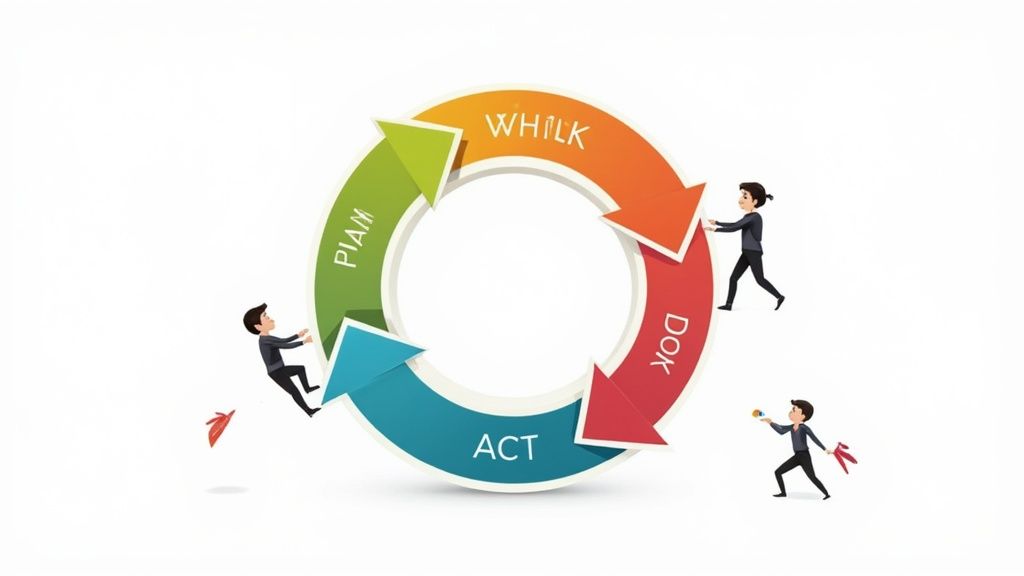
The cycle guides teams through a structured loop of improvement. The four phases are: Plan (identify an opportunity and plan a change), Do (implement the change on a small scale), Check (observe and analyze the results against expectations), and Act (implement the successful solution more broadly or restart the cycle with a new plan). For a startup, this could mean planning a new marketing campaign feature (Plan), launching it to a small user segment (Do), analyzing engagement metrics (Check), and then either rolling it out to all users or refining the approach (Act).
Implementation Tips for Startups
- Invest in Planning: Spend adequate time in the “Plan” phase to clearly define the problem, set measurable goals, and formulate a solid hypothesis. Rushing this step often leads to failed experiments.
- Start with Small Tests: Use the “Do” phase to conduct small, controlled experiments. This minimizes risk and allows for quick, low-cost learning before committing significant resources.
- Document Everything: Carefully document your process, results, and learnings at each stage. This creates a valuable knowledge base for future improvement cycles.
- Don’t Skip Phases: The “Check” and “Act” phases are crucial for validating learning and standardizing success. Skipping them turns the cycle into just “Plan-Do,” which is merely implementation without improvement.
Key Insight: PDCA is not a one-time fix; it’s a continuous loop. Its power lies in its iterative nature, which embeds a culture of constant, evidence-based improvement into your team’s DNA.
For instance, Johnson & Johnson reportedly applied PDCA principles to reduce manufacturing defects by 80%. Similarly, Southwest Airlines has used the cycle to improve its on-time performance by systematically testing changes to its turnaround procedures. For a startup, this methodical approach ensures that every change is a step toward a more efficient and effective operation.
You can dive deeper into the specific actions for each phase by exploring these process improvement steps.
Process Improvement Methods Comparison
| Methodology | Implementation Complexity 🔄 | Resource Requirements ⚡ | Expected Outcomes 📊 | Ideal Use Cases 💡 | Key Advantages ⭐ |
|---|---|---|---|---|---|
| Lean Manufacturing | Moderate to High (6-24 months) | Moderate to High (training, culture change) | Waste reduction, cost savings, quality improvement | Manufacturing, healthcare, services, software, construction | Reduces cost 15-25%, improves quality & flexibility |
| Six Sigma | High (4-6 months per project) | High (extensive training and data tools) | Dramatic quality improvement, cost savings | Processes requiring statistical quality control | Data-driven, measurable financial impact |
| Kaizen | Low (continuous, ongoing) | Low (primarily time investment) | Incremental improvements with sustainable culture | All organizational levels, daily operations | Low risk, builds employee ownership |
| Total Quality Management | High (3-5 years) | High (training, cultural transformation) | Holistic quality & customer satisfaction improvement | Enterprise-wide quality focus | Strong customer focus, integrated quality |
| Business Process Reengineering | Very High (radical redesign) | Very High (time, resources, change mgmt.) | Breakthrough performance gains (50-100%+) | Processes needing radical change | Potential for transformational results |
| Value Stream Mapping | Low to Moderate (2-4 weeks mapping) | Low to Moderate (data collection effort) | Clear waste identification & process insight | Process analysis and improvement planning | Visual tool, quick implementation |
| 5S Methodology | Low (2-4 weeks) | Very Low (time, basic supplies) | Organized, safer, efficient workplace | Workplace organization and standardization | Quick, low cost, easy to implement |
| Theory of Constraints | Moderate (6 months for results) | Moderate (specialized tools and training) | Throughput improvement (30-50%) | Bottleneck-focused system optimization | Focused on highest-impact problems |
| Agile Methodology | Moderate to High | Moderate (team training, cultural shift) | Faster delivery, improved collaboration | Software development, project management | Flexibility, rapid response to change |
| PDCA Cycle (Plan-Do-Check-Act) | Low to Moderate (iterative and ongoing) | Low (time and team involvement) | Continuous improvement, risk reduction | Any process or problem requiring systematic improvements | Simple, universal, risk-minimizing |
From Theory to Action: Making Improvement Your Competitive Edge
Navigating the landscape of process improvement methods can initially seem overwhelming. From the statistical rigor of Six Sigma to the cultural shift championed by Kaizen, each framework offers a unique lens through which to view and refine your operations. The core message across all ten methodologies we’ve explored, however, is unified and powerful: continuous, systematic improvement is not a one-time project but a fundamental requirement for sustainable growth and a powerful competitive advantage.
You don’t need to master every single framework at once. The true power lies in strategic application, not encyclopedic knowledge. The key is to move from theory to decisive action by starting with a single, manageable experiment.
Turning Knowledge into Momentum
The first step is often the most critical. Instead of aiming for a company-wide transformation, identify a specific, high-friction problem your team is facing right now.
- Is your product development cycle slow and unresponsive? Consider implementing the rapid, iterative sprints of the Agile Methodology.
- Is your physical or digital workspace cluttered and inefficient? The 5S Methodology provides a simple, visual framework to create order and reduce wasted time.
- Are you unsure where the biggest bottleneck in your entire customer delivery process is? A Value Stream Mapping (VSM) exercise will illuminate the delays and non-value-added steps you couldn’t see before.
By selecting one of these process improvement methods that directly addresses a current pain point, you create an opportunity for a quick win. This initial success builds crucial momentum, demonstrates tangible value to your team, and begins to cultivate a culture where improvement is not a top-down mandate but a shared responsibility. The goal is to empower every team member to constantly ask, “How can we make this better?”
Building a Resilient, Scalable Organization
As your startup grows, operational complexity is inevitable. The systems and workflows that served you well with five employees will buckle under the pressure of fifty. The critical difference between companies that thrive during scaling and those that crumble under their own weight is the deliberate construction of systems designed to manage this complexity.
This is where the true value of these frameworks shines. They provide the blueprints for building an organization that is not only efficient but also resilient and adaptable.
“The most successful startups are learning organizations. By embracing process improvement methods, you’re not just fixing today’s problems; you’re building the capability to solve tomorrow’s challenges faster and more effectively than your competition.”
Implementing these sophisticated approaches, however, requires more than just reading an article. It requires experience, strategic oversight, and the ability to guide a team through change. For many startups and SMBs, the expertise needed to effectively embed a framework like Lean, Six Sigma, or a Total Quality Management (TQM) system simply isn’t available in-house.
This is a common and solvable challenge. Fractional executive talent represents a game-changing solution. Experienced Chief Operating Officers or VPs of Operations have scaled multiple companies by applying these exact methodologies. They bring the hands-on leadership to not only choose the right framework but to tailor its implementation to your unique business context, helping you weave these powerful practices into your company’s DNA without the financial burden of a full-time C-suite salary.
Ultimately, mastering the art of process improvement is about creating a self-reinforcing loop of excellence. It transforms your organization from a reactive problem-solver into a proactive, opportunity-seeking engine of growth. It’s how you build a company that doesn’t just survive, but leads.
Ready to implement these powerful frameworks but need the seasoned leadership to guide you? Shiny connects you with a curated network of world-class fractional executives who specialize in operational excellence and have a proven track record of scaling companies using these very process improvement methods. Find the experienced COO or VP of Operations you need to build a more efficient, resilient, and profitable business at Shiny.