
8 Professional Development Plan Examples for Success
Ready to Reach Your Full Potential?
In business today, staying competitive requires more than just keeping up – it demands a proactive approach. Startups, rapidly growing small and medium-sized enterprises (SMEs), and established companies undergoing digital transformation all share a critical need: adaptable and highly skilled leaders. This is especially pronounced in fast-moving sectors like SaaS, FinTech, and HealthTech, where constant innovation and specialized expertise are paramount. So how can you ensure your executive team, or even yourself, have the skills to drive your organization forward? The answer lies in a well-defined professional development plan.
Professional development has always been vital for individual and organizational success, from early apprenticeships to today’s complex learning frameworks. Modern professional development plans have evolved significantly, influenced by concepts like Peter Drucker’s Management by Objectives (MBO) and the rise of competency-based frameworks. Effective approaches now prioritize measurable outcomes, personalized learning journeys, and alignment with overall business strategy. It’s not about checking off boxes; it’s about empowering individuals to acquire the precise skills and knowledge needed to excel in their roles and propel the organization forward.
Exploring Professional Development Plans
This article will explore various professional development plan examples, each designed for specific needs and goals. We’ll delve into different methodologies and frameworks, showing you how to utilize them for cultivating leadership, fostering technical mastery, and building a dynamic, future-ready team.
Unlocking Your Potential
Whether you’re an entrepreneur seeking to attract top talent, an executive looking to enhance your skills, or an HR professional responsible for workforce development, this guide will provide the insights you need to unlock true potential and achieve lasting success. We’ll cover practical strategies and real-world examples to help you create a professional development plan that delivers tangible results.
1. SMART Goals Professional Development Plan
A cornerstone of effective professional development is the SMART Goals framework. It provides a structured approach to planning and achieving growth objectives. This methodology, built around Specific, Measurable, Achievable, Relevant, and Time-bound goals, ensures development objectives are clearly defined and progress can be tracked methodically. Its widespread use across various industries and career levels highlights its effectiveness in supporting individual and organizational growth. This is especially valuable for startups and SMBs looking to maximize the impact of their leadership development.
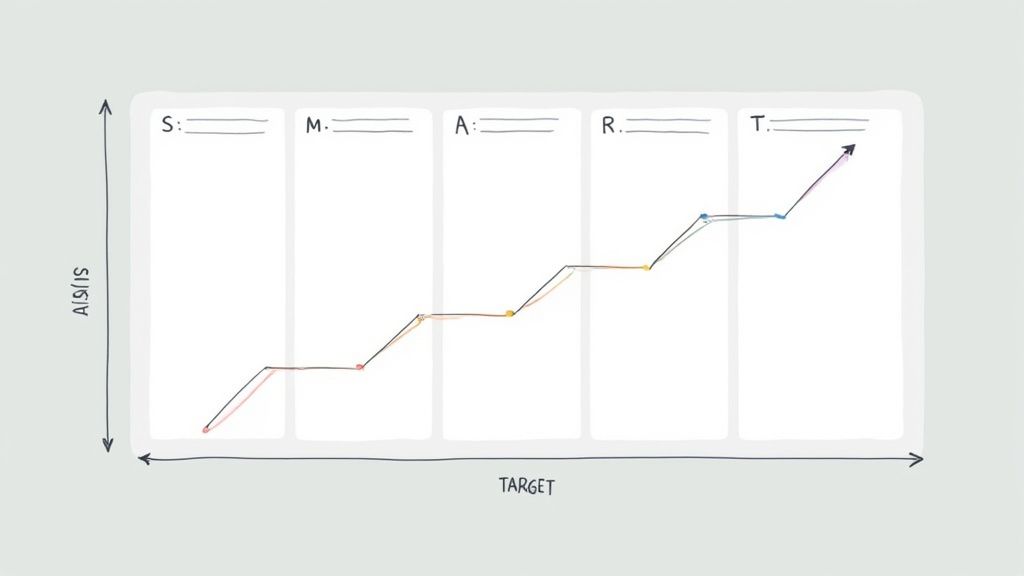
The SMART Goals PDP is built on a goal-oriented structure. This incorporates specific metrics, timeline-based milestones and deadlines, and regular progress tracking. Importantly, it emphasizes aligning personal development objectives with overall organizational goals, creating a synergistic approach to growth. This alignment is particularly helpful for startups and rapidly expanding companies where individual contributions have a direct impact on overall success. For example, a sales team member in a SaaS startup could set a SMART goal to increase their monthly recurring revenue by 15% within the next quarter, directly contributing to the company’s overall revenue targets.
Key Features and Benefits
- Goal-Oriented Structure With Specific Metrics: Instead of vague ambitions, this framework requires quantifiable targets.
- Timeline-Based Milestones and Deadlines: This encourages accountability and makes it easier to monitor progress.
- Regular Progress Tracking Mechanisms: Consistent check-ins and reviews ensure the plan stays on course.
- Alignment With Personal and Organizational Objectives: This connects individual growth with company success.
Pros and Cons of SMART Goals
Pros:
- Offers clear direction and accountability.
- Simple progress tracking and success measurement.
- Helps maintain focus on key development areas.
- Adaptable across various industries and career levels.
Cons:
- Can sometimes feel inflexible or too structured.
- May not accommodate unforeseen learning opportunities.
- Requires consistent review and adjustment to remain effective.
- Can overemphasize measurable results over qualitative growth.
Real-World Examples of SMART Goals in Action
- Google: Their OKR (Objectives and Key Results) system uses SMART goal principles, driving ambitious growth and innovation.
- Microsoft: Their performance development approach uses SMART frameworks for employee growth, creating a culture of continuous improvement.
- Education: Educational institutions using SMART PDPs for teacher development show the framework’s versatility.
Practical Tips For Implementing SMART Goals
- Review and adjust goals quarterly to stay relevant in changing environments.
- Include both short-term and long-term objectives to balance immediate needs with future aspirations.
- Ensure metrics are quantifiable and not subjective, offering concrete evidence of progress.
- Connect development goals to career advancement opportunities to increase motivation and engagement.
- For a broader view of organizational goal setting, check out: Our guide on the Strategic Planning Process.
The History and Rise of SMART Goals
The concept of SMART goals is rooted in the management theories of Peter Drucker. George Doran further developed the idea, coining the SMART acronym in 1981. Its adoption by major corporations like Intel, Google, and Microsoft solidified its position as a leading professional development methodology. The framework’s lasting popularity is due to its practicality and adaptability. It is a valuable tool for individuals and organizations, particularly in fast-paced sectors like SaaS, FinTech, and HealthTech where continuous development is essential for remaining competitive. For startups and SMBs working in these industries, a structured PDP like the SMART Goals framework can be essential for developing and maintaining a high-performing team.
2. 70-20-10 Learning & Development Model
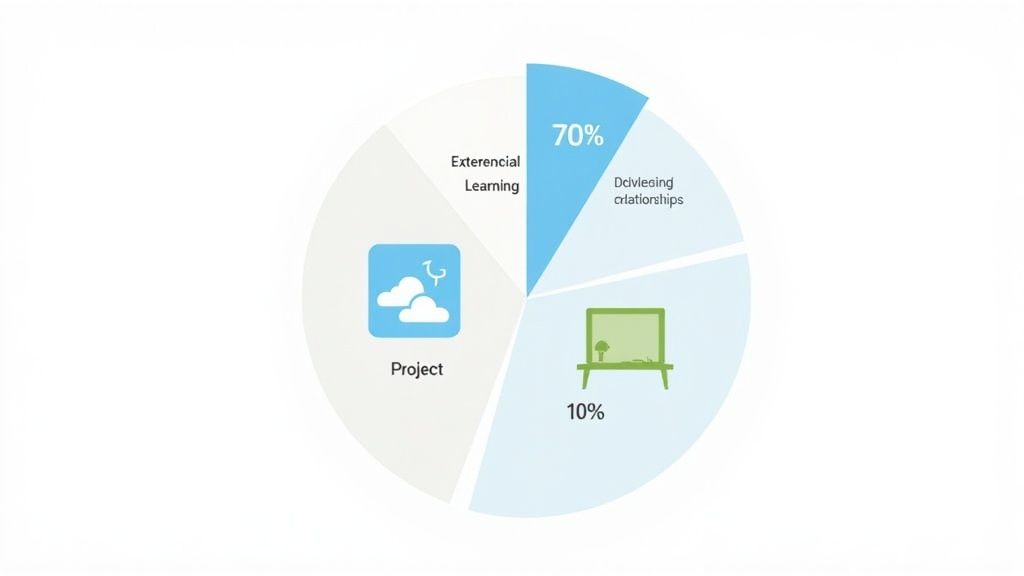
The 70-20-10 Learning & Development Model offers a practical and budget-friendly approach to professional growth. It’s particularly well-suited for startups, SMBs, and rapidly expanding companies in fast-paced sectors like SaaS, FinTech, and HealthTech.
This model suggests that 70% of learning stems from challenging experiences and on-the-job assignments. Another 20% comes from developmental relationships, such as mentoring and coaching. Finally, 10% is derived from formal coursework and structured training. This emphasis on real-world experience aligns with how professionals naturally develop expertise, making it a powerful tool for cultivating strong leadership pipelines.
Key Features & Benefits
- Experiential Learning (70%): This core element emphasizes learning by doing. Employees tackle challenging assignments and projects that stretch their abilities, allowing them to apply knowledge, hone problem-solving skills, and gain valuable hands-on experience.
- Developmental Relationships (20%): Mentorship, coaching, and feedback from peers and managers provide guidance and support. This nurtures knowledge transfer and encourages self-reflection, accelerating professional development.
- Formal Training (10%): Targeted training programs fill specific knowledge gaps and complement experiential learning. These might include workshops, online courses, or industry conferences, ensuring a well-rounded developmental approach.
Pros and Cons of the 70-20-10 Model
Understanding the advantages and disadvantages of this approach is key to successful implementation.
Pros:
- Cost-Effective: Reduces dependence on expensive formal training programs.
- Real-World Application: Encourages practical skill development in actual work scenarios.
- Promotes Knowledge Sharing: Fosters internal mentorship and collaborative learning.
- Natural Learning Process: Mirrors how professionals organically acquire and refine skills.
Cons:
- Varied Applicability: The 70-20-10 ratio is a guideline, not a rigid rule, and may not be suitable for all roles or industries.
- Organizational Support Required: Success hinges on a culture that supports challenging assignments, mentorship, and knowledge sharing.
- Difficult to Measure: Quantifying the impact of experiential learning can be a challenge.
- Challenges in Regulated Fields: Industries with strict certification requirements may find full implementation difficult.
Origins and Growth of the 70-20-10 Model
The 70-20-10 model originated from research conducted by Morgan McCall, Robert Eichinger, and Michael Lombardo at the Center for Creative Leadership. Their study of successful managers highlighted the significant role of experiential learning in professional development. Learning strategist Charles Jennings further popularized the model, championing its practical application in various organizational settings. Large organizations such as Coca-Cola, Nike, and Deloitte have successfully implemented variations of this model, demonstrating its effectiveness across diverse industries. Notable examples include General Electric’s leadership development programs, Goldman Sachs’ approach to training investment professionals, and Boeing’s emphasis on technical excellence through experience-based development.
Practical Implementation Tips
- Create a Project Inventory: Identify projects that offer rich learning opportunities for different roles and skill levels.
- Establish Formal Mentoring Programs: Pair employees with experienced mentors and establish clear development goals.
- Targeted Training: Select formal training programs that address specific skill gaps identified through experiential learning.
- Document Lessons Learned: Encourage employees to reflect on and document their experiences, capturing valuable insights and fostering a culture of continuous learning.
This model earns a spot on this list because it provides a flexible and adaptable framework for professional development. Its focus on practical experience and cost-effectiveness makes it especially appealing for startups and growing businesses looking to maximize their talent development investments. By prioritizing on-the-job learning, fostering mentorship, and strategically utilizing formal training, organizations can build high-performing teams and cultivate future leaders.
3. Competency-Based Development Plan
A Competency-Based Development Plan offers a structured approach to professional development. It focuses on specific skills and abilities, called competencies, needed for success. Unlike generic training, this model identifies key competencies, assesses current proficiency, and tailors activities to bridge the gap between current and desired capabilities. This is particularly effective for organizations maximizing development resources and individuals seeking career advancement.

How It Works
This model involves a systematic process:
- Competency Mapping and Assessment: Define the crucial competencies required for a specific role or organizational level. Then assess an individual’s current proficiency.
- Gap Analysis: Identify the discrepancies between current and required competency levels. This pinpoints areas needing development.
- Targeted Development Activities: Design specific activities aimed at bolstering specific competencies. These could include workshops, mentoring, on-the-job training, or stretch assignments.
- Progressive Proficiency Levels: Establish clear definitions for different levels of proficiency (e.g., beginner, intermediate, advanced). This allows for structured progress tracking and objective assessment.
Features and Benefits
- Detailed competency mapping and assessment: Provides a clear development roadmap.
- Gap analysis: Focuses resources on areas needing improvement.
- Targeted development activities: Ensures relevant and efficient skill-building.
- Progressive proficiency levels: Facilitates objective measurement of progress.
Pros and Cons
| Pros | Cons |
|---|---|
| Aligns development with organizational needs and strategic goals | Developing and maintaining competency frameworks can be resource-intensive. |
| Optimizes development resources for maximum impact | May struggle to adapt to rapidly evolving skill requirements and emerging competencies. |
| Creates transparent career progression paths | Some employees might find the structured approach rigid. |
| Enables objective assessment of capabilities | Requires regular updates to remain relevant to the changing industry landscape. |
Examples
- IBM’s Global Competency Model: Used for developing technical skills across the organization, ensuring consistent skill levels globally.
- Accenture’s Competency Framework: A multi-level framework used to guide consultant development and career progression, aligning skills with client needs.
- Healthcare systems using nursing competency models: Ensures nurses have the required skills and knowledge for safe and effective patient care, often tied to licensing and accreditation.
Tips for Implementation
- Involve Subject Matter Experts (SMEs): Engage experts to define relevant competencies for each role.
- Use Behavioral Indicators: Describe what each competency looks like in action, providing clear performance expectations.
- Create Targeted Development Resources: Develop learning materials and activities specifically designed to enhance each competency.
- Implement Regular Competency Assessments: Use multiple assessment methods, such as self-assessment, peer reviews, and manager feedback, for a holistic understanding of individual capabilities.
Historical Context and Popularity
Psychologist David McClelland pioneered the competency-based approach. He challenged the traditional focus on personality traits in favor of measurable skills and abilities. Organizations like SHRM and consulting firms like McKinsey and Deloitte further refined the model. The focus on demonstrable results and alignment with organizational strategy made it popular, offering businesses measurable ROI from development investments.
Why This Model Is Valuable
For startup founders, SMEs, and companies in dynamic industries like SaaS, FinTech, and HealthTech, a competency-based development plan provides a powerful tool for building high-performing teams. Its targeted approach ensures employees develop the precise skills needed for current roles and prepares them for future leadership positions. This structured approach is especially valuable in fast-paced environments, allowing companies to develop the talent they need to stay competitive.
4. Individual Development Plans (IDPs)
An Individual Development Plan (IDP) is a personalized document created collaboratively by an employee and their manager. Think of it as a roadmap outlining specific development goals, the resources required to achieve them, a clear timeline, and how success will be measured. Unlike generic training programs, an IDP balances the needs of the organization with the individual’s career aspirations. Regular reviews ensure the plan stays relevant and effective, adapting to changes and new opportunities.

IDPs are vital for businesses looking to cultivate top talent, especially in fast-paced industries like SaaS, FinTech, and HealthTech. For startups and SMEs, IDPs offer a cost-effective method for nurturing leadership from within. By fostering growth and providing a clear path for advancement, IDPs boost employee engagement and retention, a significant advantage in a competitive job market.
Features of a Successful IDP
- Collaborative Development: The manager and employee work together to create the IDP, ensuring the employee feels ownership and is invested in the process.
- Personalization: The plan focuses on the individual’s strengths, weaknesses, and career goals, making it relevant and motivating.
- Balanced Approach: It addresses both immediate needs for improving current performance and long-term career aspirations.
- Regular Reviews: Consistent check-ins (e.g., quarterly or bi-annually) keep the plan aligned with business needs and individual progress.
Pros of Implementing IDPs
- High Employee Ownership and Engagement: Employees are more invested when they actively participate in shaping their development.
- Adaptability: IDPs can be adjusted as new opportunities or challenges arise.
- Integrated Development: They connect performance improvement with career advancement.
- Enhanced Communication: Regular reviews encourage ongoing dialogue between employees and managers.
Cons of Implementing IDPs
- Manager Dependence: A successful IDP depends heavily on the manager’s commitment.
- Risk of Compliance Exercise: Without genuine engagement, IDPs can become just another bureaucratic process.
- Time Investment: Developing and maintaining effective IDPs requires time from both employees and managers.
- Strategic Alignment: IDPs need to be properly integrated to connect with broader organizational strategies.
Real-World Examples
- Adobe: Their “Check-in” system, resembling a continuous IDP process, replaced traditional performance reviews with ongoing development conversations.
- NASA: Uses a structured IDP process for technical and leadership development.
- Johnson & Johnson: Implements a development planning approach for healthcare professionals focused on continuous learning.
Tips for Effective IDP Implementation
- Self-Assessment: Start with an honest self-assessment of strengths and areas for development.
- Balanced Goals: Include both short-term achievable goals and long-term aspirations.
- Dedicated Check-ins: Schedule regular meetings specifically to discuss development progress.
- Document Everything: Keep track of both formal learning and on-the-job skill application.
Origins and Popularization
The U.S. Office of Personnel Management pioneered IDPs within government sectors. The Association for Talent Development (ATD) further promoted their use. Leading tech companies like Amazon and Microsoft have integrated IDPs into their performance management systems, demonstrating their value in driving employee growth and organizational success. This widespread adoption has made IDPs a proven talent development strategy for organizations of all sizes.
5. Leadership Development Roadmap
A Leadership Development Roadmap is a structured, long-term plan for cultivating leadership skills throughout your organization. It goes beyond simply training managers; it’s about building a pipeline of future leaders equipped to handle the specific challenges of your industry, whether it’s SaaS, FinTech, HealthTech, or any other sector. This proactive strategy identifies essential leadership competencies, offers progressive development opportunities, and prepares high-potential employees for future leadership roles. It’s a core component of any successful professional development plan.
This multi-level approach benefits everyone, from emerging leaders to seasoned executives. It combines formal training programs with personalized coaching and, most importantly, hands-on, practical experience. Many roadmaps also incorporate assessment center elements to objectively evaluate leadership potential and align these assessments with succession planning. This ensures smooth leadership transitions and maintains organizational continuity, a crucial factor for startups and growing businesses.
A well-implemented Leadership Development Roadmap offers numerous advantages. It establishes a clear leadership pipeline, offering a structured development path for high-potential employees. This demonstrable investment in employee growth is a powerful retention tool, particularly in competitive industries. It also fosters consistent leadership practices across the organization, contributing to a unified company culture and more effective strategic execution.
However, developing a strong leadership development program isn’t without its difficulties. Implementing a comprehensive roadmap can be expensive and require significant resources. There’s also the risk of inadvertently creating perceived “in-groups” and “out-groups” if not managed carefully. And while the long-term benefits are substantial, seeing a full return on investment can take time. Sustained executive sponsorship and commitment are crucial for success.
Real-World Examples and Practical Tips
Real-world success stories abound. General Electric’s renowned leadership center at Crotonville has long been a benchmark for executive development. Procter & Gamble’s “Build from Within” strategy demonstrates a commitment to nurturing internal talent. Unilever’s leadership development framework, with its focus on sustainability, showcases how these programs can integrate core organizational values.
For more in-depth information on developing effective programs, you might be interested in: Our guide on Leadership Development Strategies.
To maximize the impact of your own Leadership Development Roadmap, consider these practical tips:
- Action Learning Projects: Give participants projects with real business impact, allowing them to apply their learning in practical scenarios.
- Diversity and Inclusion: Ensure diverse representation in leadership development cohorts to cultivate a range of perspectives and experiences.
- Executive Mentoring: Pair high-potential employees with senior leaders for guidance and insights.
- Practice Opportunities: Create chances for individuals to practice leadership skills before formal promotion, such as leading project teams or taking on stretch assignments.
The concepts behind leadership development roadmaps have been explored by experts like Ram Charan, a renowned leadership consultant, and John Maxwell, a prolific leadership author and speaker. Organizations like the Center for Creative Leadership have also made significant contributions to the research and understanding of effective leadership development. A Leadership Development Roadmap is a valuable asset in any professional development plan. It provides a strategic framework for cultivating leadership talent, essential for long-term organizational success, especially for startups and SMBs looking to scale and compete effectively. It offers a structured, measurable approach to developing leaders, ensuring your organization has the right people in the right roles at the right time.
6. Technical Skills Mastery Plan
A Technical Skills Mastery Plan focuses professional development on cultivating deep expertise in a specific technical area. This is critical for individuals and organizations in fast-paced fields like SaaS, FinTech, and HealthTech. It provides a structured way to acquire and maintain crucial skills, ensuring professionals stay competitive and contribute to innovation.
These plans typically use a progressive framework, starting with foundational concepts and advancing to complex applications. Hands-on projects and assignments are key, allowing practical application and reinforcing learned concepts. Many plans incorporate industry certifications, offering recognized credentials that validate expertise and demonstrate a commitment to professional growth. Communities of practice and mentoring further enrich learning and knowledge sharing.
Features of a Technical Skills Mastery Plan
- Progressive technical skill acquisition framework: Structured learning from beginner to expert.
- Hands-on projects and assignments: Practical application of skills in realistic scenarios.
- Industry certification integration: Opportunities to obtain valuable credentials.
- Communities of practice for knowledge sharing: Collaborative platforms and peer learning.
- Technical mentoring components: Guidance from experienced professionals.
Pros of a Technical Skills Mastery Plan
- Creates valuable specialized expertise: Develops in-demand skills.
- Provides clear path to technical mastery: A structured journey for professional growth.
- Often includes recognized industry credentials: Improves credibility and marketability.
- Supports innovation and problem-solving: Equips professionals to tackle complex issues.
Cons of a Technical Skills Mastery Plan
- Risk of obsolescence: Requires continuous learning and adaptation.
- May create narrow specialists: Important to balance technical depth with broader business knowledge.
- Can be expensive: Requires investment in ongoing training and resources.
- Sometimes lacks leadership development integration: Technical skills should be paired with leadership skills.
Examples of Technical Skills Mastery Plans
- Microsoft’s internal technical development programs
- Cisco’s certification and specialization tracks
- Amazon Web Services’ technical professional development framework
Tips for Implementing a Technical Skills Mastery Plan
- Dedicate time for practice: Consistent effort is essential for mastery.
- Join technical communities: Network with peers and keep up with industry trends.
- Create practical projects: Reinforce learning through real-world applications.
- Balance depth with breadth: Avoid over-specialization and maintain a wider perspective.
Popularity and Evolution
Structured technical development has been popularized by companies like Google, known for their internal training programs. Professional organizations like IEEE and training platforms like Pluralsight and Coursera also promote and offer access to skill development resources. This approach has shifted from ad-hoc training to structured programs with defined paths and credentials.
Value for Organizations
A Technical Skills Mastery Plan is essential for attracting and retaining technical talent in dynamic industries. It provides a framework for continuous development, ensuring employees have the skills to innovate and maintain a competitive edge. This is crucial for executives who must understand emerging technologies and effectively lead their teams. By implementing such a plan, companies show commitment to employee growth and build a culture of continuous learning, becoming more attractive to potential hires and nurturing a high-performing workforce.
7. T-Shaped Professional Development Plan
The T-shaped professional development plan is a robust method for developing well-rounded and adaptable team members and leaders. It emphasizes deep expertise in a core area (the vertical bar of the T) while also promoting a broad understanding of related fields (the horizontal bar). This produces individuals capable of leading in their specialization and collaborating across different departments, a valuable asset in today’s interconnected business world. This is especially helpful for startups, SMBs, and fast-paced industries like SaaS, FinTech, and HealthTech, where agility and cross-functional teamwork are essential.
Understanding the T-Shaped Professional
A T-shaped professional possesses a valuable combination of specialized and general skills. They are not only experts in their own domain but also understand the perspectives of other departments. This allows them to bridge communication gaps and create integrated solutions. The approach fosters a holistic, systems-thinking mindset essential for addressing complex business problems.
Features of a T-Shaped Development Plan
- Deep Expertise Development in Primary Specialty: This is the base of the “T.” Individuals are encouraged to achieve mastery in their chosen field through focused training, on-the-job experience, and continuing education.
- Deliberate Exposure to Adjacent Disciplines: The horizontal bar of the “T” is developed by actively pursuing opportunities to learn about related fields. This could involve shadowing colleagues in other departments, participating in cross-functional training, or attending industry events outside of one’s core specialization.
- Cross-Functional Project Opportunities: Taking part in projects that involve multiple departments provides practical experience and strengthens collaboration skills.
- Collaborative Skill Development: Active listening, clear communication, negotiation, and conflict resolution are essential skills for T-shaped professionals to collaborate effectively with diverse teams.
- Systems Thinking Perspective: Understanding how different parts of an organization interact and contribute to overall goals is crucial for successful cross-functional collaboration and strategic decision-making.
Pros of T-Shaped Development
- Creates Versatile Professionals: T-shaped individuals can adapt to evolving business needs and contribute to diverse projects.
- Balances Specialist Knowledge with Broader Perspective: This prevents siloed thinking and promotes more innovative solutions.
- Enhances Innovation through Cross-Disciplinary Insights: Combining different perspectives often leads to breakthroughs.
- Prepares Employees for Complex Modern Workplace Challenges: The ability to navigate uncertainty and collaborate effectively is increasingly valuable.
Cons of T-Shaped Development
- Challenging to Balance Depth and Breadth: Careful planning and prioritization are needed to avoid becoming a generalist without a core strength.
- May Result in Less Specialized Expertise: This can be a concern in highly technical fields where deep specialized knowledge is paramount.
- Requires Diverse Learning Opportunities: Companies need to invest in cross-functional training and development programs.
- Can Be Difficult to Measure Progress in Breadth Areas: Evaluating knowledge and skills outside of one’s core area requires thoughtful evaluation methods.
Real-World Examples
- IDEO: Known for human-centered design, IDEO cultivates T-shaped designers with deep design expertise and broad knowledge in areas like business, technology, and social sciences.
- McKinsey: Their consultant development model focuses on building both deep industry knowledge and functional expertise in areas like strategy, operations, or marketing.
- Spotify: Known for its autonomous engineering culture, Spotify develops T-shaped engineers with deep technical skills and broader knowledge of product development, user experience, and business strategy.
Tips for Implementing a T-Shaped Development Plan
- Identify your core specialty and invest in mastering it. This is the foundation of your “T.”
- Seek opportunities in related functions for broader exposure. Shadow colleagues or work on projects outside your core area.
- Participate in cross-functional project teams. Practical experience is crucial for developing collaborative skills and expanding your perspective.
- Develop a professional network across various disciplines. Connect with professionals from different departments and industries to gain insights from their experience.
Evolution and Popularization
While the concept of “T-shaped skills” emerged in 1991 through David Guest, it gained wider recognition through the work of Tim Brown, CEO of IDEO. Brown championed the idea of T-shaped designers. The model has been adopted by innovative tech companies like IBM and Google, and its importance continues to grow in today’s increasingly complex and interconnected business environment. For startups, SMBs, and companies in dynamic industries, building a team of T-shaped professionals can be a key differentiator and a driver of success.
8. Career Lattice Development Plan
Traditional career paths often resemble a ladder, climbing rung by rung toward promotions. A career lattice development plan, however, offers a more dynamic and multi-directional approach. This model prioritizes diverse experiences, skill development, and adaptability, rather than focusing solely on upward movement. Think of it as navigating a lattice, exploring various paths: lateral moves, stretch assignments, cross-functional projects, and, yes, even traditional promotions. This approach is especially valuable in today’s ever-changing job market, cultivating well-rounded professionals equipped to handle complex challenges.
A key characteristic of a career lattice is its emphasis on multi-directional career mapping. This means career progression can be vertical (promotions), lateral (different roles at the same level), or diagonal (a combination of both). Experiencing diverse roles becomes a core development principle. Role rotations and cross-functional assignments provide opportunities to acquire a broader skill set. The focus shifts to skill acquisition over title advancement, allowing individuals to build a unique and valuable skill set. A career lattice also allows for personalized path definition, recognizing that individual career goals and aspirations differ.
The benefits of a career lattice structure are numerous. It offers multiple avenues for growth beyond traditional promotions, revealing opportunities not visible on a linear career path. It develops well-rounded professionals with varied experiences, making them more adaptable and valuable assets. A career lattice also fosters organizational flexibility and knowledge sharing as individuals move between roles and departments. Importantly, it accommodates different life stages and priorities, acknowledging that upward trajectory isn’t everyone’s primary goal.
Implementing a career lattice, however, also presents challenges. It may seem less structured than traditional career paths, potentially creating confusion or uncertainty for some. It can be difficult to convey the value of lateral moves, especially in organizations with a strong hierarchical focus. Successful implementation requires significant organizational support and a suitable culture, including systems for recognizing and rewarding diverse experiences. Finally, it might delay upward movement within a traditional hierarchy, a potential concern for those focused on climbing the corporate ladder.
Real-world examples showcase the effectiveness of the career lattice model. Deloitte, a pioneer in this area, uses a career lattice approach for its consulting professionals, providing diverse growth and development opportunities. Cisco’s internal mobility program encourages employees to explore different career paths within the company, fostering a culture of continuous learning and adaptability. PepsiCo also leverages experience-based development across its various brands and functions, allowing employees to gain a broad understanding of the business.
To effectively navigate a career lattice, consider these tips: Prioritize skill development over title advancement, seeking projects outside your comfort zone. Network across multiple departments to broaden your connections and gain exposure to different areas of the business. Crucially, document how diverse experiences contribute to your unique value proposition, showcasing your versatility and adaptability to potential employers or within your current organization. You might be interested in: Our guide on a Talent Management Framework.
The career lattice concept, popularized by Cathy Benko and Molly Anderson, authors of The Corporate Lattice, along with Deloitte’s workforce transformation experts and HR leaders at companies like AT&T and Mastercard, is crucial for startup founders, SMBs, and companies in fast-paced industries. A career lattice framework attracts and retains top talent by offering diverse growth opportunities, creating a more agile and resilient workforce. This is particularly relevant for organizations seeking cost-effective leadership solutions and flexible, part-time executive roles, aligning with the dynamic needs of the modern business environment.
8-Model Professional Development Plan Comparison
| Plan Title | 🔄 Implementation Complexity | ⚡ Resource Requirements | 📊 Expected Outcomes | 💡 Ideal Use Cases | ⭐ Key Advantages |
|---|---|---|---|---|---|
| SMART Goals Professional Development Plan | Moderate due to a structured approach and regular reviews | Low-Medium with periodic check-ins | Clear, measurable progress and accountability | Goal-oriented roles and environments focused on measurable goals | Clear direction, accountability, and adaptability |
| 70-20-10 Learning & Development Model | Moderate complexity balancing experiential, relational, and formal learning | Low-Moderate; leverages on-the-job experiences | Real work application and natural learning progression | Organizations valuing hands-on experience and mentoring | Reflects natural learning, cost-effectiveness, and collaborative growth |
| Competency-Based Development Plan | High; in-depth mapping and gap analysis requires detailed planning | High; demands substantial investment in frameworks and assessments | Measurable competency growth and targeted skills development | Organizations focused on precise skill-building and objective measurement | Targeted development with clear career progression paths |
| Individual Development Plan (IDP) | Moderate; requires collaborative planning between employee and manager | Moderate; involves consistent time investment and follow-ups | Tailored career growth with continuous performance improvement | Environments emphasizing personalized guidance and employee engagement | High engagement, personalized objectives, and adaptable implementation |
| Leadership Development Roadmap | High; multi-level planning with executive sponsorship and ongoing reviews | High; significant investment in specialized training and succession plans | Structured leadership pipeline and strategic long-term growth | Organizations focused on leadership succession and developing high-potential talent | Clear leadership pipeline and comprehensive, strategic development |
| Technical Skills Mastery Plan | Moderate-High; specialized framework with iterative skill enhancements | High; continuous learning, certifications, and practical projects | Mastery in technical skills with recognized industry credentials | Technical roles in fast-evolving, innovation-centric fields | Deep specialization, industry credentials, and clear technical pathways |
| T-Shaped Professional Development Plan | Moderate; balancing deep expertise with cross-disciplinary exposure | Moderate; requires diverse learning opportunities across various functions | Versatile skillset combining depth in one area with broad functional insights | Teams needing interdisciplinary collaboration and innovative problem solving | Balanced expertise with cross-functional insights and adaptability |
| Career Lattice Development Plan | Moderate-High; non-linear mapping across multiple career directions | Moderate-High; depends on strong organizational support for diverse roles | Broad exposure with adaptive, varied career growth | Organizations promoting flexible, non-traditional career trajectories | Multiple growth paths and well-rounded, diversified development |
Chart Your Course to Success
These professional development plan examples – from SMART goals and the 70-20-10 model to competency-based and T-shaped plans – offer a starting point for charting your course toward career advancement. Whether you’re focusing on leadership development, technical skills mastery, or navigating a career lattice, choosing the right model and adapting it to your specific needs is crucial.
Remember, continuous growth is a dynamic process. Embrace lifelong learning, actively seek opportunities for development, and remain adaptable. The professional landscape is constantly changing, with trends like remote work, AI integration, and data-driven decision-making becoming increasingly prevalent. Staying informed about these developments and incorporating relevant skills into your development plan will be essential for future success.
Key Takeaways:
- Define clear, measurable goals: Use frameworks like SMART goals to ensure your development efforts are focused and effective.
- Embrace diverse learning methods: The 70-20-10 model highlights the importance of experiential learning alongside formal training and mentoring.
- Focus on core competencies: Identify the key skills and knowledge required for your desired role or career path.
- Personalize your plan: Adapt the examples provided to align with your individual strengths, weaknesses, and aspirations.
- Remain adaptable: The professional world is constantly changing, so continuous learning and adaptation are essential for long-term success.
Building a strong leadership team is crucial for any organization’s growth, especially for startups navigating the challenges of rapid scaling. Finding and retaining top-tier executive talent can be costly and time-consuming, often requiring extensive networks and resources.
Are you seeking experienced executives to drive growth in your startup or SME? Do you need cost-effective, flexible leadership solutions in SaaS, FinTech, HealthTech, or other dynamic industries? Shiny offers a unique fractional executive marketplace connecting you with vetted executives for 5 to 25 hours a week.
Gain access to a pool of over 650 experienced professionals across 40+ industries, streamlining your executive hiring process and saving you time and money. Start building your dream team today and experience the power of fractional leadership with Shiny: Shiny