Reverse Merger Meaning Explained and How It Compares to IPOs
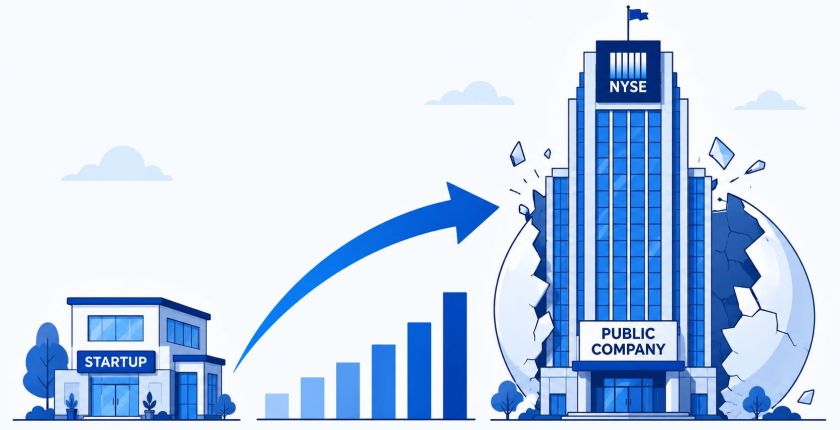
A reverse merger is when a private company becomes public by merging into an already-public shell company instead of completing a traditional IPO. In the United States, the structure has faced heightened regulatory oversight, including stricter listing standards approved in November 2011 after trading was suspended in six reverse-merger entities.
You may be in the position many growth-stage founders eventually reach. The business is scaling, private investors want liquidity, and public stock could support hiring, acquisitions, or future fundraising. Yet a traditional IPO can demand extensive preparation, management attention, and market timing. A reverse merger may look like a shortcut, but it's better understood as a change in public-company status followed by a demanding compliance program.
What Reverse Merger Meaning Really Covers for Founders
Suppose your company is growing, investors want a path to liquidity, and a public stock could support hiring or acquisitions. A reverse merger may appear to offer a faster route than a traditional IPO. The trade-off is that the work shifts. Instead of concentrating the process before an IPO, you inherit a public company and then face an intensive compliance program.
A reverse merger combines a private operating company with a publicly traded shell company. The shell generally has little or no active business, but it already exists as a public entity. Shareholders of the private company typically receive shares in the combined company, while its founders and executives take control of the board and operations. The outcome is a public company organized around the existing operating business, rather than a newly registered offering led by an underwriter.
The shell resembles a partly built public-market vehicle. It may offer an existing corporate structure, reporting history, and trading identity. It may also contain liabilities, incomplete filings, ownership disputes, or reputational baggage. A founder's first question should be whether the shell is clean enough for the operating company to inherit its public identity.
Founder perspective: A reverse merger can shorten the route to public status, but it does not shorten the responsibility of running a public company.
The meaning also extends beyond the transaction itself. Public-market value and operating-company value are different measures, so founders need to examine ownership, control, dilution, and the combined entity's enterprise value. That distinction helps prevent a public vehicle's quoted value from being mistaken for the underlying business's value.
The SEC describes reverse mergers as a distinct route to becoming public, rather than an ordinary acquisition. Its SEC reverse-merger investor bulletin explains the shell-company structure and discusses regulatory concerns involving reporting accuracy and audit reliability. For founders, that means the deal is also a compliance-heavy recapitalization. The post-closing Super 8-K, ongoing reporting, and listing-seasoning requirements can shape the timetable and financing plan.
Before signing, ask:
- What exactly are we acquiring? Public status, a reporting history, a trading symbol, or unresolved problems?
- Can our finance team support public reporting? The company will need recurring disclosures, controls, audits, and governance processes.
- Where will new capital come from? Public status does not automatically provide operating cash.
- Who owns the process? A fractional CFO, general counsel, or public-company operations lead can coordinate diligence, disclosure, controls, and the Super 8-K before the deal begins.
The practical question is whether the company can carry these obligations after closing. A capable fractional executive team can expose gaps early, assign owners, and determine whether faster public status justifies the compliance burden.
How a Reverse Merger Works Behind the Scenes
The easiest analogy is moving into a pre-built house. The public shell supplies the address, legal structure, and public-market history. The private company supplies the occupants, operating systems, customers, employees, and business model. Before moving in, the buyer must inspect the house carefully. A fresh coat of paint doesn't reveal old liens, broken plumbing, or structural damage.
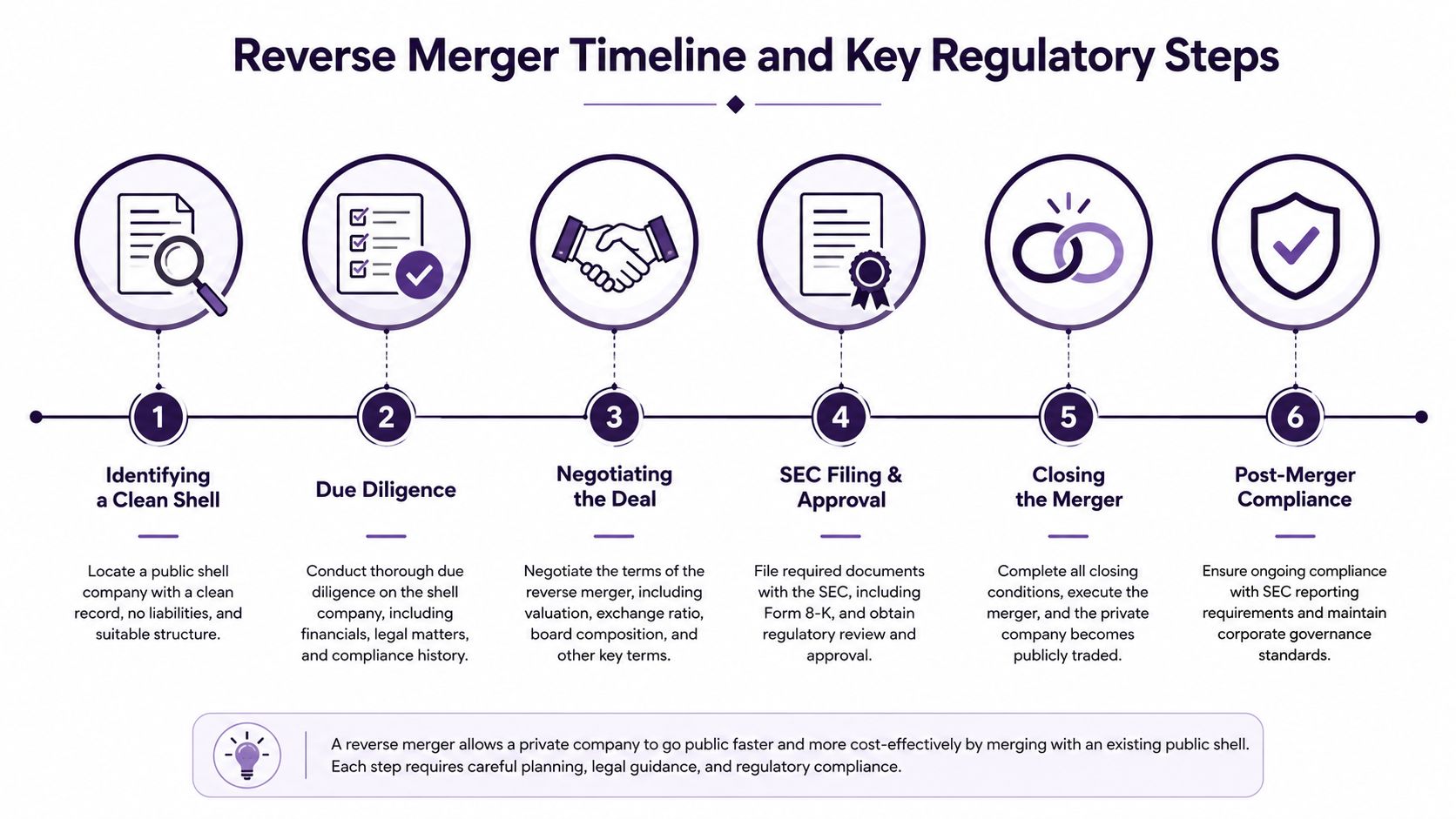
The transaction commonly follows this logic:
- Identify a public shell. The private company looks for a publicly traded entity with limited operations.
- Investigate the shell. Counsel and finance professionals review filings, liabilities, ownership records, and corporate history.
- Negotiate the combination. The parties agree on ownership, governance, representations, protections, and closing conditions.
- Exchange shares. The private company's shareholders receive shares in the public entity.
- Transfer control. The operating company's leadership and business become the center of the combined company.
- Complete post-deal disclosure. The new public company reports the transaction and provides detailed information about the operating business.
The accounting and disclosure treatment creates an important distinction. The SEC treats many reverse-merger outcomes as a reverse recapitalization in substance, rather than a normal business combination. That classification affects how the company presents the transaction, historical financial statements, ownership, and the continuing business in its filings (SEC guidance on reverse recapitalizations and shell companies).
A company that stops being a shell must prepare a rapid post-deal disclosure package. That package includes historical financial statements and Form 10-level information, so the transaction isn't a paperwork-free alternative to an IPO. The reporting burden arrives on a different schedule and requires accurate records from the private business.
Why the recapitalization label matters
In a conventional acquisition, the buyer generally acquires another operating business and records the purchase under acquisition-accounting principles. In a reverse recapitalization, the private operating company is often treated as the accounting acquirer even though the public shell remains the legal entity.
That difference affects:
- Historical presentation, including which company's financial history appears as the continuing business.
- Shareholder ownership, because the private company's owners generally control the combined entity.
- Disclosure timing, since the public company must quickly describe the operating business.
- Audit preparation, because incomplete records can delay filings and invite regulatory questions.
Founders should therefore avoid describing the transaction internally as “just buying a public shell.” The legal combination may be straightforward, but the accounting identity and disclosure package determine whether the new public company can explain itself credibly to regulators and investors.
Reverse Merger Timeline and Key Regulatory Steps
A reverse merger moves through connected workstreams rather than one single closing event. The fastest path depends less on signing quickly than on having the private company's records, governance, audits, and disclosure materials ready before the shell is selected.
First, screen the shell
Start with the shell's public filings, corporate records, ownership history, liabilities, and trading background. A clean shell should withstand scrutiny from securities counsel, auditors, transfer agents, and the future listing venue.
Review:
- SEC filing history: Look for missing, inconsistent, or unresolved disclosures.
- Cap table: Reconcile issued shares, outstanding instruments, control positions, and shareholder records.
- Liabilities: Investigate tax, litigation, contractual, and regulatory exposure.
- Corporate authority: Confirm that prior issuances, board actions, and governance records are properly documented.
- Trading history: Check whether the shell's history could create questions for brokers, regulators, or future investors.
Then negotiate and close
After diligence, the parties negotiate the merger agreement. Ownership percentages, board composition, officer appointments, indemnification, escrow, conditions to closing, and treatment of existing securities all deserve specific attention.
Shareholder approval may be required for both companies, depending on state law, organizational documents, and the chosen structure. Once approvals and closing conditions are satisfied, the parties execute the share exchange and appoint the new leadership team.
The first filing deadline is immediate
The company must file a Form 8-K within four business days of closing. That filing announces the transaction and begins the public explanation of what changed. The later disclosure package must provide the operating company's financial and business information in much greater depth.
Nasdaq's Rule 5110 creates a separate hurdle for companies formed through a reverse merger. The company must trade for at least one year after the transaction in the U.S. OTC market, another national exchange, or a regulated foreign exchange. It must also have a qualifying closing share price for at least 30 of the most recent 60 trading days before satisfying the stated listing conditions (Nasdaq Rule 5110 listing conditions).
That seasoning requirement can change the founder's decision. A company may become public before it can access the desired national exchange, so the team must plan for reporting, investor communications, and capital formation during the interim period.
The transaction closes on one date. The public-company work continues long after it.
Advantages and Risks Every Startup Should Weigh
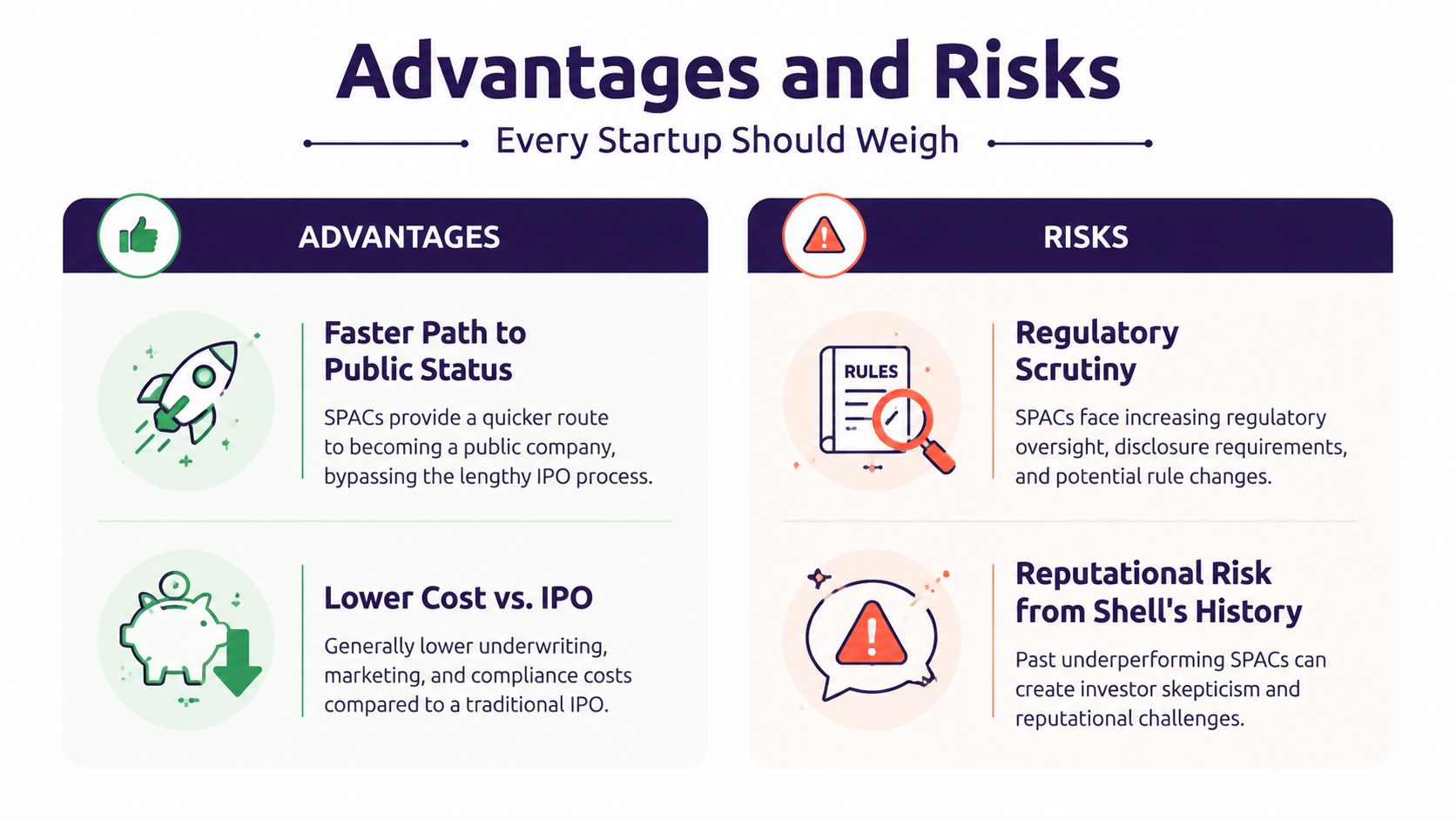
A founder may choose a reverse merger after an IPO window becomes difficult to use, while still wanting public-company status. The route can offer more direct negotiation with a specific public vehicle, but it is not a lighter version of going public. It is a compliance-heavy recapitalization followed by continuing disclosure, governance, and market-readiness work.
The potential advantages are practical:
- Speed and control: The parties negotiate directly, which can give management more influence over timing, ownership terms, and transaction structure.
- Less IPO-specific friction: The process may avoid a traditional roadshow and underwriting process, although it still requires substantial legal, accounting, and disclosure work.
- Timing flexibility: A bilateral merger does not depend on completing a public offering at one particular market moment.
- Separate financing choices: The company can arrange a private placement or another financing separately, instead of treating listing and fundraising as one event.
- Founder ownership: The operating company's shareholders may retain control when the exchange ratio and governance terms support that outcome.
Those benefits shift the burden rather than remove it. Founders should treat the merger like changing the vehicle while keeping responsibility for the entire journey. The public shell's history, the operating company's records, and the post-closing reporting plan all matter.
The risks that affect the operating business
A shell can carry prior liabilities, shareholder history, unresolved filings, and trading restrictions. Even an inactive-looking shell may require the new company to explain its public record clearly. A careful review should cover corporate records, securities issued in the past, outstanding obligations, and the condition of required filings.
Public status also does not guarantee cash. The company may complete the transaction without receiving meaningful capital, so working capital and future financing need their own plan.
Other risks include:
- Regulatory scrutiny: Reverse mergers can receive close attention because the structure does not follow the traditional IPO review sequence.
- Liquidity uncertainty: A listing does not ensure active trading, analyst coverage, or institutional demand.
- Reputation risk: Investors may connect the structure with earlier problem transactions, even when the current company has sound controls.
- Post-merger dilution: Financing, legacy shell securities, and negotiated ownership can change the expected cap table.
- Management distraction: Public-company disclosures can pull founders away from customers, product, and operations.
A further hurdle is listing seasoning. As noted earlier, tougher standards adopted in November 2011 require some companies that became public through reverse mergers to establish a trading record and meet additional listing conditions before qualifying for an exchange. That history is why reviewers may examine audit quality, ownership, internal controls, and reporting discipline closely.
The Super 8-K is another practical checkpoint. It turns the transaction into a detailed public account of the operating company, so missing records or weak financial controls can become visible after closing. A fractional CFO, controller, legal lead, or compliance executive can coordinate the work, assign owners to each disclosure, and keep the founder focused on decisions rather than document chasing.
The decision test is straightforward. A company seeking only a faster ticker, without readiness for public reporting, may create more risk than value. A company with reliable records, credible governance, a separate capital plan, and executives assigned to the compliance workload can evaluate the structure on its actual trade-offs.
Reverse Merger vs IPO vs SPAC Comparison
These routes all can lead to public ownership, but they solve different problems. A traditional IPO combines registration, investor marketing, underwriting, and fundraising. A reverse merger combines an operating company with an existing public shell. A SPAC uses a purpose-built public vehicle that generally raises capital before seeking an operating-company combination.
The right choice depends on the company's cash needs, investor base, desired exchange, control objectives, and readiness for public reporting.
Choosing Your Path to Public Markets
| Criteria | Reverse Merger | Traditional IPO | SPAC |
|---|---|---|---|
| Primary mechanism | Merge with an existing public shell | Register shares and sell them through a public offering | Merge with a public acquisition vehicle |
| Capital at listing | Not inherent in the merger, separate financing may be needed | Capital is raised through the offering | The vehicle may provide trust capital, subject to transaction terms and investor decisions |
| Underwriter role | Not central to the merger structure | Central to pricing, distribution, and offering execution | Sponsors, advisers, and financing participants shape the transaction |
| Review sequence | Significant disclosure and compliance work follows closing | Registration and offering review precede the listing | Shell-combination rules and transaction filings apply |
| Control | Private-company shareholders may control the combined entity | Existing owners negotiate offering dilution and governance | Sponsor economics and target-company ownership both affect control |
| Exchange path | May begin outside a national exchange and face seasoning conditions | Often designed around a national-exchange listing | Commonly structured around an exchange-listed acquisition vehicle |
| Fundraising fit | Better suited to companies that can arrange capital separately | Strong fit when raising capital is central to the listing | Useful when the transaction is designed to combine listing and financing |
| Main execution risk | Shell history, disclosure readiness, and post-closing compliance | Market timing, pricing, investor demand, and offering execution | Sponsor terms, investor redemptions, valuation, and transaction disclosure |
A SPAC isn't a faster version of a classic shell transaction. The SEC's 2024 final rules, including Rule 145a, were designed to cover shell-company business combinations used to convert a private company into a public company, including combinations that have the substance of a shell-company conversion (analysis of the SEC's 2024 SPAC and shell-company rules).
That regulatory treatment matters because labels can hide structural similarities. A founder should examine the actual transaction, the disclosures required, the source of capital, the exchange conditions, and the ownership outcome instead of relying on marketing language such as “backdoor IPO.”
Choose a traditional IPO when capital formation, institutional validation, and a national exchange are central and the company can support the preparation process. Consider a SPAC when the sponsor relationship, financing structure, and target-company narrative justify that route. Evaluate a reverse merger when public status and transaction flexibility matter, but only if the company can fund and manage the compliance obligations that follow.
Real World Reverse Merger Examples and Lessons
Reverse mergers have been a recognizable capital-markets pathway for decades. Academic research counted 5 reverse mergers in 1995, 4 in 1996, 14 in 1997, and 3 in 1998, with the figures representing 7.81%, 6.25%, 21.88%, and 4.69% of that study's sample, respectively (Harvard Business Law Review analysis of reverse-merger seasoning).
Those figures show repeated use in the U.S. market by the late 1990s. They don't prove that the structure works for every company. They show that founders and investors have used it long enough for regulators, exchanges, auditors, and courts to develop specific expectations.
The SEC's later enforcement history provides the harder lesson. By 2011, the agency had documented trading suspensions in six reverse-merger companies. The problem wasn't the existence of a merger mechanism. The problem was whether public companies could support reliable reporting, credible audits, and investor protection after taking that route.
What the history teaches founders
A strong public vehicle can't compensate for weak operating-company controls. Founders should treat the following as essential preparation areas:
- Audit quality: Financial statements must withstand regulator and investor review.
- Ownership clarity: The cap table should explain who owns what and why.
- Disclosure discipline: Management needs a repeatable process for identifying and reporting material information.
- Shell diligence: The public entity's past can become the combined company's present.
- Investor communication: A new public company must explain its business, risks, governance, and financing plans clearly.
Post-merger integration also matters. The operating company must absorb public-company calendars, controls, board processes, reporting responsibilities, and communications routines without losing operational focus. Guidance on merger and acquisition integration is useful because the work extends beyond legal closing. The leadership team must integrate systems, decision rights, people, and accountability.
The enduring lesson is that the shell is only the platform. Investors ultimately judge the operating business and the team's ability to manage public-company obligations.
Startup Checklist and How Fractional Executives Help You Go Public
A founder doesn't need every public-company capability on staff before evaluating a reverse merger, but the gaps must be visible and assigned. A practical readiness review should cover:
- Shell diligence: Confirm filing history, liabilities, ownership records, governance, and trading restrictions.
- Cap-table control: Reconcile all shares, options, notes, warrants, and shareholder approvals.
- Audit readiness: Determine whether historical financial statements can support the required disclosure.
- Super 8-K preparation: Assign owners for business disclosure, financial statements, management discussion, executive information, and review responses.
- Governance setup: Define board responsibilities, committee needs, approval procedures, and insider policies.
- Capital planning: Decide whether financing will occur before, during, or after the merger.
- Investor relations: Prepare a clear explanation of the business, transaction, risks, milestones, and reporting calendar.
- Post-closing ownership: Make one executive accountable for filings, controls, deadlines, and coordination with counsel and auditors.
Where fractional leadership fits
A fractional executive can provide experienced ownership before the company needs a permanent full-time hire. A fractional CFO may coordinate audit preparation, improve close procedures, reconcile the cap table, and manage reporting schedules. A fractional General Counsel can coordinate transaction counsel, disclosure review, governance documents, and regulatory workflows. A fractional COO can keep the operating business moving while founders and advisers manage the transaction.
The value isn't a title on an organizational chart. It's a clear owner for work that otherwise falls between the founder, outside counsel, the auditor, and the board.
Shiny connects startups with fractional executives through a marketplace that supports part-time leadership across finance, operations, legal, sales, marketing, and other functions. Founders can explore fractional executive support when they need senior capacity without immediately committing to a full-time executive search.
Practical rule: Don't wait until the closing date to assign ownership of the first public-company filing. The person responsible should understand the data, deadlines, reviewers, and escalation process before the merger agreement is signed.
A reverse merger deserves a go or no-go decision based on more than speed. Review the shell, test the company's reporting readiness, map the financing plan, and identify the leadership gaps that could undermine the first year as a public company.
Shiny can help you connect with experienced fractional CFOs, COOs, and General Counsels who understand the preparation and coordination a reverse merger demands. Visit Shiny to explore executive support or schedule a consultation about the leadership your public-listing plan requires.