10 Sales Enablement Best Practices for SMBs in 2025
For startups and SMBs, scaling a sales team is a high-stakes challenge. You're fighting for market share with limited resources, and every hire, every deal, and every minute counts. The difference between stagnation and exponential growth often comes down to one critical function: sales enablement.
But what does it actually mean? It’s not just about giving your team a CRM and some slide decks. True sales enablement is the strategic, ongoing process of equipping your sales team with the tools, content, training, and insights they need to sell more effectively and efficiently. It’s about creating a system that makes desired sales outcomes repeatable and predictable.
The problem is, most 'best practices' are designed for large enterprises with massive budgets and dedicated enablement departments. This guide cuts through the noise. We'll break down the top 10 sales enablement best practices that are not just effective but achievable for resource-strapped companies. These are the foundational pillars that drive consistent revenue, from developing powerful playbooks and managing content to implementing effective coaching and optimizing your tech stack.
We'll also explore a powerful shortcut for leaders who lack the time or in-house expertise to build this framework from scratch. Discover how fractional leadership can implement these strategies faster and more cost-effectively than you might think possible, transforming your sales function from a cost center into a predictable revenue engine. This article provides the blueprint to stop guessing and start building a high-performance sales machine.
1. Sales Playbook Development
A sales playbook is far more than a simple document; it's the operational bible for your sales team. This comprehensive guide standardizes your entire sales process, from initial prospecting to closing deals and managing accounts. It codifies the proven tactics, messaging, and methodologies that your top performers use, creating a repeatable blueprint for success that ensures consistency across the organization.
For startups and SMBs, a well-defined playbook is a powerful asset that accelerates ramp-up time for new hires and aligns the entire team on how to engage prospects effectively.
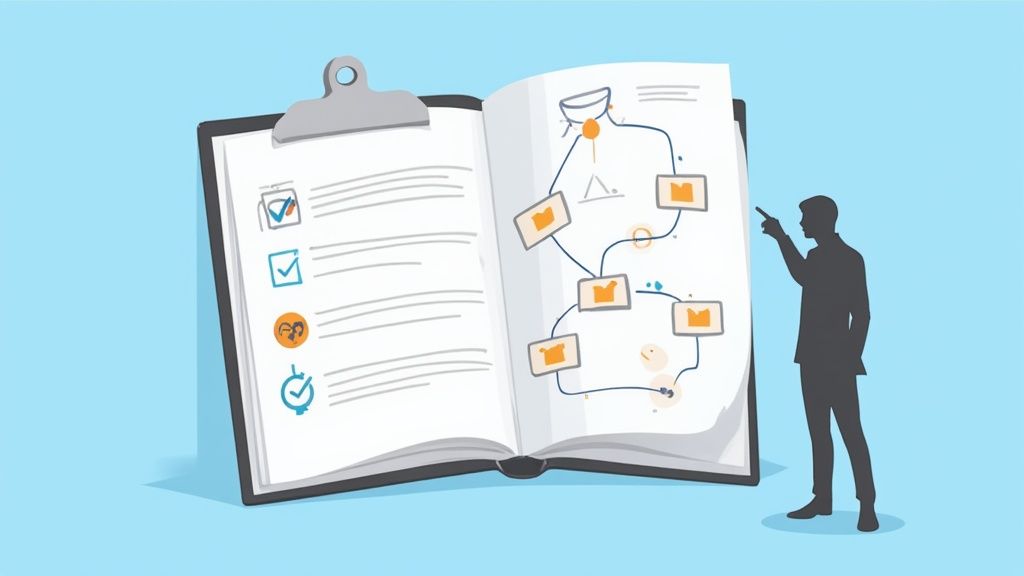
This structured approach is one of the most fundamental sales enablement best practices because it eliminates guesswork. Think of it like a restaurant franchise: a new McDonald's in any city can be successful quickly because it follows a meticulously documented playbook for everything from cooking fries to managing inventory. They don't leave success to chance; they engineer it.
Actionable Implementation Steps
To create a playbook that drives results, focus on practical application rather than abstract theory. Involve your top-performing reps in its creation to capture what actually works and build credibility with the rest of the team.
- Core Components: Include buyer personas, value propositions, competitor battle cards, discovery call scripts, email templates, and objection-handling guides.
- Accessibility: Host the playbook in a central, cloud-based location (like a company wiki or a sales enablement platform) that is easily accessible, searchable, and mobile-friendly.
- Dynamic Updates: Implement version control and assign an owner to review and update the playbook quarterly. Use win/loss analysis and feedback from the team to refine content and keep it relevant.
Key Insight: A sales playbook should be a living document, not a static PDF. It evolves with your market, product, and customer feedback. Its purpose is to guide, not restrict, empowering reps to adapt proven strategies to real-world conversations.
For companies without the internal bandwidth to spearhead such a foundational project, a fractional sales leader can be invaluable. They bring the expertise to develop a robust playbook quickly, ensuring it aligns with your broader growth strategy and sets your team up for scalable success.
2. Buyer Persona Development and Mapping
Understanding who you are selling to is the bedrock of any successful sales strategy. Buyer personas are semi-fictional, research-backed representations of your ideal customers. They move beyond basic demographics to uncover the goals, motivations, pain points, and buying behaviors of the key decision-makers and influencers your sales team engages.
For startups and SMBs, this practice is critical for ensuring that every piece of sales collateral, every email, and every discovery call resonates deeply with the prospect's actual needs.
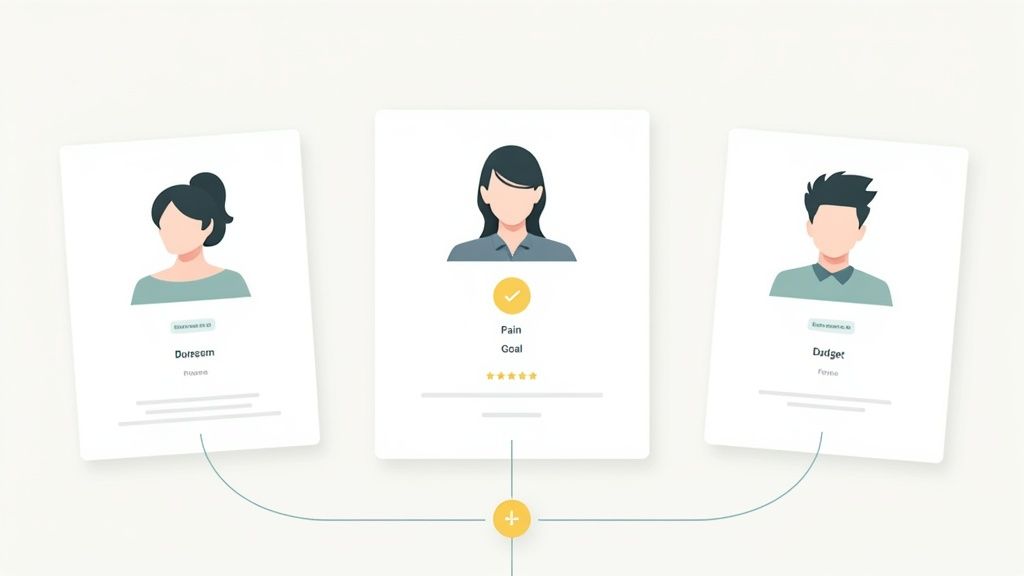
Developing detailed personas is one of the most impactful sales enablement best practices because it shifts the focus from a product-centric pitch to a customer-centric conversation. Imagine a doctor prescribing medication without diagnosing the patient's symptoms first. It would be ineffective at best. Similarly, selling without understanding your buyer's pain points leads to generic pitches that fall flat. This alignment ensures your team speaks the customer's language, leading to higher engagement and conversion rates.
Actionable Implementation Steps
To create personas that are more than just a document, root them in real data and qualitative insights. Involve your sales, marketing, and customer success teams to get a holistic view of the customer journey and validate your assumptions with real-world evidence.
- Data-Driven Research: Conduct interviews with your best customers, prospects who chose a competitor, and recent losses. Supplement this with data from your CRM, analytics tools, and sales rep feedback.
- Comprehensive Profiles: Map out each persona's role, goals, primary challenges, common objections, and preferred communication channels. Include direct quotes from interviews to bring them to life.
- Operational Integration: Embed personas directly into your sales playbook, CRM, and training materials. Coach reps on how to identify which persona they are speaking with and tailor their approach accordingly.
Key Insight: A buyer persona isn't just a marketing tool; it's a sales compass. It guides your team on what to say, what content to share, and which pain points to emphasize, ensuring every interaction is relevant and valuable to the prospect.
For businesses struggling to define their ideal customer profile, this foundational work can feel overwhelming. A fractional sales leader can accelerate this process, leveraging their experience to conduct effective customer research and build actionable personas that immediately sharpen your team’s messaging and sales approach.
3. Sales Training and Continuous Learning Programs
Onboarding is just the beginning; true sales excellence is built through a commitment to ongoing development. Sales training and continuous learning programs are systematic initiatives designed to consistently elevate your team's skills, product knowledge, and market awareness. This moves beyond a one-and-done training session, creating a culture where improvement is a constant, not an event.
For SMBs competing against larger, more established players, a highly skilled and adaptable sales team becomes a decisive competitive advantage.
This ongoing education is one of the most critical sales enablement best practices because it directly addresses skill gaps before they impact revenue. Top athletes don't just show up for the game; they practice constantly, review game footage, and work with coaches to refine every aspect of their performance. The same principle applies to sales. This discipline is what separates amateurs from elite professionals.
Actionable Implementation Steps
To build a training program that sticks, focus on engagement, reinforcement, and real-world application. Involve sales managers directly in the process to ensure concepts learned in training are coached and reinforced during daily activities.
- Interactive Learning: Ditch static lectures. Use scenario-based role-playing, group workshops, and call reviews to make learning active and practical.
- Microlearning Modules: Break down complex topics into short, digestible modules (5-15 minutes) that reps can consume on their own time, reinforcing knowledge without disrupting their workflow.
- Tie Training to Outcomes: Measure the effectiveness of training by tracking improvements in specific KPIs, such as conversion rates, deal size, or sales cycle length. This demonstrates ROI and secures buy-in for future initiatives.
Key Insight: The goal of sales training isn't just knowledge transfer; it's behavior change. Effective programs focus on reinforcing key concepts over time through spaced repetition and manager-led coaching, turning learned skills into ingrained habits that drive performance.
For growing companies, designing and executing a comprehensive training curriculum can be a major challenge. A fractional sales leader can step in to build a scalable training and coaching framework, ensuring your team is not just equipped for today's challenges but is continuously developing the skills to conquer tomorrow's.
4. Content Library and Sales Collateral Management
An effective content library is the arsenal your sales team uses to win deals. It's a centralized, organized, and easily searchable repository for every piece of collateral, from case studies and whitepapers to proposal templates and ROI calculators. By providing instant access to relevant, up-to-date materials, you eliminate the time reps waste searching for assets and ensure they deliver a consistent, on-brand message at every stage of the buyer's journey.
For SMBs, this organized approach stops reps from using outdated or "rogue" content, protecting brand integrity and boosting credibility.

This methodical approach to content is one of the most impactful sales enablement best practices because it directly connects marketing's output with sales' real-world needs. Think of it like a chef's kitchen: a well-organized station with every ingredient labeled and in its place allows the chef to create amazing dishes quickly and consistently. A chaotic kitchen leads to slow service and inconsistent quality. The same is true for your sales content.
Actionable Implementation Steps
To build a content library that salespeople actually use, prioritize ease of access, relevance, and a clear feedback mechanism. Make it intuitive for a rep to find exactly what they need in under 30 seconds.
- Strategic Organization: Categorize all content by buyer journey stage (Awareness, Consideration, Decision), buyer persona, product line, and content type (e.g., case study, battle card). Use a consistent tagging system.
- Centralized Platform: Choose a single source of truth, whether it's a dedicated platform like Highspot, a cloud storage system like SharePoint, or integrated CRM features. Ensure it has powerful search capabilities.
- Governance and Audits: Assign an owner to manage the library. Implement a process for content submission, approval, and a quarterly audit to remove outdated materials and identify content gaps based on sales team feedback.
Key Insight: Your content library isn't just a storage folder; it's a dynamic sales tool. The best libraries integrate analytics to show which assets are being used most often and which ones are most effective at progressing deals, creating a data-driven feedback loop for continuous improvement.
For growing businesses overwhelmed by the task of organizing years of accumulated content, a fractional CMO or sales leader can provide immediate strategic direction. They have the expertise to establish a robust content management strategy that aligns marketing efforts with sales outcomes, ensuring your team is always equipped with the most powerful collateral.
5. Sales Coaching and Manager Effectiveness Programs
Effective sales enablement extends beyond equipping reps; it involves empowering the managers who lead them. Manager effectiveness programs are structured initiatives designed to transform sales managers from simple supervisors into elite performance coaches. This approach recognizes that the manager is the single most critical lever for improving team performance.
By training them on how to conduct impactful one-on-one sessions, deliver constructive feedback, and diagnose skill gaps, you create a scalable system for continuous improvement that elevates the entire sales floor.

This focus on leadership is one of the most impactful sales enablement best practices because it creates a multiplier effect. A great coach doesn't just improve one rep; they elevate the performance of their entire team. Top sports teams invest heavily in expert coaches because they understand that a superstar player can win a game, but a superstar coach can build a dynasty. The same is true in sales.
Actionable Implementation Steps
To build a program that truly moves the needle, focus on providing managers with practical frameworks and tools they can apply immediately. The goal is to make coaching a consistent, data-driven habit rather than an occasional, reactive conversation.
- Establish a Formal Framework: Implement a structured coaching model like GROW (Goal, Reality, Options, Will) to guide conversations and ensure they are productive and forward-looking.
- Utilize Technology: Leverage conversation intelligence tools like Gong or Chorus to provide managers with call recordings and AI-driven insights, enabling them to ground their feedback in objective data, not just opinion.
- Focus on Specific Behaviors: Train managers to coach specific, observable behaviors (e.g., talk-to-listen ratio, question-asking techniques) rather than vague outcomes. This makes feedback more actionable and progress easier to measure.
Key Insight: The best sales coaching is diagnostic, not prescriptive. Instead of just telling reps what to do, effective managers help them self-discover areas for improvement by asking powerful questions and guiding them to their own conclusions.
For SMBs that lack the internal resources to design and run these leadership programs, a fractional sales leader can be a game-changer. Their expertise is crucial in building a high-performance sales culture by implementing proven coaching methodologies and training your managers to become force multipliers for growth.
6. CRM Optimization and Data Management Practices
Your Customer Relationship Management (CRM) system is the central nervous system of your sales operation. However, its value is directly proportional to the quality of the data it contains. Rigorous data management practices ensure that your CRM is an asset for accurate forecasting and insightful reporting, not a liability filled with outdated or incomplete information.
This disciplined approach provides a reliable foundation for every other sales tool and strategy.
Actionable Implementation Steps
To transform your CRM into a high-performance engine, focus on simplifying data entry and creating clear processes for maintaining its integrity. Make data hygiene a shared responsibility, not just an administrative task.
- Simplify Data Entry: Start with only the most essential fields required for reporting and segmentation. Use picklists, default values, and automation to make it easy for reps to input clean data quickly.
- Automate and Enrich: Implement automated data validation rules, deduplication tools, and data enrichment services (like DealSignals or InsideView) to keep contact and company information current without manual effort.
- Establish a Rhythm: Conduct monthly data quality audits and create real-time dashboards that visualize key metrics. This demonstrates the value of clean data to the team and helps managers hold reps accountable.
Key Insight: A CRM is only as powerful as the data within it. Treat data hygiene not as a chore, but as a strategic imperative that enables smarter decisions, better customer relationships, and more predictable revenue growth.
For organizations struggling with messy data or a poorly configured system, a fractional sales leader can diagnose the core issues and implement a sustainable data governance strategy. They possess the expertise to streamline workflows and show you how to properly implement a CRM system that truly supports your sales process, ensuring your team works from a single source of truth.
7. Sales Methodology Standardization (MEDDIC, SPIN, Sandler, etc.)
Adopting a formal sales methodology is like giving your entire sales team a shared language and a proven navigation system for every deal. Instead of relying on individual talent or intuition, a standardized methodology like MEDDIC, SPIN, or Sandler provides a consistent framework for qualifying opportunities, engaging prospects, and moving deals through the pipeline predictably.
This structure is critical for startups and SMBs aiming to build a scalable and repeatable sales engine.
Actionable Implementation Steps
The key to success isn't just picking a methodology; it's about deeply integrating it into your daily operations. The chosen framework must align with your typical sales cycle length, deal complexity, and buyer profile to be effective.
- Select and Customize: Choose a methodology that fits your business. For complex enterprise sales, MEDDIC is excellent for qualification. For value-driven, consultative sales, SPIN or Challenger Selling might be a better fit. Customize the terminology and stages to match your specific context.
- Uniform Training: Train the entire go-to-market team, not just sales reps. Consistent understanding across leadership, SDRs, and AEs is crucial for reinforcement and adoption.
- CRM Integration: Embed the methodology directly into your CRM. Create required fields for qualification criteria (e.g., MEDDIC checklist) and align your sales stages to the methodology’s process to enforce compliance and track progress.
- Reinforce Continuously: Weave methodology concepts into every team meeting, deal review, and coaching session. Constant reinforcement moves the framework from a theoretical concept to an ingrained habit.
Key Insight: A sales methodology is not a rigid script; it's a flexible framework for critical thinking. Its purpose is to guide salespeople on what to know and when to know it, empowering them to ask the right questions and control the sales cycle.
Implementing and reinforcing a new methodology requires dedicated focus and expertise. For businesses needing to instill this discipline without hiring a full-time sales leader, a fractional executive can drive adoption and customize the framework to your unique needs, ensuring the investment translates directly into improved sales performance.
8. Sales Intelligence and Competitive Insights Program
In today’s crowded market, selling without intelligence is like navigating without a map. A systematic sales intelligence program arms your team with the critical data needed to understand competitor positioning, market trends, and prospect needs. It’s a proactive approach that moves reps from reactive selling to strategic, insight-led conversations, empowering them to anticipate objections and tailor their value proposition with surgical precision.
For SMBs, this practice levels the playing field, allowing them to compete against larger incumbents by being smarter and more agile.
Actionable Implementation Steps
To build an effective intelligence program, focus on delivering timely, digestible, and easily accessible information that reps can use in their daily workflows. Avoid overwhelming them with data dumps; instead, provide curated insights.
- Build Competitor Battle Cards: Create concise, one-page documents for your top 3-5 competitors. Include their key strengths and weaknesses, our unique differentiators, and specific "landmine" questions reps can ask to expose competitor gaps.
- Centralize Intelligence: House all intelligence assets, such as battle cards, win/loss analyses, and market reports, in a dedicated channel (like a Slack channel or a folder in your CRM) for easy access.
- Establish Feedback Loops: Create a formal process for reps to share intel they gather from the field. A simple form or a dedicated email address can help capture real-time insights from customer conversations to keep your information current.
Key Insight: The most effective sales intelligence isn’t just about what your competitors do; it's about how their actions are perceived by your target customers. Use win/loss analysis to capture the voice of the customer and turn it into your most powerful competitive weapon.
9. Sales Metrics, KPIs, and Performance Analytics
You can't improve what you don't measure. Establishing a clear framework for sales metrics, KPIs, and performance analytics transforms sales management from an art into a science. This practice provides an objective, data-driven view of what’s working and what isn’t, enabling leaders to pinpoint bottlenecks, coach effectively, and forecast with greater accuracy.
For startups and SMBs, this data-centric approach is a powerful competitive advantage, allowing for agile adjustments and ensuring every sales activity is aligned with core business objectives.
Actionable Implementation Steps
To build an effective analytics framework, prioritize clarity and relevance over tracking every possible metric. The goal is to empower your team with insights, not overwhelm them with data.
- Define Core KPIs: Select a mix of 3-5 leading indicators (e.g., discovery calls booked, demos completed) and lagging indicators (e.g., win rate, average deal size). Ensure they directly tie to your overarching revenue goals.
- Create Accessible Dashboards: Use tools like Salesforce, Tableau, or Power BI to build role-specific dashboards. Reps should see their individual performance, managers their team's progress, and executives the high-level business impact.
- Establish a Review Cadence: Integrate KPI reviews into your weekly sales meetings. This creates a consistent rhythm for discussing performance, sharing best practices, and addressing challenges before they derail the quarter. Explore how optimizing your sales funnel with the right metrics can drive significant growth.
Key Insight: The most impactful metrics tell a story. They connect daily activities to long-term outcomes, showing reps exactly how their efforts contribute to the company's success and empowering them to take ownership of their results.
For businesses struggling to translate raw sales data into a coherent strategy, a fractional sales leader can provide immediate clarity. They possess the expertise to define the right KPIs, implement the necessary analytics tools, and establish a data-driven culture that fuels predictable revenue growth.
10. Sales Technology Stack Integration and Automation
Your sales technology stack is the engine that powers your sales process, but disjointed tools create friction, not momentum. A strategically integrated and automated tech stack ensures that your CRM, sales engagement platforms, and intelligence tools work together seamlessly. This cohesion eliminates manual data entry, reduces administrative burdens, and provides a unified view of the customer, empowering reps to focus on selling rather than toggling between applications.
For startups and SMBs, a well-integrated stack is a force multiplier, driving efficiency and data accuracy.
This connected approach is one of the most impactful sales enablement best practices because it turns technology from a simple record-keeping system into a proactive revenue-generating asset. Imagine a modern assembly line where each robotic arm works in perfect sync. This level of integration is what allows for massive scale and efficiency. Your tech stack should operate with the same seamless precision.
Actionable Implementation Steps
To build a high-performance tech stack, prioritize seamless data flow and user experience. Map your existing sales process first to identify key friction points that technology can solve, ensuring you invest in tools that reps will actually adopt and use.
- Map and Prioritize: Before buying any software, map your entire sales process. Identify the core needs first, typically a CRM (like Salesforce or Pipedrive) and a sales engagement tool (like Outreach or Apollo.io).
- Focus on Integration: Select tools that offer native integrations or can be easily connected using platforms like Zapier. Ensure data flows bidirectionally between your most critical systems to maintain a single source of truth.
- Audit and Optimize: Regularly audit your tech stack to identify underutilized tools, redundant subscriptions, and opportunities for better automation. Measure adoption rates and ROI to justify each component of your stack.
Key Insight: The goal of a sales tech stack is not to have the most tools, but the right tools working in harmony. A lean, deeply integrated stack will always outperform a bloated collection of disconnected software.
For organizations struggling to select and implement the right technology, a fractional sales leader can provide immediate clarity. Their expertise helps you choose and integrate a cost-effective tech stack that aligns with your specific sales process, avoiding costly mistakes and maximizing your team’s productivity from day one.
10-Point Sales Enablement Best Practices Comparison
| Item | 🔄 Implementation Complexity | ⚡ Resource Requirements | ⭐ Expected Outcomes | 💡 Ideal Use Cases | 📊 Key Advantages |
|---|---|---|---|---|---|
| Sales Playbook Development | High — structured design & maintenance | Medium‑High — SMEs, time, doc management | ⭐⭐⭐ Consistent sales approach; reduced ramp time | Onboarding, scaling GTM, standardizing reps | Institutional knowledge; faster onboarding; performance standards |
| Buyer Persona Development and Mapping | Medium — research & synthesis | Medium — interviews, data analysis | ⭐⭐⭐ Better targeting; improved conversion rates | Segmentation, personalized outreach, messaging refinement | Improved message‑market fit; prioritization; sales‑marketing alignment |
| Sales Training and Continuous Learning Programs | High — program design + ongoing delivery | High — budget, trainers, LMS/platform | ⭐⭐⭐⭐ Increased rep competency and retention | New hire onboarding, skill uplift, product launches | Higher performance; reduced ramp; career development |
| Content Library and Sales Collateral Management | Medium — taxonomy & governance | Medium — content creation, CMS, tagging | ⭐⭐⭐ Faster access to approved content; consistent messaging | Proposal generation, customer meetings, personalization at scale | Time saved; brand control; data‑driven content optimization |
| Sales Coaching and Manager Effectiveness Programs | High — coach training and frameworks | Medium‑High — manager time, coaching tools | ⭐⭐⭐⭐ Multiplied rep improvement; improved retention | Improving underperformers, leadership development, scaling teams | Manager leverage; early issue detection; stronger manager‑rep relationships |
| CRM Optimization and Data Management Practices | Medium — rules, audits, integrations | Medium — governance, data tools, training | ⭐⭐⭐ More reliable forecasts and pipeline visibility | Forecasting, territory management, analytics | Better BI; reduced duplicates; consistent data hygiene |
| Sales Methodology Standardization (MEDDIC, SPIN, etc.) | Medium‑High — selection + adoption | Medium — training, CRM alignment | ⭐⭐⭐ Predictable process and improved forecast accuracy | Complex B2B deals, cross‑team alignment, scaling sales ops | Standardized language; predictable pipeline; easier coaching |
| Sales Intelligence and Competitive Insights Program | Medium — collection & distribution processes | Medium‑High — research tools, analysts | ⭐⭐⭐ Better positioning; fewer competitive losses | Competitive deals, account‑based selling, market shifts | Faster prospect research; improved messaging; new opportunity ID |
| Sales Metrics, KPIs, and Performance Analytics | Medium — metric design & dashboards | Medium — analytics tools, data pipeline | ⭐⭐⭐ Clear visibility; early intervention on issues | Performance management, coaching, executive reporting | Real‑time visibility; targeted coaching; identify bottlenecks |
| Sales Technology Stack Integration and Automation | High — integrations & orchestration | High — licenses, engineering, maintenance | ⭐⭐⭐⭐ Increased efficiency; scale without linear cost | Scaling organizations, reducing manual work, complex toolsets | Productivity gains; unified data; fewer manual errors |
Your Shortcut to World-Class Sales Enablement
Navigating the landscape of sales enablement can feel like building a complex machine while it's already running. We’ve journeyed through the ten foundational pillars, from creating detailed buyer personas and dynamic playbooks to optimizing your tech stack and embedding continuous coaching. Each of these sales enablement best practices represents a critical gear in your revenue engine. Implemented correctly, they transform your sales team from a group of individual contributors into a unified, high-performance force.
The core takeaway is that modern sales success is not accidental; it’s engineered. It’s the result of a deliberate, strategic framework that empowers every seller with the right content, skills, and tools at precisely the right moment in the buyer’s journey. This isn’t about just closing deals faster; it's about creating a scalable, predictable, and efficient growth model that can weather market shifts and competitive pressures.
The Pain Point: The Execution Gap
The challenge for most startups and SMBs isn't understanding the what but mastering the how. You know you need a killer sales playbook, but who has the bandwidth to build it? You recognize the value of consistent coaching, but your sales leaders are already stretched thin. This is where the gap between ambition and execution widens, and potential revenue is lost.
Implementing these systems requires more than just time; it demands specialized expertise. A common misstep is to view sales enablement as a series of disconnected projects. In reality, it’s an integrated system where your CRM data informs your coaching, your coaching refines your playbook, and your playbook dictates your content strategy. This interconnectedness is what separates functional teams from truly elite ones.
The Solution: Expertise on Demand
For a growing business, the thought of hiring a full-time, six-figure Head of Sales Enablement to build this ecosystem can be daunting. The recruitment process is long, the financial commitment is significant, and there's always the risk of a mis-hire. This is precisely the scenario where a fractional executive becomes your strategic advantage.
Instead of a full-time commitment, you gain access to a seasoned leader who has built and scaled sales enablement functions multiple times. A fractional expert can step in immediately to:
- Prioritize and Execute: They can rapidly assess your current state and identify the 2-3 initiatives that will drive the most significant impact on revenue this quarter, rather than trying to boil the ocean.
- Implement Proven Frameworks: There’s no need to reinvent the wheel. They bring battle-tested templates for playbooks, content management, and coaching programs, tailoring them to your unique business needs.
- Mentor Your Existing Team: A fractional leader doesn’t just do the work; they upskill your current managers and sales reps, leaving a legacy of best practices long after their engagement ends.
This approach de-risks the investment in world-class sales enablement, making it accessible and affordable. You get the strategic horsepower of a top-tier executive without the associated overhead, allowing you to build a powerful sales engine that drives sustainable growth.
Ready to bridge the gap between your sales goals and reality? The fractional executives in the Shiny marketplace have the expertise to implement these sales enablement best practices and build a revenue engine that scales. Explore our vetted leaders or schedule a consultation to discover how you can achieve enterprise-level results on a startup-friendly budget.