
How to Write a Sales Leader Job Description That Attracts A-Players
A sales leader job description isn't just an HR document. Think of it as your first sales pitch—a strategic asset meant to attract, engage, and persuade a high-impact executive to join your team. It's the difference between a pipeline full of mismatched applicants and one that surfaces the A-player who will define your next growth chapter.
This guide will show you how to move beyond generic templates and craft a compelling narrative that attracts the right kind of leader—whether you need a full-time VP or a flexible fractional executive.
Why Your Sales Leader Job Description Isn't Working
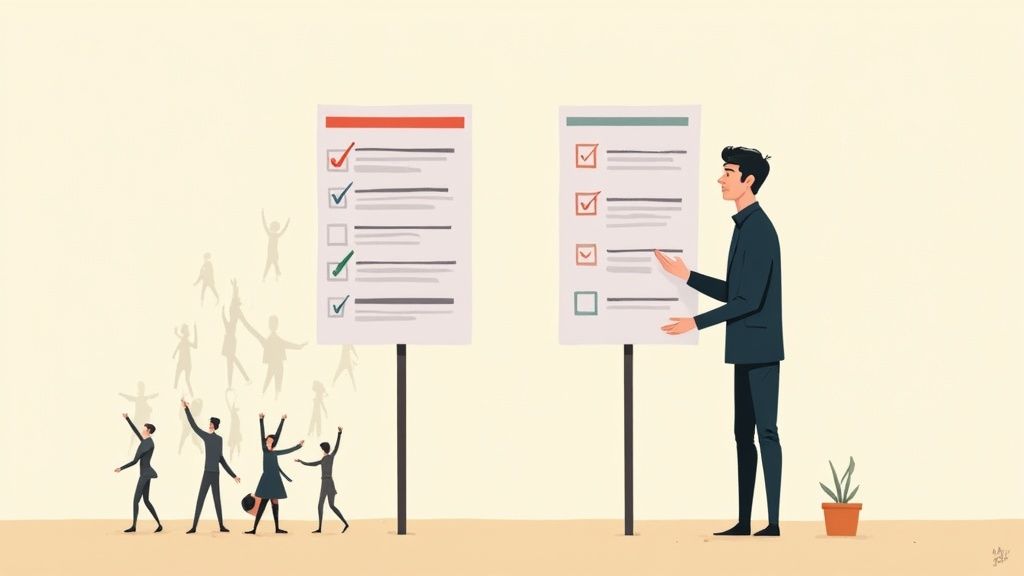
Let’s be honest. Most job descriptions are just task lists. They’re a tired mashup of recycled templates and vague corporate jargon that end up attracting applicants, not the strategic leaders you actually need.
If your hiring pipeline is full of mismatched candidates—or worse, empty—the problem probably starts here. A weak job post signals to top-tier talent that your company might lack clarity, vision, or a compelling future. The best sales leaders aren't scrolling through job boards for a laundry list of duties. They’re looking for a challenge they can own and a mission they can get behind.
The True Cost of a Generic Job Post
A poorly written job description creates a ripple effect of problems. It’s an unforced error that actively works against your growth goals.
- You attract the wrong candidates. Generic descriptions attract generic experience. You get people who check the boxes but lack the specific skills to solve your unique business problems.
- You extend your hiring timeline. Vague language leads to a flood of unqualified applicants, forcing your team to waste countless hours sifting through resumes and leaving a critical leadership gap open for months.
- You risk a costly mis-hire. The cost of a bad executive hire is staggering, often exceeding 2.5 times their annual salary when you factor in recruitment costs, lost productivity, and team disruption. An unclear job description is the first step toward that expensive mistake.
Your job description is your first sales pitch to your next game-changing leader. It’s not an administrative task; it’s a strategic marketing asset designed to sell a career-defining opportunity.
The fundamental shift is moving from "filling a seat" to "attracting a strategic partner." Your sales leader job description must clearly articulate the vision, the challenge, and the impact the right person will have. It should answer the questions elite candidates are actually asking: "What problem can I solve?" and "How can I make a significant impact here?"
For many businesses, this level of expertise feels out of reach. But what if you could get the strategic mind of a top-tier executive without the full-time cost? This is where fractional leadership becomes a game-changer, offering a powerful alternative for targeted growth.
Figure Out What Your Business Actually Needs First
Before you write a single word, get brutally honest about the "why" behind this hire. Too many founders jump straight to a template. That’s like building a house without a blueprint; you might end up with something that stands, but it won’t be designed for what you truly need.
This foundational work separates a generic job post from one that pulls in A-players. It ensures your JD is rooted in actual business strategy, not just a wish list.
Pinpoint the Core Mission
Define the single most important objective for this role over the next 12-18 months. Don't try to boil the ocean. Is the mission to build a sales engine from scratch? Scale an existing team? Spearhead entry into a new market?
Get specific. For example, "grow revenue" is useless. Instead, frame it as a clear mission: "Build a repeatable, outbound sales process to increase new logo acquisition by 40% year-over-year." This clarity transforms a vague management job into an exciting challenge.
A great sales leader isn't just looking for another job. They're looking for a problem they are uniquely qualified to solve. Your job description must articulate that problem with absolute clarity.
This sharp focus helps you attract specialists, not generalists. A leader who excels at building a sales team from zero has a different playbook than an executive skilled at optimizing a 100-person enterprise sales force. Be honest about which one you need right now.
Identify the Key Business Challenges
Once the core mission is clear, list the main obstacles this leader will need to tear down. These are the pain points that keep you up at night.
- A Stagnant Pipeline: Leads die on the vine before becoming qualified opportunities.
- Inconsistent Performance: A couple of star players carry the whole team, but there's no predictable system for success.
- High Churn: The sales team is a revolving door, pointing to deeper issues with culture, training, or leadership.
- New Market Entry: You're launching a new product and need a playbook built from the ground up.
Laying out these challenges shows self-awareness. It signals that you're looking for a true partner to solve real problems, not just a manager to babysit a team.
Align with Your Internal Stakeholders
A sales leader doesn't operate in a vacuum. One of the fastest ways to kill a new hire's momentum is to throw them into a culture of internal misalignment.
Before finalizing the role's scope, get your department heads in a room. Sit down with marketing to define a "sales-qualified lead." Talk to finance about realistic revenue targets and budget constraints. This cross-functional alignment is non-negotiable for setting your new leader up for success.
The role of a sales leader is multifaceted, requiring them to support and increase sales through various means, including training new team members and strategic planning. Their success often hinges on strong internal collaboration, leadership, and the ability to motivate their team effectively. Indeed's guide to the role offers some great additional insights on what these responsibilities can look like in practice.
This discovery process turns a vague need into a well-defined opportunity. When your sales leader job description is built on this strategic foundation, it becomes a magnet for the exact executive who can drive your business forward. For companies needing this strategic horsepower without the full-time overhead, fractional leadership offers a potent solution, connecting you with experienced executives ready to tackle these specific challenges.
Crafting a Job Description That Pulls in Top Sales Talent

You've mapped out the mission and pinpointed the challenges. Now, it's time to translate that strategy into a compelling story. This is where your sales leader job description becomes a powerful marketing tool to convince an elite performer that this is their next career-defining move.
A-players are driven by impact, ownership, and solving meaningful problems. Your job description must speak their language.
Frame the Role Around Impact, Not Tasks
This is the most common pitfall. Companies churn out job descriptions filled with generic responsibilities like "manage sales pipeline," "oversee team," and "prepare reports." These are red flags for top-tier leaders because they describe the boring parts of any management job, not the specific challenge of this one.
Instead, reframe every responsibility as a mission with a clear outcome.
- Weak: "Manage the sales pipeline and team activities."
- Strong: "Architect and implement a high-velocity sales methodology to increase pipeline conversion by 25% within the first year."
The first is a chore. The second is a mission—a tangible goal that a results-driven leader can get excited about.
Create a Role Summary That Grabs Their Attention
Your role summary is your headline and your hook. It’s the first thing a candidate reads, so don't waste it on a boilerplate paragraph about your company.
Sell the opportunity from the start. Lead with the core challenge you identified. Are they building a sales function from scratch? Scaling a proven playbook? Make it clear and exciting.
A great role summary doesn't just describe the job; it paints a vivid picture of the impact the right leader will make. It should feel like the role was written specifically for them.
Show them what's in it for them. Talk about the autonomy they’ll have, the resources at their disposal, and the direct line they’ll have to shaping the company's future.
Define Must-Haves vs. Nice-to-Haves
An endless wish list of qualifications signals you don’t know what you need. Worse, studies show that packing a JD with too many requirements disproportionately discourages qualified women and other underrepresented groups from applying.
Get crystal clear on your deal-breakers versus your "nice-to-haves."
-
Must-Haves: These are the non-negotiables. Limit this to 3-5 core qualifications. For example: "Demonstrated experience building and scaling a B2B SaaS sales team from $5M to $20M ARR" or "Expertise in implementing and optimizing Salesforce for a high-volume sales process."
-
Nice-to-Haves: These are bonus skills. Frame them that way. "Experience with international market expansion is a plus" or "Familiarity with the HealthTech industry is beneficial but not required."
This separation respects a candidate’s time and widens your talent pool. For more inspiration, there are great resources on writing compelling and effective executive job descriptions.
Hard Skills vs Soft Skills for a Modern Sales Leader
A great leader needs both technical know-how and leadership qualities. A leader who can build a forecast but can't inspire their team is just as limited as one who's a great motivator but can't read a P&L.
| Skill Category | Hard Skills Examples | Soft Skills Examples |
|---|---|---|
| Data & Analytics | Sales Forecasting, Pipeline Management, CRM Proficiency (Salesforce, HubSpot), Financial Modeling, Data Analysis | Strategic Thinking, Problem-Solving, Decision-Making |
| Process & Strategy | Sales Methodology (MEDDIC, Challenger), Go-to-Market Strategy, Sales Operations, Compensation Plan Design | Adaptability, Vision Setting, Organizational Skills |
| Team Leadership | Performance Management, Sales Coaching & Training, Recruiting & Hiring, Territory Planning | Communication, Empathy, Motivation, Conflict Resolution |
| Execution | Contract Negotiation, Public Speaking/Presenting, Lead Generation Tactics, Product Demonstration | Resilience, Emotional Intelligence, Persuasion |
Your JD should reflect the need for this balance.
Quantify Success with Clear KPIs
Top sales leaders live and breathe data. They want to know exactly how you’ll measure success. Your sales leader job description needs to state the Key Performance Indicators (KPIs) they will own.
This isn’t about setting rigid targets in the job post itself. It's about signaling that you're a results-oriented organization that values transparency.
Include metrics like:
- Annual Recurring Revenue (ARR) Growth
- New Logo Acquisition Targets
- Sales Cycle Length Reduction
- Customer Acquisition Cost (CAC) Efficiency
- Team Quota Attainment Percentage
By defining what "winning" looks like, you attract leaders who are confident in their ability to deliver.
The Fractional Advantage: Senior Leadership on Your Terms
Sometimes, the perfect hire isn't a full-time employee. You might realize you need executive-level strategy and years of experience, but you don't have the budget—or the full-time workload—for a six-figure salary.
This is where a fractional sales leader comes in. A fractional executive is a seasoned expert who joins your team on a part-time basis, typically for 5 to 25 hours a week. This isn't a consultant who drops off a strategy deck and disappears. They are a true leadership partner who rolls up their sleeves and executes alongside your team.
When a Fractional Model Makes Perfect Sense
Imagine a startup that just closed its seed round. The founders have been juggling sales but have hit a ceiling. They desperately need a seasoned leader to build a scalable playbook, but a $200,000+ salary for a full-time VP of Sales would eat up their runway.
A fractional leader is the perfect solution. An experienced exec can step in for 10-15 hours a week to:
- Build the Foundation: Develop the sales process, select the right CRM, and create initial sales collateral.
- Mentor the Team: Coach junior reps, giving them the direction they need to succeed.
- Establish Key Metrics: Define and track the KPIs that matter.
In this scenario, the company gets the strategic horsepower it needs at a fraction of the cost. You're not paying a leader to manage a large team that doesn't exist yet; you're paying for pure, focused execution.
A fractional sales leader bridges the gap between needing senior strategic guidance and not being ready for a full-time executive commitment. It's about getting the right expertise at the right time.
Another common use case is navigating a leadership change. If your sales director leaves, a fractional leader can parachute in, stabilize the team, keep performance on track, and help you define the job description for the permanent role.
Immediate ROI and Strategic Flexibility
The magic of fractional leadership is its immediate impact. These executives have seen your exact challenges before and bring a career's worth of playbooks with them. They are hired to solve a specific problem and get to work on day one.
This model also offers incredible flexibility. As your company grows, the engagement can scale. Once the systems are built, the fractional exec can help you find and train their own replacement. Our guide on the benefits of fractional leadership dives deeper into how this works.
If this flexible, high-impact approach sounds like the answer to your leadership challenges, connecting with a pre-vetted fractional executive could be your best next move.
Job Description Examples You Can Actually Use
Theory is great, but let's get practical. Here are three annotated job description examples built for common business scenarios. Use them as strategic blueprints to connect with the right leader for your growth stage.
Example 1: The Startup Player-Coach (Head of Sales)
This is for the early-stage company needing someone who can both build the machine and run it—closing deals while creating the playbook for future hires.
Job Title: Head of Sales (Founding Sales Leader)
Company: [Your Company Name] – A fast-growing B2B tech startup poised to disrupt the [Your Industry] space.
Location: [City, State or Remote]
About The Opportunity:
We are looking for our first dedicated sales leader—a true builder excited to roll up their sleeves and architect our sales function from the ground up. As our Head of Sales, you will be both a strategist and a top-performing individual contributor. This is a rare opportunity to build the sales engine of a venture-backed startup and directly shape our company's future.
What You'll Achieve:
- Build the Playbook: Develop and document our first formal sales process, establishing the foundation for a scalable revenue engine.
- Drive Initial Revenue: Personally own and exceed a new business quota for the first 6-9 months while refining our ideal customer profile.
- Hire and Mentor the Founding Team: Recruit, onboard, and coach our first 2-3 Account Executives, cultivating a culture of high performance.
- Establish Our Tech Stack: Select, implement, and manage the essential sales tools (CRM, sales enablement, etc.).
What You'll Bring:
- Must-Have: Proven experience as an early-stage sales hire (first 50 employees) at a B2B startup, with a track record of exceeding quota.
- Must-Have: Demonstrated ability to create sales processes and playbooks from scratch in a fast-paced environment.
- Experience: A minimum of 5-7 years in a full-cycle B2B sales role, with at least 1-2 years in a team lead or mentorship capacity.
- Mindset: A strong bias for action, deep curiosity, and a player-coach mentality.
Example 2: The SaaS Scale-Up Leader (VP of Sales)
This leader isn't building from zero. They're taking what works and pouring gasoline on the fire. It’s all about process optimization, team expansion, and predictable growth.
Job Title: Vice President (VP) of Sales
Company: [Your Company Name] – A high-growth B2B SaaS company with established product-market fit.
Location: [City, State]
About The Opportunity:
We are searching for a strategic and data-driven VP of Sales to lead our organization through its next phase of exponential growth. You will be responsible for scaling our team, optimizing our go-to-market strategy, and expanding into new segments. This role reports directly to the CEO and is a key member of the executive leadership team.
What You'll Achieve:
- Scale the Team: Grow the sales organization from 15 to 40+ reps across SMB, Mid-Market, and Enterprise segments within 24 months.
- Optimize Performance: Refine our sales methodology, implement a robust coaching program, and improve sales cycle velocity by 20%.
- Drive Revenue Growth: Own the global revenue number and develop strategies to increase Annual Recurring Revenue (ARR) from $10M to $30M+.
- Cross-Functional Leadership: Collaborate closely with Marketing, Product, and Customer Success to ensure tight alignment.
What You'll Bring:
- Must-Have: A minimum of 10+ years of sales experience, with at least 5 years in a senior leadership role (Director or VP level) at a B2B SaaS company.
- Must-Have: Demonstrable experience scaling a sales team through a significant growth phase (e.g., from $5M to $25M+ ARR).
- Expertise: Deep knowledge of modern sales methodologies (e.g., MEDDIC, Challenger Sale), sales operations, and compensation plan design.
- Data Fluency: A master of pipeline management, forecasting accuracy, and using data to drive strategic decisions. Proficiency with Salesforce is required.
Example 3: The Fractional Head of Sales
This role is for when you need senior-level strategy now but aren't ready for a full-time executive salary. A fractional leader brings immediate impact, focusing on building the foundation for efficient scaling.
Job Title: Fractional Head of Sales
Company: [Your Company Name]
Location: Remote (Engagement: 10-15 hours/week)
About The Opportunity:
We are seeking an experienced Fractional Head of Sales to provide immediate strategic leadership and build the foundational processes for our sales function. This is an ideal role for a seasoned executive who excels at creating order from chaos and wants to make a high-impact contribution without a full-time commitment. You will be our senior sales strategist, process architect, and team mentor.
What You'll Achieve:
- Immediate Impact: Within 90 days, conduct a full audit of our current sales activities and deliver a strategic roadmap for scalable growth.
- Process Implementation: Build and document a repeatable sales process, establish clear KPIs, and configure our CRM for effective pipeline management.
- Team Enablement: Provide hands-on coaching and mentorship to our existing junior sales reps, improving their performance and confidence.
What You'll Bring:
- Must-Have: 15+ years of B2B sales leadership experience, including multiple successful tenures as a Head of Sales or VP of Sales.
- Must-Have: A proven "builder" track record, with specific examples of creating and implementing sales infrastructure from the ground up.
- Expertise: Deep experience in sales strategy, process optimization, and team coaching. You are a systems-thinker who knows what great looks like.
This infographic breaks down why engaging a fractional sales leader is so powerful. It’s about injecting high-level strategy, mentorship, and speed directly into your team.
As you can see, this isn't just a cost-saving measure. It’s a strategic move to get proven expertise focused on your biggest challenges. The compensation for these roles reflects their immense value. According to the U.S. Bureau of Labor Statistics, the median annual wage for sales managers was approximately $138,060 as of May 2024.
The job outlook is also strong. The BLS projects a growth rate of 5% for these leaders through 2034, which is faster than the average for all occupations. You can dig into the career outlook for sales managers from the BLS for more detail.
Find the Right Leader to Accelerate Your Growth

A strong sales leader job description does more than fill a seat—it aligns your team and brings in a true partner for growth. The goal is to find the person who won’t just manage a team but will fundamentally accelerate your entire business.
As you prepare to hire, it’s crucial to weigh all your options. The right choice depends on your company's stage, budget, and the specific problems you need to solve.
Making the Strategic Hiring Decision
The talent pool for sales leadership is more diverse than ever. Recent data shows that women now make up about 59.3% of sales leaders. Yet, a significant pay gap still exists, highlighting the importance of fair and transparent hiring practices. You can learn more about the demographics shaping sales leadership to get a clearer picture.
This data drives home the need for a thoughtful recruiting process designed to attract the absolute best talent, regardless of their background.
Finding the right executive isn't just about filling a spot on the org chart. It's about securing a multiplier for your team—someone whose expertise elevates everyone around them and drives predictable revenue growth.
Hiring an executive is a different ballgame. To ensure you're ready for every step, from outreach to the final offer, take a look at our detailed guide on how to hire executives effectively.
And if you need help connecting with pre-vetted talent who can help you hit ambitious goals, our team is here to define exactly what you need and find the perfect match.
Frequently Asked Questions
Crafting the perfect job description is just the first step. Here are answers to common questions we hear from founders.
What’s the real difference between a sales manager and a sales leader?
A Sales Manager is an operator focused on the day-to-day. They manage the team against existing targets and ensure the current sales engine is running smoothly.
A Sales Leader is an architect. They are strategists who build the sales vision, create scalable processes, and align the sales function with the company's broader goals.
In short: leaders build the system; managers operate within it. If you have a proven system that needs tuning, a manager might work. If you're building from scratch, you need a leader.
How long should a sales leader job description be?
Forget word count. Focus on clarity and impact. That said, a sweet spot is usually 400-700 words. This gives you enough room to outline the role's strategic importance without losing the attention of a busy executive.
What are the biggest red flags to avoid in a job description?
You want to attract the best, not scare them away. Avoid these common turn-offs:
- Vague corporate jargon: Phrases like "synergize cross-functional initiatives" are meaningless and signal a lack of clear thinking.
- An endless scroll of responsibilities: Listing dozens of tasks suggests you haven't identified what truly matters.
- Unrealistic expectations: Demanding "10+ years of SaaS experience" for a junior leadership role will deter great candidates.
- Focusing only on your demands: A one-sided job description that doesn't sell the opportunity for growth and impact will be ignored by top talent.
Finding the right executive—whether full-time or fractional—is about securing a true strategic partner for growth. Shiny connects you with a pre-vetted network of experienced sales leaders ready to build your playbook, mentor your team, and drive immediate results.
Explore our network of fractional executives and schedule a consultation today.